 Скачать презентацию Second National Medicare Prescription Drug Congress October 31
84cbb57cb7e765fb3828e0551cb30693.ppt
- Количество слайдов: 38



Second National Medicare Prescription Drug Congress October 31, 2005 The 340 B Drug Pricing Program: Overview from the Manufacturers’ Perspective John D. Shakow jshakow@kslaw. com 202 -626 -5523 Copyright 2005 King & Spalding LLP
Agenda • 340 B Program Basics • 340 B Pricing and Beneficiaries • 340 B Reports and Litigation • The Future of 340 B 2
340 B Program Basics 3
The Veterans Health Care Act of 1992 • Title VI passed in November 1992 in response to the Omnibus Budget Reconciliation Act of 1990, which created the Medicaid rebate system • As FSS and PHS entities were not best price exempt, manufacturers raised prices offered to them • Three sections: – 601 Changes to Medicaid Rebate Program – 602 Special pricing for PHS Covered Entities – 603 Special pricing for Big Four (including PHS itself) 4
VHCA Section 602 • Amended PHS Act – 42 U. S. C. § 256 b • “Limitation on prices of drugs purchased by covered entities” • The statute – Manufacturer agreement with the Secretary of HHS – Ceiling price – Covered outpatient drugs only – Covered entities 5
All together now • PHS ceiling price • 340 B ceiling price • Section 602 ceiling price • Public Law 102 -585 6
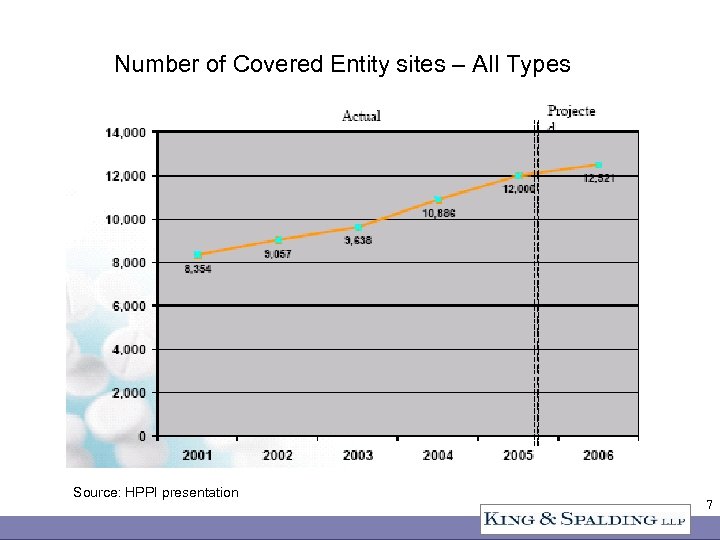
Number of Covered Entity sites – All Types Source: HPPI presentation 7
Government Oversight • Human Resources and Services Administration (HRSA) • Healthcare Systems Bureau (HSB) • Office of Pharmacy Affairs (OPA) – Manages contracts with manufacturers – Manages enrollment of covered entities – Formerly the Office of Drug Pricing – Formerly the Pharmacy Affairs Branch – OPA Director Jimmy Mitchell – Excellent website: www. hrsa. gov/opa • Office of Inspector General of HHS (OIG) 8
Importance of 340 B • Serves uninsured low income populations • Public health systems critical to reaching underserved areas and disease states • PHS purchasing saves Medicaid systems millions of dollars every year by billing at acquisition cost, not a reimbursement amount based on AWP 9
340 B Pricing and Beneficiaries 10
340 B Ceiling Price • Discount version of a Medicaid rebate • Ceiling price, determined quarterly: AMP less the Unit Rebate Amount for the most recently reported quarter • Branded URA = AMP x 15. 1% or AMP – BP • Generic URA = AMP x 11% • Recall that this is just a ceiling – manufacturers may offer sub-ceiling prices that are still best price exempt • Sub-ceiling sales are only exempt from Non-FAMP if they go through the prime vendor 11
340 B Ceiling Price • Manufacturers calculate the ceiling price to effectuate sales – they need not report them • The government separately calculates the ceiling price to aid in program oversight, but does not actively check against the manufacturers’ price lists – CMS – Since last month, HRSA per inter-agency agreement • The covered entities do not have access to the AMP or URA, and therefore can do no independent check of the calculated ceiling price 12
Package Size • AMP, BP and URA are calculated based on Medicaid rebate units, that is, the smallest dispensable unit (e. g. , pill, blister pack, etc) • Covered entities purchase (or seek rebates) at a package size • Gross up URA to package size to determine actual price (or rebate) per NDC-11 • OPA wants manufacturers to volunteer package size information directly, so that it does not have to go to publishers to get it 13
340 B Ceiling Price for New Drugs • Use “Estimated Ceiling Price” until actual data is known – 3 quarters • For example: – Launch mid 1 Q 05 – First full quarter is 2 Q 05 – Base quarter data known July 30, 2005 – Actual PHS price set and offered in 4 Q 05 • Where estimated > ceiling, manufacturers must reconcile upon request • Where estimated < ceiling, that’s a sub-ceiling sale not subject to reconciliation 14
Changes to AMP or BP and the 340 B Ceiling Price • Only written guidance on this issue is in the context of new drugs • Where a manufacturer has a retrospective change in methodology and pursues significant revisions to AMP and BP under Releases 14 and 61, OPA expects the PHS price to be revised and overcharges reconciled • What is unclear is at what threshold of ceiling price change reconciliation is required • Routine true-ups to AMP and BP? De minimus changes to the ceiling price? Only upon request? • OPA has invited comment on the question 15
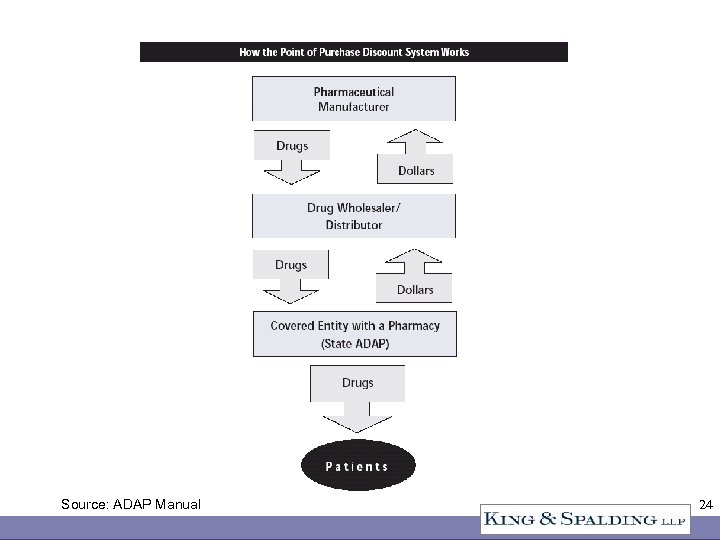
340 B Prime Vendor Program (PVP) • Purposes: – Negotiate sub-ceiling discounts for CEs – Offer CEs drug distribution options • Manufacturers must participate (PPA II(g)) • Health. Care Purchasing Partners Intl. (HPPI) (a GPO) • Represents 1, 750 CEs purchasing over $2 billion • Discounts range from 1% to 49% below ceiling • Claims to offer best price protection • Sub-ceiling sales through PVP are Non-FAMP exempt 16
340 B Covered Entities • Certain facilities or programs funded by HRSA (as set out in 42 U. S. C. § 256 b) – Federally-qualified health centers – Certain federal grant recipients – Family planning clinics – AIDS Drug Assistance Programs (ADAPs) – Black lung clinics – Hemophilia treatment centers – Native Hawaiian Health Centers – Urban Indian organizations – Tuberculosis/STD clinics – Disproportionate Share Hospital outpatient programs 17
340 B Covered Entities • Disproportionate share hospitals owned by or under contract with state or local governments – Disproportionate share adjustment percentage greater than 11. 75% – May not utilize a GPO for outpatient drug purchasing – Inpatient v. outpatient segregation • Sales to covered entities are exempt from best price 18
340 B Covered Entities • Other requirements for covered entities – May not double-dip with Medicaid – May not resell to a non-patient (diversion) • Three part “patient” test – Entity-patient relationship – Entity retains responsibility for care – Entity provides services consistent with those for which grant funding was given 19
340 B Covered Entities: Manufacturer / CE Conflict • Manufacturers may audit any covered entity that purchased its drugs at 340 B program prices • Use of the informal dispute process encouraged by OPA • Details of each at 61 F. R. 65406 20
340 B Covered Entities: Manufacturer Tracking • Entities bear affirmative obligation to become and remain CEs (and to ask for price) • Manufacturers bear affirmative obligation to give all CEs the 340 B ceiling price or below • Manufacturers that fail to track fall-offs run the risk of setting new best prices • HRSA website: http: //opanet. hrsa. gov/opa/Login/Main. Menu. aspx 21
340 B Covered Entities: Manufacturer Tracking • Manufacturers need to monitor who is entitled to purchase off the 340 B contract, and when • Treat like commercial GPO contracts • Do not rely on the wholesaler to police – review before chargebacks are processed • Burn a CD of the HRSA list every quarter for internal use and recordkeeping 22
340 B Sales Channels • Direct sales to CEs at ceiling price or below • Indirect sales through a wholesaler – PVP contract – Other contract • Contract pharmacy • Rebate program for ADAPs only 23
Source: ADAP Manual 24
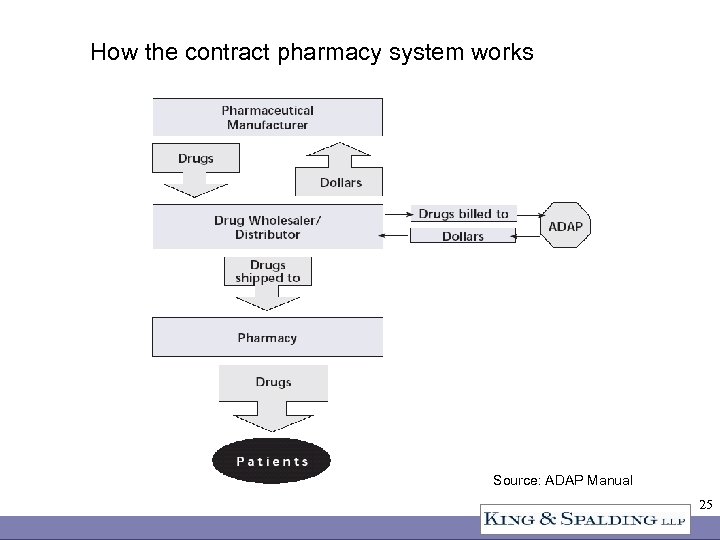
How the contract pharmacy system works Source: ADAP Manual 25
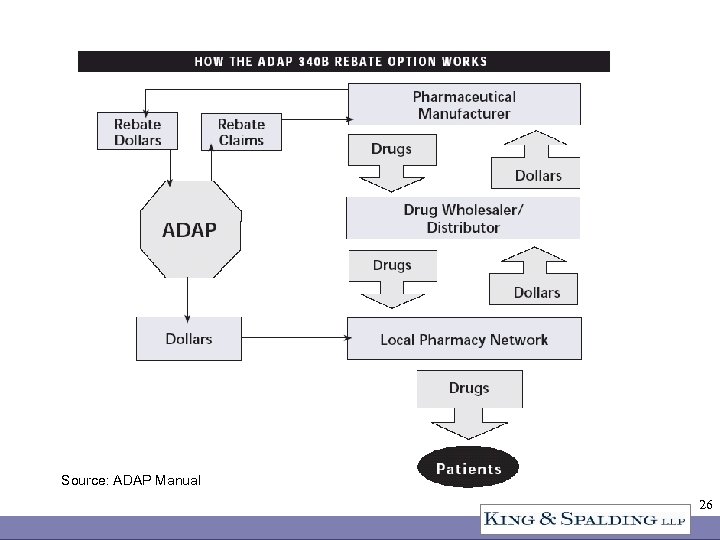
Source: ADAP Manual 26
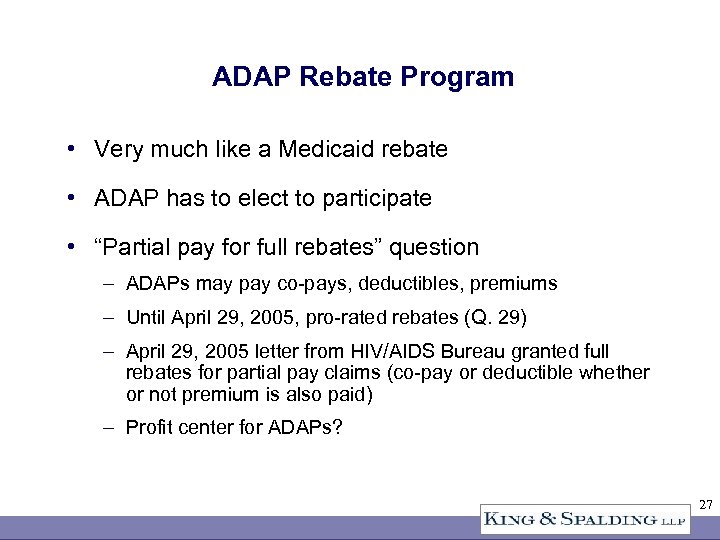
ADAP Rebate Program • Very much like a Medicaid rebate • ADAP has to elect to participate • “Partial pay for full rebates” question – ADAPs may pay co-pays, deductibles, premiums – Until April 29, 2005, pro-rated rebates (Q. 29) – April 29, 2005 letter from HIV/AIDS Bureau granted full rebates for partial pay claims (co-pay or deductible whether or not premium is also paid) – Profit center for ADAPs? 27
340 B Reports and Litigation 28
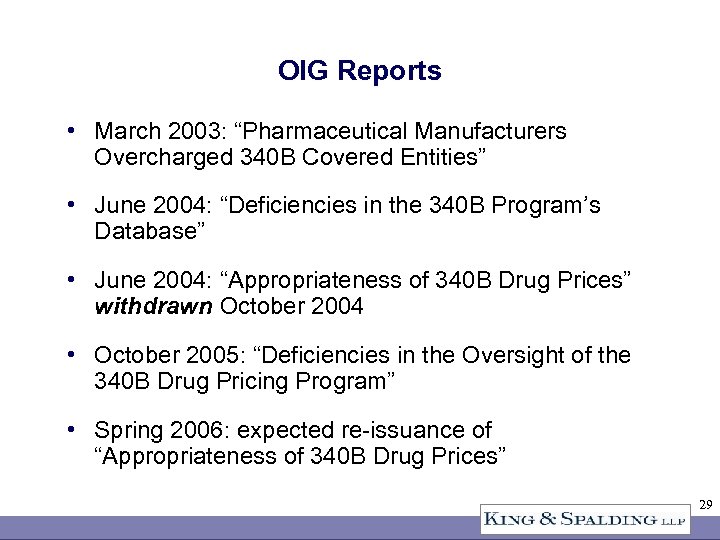
OIG Reports • March 2003: “Pharmaceutical Manufacturers Overcharged 340 B Covered Entities” • June 2004: “Deficiencies in the 340 B Program’s Database” • June 2004: “Appropriateness of 340 B Drug Prices” withdrawn October 2004 • October 2005: “Deficiencies in the Oversight of the 340 B Drug Pricing Program” • Spring 2006: expected re-issuance of “Appropriateness of 340 B Drug Prices” 29
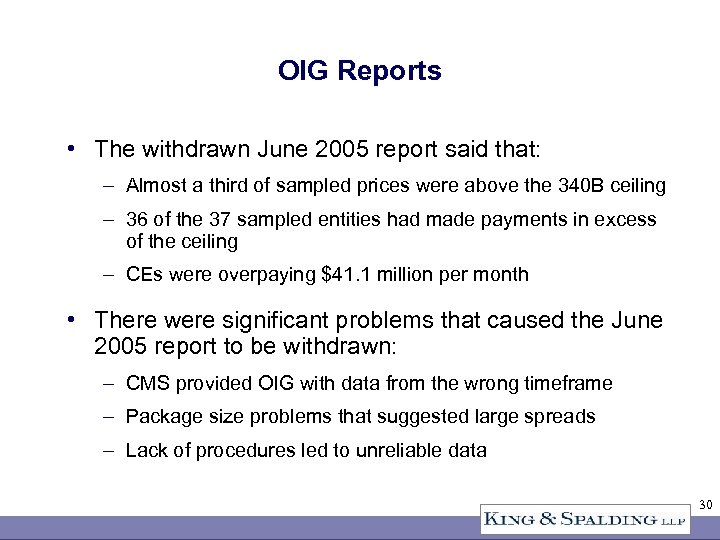
OIG Reports • The withdrawn June 2005 report said that: – Almost a third of sampled prices were above the 340 B ceiling – 36 of the 37 sampled entities had made payments in excess of the ceiling – CEs were overpaying $41. 1 million per month • There were significant problems that caused the June 2005 report to be withdrawn: – CMS provided OIG with data from the wrong timeframe – Package size problems that suggested large spreads – Lack of procedures led to unreliable data 30
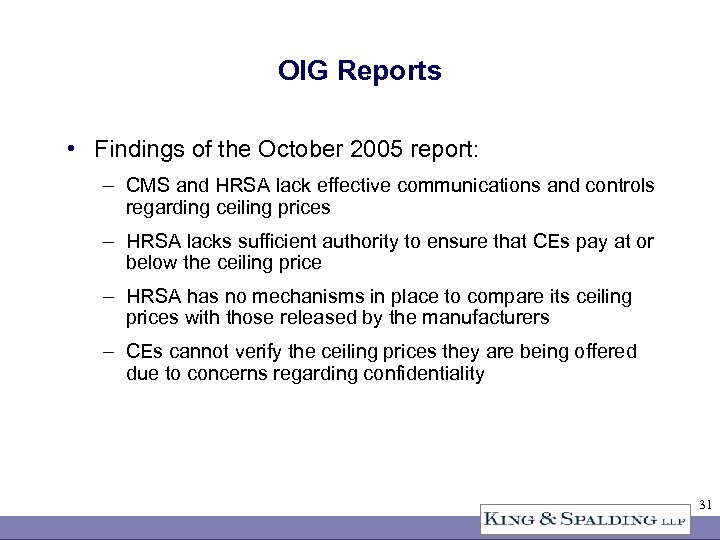
OIG Reports • Findings of the October 2005 report: – CMS and HRSA lack effective communications and controls regarding ceiling prices – HRSA lacks sufficient authority to ensure that CEs pay at or below the ceiling price – HRSA has no mechanisms in place to compare its ceiling prices with those released by the manufacturers – CEs cannot verify the ceiling prices they are being offered due to concerns regarding confidentiality 31
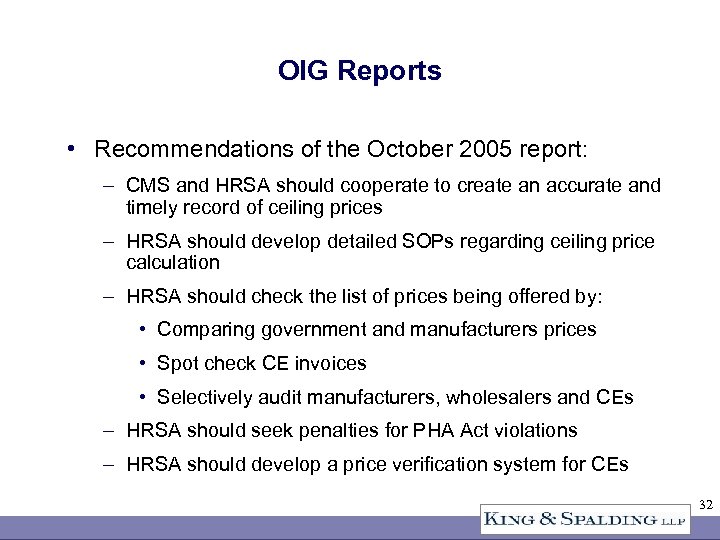
OIG Reports • Recommendations of the October 2005 report: – CMS and HRSA should cooperate to create an accurate and timely record of ceiling prices – HRSA should develop detailed SOPs regarding ceiling price calculation – HRSA should check the list of prices being offered by: • Comparing government and manufacturers prices • Spot check CE invoices • Selectively audit manufacturers, wholesalers and CEs – HRSA should seek penalties for PHA Act violations – HRSA should develop a price verification system for CEs 32
340 B Lawsuits • Central Alabama Comprehensive Healthcare v. Aventis et al (N. D. Ala. 2004) – Nationwide class of CEs who claim, based on the June 2004 OIG report, that they have been overcharged – Counts: Accounting, Breach of Contract, Unjust Enrichment – Report withdrawn October 2004 – Motion to dismiss denied September 2005 • Santa Clara County v. Astra USA et al (N. D. Cal. 2005) – Same, except plaintiffs are California counties that fund CEs – Motion to remand pending 33
The Future of 340 B 34
Pending Legislative Action • Senate Finance Committee (Grassley) has been inquiring about manufacturers’ compliance with the 340 B program • Senate and House bills would affect the 340 B program: – House bill would make 75 children’s hospitals eligible for 340 B pricing – Senate bill would increase the rebate percentage for both branded and generic drugs to 17%, lowering the 340 B ceiling price for many drugs – Senate bill would also require authorized generics’ best prices to be included in branded’s best price, lowering the 340 B ceiling price for many drugs 35
Questions Confronting the 340 B Program • What will the revised OIG report say about the prices actually received by 340 B entities? • Will the 340 B litigation spawn similar lawsuits around the country? • How will the tension between 340 B oversight and confidentiality of AMP and BP be resolved? • How will HRSA reform its operations in response to the OIG criticisms? • Will the 340 B program be expanded to cover inpatient drugs? 36
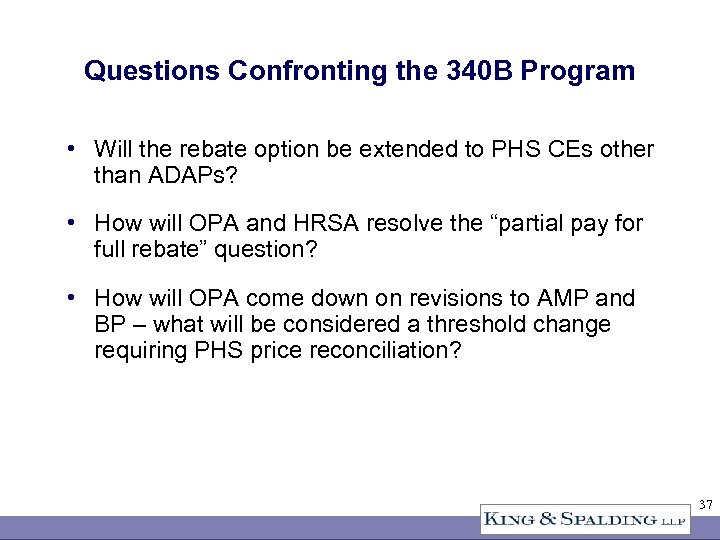
Questions Confronting the 340 B Program • Will the rebate option be extended to PHS CEs other than ADAPs? • How will OPA and HRSA resolve the “partial pay for full rebate” question? • How will OPA come down on revisions to AMP and BP – what will be considered a threshold change requiring PHS price reconciliation? 37
For further information, please feel free to call or e-mail. John Shakow jshakow@kslaw. com 202 -626 -5523
Скачать презентацию Second National Medicare Prescription Drug Congress October 31
84cbb57cb7e765fb3828e0551cb30693.ppt