 Скачать презентацию Second language L 2 acquisition December 3 2008
f161d4990da77dfa30a4eadad75aeeab.ppt
- Количество слайдов: 36



Second language (L 2) acquisition December 3, 2008
Second language (L 2) acquisition Refers to research involving n Simultaneous bilinguals (learned two languages at the same time) n Developmental bilingualism (learned second language in childhood) n Adult bilingualism (learned L 2 in adulthood) n Multilingualism (learned more than 2 languages) Researchers can refer to anyone who has or is learning a second language as a “bilingual”
Methods of Analyzing L 2 acquisition 1. 2. 3. 4. Corpora Surveys/interviews Experimental Observations
Second Language Acquisition Typical research questions: 1. What kinds of classroom techniques are best for teaching/learning L 2? (observations) 2. What kinds of errors do L 2 learners make and why do they make them? (corpora) 3. What makes someone a good/bad L 2 learner? (surveys) 4. Is there an optimal age to learn a second language? (experimental) 5. What happens in the mind/brain when learning a second language? (experimental-brain imaging) 6. Does learning an L 2 “mess up” the L 1? (experimental-brain imaging)
1. Corpora CHILDES: http: //childes. psy. cmu. edu/ Databank of transcripts, audio and video (or all three) of children playing with caretakers Provided for several different languages. n http: //childes. psy. cmu. edu/data/local. html n
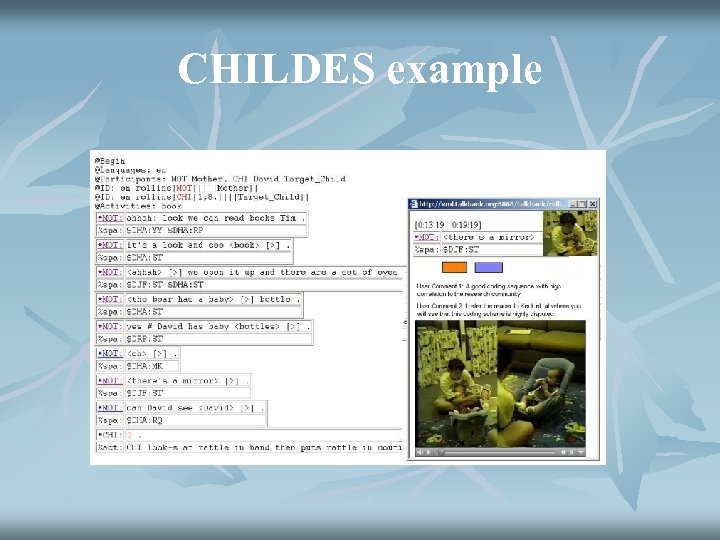
CHILDES example
1. Corpora n n n n ICE: http: //www. ucl. ac. uk/english-usage/ice/ CLC: http: //www. cambridge. org/elt/corpus/learner_corpus 2. htm MICASE: http: //lw. lsa. umich. edu/eli/micase/index. htm. M ELISA: http: //www. unituebingen. de/elisa/html/elisa_index. html CLEC: http: //langbank. engl. polyu. edu. hk/corpus/clec. html ICLE: http: //www. i 6 doc. com/I 6 Doc/Web. Objects/I 6 Doc. woa/wa/Doc ument. DA/document? language=FR&d=1005662 LCorpus: http: //leo. meikai. ac. jp/~tono/lcorpuslist. html
1. Corpora For your corpus determine 1. Spoken or written? 2. Tagged or untagged? 3. How many words? 4. Native or non-native English or both? 5. What kind of texts? 6. If allowed, briefly browse the corpus—what kinds of research questions could be answered by using this corpus?
2. Surveys/interviews Some surveys used in L 2 acquisition research: 1. The Foreign Language Classroom Anxiety Scale (FLAS) 2. Beliefs about language learning inventory (BALLI) 3. Modern Language Aptitude Test (MLAT) 4. Strategy Inventory for Language Learning (SILL) 5. Myers-Briggs Personality Scale
3. Experimental Most experiments we have talked about in class have also been used to examine L 2 learners/bilinguals Experiments we haven’t looked at yet: a. Grammaticality Judgment Tests b. Brain imaging

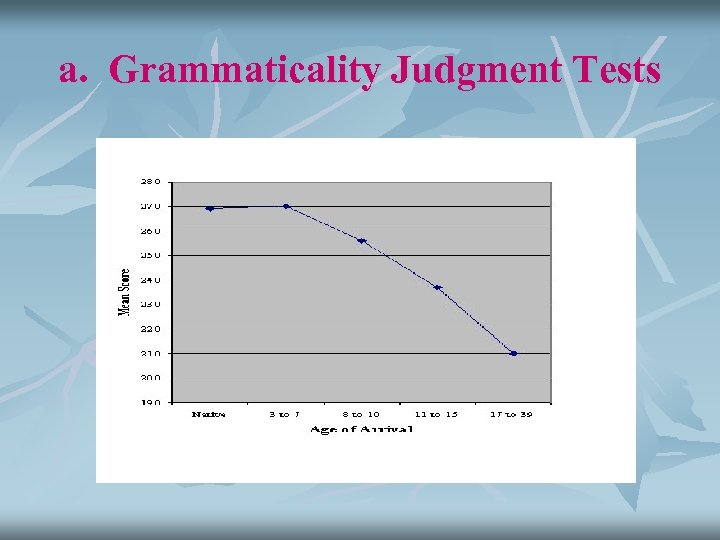
a. Grammaticality Judgment Tests 1. 2. 3. 4. 5. 6. 7. 8. 9. 10. Carol is cook dinner for her family. Sharon is babysitting for hers neighbor. Tom is reading book in the bathtub. Janice is following a special recipe for the cake. Larry went the home after the party. The man allows his son watch T. V. I want you will go the store now. He came my house at six o’clock. Has the king been served his dinner? Did washed your car this week?
a. Grammaticality Judgment Tests

a. Grammaticality Judgment Tests Lexically based sentences: n n n The farmers were hoping rain. Larry went the home after the party. The girls enjoy to feed the ducks. Rule-based sentences: n n n The girl cooks dinner for her family last night. Three boys played on the swings in the park. The girl cut himself on a piece of glass. Flege, Yeni-Komshian, & Liu (1999). Journal of Memory and Language.

a. Grammaticality Judgment Tests Chronological age: Use of English and Korean: Years of residence in the U. S. : Years of education in the U. S. : r =. 68 r = -. 56 and. 66 r = -. 42 r = -. 92 Flege, Yeni-Komshian, & Liu (1999). Journal of Memory and Language.
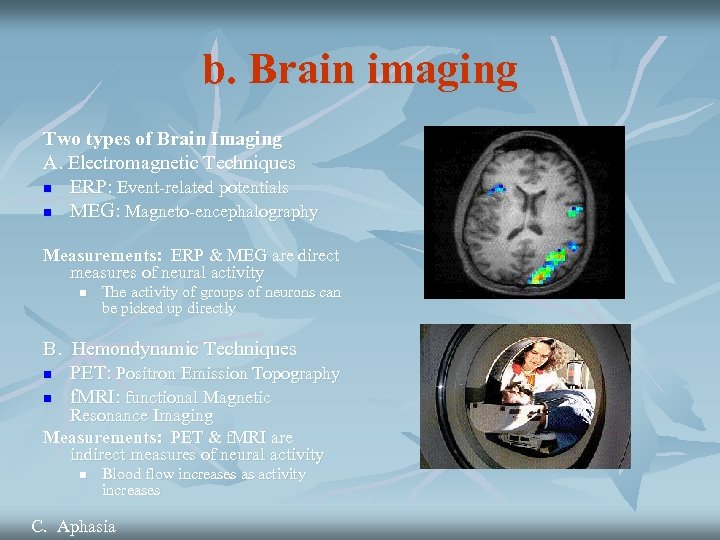
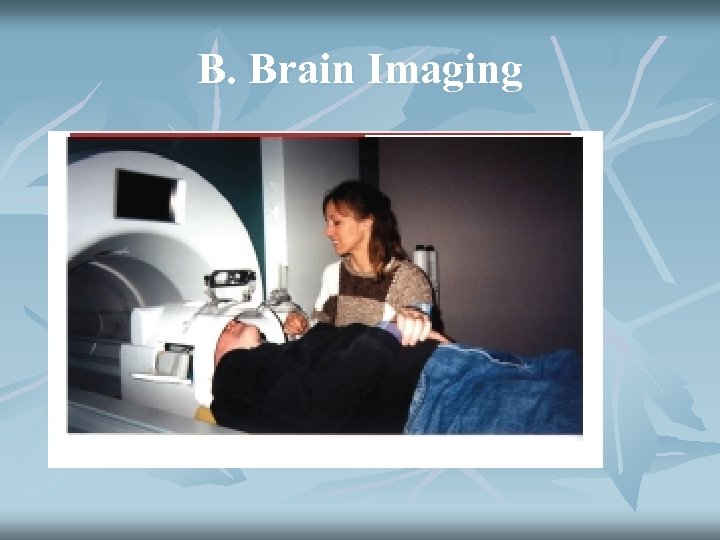
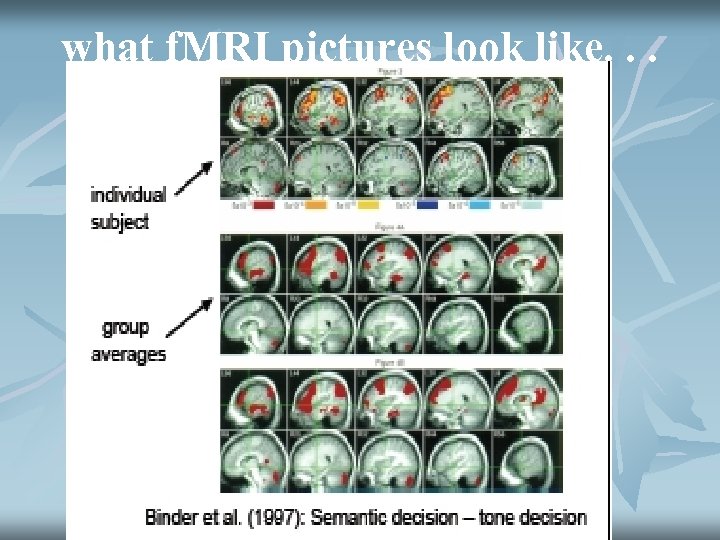
b. Brain imaging Two types of Brain Imaging A. Electromagnetic Techniques n ERP: Event-related potentials n MEG: Magneto-encephalography Measurements: ERP & MEG are direct measures of neural activity n The activity of groups of neurons can be picked up directly B. Hemondynamic Techniques n PET: Positron Emission Topography n f. MRI: functional Magnetic Resonance Imaging Measurements: PET & f. MRI are indirect measures of neural activity n Blood flow increases as activity increases C. Aphasia
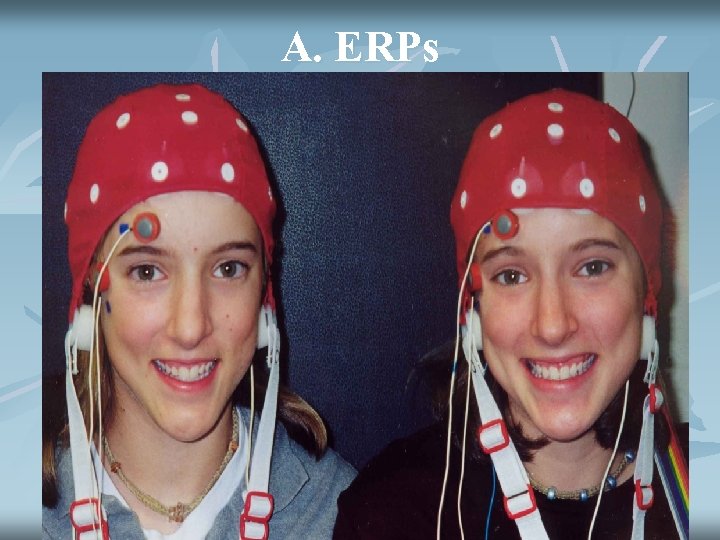
A. ERPs
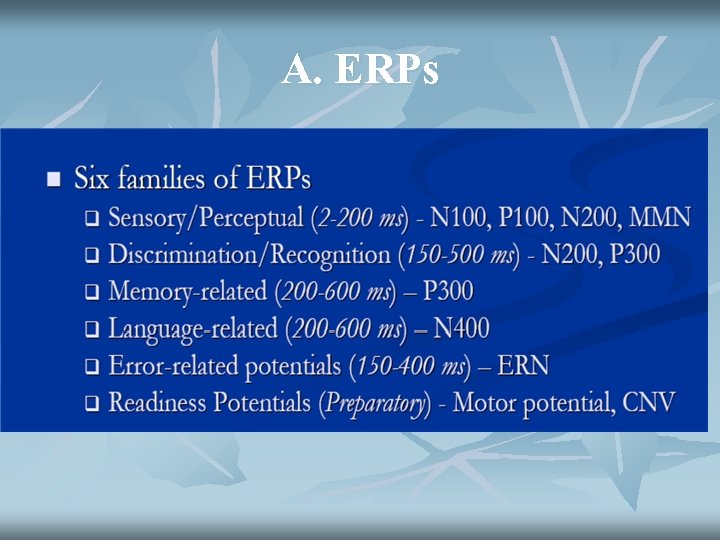
A. ERPs
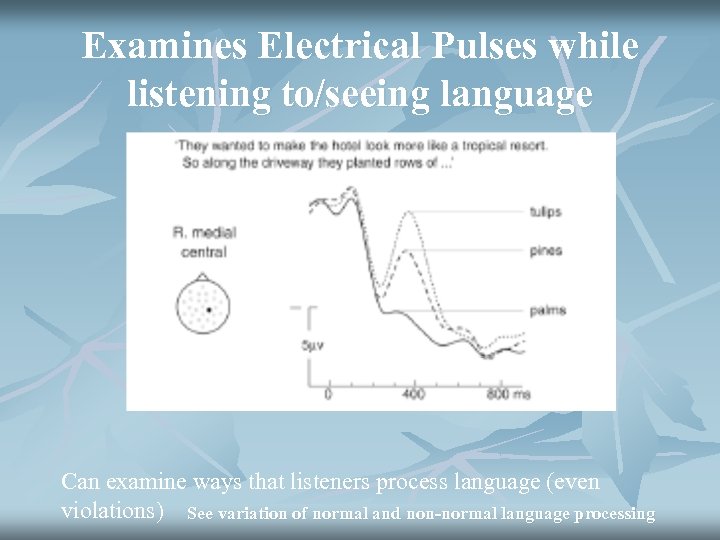
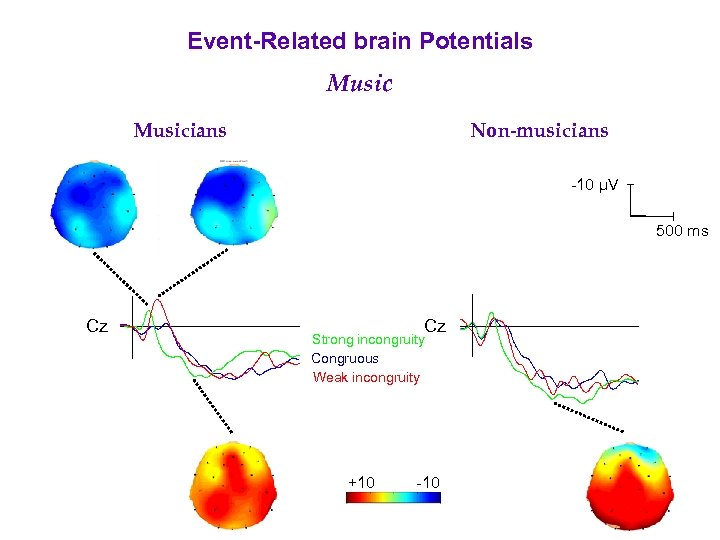
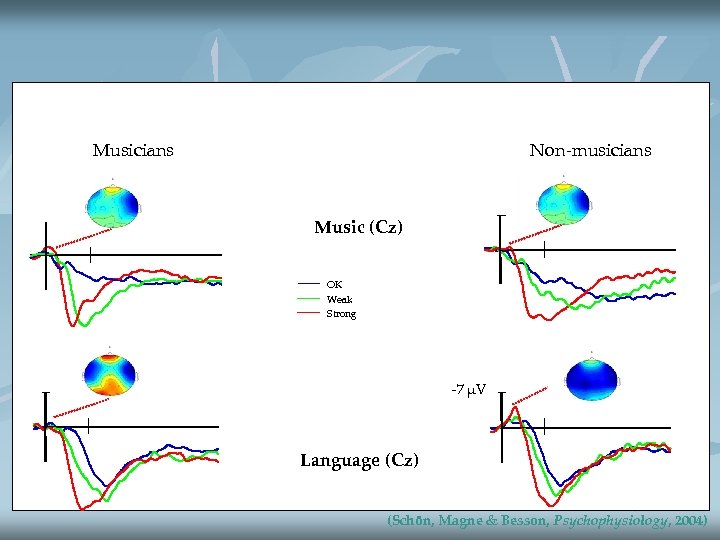
Examines Electrical Pulses while listening to/seeing language Can examine ways that listeners process language (even violations) See variation of normal and non-normal language processing
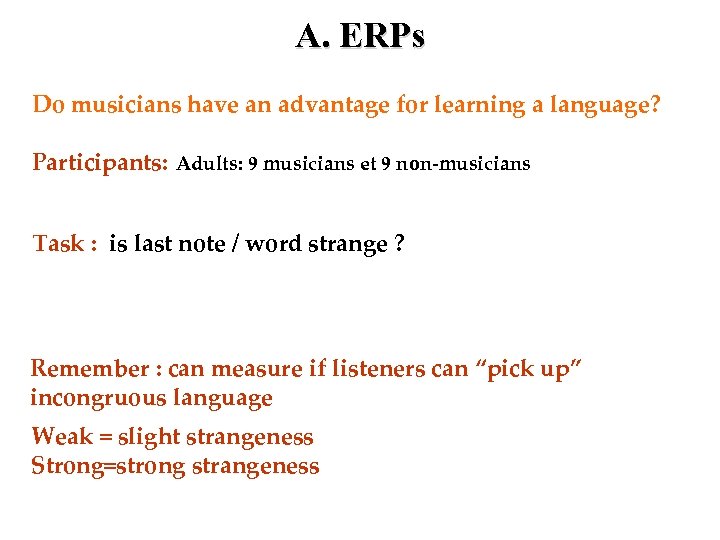
A. ERPs Do musicians have an advantage for learning a language? Participants: Adults: 9 musicians et 9 non-musicians Task : is last note / word strange ? Remember : can measure if listeners can “pick up” incongruous language Weak = slight strangeness Strong=strong strangeness
Event-Related brain Potentials Musicians Non-musicians -10 µV 500 ms Cz Cz Strong incongruity Congruous Weak incongruity +10 -10
Musicians Non-musicians Music (Cz) 500 ms OK Weak Strong -7 µV Language (Cz) (Schön, Magne & Besson, Psychophysiology, 2004)
B. Brain Imaging
what f. MRI pictures look like. . .
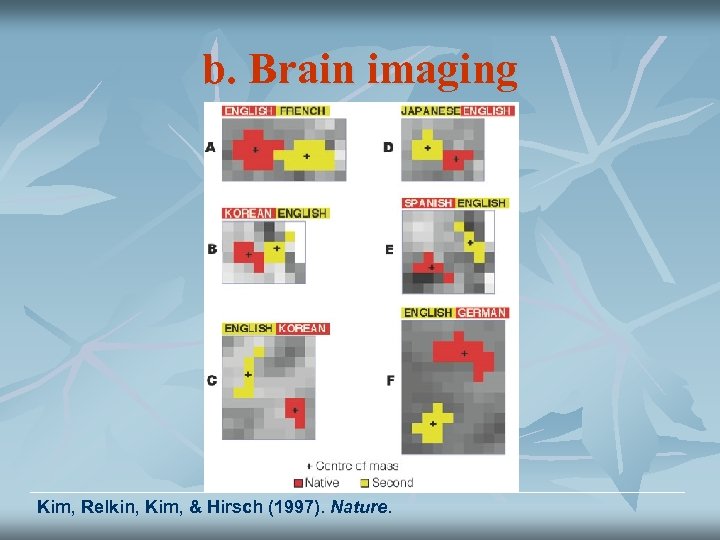
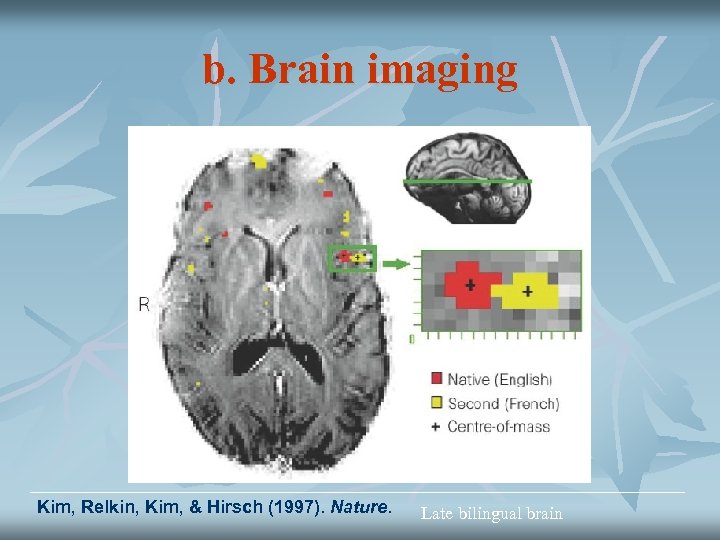
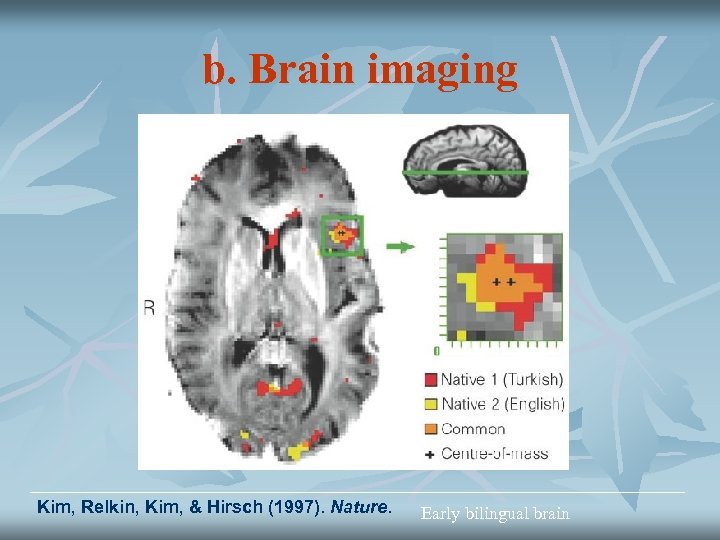
b. Brain imaging Are your two languages going to be located in different areas of the brain depending on when you learned your L 2? Kim, Reilkin, Lee, & Hirsch, 1997 n Early bilinguals (childhood, before age 8) n Late bilinguals (adulthood, mostly after age 20) n Task, imagine describing a scenario in one language vs. another n f. MRI scans during imagined speaking task
b. Brain imaging Kim, Relkin, Kim, & Hirsch (1997). Nature.
b. Brain imaging Kim, Relkin, Kim, & Hirsch (1997). Nature. Late bilingual brain
b. Brain imaging Kim, Relkin, Kim, & Hirsch (1997). Nature. Early bilingual brain
b. Brain imaging What if you heard Korean your first 3 years of life, then were adopted, then are re-exposed to Korean—can you recognize it? Does your brain process it as language? Ventureyra , Pallier & Hi-Yon Yoo (2004): Native French and native “Korean” speakers listened to Polish, Japanese and Korean. . .
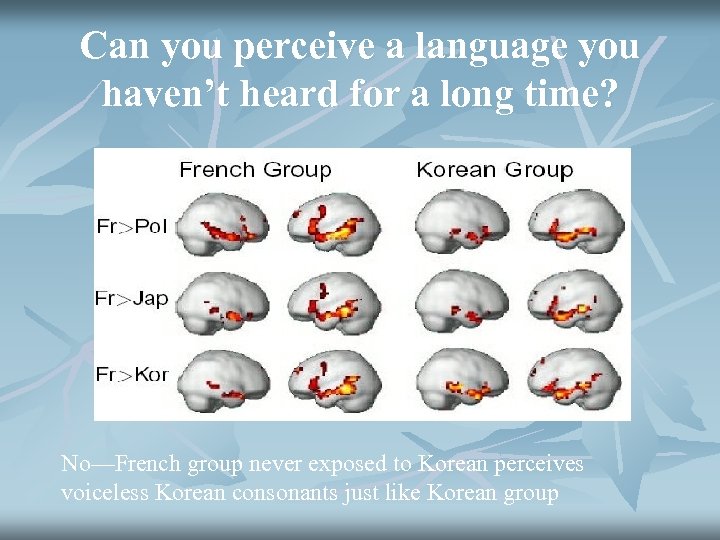
Can you perceive a language you haven’t heard for a long time? No—French group never exposed to Korean perceives voiceless Korean consonants just like Korean group
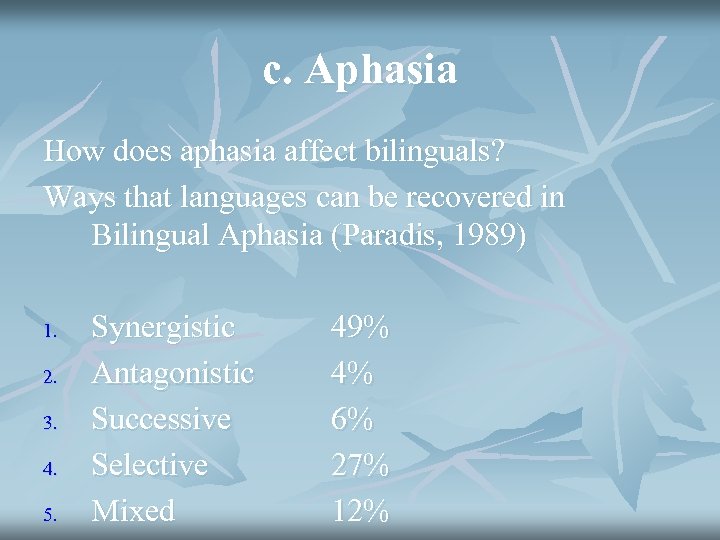
c. Aphasia How does aphasia affect bilinguals? Ways that languages can be recovered in Bilingual Aphasia (Paradis, 1989) 1. 2. 3. 4. 5. Synergistic Antagonistic Successive Selective Mixed 49% 4% 6% 27% 12%
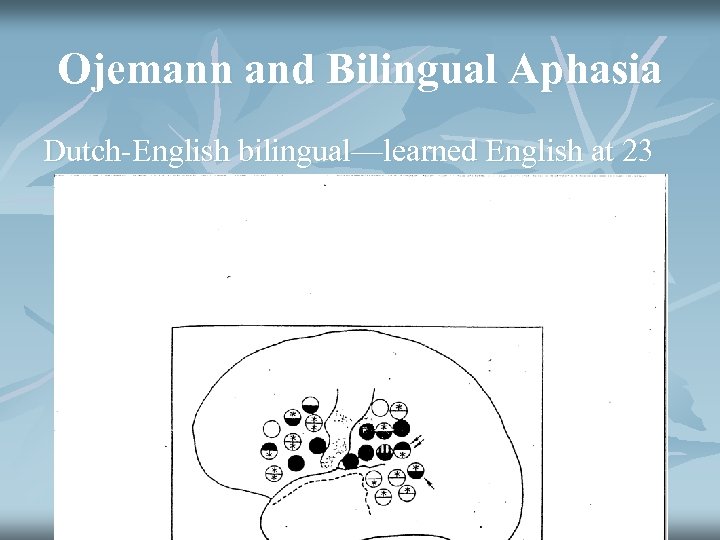
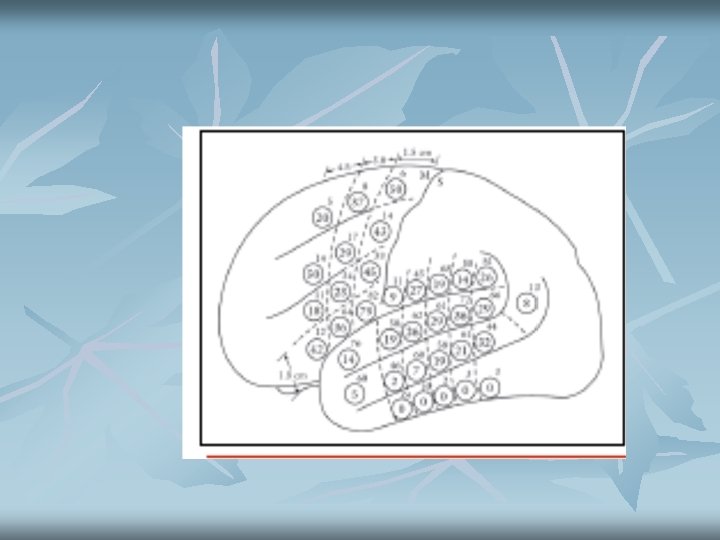
Ojemann and Bilingual Aphasia Dutch-English bilingual—learned English at 23 when came to live in U. S. -surgery at 30
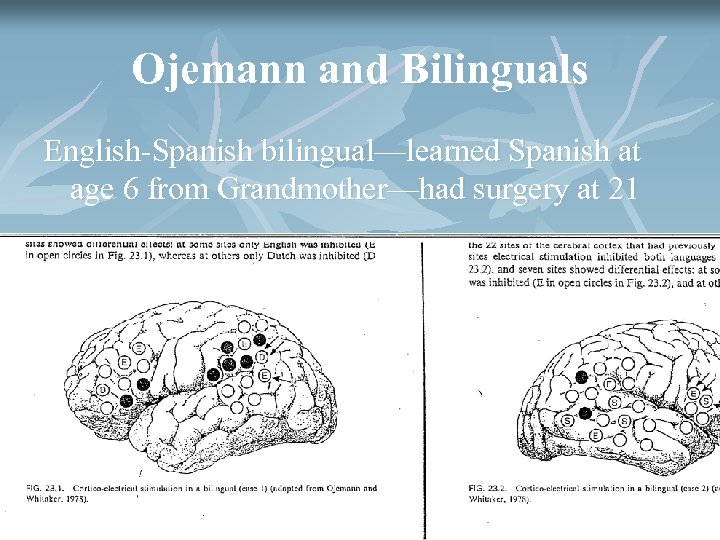
Ojemann and Bilinguals English-Spanish bilingual—learned Spanish at age 6 from Grandmother—had surgery at 21

Ojemann and Bilingual Aphasia Results: 1. 2. 3. There are some areas that serve both languages There are some areas that serve only one language or the other The first language seems less diffuse than the second
4. Observations Classroom observations http: //elc. byu. edu/teachers_resources/reading/vid eos/jacob_udall 4/ls_video_jacob_udall. html
Скачать презентацию Second language L 2 acquisition December 3 2008
f161d4990da77dfa30a4eadad75aeeab.ppt