


 Скачать презентацию Second Impact Syndrome Tanvir Choudhri MD Assistant Professor
b8b73c22ece8bb1c95d6195a7e1d76d4.ppt
- Количество слайдов: 28
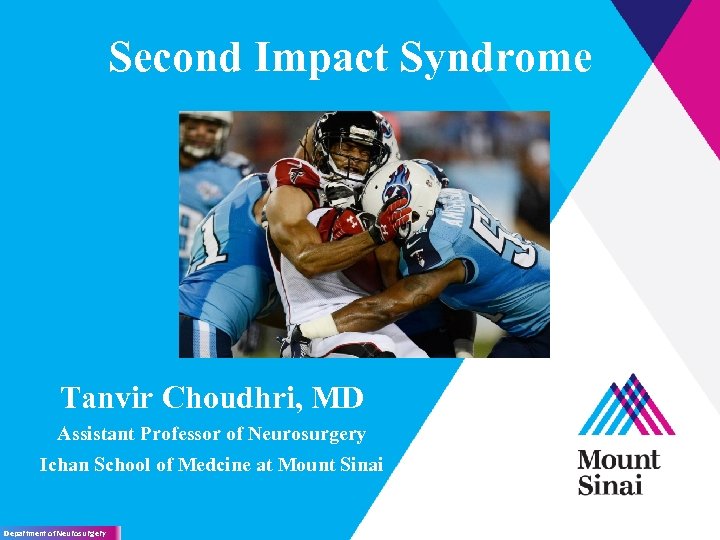 Second Impact Syndrome Tanvir Choudhri, MD Assistant Professor of Neurosurgery Ichan School of Medcine at Mount Sinai Department of Neurosurgery
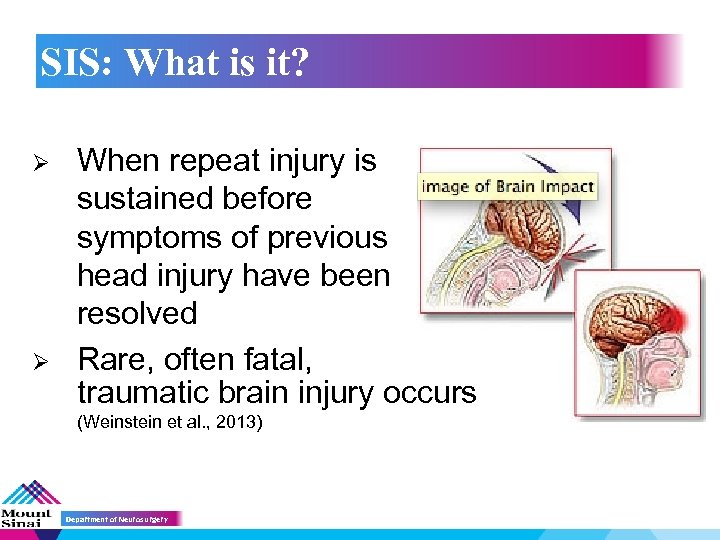 SIS: What is it? Ø Ø When repeat injury is sustained before symptoms of previous head injury have been resolved Rare, often fatal, traumatic brain injury occurs (Weinstein et al. , 2013) Department of Neurosurgery
 SIS: What is it? Ø Ø Ø Saunders RL, Harbaugh RE The second impact in catastrophic contact-sports head trauma JAMA 252: 538 -539, 1984 Department of Neurosurgery
 SIS: How often does it occur? Ø Ø Exact incidence unknown Less than 20 documented SIS cases in world literature (Randolph et al. , 2009, Arch Clin Neuropsychol) 1 possible SIS for every 205, 000 player seasons Ø Ø Annual participation rate: 1. 8 million high school/collegiate subjects (Mc. Crory, et al. , 2012, Current sports medicine reports) Department of Neurosurgery
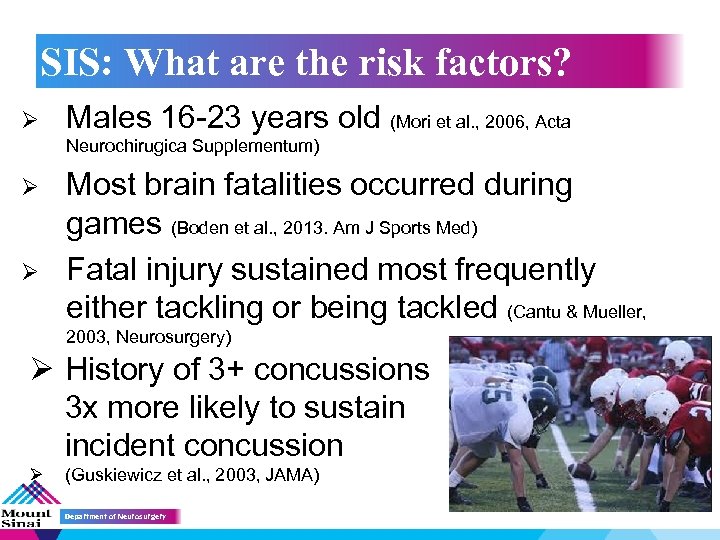 SIS: What are the risk factors? Ø Males 16 -23 years old (Mori et al. , 2006, Acta Neurochirugica Supplementum) Ø Ø Most brain fatalities occurred during games (Boden et al. , 2013. Am J Sports Med) Fatal injury sustained most frequently either tackling or being tackled (Cantu & Mueller, 2003, Neurosurgery) Ø History of 3+ concussions 3 x more likely to sustain incident concussion Ø (Guskiewicz et al. , 2003, JAMA) Department of Neurosurgery
 SIS: How does it occur? Ø Within vulnerable period from previous injury (Weinstein et al. , 2013, J Neurosurg) Ø Ø Impairment of cellular energetic metabolism Loss of autoregulation of cerebral blood flow Ø Ø Subsequent vascular engorgement Increased intracranial pressure Eventual herniation Subdural hematoma Brain Swelling Department of Neurosurgery
 SIS: Effects of 2 nd Impact Ø Ø Ø Loss of autoregulation Rapid onset massive cerebral edema Transtentorial brain herniation Raised intracranial pressure Death can be as early as 2 -5 min (Zollman, 2011, Demos Medical Publishing) Department of Neurosurgery
 SIS: Pathophysiology Functional injury Ø Reinjury to neuronal cells within vulnerable period from previous injury (Weinstein et al. , 2013, J Ø Neurosurg Pediatrics) Ø Dysautoregulation Ø hyperemic brain swelling Ø Increased intracranial pressure Ø Herniation Ø Brainstem compression Department of Neurosurgery
 Concussion: Pathophysiology Ø Neurometabolic cascade (Marshall, 2012, J Can Chiropr Assoc) Ø Ø Ø Mechanical stretching/shearing of neurons Ø Disrupts ion channels Ø Excitation phase Ø Neuronal suppression Net result = neuronal ion imbalance, cellular dysfunction, cerebral energy deficit Requires max function of Na+/K+ pump to restore homeostasis Department of Neurosurgery
 Concussion: Pathophysiology ▶ http: //www. youtube. com/watch? v=Krv. C 2 UUEJ 8 Y ▶ http: //www. youtube. com/watch? v=u. EGXc. NNyzp Y Mount Sinai / Presentation Slide / December 5, 2012 10
 SIS: How to recognize it? Ø Ø 2 nd injury generally not severe Remains standing - appears dazed Sec-min after 2 nd blow collapses to ground Semicomatose, dilating pupils, loss of eye movement, respiratory failure (Cantu & Gean, 2010, Journal of neurotrauma) Ø Death can be as early as 2 -5 min of 2 nd impact (Zollman, 2011, Demos Medical Publishing) Department of Neurosurgery
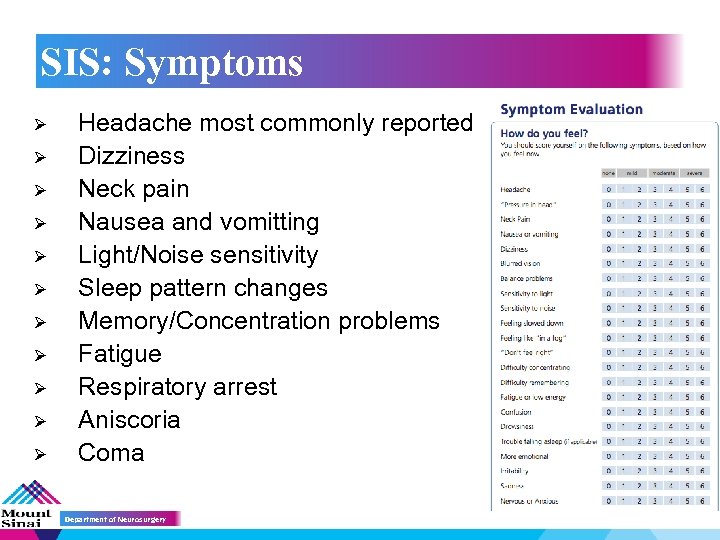 SIS: Symptoms Ø Ø Ø Headache most commonly reported Dizziness Neck pain Nausea and vomitting Light/Noise sensitivity Sleep pattern changes Memory/Concentration problems Fatigue Respiratory arrest Aniscoria Coma Department of Neurosurgery
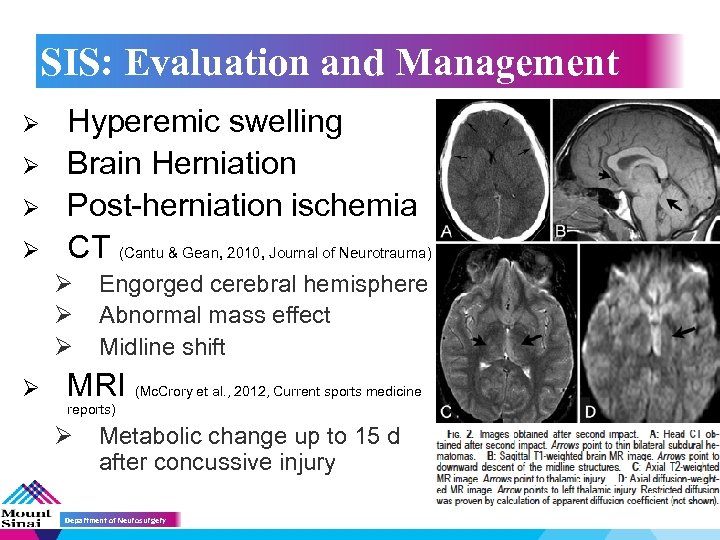 SIS: Evaluation and Management Ø Ø Hyperemic swelling Brain Herniation Post-herniation ischemia CT (Cantu & Gean, 2010, Journal of Neurotrauma) Ø Ø Engorged cerebral hemisphere Abnormal mass effect Midline shift MRI (Mc. Crory et al. , 2012, Current sports medicine reports) Ø Metabolic change up to 15 d after concussive injury Department of Neurosurgery
 SIS: Neurosurgeon’s role Ø Neurosurgical consult in case of anatomic abnormality (Bey & Ostick, 2009, Western Journal of Emergency Medicine) Ø Ø Ø Attention for potential c-spine injury Patient immediately stabilized Airway management Rapid intubation Mannitol to minimize morbidity Surgery generally not effective for treatment of impaired autoregulation Department of Neurosurgery
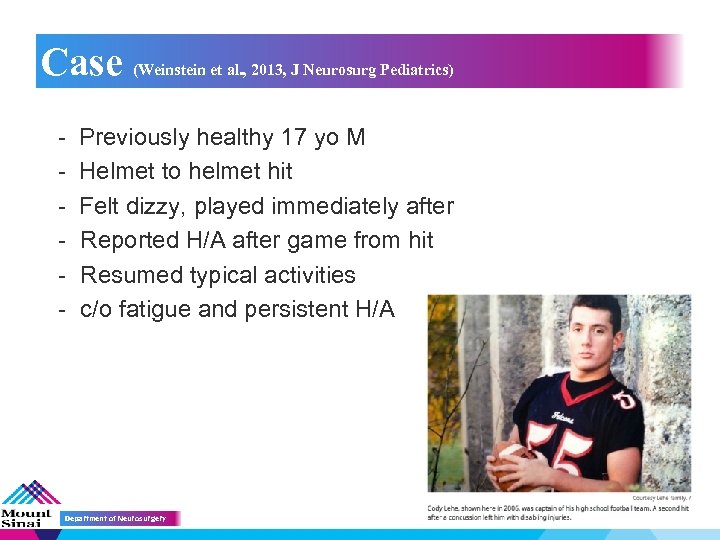 Case - (Weinstein et al. , 2013, J Neurosurg Pediatrics) Previously healthy 17 yo M Helmet to helmet hit Felt dizzy, played immediately after Reported H/A after game from hit Resumed typical activities c/o fatigue and persistent H/A Department of Neurosurgery
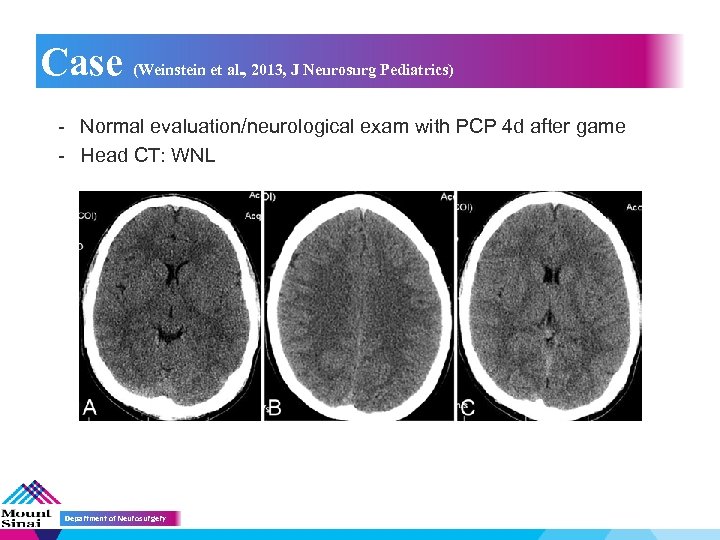 Case (Weinstein et al. , 2013, J Neurosurg Pediatrics) - Normal evaluation/neurological exam with PCP 4 d after game - Head CT: WNL Department of Neurosurgery
 Case (Weinstein et al. , 2013, J Neurosurg Pediatrics) - Persistent H/A, difficulty with concentration - 5 days after initial injury participated in practic (including hitting drills) - After a hit on fourth drill: slow to get up “OK” but H/A - Several plays later down on one knee dizziness and headache couldn't feel legs unresponsive generalized seizure activity - Local ER: intubated, treated with lidocaine, mannitol, fosphenytoin, fentanyl, midazolam - Air transport to trauma/NS center - 143/79, HR 93, GCS 7 T, 3 mm sluggish pupils, ICP 25 -30 - Coagulation studies normal, Utox neg Department of Neurosurgery
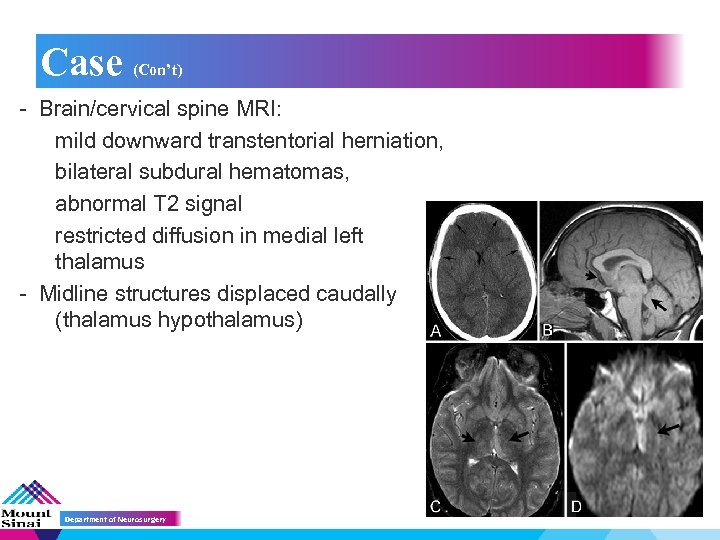 Case (Con’t) - Brain/cervical spine MRI: mild downward transtentorial herniation, bilateral subdural hematomas, abnormal T 2 signal restricted diffusion in medial left thalamus - Midline structures displaced caudally (thalamus hypothalamus) Department of Neurosurgery
 Case (Con’t) Hospital course: Episode of hypotension, severe metabolic acidosis and renal failure, Sepsis, ventilator-assoc. pneumonia with empyema, disseminated intravascular coagulation, cardiac arrest Later resolution of subdural hematomas and areas of encephalomalacia At time of discharge (day 98) nonverbal and nonambulatory Department of Neurosurgery
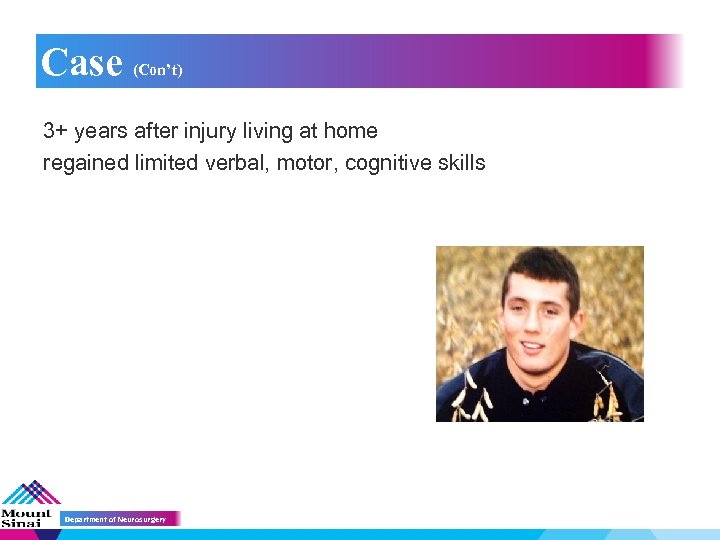 Case (Con’t) 3+ years after injury living at home regained limited verbal, motor, cognitive skills Department of Neurosurgery
 SIS http: //www. youtube. com/watch? v=V 12 Z qmd 3 Btc Department of Neurosurgery
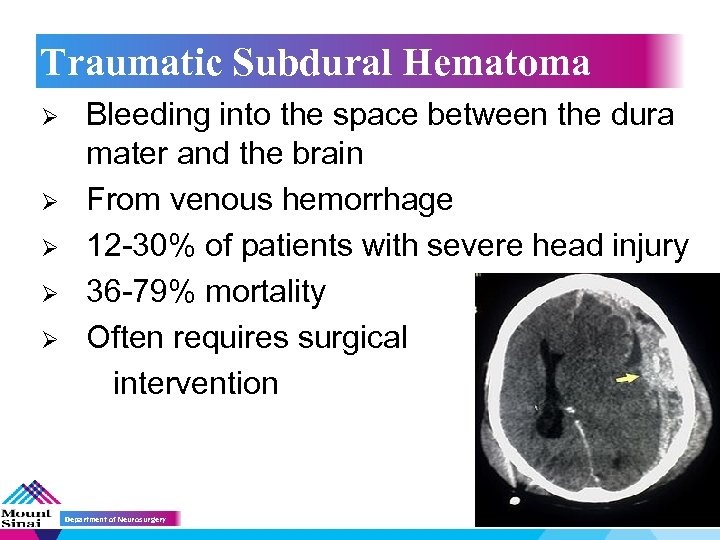 Traumatic Subdural Hematoma Ø Ø Ø Bleeding into the space between the dura mater and the brain From venous hemorrhage 12 -30% of patients with severe head injury 36 -79% mortality Often requires surgical intervention Department of Neurosurgery
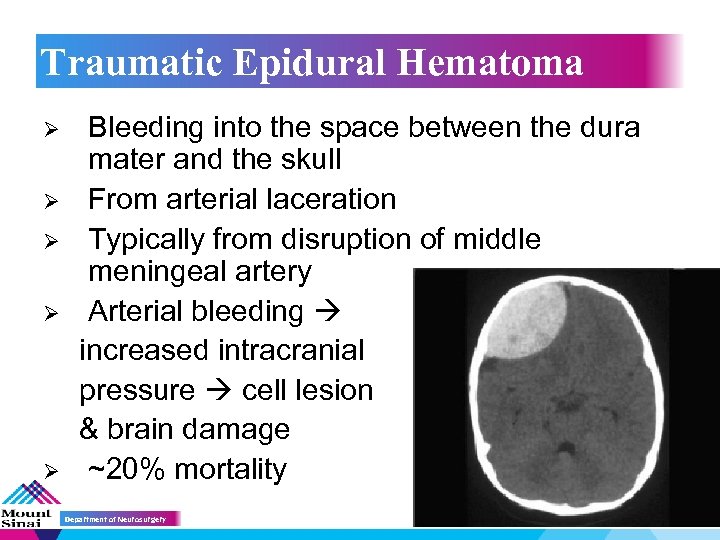 Traumatic Epidural Hematoma Ø Ø Ø Bleeding into the space between the dura mater and the skull From arterial laceration Typically from disruption of middle meningeal artery Arterial bleeding increased intracranial pressure cell lesion & brain damage ~20% mortality Department of Neurosurgery
 Post Concussion Syndrome Ø Ø Persistent post-concussion symptoms 3+ months Increased risk of depression Working memory and Info processing speed impairments in mild TBI and persistent PCS (Dean & Sterr, 2013, Frontiers in Human Neuroscience) Department of Neurosurgery
 Chronic Traumatic Encephalopathy Ø Ø Ø Repetitive brain trauma necessary for development of CTE Progressive neurodegenerative disease Symptoms present years after trauma (Stern et al. , 2011, American Academy of Physical Medicine and Rehabilitation) Ø Decline of memory/cognition Ø Depression Ø Suicidal behavior Ø Poor impulse control Ø Aggressiveness Ø Parkinsonism Ø Dementia Ø Generalized atrophy Department of Neurosurgery
 Conclusions Ø Ø Vulnerable window following TBI Second impact before resolution of symptoms can result in catastrophic brain injury/ fatality Highlights importance of return-to-play decisions PCS and CTE represent long-term consequences of repetitive head impacts Department of Neurosurgery
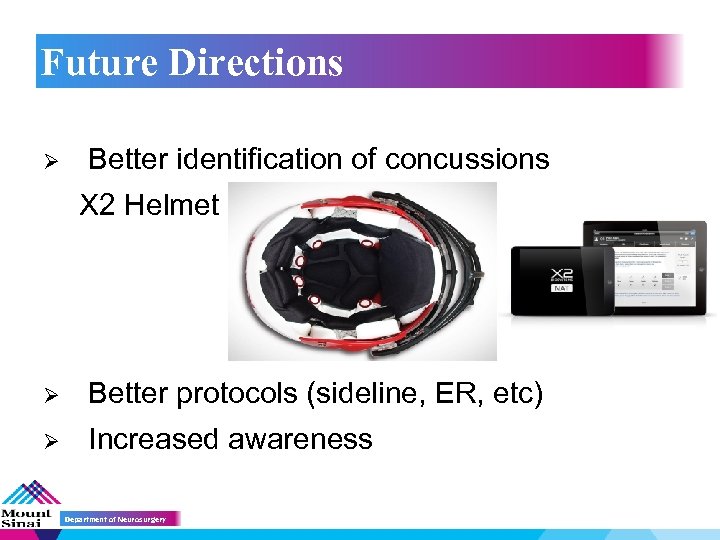 Future Directions Ø Better identification of concussions X 2 Helmet Ø Better protocols (sideline, ER, etc) Ø Increased awareness Department of Neurosurgery
 Acknowledgements Ø Alexa Dessy, BA Ø Jonathan Rasouli, MD Ø Mount Sinai PLAYSAFE team Ø Alex Gometz, DPT, CIC (Concussion Management of New York) Department of Neurosurgery