


 Скачать презентацию SEC 598 F 16 Photovoltaic Systems Engineering Session
6552db6ae2c7e3646d5770482ae79bf2.ppt
- Количество слайдов: 9
 SEC 598 F 16 Photovoltaic Systems Engineering Session 16 Stand-Alone PV Systems Design Considerations – Residential Scale October 19, 2017
 Stand-Alone PV Systems – Design Steps in stand-alone system design 1 Evaluation of solar availability, electrical consumption, essential electrical loads 1 Battery selection 2 PV array sizing 3 Module selection 4 Charge controller selection 5 Inverter selection 1 Balance of system 2
 Example 4. A stand-alone solar-powered refrigerator for home brewing. A friend has an old house in Phoenix with a set back garage that has limited electrical service. Upgrading the service would require extensive trenching from the service panel, which he would prefer to avoid. In this project, we shall design a stand-alone PV system designed to power a refrigerator that will be used for fermentation and aging 5 -gallon containers of home-brewed beer. This beer will be Peter’s Solar IPA or something similar 3
 Example 4. A stand-alone solar-powered refrigerator for home brewing. Evaluation of solar availability, electrical consumption, essential electrical loads The Kenwood refrigerator draws about 386 k. Wh per year (Energy Star sticker), so that it has a daily use of roughly 1. 1 k. Wh. This is consistent with its nominal power draw (200 W) and 5 hours/day operation. To account for inverter losses of approximately 5% and to meet electrical surges at start, I shall choose a 300 W pure sine wave inverter: 4
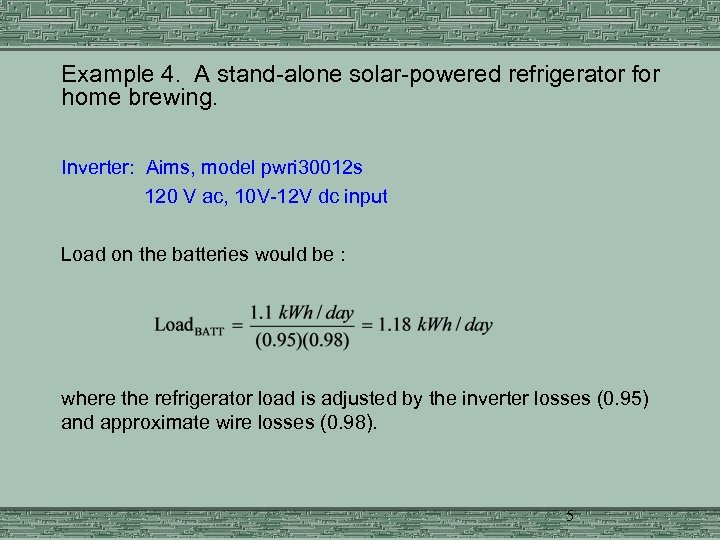 Example 4. A stand-alone solar-powered refrigerator for home brewing. Inverter: Aims, model pwri 30012 s 120 V ac, 10 V-12 V dc input Load on the batteries would be : where the refrigerator load is adjusted by the inverter losses (0. 95) and approximate wire losses (0. 98). 5
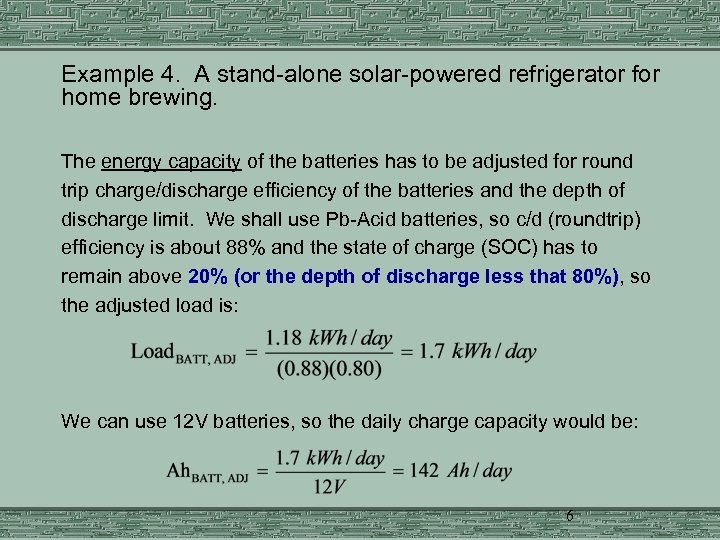 Example 4. A stand-alone solar-powered refrigerator for home brewing. The energy capacity of the batteries has to be adjusted for round trip charge/discharge efficiency of the batteries and the depth of discharge limit. We shall use Pb-Acid batteries, so c/d (roundtrip) efficiency is about 88% and the state of charge (SOC) has to remain above 20% (or the depth of discharge less that 80%), so the adjusted load is: We can use 12 V batteries, so the daily charge capacity would be: 6
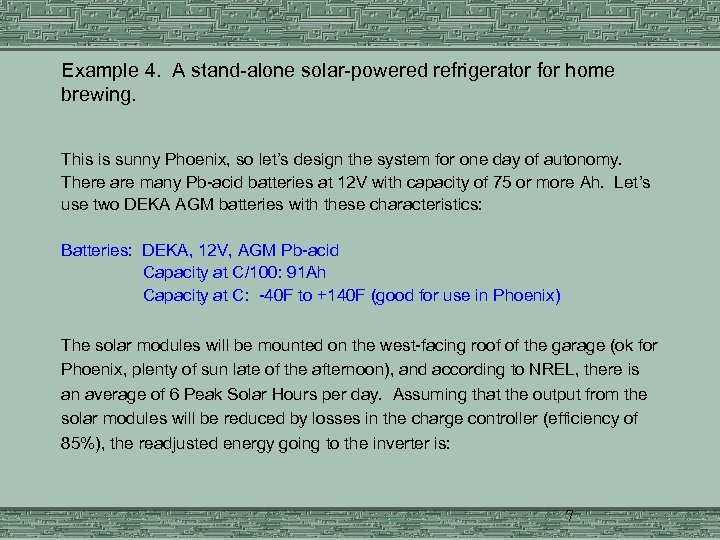 Example 4. A stand-alone solar-powered refrigerator for home brewing. This is sunny Phoenix, so let’s design the system for one day of autonomy. There are many Pb-acid batteries at 12 V with capacity of 75 or more Ah. Let’s use two DEKA AGM batteries with these characteristics: Batteries: DEKA, 12 V, AGM Pb-acid Capacity at C/100: 91 Ah Capacity at C: -40 F to +140 F (good for use in Phoenix) The solar modules will be mounted on the west-facing roof of the garage (ok for Phoenix, plenty of sun late of the afternoon), and according to NREL, there is an average of 6 Peak Solar Hours per day. Assuming that the output from the solar modules will be reduced by losses in the charge controller (efficiency of 85%), the readjusted energy going to the inverter is: 7
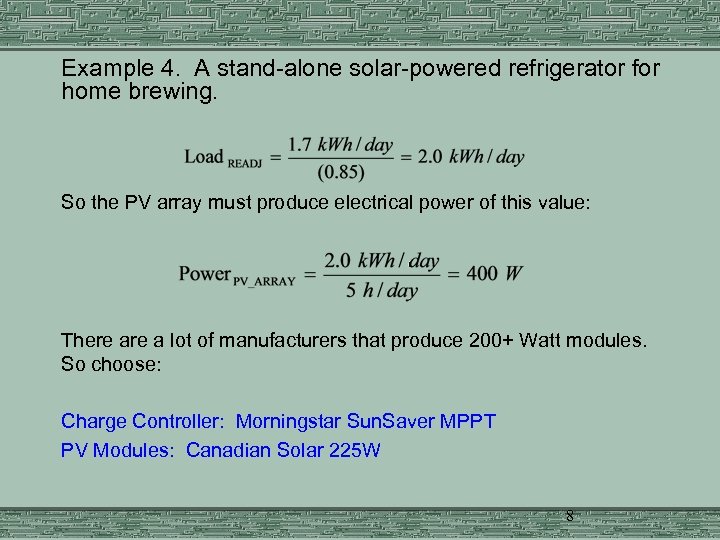 Example 4. A stand-alone solar-powered refrigerator for home brewing. So the PV array must produce electrical power of this value: There a lot of manufacturers that produce 200+ Watt modules. So choose: Charge Controller: Morningstar Sun. Saver MPPT PV Modules: Canadian Solar 225 W 8
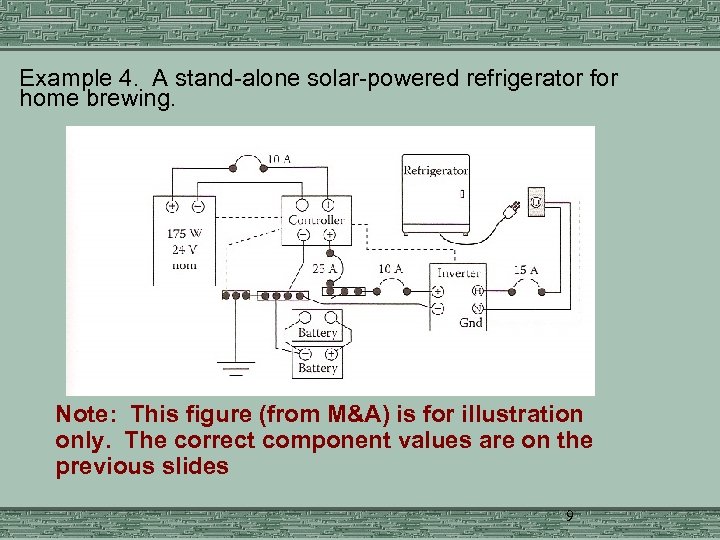 Example 4. A stand-alone solar-powered refrigerator for home brewing. Note: This figure (from M&A) is for illustration only. The correct component values are on the previous slides 9