


 Скачать презентацию Seawater Saline Agriculture for Energy Warming Water Rainfall Land
525ecdedbf2d27e0f7eb0bc105e02638.ppt
- Количество слайдов: 38
 Seawater/Saline Agriculture for Energy, Warming, Water, Rainfall, Land, Food and Minerals Dennis M. Bushnell Chief Scientist NASA Langley Research Center
 “SPACESHIP EARTH” We, The crew are: - Plundering the ship’s supplies - Tinkering with the temperature and life-support controls - Still looking for the instruction manual - Engaging in bloody skirmishes in every corner of the vessel - Increasing the size of the crew by 2 million PER WEEK P. Creola
 The (Economic) Ages of Humankind • Hunter/Killer groups (~1 Million - ~5 K BC) • Agriculture (~5 K BC - ~1850 AD) • Industrial (~1850 AD - ~1950 AD) • Information (~1950 AD - ~2040 AD) • BIO/NANO (~1995 - ~2040) • Virtual (~2015 - ? )
 • Hunter-Gatherer - “Nature Provided” • Agriculture - Controlled Nature (Plants/Animals) • Industrial - Mechanized Agriculture [1800 -97% Farmers, Now-2%] • IT/BIO/Nano - Automating Industry/Agriculture • Virtual - Robotization of IT/Bio/Nano/Industry/Agriculture Technology MATTERS - For Both Good and ill………
![Humans Have “Taken Over” and Vastly Shortened “Evolution” [Human Engendered~E 7 times “Natural”] Of](https://present5.com/presentation/525ecdedbf2d27e0f7eb0bc105e02638/image-5.jpg "Humans Have “Taken Over” and Vastly Shortened “Evolution” [Human Engendered~E 7 times “Natural”] Of") Humans Have “Taken Over” and Vastly Shortened “Evolution” [Human Engendered~E 7 times “Natural”] Of the Planet Global Warming/Pollution/Deforestation Huge “Public Works” (e. g. 3 Gorges Dam) Of the Human Species Genomic Design and Repair “Mind Children” (Moravec) Products/Life Forms Cross Species Molecular Breeding “Directed Evolution” (Maxygen etc. )
Humans Have “Taken Over” and Vastly Shortened “Evolution” [Human Engendered~E 7 times “Natural”] Of the Planet Global Warming/Pollution/Deforestation Huge “Public Works” (e. g. 3 Gorges Dam) Of the Human Species Genomic Design and Repair “Mind Children” (Moravec) Products/Life Forms Cross Species Molecular Breeding “Directed Evolution” (Maxygen etc. )
 - CO 2 levels are NOW greater than at any time in the last 650, 000 Years……… - Tundra Melting, Releasing huge amounts of Methane……. - European Gulf Stream Heating reduced by 30% [overlying fresh water from melting glaciers]…….
 • • • THE KEY TECHNOLOGIES (highly synergistic / at the frontiers of the small / in a “feeding frenzy” off each other) IT (comms/computing/sensors/electronics/machine intelligence) Bio (genomics/molecular biology/designer life forms) Nano (coatings/barriers/computers/sensors/materials/ “assemblers”) Energetics (HEDM (various)/revol. solar/biomass/explosives/propellants/storage) Quantum [crypto/computing/sensors/optics/Electronics] Societal Technological Systems (motivational asynchronous “distance learning, ” immersive/virtual presence, “tele-everything, ” “robotic everything, ” digital earth/digital airspace)
![The [Major] Societal Problems • Warming [Anthropogenic CO 2 Induced, Attendant Arctic Methane Release]](https://present5.com/presentation/525ecdedbf2d27e0f7eb0bc105e02638/image-8.jpg "The [Major] Societal Problems • Warming [Anthropogenic CO 2 Induced, Attendant Arctic Methane Release]") The [Major] Societal Problems • Warming [Anthropogenic CO 2 Induced, Attendant Arctic Methane Release] • Consequent “Green Energy” Requirement, Simultaneous Demise of “Cheap Oil” • Shortages of Water & Arable Land • An Increasing Food Shortage
The [Major] Societal Problems • Warming [Anthropogenic CO 2 Induced, Attendant Arctic Methane Release] • Consequent “Green Energy” Requirement, Simultaneous Demise of “Cheap Oil” • Shortages of Water & Arable Land • An Increasing Food Shortage
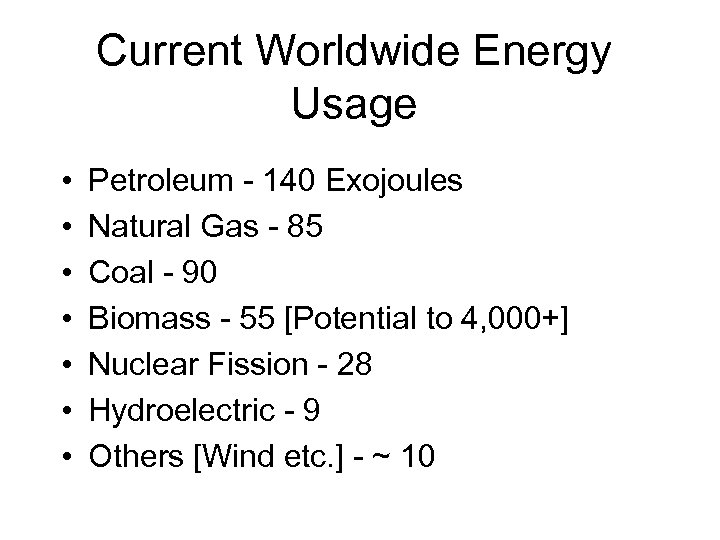 Current Worldwide Energy Usage • • Petroleum - 140 Exojoules Natural Gas - 85 Coal - 90 Biomass - 55 [Potential to 4, 000+] Nuclear Fission - 28 Hydroelectric - 9 Others [Wind etc. ] - ~ 10
![Petroleum [Transportation Fuel] Outlook • In General, ”Cheap Oil” Production is peaking or has](https://present5.com/presentation/525ecdedbf2d27e0f7eb0bc105e02638/image-10.jpg "Petroleum [Transportation Fuel] Outlook • In General, ”Cheap Oil” Production is peaking or has") Petroleum [Transportation Fuel] Outlook • In General, ”Cheap Oil” Production is peaking or has peaked. Residual supplies will have greater production costs. Increasing Petroleum demand, particularly from the developing world , will ensure ever increasing oil prices and shifts, from purely economic drivers, to “Alternatives” [H 2, Biomass] • Demand Example - U. S. has 745 vehicles per 1, 000 population. China, the second largest oil importer, has 3 vehicles per 1, 000 population. If China goes to 5 Vehicles per 1, 000 Population they will have to DOUBLE their Oil Imports to 10 Million Barrels/Day
Petroleum [Transportation Fuel] Outlook • In General, ”Cheap Oil” Production is peaking or has peaked. Residual supplies will have greater production costs. Increasing Petroleum demand, particularly from the developing world , will ensure ever increasing oil prices and shifts, from purely economic drivers, to “Alternatives” [H 2, Biomass] • Demand Example - U. S. has 745 vehicles per 1, 000 population. China, the second largest oil importer, has 3 vehicles per 1, 000 population. If China goes to 5 Vehicles per 1, 000 Population they will have to DOUBLE their Oil Imports to 10 Million Barrels/Day
 Energy and Warming • 75% of Energy Usage is releasing climatechanging amounts of Fossil Carbon as CO 2 • This Fossil CO 2 warming is releasing Fossil Methane from the Tundra, Methane some 22 X more of a warming gas than CO 2, A Warming “Accelerant” • Of the “Renewables”, only Solar [via Biomass and “Other Approaches] has the potential to provide the requisite “Capacity” [Wind, Hydro, Nuc cannot…. ] • Biomass Produces Liquid Fuels and is less expensive currently than “other Solar”
![[Direct] Solar Energy Utilization Spectrum • Biomass • PV [emerging Plastic/Nano PV, 1/10 th](https://present5.com/presentation/525ecdedbf2d27e0f7eb0bc105e02638/image-12.jpg "[Direct] Solar Energy Utilization Spectrum • Biomass • PV [emerging Plastic/Nano PV, 1/10 th") [Direct] Solar Energy Utilization Spectrum • Biomass • PV [emerging Plastic/Nano PV, 1/10 th the cost…. ] • H 2 from Photosynthesis [Genomic Biologics and artificial Photosynthesis] • Photo-Catalytic Disassociation of Water • Solar Furnaces/Concentrators/Direct Heating [including Zn production for H 2 Generation. . ]
[Direct] Solar Energy Utilization Spectrum • Biomass • PV [emerging Plastic/Nano PV, 1/10 th the cost…. ] • H 2 from Photosynthesis [Genomic Biologics and artificial Photosynthesis] • Photo-Catalytic Disassociation of Water • Solar Furnaces/Concentrators/Direct Heating [including Zn production for H 2 Generation. . ]
 Biomass Benefits • • • Renewable Nearly “CO 2 -Neutral” No New H 2 infrastructure Required Minimal Sulfur Relatively Inexpensive Energy costs of biomass production/Processing up to an order of magnitude less than Energy “Yields” - Capacity/Tonnage Currently limited by available water and suitable land
 “Bio-Refineries” • Bio-Chemical, Enzymatic Hydrolysis/Fermentation of Biomass into Sugars, Lignin, alcohol and Methane • Thermochemical, Pyrolysis/gasification, Co nversion to gas/liquid/solid mix, catalysis producing Biopolymers and Liquid or Gaseous Fuels • Chemical, Biomass Oil conversion to “Bio. Diesel” etc. fuels - Due to costs of Biomass transportation, Bio-refineries should be “Distributed”, Products largely delivered/deliverable via Pipelines
![Sampling - Biomass Utilization Archipelago • Transportation/Liquid Fuels [Distill/Refine it] • Direct Heat Generation](https://present5.com/presentation/525ecdedbf2d27e0f7eb0bc105e02638/image-15.jpg "Sampling - Biomass Utilization Archipelago • Transportation/Liquid Fuels [Distill/Refine it] • Direct Heat Generation") Sampling - Biomass Utilization Archipelago • Transportation/Liquid Fuels [Distill/Refine it] • Direct Heat Generation [Burn it] • Direct Electricity Generation [Bio Fuel Cells] • Food [via Genomics] • “Petro-Chemical Feed-Stock [Plastics etc. ] • Direct H 2 Production [e. g. Fermentation/Algae feeding] • On Site Micro-Power/Co-[electricity] Generation
Sampling - Biomass Utilization Archipelago • Transportation/Liquid Fuels [Distill/Refine it] • Direct Heat Generation [Burn it] • Direct Electricity Generation [Bio Fuel Cells] • Food [via Genomics] • “Petro-Chemical Feed-Stock [Plastics etc. ] • Direct H 2 Production [e. g. Fermentation/Algae feeding] • On Site Micro-Power/Co-[electricity] Generation
![Biomass Energy Potential[s] • 6% of U. S. land mass producing Biomass could supply](https://present5.com/presentation/525ecdedbf2d27e0f7eb0bc105e02638/image-16.jpg "Biomass Energy Potential[s] • 6% of U. S. land mass producing Biomass could supply") Biomass Energy Potential[s] • 6% of U. S. land mass producing Biomass could supply the U. S. with current Oil AND Natural Gas Usage • Estimates indicate that Biomass grown on the Sahara [only] could supply the World’s Energy Requirement[s]…
Biomass Energy Potential[s] • 6% of U. S. land mass producing Biomass could supply the U. S. with current Oil AND Natural Gas Usage • Estimates indicate that Biomass grown on the Sahara [only] could supply the World’s Energy Requirement[s]…
 “Water Scarcity is now the single greatest threat to Human Health, The Environment and the Global Food Supply”
 Per Capita Water Availability in North Africa • 1955 - 2285 M 3 • 1990 - 958 M 3 • 2025 ~ 600 M 3 - Long Distance Water Transfer Costs [600 Km Plus] for 1. 2 Acre Meter of water [1. 2 meters of water covering an acre of land over a years time - required for Agriculture] is ~ $1200 - Desalinization Costs for 1. 2 Acre Meter of Water by Reverse Osmosis is ~ $2, 400
 Sahara Groundwater Resources • Vast Distributed underground Aquifers, largely trans-national and underutilized. • Often Saline and becoming more so • Utilization causing land Salinization • A “Sufficiency” example - For the Nubian sandstone Aquifer the total water available is ~75 Acre Meters, would suffice for some 60 years [only] of Intensive Agriculture. Water age some 20, 000 years. Compared to agricultural use rates the fill rates are negligible.
 North African Irrigation Growth • 65% to 90% of Fresh water utilized for Agriculture • 1800 - 8 Mha Irrigated • 1900 - 40 Mha • 2000 - ~ 240 Mha • 20% of Irrigated land affected by Salinity, Growing at 3 Ha PER MINUTE • By 2025, 80% of Food Production from Irrigated Land
 The Emerging Desert Mantra • Desert Area Characteristics - Sunlight - Brackish/Saline Ground Water - Many near/on seacoasts • Utilize these “Resources” For: - Nano-Plastic PV - Saline-Seawater Agriculture for Biomass/Energy and Food
 Conventional/Historical “Wisdom” Seawater/Saline incursions/occurance Detrimental-to. Disasterous for Agriculture Unconventional Saline/Salt water Agriculture a Viable-to. Desirable Alternative to Conventional Agriculture
 Saline/Seawater Agriculture • Quasi-Conventional: - For Food & Fodder - “Reclaim”/Desalinate land via Biologics • Unconventional - For Land, Water, Energy, Warming, Mineral s, Food and Terra-Forming/enhanced Rainfall i. e. STRATEGIC Not Tactical, to Contribute to ALL the Major Problems, not just food
 Advantages of Seawater AG • 97% of all water is seawater, will not “Run Out” • Seawater Contains: - wide variety of important minerals - ~ 80% of Nutrients required for Agriculture [need to add Nitrogen, Phosphorus and Iron] • In proximity to a number of Dry/Desert Areas
![Mineral Extraction from Seawater - “[Conventional] mining is one of the most environmentally damaging](https://present5.com/presentation/525ecdedbf2d27e0f7eb0bc105e02638/image-25.jpg "Mineral Extraction from Seawater - “[Conventional] mining is one of the most environmentally damaging") Mineral Extraction from Seawater - “[Conventional] mining is one of the most environmentally damaging activities carried out by Humans” • Seawater AG puts “missing/trace Minerals” back into Food Supply • Current Seawater Mineral Extraction Magnesium, Bromide, Salts, Phosphorites, Meta llic Sulfides, • “Seawater and Brines appear destined to replace Mineral Ores as the main source of Light Metals” • Nascent [low cost/energy] Bio/Algae Extraction Approaches….
Mineral Extraction from Seawater - “[Conventional] mining is one of the most environmentally damaging activities carried out by Humans” • Seawater AG puts “missing/trace Minerals” back into Food Supply • Current Seawater Mineral Extraction Magnesium, Bromide, Salts, Phosphorites, Meta llic Sulfides, • “Seawater and Brines appear destined to replace Mineral Ores as the main source of Light Metals” • Nascent [low cost/energy] Bio/Algae Extraction Approaches….
![Alternative Seawater AG Employment Approaches • Desalinization [in General, too expensive for Agriculture] •](https://present5.com/presentation/525ecdedbf2d27e0f7eb0bc105e02638/image-26.jpg "Alternative Seawater AG Employment Approaches • Desalinization [in General, too expensive for Agriculture] •") Alternative Seawater AG Employment Approaches • Desalinization [in General, too expensive for Agriculture] • Cold/deeper Ocean water to [via heat exchangers] precipitate moisture from the atmosphere • Seawater Greenhouses [involve vaporization/re-precipitation] • Direct Plant Seawater Irrigation
Alternative Seawater AG Employment Approaches • Desalinization [in General, too expensive for Agriculture] • Cold/deeper Ocean water to [via heat exchangers] precipitate moisture from the atmosphere • Seawater Greenhouses [involve vaporization/re-precipitation] • Direct Plant Seawater Irrigation
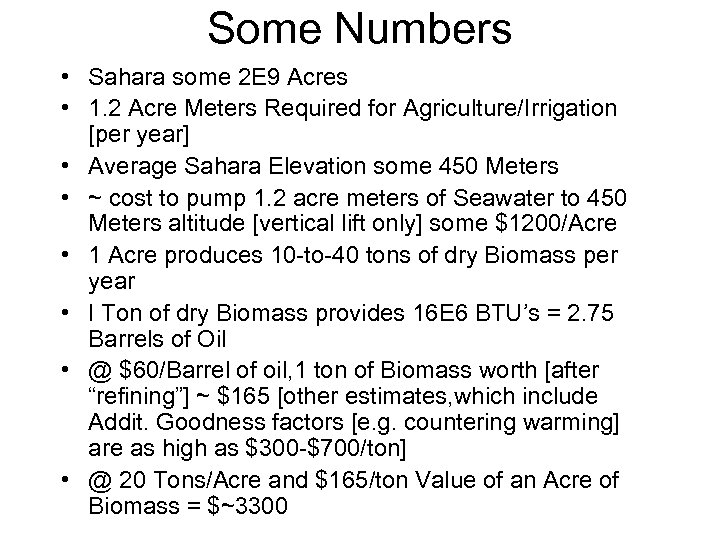 Some Numbers • Sahara some 2 E 9 Acres • 1. 2 Acre Meters Required for Agriculture/Irrigation [per year] • Average Sahara Elevation some 450 Meters • ~ cost to pump 1. 2 acre meters of Seawater to 450 Meters altitude [vertical lift only] some $1200/Acre • 1 Acre produces 10 -to-40 tons of dry Biomass per year • I Ton of dry Biomass provides 16 E 6 BTU’s = 2. 75 Barrels of Oil • @ $60/Barrel of oil, 1 ton of Biomass worth [after “refining”] ~ $165 [other estimates, which include Addit. Goodness factors [e. g. countering warming] are as high as $300 -$700/ton] • @ 20 Tons/Acre and $165/ton Value of an Acre of Biomass = $~3300
 Irrigation Influences Upon Rainfall • “Irrigation can Represent an Enormous Perturbation of the Regional Atmospheric Water and Heat Balance” • Cool, Wet Surface increases low level Atmospheric Instabilities, incites “Storms” • Various Studies Indicate - 18%-25% precipitation Increase [from only. 4 acre meter Irrigation] - Irrigation increased Rainfall by 91% - Irrigation and Vegetation changes are clear dominating factors with direct influence upon atmospheric water content
![Halophyte [Salt-Plant] Utilization [Per Yensen] • Patents issued for Halophyte Crop[s] [Genetics, Genomics] •](https://present5.com/presentation/525ecdedbf2d27e0f7eb0bc105e02638/image-29.jpg "Halophyte [Salt-Plant] Utilization [Per Yensen] • Patents issued for Halophyte Crop[s] [Genetics, Genomics] •") Halophyte [Salt-Plant] Utilization [Per Yensen] • Patents issued for Halophyte Crop[s] [Genetics, Genomics] • 10, 000+ “Natural” Halophyte Plants, 250 of these are potential “Staple” crops • Research ongoing on/for Halophilic [Salt. LOVING] Halophytes, The more salt the faster the growth… • Huge areas worldwide are already saltaffected [1 B Hectares] and another Billion Hectares overlie Saline Aquifers. • Over 100 halophyte plants now in “trials” for “Commercial” applications
Halophyte [Salt-Plant] Utilization [Per Yensen] • Patents issued for Halophyte Crop[s] [Genetics, Genomics] • 10, 000+ “Natural” Halophyte Plants, 250 of these are potential “Staple” crops • Research ongoing on/for Halophilic [Salt. LOVING] Halophytes, The more salt the faster the growth… • Huge areas worldwide are already saltaffected [1 B Hectares] and another Billion Hectares overlie Saline Aquifers. • Over 100 halophyte plants now in “trials” for “Commercial” applications
![[Sample] Countries with Saline AG projects • China • Mexico • Eritria • India](https://present5.com/presentation/525ecdedbf2d27e0f7eb0bc105e02638/image-30.jpg "[Sample] Countries with Saline AG projects • China • Mexico • Eritria • India") [Sample] Countries with Saline AG projects • China • Mexico • Eritria • India • Pakistan • Israel • Libya • Jordan • Tunisia - Current Status, Prototype Farms/Experiments for FOOD • • • Egypt Iran Morocco U. S. Saudi Arabia Syria UAE Kuwait Australia Sudan
[Sample] Countries with Saline AG projects • China • Mexico • Eritria • India • Pakistan • Israel • Libya • Jordan • Tunisia - Current Status, Prototype Farms/Experiments for FOOD • • • Egypt Iran Morocco U. S. Saudi Arabia Syria UAE Kuwait Australia Sudan
![Chinese Seawater AG Reporting • Genetically Modified [grown on “Beaches” using Seawater]: - Tomato](https://present5.com/presentation/525ecdedbf2d27e0f7eb0bc105e02638/image-31.jpg "Chinese Seawater AG Reporting • Genetically Modified [grown on “Beaches” using Seawater]: - Tomato") Chinese Seawater AG Reporting • Genetically Modified [grown on “Beaches” using Seawater]: - Tomato - Eggplant - Pepper - Wheat - Rice - Rapeseed
Chinese Seawater AG Reporting • Genetically Modified [grown on “Beaches” using Seawater]: - Tomato - Eggplant - Pepper - Wheat - Rice - Rapeseed
![The Potential[s] for enhanced [Halophyte] Plant Growth via Nano/Bio Technology thought to be Large,](https://present5.com/presentation/525ecdedbf2d27e0f7eb0bc105e02638/image-32.jpg "The Potential[s] for enhanced [Halophyte] Plant Growth via Nano/Bio Technology thought to be Large,") The Potential[s] for enhanced [Halophyte] Plant Growth via Nano/Bio Technology thought to be Large, 60% improvements thus far, ”Only Beginning” - An Example Requisite Capability Nitrogen Fixation [utilization/extraction from the air]
The Potential[s] for enhanced [Halophyte] Plant Growth via Nano/Bio Technology thought to be Large, 60% improvements thus far, ”Only Beginning” - An Example Requisite Capability Nitrogen Fixation [utilization/extraction from the air]
 On-going Research Areas • Enhanced Plant growth rates and enhanced “Salt-Loving” • Reduced water/nutrient Requirements • Irrigation Efficiency Improvements • Plant /Lifeform tailoring for specific Bio. Conversion/Refining Processes • ‘Safe”/’Contained” Saline/Seawater Irrigation Practices, Avoid-to-Obviate Fresh Aquifer Contamination
 Suggested North African/Sahara Biomass “Solution” Mix • Seawater Irrigation near “dry” and flattish Coastal areas • Saline irrigation where Saline Aquifers are available at Reasonable Pumping Depths • Seawater Irrigation inland where Economics appear feasible • Enhanced rainfall induced by Irrigation [the “Terraforming” aspect[s]]
 Terra. Forming -1 • Altering a Planetary Surface to make it suitable for Terrestrial life • Seawater AG for Biomass Energy can be of sufficient magnitude to qualify as Terra. Forming • Humans have long practiced “Anti. Terraforming” with neither plan nor prediction • It appears timely/necessary to attempt terraforming of North Africa but with both Plan and Prediction…
![Terra. Forming -2 [Raddatz and Knom] • The Biosphere/Surface vegetation plays a dominant role](https://present5.com/presentation/525ecdedbf2d27e0f7eb0bc105e02638/image-36.jpg "Terra. Forming -2 [Raddatz and Knom] • The Biosphere/Surface vegetation plays a dominant role") Terra. Forming -2 [Raddatz and Knom] • The Biosphere/Surface vegetation plays a dominant role on climate • Vegetation can affect continent-scale atmospheric motion[s], e. g. in North Africa • The interaction between Atmosphere and land cover in North Africa is HIGHLY NON-LINEAR…. .
Terra. Forming -2 [Raddatz and Knom] • The Biosphere/Surface vegetation plays a dominant role on climate • Vegetation can affect continent-scale atmospheric motion[s], e. g. in North Africa • The interaction between Atmosphere and land cover in North Africa is HIGHLY NON-LINEAR…. .
![[Obvious] Terraforming Modeling/Computation Requirements/Inputs • • Irrigated Land Area Type of Vegetation/Evaporation Rate Vegetation](https://present5.com/presentation/525ecdedbf2d27e0f7eb0bc105e02638/image-37.jpg "[Obvious] Terraforming Modeling/Computation Requirements/Inputs • • Irrigated Land Area Type of Vegetation/Evaporation Rate Vegetation") [Obvious] Terraforming Modeling/Computation Requirements/Inputs • • Irrigated Land Area Type of Vegetation/Evaporation Rate Vegetation Coverage Atmospheric Particulate details [allow cloud formation at. 1% super-saturation] • Utilization of both “Boundary Layer Meteorology and Global Circulation/Earth System Models • ETC……
[Obvious] Terraforming Modeling/Computation Requirements/Inputs • • Irrigated Land Area Type of Vegetation/Evaporation Rate Vegetation Coverage Atmospheric Particulate details [allow cloud formation at. 1% super-saturation] • Utilization of both “Boundary Layer Meteorology and Global Circulation/Earth System Models • ETC……
 Bottom Line Enablers/”Pull” Saline/Seawater Biomass Irrigation • Oil Prices now high enough [and going higher] to make the economics worth looking into [again] • H 2 Infrastructure Costs & Storage issues • Potential Halophyte Genomic improvements • Global Warming, Green Energy Requirements • Increasing shortages of Sweet water/”Arable Land” - Requires SERIOUS Forecasting……