 Скачать презентацию Seasonal Forecasting Alberto Arribas EUROBRISA Paraty March 2007
21af0731435ab3f44d82354b29662681.ppt
- Количество слайдов: 51



Seasonal Forecasting Alberto Arribas EUROBRISA. Paraty, March 2007 © Crown copyright Met Office
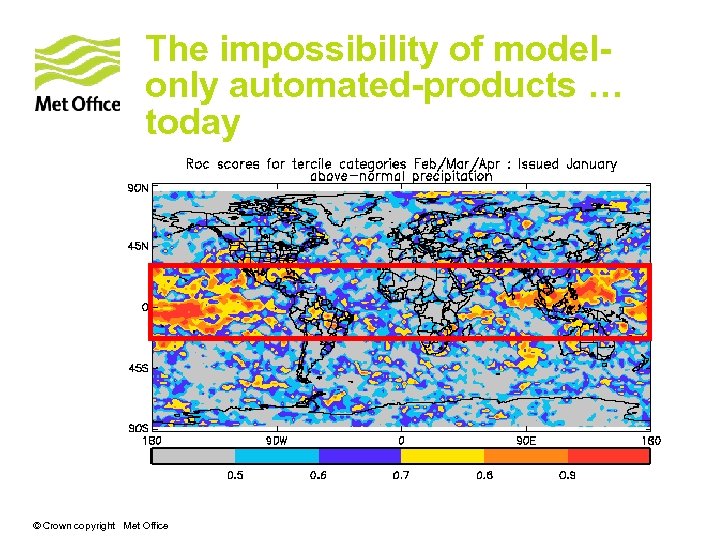
The impossibility of modelonly automated-products … today © Crown copyright Met Office
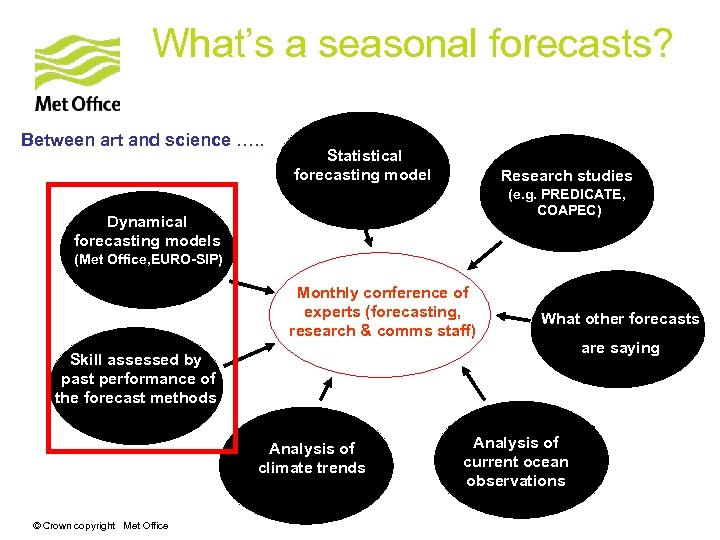
What’s a seasonal forecasts? Between art and science …. . Statistical forecasting model Research studies (e. g. PREDICATE, COAPEC) Dynamical forecasting models (Met Office, EURO-SIP) Monthly conference of experts (forecasting, research & comms staff) What other forecasts Skill assessed by past performance of the forecast methods Analysis of climate trends © Crown copyright Met Office Analysis of current ocean observations are saying
What’s a seasonal forecasts? • Based around the view that seasonal-to-decadal variability has: • a few large scale patterns • is a fluid-dynamical jigsaw puzzle with a few key pieces • Mechanisms (models and obs): predictability! • Input to operational forecasts © Crown copyright Met Office
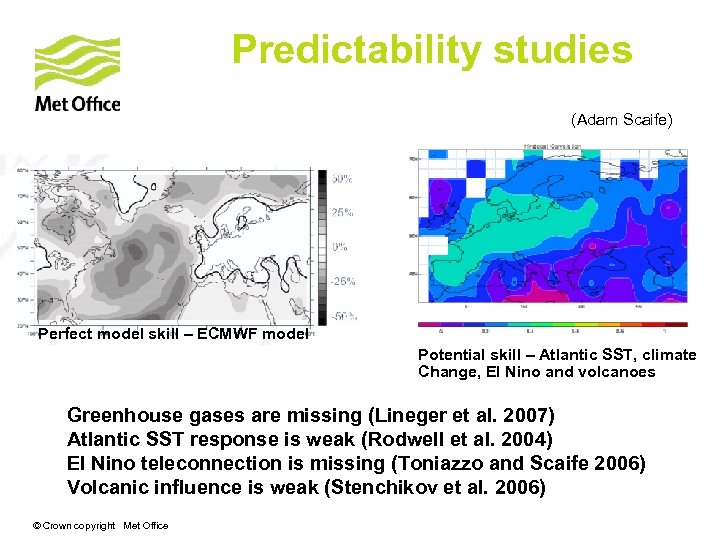
Predictability studies (Adam Scaife) Perfect model skill – ECMWF model Potential skill – Atlantic SST, climate Change, El Nino and volcanoes Greenhouse gases are missing (Lineger et al. 2007) Atlantic SST response is weak (Rodwell et al. 2004) El Nino teleconnection is missing (Toniazzo and Scaife 2006) Volcanic influence is weak (Stenchikov et al. 2006) © Crown copyright Met Office
Glo. Sea 4, the new Met Office Seasonal Forecasting System • Expected to become operational in April 2009 and later to be integrated with our decadal system • Main drivers: • Role of seasonal forecasts as adaptation tool to climate change • Bridge between NWP – Climate to facilitate model development SCIENTIFIC CHALLENGES © Crown copyright Met Office
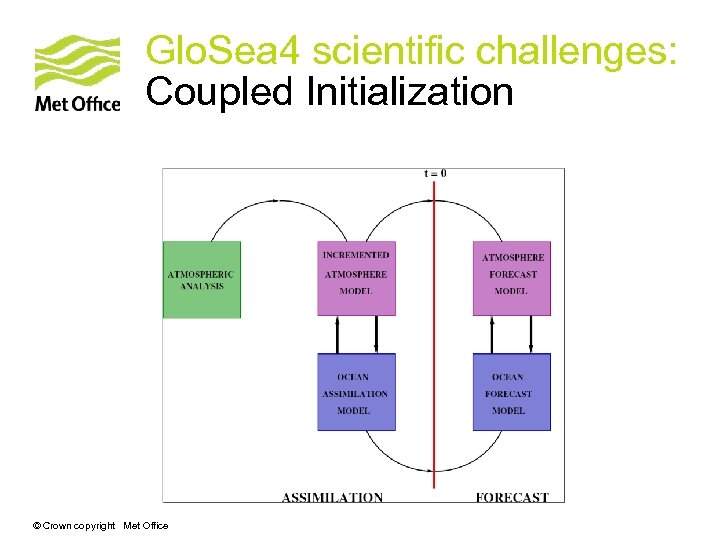
Glo. Sea 4 scientific challenges: Coupled Initialization © Crown copyright Met Office
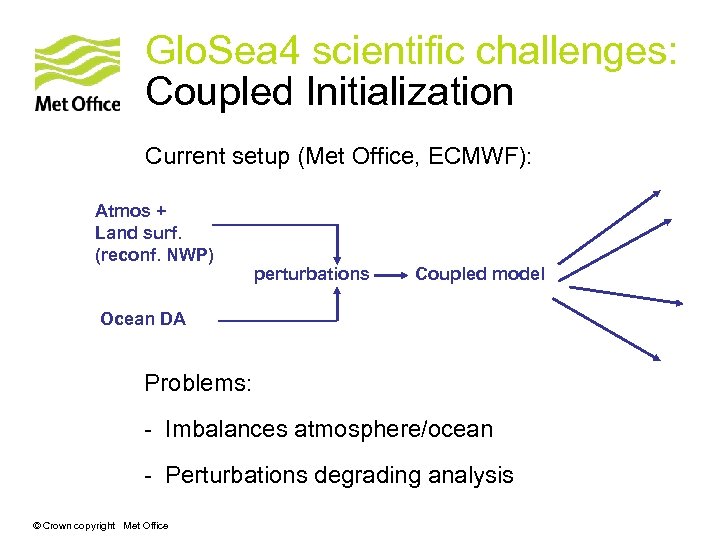
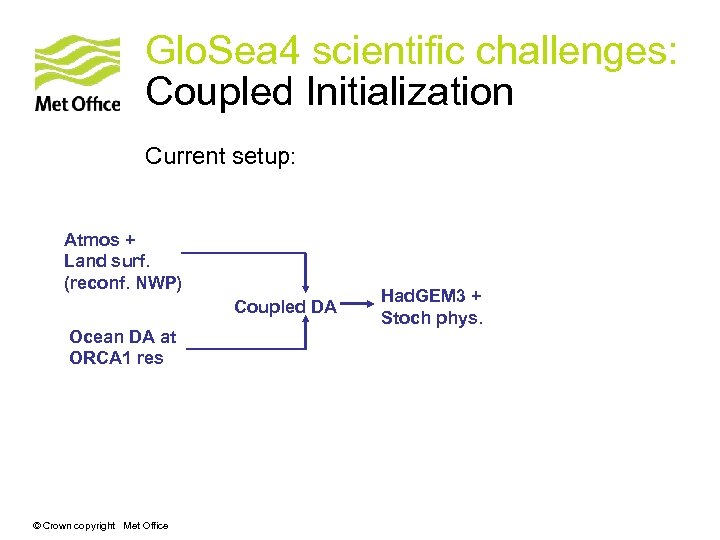
Glo. Sea 4 scientific challenges: Coupled Initialization Current setup (Met Office, ECMWF): Atmos + Land surf. (reconf. NWP) perturbations Coupled model Ocean DA Problems: - Imbalances atmosphere/ocean - Perturbations degrading analysis © Crown copyright Met Office
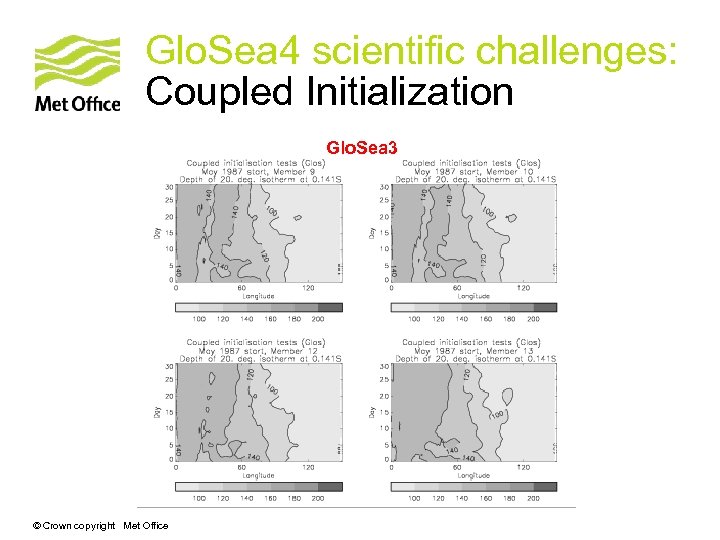
Glo. Sea 4 scientific challenges: Coupled Initialization Glo. Sea 3 © Crown copyright Met Office
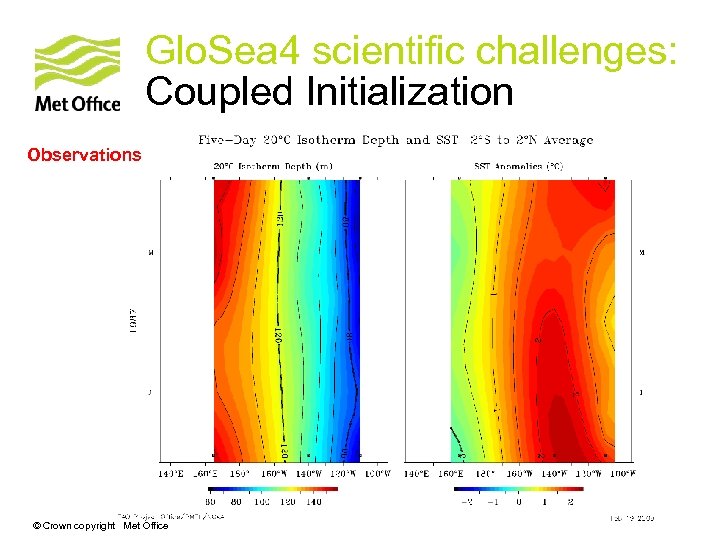
Glo. Sea 4 scientific challenges: Coupled Initialization Observations © Crown copyright Met Office
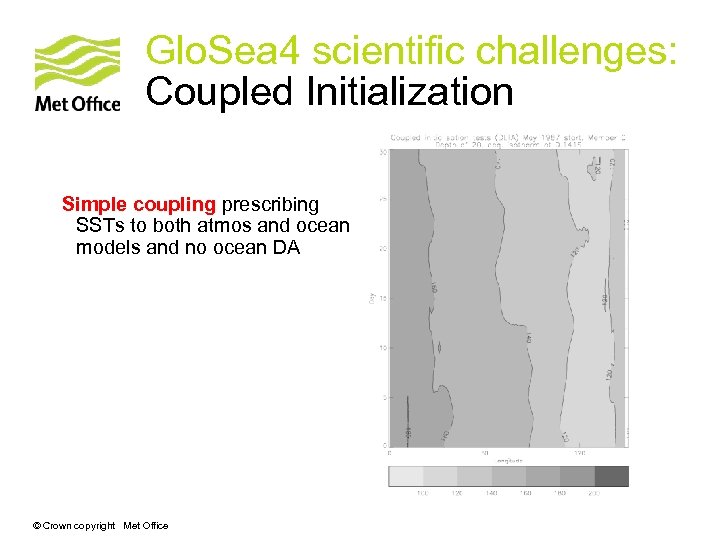
Glo. Sea 4 scientific challenges: Coupled Initialization Simple coupling prescribing SSTs to both atmos and ocean models and no ocean DA © Crown copyright Met Office
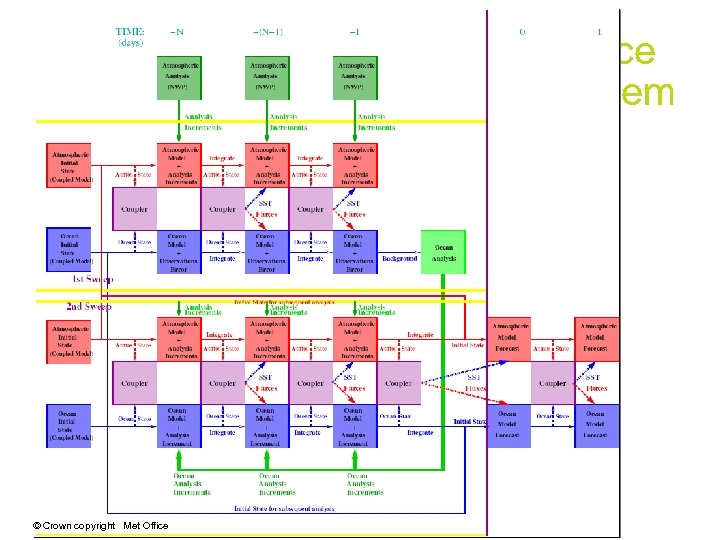
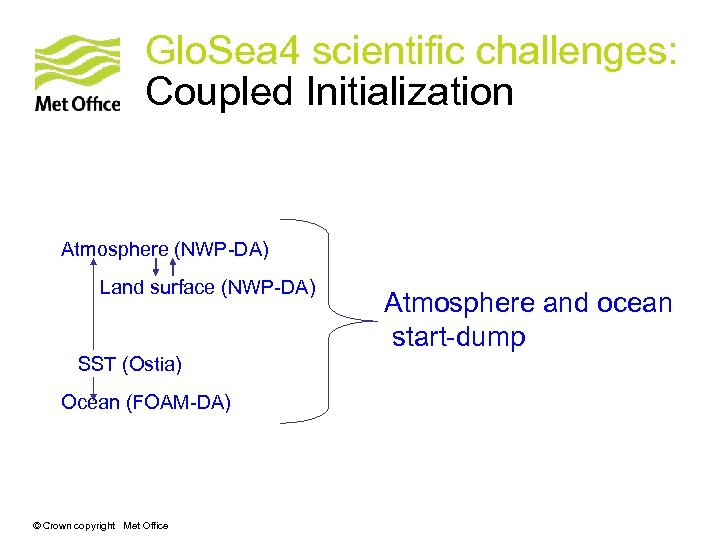
Glo. Sea 4 scientific challenges: Coupled Initialization • Ocean, ice and atmosphere to see coupled model fluxes during assimilation period (no mismatch between NWP and coupled forecast fluxes) • Background state for assimilation will be a coupled model state • Eliminates initial shocks: Coupled model should be in balanced state at end of initialization process. © Crown copyright Met Office
Glo. Sea 4 scientific challenges: Perturbations • Problems of the current perturbations (to SST and wind stress) used at ECMWF and Met Office: • Not relevant for extra tropics • Not Flow dependant • Degrading analysis © Crown copyright Met Office
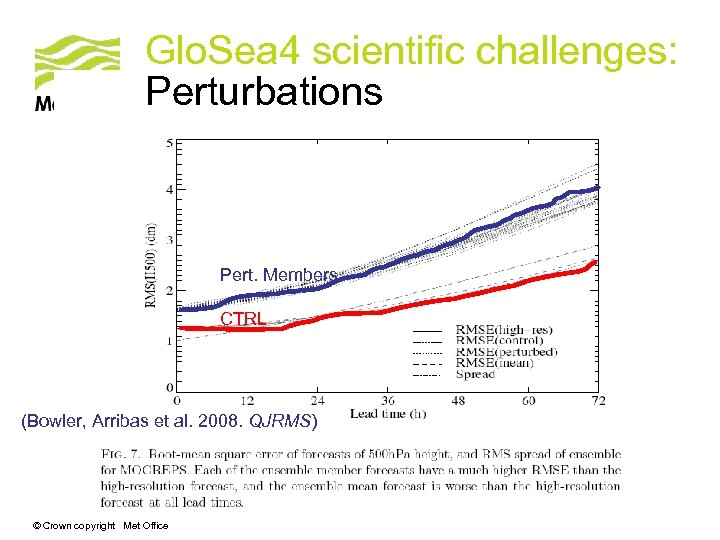
Glo. Sea 4 scientific challenges: Perturbations Pert. Members CTRL (Bowler, Arribas et al. 2008. QJRMS) © Crown copyright Met Office
Glo. Sea 4 scientific challenges: Perturbations • Problems of the current perturbations (to SST and wind stress) used at ECMWF and Met Office: • Not relevant for extra tropics • Not Flow dependant • Degrading analysis Glo. Sea 4 will use a lagged approach (not perturbing a central analysis) © Crown copyright Met Office
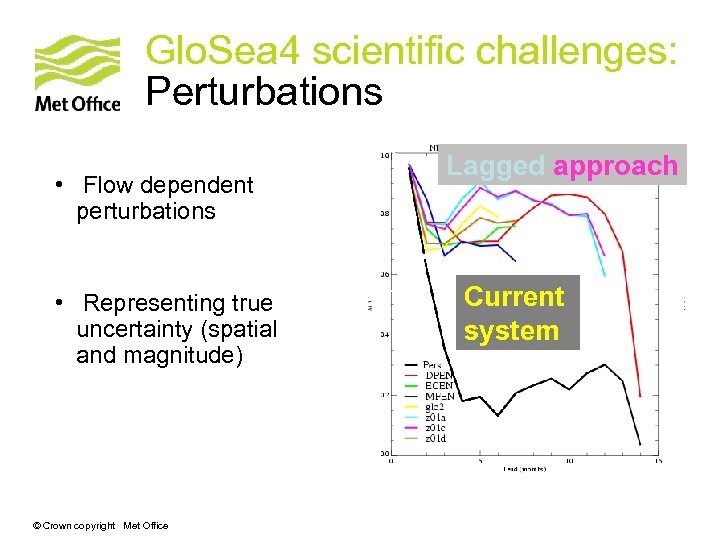
Glo. Sea 4 scientific challenges: Perturbations • Flow dependent perturbations • Representing true uncertainty (spatial and magnitude) © Crown copyright Met Office Lagged approach Current system
Glo. Sea 4 scientific challenges: Model development and uncertainties © Crown copyright Met Office
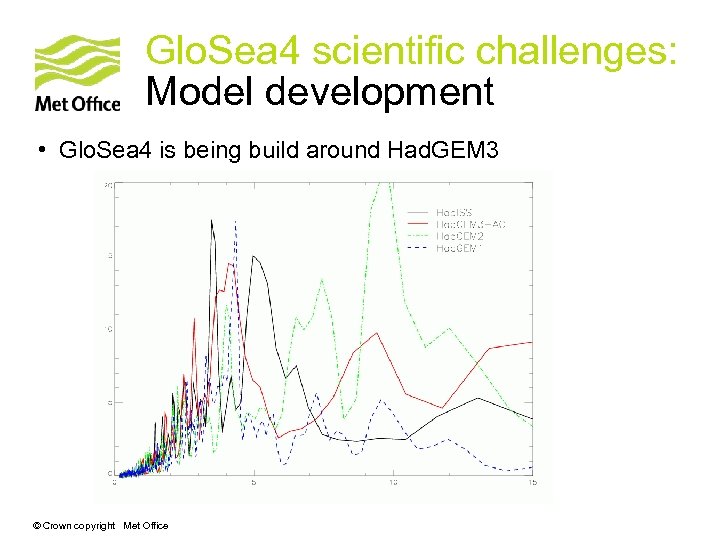
Glo. Sea 4 scientific challenges: Model development • Glo. Sea 4 is being build around Had. GEM 3 © Crown copyright Met Office
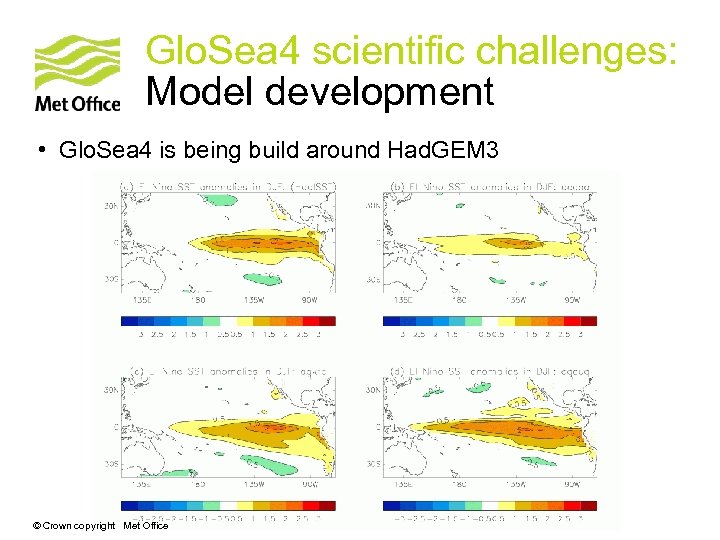
Glo. Sea 4 scientific challenges: Model development • Glo. Sea 4 is being build around Had. GEM 3 © Crown copyright Met Office
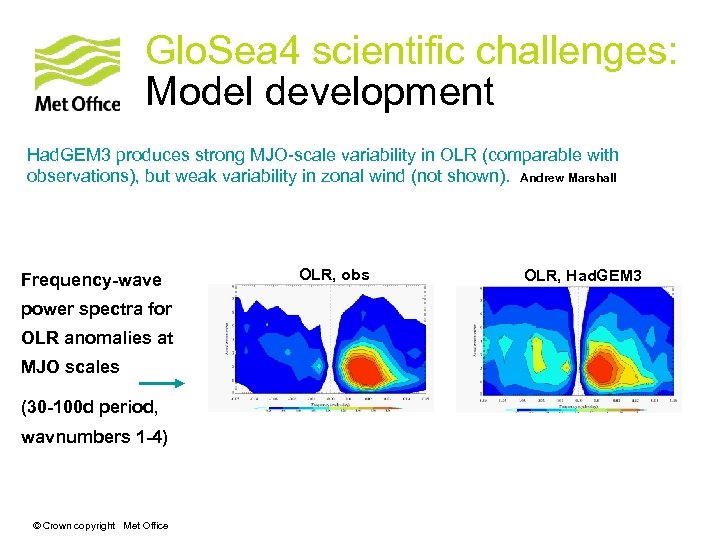
Glo. Sea 4 scientific challenges: Model development Had. GEM 3 produces strong MJO-scale variability in OLR (comparable with observations), but weak variability in zonal wind (not shown). Andrew Marshall Frequency-wave power spectra for OLR anomalies at MJO scales (30 -100 d period, wavnumbers 1 -4) © Crown copyright Met Office OLR, obs OLR, Had. GEM 3
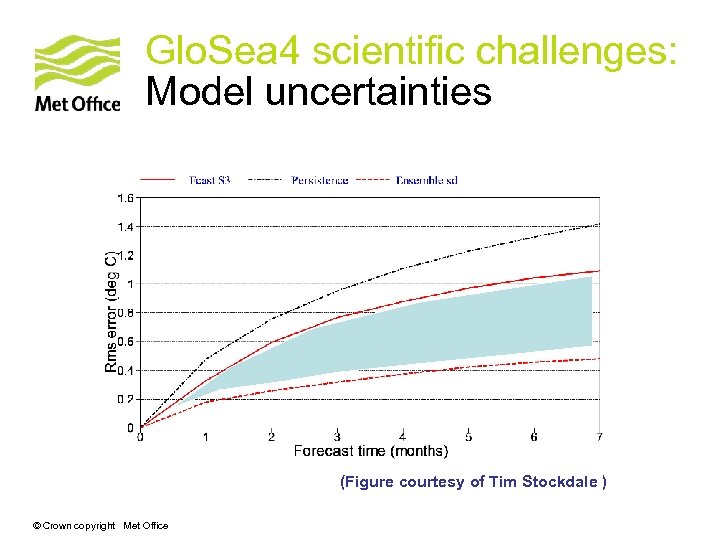
Glo. Sea 4 scientific challenges: Model uncertainties (Figure courtesy of Tim Stockdale ) © Crown copyright Met Office
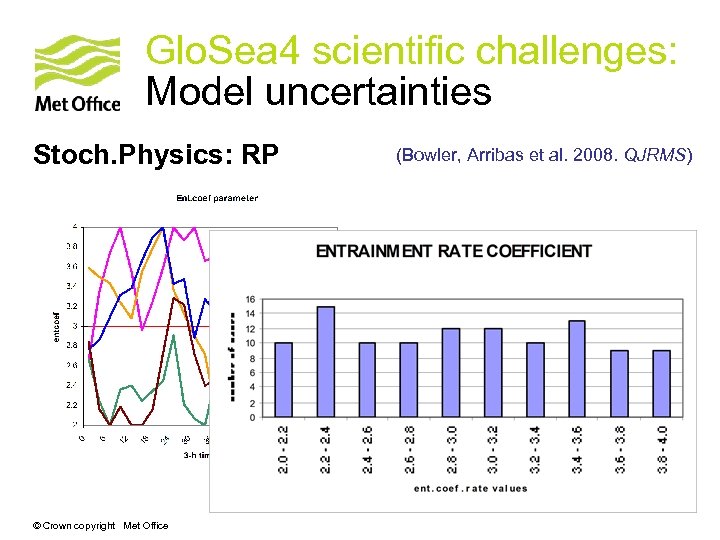
Glo. Sea 4 scientific challenges: Model uncertainties Stoch. Physics: RP © Crown copyright Met Office (Bowler, Arribas et al. 2008. QJRMS)
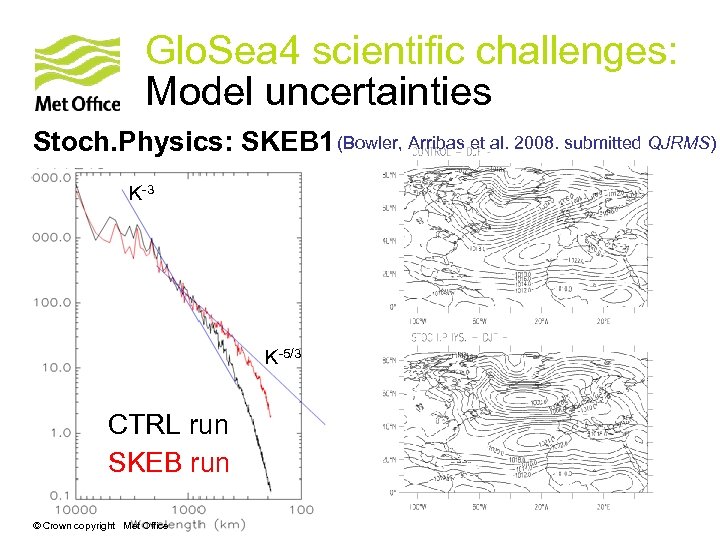
Glo. Sea 4 scientific challenges: Model uncertainties Stoch. Physics: SKEB 1 (Bowler, Arribas et al. 2008. submitted QJRMS) K-3 K-5/3 §CTRL run §SKEB run © Crown copyright Met Office
Glo. Sea 4 scientific challenges: Post-processing © Crown copyright Met Office
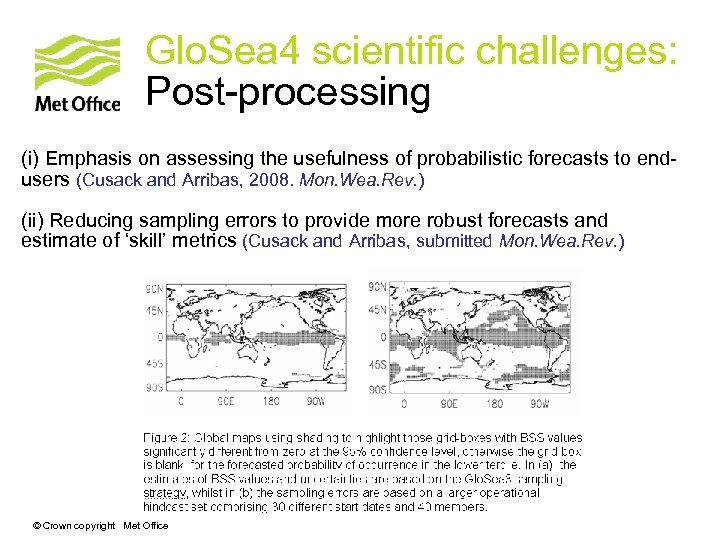
Glo. Sea 4 scientific challenges: Post-processing (i) Emphasis on assessing the usefulness of probabilistic forecasts to endusers (Cusack and Arribas, 2008. Mon. Wea. Rev. ) (ii) Reducing sampling errors to provide more robust forecasts and estimate of ‘skill’ metrics (Cusack and Arribas, submitted Mon. Wea. Rev. ) © Crown copyright Met Office
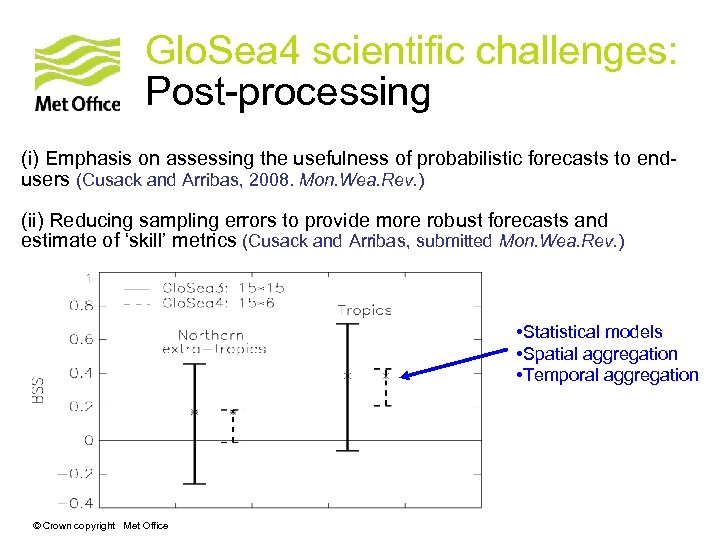
Glo. Sea 4 scientific challenges: Post-processing (i) Emphasis on assessing the usefulness of probabilistic forecasts to endusers (Cusack and Arribas, 2008. Mon. Wea. Rev. ) (ii) Reducing sampling errors to provide more robust forecasts and estimate of ‘skill’ metrics (Cusack and Arribas, submitted Mon. Wea. Rev. ) • Statistical models • Spatial aggregation • Temporal aggregation © Crown copyright Met Office
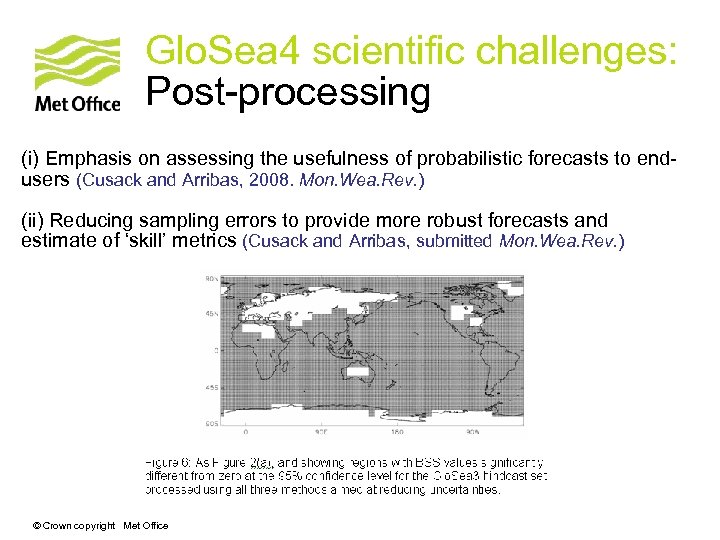
Glo. Sea 4 scientific challenges: Post-processing (i) Emphasis on assessing the usefulness of probabilistic forecasts to endusers (Cusack and Arribas, 2008. Mon. Wea. Rev. ) (ii) Reducing sampling errors to provide more robust forecasts and estimate of ‘skill’ metrics (Cusack and Arribas, submitted Mon. Wea. Rev. ) © Crown copyright Met Office
Glo. Sea 4 scientific challenges: Visualization/Communication © Crown copyright Met Office
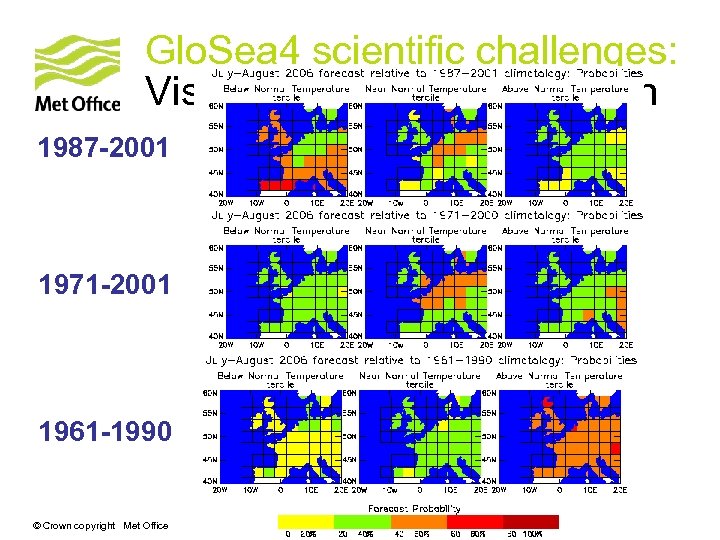
Glo. Sea 4 scientific challenges: Visualization/Communication 1987 -2001 1971 -2001 1961 -1990 © Crown copyright Met Office
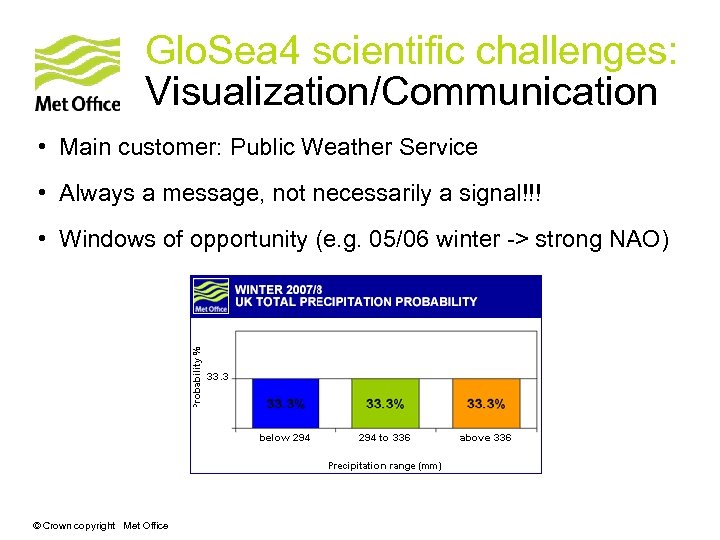
Glo. Sea 4 scientific challenges: Visualization/Communication • Main customer: Public Weather Service • Always a message, not necessarily a signal!!! • Windows of opportunity (e. g. 05/06 winter -> strong NAO) © Crown copyright Met Office
The need to combine forecasts with additional data …. © Crown copyright 2004 Page 31
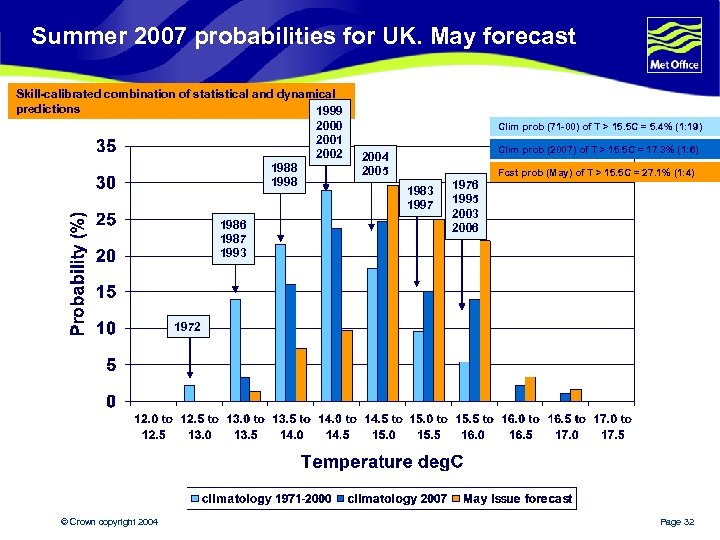
Summer 2007 probabilities for UK. May forecast Skill-calibrated combination of statistical and dynamical predictions 1999 2000 2001 2002 1988 1998 1986 1987 1993 Clim prob (71 -00) of T > 15. 5 C = 5. 4% (1: 19) Clim prob (2007) of T > 15. 5 C = 17. 3% (1: 6) 2004 2005 Fcst prob (May) of T > 15. 5 C = 27. 1% (1: 4) 1983 1997 1976 1995 2003 2006 1972 © Crown copyright 2004 Page 32
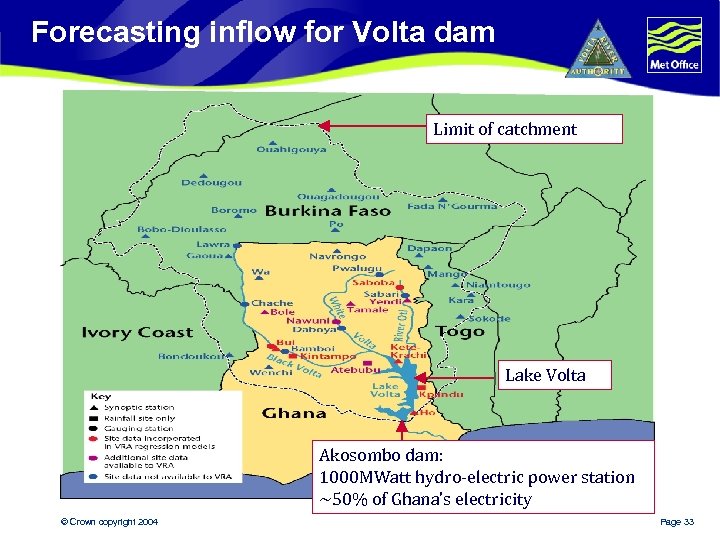
Forecasting inflow for Volta dam Limit of catchment Lake Volta Akosombo dam: 1000 MWatt hydro-electric power station ~50% of Ghana’s electricity © Crown copyright 2004 Page 33
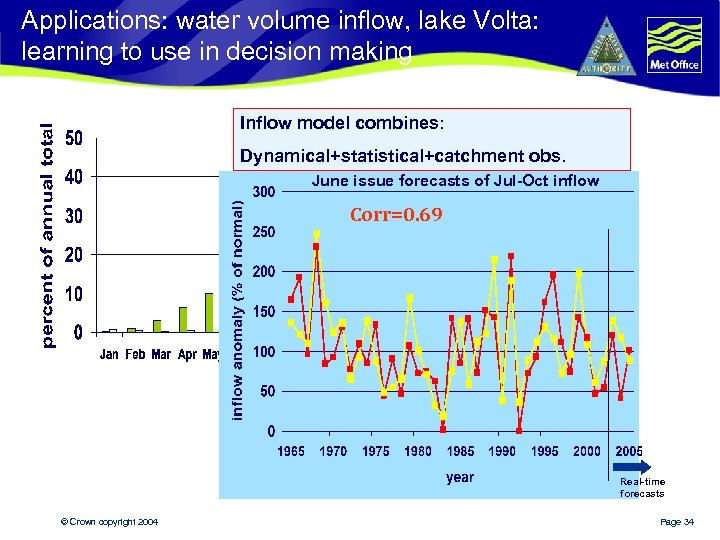
Applications: water volume inflow, lake Volta: learning to use in decision making Inflow model combines: Dynamical+statistical+catchment obs. June issue forecasts of Jul-Oct inflow Corr=0. 69 Real-time forecasts © Crown copyright 2004 Page 34
Page 35
Thanks / Obrigado / Gracias All questions welcome © Crown copyright Met Office
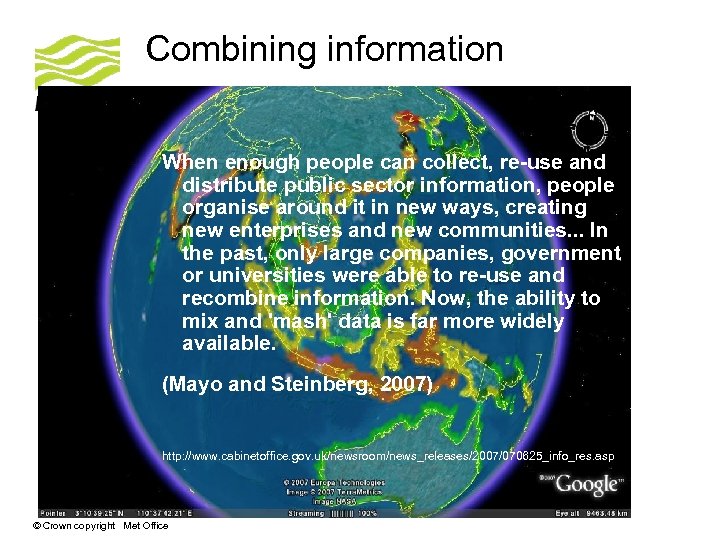
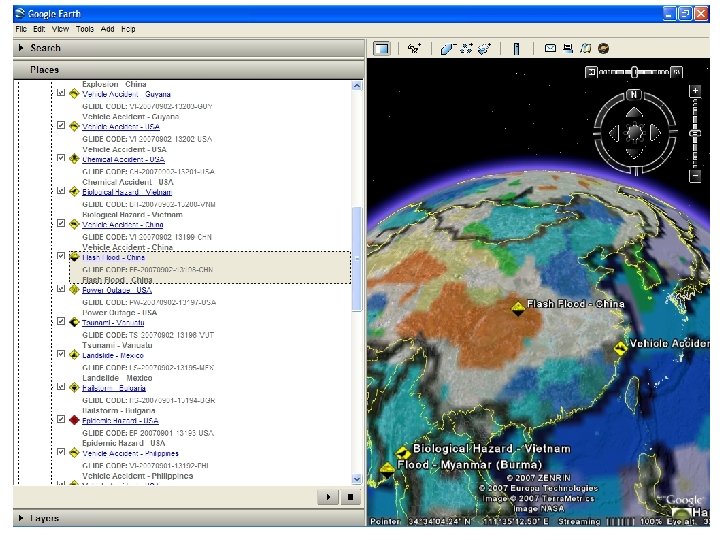
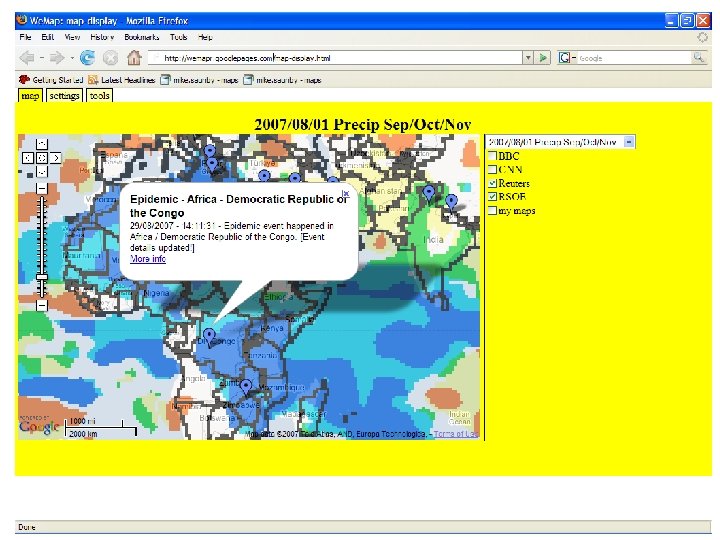
Combining information When enough people can collect, re-use and distribute public sector information, people organise around it in new ways, creating new enterprises and new communities. . . In the past, only large companies, government or universities were able to re-use and recombine information. Now, the ability to mix and 'mash' data is far more widely available. (Mayo and Steinberg, 2007) http: //www. cabinetoffice. gov. uk/newsroom/news_releases/2007/070625_info_res. asp © Crown copyright Met Office
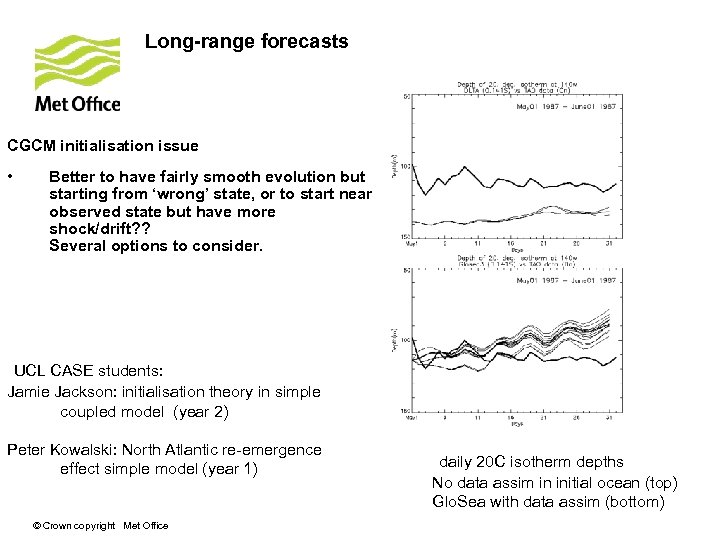
Long-range forecasts CGCM initialisation issue • Better to have fairly smooth evolution but starting from ‘wrong’ state, or to start near observed state but have more shock/drift? ? Several options to consider. UCL CASE students: Jamie Jackson: initialisation theory in simple coupled model (year 2) Peter Kowalski: North Atlantic re-emergence effect simple model (year 1) © Crown copyright Met Office daily 20 C isotherm depths No data assim in initial ocean (top) Glo. Sea with data assim (bottom)
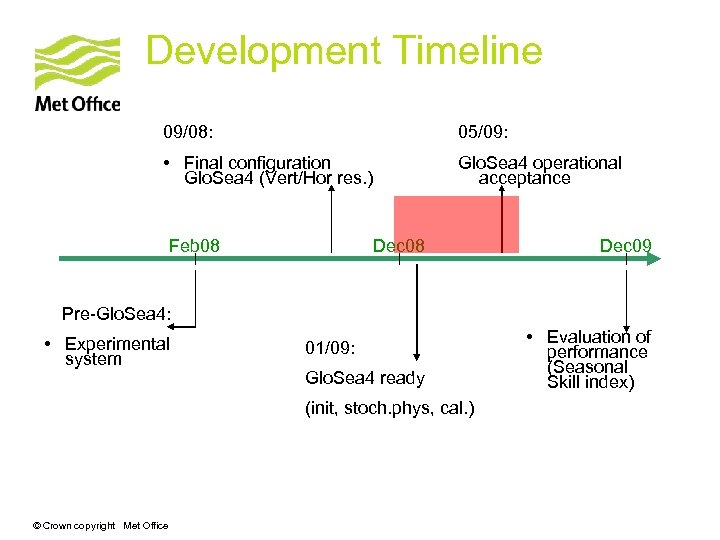
Development Timeline 09/08: 05/09: • Final configuration Glo. Sea 4 (Vert/Hor res. ) Glo. Sea 4 operational acceptance Feb 08 Dec 09 Glo. Sea 4 ready • Evaluation of performance (Seasonal Skill index) Pre-Glo. Sea 4: • Experimental system 01/09: (init, stoch. phys, cal. ) © Crown copyright Met Office
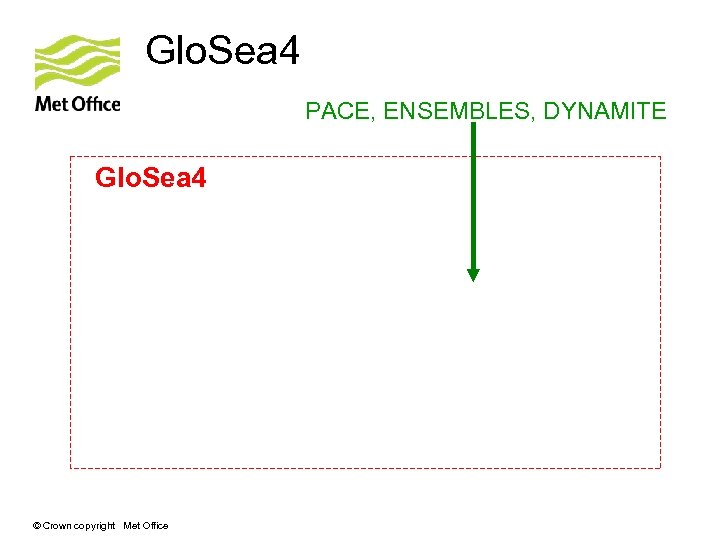
Glo. Sea 4 PACE, ENSEMBLES, DYNAMITE (Stephen, Anna) Initialization + IC unc. (Drew, Margaret) Model dev. Model unc. (Alberto) Calibration Glo. Sea 4 (Maff) (Stephen, Margaret) © Crown copyright Met Office
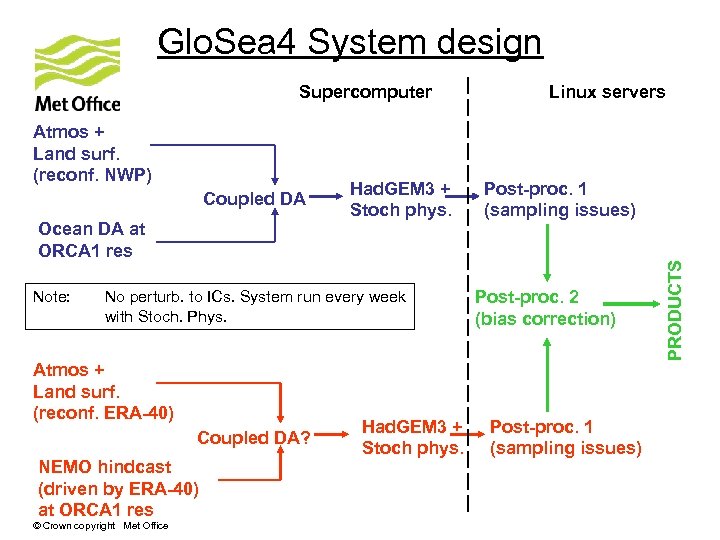
Glo. Sea 4 System design Atmos + Land surf. (reconf. NWP) Coupled DA Ocean DA at ORCA 1 res Note: Had. GEM 3 + Stoch phys. No perturb. to ICs. System run every week with Stoch. Phys. Atmos + Land surf. (reconf. ERA-40) Coupled DA? NEMO hindcast (driven by ERA-40) at ORCA 1 res © Crown copyright Met Office Had. GEM 3 + Stoch phys. Linux servers Post-proc. 1 (sampling issues) Post-proc. 2 (bias correction) Post-proc. 1 (sampling issues) PRODUCTS Supercomputer
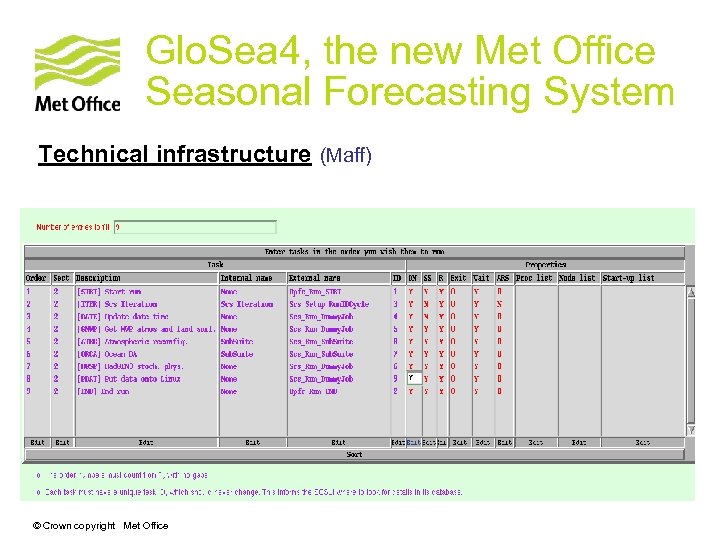
Glo. Sea 4, the new Met Office Seasonal Forecasting System Technical infrastructure (Maff) • Design considerations: • As smooth as possible to transfer between research and operations. (e. g. creative use of SCS task filtering. ) UI changes kept to a minimum • Mimic operational file systems in research mode • Self-correcting in event of failure, where possible • Scripting kept out of SCS: can then be properly version controlled • Use of automatic documentation tools, and clear user/implementation guides: anyone can easily find their way around the system • FCM repository: easy control of script versions passed to operations. Branching => bug fixing and suite development. Also issue tracking. © Crown copyright Met Office
Glo. Sea 4 scientific challenges: Coupled Initialization © Crown copyright Met Office
Glo. Sea 4, the new Met Office Seasonal Forecasting System Technical infrastructure (Maff) © Crown copyright Met Office
Glo. Sea 4, the new Met Office Seasonal Forecasting System Coupled atmosphere/ocean initialization © Crown copyright Met Office
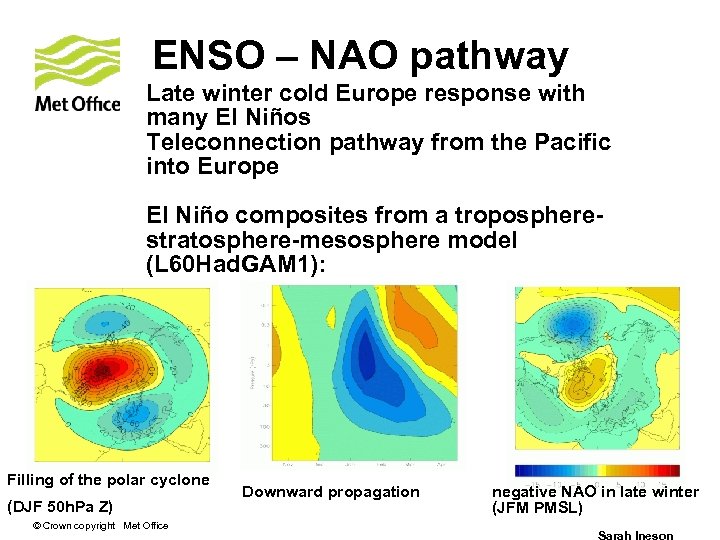
ENSO – NAO pathway Late winter cold Europe response with many El Niños Teleconnection pathway from the Pacific into Europe El Niño composites from a tropospherestratosphere-mesosphere model (L 60 Had. GAM 1): Filling of the polar cyclone (DJF 50 h. Pa Z) © Crown copyright Met Office Downward propagation negative NAO in late winter (JFM PMSL) Sarah Ineson
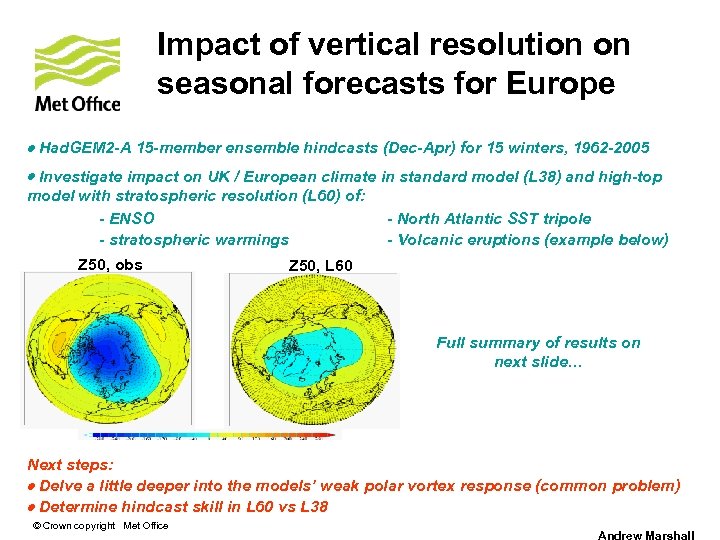
Impact of vertical resolution on seasonal forecasts for Europe Had. GEM 2 -A 15 -member ensemble hindcasts (Dec-Apr) for 15 winters, 1962 -2005 Investigate impact on UK / European climate in standard model (L 38) and high-top model with stratospheric resolution (L 60) of: - ENSO - stratospheric warmings Z 50, obs - North Atlantic SST tripole - Volcanic eruptions (example below) Z 50, L 60 Full summary of results on next slide… Next steps: Delve a little deeper into the models’ weak polar vortex response (common problem) Determine hindcast skill in L 60 vs L 38 © Crown copyright Met Office Andrew Marshall
Glo. Sea 4 scientific challenges: Coupled Initialization Current setup: Atmos + Land surf. (reconf. NWP) Coupled DA Ocean DA at ORCA 1 res © Crown copyright Met Office Had. GEM 3 + Stoch phys.
Glo. Sea 4 scientific challenges: Coupled Initialization Atmosphere (NWP-DA) Land surface (NWP-DA) SST (Ostia) Ocean (FOAM-DA) © Crown copyright Met Office Atmosphere and ocean start-dump
Скачать презентацию Seasonal Forecasting Alberto Arribas EUROBRISA Paraty March 2007
21af0731435ab3f44d82354b29662681.ppt