


 Скачать презентацию Searching for Quantum Gravity with AMANDA-II and Ice
5a585fe36348b52f99a6c2c37acb0d19.ppt
- Количество слайдов: 24
 Searching for Quantum Gravity with AMANDA-II and Ice. Cube John Kelley November 11, 2008 PANIC’ 08, Eilat, Israel
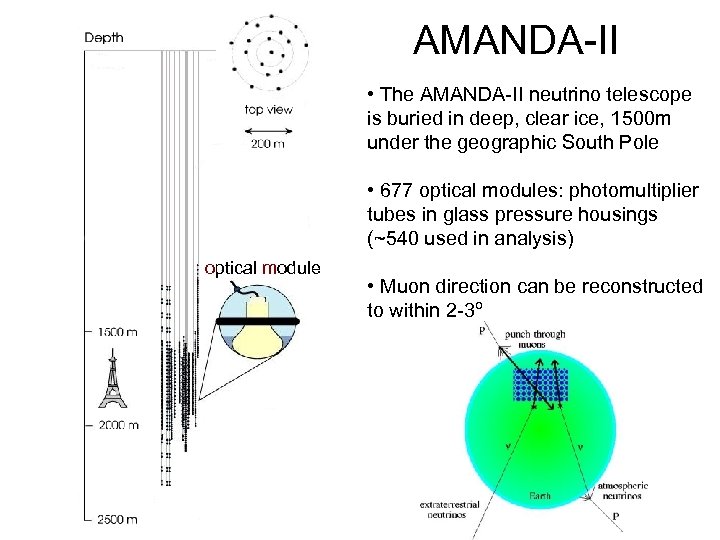 AMANDA-II • The AMANDA-II neutrino telescope is buried in deep, clear ice, 1500 m under the geographic South Pole • 677 optical modules: photomultiplier tubes in glass pressure housings (~540 used in analysis) optical module • Muon direction can be reconstructed to within 2 -3º
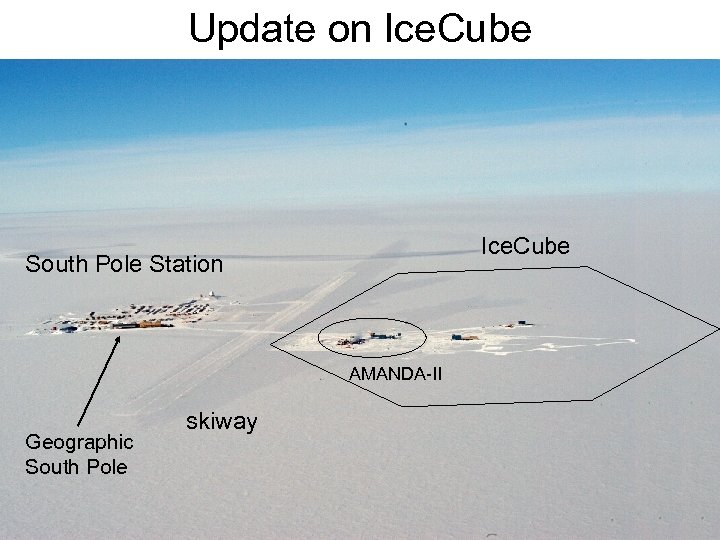
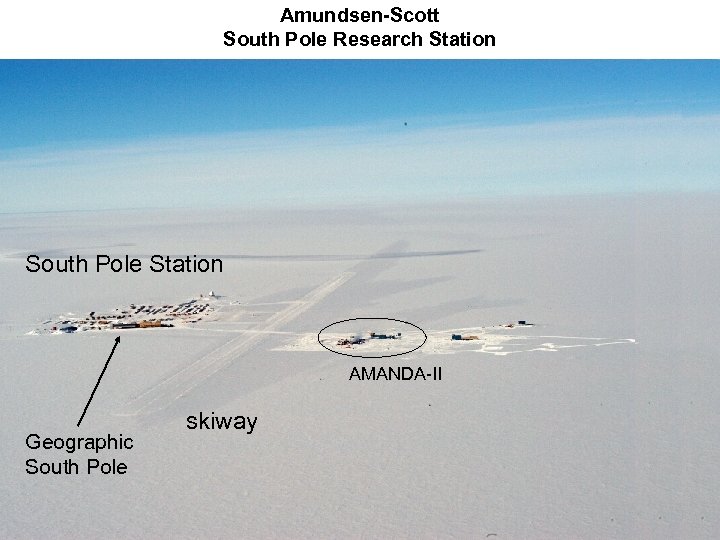 Amundsen-Scott South Pole Research Station South Pole Station AMANDA-II Geographic South Pole skiway
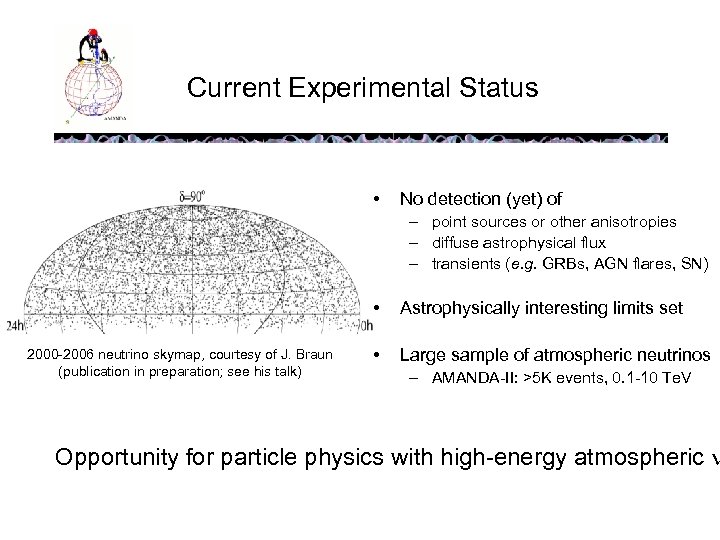 Current Experimental Status • No detection (yet) of – point sources or other anisotropies – diffuse astrophysical flux – transients (e. g. GRBs, AGN flares, SN) • 2000 -2006 neutrino skymap, courtesy of J. Braun (publication in preparation; see his talk) Astrophysically interesting limits set • Large sample of atmospheric neutrinos – AMANDA-II: >5 K events, 0. 1 -10 Te. V Opportunity for particle physics with high-energy atmospheric
 New Physics with Neutrinos? • Neutrinos are already post-Standard Model (massive) • For E > 100 Ge. V and m < 1 e. V, Lorentz > 1011 • Oscillations are a sensitive quantum-mechanical interferometer — small shifts in energy can lead to large changes in flavor content Eidelman et al. : “It would be surprising if further surprises were not in store…”
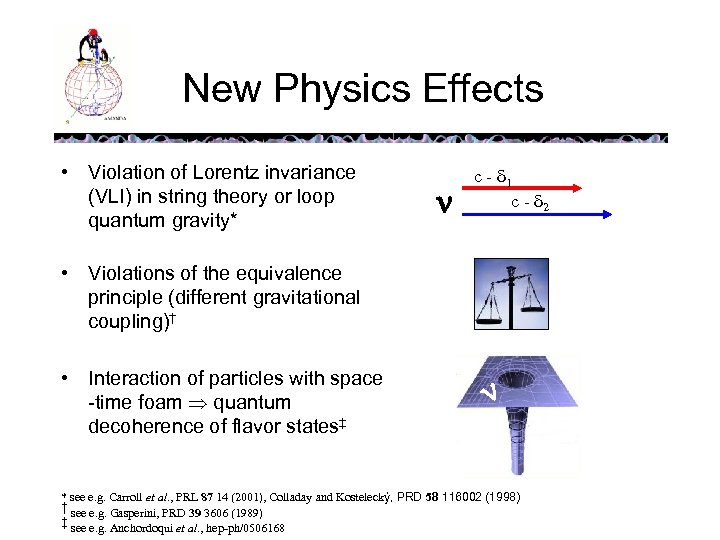 New Physics Effects • Violation of Lorentz invariance (VLI) in string theory or loop quantum gravity* c - 1 c - 2 • Violations of the equivalence principle (different gravitational coupling)† • Interaction of particles with space -time foam quantum decoherence of flavor states‡ * see e. g. Carroll et al. , PRL 87 14 (2001), Colladay and Kostelecký, PRD 58 116002 (1998) † see e. g. Gasperini, PRD 39 3606 (1989) ‡ see e. g. Anchordoqui et al. , hep-ph/0506168
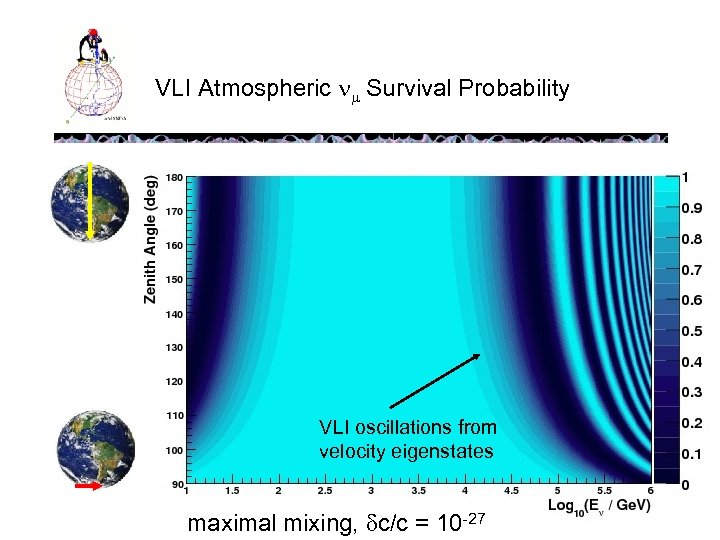 VLI Atmospheric Survival Probability VLI oscillations from velocity eigenstates maximal mixing, c/c = 10 -27
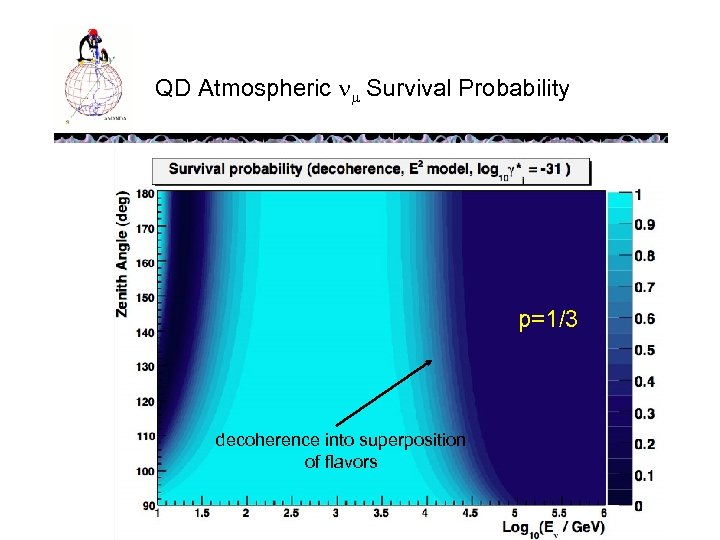 QD Atmospheric Survival Probability p=1/3 decoherence into superposition of flavors
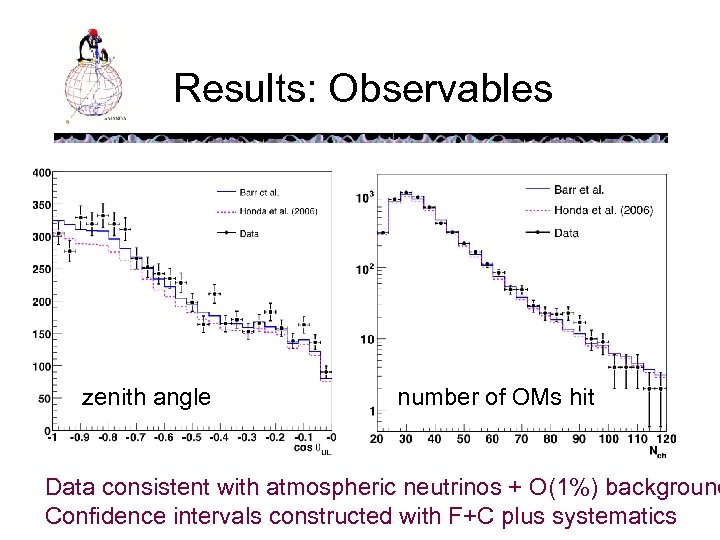 Results: Observables zenith angle number of OMs hit Data consistent with atmospheric neutrinos + O(1%) background Confidence intervals constructed with F+C plus systematics
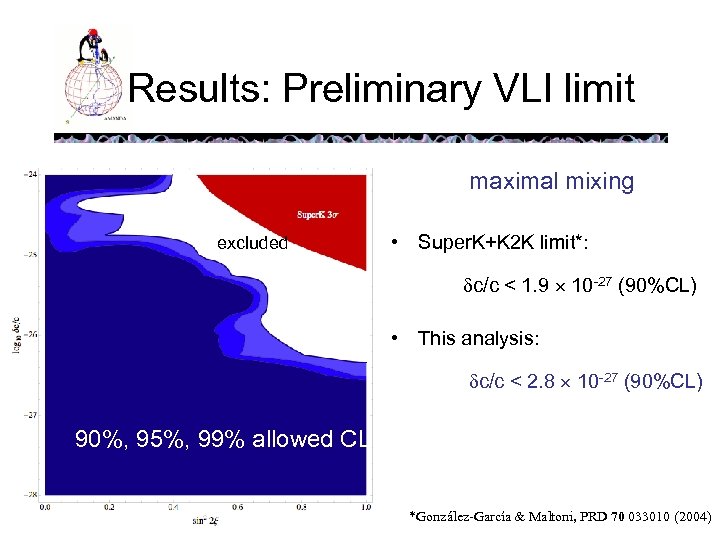 Results: Preliminary VLI limit maximal mixing excluded • Super. K+K 2 K limit*: c/c < 1. 9 10 -27 (90%CL) • This analysis: c/c < 2. 8 10 -27 (90%CL) 90%, 95%, 99% allowed CL *González-García & Maltoni, PRD 70 033010 (2004)
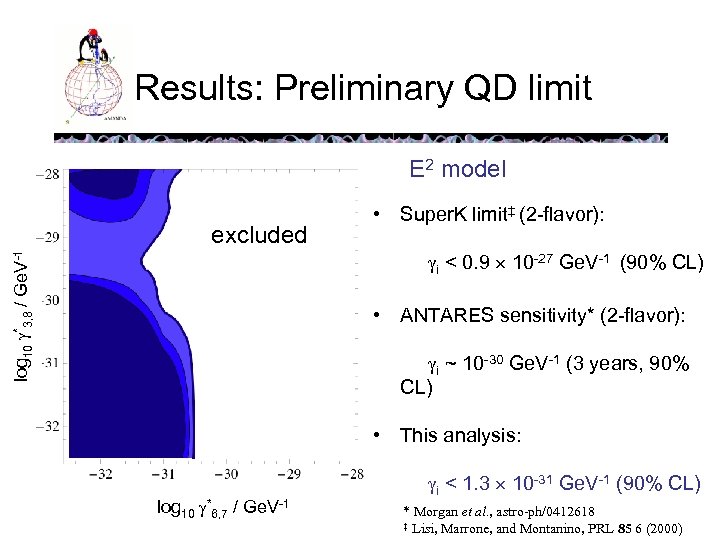 Results: Preliminary QD limit E 2 model excluded • Super. K limit‡ (2 -flavor): log 10 *3, 8 / Ge. V-1 i < 0. 9 10 -27 Ge. V-1 (90% CL) • ANTARES sensitivity* (2 -flavor): i ~ 10 -30 Ge. V-1 (3 years, 90% CL) • This analysis: best fit log 10 *6, 7 / Ge. V-1 i < 1. 3 10 -31 Ge. V-1 (90% CL) * Morgan et al. , astro-ph/0412618 ‡ Lisi, Marrone, and Montanino, PRL 85 6 (2000)
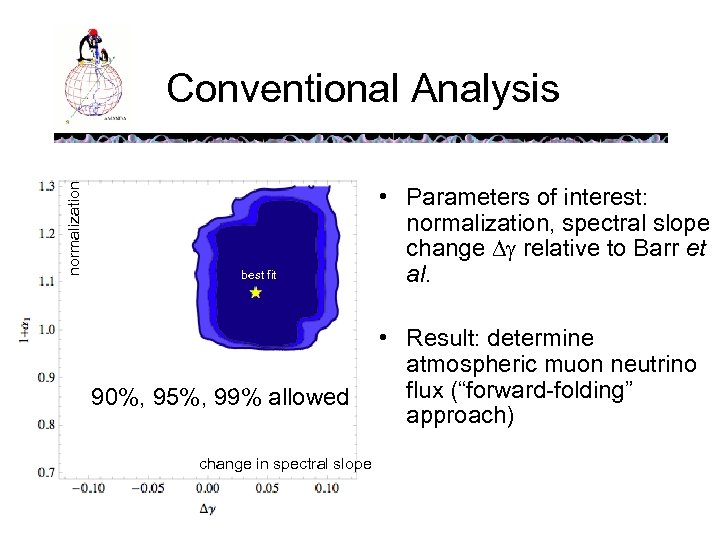 normalization Conventional Analysis best fit 90%, 95%, 99% allowed change in spectral slope • Parameters of interest: normalization, spectral slope change relative to Barr et al. • Result: determine atmospheric muon neutrino flux (“forward-folding” approach)
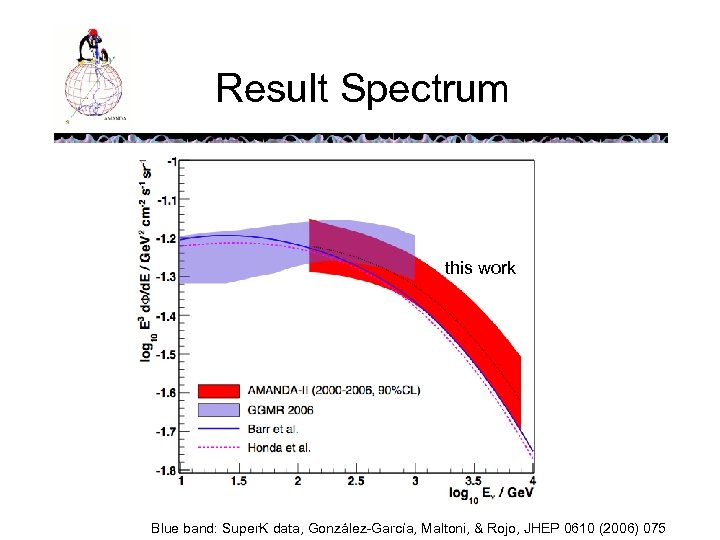 Result Spectrum this work Blue band: Super. K data, González-García, Maltoni, & Rojo, JHEP 0610 (2006) 075
 Update on Ice. Cube South Pole Station AMANDA-II Geographic South Pole skiway
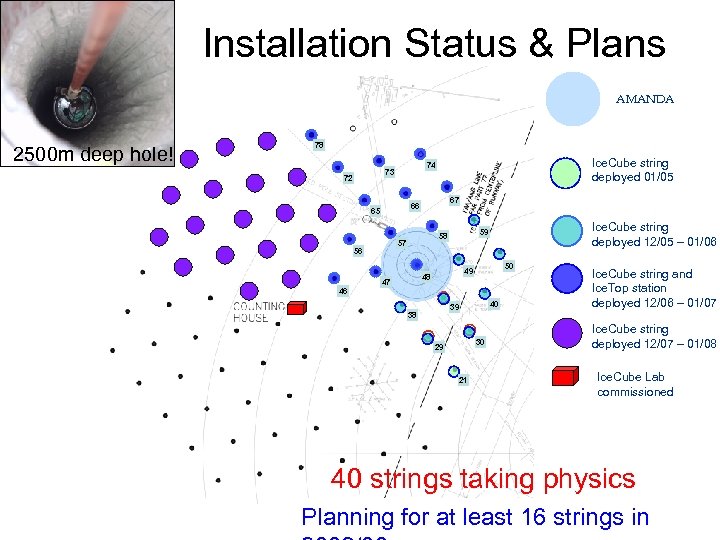 Installation Status & Plans AMANDA 2500 m deep hole! 78 72 67 66 65 50 49 48 47 Ice. Cube string deployed 12/05 – 01/06 59 58 57 56 46 Ice. Cube string deployed 01/05 74 73 40 39 38 30 29 21 Ice. Cube string and Ice. Top station deployed 12/06 – 01/07 Ice. Cube string deployed 12/07 – 01/08 Ice. Cube Lab commissioned 40 strings taking physics data Planning for at least 16 strings in
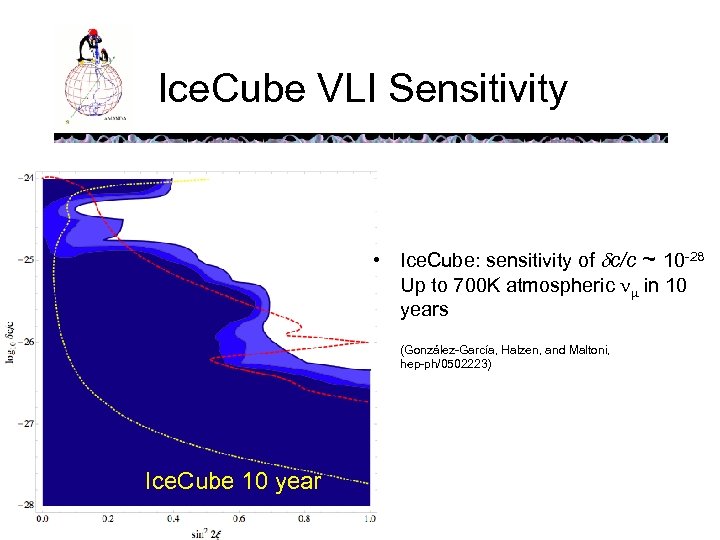 Ice. Cube VLI Sensitivity • Ice. Cube: sensitivity of c/c ~ 10 -28 Up to 700 K atmospheric in 10 years (González-García, Halzen, and Maltoni, hep-ph/0502223) Ice. Cube 10 year
 Other Possibilities • Extraterrestrial neutrino sources would provide even more powerful probes of QG – GRB neutrino time delay (see, e. g. Amelino-Camelia, gr-qc/0305057) – Electron antineutrino decoherence from, say, Cygnus OB 2 (see Anchordoqui et al. , hepph/0506168) • Hybrid techniques (radio, acoustic) will extend energy reach — GZK neutrinos
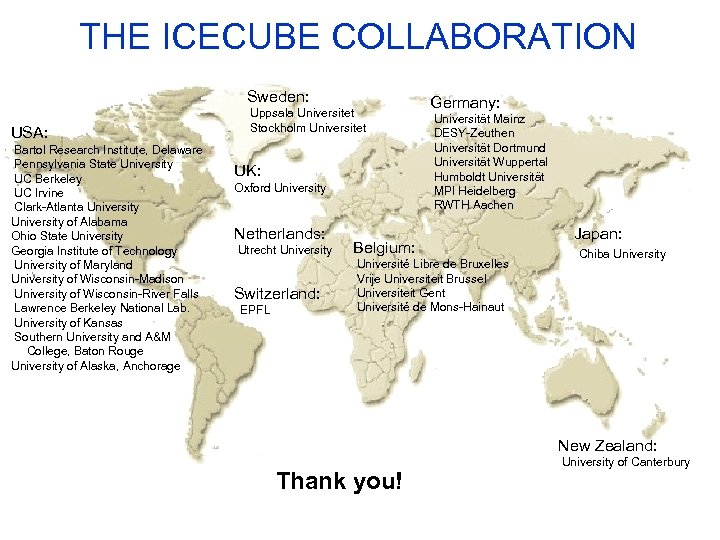 THE ICECUBE COLLABORATION Sweden: USA: Bartol Research Institute, Delaware Pennsylvania State University UC Berkeley UC Irvine Clark-Atlanta University of Alabama Ohio State University Georgia Institute of Technology University of Maryland University of Wisconsin-Madison University of Wisconsin-River Falls Lawrence Berkeley National Lab. University of Kansas Southern University and A&M College, Baton Rouge University of Alaska, Anchorage Uppsala Universitet Stockholm Universitet UK: Oxford University Netherlands: Utrecht University Switzerland: EPFL Germany: Universität Mainz DESY-Zeuthen Universität Dortmund Universität Wuppertal Humboldt Universität MPI Heidelberg RWTH Aachen Belgium: Université Libre de Bruxelles Vrije Universiteit Brussel Universiteit Gent Université de Mons-Hainaut Japan: Chiba University New Zealand: Thank you! University of Canterbury
 Backup Slides
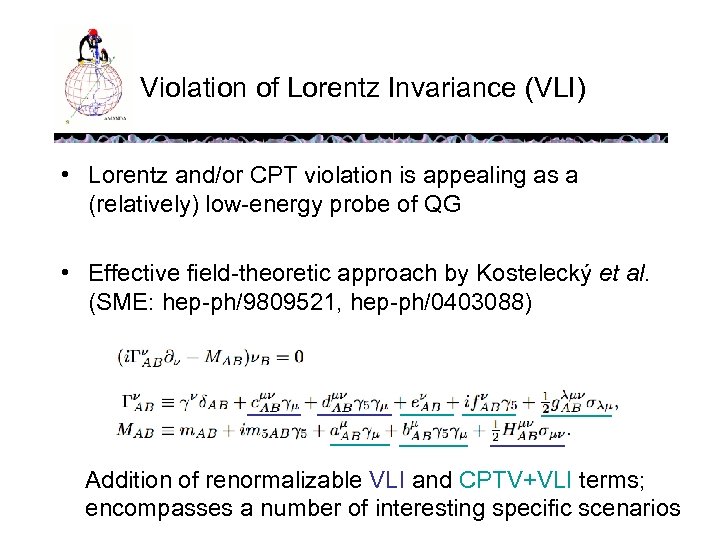 Violation of Lorentz Invariance (VLI) • Lorentz and/or CPT violation is appealing as a (relatively) low-energy probe of QG • Effective field-theoretic approach by Kostelecký et al. (SME: hep-ph/9809521, hep-ph/0403088) Addition of renormalizable VLI and CPTV+VLI terms; encompasses a number of interesting specific scenarios
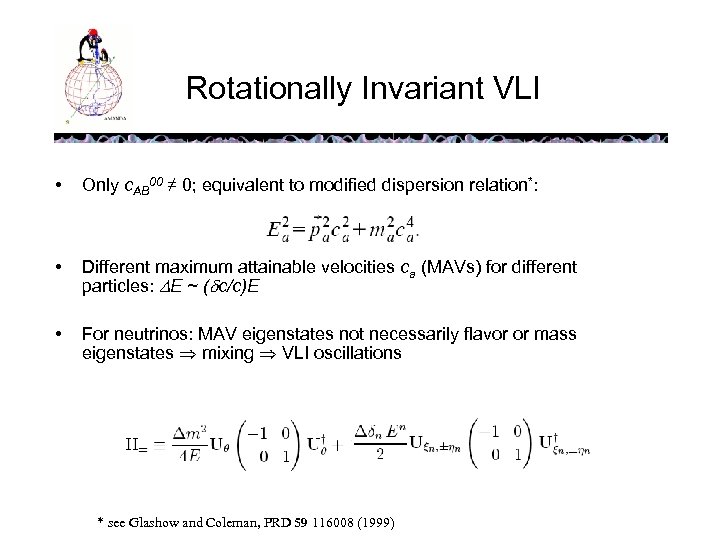 Rotationally Invariant VLI • Only c. AB 00 ≠ 0; equivalent to modified dispersion relation*: • Different maximum attainable velocities ca (MAVs) for different particles: E ~ ( c/c)E • For neutrinos: MAV eigenstates not necessarily flavor or mass eigenstates mixing VLI oscillations * see Glashow and Coleman, PRD 59 116008 (1999)
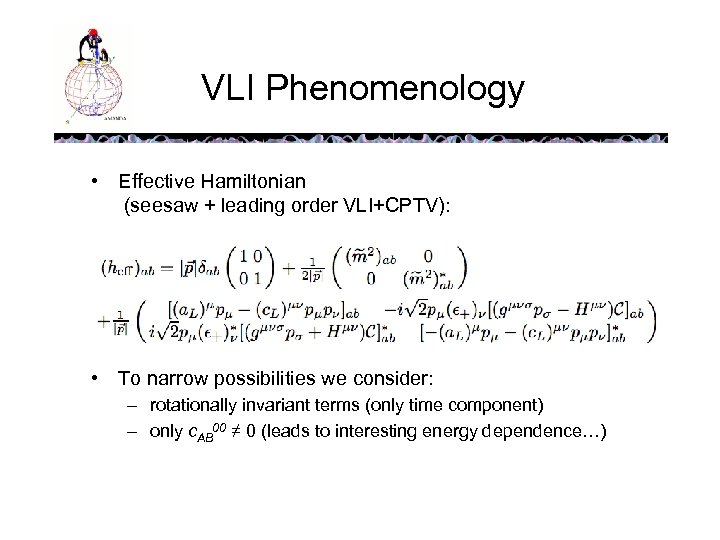 VLI Phenomenology • Effective Hamiltonian (seesaw + leading order VLI+CPTV): • To narrow possibilities we consider: – rotationally invariant terms (only time component) – only c. AB 00 ≠ 0 (leads to interesting energy dependence…)
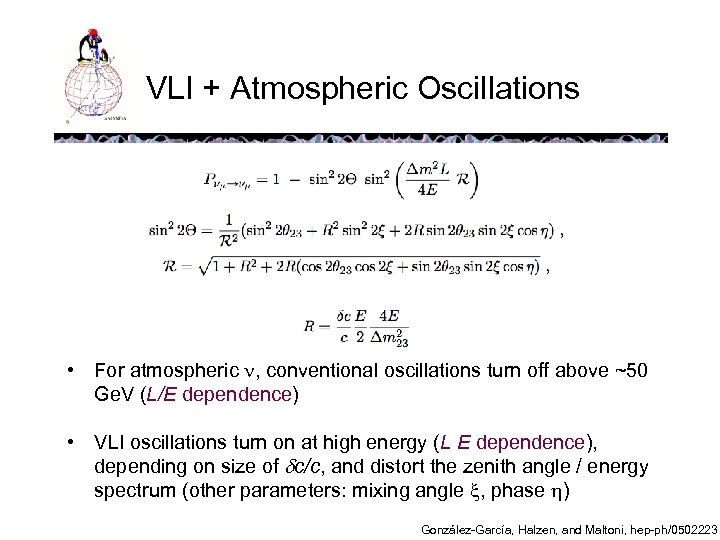 VLI + Atmospheric Oscillations • For atmospheric , conventional oscillations turn off above ~50 Ge. V (L/E dependence) • VLI oscillations turn on at high energy (L E dependence), depending on size of c/c, and distort the zenith angle / energy spectrum (other parameters: mixing angle , phase ) González-García, Halzen, and Maltoni, hep-ph/0502223
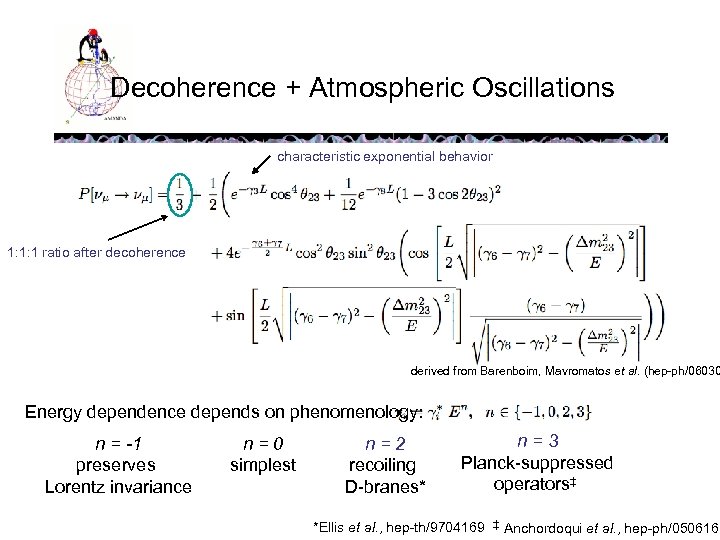 Decoherence + Atmospheric Oscillations characteristic exponential behavior 1: 1: 1 ratio after decoherence derived from Barenboim, Mavromatos et al. (hep-ph/06030 Energy dependence depends on phenomenology: n = -1 preserves Lorentz invariance n=0 simplest n=2 recoiling D-branes* n=3 Planck-suppressed operators‡ *Ellis et al. , hep-th/9704169 ‡ Anchordoqui et al. , hep-ph/0506168