


 Скачать презентацию Seamless Knowledge with Topic Maps A Standard Model
9e47ca60c4f7d620cf32ac4a96b35132.ppt
- Количество слайдов: 53
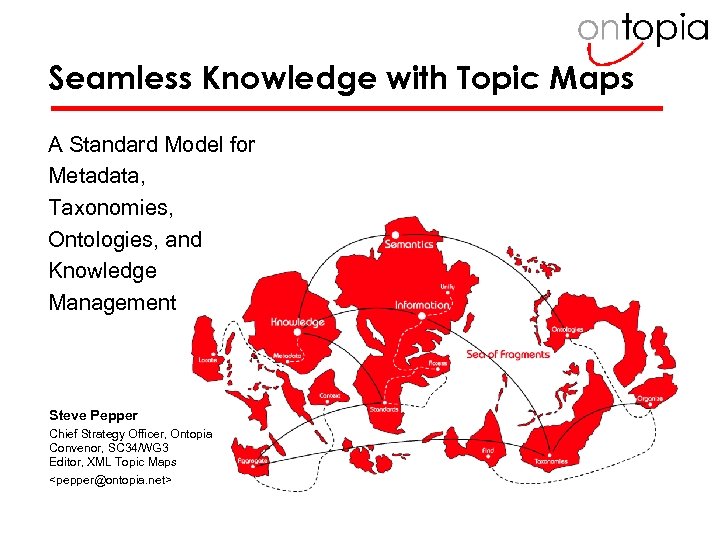 Seamless Knowledge with Topic Maps A Standard Model for Metadata, Taxonomies, Ontologies, and Knowledge Management Steve Pepper Chief Strategy Officer, Ontopia Convenor, SC 34/WG 3 Editor, XML Topic Maps
 Ontopia – The Topic Maps Company • Our mission: – To provide Topic Maps technology and services for information and knowledge management • Background: – – • Established April 2000 out of STEP Infotek Headquarters in Oslo, Norway Partners in 13 countries around the world Recognized leaders of the Topic Maps community On'topia, 1999. [f. Gr. ‘onto-’ (being) + Gr. ‘topos’ (place); see IA. ] I. An imaginary world in which knowledge is well organized. II. A company that provides tools to help you realize your own Ontopia… Products: – Ontopia Knowledge Suite™ – Consultancy, training, and application development through partners © 2005 Ontopia AS Norway Partners: Bouvet AS Lava Group http: //www. ontopia. net/
 What is Topic Maps? • An International Standard for subject-based organization of information and knowledge management • More importantly… • What is Topic Maps used for? • (What are topic maps used for? ) + + + Organizing large bodies of information Capturing organizational memory Representing complex rules and processes Supporting concept-based e. Learning Managing distributed knowledge and information Aggregating information and knowledge etc… = Seamless Knowledge © 2005 Ontopia AS http: //www. ontopia. net/
 Perspectives on Topic Maps • The information management perspective – A standard for subject-based organization of information in support of findability • The knowledge management perspective – A knowledge representation formalism optimized for use in information management – the world’s first standard for KM • The library science perspective – A way to collocate all knowledge about a subject – in particular its relationship to other subjects and to information resources © 2005 Ontopia AS 4 http: //www. ontopia. net/
 ISO 13250: Background and current status • Origins date back to early 1990’s – Davenport Group GCARI / CAPH ISO • First Edition – International Standard (ISO/IEC 13250: 2000) – Model and syntax based on SGML • Second Edition – XML Topic Maps (XML version for use on the Web) – ISO 13250: 2003 (includes XTM) • Revised Edition – Multipart standard appearing in 2005 – Includes data model, query language, constraint language © 2005 Ontopia AS http: //www. ontopia. net/
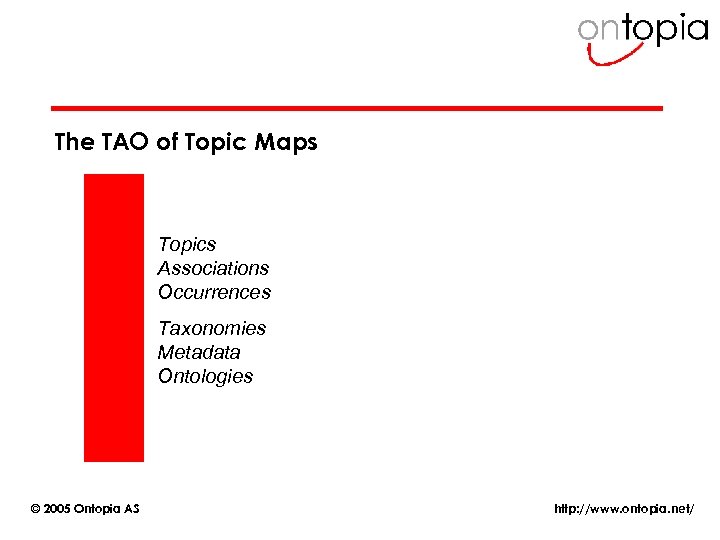 The TAO of Topic Maps Topics Associations Occurrences Taxonomies Metadata Ontologies © 2005 Ontopia AS http: //www. ontopia. net/
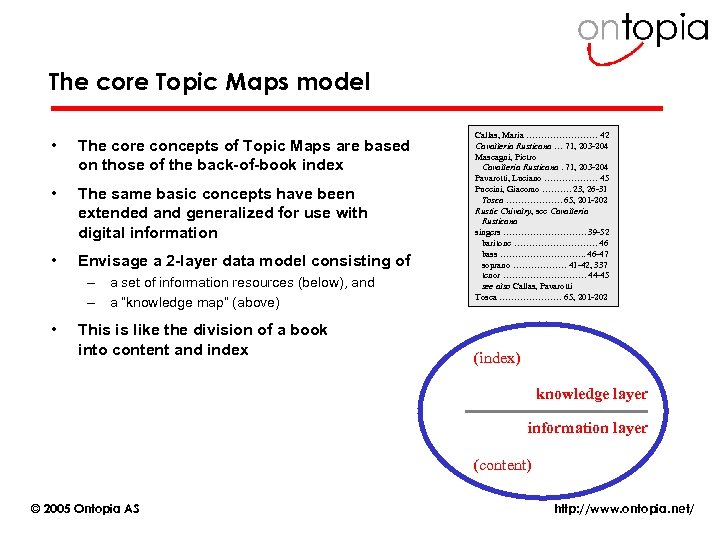 The core Topic Maps model • The core concepts of Topic Maps are based on those of the back-of-book index • The same basic concepts have been extended and generalized for use with digital information • Envisage a 2 -layer data model consisting of – a set of information resources (below), and – a “knowledge map” (above) • This is like the division of a book into content and index Callas, Maria ………… 42 Cavalleria Rusticana … 71, 203 -204 Mascagni, Pietro Cavalleria Rusticana. 71, 203 -204 Pavarotti, Luciano ……………… 45 Puccini, Giacomo ………. 23, 26 -31 Tosca ………………. 65, 201 -202 Rustic Chivalry, see Cavalleria Rusticana singers ……………. 39 -52 baritone ……………. 46 bass ……………. . 46 -47 soprano ……………… 41 -42, 337 tenor ……………. 44 -45 see also Callas, Pavarotti Tosca ………………… 65, 201 -202 (index) knowledge layer information layer (content) © 2005 Ontopia AS http: //www. ontopia. net/
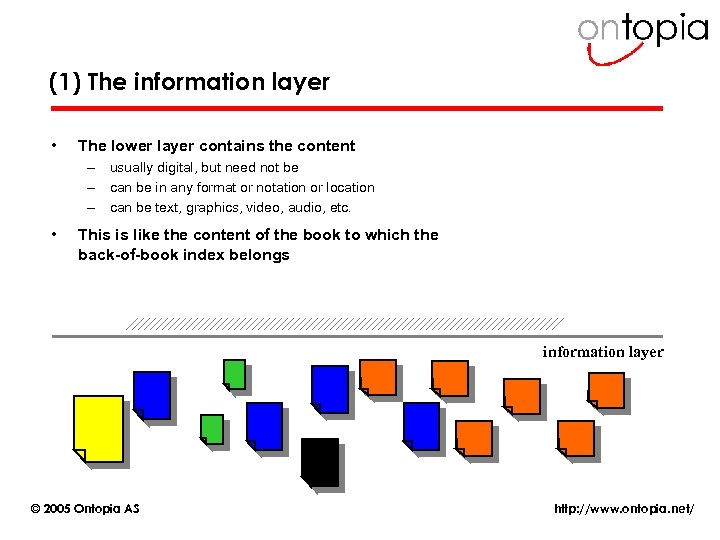 (1) The information layer • The lower layer contains the content – usually digital, but need not be – can be in any format or notation or location – can be text, graphics, video, audio, etc. • This is like the content of the book to which the back-of-book index belongs information layer © 2005 Ontopia AS http: //www. ontopia. net/
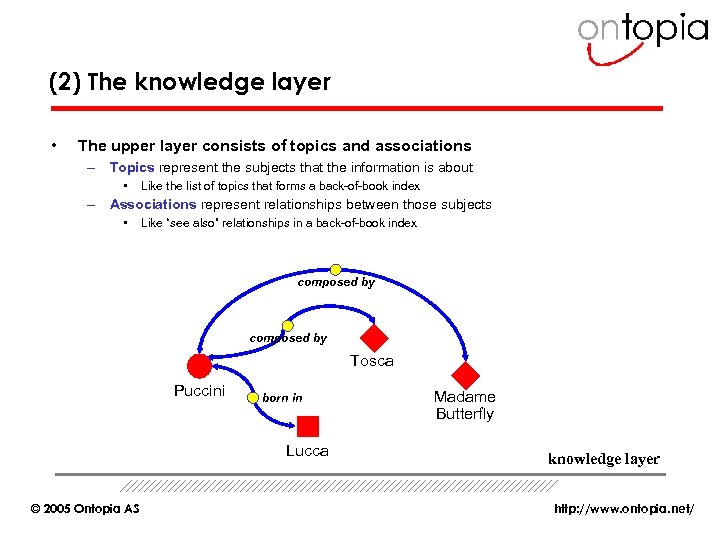 (2) The knowledge layer • The upper layer consists of topics and associations – Topics represent the subjects that the information is about • Like the list of topics that forms a back-of-book index – Associations represent relationships between those subjects • Like “see also” relationships in a back-of-book index composed by Tosca Puccini born in Lucca © 2005 Ontopia AS Madame Butterfly knowledge layer http: //www. ontopia. net/
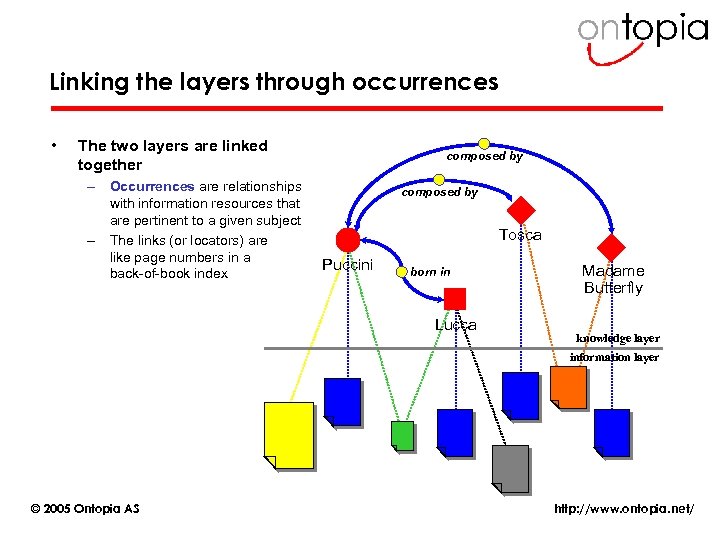 Linking the layers through occurrences • The two layers are linked together – Occurrences are relationships with information resources that are pertinent to a given subject – The links (or locators) are like page numbers in a back-of-book index composed by Tosca Puccini born in Lucca Madame Butterfly knowledge layer information layer © 2005 Ontopia AS http: //www. ontopia. net/
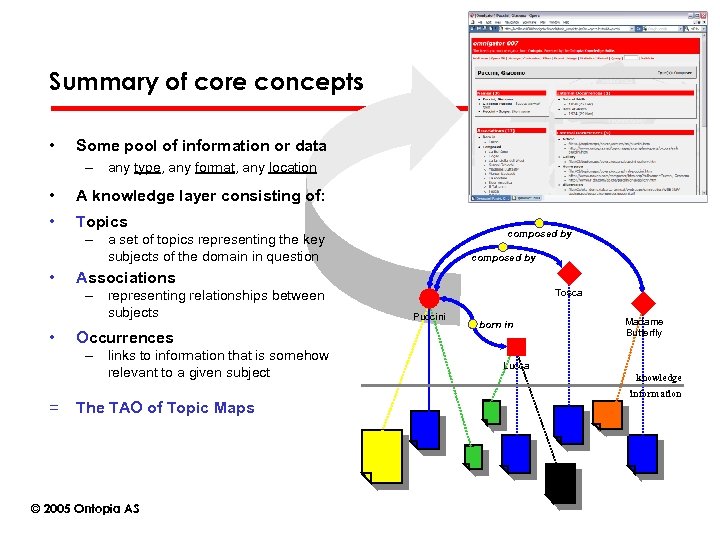 Summary of core concepts • Some pool of information or data Let’s look at some TAOs in the Omnigator… – any type, any format, any location • A knowledge layer consisting of: • Topics composed by – a set of topics representing the key subjects of the domain in question • Associations – representing relationships between subjects • Occurrences – links to information that is somehow relevant to a given subject = composed by The TAO of Topic Maps © 2005 Ontopia AS Tosca Puccini born in Madame Butterfly Lucca knowledge information http: //www. ontopia. net/
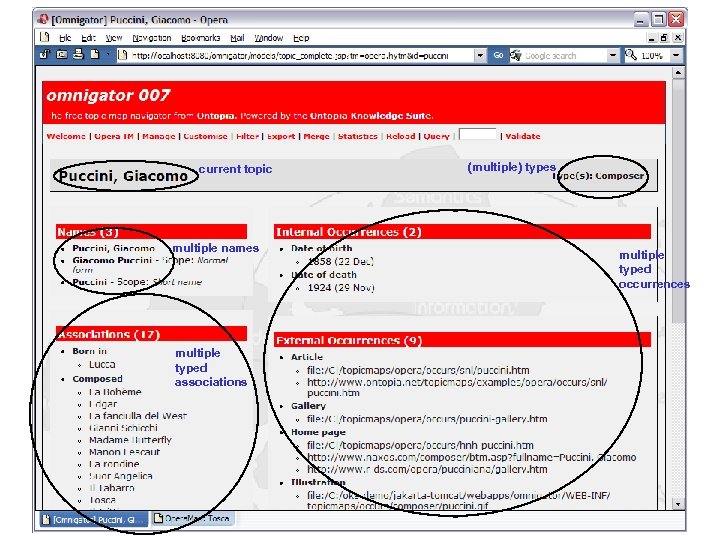 current topic multiple names multiple typed associations (multiple) types multiple typed occurrences
 With this simple but flexible model you can • Represent subjects explicitly – Topics represent the “things” your users are interested in • Capture relationships between subjects – Associations provide user-friendly navigation paths to information – They also promote serendipitous knowledge discovery through browsing • Make information findable – Topics provide a “one-stop-shop” for everything that is known about a subject – Occurrences allow information about a common subject to be linked across multiple systems or databases • Represent taxonomies and thesauri – Associations may represent hierarchical relationships – Topic Maps permits multiple, interlinked hierarchies and faceted classification • Transcend simple hierarchies – Rich associative structures capture the complexity of knowledge and reflect the way people think • Manage knowledge – The topic map is the embodiment of “corporate memory” © 2005 Ontopia AS http: //www. ontopia. net/
 Topic Maps and ontologies • The term “ontology” is used in many different ways: – “An ontology is the types and subtypes of concepts and relations that exist in some domain…” John Sowa: Knowledge Representation (Pacific Grove, 2000) • In Topic Maps the basic building blocks are – Topics: e. g. “Puccini”, “Lucca”, “Tosca” – Associations: e. g. “Puccini was born in Lucca” – Occurrences: e. g. “http: //www. opera. net/puccini/bio. html is a biography of Puccini” • Each of these constructs can be typed – Topic types: “composer”, “city”, “opera” – Association types: “born in”, “composed by” – Occurrence types: “biography”, “street map”, “synopsis” • All such types are also topics (within the same topic map) – “Puccini” is a topic of type “composer” … and “composer” is also a topic • A topic map thus contains its own ontology! © 2005 Ontopia AS http: //www. ontopia. net/
 Five cool things to do with a topic map Querying Constraining Filtering Visualizing Merging © 2005 Ontopia AS http: //www. ontopia. net/
 Querying topic maps • Topic Maps is based on a formal data model – This means that topic maps can be queried, like databases • ISO 18048 Topic Maps Query Language (TMQL) – Companion to ISO 13250, currently being balloted in ISO – Allows more powerful use of taxonomies to retrieve information – Permits queries that would make Google boggle (see below) • TMQL is based on Ontopia’s query language tolog • Demo of querying in the Omnigator • Query example: – Give me all composers that composed operas that were based on plays that were written by Shakespeare © 2005 Ontopia AS http: //www. ontopia. net/
 Constraining topic maps • ISO 13250 itself provides no way to constrain topic maps – Examples of constraints: – “All persons must be born somewhere” – “A person may have died somewhere” • Constraints are necessary in order to: – – • Permit semantic validation of content Ensure consistency Enable more intuitive user interfaces Simplify application development ISO 19756 Topic Maps Constraint Language (TMCL) – Companion to ISO 13250, currently being balloted in ISO – Will interoperate with OWL (Web Ontology Language) • Ontopia has developed OSL for its customers • Demo of OSL in the Omnigator © 2005 Ontopia AS http: //www. ontopia. net/
 Filtering, scoping and personalizing topic maps • Multiple world views – Reality is ambiguous and knowledge has a subjective dimension – Scope allows the expression of multiple perspectives in a single topic map – Typical application: Combining related but divergent taxonomies • Contextual knowledge – Some knowledge is only valid in a certain context, and not valid otherwise – Scope enables the expression of contextual validity • Personalized knowledge – Different users have different knowledge requirements – Scope permits personalization based on personal references, skill levels, security clearance, etc. • Demo of scope-based filtering in the Omnigator © 2005 Ontopia AS http: //www. ontopia. net/
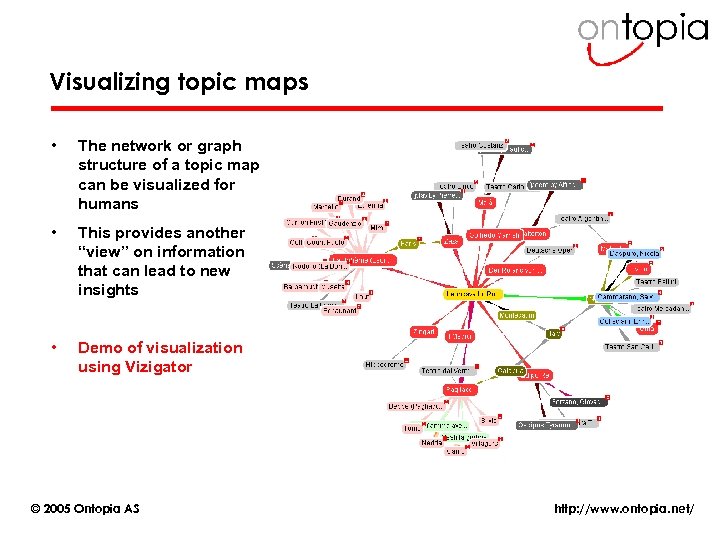 Visualizing topic maps • The network or graph structure of a topic map can be visualized for humans • This provides another “view” on information that can lead to new insights • Demo of visualization using Vizigator © 2005 Ontopia AS http: //www. ontopia. net/
 Merging topic maps • Topic Maps can be merged automatically – You can always and in any situation take any two arbitrary topic maps and merge them to a single topic map – This cannot be done with databases or XML documents • The merge capability enables many advanced applications – – • Information integration across repositories Sharing and reusing taxonomies Automated content aggregation Distributed knowledge management The concept that makes merging possible is subject identity – Topic Maps has a robust mechanism for using URIs as identifiers © 2005 Ontopia AS http: //www. ontopia. net/
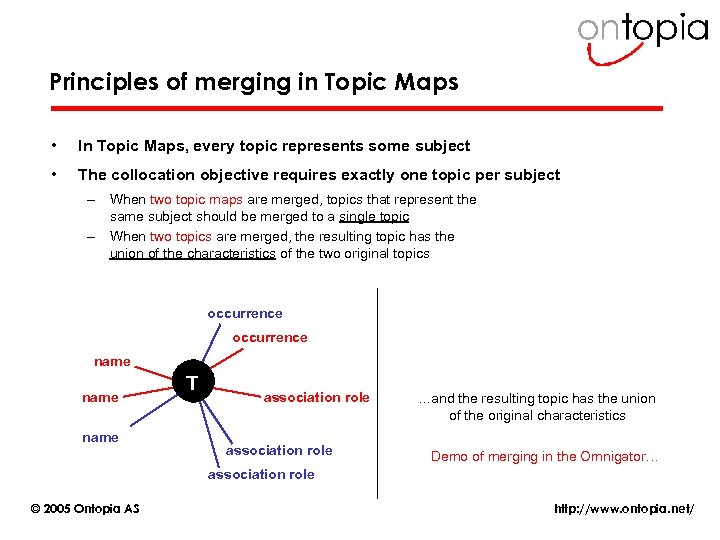 Principles of merging in Topic Maps • In Topic Maps, every topic represents some subject • The collocation objective requires exactly one topic per subject – When two topic maps are merged, topics that represent the same subject should be merged to a single topic – When two topics are merged, the resulting topic has the union of the characteristics of the two original topics occurrence name T association role © 2005 Ontopia AS occurrence T name association Merge the two topics together. . . and the resulting topic has the union role of the original characteristics A second topic (in another topic Demo of merging in the Omnigator… map) “about” the same subject http: //www. ontopia. net/
 How Topic Maps improves access to information • Intuitive navigational interfaces for humans – The topic/association layer mirrors the way people think • Powerful semantic queries for applications – A formal underlying data structure • Customized views based on individual requirements – Personalization based on scope • Information aggregation across systems and organizations – Topic Maps can be merged automatically… © 2005 Ontopia AS http: //www. ontopia. net/
 Applications of Topic Maps Taxonomy Management Metadata Management Semantic Portals… Information Integration e. Learning Business Process Modelling Product Configuration Business Rules Management IT Asset Management (Manufacturing) © 2005 Ontopia AS http: //www. ontopia. net/
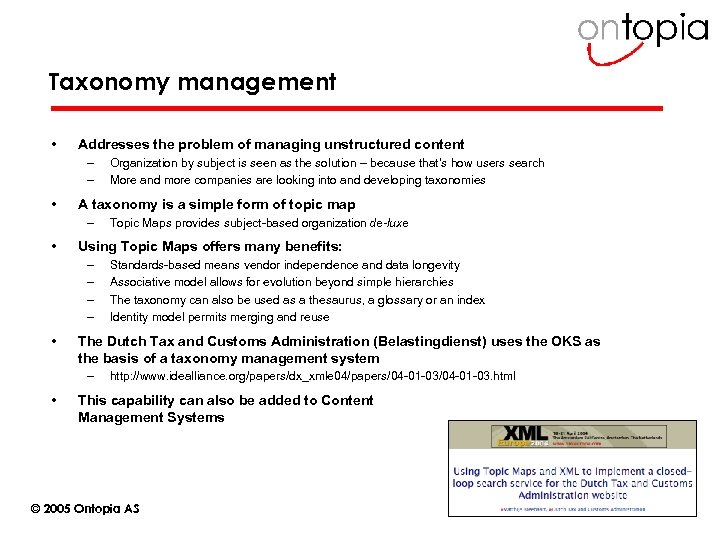 Taxonomy management • Addresses the problem of managing unstructured content – – • A taxonomy is a simple form of topic map – • Standards-based means vendor independence and data longevity Associative model allows for evolution beyond simple hierarchies The taxonomy can also be used as a thesaurus, a glossary or an index Identity model permits merging and reuse The Dutch Tax and Customs Administration (Belastingdienst) uses the OKS as the basis of a taxonomy management system – • Topic Maps provides subject-based organization de-luxe Using Topic Maps offers many benefits: – – • Organization by subject is seen as the solution – because that’s how users search More and more companies are looking into and developing taxonomies http: //www. idealliance. org/papers/dx_xmle 04/papers/04 -01 -03. html This capability can also be added to Content Management Systems © 2005 Ontopia AS http: //www. ontopia. net/
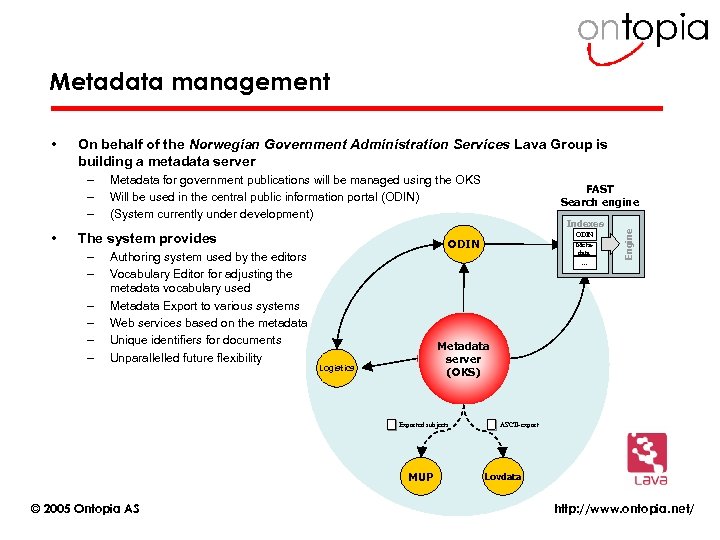 Metadata management On behalf of the Norwegian Government Administration Services Lava Group is building a metadata server – – – • Metadata for government publications will be managed using the OKS Will be used in the central public information portal (ODIN) (System currently under development) The system provides – – – Authoring system used by the editors Vocabulary Editor for adjusting the metadata vocabulary used Metadata Export to various systems Web services based on the metadata Unique identifiers for documents Unparallelled future flexibility Indexes ODIN Metadata … ODIN Metadata server (OKS) Logistics Exported subjects MUP © 2005 Ontopia AS FAST Search engine Engine • ASCII-export Lovdata http: //www. ontopia. net/
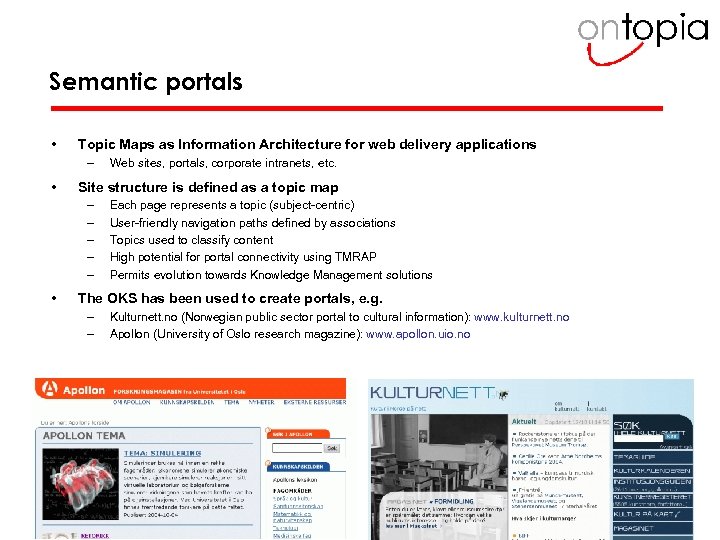 Semantic portals • Topic Maps as Information Architecture for web delivery applications – • Site structure is defined as a topic map – – – • Web sites, portals, corporate intranets, etc. Each page represents a topic (subject-centric) User-friendly navigation paths defined by associations Topics used to classify content High potential for portal connectivity using TMRAP Permits evolution towards Knowledge Management solutions The OKS has been used to create portals, e. g. – – Kulturnett. no (Norwegian public sector portal to cultural information): www. kulturnett. no Apollon (University of Oslo research magazine): www. apollon. uio. no © 2005 Ontopia AS http: //www. ontopia. net/
 Dynamic Content Aggregation An Application of Seamless Knowledge Automatic Portal Integration Topic Maps Remote Access Protocol © 2005 Ontopia AS http: //www. ontopia. net/
 Semantic portals • Think of Topic Maps as an Information Architecture – Topic Maps is an ideal model for portals and other forms of web-based information delivery • The basic concept is to have the topic map drive the portal – Not just a navigational layer on top of something else – The very structure of the portal is a topic map – All content is organized around topics (“subject-centric organization”) • Each page represents a topic (we call this a “Topic Page”) – Topics act as points of collocation – They provide a “one-stop shop” for everything that is known about a particular subject • Navigating the portal == Navigating the topic map – Associations provide very intuitive navigation (“As we may think”) © 2005 Ontopia AS http: //www. ontopia. net/
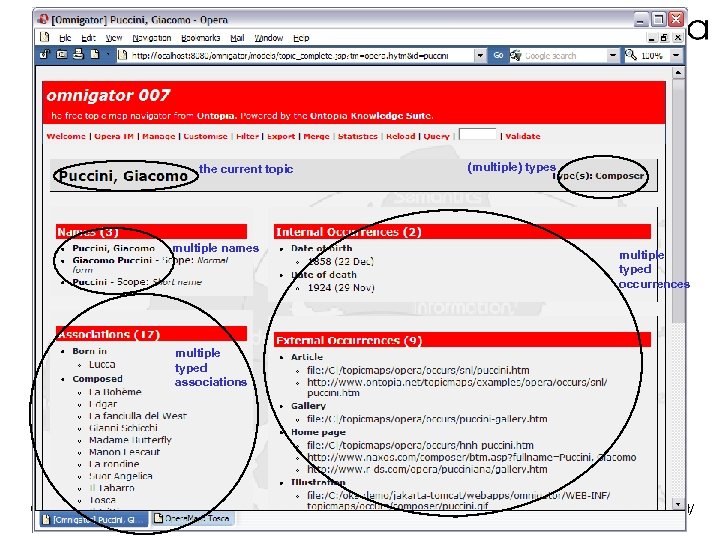 A topic page the current topic multiple names (multiple) types multiple typed occurrences multiple typed associations © 2005 Ontopia AS http: //www. ontopia. net/
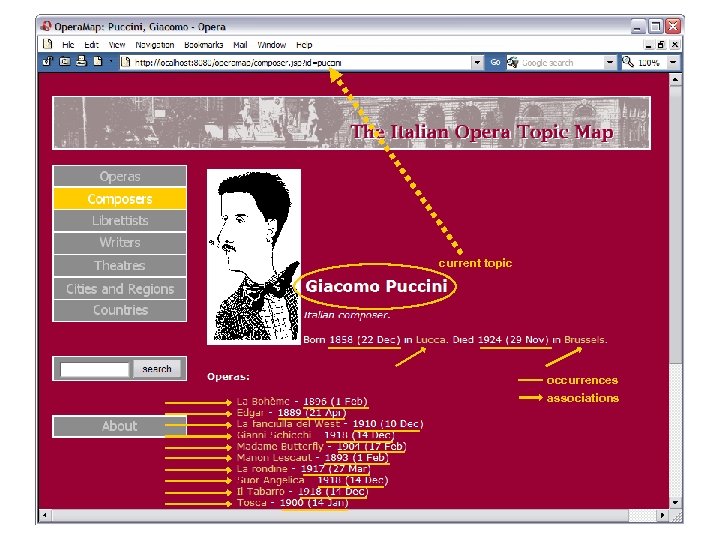 current topic occurrences associations
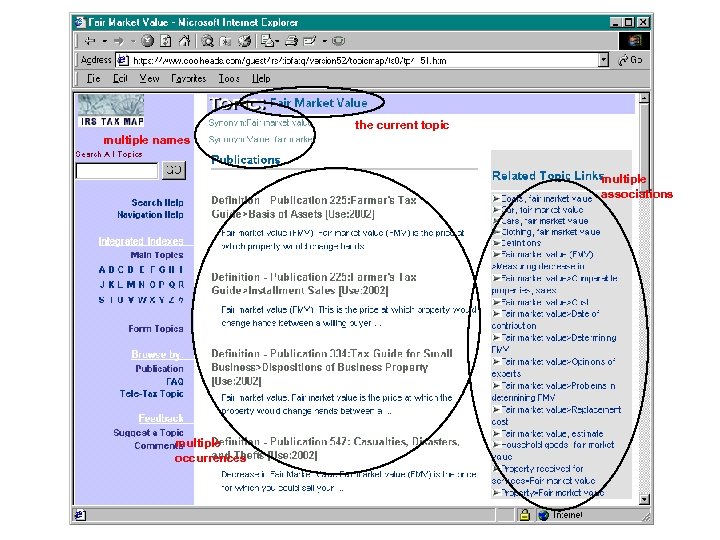 the current topic multiple names multiple associations multiple occurrences
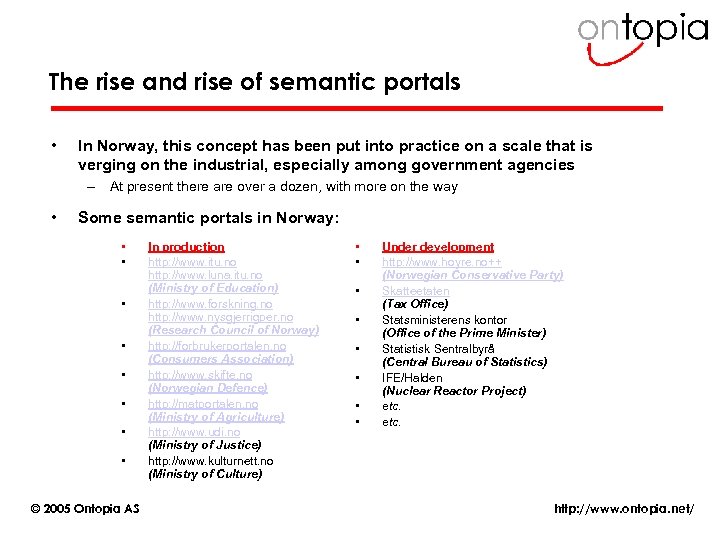 The rise and rise of semantic portals • In Norway, this concept has been put into practice on a scale that is verging on the industrial, especially among government agencies – At present there are over a dozen, with more on the way • Some semantic portals in Norway: • • © 2005 Ontopia AS In production http: //www. itu. no http: //www. luna. itu. no (Ministry of Education) http: //www. forskning. no http: //www. nysgjerrigper. no (Research Council of Norway) http: //forbrukerportalen. no (Consumers Association) http: //www. skifte. no (Norwegian Defence) http: //matportalen. no (Ministry of Agriculture) http: //www. udi. no (Ministry of Justice) http: //www. kulturnett. no (Ministry of Culture) • • Under development http: //www. hoyre. no++ (Norwegian Conservative Party) Skatteetaten (Tax Office) Statsministerens kontor (Office of the Prime Minister) Statistisk Sentralbyrå (Central Bureau of Statistics) IFE/Halden (Nuclear Reactor Project) etc. http: //www. ontopia. net/
 Towards seamless knowledge • As the number of portals multiplies, the amount of overlap increases… • Take these three portals as an example: • forskning. no (Research Council web site aimed at young adults) • forbrukerportalen. no (Public site of the Norwegian Consumer Association) • matportalen. no (Biosecurity portal of the Department of Agriculture) © 2005 Ontopia AS http: //www. ontopia. net/
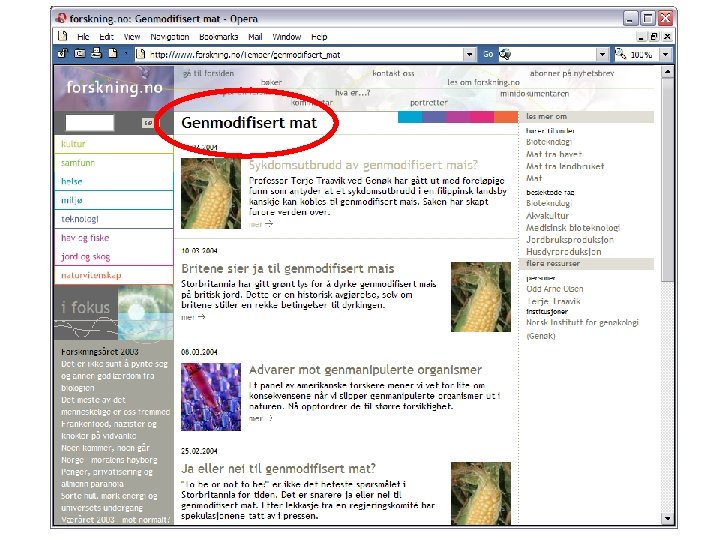 Genetically modified food at forskning. no
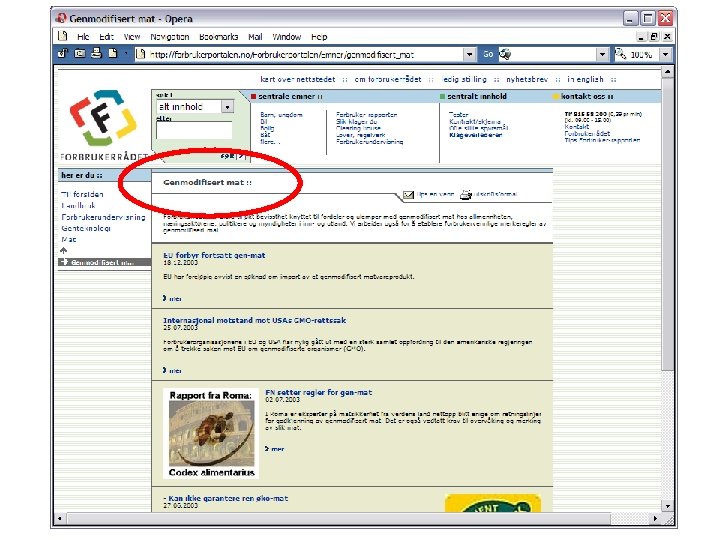 Genetically modified food at Forbukerrådet
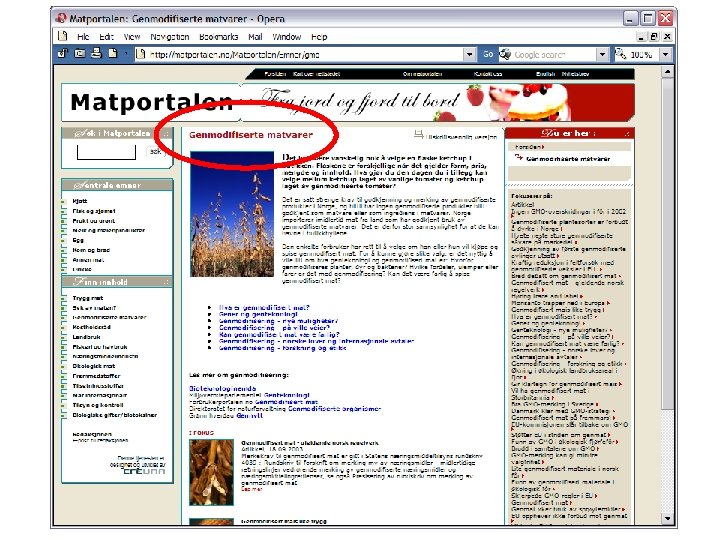 Genetically modified foodstuffs at Matportalen
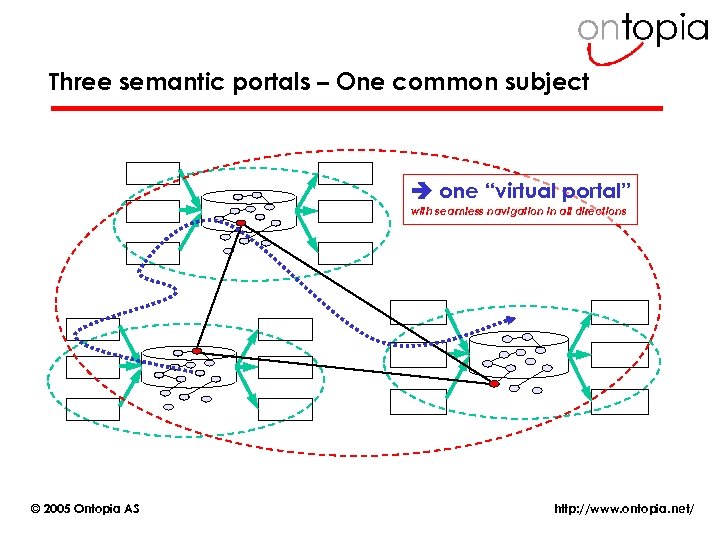 Three semantic portals – One common subject one “virtual portal” with seamless navigation in all directions © 2005 Ontopia AS http: //www. ontopia. net/
 Achieving seamless knowledge • Very little is required for these portals to achieve a simple but effective form of Seamless Knowledge • They have already achieved subject-centric organization of their content – Without this, Seamless Knowledge is beyond reach • From a technical perspective, only two additional pieces are required to complete the puzzle: #1 An identity mechanism – To make it possible to know when their subjects are the same – Published subjects solve this problem • • A flexible and robust mechanism for using URIs as global identifiers See www. oasis-open. org. #2 An exchange protocol – To enable information to be requested and exchanged automatically – Ontopia has developed Topic Maps Remote Access Protocol © 2005 Ontopia AS http: //www. ontopia. net/
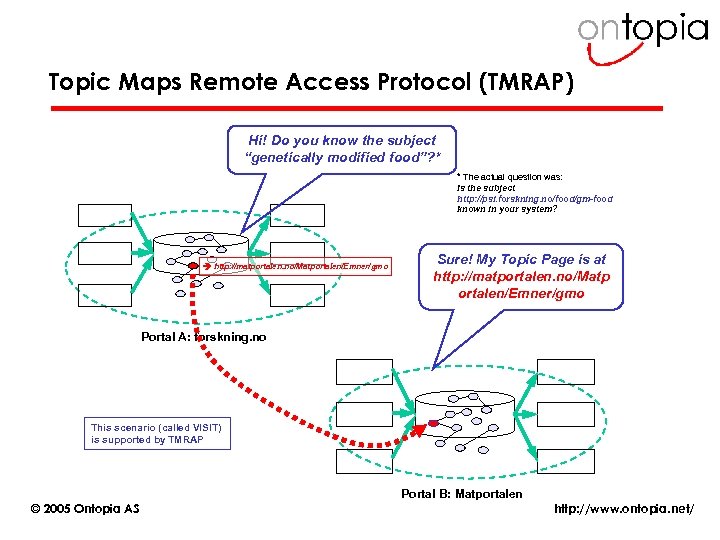 Topic Maps Remote Access Protocol (TMRAP) Hi! Do you know the subject “genetically modified food”? * * The actual question was: Is the subject http: //psi. forskning. no/food/gm-food known in your system? http: //matportalen. no/Matportalen/Emner/gmo Sure! My Topic Page is at http: //matportalen. no/Matp ortalen/Emner/gmo Portal A: forskning. no This scenario (called VISIT) is supported by TMRAP Portal B: Matportalen © 2005 Ontopia AS http: //www. ontopia. net/
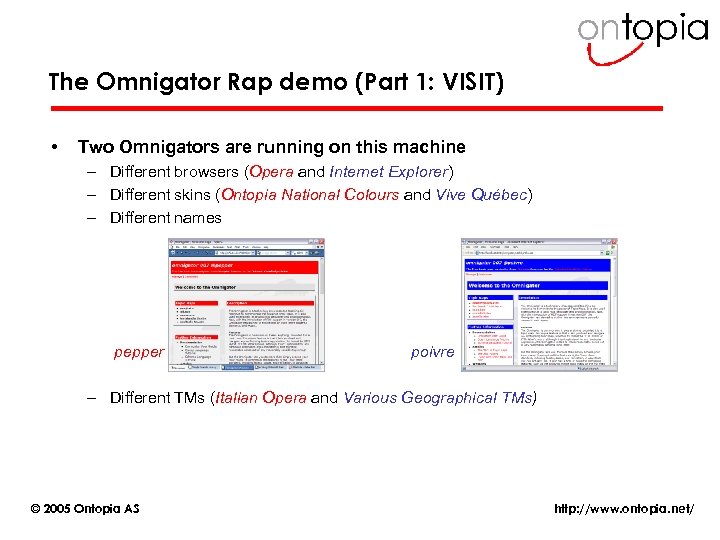 The Omnigator Rap demo (Part 1: VISIT) • Two Omnigators are running on this machine – Different browsers (Opera and Internet Explorer) – Different skins (Ontopia National Colours and Vive Québec) – Different names pepper poivre – Different TMs (Italian Opera and Various Geographical TMs) © 2005 Ontopia AS http: //www. ontopia. net/
 VISIT: Some considerations • The functionality is deceptively simple, yet potential very powerful – From the user’s point of view the VISIT links might have been hand-coded (there is no visible difference) – The cool thing is that they are generated entirely automatically – This is dynamic content aggregation in practice!! • NO MAINTENANCE of cross-site links is required • Solves the publisher’s cross-site link management problem with technology • And we can go a step further with relatively little effort – Rich data based on Topic Maps can be merged … – … so we can exchange not only links, – but also whole chunks of rich data • We call those chunks topic maplets • This is how it works… © 2005 Ontopia AS http: //www. ontopia. net/
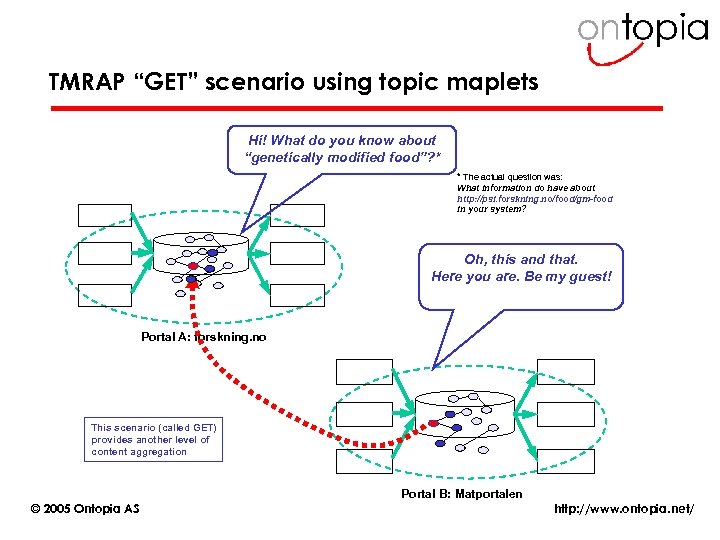 TMRAP “GET” scenario using topic maplets Hi! What do you know about “genetically modified food”? * * The actual question was: What information do have about http: //psi. forskning. no/food/gm-food in your system? Oh, this and that. Here you are. Be my guest! Portal A: forskning. no This scenario (called GET) provides another level of content aggregation Portal B: Matportalen © 2005 Ontopia AS http: //www. ontopia. net/
 GET: Some considerations • The functionality is even more powerful… – The “seamlessness” factor is much greater (In fact we have “dumbed it down” in this demo in order to show what is actually going on: The GET functionality could be activated automatically) • Application areas are slightly different: – Useful when seamlessness is more important and branding issues less important • E. g. , within a corporate or government environment © 2005 Ontopia AS http: //www. ontopia. net/
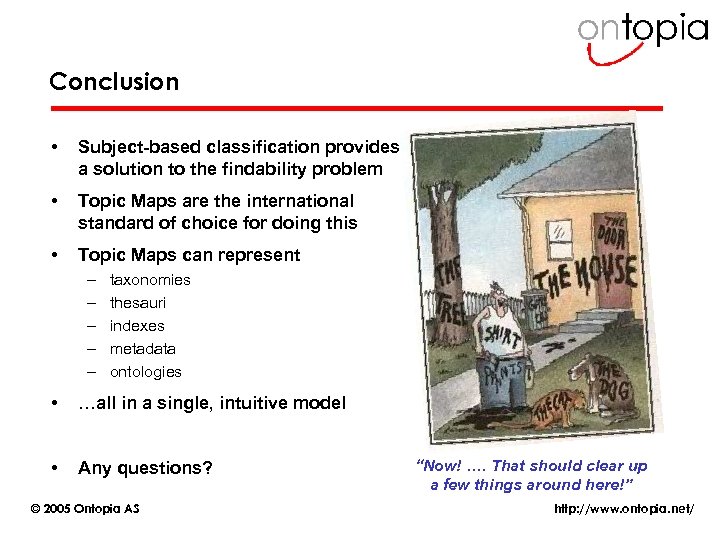 Conclusion • Subject-based classification provides a solution to the findability problem • Topic Maps are the international standard of choice for doing this • Topic Maps can represent – – – taxonomies thesauri indexes metadata ontologies • …all in a single, intuitive model • Any questions? © 2005 Ontopia AS “Now! …. That should clear up a few things around here!” http: //www. ontopia. net/
 What now? • Read The TAO of Topic Maps* • Download the Omnigator* • Learn LTM* and create your own first topic map • Consider doing a thesis on a Topic Maps-related subject • Attend Ontopia’s training class* – – June 6 th: Full day introduction to Topic Maps June 7 th: Ontology design for Topic Mappers (other days cost money) Make sure you register! * All details at www. ontopia. net © 2005 Ontopia AS http: //www. ontopia. net/
 RDF and Topic Maps Similarities Differences Interoperability © 2005 Ontopia AS http: //www. ontopia. net/
 “Two households, both alike in dignity…” • During the late 1990 s the W 3 C and ISO developed two semantic technologies in parallel • Two communities, largely unaware of each other • Tackling the same fundamental problems – Findability – Semantic interoperability • The results were RDF and Topic Maps © 2005 Ontopia AS http: //www. ontopia. net/
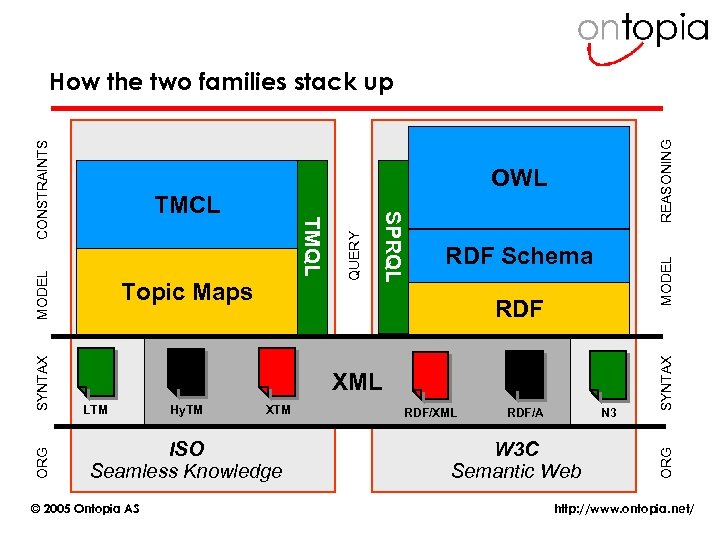 REASONING MODEL RDF Schema RDF XML LTM Hy. TM XTM ISO Seamless Knowledge © 2005 Ontopia AS RDF/XML RDF/A N 3 W 3 C Semantic Web SYNTAX MODEL SYNTAX ORG Topic Maps SPRQL TMCL QUERY OWL ORG CONSTRAINTS How the two families stack up http: //www. ontopia. net/
 Similarities that cry out for unification • Striking similarities – – – – • Both “extend” XML into the realm of semantics Both allow assertions to be made about subjects in the outside world Both define abstract, associative (graph-based) models Both are intensely concerned with “identity” Both allow some measure of inferencing or reasoning Both have XML-based interchange syntaxes Both have constraint languages and query languages This lead to calls for unification – “Free-for-all” between the two Erics at Extreme Markup 2000 – Michael Sperberg-Mc. Queen suggested locking the RDF people and the Topic Maps people in a room together until they had harmonized the two… © 2005 Ontopia AS http: //www. ontopia. net/
 But there are important differences too… • Different roots – Topic Maps has its roots in traditional finding aids (indexes, thesauri, etc. ) – RDF has its roots in document metadata and formal logic • Different levels of semantics… – RDF is more low level; Topic Maps has more higher-level semantics • Different models – Identity, scope, association roles, n-ary relationships, variant names, … • Different goals – RDF: An artificially intelligent web for software agents – Topic Maps: Findability and knowledge integration for humans • So unification never happened – But the perception of rivalry is a cause for confusion © 2005 Ontopia AS http: //www. ontopia. net/
 It’s time to move beyond bigotry • Let’s look for the synergies instead! – Both families have user communities – Neither standard will go away anytime soon – Common interest in the success of semantic technologies – Semantics are hard enough to explain to the market as it is – A standards war will indeed lead to a Plague o’ Both Our Houses… • RDF and Topic Maps are different – Different strengths, different weaknesses – Let’s recognize this – And let’s go for interoperability • That’s the goal of RDFTM… © 2005 Ontopia AS http: //www. ontopia. net/
 RDFTM • RDF/Topic Maps Interoperability Task Force – A task force within the Semantic Web Best Practices and Deployment Working Group • Chartered to deliver two documents: – Survey of Existing Interoperability Proposals (WG Note) – Guidlines for RDF/Topic Maps Interoperability (WG Note or Recommendation) • First draft of Survey recently delivered to WG – http: //www. w 3. org/2001/sw/Best. Practices/RDFTM/survey • First draft of Guidelines for Extreme Markup 2005 – http: //www. extrememarkup. org/ © 2005 Ontopia AS http: //www. ontopia. net/
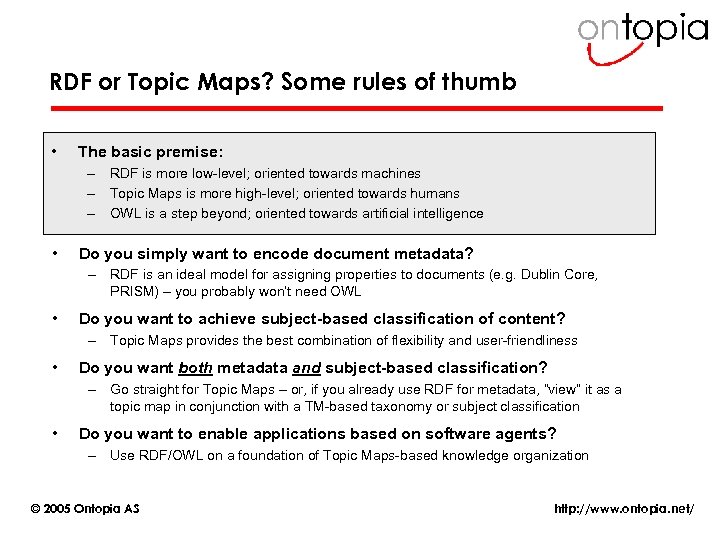 RDF or Topic Maps? Some rules of thumb • The basic premise: – RDF is more low-level; oriented towards machines – Topic Maps is more high-level; oriented towards humans – OWL is a step beyond; oriented towards artificial intelligence • Do you simply want to encode document metadata? – RDF is an ideal model for assigning properties to documents (e. g. Dublin Core, PRISM) – you probably won’t need OWL • Do you want to achieve subject-based classification of content? – Topic Maps provides the best combination of flexibility and user-friendliness • Do you want both metadata and subject-based classification? – Go straight for Topic Maps – or, if you already use RDF for metadata, “view” it as a topic map in conjunction with a TM-based taxonomy or subject classification • Do you want to enable applications based on software agents? – Use RDF/OWL on a foundation of Topic Maps-based knowledge organization © 2005 Ontopia AS http: //www. ontopia. net/