Скачать презентацию Seamless Knowledge Spontaneous Knowledge Federation using TMRAP Steve
928902146f1125822bb57065440da122.ppt
- Количество слайдов: 42
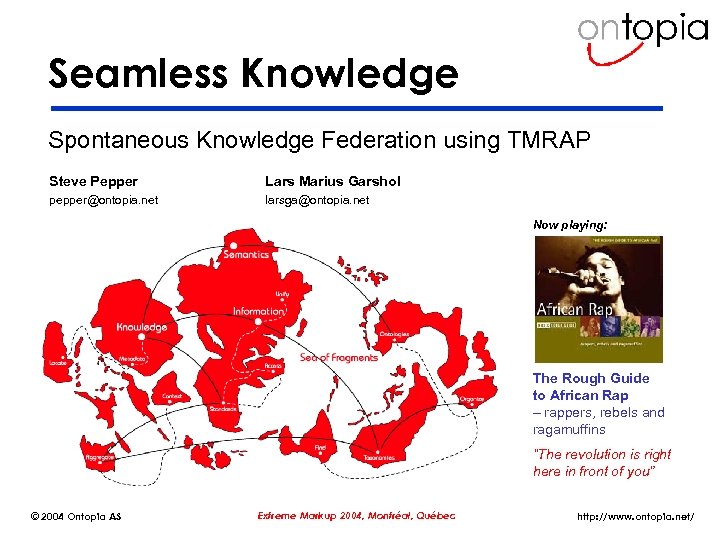 Seamless Knowledge Spontaneous Knowledge Federation using TMRAP Steve Pepper Lars Marius Garshol pepper@ontopia. net larsga@ontopia. net Now playing: The Rough Guide to African Rap – rappers, rebels and ragamuffins “The revolution is right here in front of you” © 2004 Ontopia AS Extreme Markup 2004, Montréal, Québec http: //www. ontopia. net/
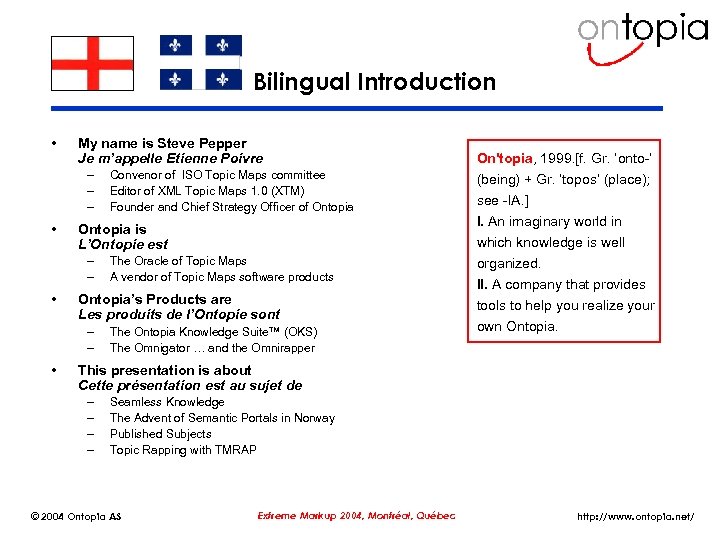 Bilingual Introduction • My name is Steve Pepper Je m’appelle Etienne Poivre – – – • Ontopia is L’Ontopie est – – • The Oracle of Topic Maps A vendor of Topic Maps software products Ontopia’s Products are Les produits de l’Ontopie sont – – • Convenor of ISO Topic Maps committee Editor of XML Topic Maps 1. 0 (XTM) Founder and Chief Strategy Officer of Ontopia The Ontopia Knowledge Suite™ (OKS) The Omnigator … and the Omnirapper On'topia, 1999. [f. Gr. ‘onto-’ (being) + Gr. ‘topos’ (place); see -IA. ] I. An imaginary world in which knowledge is well organized. II. A company that provides tools to help you realize your own Ontopia. This presentation is about Cette présentation est au sujet de – – Seamless Knowledge The Advent of Semantic Portals in Norway Published Subjects Topic Rapping with TMRAP © 2004 Ontopia AS Extreme Markup 2004, Montréal, Québec http: //www. ontopia. net/
 What is Topic Maps? • Topic Maps is an ISO standard for Knowledge Integration • It is the only international standard for Knowledge Integration • But the more important question is… © 2004 Ontopia AS Extreme Markup 2004, Montréal, Québec http: //www. ontopia. net/
 What are Topic Maps used for? • That’s like asking: What are relational databases used for? • The answer is: A whole number of things, including (but not limited to): – – – Organizing large bodies of information Capturing corporate memory Representing complex rules and processes Supporting concept-based e. Learning Enabling Enterprise Knowledge Integration (EKI) • But in particular… • Any or all of the above, in combination! • Topic Maps lets you achieve Seamless Knowledge © 2004 Ontopia AS Extreme Markup 2004, Montréal, Québec http: //www. ontopia. net/
 Seamless Knowledge • A term coined within the Topic Maps community as a “marketing banner” – the standard under which we march (in more ways than one!) • Instead of focusing on the technology, it speaks to the business benefits of applying Topic Maps • The business problem that Topic Maps addresses is the Disconnectedness of Information and Knowledge • There is growing awareness of the scale of this problem: – – Increased talk about “metadata”, “taxonomies”, “ontologies”, and “semantics” The META Group talks of a “near-impending crisis” What people are looking for is knowledge integration, or Seamless Knowledge Topic Maps offers a standards-based solution • (The ROI can speak for itself … at least at this conference) • Seamless Knowledge is not the same as the Semantic Web – But there is some overlap and even more potential synergy © 2004 Ontopia AS Extreme Markup 2004, Montréal, Québec http: //www. ontopia. net/
 Semantic Portals • One of many applications of Topic Maps – Topic Maps provides an ideal model for portals and other forms of webbased information delivery • The basic concept is to have topic maps drive the portal – Not just a navigational layer on top of something else – The very structure of the portal is a topic map – All content is organized around topics (“subject-based organization”) • Each page represents a topic (we call this a “Topic Page”) – Topics act as points of collocation – They provide a “one-stop shop” for everything that is known about a particular subject • Navigating the portal == Navigating the topic map – Associations provide very intuitive navigation (“As we may think”) © 2004 Ontopia AS Extreme Markup 2004, Montréal, Québec http: //www. ontopia. net/
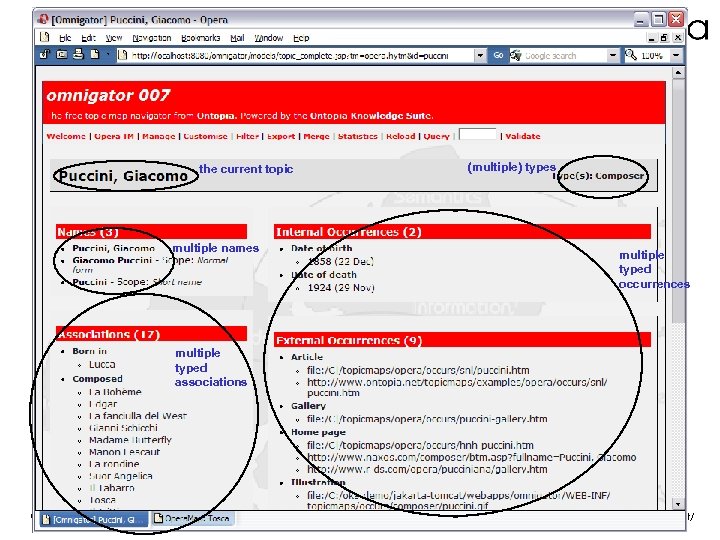 A Topic Page the current topic multiple names (multiple) types multiple typed occurrences multiple typed associations © 2004 Ontopia AS Extreme Markup 2004, Montréal, Québec http: //www. ontopia. net/
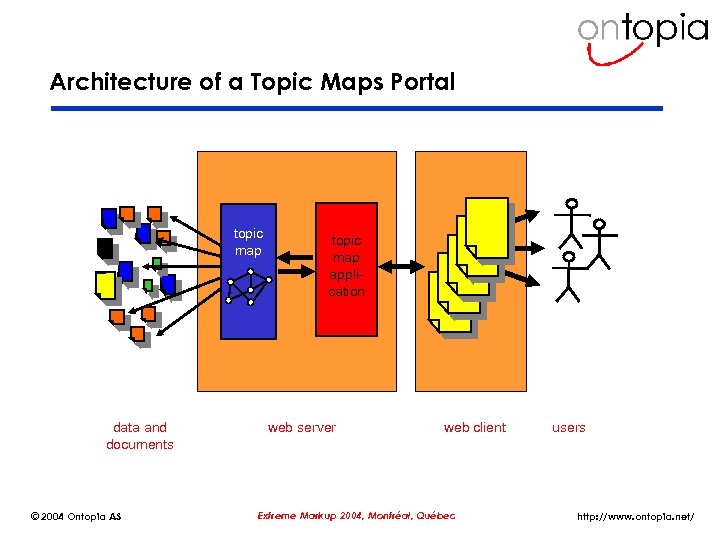 Architecture of a Topic Maps Portal topic map data and documents © 2004 Ontopia AS topic map application web server web client Extreme Markup 2004, Montréal, Québec users http: //www. ontopia. net/
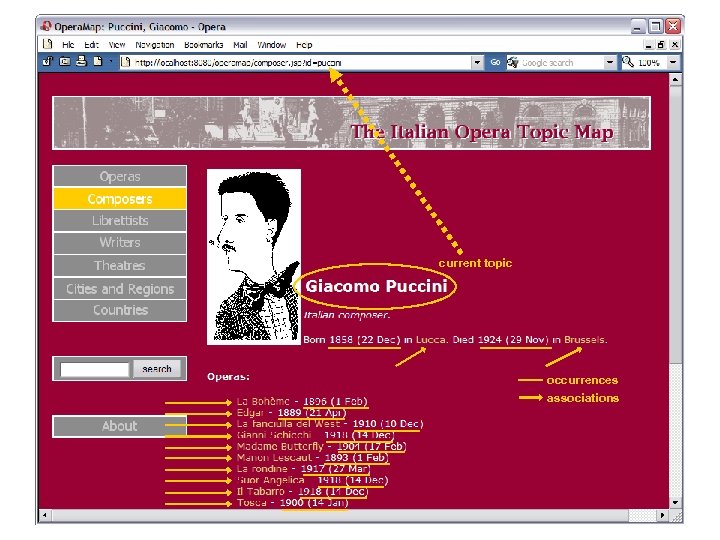 current topic occurrences associations
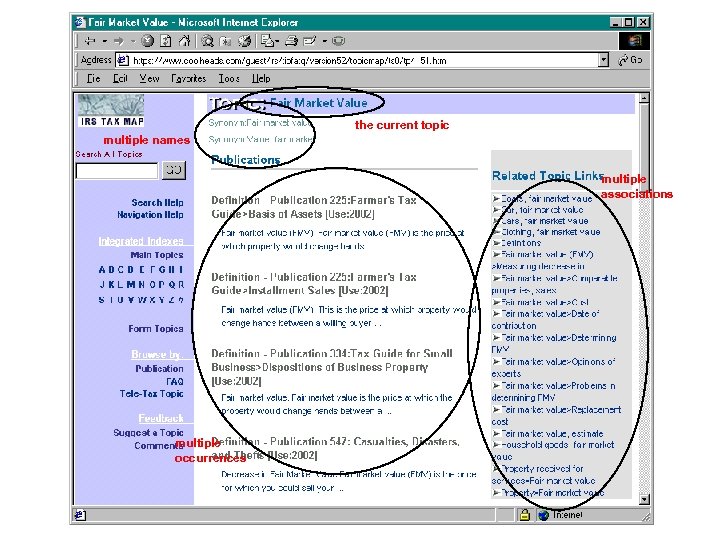 the current topic multiple names multiple associations multiple occurrences
 The Rise and Rise of Semantic Portals in Norway • In Norway, this concept has been put into practice on a scale that is now verging on the industrial… – There are over a dozen topic map-driven portals in production – More are on the way… • And while the rest of the world is asking questions like – “Metadata? ” “Taxonomies? ” “Ontologies? ” • …in Norway, customers are saying “Topic Maps!” – – • Rf. Ps regularly specify Topic Maps as a requirement Headhunters are looking for Topic Maps experts 120 people attended the last Topic Maps Congress (Norway: pop. 4 million) Topic Maps are quickly moving from “early adopter” to “early majority” How did this situation come about? – The presence of Ontopia was important, but not enough on its own – We needed a high visibility success story as well… © 2004 Ontopia AS Extreme Markup 2004, Montréal, Québec http: //www. ontopia. net/
 The ITU Story (in brief) • Once upon a time, not long ago (in late 2000), … • … the Network for IT Research and Competence in Education (ITU) was planning a new web site • They had rather special requirements… – “Relationships between objects and various groups of objects offer users multiple paths to the same content and stimulate cross-site content exploration. ” – “Visualisation of this network is supposed to give the user a conceptual model of the network, and give a feeling of being in a ‘relational space’. ” • The consultant leading the project was Stian Danenbarger • At exactly the same time, XTM 1. 0 was announced: – “A standardized notation … used to define topics, and the relationships between topics. . . A topic map defines a multidimensional topic space (in which) locations are topics… relationships […] define the path from one topic to another. ” – A light bulb went on for Stian… – Ontopia helped him build an Open Source web-based content management and publishing system that was entirely driven by topic maps, called ZTM (Zope Topic Maps) • … and ITU got the web site it was looking for: © 2004 Ontopia AS Extreme Markup 2004, Montréal, Québec http: //www. ontopia. net/
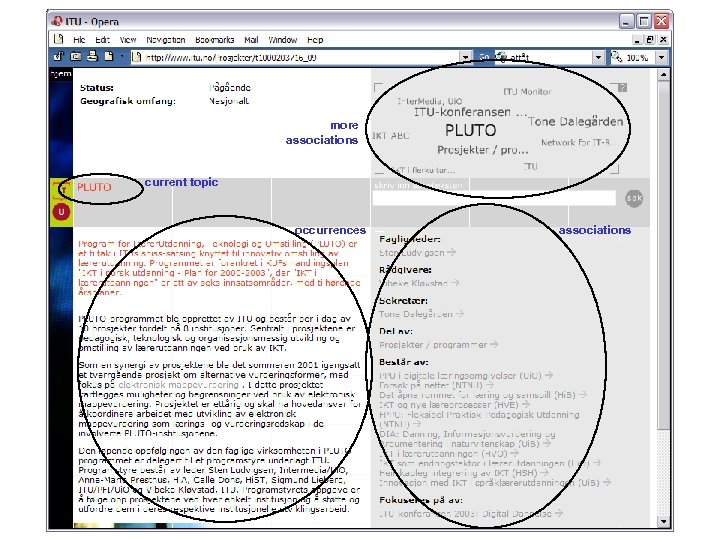 more associations current topic occurrences associations
 The success of ITU started a trend • ITU was “bleeding edge” in early 2001 – Stian calls it a “technical base jump – without a parachute” – Such adventures are not for the faint-hearted • Since then Topic Maps Portals have become a proven and well established technology – …at least in Norway. . . • ITU was followed by web sites for the Norwegian Research Council, the Norwegian Consumers Association and many others… – Some of these are based on ZTM – Others are based on other Topic Maps engines • At present there are over a dozen, with more on the way © 2004 Ontopia AS Extreme Markup 2004, Montréal, Québec http: //www. ontopia. net/
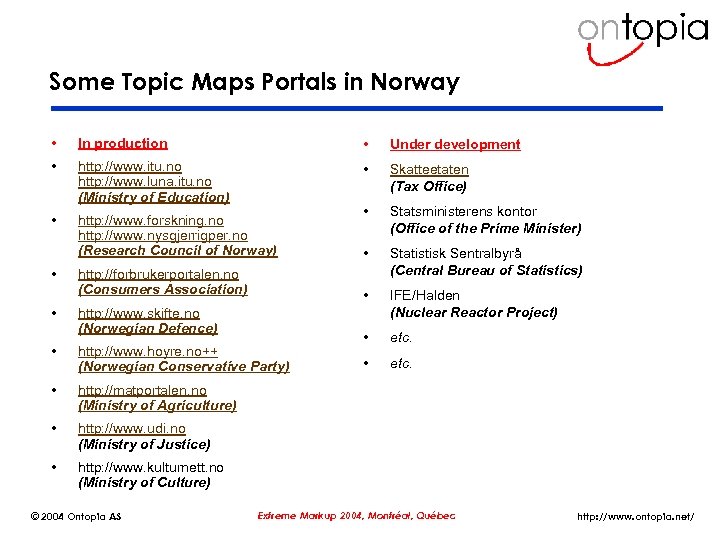 Some Topic Maps Portals in Norway • In production • Under development • http: //www. itu. no http: //www. luna. itu. no (Ministry of Education) • Skatteetaten (Tax Office) • http: //www. forskning. no http: //www. nysgjerrigper. no (Research Council of Norway) • Statsministerens kontor (Office of the Prime Minister) • Statistisk Sentralbyrå (Central Bureau of Statistics) • IFE/Halden (Nuclear Reactor Project) • etc. • • http: //forbrukerportalen. no (Consumers Association) http: //www. skifte. no (Norwegian Defence) • http: //www. hoyre. no++ (Norwegian Conservative Party) • http: //matportalen. no (Ministry of Agriculture) • http: //www. udi. no (Ministry of Justice) • http: //www. kulturnett. no (Ministry of Culture) © 2004 Ontopia AS Extreme Markup 2004, Montréal, Québec http: //www. ontopia. net/
 Towards Seamless Knowledge • As the number of portals multiplies, the amount of overlap increases… • Take these three portals as an example: • forskning. no (Research Council web site aimed at young adults) • forbrukerportalen. no (Public site of the Norwegian Consumer Association) • matportalen. no (Biosecurity portal of the Department of Agriculture) © 2004 Ontopia AS Extreme Markup 2004, Montréal, Québec http: //www. ontopia. net/
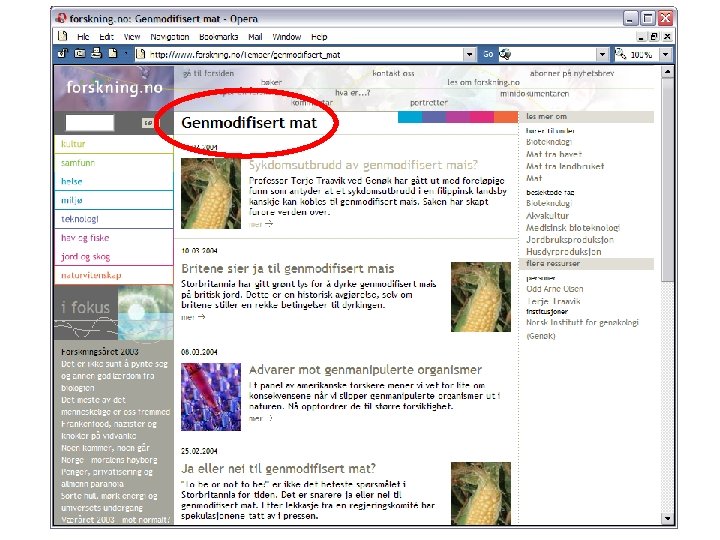 Genetically modified food at forskning. no
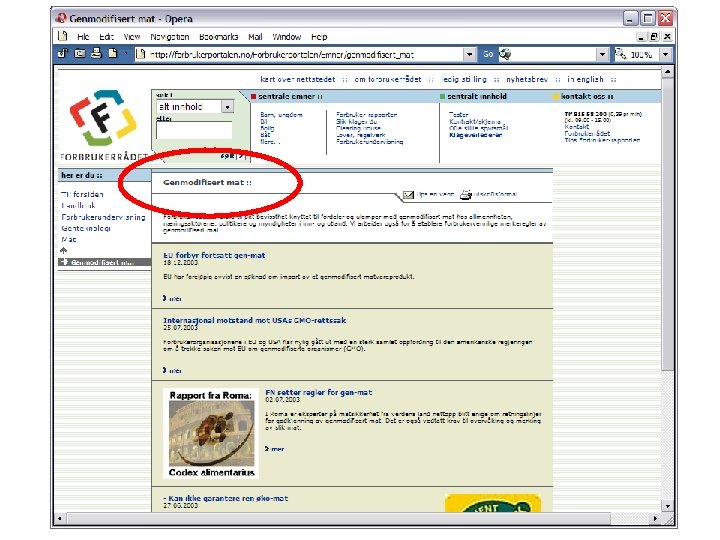 Genetically modified food at Forbukerrådet
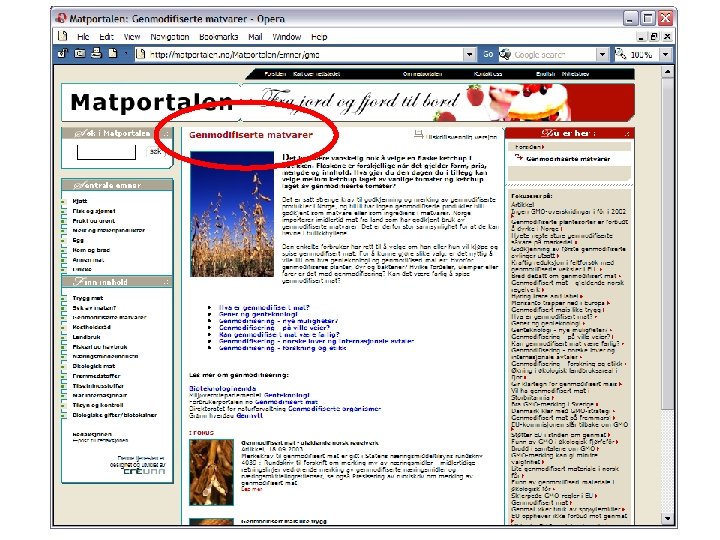 Genetically modified foodstuffs at Matportalen
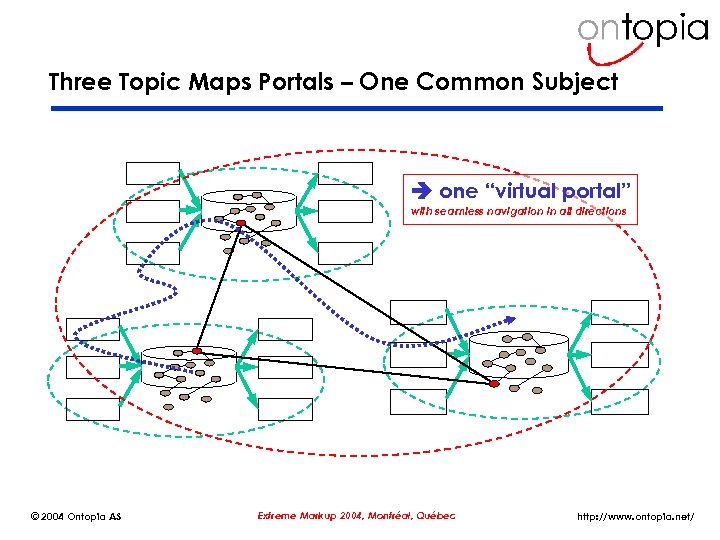 Three Topic Maps Portals – One Common Subject one “virtual portal” with seamless navigation in all directions © 2004 Ontopia AS Extreme Markup 2004, Montréal, Québec http: //www. ontopia. net/
 Towards Seamless Knowledge (part 1 of n) • Very little is required for these portals to achieve a simple but effective form of Seamless Knowledge • They have already achieved subject-based organization of their content – Without this, Seamless Knowledge is beyond reach • From a technical viewpoint, only two additional pieces are required to complete the puzzle: #1 An identity mechanism – To make it possible to know when their subjects are the same #2 An exchange protocol – To enable information to be requested and exchanged automatically • (There must also be a real desire to share information, but that’s a political matter) © 2004 Ontopia AS Extreme Markup 2004, Montréal, Québec http: //www. ontopia. net/
 Piece #1: The Identity Mechanism • Simply put: – How can we know that “genetically modified food” is the same as “genetically modified foodstuffs” (or “GM food”, or “genmodifisert mat”, for that matter)? • One thing is certain: Basing this on names won’t work – Synonyms, homonyms and polysemy make names a minefield – In any case we would like to multilingual knowledge integration • What is needed is nothing more or less than unique, “global” identifiers for all subjects of common interest • An impossible task? • Not if we go about it the right way… • In fact, the solution already exists in the form of a mechanism developed as part of the Topic Maps standard… • That mechanism is called Published Subjects © 2004 Ontopia AS Extreme Markup 2004, Montréal, Québec http: //www. ontopia. net/
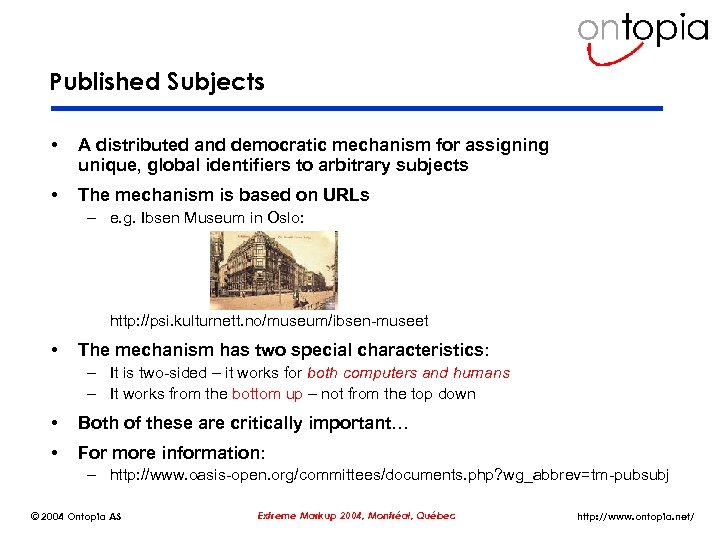 Published Subjects • A distributed and democratic mechanism for assigning unique, global identifiers to arbitrary subjects • The mechanism is based on URLs – e. g. Ibsen Museum in Oslo: http: //psi. kulturnett. no/museum/ibsen-museet • The mechanism has two special characteristics: – It is two-sided – it works for both computers and humans – It works from the bottom up – not from the top down • Both of these are critically important… • For more information: – http: //www. oasis-open. org/committees/documents. php? wg_abbrev=tm-pubsubj © 2004 Ontopia AS Extreme Markup 2004, Montréal, Québec http: //www. ontopia. net/
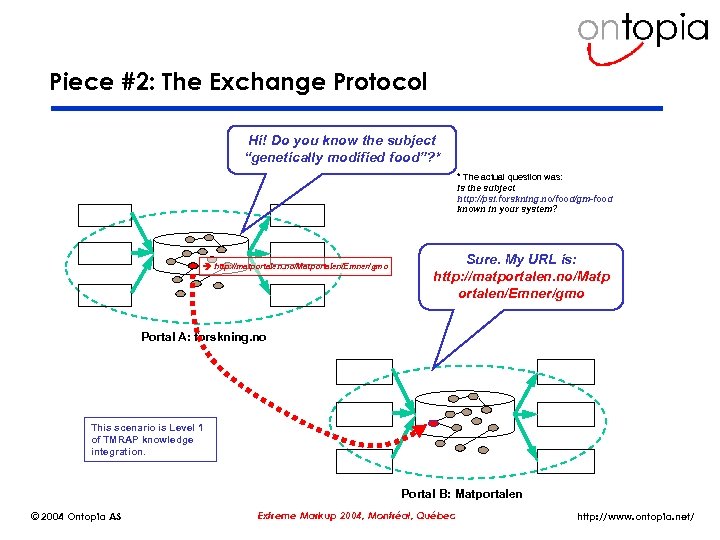 Piece #2: The Exchange Protocol Hi! Do you know the subject “genetically modified food”? * * The actual question was: Is the subject http: //psi. forskning. no/food/gm-food known in your system? http: //matportalen. no/Matportalen/Emner/gmo Sure. My URL is: http: //matportalen. no/Matp ortalen/Emner/gmo Portal A: forskning. no This scenario is Level 1 of TMRAP knowledge integration. Portal B: Matportalen © 2004 Ontopia AS Extreme Markup 2004, Montréal, Québec http: //www. ontopia. net/
 TMRAP (Topic Maps Remote Access Protocol) • Abstract protocol for getting information from remote repositories – The protocol has an HTTP REST binding – A SOAP binding would be easy to do • Any repository can support TMRAP – For topic map applications support TMRAP is very easy – For other applications it’s less easy, but the benefit is that legacy applications can be integrated • The OKS currently contains a prototype implementation – Used to implement the Vizigator applet – Also used for the Omnigator Rap demo • For a short introduction to TMRAP: – http: //www. jtc 1 sc 34. org/repository/0507. htm • Some related work: – RDF Net API: http: //www. w 3. org/Submission/2003/SUBM-rdf-netapi-20031002/ – SNAPI: http: //sourceforge. net/projects/snapi © 2004 Ontopia AS Extreme Markup 2004, Montréal, Québec http: //www. ontopia. net/
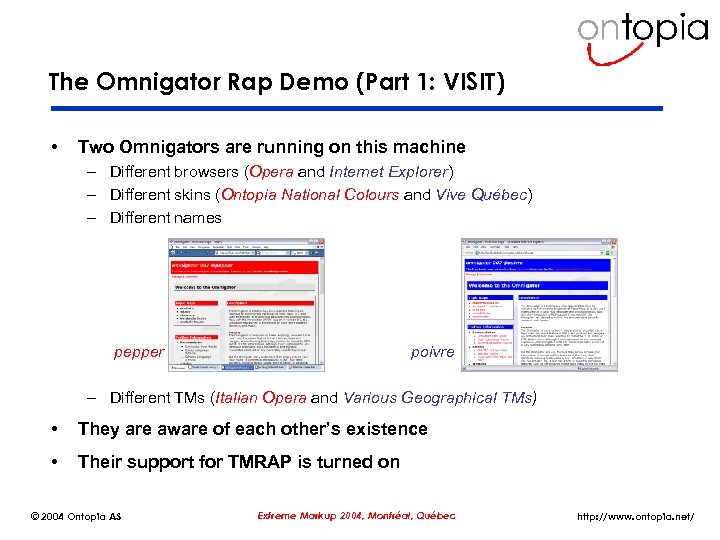 The Omnigator Rap Demo (Part 1: VISIT) • Two Omnigators are running on this machine – Different browsers (Opera and Internet Explorer) – Different skins (Ontopia National Colours and Vive Québec) – Different names pepper poivre – Different TMs (Italian Opera and Various Geographical TMs) • They are aware of each other’s existence • Their support for TMRAP is turned on © 2004 Ontopia AS Extreme Markup 2004, Montréal, Québec http: //www. ontopia. net/
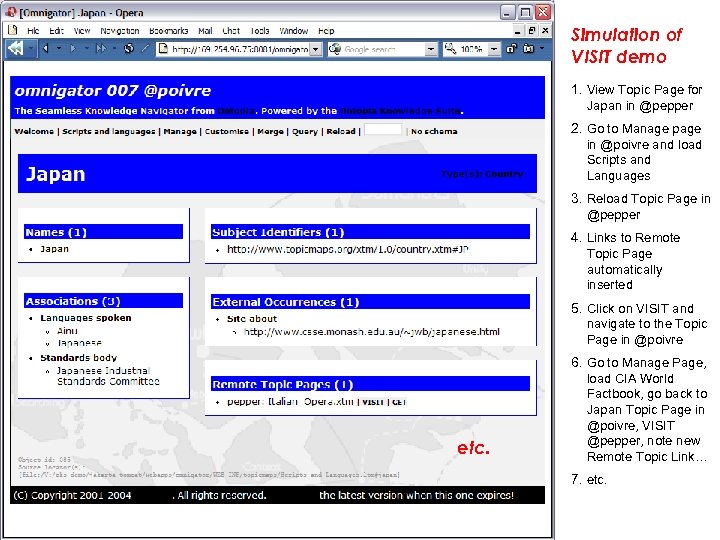 Simulation of VISIT demo 1. View Topic Page for Japan in @pepper 2. Go to Manage page in @poivre and load Scripts and Languages 3. Reload Topic Page in @pepper 4. Links to Remote Topic Page automatically inserted 5. Click on VISIT and navigate to the Topic Page in @poivre etc. 6. Go to Manage Page, load CIA World Factbook, go back to Japan Topic Page in @poivre, VISIT @pepper, note new Remote Topic Link… 7. etc.
 VISIT: Some Considerations • The functionality is deceptively simple, yet potential very powerful – From the user’s point of view the VISIT links might have been hand-coded (there is no visible difference) – The cool thing is that they are generated entirely automatically – This is spontaneous knowledge federation in practice!! • Think about it a bit: – Having multiple Omnigators rapping together is already fairly cool – In fact, any application built with the Ontopia Knowledge Suite can now join in the fun – And more importantly: – So can any application at all – whether or not it is based on Topic Maps – The only prerequisites are: • Subject-based organization (i. e. , some concept of Topic Pages) • Use of Published Subjects (for the purpose of subject identification) • Support for TMRAP (in order to send and respond to requests) © 2004 Ontopia AS Extreme Markup 2004, Montréal, Québec http: //www. ontopia. net/
 VISIT: More Considerations • How useful is it really? • Isn’t it a little simple-minded? • For many of our customers it is sufficient as a first step – The Norwegian Research Council and the Norwegian Consumers’ Association want to be able to link to each other in this way – The VISIT paradigm enables them to retain their own branding – At the same time, they offer their users an extremely valuable service • TMRAP is already being implemented in ZTM – When done, not only will the Research Council and the Consumers’ Association be able to rap together… – …any Omnigator user will also be able to rap with them! • And remember: – This game can be played by any service that uses some kind of subject-based organization and PSIs © 2004 Ontopia AS Extreme Markup 2004, Montréal, Québec http: //www. ontopia. net/
 The Omnigator Rap Demo (Part 2: GET) • But we can go a step further with relatively little effort • Remember: Topic Maps are designed for merging … • … so we can exchange not only Topic Page URLs • But also fragments of content in topic map form • We are calling those fragments topic maplets • TMRAP also supports exchanging maplets © 2004 Ontopia AS Extreme Markup 2004, Montréal, Québec http: //www. ontopia. net/
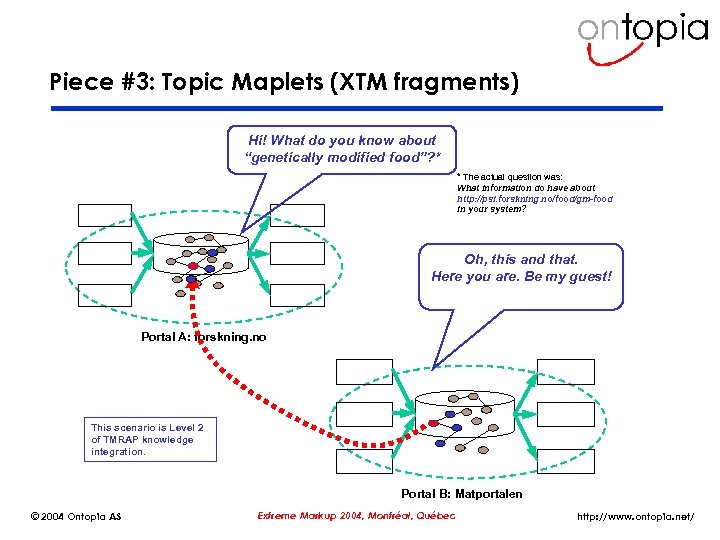 Piece #3: Topic Maplets (XTM fragments) Hi! What do you know about “genetically modified food”? * * The actual question was: What information do have about http: //psi. forskning. no/food/gm-food in your system? Oh, this and that. Here you are. Be my guest! Portal A: forskning. no This scenario is Level 2 of TMRAP knowledge integration. Portal B: Matportalen © 2004 Ontopia AS Extreme Markup 2004, Montréal, Québec http: //www. ontopia. net/
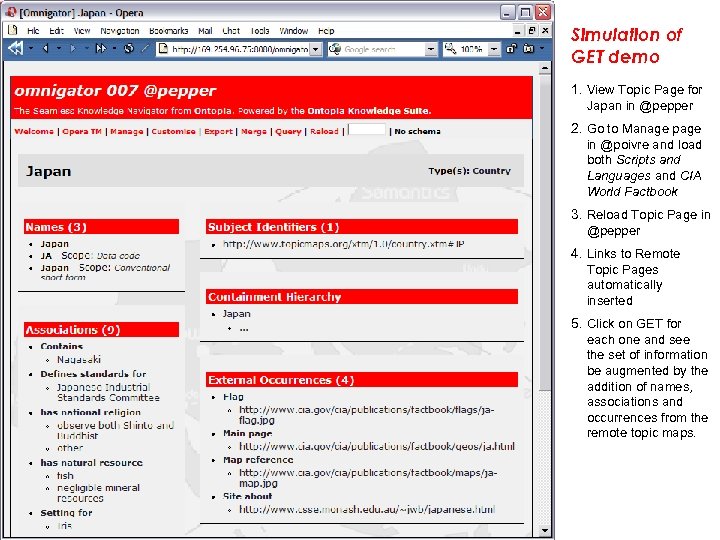 Simulation of GET demo 1. View Topic Page for Japan in @pepper 2. Go to Manage page in @poivre and load both Scripts and Languages and CIA World Factbook 3. Reload Topic Page in @pepper 4. Links to Remote Topic Pages automatically inserted 5. Click on GET for each one and see the set of information be augmented by the addition of names, associations and occurrences from the remote topic maps.
 GET: Some Considerations • The functionality is even more powerful… – The seamlessness factor is much greater – (In fact we have “dumbed it down” in this Omnigator implementation in order to be able to show what is going on: The GET functionality could be activated automatically) • It’s also somewhat more complex than meets the eye… – There a number of issues related to Topic Maplets – The most important is deciding exactly what the fragment should contain – There a number of possible approaches to deciding the maplet topology… © 2004 Ontopia AS Extreme Markup 2004, Montréal, Québec http: //www. ontopia. net/
 Maplet Topologies • The approach we have chosen for our initial implementation is, for a given topic identifier, to return – – – • All the identifiers of corresponding topic All of that topic’s names (including their scopes and variant names) All its occurrences (and their scopes and types) All associations in which it plays a role (and their scopes and types) All players of roles in those associations (the “associated topics”) All identifiers and one name (preferably in the unconstrained scope) for all scoping topics, typing topics, and “associated topics” This gives us sufficient information to provide a useful view for the user and to be able to repeat the process incrementally – However, more work needs to be done on XTM Fragments in general • References: – http: //www. techquila. com/topicmapster. html – http: //www. ontopia. net/topicmaps/materials/xtm-fragments. html © 2004 Ontopia AS Extreme Markup 2004, Montréal, Québec http: //www. ontopia. net/
 TMRAP – Abstract Protocol • get. Topic. Main. Page(topic identity) – Returns XML structure with links to the Topic Page(s) for the identified topic(s) • get. Topic. XTM(topic identity) – Returns XTM fragment (topic maplet) for the identified topic(s) • The topic identity is the topic’s – subject identifiers, – source locators, and – subject locator © 2004 Ontopia AS Extreme Markup 2004, Montréal, Québec http: //www. ontopia. net/
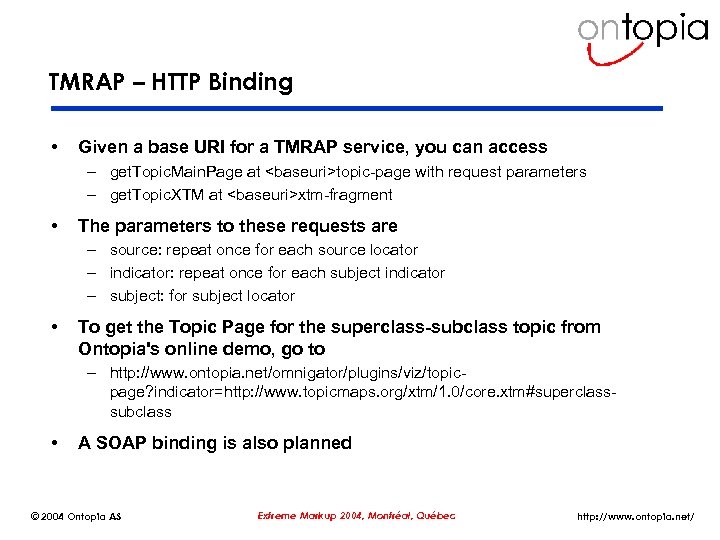 TMRAP – HTTP Binding • Given a base URI for a TMRAP service, you can access – get. Topic. Main. Page at
 TMRAP future • Once TMQL is ready we can add a request for returning TMQL results – – • TMQL will be able to produce topic maplets as the query results These topic maps can then be exported as XTM and returned This allows advanced and fine-grained information retrieval An implementation using Ontopia’s query language tolog is planned Once TMQL-Update is ready, remote updates are also possible – A TMQL update statement can be sent that updates the remote topic map • Even now simple updates are possible – An XTM upload feature would allow quite advanced additions to the topic map – With conventions and algorithms for controlling updates this can be used to update, or even build, the topic map remotely • For more information on TMQL: – http: //www. isotopicmaps. org/tmql/ © 2004 Ontopia AS Extreme Markup 2004, Montréal, Québec http: //www. ontopia. net/
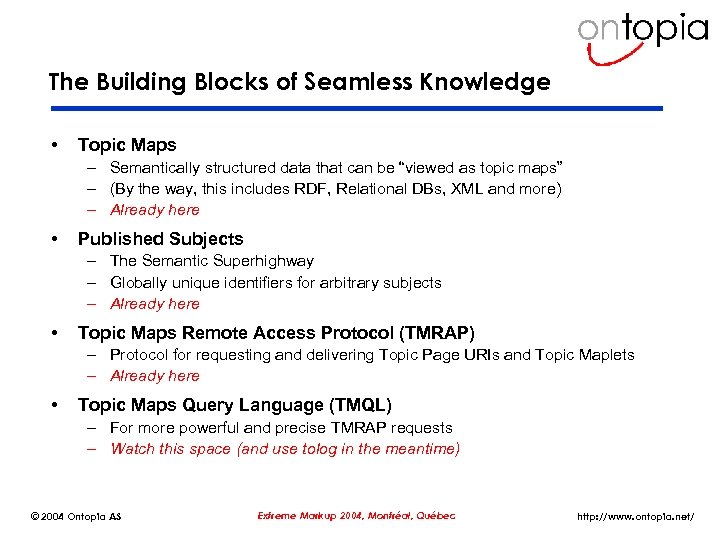 The Building Blocks of Seamless Knowledge • Topic Maps – Semantically structured data that can be “viewed as topic maps” – (By the way, this includes RDF, Relational DBs, XML and more) – Already here • Published Subjects – The Semantic Superhighway – Globally unique identifiers for arbitrary subjects – Already here • Topic Maps Remote Access Protocol (TMRAP) – Protocol for requesting and delivering Topic Page URIs and Topic Maplets – Already here • Topic Maps Query Language (TMQL) – For more powerful and precise TMRAP requests – Watch this space (and use tolog in the meantime) © 2004 Ontopia AS Extreme Markup 2004, Montréal, Québec http: //www. ontopia. net/
 Seamless Knowledge and the Semantic Web • Are they the same thing? – Not if you go by the vision of the Semantic Web articulated by Tim Berners-Lee and the W 3 C (e. g. , in the famous Scientific American article) – In reality, that amounts to AI on the Web – Most business users today don’t need AI and they don’t want to be restricted to the Web • On the other hand, semantics are akin to knowledge … and seamlessness implies the existence of something web-like – So in a broader sense they do have a lot in common – Certainly Semantic Web data (read: RDF) will be easily reusable in the context of Seamless Knowledge • However, the Semantic Web won’t be here for many years – There is much research still to be done • Seamless Knowledge is achievable today – The problem of disconnected knowledge on a less ambitious scale © 2004 Ontopia AS Extreme Markup 2004, Montréal, Québec http: //www. ontopia. net/
 Further work on TMRAP • Extending the protocol – More structured get. Topic. Page request – Ability to specify maplet topologies more precisely – Support for TMQL queries • Implementation in other engines – ZTM and TM 4 J are the prime candidates – An extension to Joseki (Jena RDF server) would also be fun – RDBMS-driven applications are also interesting targets • Evaluating “competing” technologies – JSR 168: Portlet specification (Java Community Process) – WSRP: Web Services for Remote Portlets (OASIS) • Evaluating complementary technologies – Jabber (Open Source XML chat protocols) – JXTA (Java peer-to-peer technology) – … © 2004 Ontopia AS Extreme Markup 2004, Montréal, Québec http: //www. ontopia. net/
 Conclusions • Topic Maps have crossed the chasm – at least in Norway – Web sites, Portals, E-learning, Knowledge Management, Enterprise Knowledge Integration, … • Seamless Knowledge is a more appropriate banner to march under – “Topic Maps” speaks only to the technology – CIOs are interested in business benefits and ROI • The TMRAP approach redefines what it means to be a “Topic Maps Application” – Provided information can be made to look like a topic map, any legacy technology can play – The key is subject-based organization of information • Extreme Markup is a very cool place for extremists! – See you there next year! © 2004 Ontopia AS Extreme Markup 2004, Montréal, Québec http: //www. ontopia. net/