


 Скачать презентацию SEADMC 2009 Overview of Regional and International Disaster
4724550365356cdfdcb8c8d9c92248a1.ppt
- Количество слайдов: 21
 SEADMC 2009 Overview of Regional and International Disaster Management & Emergency Response Mechanisms 2 December 2009 UNCLASSIFIED 1
 Agenda • Definitions • The Dilemma • Paradigms – Organizational – Sectoral – Functional • Where are we now? • Where are we going? UNCLASSIFIED 2
 Definitions • Disaster Management – continuous process by which all individuals, groups, and communities manage hazards in an effort to avoid or ameliorate the impact of disasters resulting from the hazards • Emergency Response – mobilization of emergency response capabilities to address the needs of the affected population UNCLASSIFIED 3
 Definitions • Mechanism – A process, technique or system for achieving results – Captured in: Plans § Guidelines § Procedures § – There are internal & external mechanisms Most of the internal mechanisms are well-developed § External mechanisms between systems are in various stages of development § UNCLASSIFIED 4
 The Dilemma • Are we better prepared and more capable today? –To respond to another occurrence of the December 2004 Indian Ocean earthquake and tsunamis? –To respond to a major disaster resulting from the explosion of Anak Krakatau volcano? UNCLASSIFIED 5
 Paradigms • Organizational: –States (affected, assisting & transit) –Regional Organization(s) –Humanitarian § UN Agencies, Funds, & Programs § International Organizations (IOs) § Nongovernmental Organizations (NGOs) § Red Cross / Red Crescent Movement –Civil Society (local) UNCLASSIFIED 6
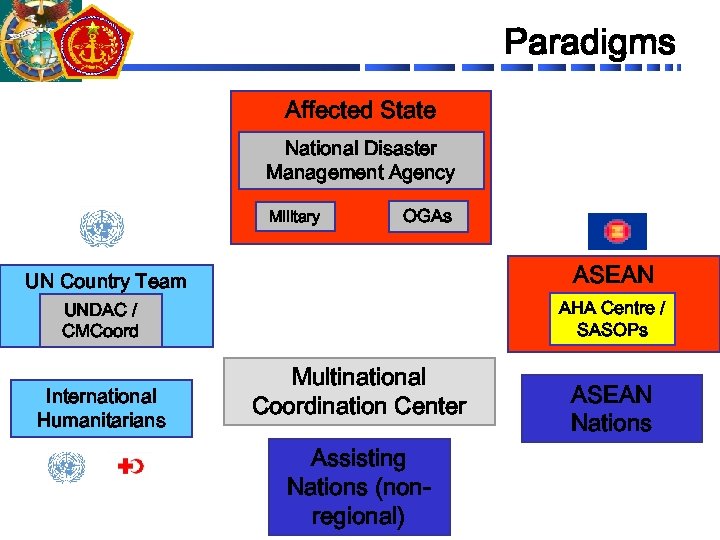 Paradigms Affected State National Disaster Management Agency Military OGAs ASEAN UN Country Team AHA Centre / SASOPs UNDAC / CMCoord International Humanitarians Multinational Coordination Center Assisting Nations (nonregional) ASEAN Nations
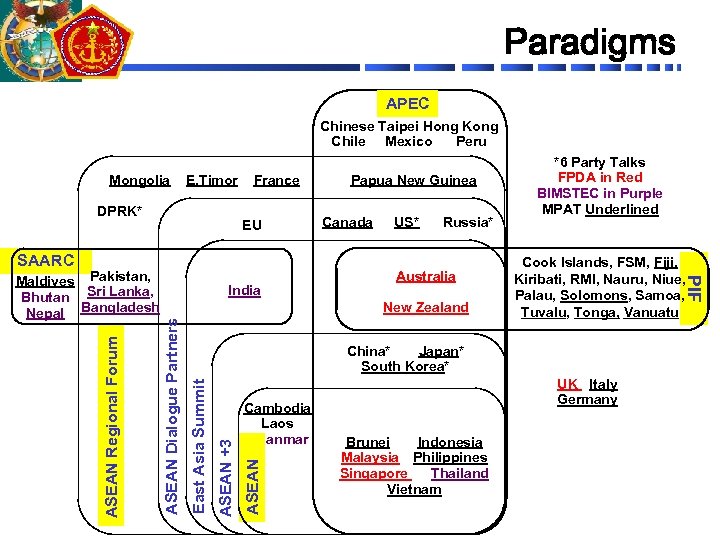 Paradigms APEC Chinese Taipei Hong Kong Chile Mexico Peru Mongolia E. Timor DPRK* France EU SAARC US* Russia* Australia New Zealand Cook Islands, FSM, Fiji, Kiribati, RMI, Nauru, Niue, Palau, Solomons, Samoa, Tuvalu, Tonga, Vanuatu Cambodia Laos Myanmar ASEAN +3 China* Japan* South Korea* East Asia Summit ASEAN Dialogue Partners ASEAN Regional Forum India Canada PIF Maldives Pakistan, Bhutan Sri Lanka, Nepal Bangladesh Papua New Guinea *6 Party Talks FPDA in Red BIMSTEC in Purple MPAT Underlined UK Italy Germany Brunei Indonesia Malaysia Philippines Singapore Thailand Vietnam
 Paradigms • Functional –Disaster Risk Reduction § International Strategy for Disaster Risk Reduction § Development Efforts –Disaster Response § Local Emergency Management (fire, police, emergency medical) § Lead Emergency Management Agency § International Search and Rescue § Humanitarian Relief Organizations UNCLASSIFIED 9
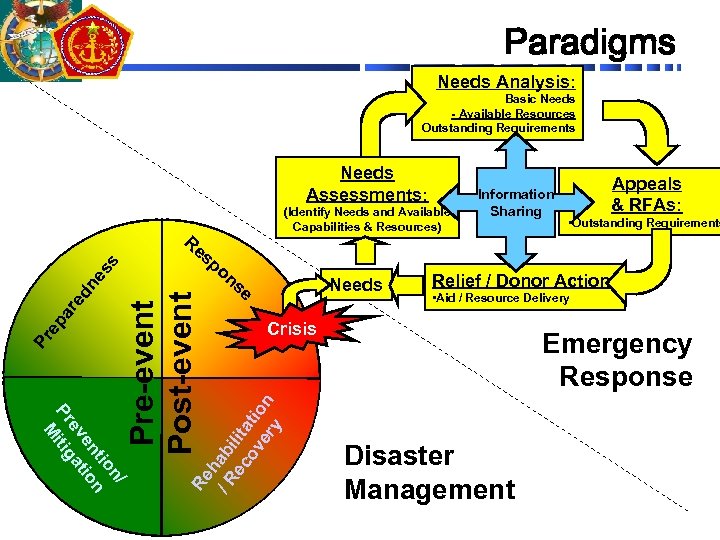 Paradigms Needs Analysis: Basic Needs - Available Resources Outstanding Requirements Needs Assessments: (Identify Needs and Available Capabilities & Resources) sp on se Needs Appeals & RFAs: • Outstanding Requirements Relief / Donor Action: • Aid / Resource Delivery Crisis Re h / R ab ec ilita ov tio er n y n/ tio n en io ev at Pr itig M Pre-event Post-event Pr ep ar ed n es s Re Information Sharing Emergency Response Disaster Management
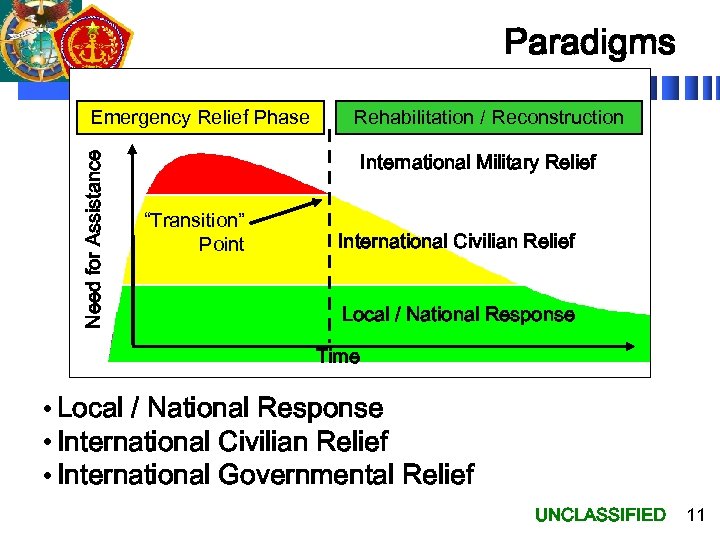 Paradigms Need for Assistance Emergency Relief Phase Rehabilitation / Reconstruction International Military Relief “Transition” Point International Civilian Relief Local / National Response Time • Local / National Response • International Civilian Relief • International Governmental Relief UNCLASSIFIED 11
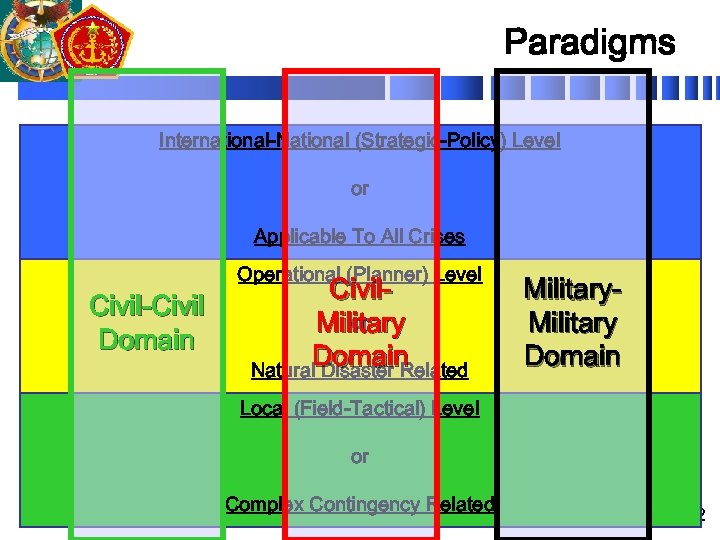 Paradigms International-National (Strategic-Policy) Level or Applicable To All Crises Civil-Civil Domain Operational (Planner) Level Civilor Military Domain Natural Disaster Related Military Domain Local (Field-Tactical) Level or Complex Contingency Related UNCLASSIFIED 12
 Paradigms • Sectoral – Cluster Approach – a mechanism that can help to address identified gaps in response and enhance the quality of humanitarian action Globally: strengthen system-wide preparedness and technical capacity to respond to humanitarian emergencies by ensuring that there is predictable leadership and accountability in all the main sectors or areas of humanitarian response § Nationally: strengthen humanitarian response by demanding high standards of predictability, accountability and partnership in all sectors or areas of activity § UNCLASSIFIED 13
 Where are we now? • Given the various ways of approaching disaster management & emergency response, organizational adjustments, promulgations of guidelines and mechanisms, activities and supporting efforts, are we better prepared? UNCLASSIFIED 14
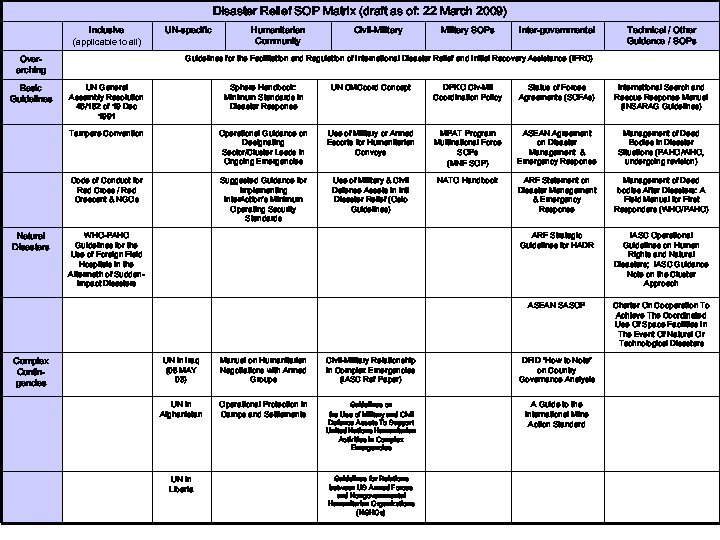 Disaster Relief SOP Matrix (draft as of: 22 March 2009) Inclusive (applicable to all) Overarching Basic Guidelines UN-specific Humanitarian Community Civil-Military SOPs Inter-governmental Technical / Other Guidance / SOPs Guidelines for the Facilitation and Regulation of International Disaster Relief and Initial Recovery Assistance (IFRC) UN CMCoord Concept DPKO Civ-Mil Coordination Policy Status of Forces Agreements (SOFAs) International Search and Rescue Response Manual (INSARAG Guidelines) Operational Guidance on Designating Sector/Cluster Leads in Ongoing Emergencies Use of Military or Armed Escorts for Humanitarian Convoys MPAT Program Multinational Force SOPs (MNF SOP) ASEAN Agreement on Disaster Management & Emergency Response Management of Dead Bodies in Disaster Situations (PAHO/WHO, undergoing revision) Code of Conduct for Red Cross / Red Crescent & NGOs Suggested Guidance for Implementing Inter. Action’s Minimum Operating Security Standards Use of Military & Civil Defense Assets in Intl Disaster Relief (Oslo Guidelines) NATO Handbook ARF Statement on Disaster Management & Emergency Response Management of Dead bodies After Disasters: A Field Manual for First Responders (WHO/PAHO) ARF Strategic Guidelines for HADR IASC Operational Guidelines on Human Rights and Natural Disasters; IASC Guidance Note on the Cluster Approach ASEAN SASOP Complex Contingencies Sphere Handbook: Minimum Standards in Disaster Response Tampere Convention Natural Disasters UN General Assembly Resolution 46/182 of 19 Dec 1991 Charter On Cooperation To Achieve The Coordinated Use Of Space Facilities In The Event Of Natural Or Technological Disasters WHO-PAHO Guidelines for the Use of Foreign Field Hospitals in the Aftermath of Sudden. Impact Disasters UN in Iraq (08 MAY 03) Manual on Humanitarian Negotiations with Armed Groups Civil-Military Relationship in Complex Emergencies (IASC Ref Paper) DFID “How to Note” on Country Governance Analysis UN in Afghanistan Operational Protection in Camps and Settlements Guidelines on the Use of Military and Civil Defence Assets To Support United Nations Humanitarian Activities in Complex Emergencies A Guide to the International Mine Action Standard UN in Liberia Guidelines for Relations between US Armed Forces and Nongovernmental Humanitarian Organizations (NGHOs) UNCLASSIFIED 15
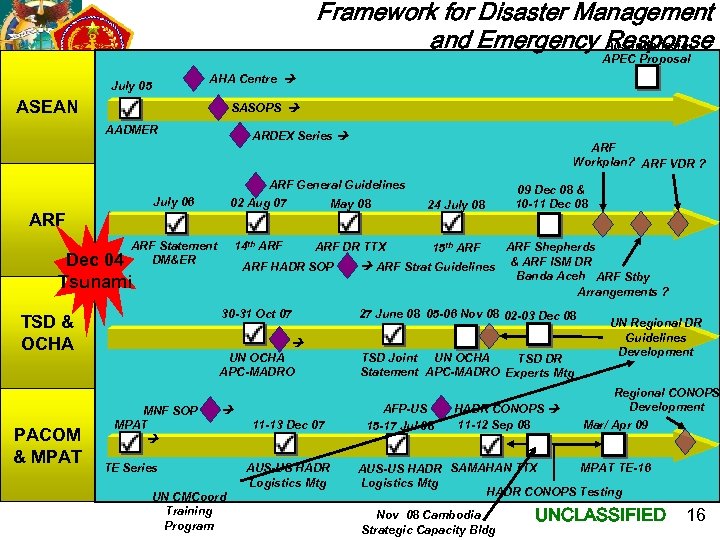 Framework for Disaster Management and Emergency Aus-Indonesia Response APEC Proposal AHA Centre July 05 ASEAN SASOPS AADMER ARDEX Series ARF General Guidelines 02 Aug 07 May 08 July 06 ARF Statement DM&ER 14 th ARF Dec 04 Tsunami PACOM & MPAT ARF HADR SOP 24 July 08 09 Dec 08 & 10 -11 Dec 08 ARF Shepherds ARF Strat Guidelines & ARF ISM DR Banda Aceh ARF Stby Arrangements ? ARF DR TTX 30 -31 Oct 07 TSD & OCHA ARF Workplan? ARF VDR ? 15 th ARF 27 June 08 05 -06 Nov 08 02 -03 Dec 08 UN OCHA APC-MADRO MNF SOP MPAT 11 -13 Dec 07 TE Series UN CMCoord Training Program AUS-US HADR Logistics Mtg TSD Joint UN OCHA TSD DR Statement APC-MADRO Experts Mtg AFP-US 15 -17 Jul 08 HADR CONOPS 11 -12 Sep 08 UN Regional DR Guidelines Development Regional CONOPS Development Mar/ Apr 09 MPAT TE-16 AUS-US HADR SAMAHAN TTX Logistics Mtg HADR CONOPS Testing Nov 08 Cambodia Strategic Capacity Bldg UNCLASSIFIED 16
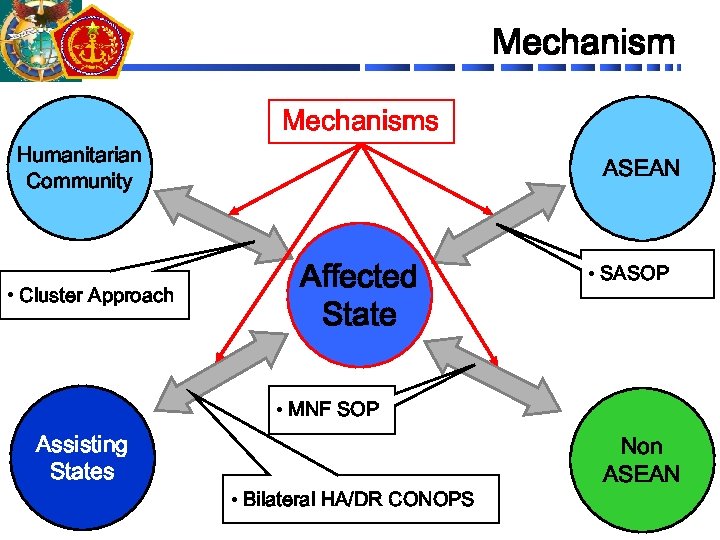 Mechanisms Humanitarian Community • Cluster Approach ASEAN Affected State • SASOP • MNF SOP Assisting States • Bilateral HA/DR CONOPS Non ASEAN
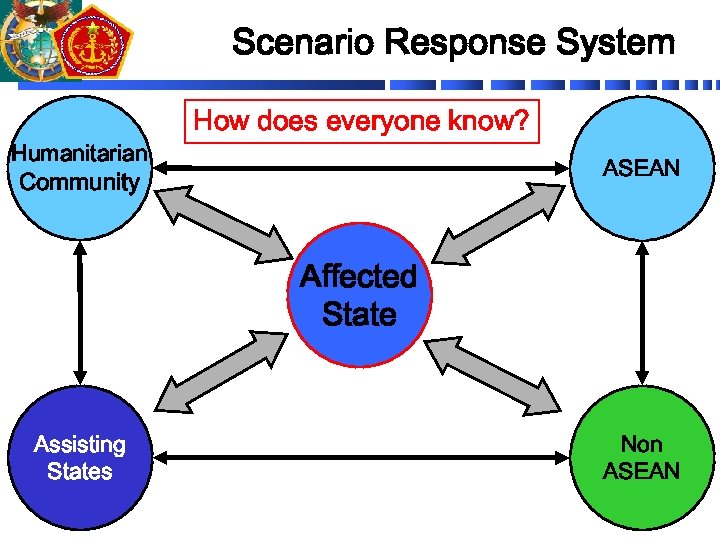 Scenario Response System Humanitarian Community How does everyone know? ASEAN Affected State Assisting States Non ASEAN UNCLASSIFIED 18
 Where are we going? • What will the future of disaster management and emergency response be? –Will we continue down the current path of incremental improvements? –Will there be a move toward greater cohesion? –Will there be a paradigm shift? UNCLASSIFIED 19
 Where are we going? • What will the future of disaster management and emergency response be? –How will the role of major actors and stakeholders change (i. e. , governments, humanitarians, regional and international organizations)? –Who will be in charge? UNCLASSIFIED 20
 Discussion UNCLASSIFIED