


 Скачать презентацию Sea-Force Presentation Outline Introduction Conclusions Total Ship Evaluation
74e992df6beeff43c8d9453582962fec.ppt
- Количество слайдов: 97
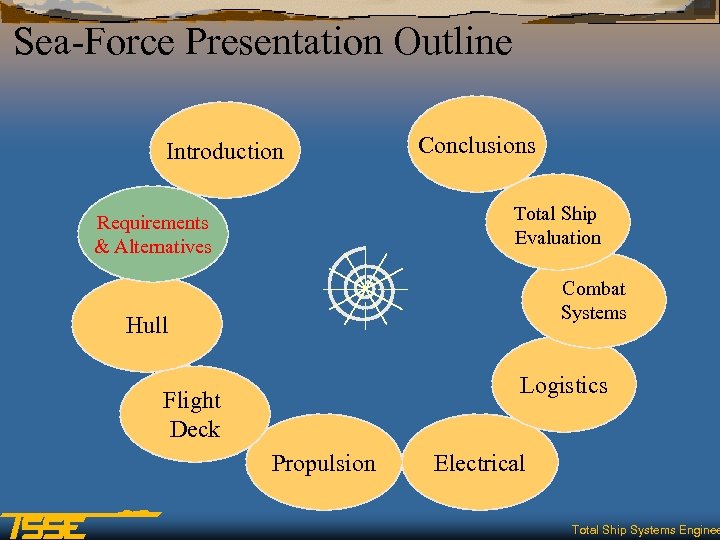
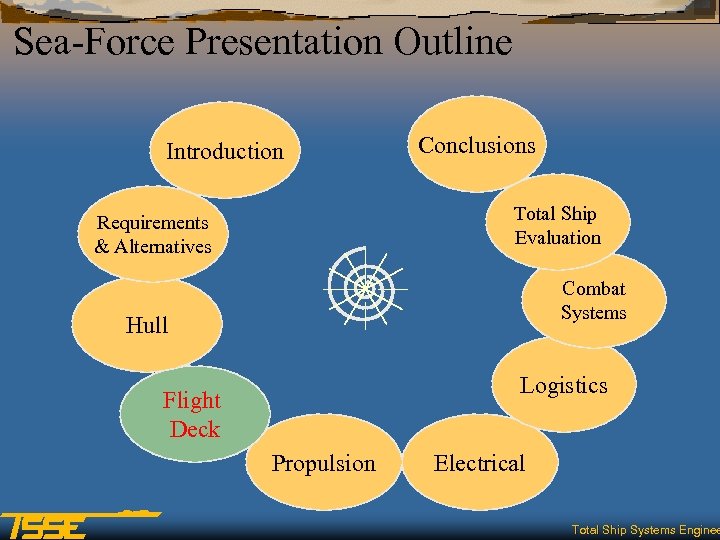
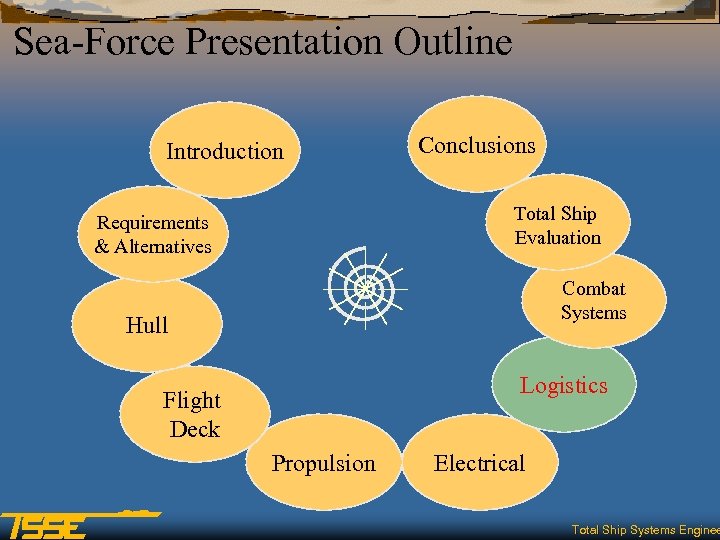
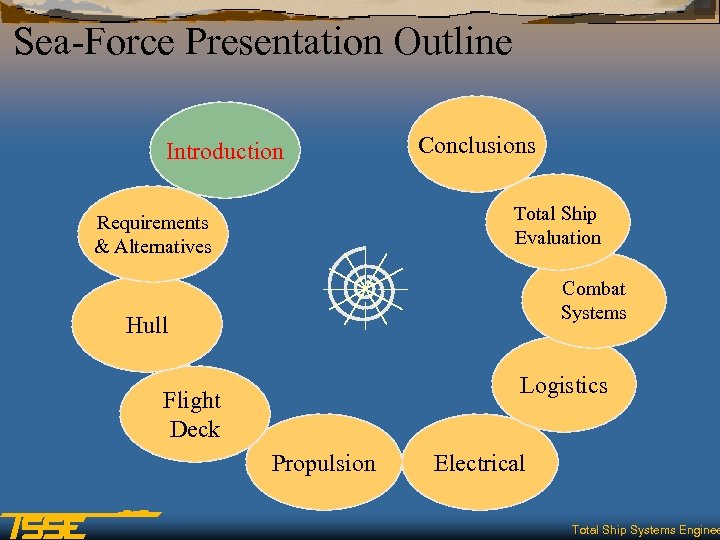 Sea-Force Presentation Outline Introduction Conclusions Total Ship Evaluation Requirements & Alternatives Combat Systems Hull Logistics Flight Deck Propulsion Electrical Total Ship Systems Enginee
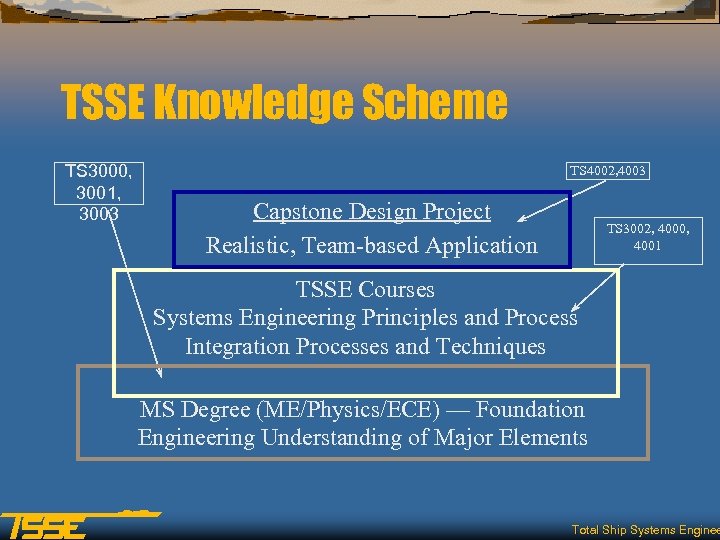 TSSE Knowledge Scheme TS 3000, 3001, 3003 TS 4002, 4003 Capstone Design Project Realistic, Team-based Application TS 3002, 4000, 4001 TSSE Courses Systems Engineering Principles and Process Integration Processes and Techniques MS Degree (ME/Physics/ECE) — Foundation Engineering Understanding of Major Elements Total Ship Systems Enginee
 2002 TSSE Faculty and Team Members • Faculty Members • Professor Harney • Professor Papoulias • Team Members • LT Luis Alvarez, USN • LT Jihed Boulares, Tunisia Navy • MAJ Keng-Shin Chong, RSN • LT Lynn Fodrea, USN • LT Brian Higgins, USCG • LT Seth Miller, USN • LTJG Korkut Murat, Turkish Navy • LT Koray Savur, Turkish Navy • LT Matt Steeno, USN • MAJ Chong-Ann Teh, RSN • LT Dwight Warnock, USN More information at www. nps. navy. mil/tsse/ Total Ship Systems Enginee
 Design Project Guidance …to examine the concepts associated with “seabasing”. and …produce a design for a ship to enable effective seabasing. and …explore the feasibility of building an LHA, MPF, and LMSR on a common hull form. Total Ship Systems Enginee
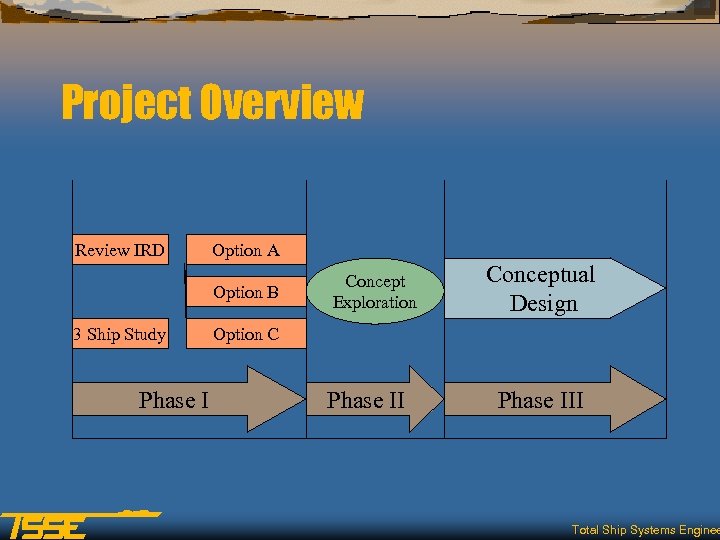 Project Overview Review IRD Option A Option B 3 Ship Study Phase I Concept Exploration Conceptual Design Option C Phase III Total Ship Systems Enginee
 Design Constraints • • • Access to major U. S. ports. Draft and height not greater than that of a CVN. Length less than 1000 ft. Displacement not greater than 100 k LT Technology ready for shipboard installation in 2020. Total Ship Systems Enginee
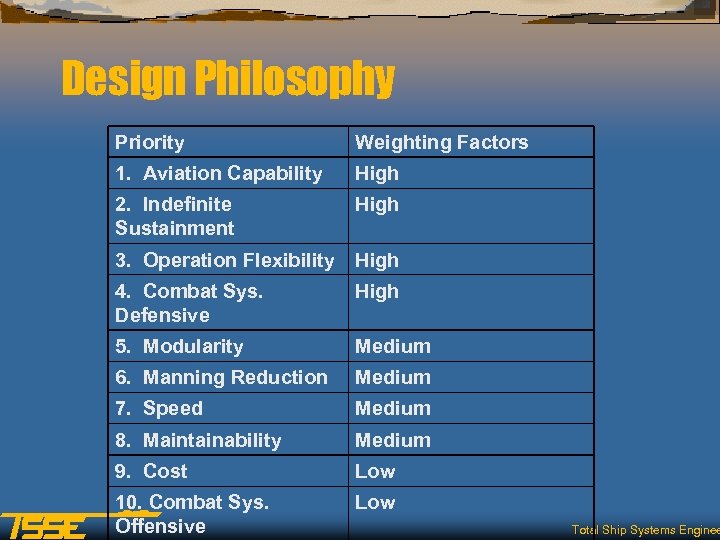 Design Philosophy Priority Weighting Factors 1. Aviation Capability High 2. Indefinite Sustainment High 3. Operation Flexibility High 4. Combat Sys. Defensive High 5. Modularity Medium 6. Manning Reduction Medium 7. Speed Medium 8. Maintainability Medium 9. Cost Low 10. Combat Sys. Offensive Low Total Ship Systems Enginee
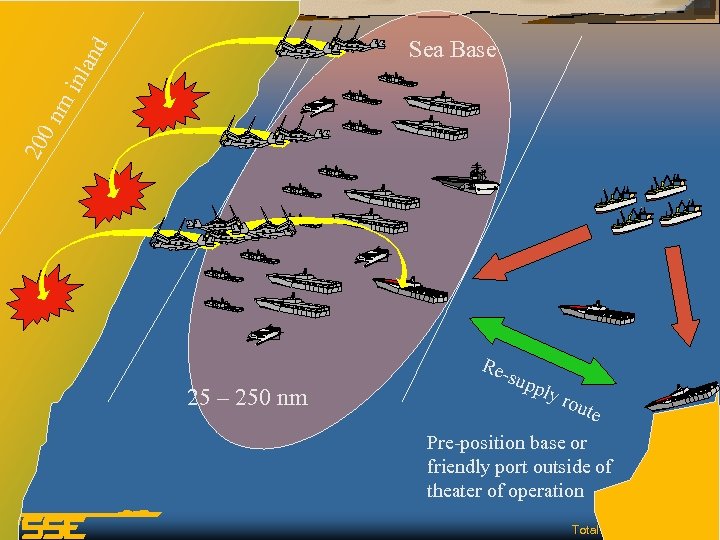 nm inl and Sea Base Chris Wagner 20 0 Chris Wagner Chris Wagner Chris Wagner 25 – 250 nm Resu ppl y ro ute r is Wa gne Chr Pre-position base or friendly port outside of theater of operation Total Ship Systems Enginee
 Sea-Force Presentation Outline Introduction Conclusions Total Ship Evaluation Requirements & Alternatives Combat Systems Hull Logistics Flight Deck Propulsion Electrical Total Ship Systems Enginee
 Requirements Analysis • Systems Engineering and Analysis • Initial Requirements Document requests family of ships capable of Sea Basing and STOM • TSSE System Engineering Methodology • “Top Down” analysis of IRD • Traceability • Context • “Bottom Up” study of planned platforms Total Ship Systems Enginee
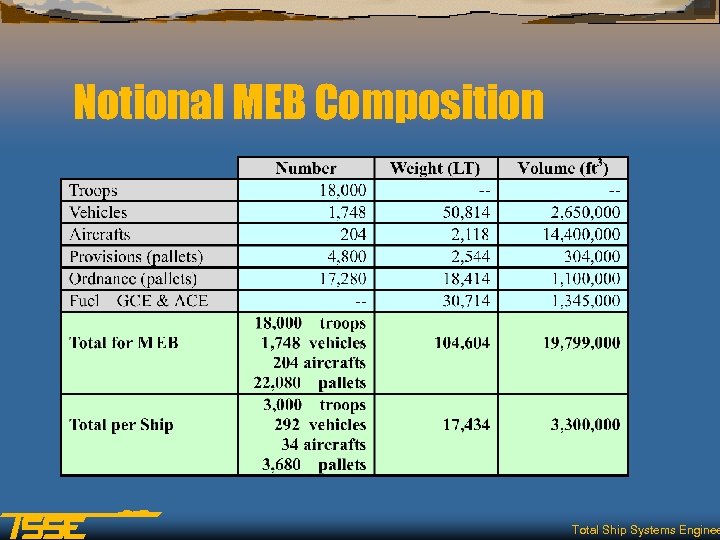 Notional MEB Composition Total Ship Systems Enginee
 Analysis of Alternatives • A. Single Ship Design • One hull form • Combat configured or logistics configured • B. LHA/MPF with LMSR • LHA/MPF variant – troops, hospital, combat systems • LMSR variant – fuel, provisions, ammo • C. MPF/LMSR with LHA • MPF/LMSR variant – troops, hospital, stores Total Ship Systems Enginee
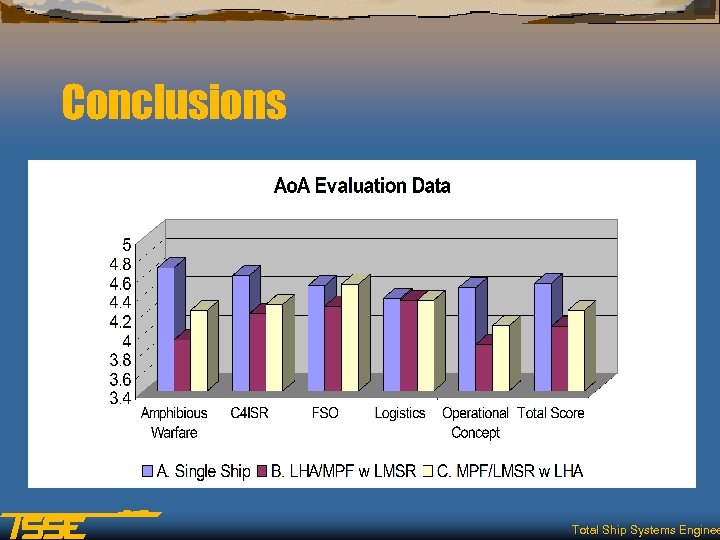 Conclusions Total Ship Systems Enginee
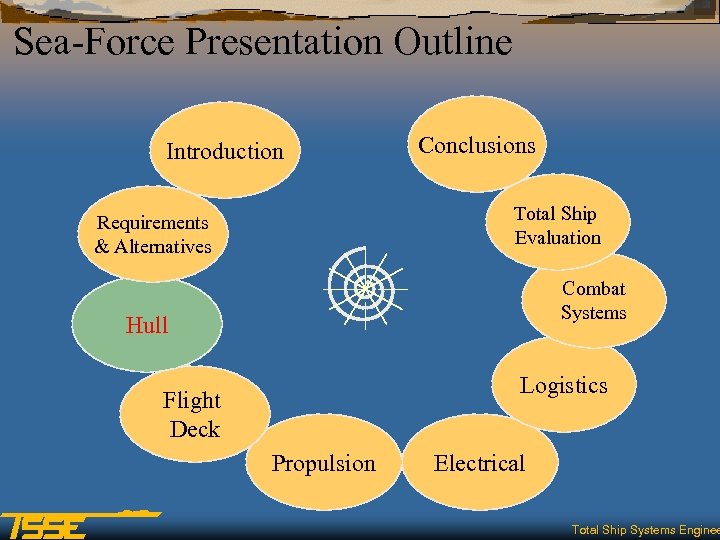 Sea-Force Presentation Outline Introduction Conclusions Total Ship Evaluation Requirements & Alternatives Combat Systems Hull Logistics Flight Deck Propulsion Electrical Total Ship Systems Enginee
 What we needed in a hull design: • • • Large cargo capacity Large flight deck Space for a well deck Durability/Survivability Propulsion efficiency Total Ship Systems Enginee
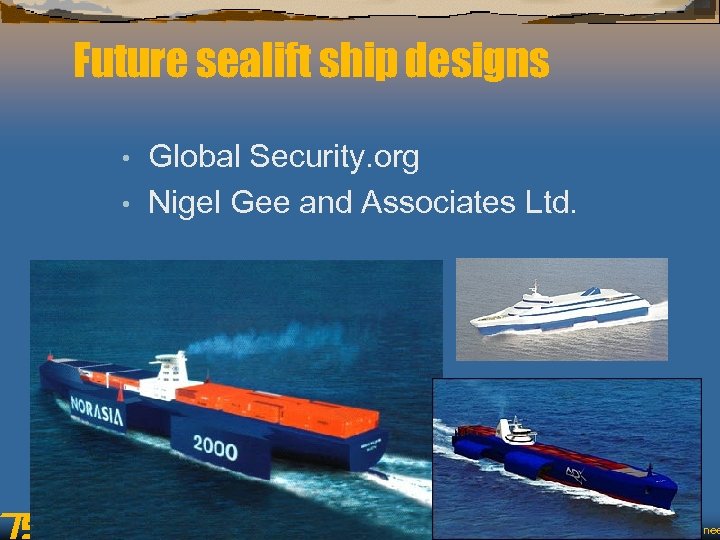 Future sealift ship designs Global Security. org • Nigel Gee and Associates Ltd. • Total Ship Systems Enginee
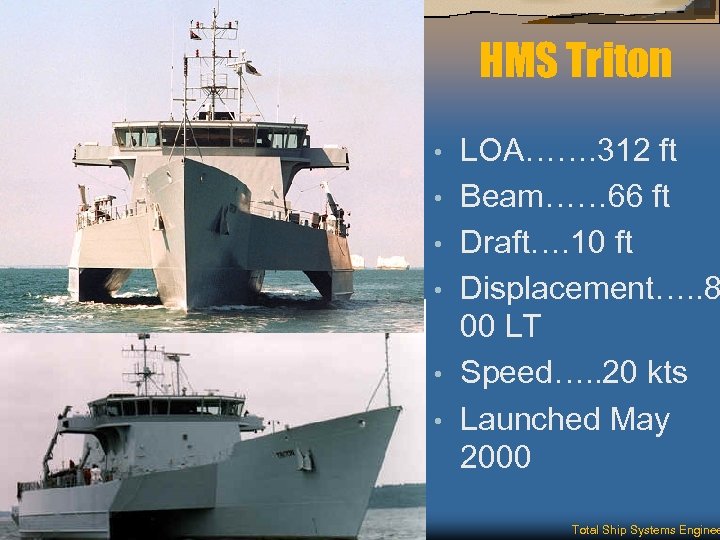 HMS Triton • • • LOA……. 312 ft Beam…… 66 ft Draft…. 10 ft Displacement…. . 8 00 LT Speed…. . 20 kts Launched May 2000 Total Ship Systems Enginee
 • Additional benefits from Tri Hull design Wide open deck layouts • Excellent Stability • Protection from missile/Torpedo hits • Total Ship Systems Enginee
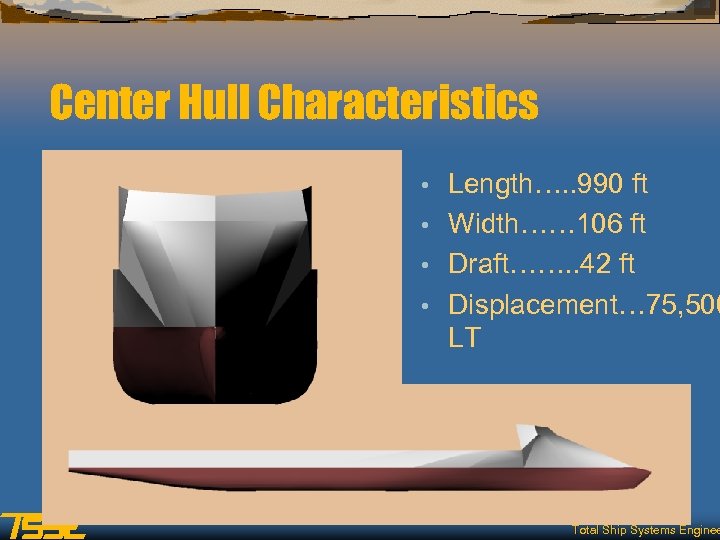 Center Hull Characteristics Length…. . 990 ft • Width…… 106 ft • Draft……. . 42 ft • Displacement… 75, 500 LT • Total Ship Systems Enginee
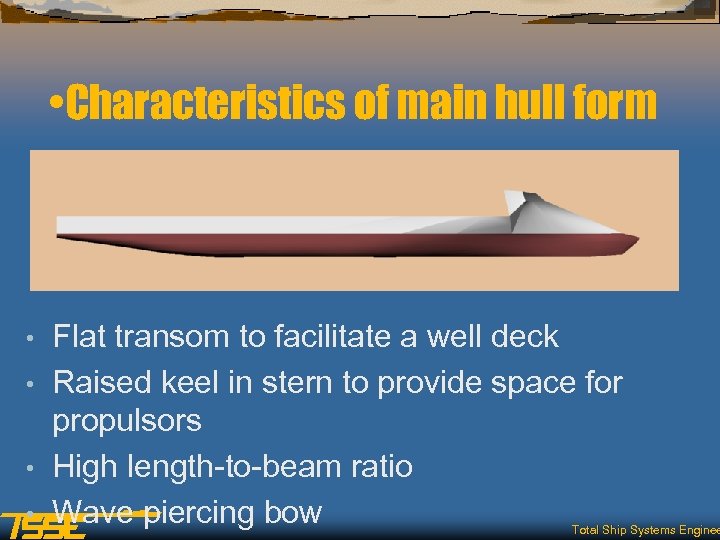 • Characteristics of main hull form Flat transom to facilitate a well deck • Raised keel in stern to provide space for propulsors • High length-to-beam ratio • Wave piercing bow • Total Ship Systems Enginee
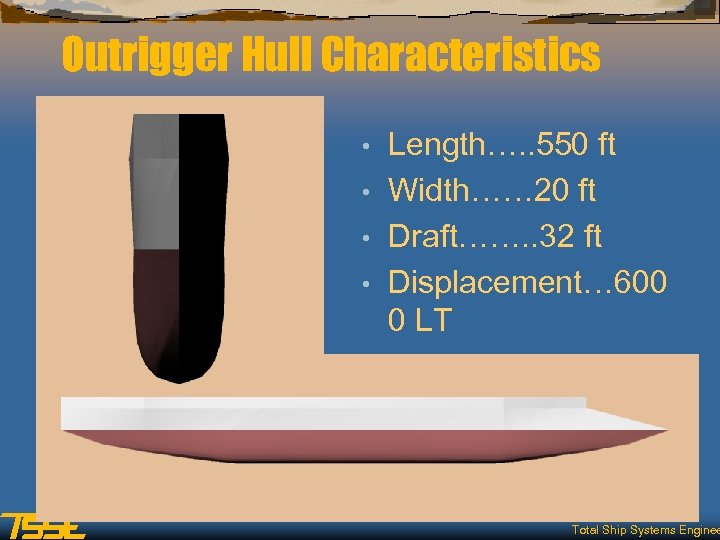 Outrigger Hull Characteristics Length…. . 550 ft • Width…… 20 ft • Draft……. . 32 ft • Displacement… 600 0 LT • Total Ship Systems Enginee
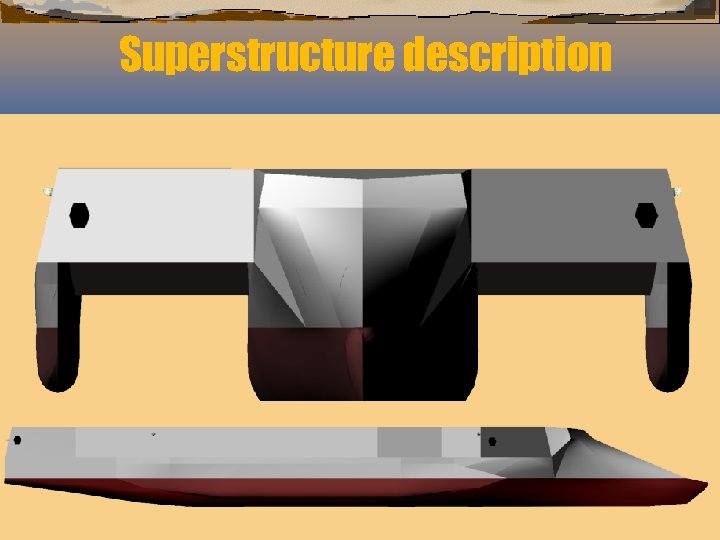 Superstructure description Total Ship Systems Enginee
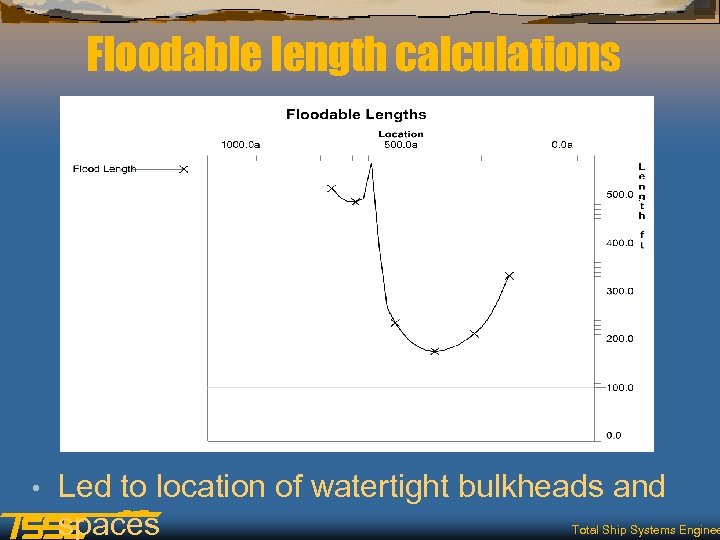 Floodable length calculations • Led to location of watertight bulkheads and spaces Total Ship Systems Enginee
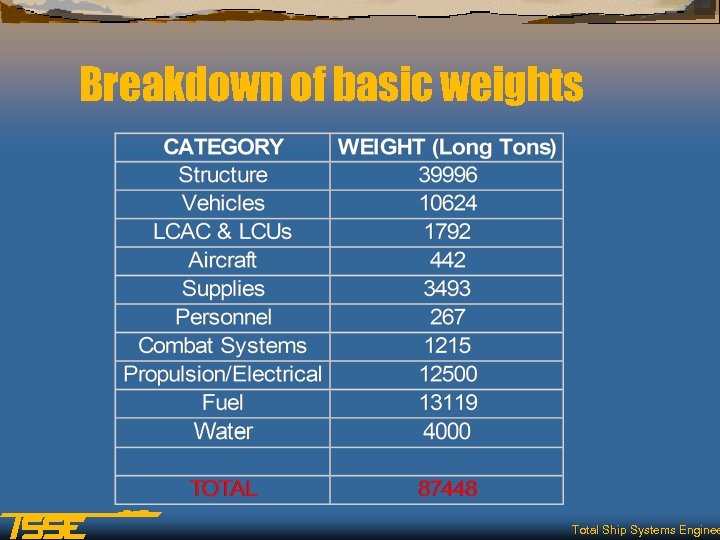 Breakdown of basic weights Total Ship Systems Enginee
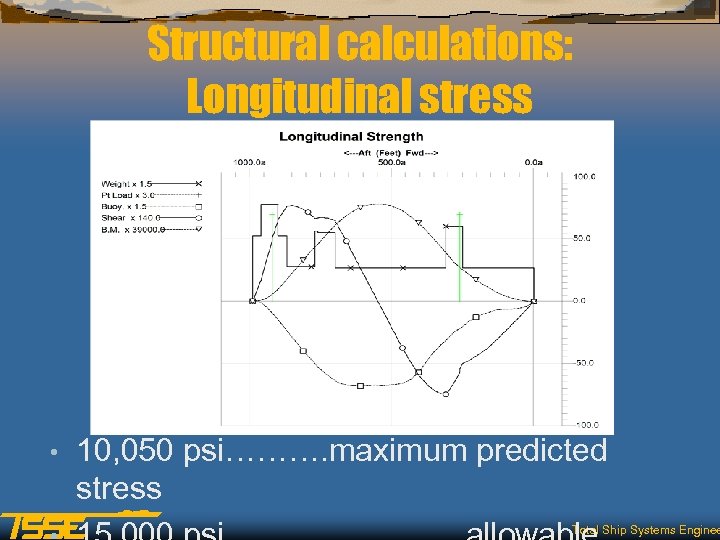 Structural calculations: Longitudinal stress • 10, 050 psi………. maximum predicted stress Total Ship Systems Enginee
 Rolling calculations • Based on the same analysis done at MIT for the LHA-R design. • Predicted snap roll will be countered using anti-roll fins Total Ship Systems Enginee
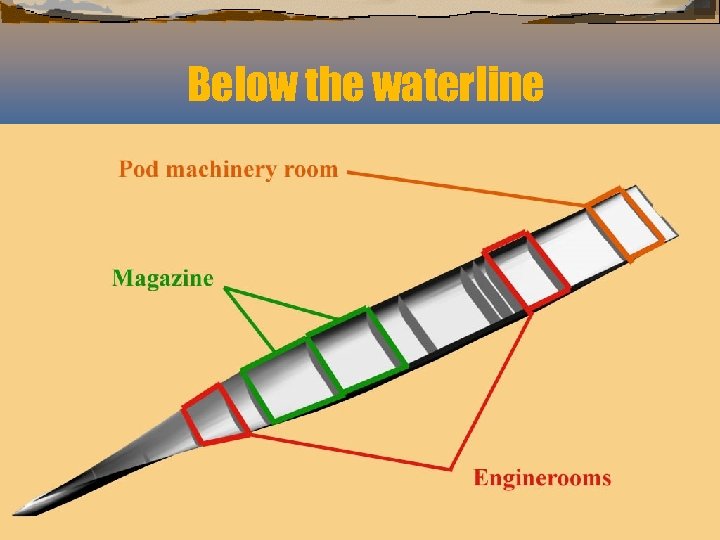 Below the waterline Total Ship Systems Enginee
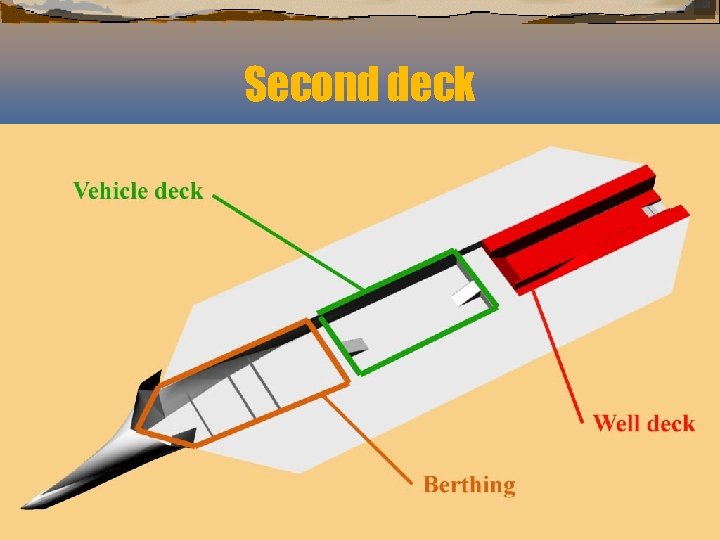 Second deck Total Ship Systems Enginee
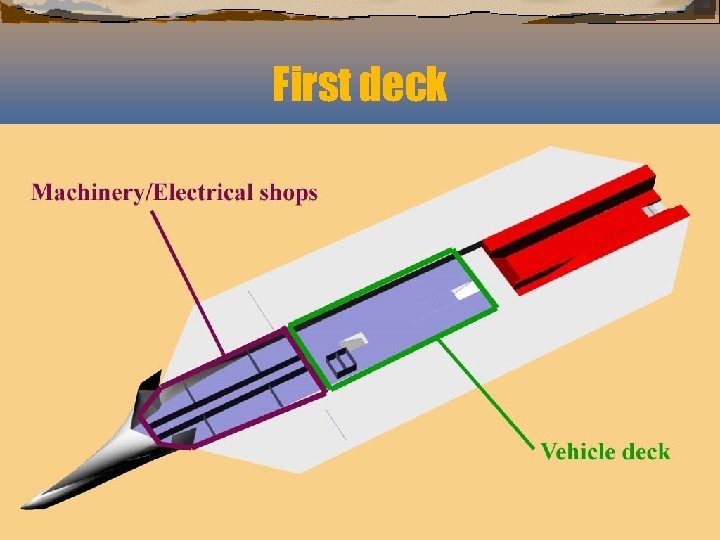 First deck Total Ship Systems Enginee
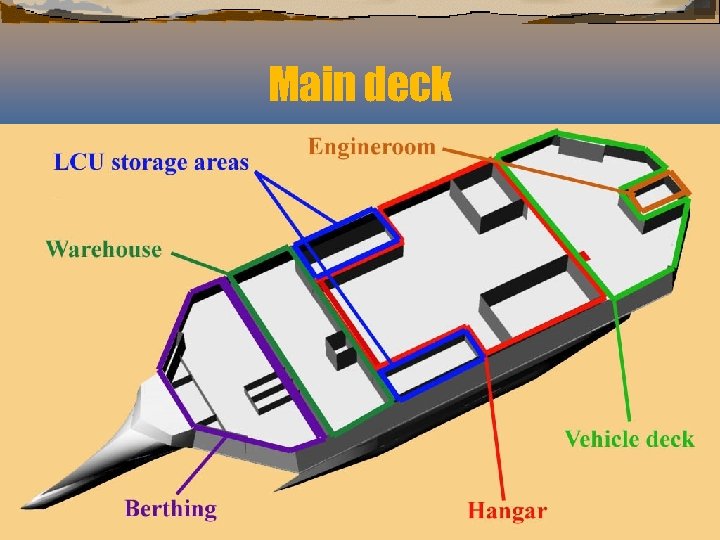 Main deck Total Ship Systems Enginee
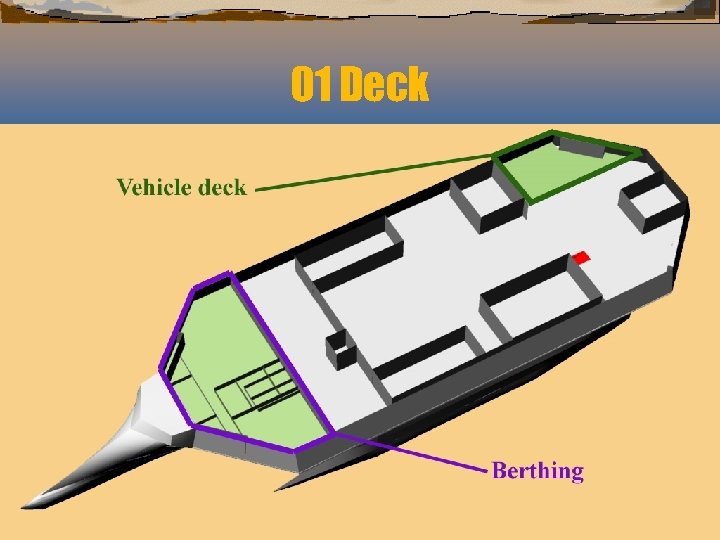 01 Deck Total Ship Systems Enginee
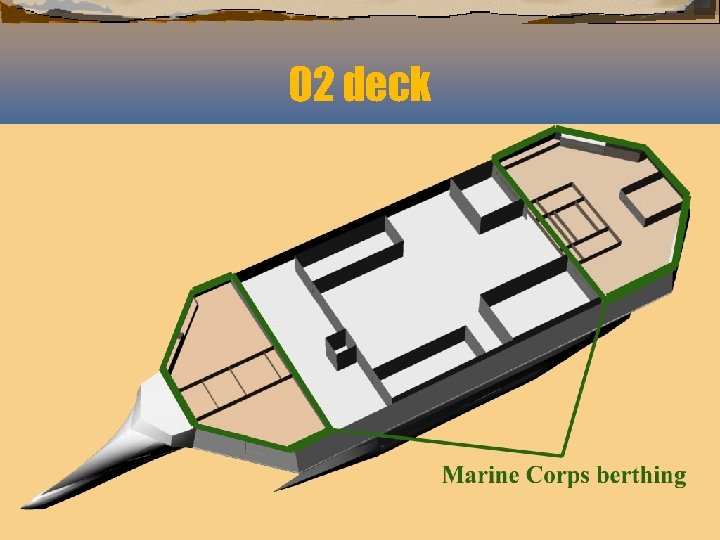 02 deck Total Ship Systems Enginee
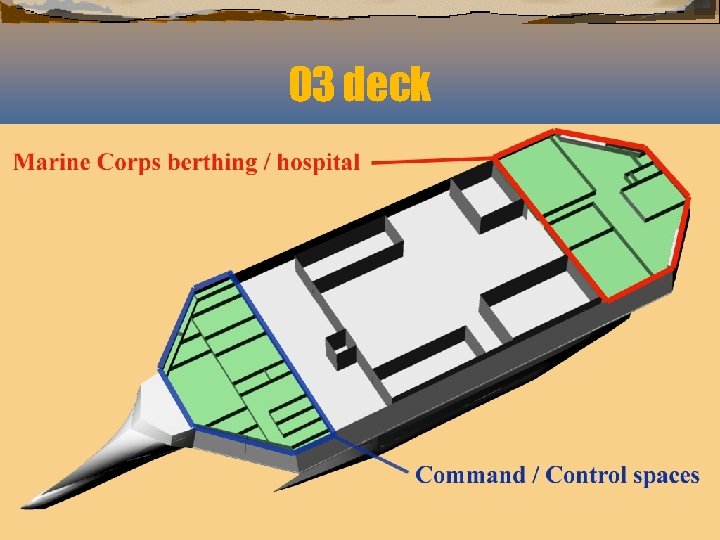 03 deck Total Ship Systems Enginee
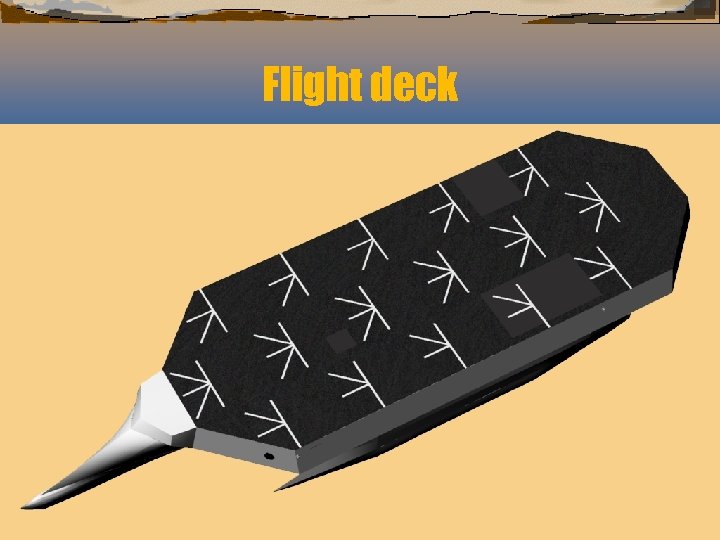 Flight deck Total Ship Systems Enginee
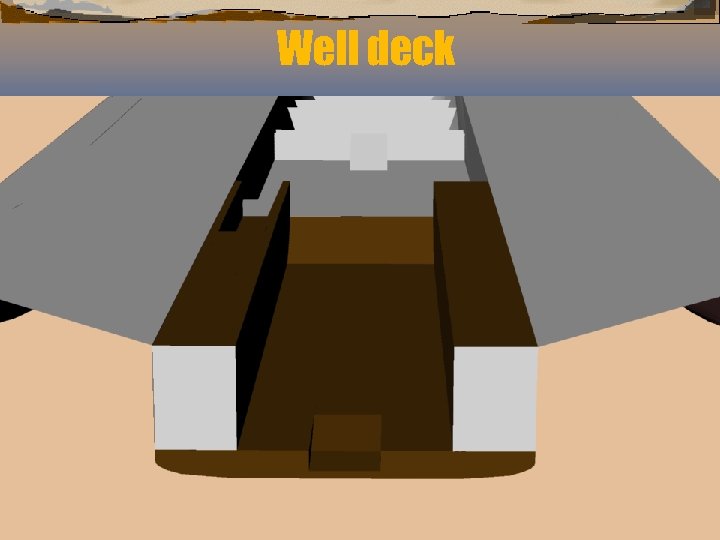 Well deck Total Ship Systems Enginee
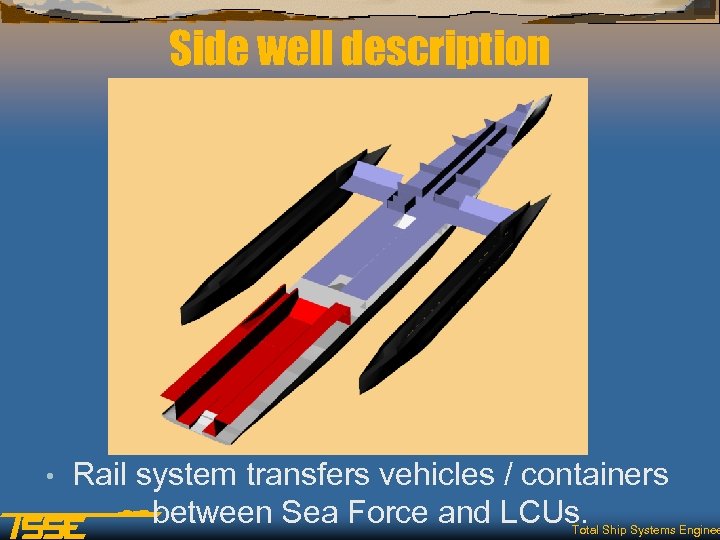 Side well description • Rail system transfers vehicles / containers between Sea Force and LCUs. Total Ship Systems Enginee
 Sea-Force Presentation Outline Introduction Conclusions Total Ship Evaluation Requirements & Alternatives Combat Systems Hull Logistics Flight Deck Propulsion Electrical Total Ship Systems Enginee
 Flight Deck • Description • Aircraft • Minimize Manning Total Ship Systems Enginee
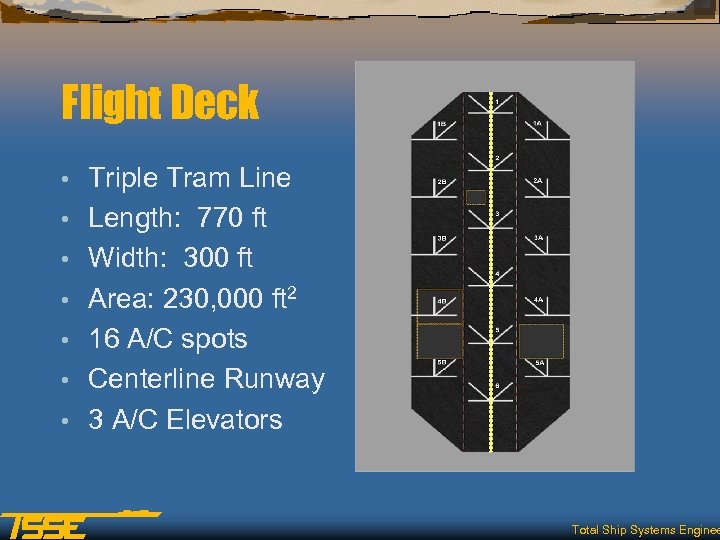 Flight Deck • • Triple Tram Line Length: 770 ft Width: 300 ft Area: 230, 000 ft 2 16 A/C spots Centerline Runway 3 A/C Elevators Total Ship Systems Enginee
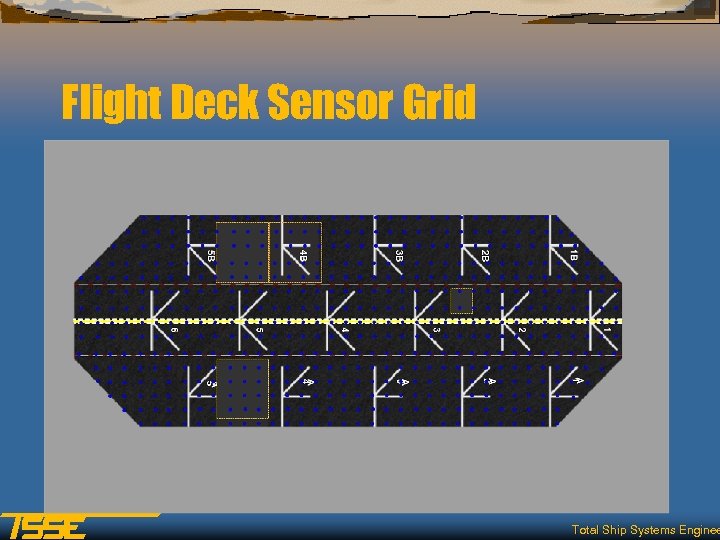 Flight Deck Sensor Grid Total Ship Systems Enginee
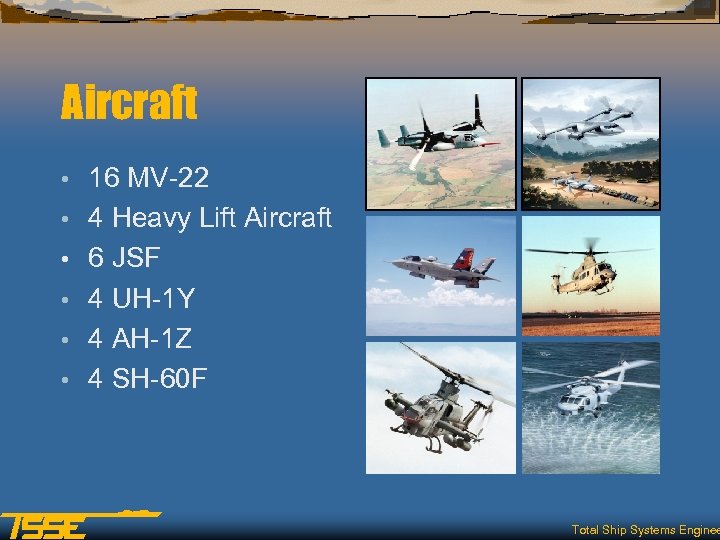 Aircraft • • • 16 MV-22 4 Heavy Lift Aircraft 6 JSF 4 UH-1 Y 4 AH-1 Z 4 SH-60 F Total Ship Systems Enginee
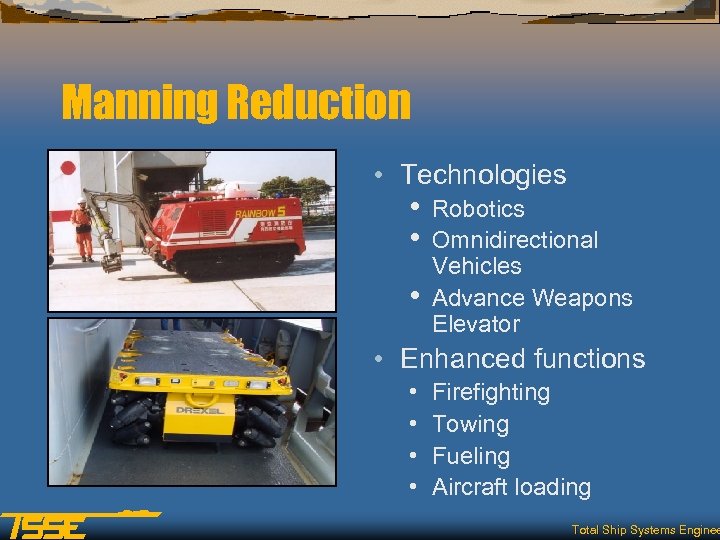 Manning Reduction • Technologies • • • Robotics Omnidirectional Vehicles Advance Weapons Elevator • Enhanced functions • • Firefighting Towing Fueling Aircraft loading Total Ship Systems Enginee
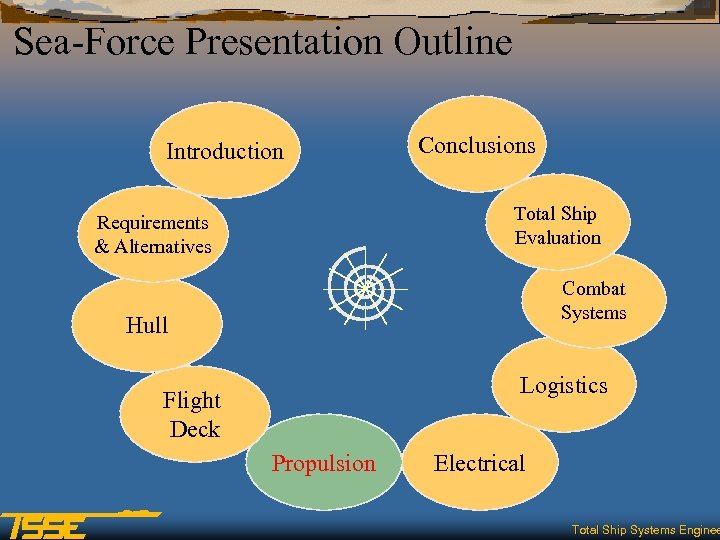 Sea-Force Presentation Outline Introduction Conclusions Total Ship Evaluation Requirements & Alternatives Combat Systems Hull Logistics Flight Deck Propulsion Electrical Total Ship Systems Enginee
 Propulsion • • Resistance Calculations and Power Req. Alternatives for Propulsion Plant Prime Mover Selection Comparison of Gas Turbines Propulsor Selection Propulsion Motor Selection Fuel Consumption comparison Lay out plan Total Ship Systems Enginee
 Alternatives for Propulsion Plant • Conventional steam plant • Nuclear steam plant • Diesel engines • Fuel cells • Gas turbines Total Ship Systems Enginee
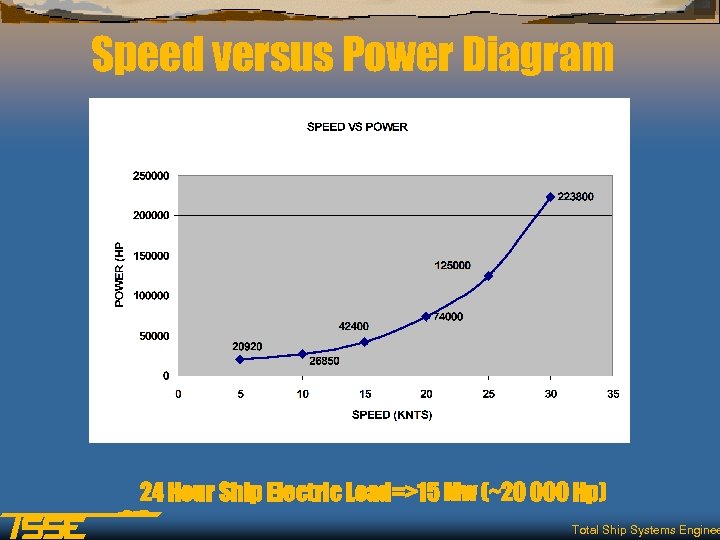 Speed versus Power Diagram 24 Hour Ship Electric Load=>15 Mw (~20 000 Hp) Total Ship Systems Enginee
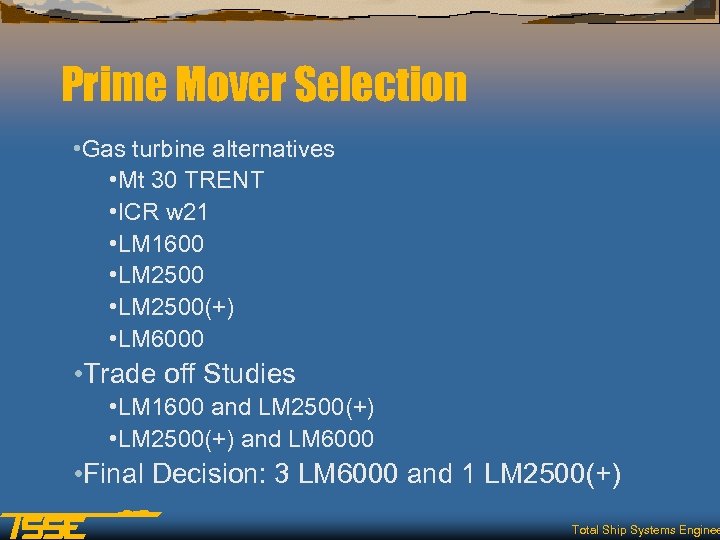 Prime Mover Selection • Gas turbine alternatives • Mt 30 TRENT • ICR w 21 • LM 1600 • LM 2500(+) • LM 6000 • Trade off Studies • LM 1600 and LM 2500(+) • LM 2500(+) and LM 6000 • Final Decision: 3 LM 6000 and 1 LM 2500(+) Total Ship Systems Enginee
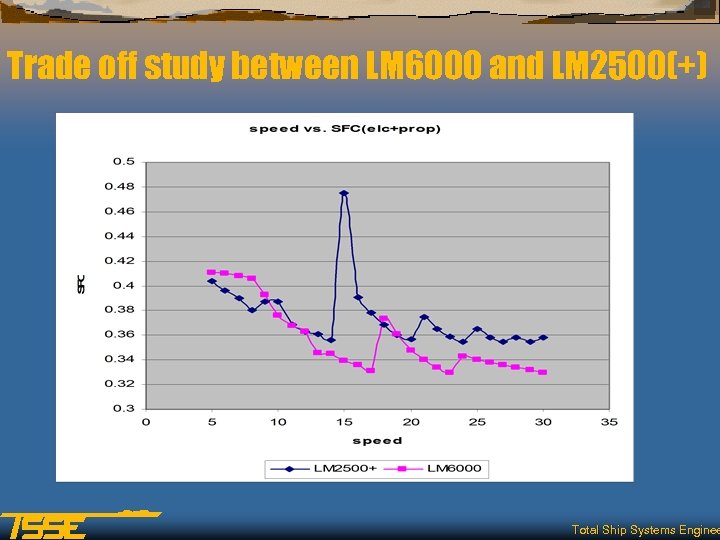 Trade off study between LM 6000 and LM 2500(+) Total Ship Systems Enginee
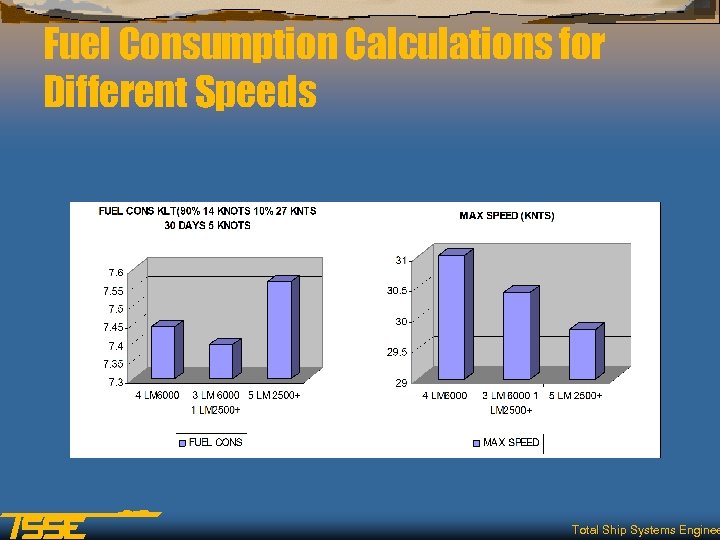 Fuel Consumption Calculations for Different Speeds Total Ship Systems Enginee
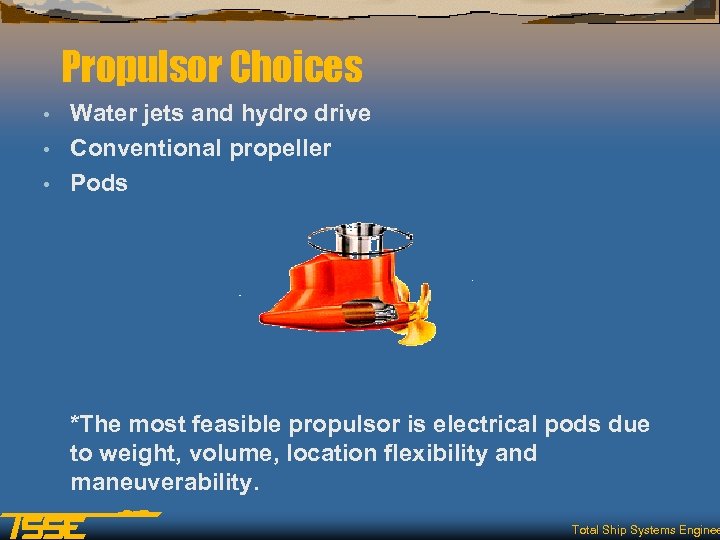 Propulsor Choices Water jets and hydro drive • Conventional propeller • Pods • *The most feasible propulsor is electrical pods due to weight, volume, location flexibility and maneuverability. Total Ship Systems Enginee
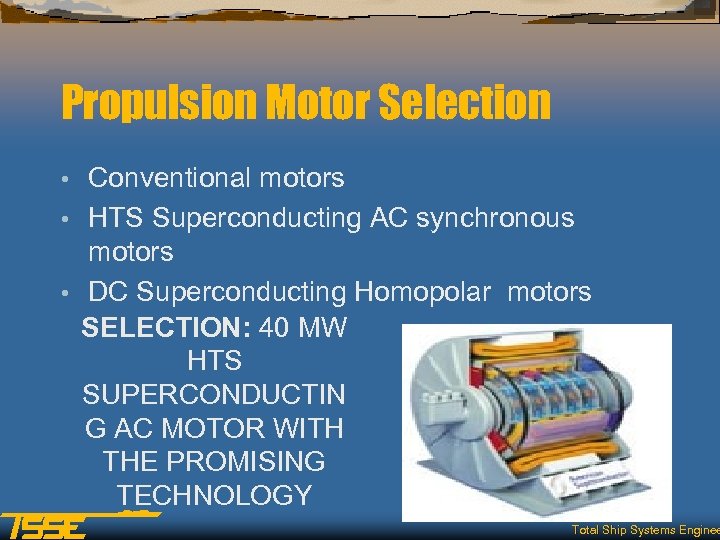 Propulsion Motor Selection Conventional motors • HTS Superconducting AC synchronous motors • DC Superconducting Homopolar motors SELECTION: 40 MW HTS SUPERCONDUCTIN G AC MOTOR WITH THE PROMISING TECHNOLOGY • Total Ship Systems Enginee
 Total Ship Systems Enginee
 Sea-Force Presentation Outline Introduction Conclusions Total Ship Evaluation Requirements & Alternatives Combat Systems Hull Logistics Flight Deck Propulsion Electrical Total Ship Systems Enginee
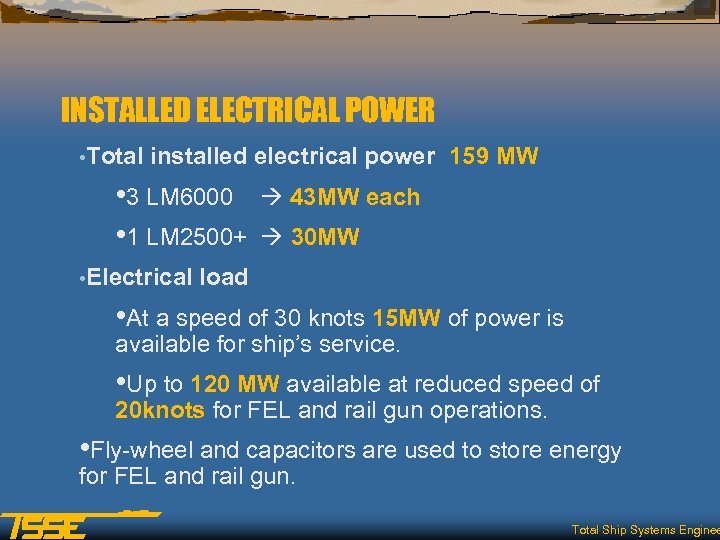 INSTALLED ELECTRICAL POWER • Total installed electrical power 159 MW • 3 LM 6000 43 MW each • 1 LM 2500+ 30 MW • Electrical load • At a speed of 30 knots 15 MW of power is available for ship’s service. • Up to 120 MW available at reduced speed of 20 knots for FEL and rail gun operations. • Fly-wheel and capacitors are used to store energy for FEL and rail gun. Total Ship Systems Enginee
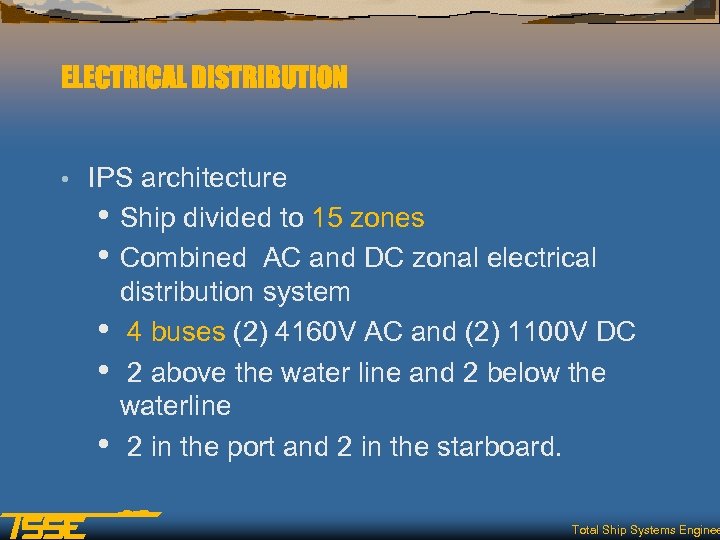 ELECTRICAL DISTRIBUTION • IPS architecture • Ship divided to 15 zones • Combined AC and DC zonal electrical distribution system • 4 buses (2) 4160 V AC and (2) 1100 V DC • 2 above the water line and 2 below the waterline • 2 in the port and 2 in the starboard. Total Ship Systems Enginee
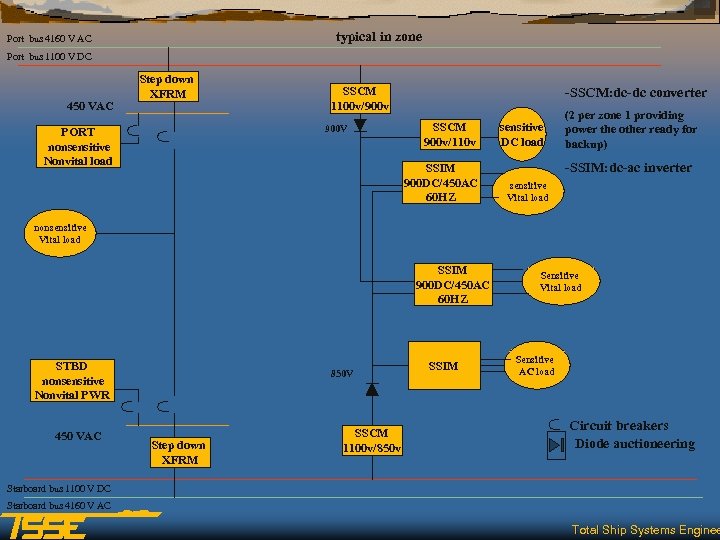 typical in zone Port bus 4160 V AC Port bus 1100 V DC 450 VAC Step down XFRM 900 V PORT nonsensitive Nonvital load -SSCM: dc-dc converter SSCM 1100 v/900 v SSCM 900 v/110 v SSIM 900 DC/450 AC 60 HZ sensitive DC load (2 per zone 1 providing power the other ready for backup) -SSIM: dc-ac inverter sensitive Vital load nonsensitive Vital load SSIM 900 DC/450 AC 60 HZ STBD nonsensitive Nonvital PWR 450 VAC 850 V Step down XFRM SSCM 1100 v/850 v SSIM Sensitive Vital load Sensitive AC load Circuit breakers Diode auctioneering Starboard bus 1100 V DC Starboard bus 4160 V AC Total Ship Systems Enginee
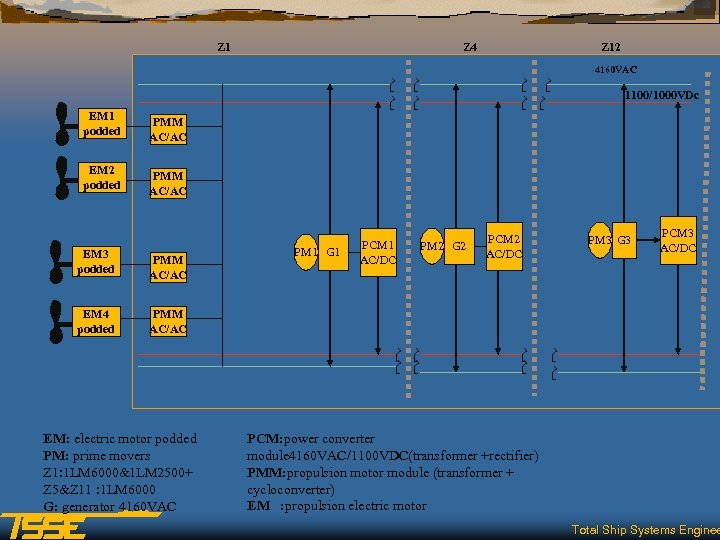 Z 1 Z 4 Z 12 4160 VAC 1100/1000 VDc EM 1 podded PMM AC/AC EM 2 podded PMM AC/AC EM 3 podded PMM AC/AC EM 4 podded PM 1 G 1 PCM 1 AC/DC PM 2 G 2 PCM 2 AC/DC PM 3 G 3 PCM 3 AC/DC PMM AC/AC EM: electric motor podded PM: prime movers Z 1: 1 LM 6000&1 LM 2500+ Z 5&Z 11 : 1 LM 6000 G: generator 4160 VAC PCM: power converter module 4160 VAC/1100 VDC(transformer +rectifier) PMM: propulsion motor module (transformer + cycloconverter) EM : propulsion electric motor Total Ship Systems Enginee
 IPS Advantages • • • Reduces cost, weight, fuel consumption and manning Increases survivability Equipment installed and tested prior to zone interconnection Faster and simpler fault detection and zone isolation Only main buses cross watertight compartment bulkheads Total Ship Systems Enginee
 Sea-Force Presentation Outline Introduction Conclusions Total Ship Evaluation Requirements & Alternatives Combat Systems Hull Logistics Flight Deck Propulsion Electrical Total Ship Systems Enginee
 Derived logistics requirements • Distribution and logistics hub • Interface with existing and future supply assets • Increase inter & intra ship material handling efficiency in a robust environment • Leverage on technology & automation to meet reduce manning requirements for logistical functions Total Ship Systems Enginee
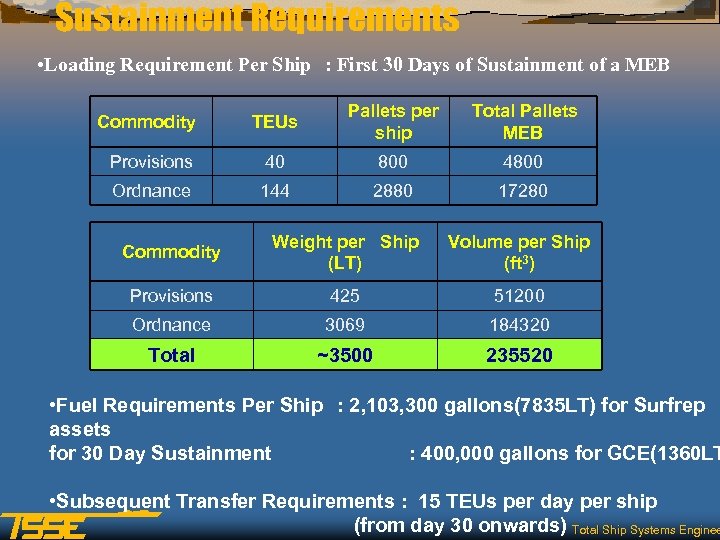 Sustainment Requirements • Loading Requirement Per Ship : First 30 Days of Sustainment of a MEB TEUs Pallets per ship Total Pallets MEB Provisions 40 800 4800 Ordnance 144 2880 17280 Commodity Weight per Ship (LT) Volume per Ship (ft 3) Provisions 425 51200 Ordnance 3069 184320 Total ~3500 235520 • Fuel Requirements Per Ship : 2, 103, 300 gallons(7835 LT) for Surfrep assets for 30 Day Sustainment : 400, 000 gallons for GCE(1360 LT • Subsequent Transfer Requirements : 15 TEUs per day per ship (from day 30 onwards) Total Ship Systems Enginee
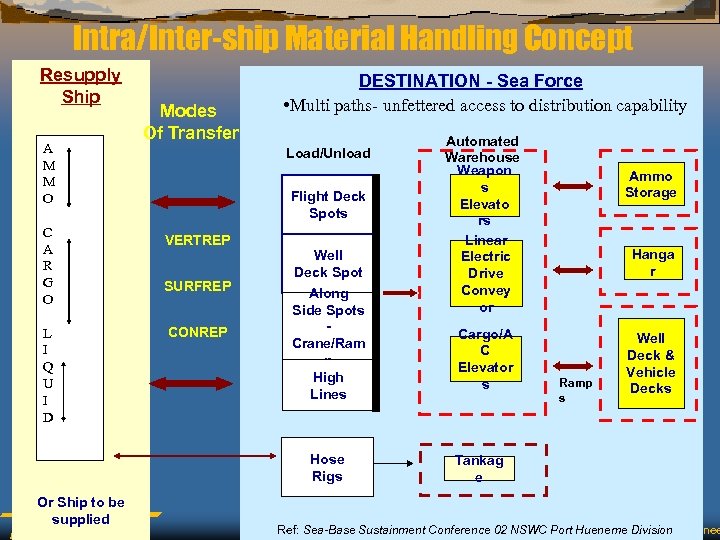 Intra/Inter-ship Material Handling Concept Resupply Ship A M M O C A R G O L I Q U I D Modes Of Transfer DESTINATION - Sea Force • Multi paths- unfettered access to distribution capability Load/Unload Flight Deck Spots VERTREP SURFREP CONREP Well Deck Spot Along Side Spots Crane/Ram p High Lines Hose Rigs Or Ship to be supplied Automated Warehouse Weapon s Elevato rs Linear Electric Drive Convey or Cargo/A C Elevator s Ammo Storage Hanga r Ramp s Well Deck & Vehicle Decks Tankag e Ref: Sea-Base Sustainment Conference 02 NSWC Port. Total Ship Systems Enginee Hueneme Division
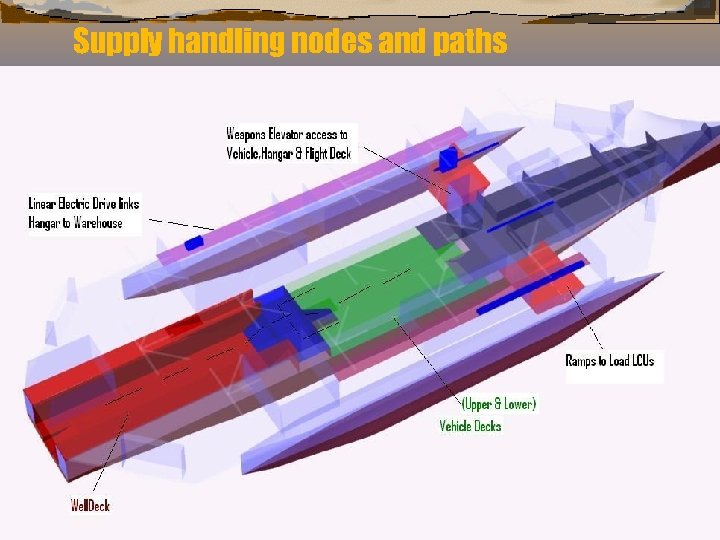 Supply handling nodes and paths Total Ship Systems Enginee
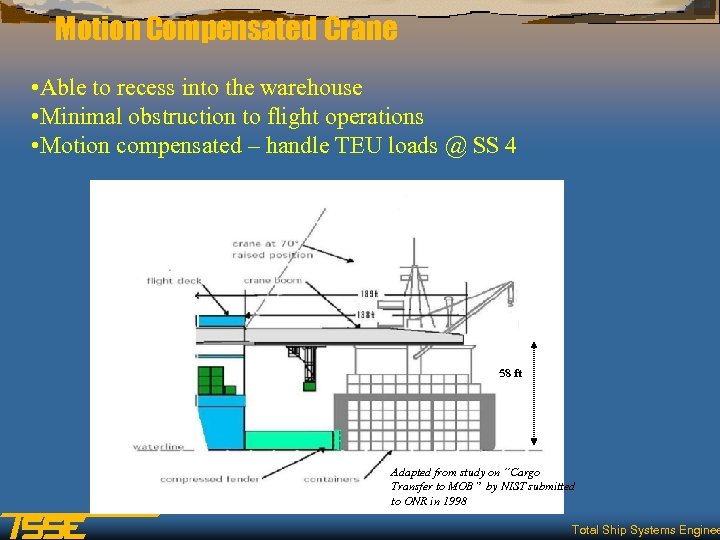 Motion Compensated Crane • Able to recess into the warehouse • Minimal obstruction to flight operations • Motion compensated – handle TEU loads @ SS 4 58 ft Adapted from study on “Cargo Transfer to MOB” by NIST submitted to ONR in 1998 Total Ship Systems Enginee
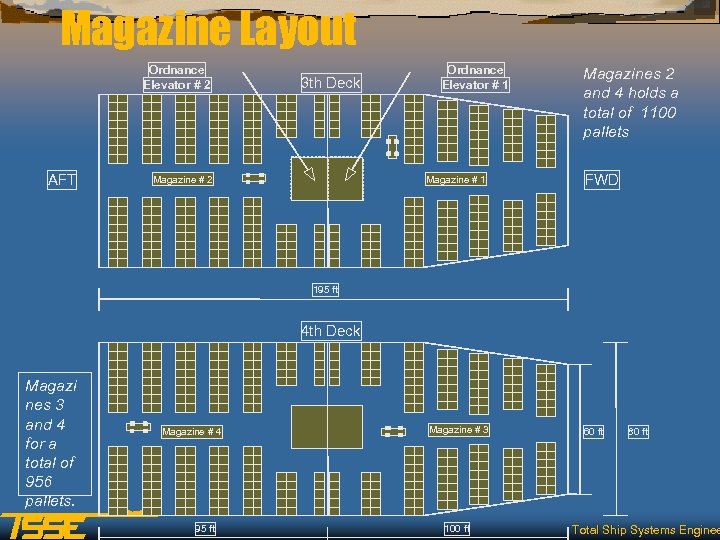 Magazine Layout Ordnance Elevator # 2 AFT 3 th Deck Ordnance Elevator # 1 Magazines 2 and 4 holds a total of 1100 pallets Magazine # 1 Magazine # 2 FWD Magazine # 3 60 ft 195 ft 4 th Deck Magazi nes 3 and 4 for a total of 956 pallets. Magazine # 4 95 ft 100 ft 80 ft Total Ship Systems Enginee
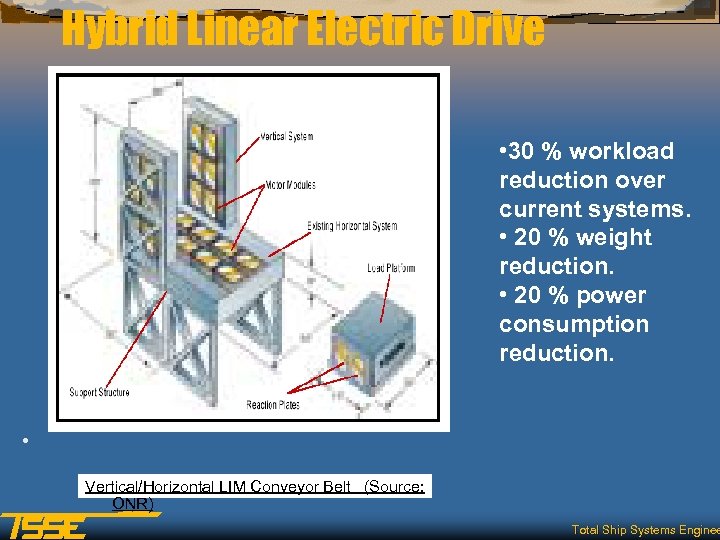 Hybrid Linear Electric Drive • 30 % workload reduction over current systems. • 20 % weight reduction. • 20 % power consumption reduction. • • Vertical/Horizontal LIM Conveyor Belt (Source: ONR) Total Ship Systems Enginee
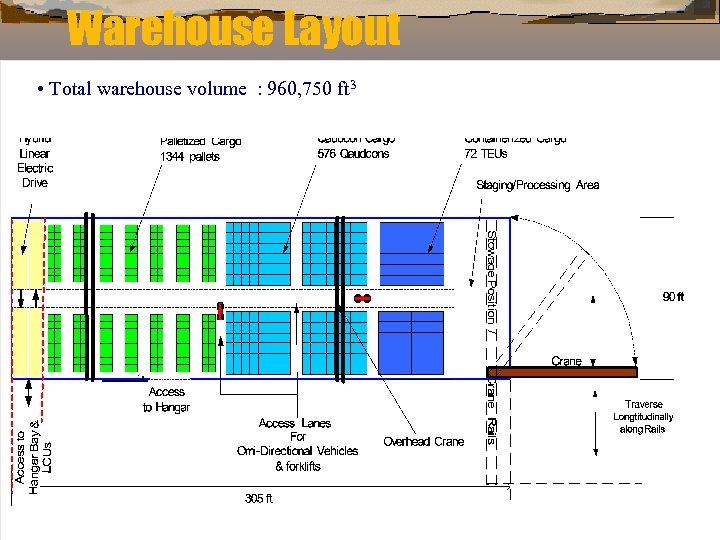 Warehouse Layout • Total warehouse volume : 960, 750 ft 3 Total Ship Systems Enginee
 Sea-Force Presentation Outline Introduction Conclusions Total Ship Evaluation Requirements & Alternatives Combat Systems Hull Logistics Flight Deck Propulsion Electrical Total Ship Systems Enginee
 Combat Systems Design Requirements Basic Ship Self-Defense in a Littoral Environment Major threats include: High-density missile and small boat attacks Floating, Bottom and Surface Moored Mines Coastal Water Submarines Robust C 4 ISR Capability Support for MEB/MEU forces afloat and ashore Enables ship to function as a Joint Command Center in theater Compatible with current as well as legacy systems Total Ship Systems Enginee
 Overall Architecture The combat systems and C 4 ISR suite will be fully integrated to include both organic and non-organic sensor inputs for power projection and ship self-defense to better support Network Centric Warfare Combat Systems Integration • Year 2020 Generation Cooperative Engagement Capability (CEC) • Year 2020 Generation Ship Self-Defense System (SSDS) Robust C 4 ISR Capabilities • Ability to Integrate Battle Group Assets using systems such as Year 2020 CEC, GCCS-M, NTCSS, NAVSSI, and the Expeditionary Sensor Grid (ESG) • Ability to act as Joint Command Center in Theater providing a full range of communication and information gathering equipment Total Ship Systems Enginee
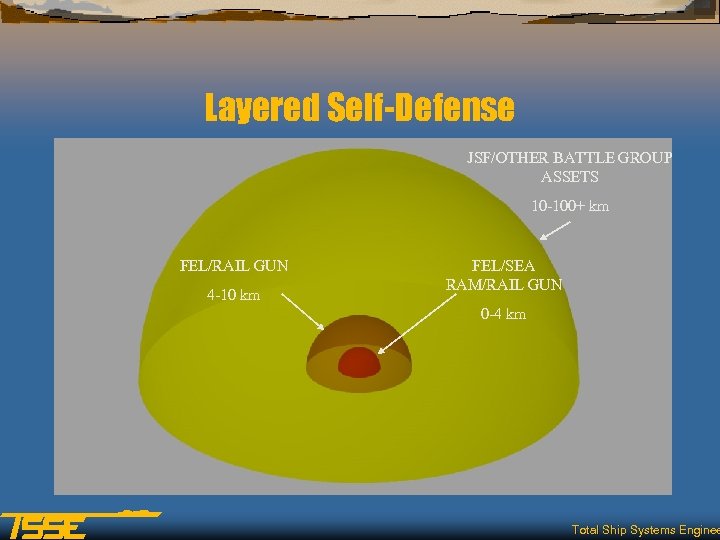 Layered Self-Defense JSF/OTHER BATTLE GROUP ASSETS 10 -100+ km FEL/RAIL GUN 4 -10 km FEL/SEA RAM/RAIL GUN 0 -4 km Total Ship Systems Enginee
 Naval Surface Fire Support The ship will be capable of providing Fire Support for the embarked Expeditionary Forces Electromagnetic Rail Gun • Can provide fire support against targets such as enemy personnel and tanks at ranges up to 400 NM • Four mounts operated NMT two at a time (port or starboard) due to power requirements Embarked Aircraft • Joint Strike Fighter could be utilized Battle Group Assets • Escort Ships and Aircraft Total Ship Systems Enginee
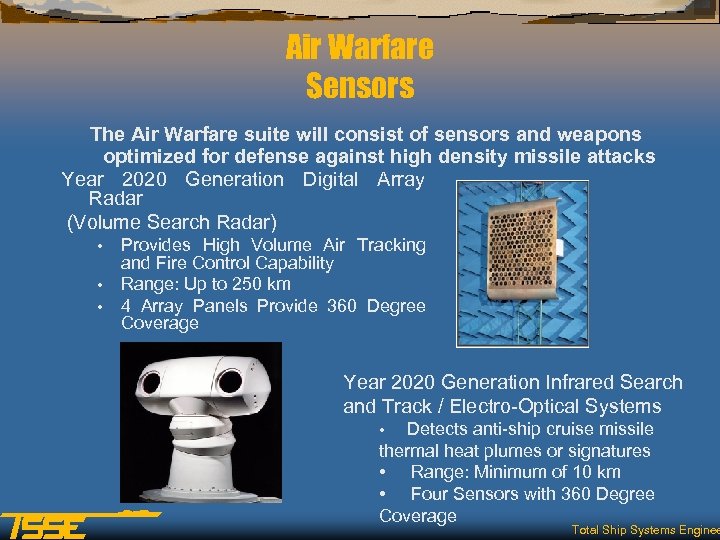 Air Warfare Sensors The Air Warfare suite will consist of sensors and weapons optimized for defense against high density missile attacks Year 2020 Generation Digital Array Radar (Volume Search Radar) • • • Provides High Volume Air Tracking and Fire Control Capability Range: Up to 250 km 4 Array Panels Provide 360 Degree Coverage Year 2020 Generation Infrared Search and Track / Electro-Optical Systems Detects anti-ship cruise missile thermal heat plumes or signatures • Range: Minimum of 10 km • Four Sensors with 360 Degree Coverage • Total Ship Systems Enginee
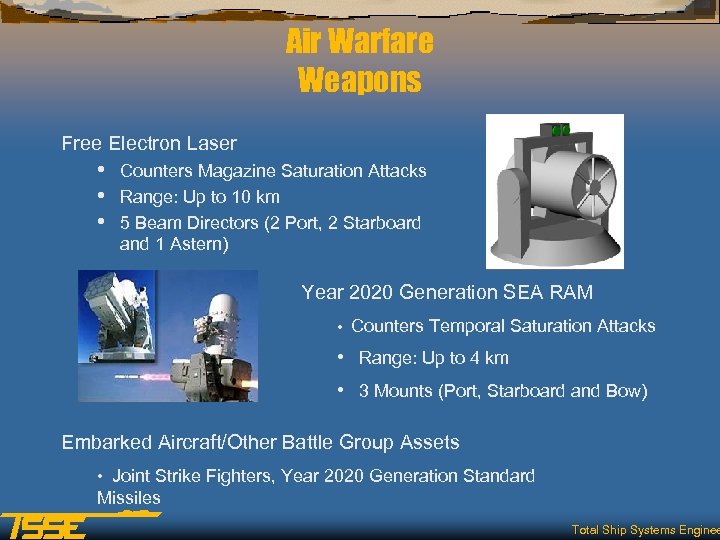 Air Warfare Weapons Free Electron Laser • • • Counters Magazine Saturation Attacks Range: Up to 10 km 5 Beam Directors (2 Port, 2 Starboard and 1 Astern) Year 2020 Generation SEA RAM • Counters Temporal Saturation Attacks • Range: Up to 4 km • 3 Mounts (Port, Starboard and Bow) Embarked Aircraft/Other Battle Group Assets • Joint Strike Fighters, Year 2020 Generation Standard Missiles Total Ship Systems Enginee
 Mine Interdiction Warfare The Mine Interdiction Suite will be capable of only Basic Mine Detection and Avoidance Unmanned Undersea Vehicles • Perform remote mine detection, reconnaissance and clearance operations • Systems for employment include (Year 2020 Generation): Long Term Mine Reconnaissance System (LMRS), Remote Mine Hunting System (RMS), Enhanced Mine Neutralization System (EMNS) Aircraft Mounted Mine Detection and Removal Equipment • Equipment is easily mounted into embarked assets such as the SH 60 or MV-22 configured aircraft • Systems for employment include (Year 2020 Generation): Airborne Laser Mine Detection System (ALMDS), Rapid Airborne Mine Clearance Systems (RAMICS) Total Ship Systems Enginee
 Surface Warfare Sensors The ship will be configured to defend primarily against small boat attacks Year 2020 Generation SPS-73 Surface Search/Navigation Radar • Primary Surface Search/Navigation Radar Year 2020 Generation Digital Array Radar • Primary Fire Control Radar Year 2020 Generation Electro-Optical Systems Infrared Search and Track/FLIR and/or TISS System • Primary/Secondary Fire Control Systems • Total Ship Systems Enginee
 Surface Warfare Weapons Year 2020 Generation SEA RAM • • Current System is air defense only and would require a surface mode similar to CIWS Block 1 B Range: 4 km utilizing four mounts (Two Fwd and Two Aft) Electromagnetic Rail Gun • • Primarily for Targeting small to medium sized vessels Range: 10 km utilizing four mounts NMT two at a time (Two Port and Two Stbd) Free Electron Laser • • Targeting of small boats only Range: 10 km utilizing any 3 of 5 beam directors simultaneously (Two Port, Two Stbd and 1 Astern) Battle Group Assets / Embarked Aircraft (i. e. JSF) Total Ship Systems Enginee
 Undersea Warfare Sensors/Weapons The Undersea Warfare Suite will be limited to basic Undersea Warfare capabilities using embarked Air, Undersea Vehicle and other Battle Group Assets Utilize Unmanned Undersea Vehicles (UUV’s) and dipping sonar from embarked SH-60 F or MV-22 configured aircraft. Utilize year 2020 generation MK 50 torpedoes launched from SH-60 or MV-22 configured aircraft. Other Battle Group assets will be required for any other operation than basic self-defense (i. e. ships, aircraft and submarines). Total Ship Systems Enginee
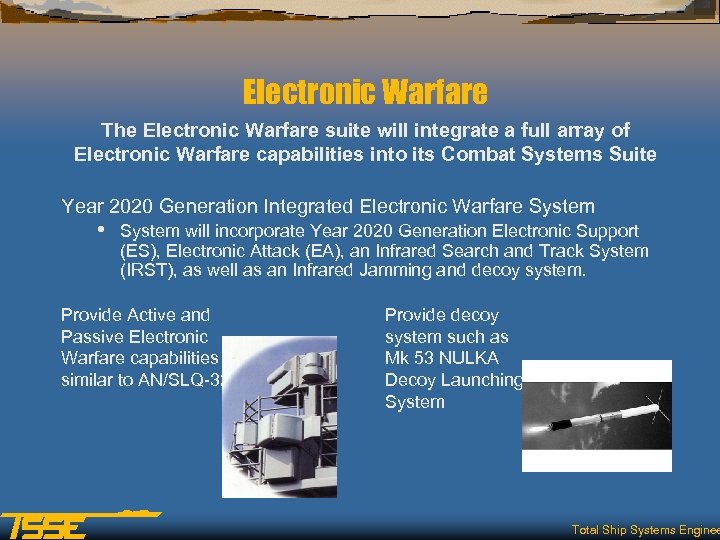 Electronic Warfare The Electronic Warfare suite will integrate a full array of Electronic Warfare capabilities into its Combat Systems Suite Year 2020 Generation Integrated Electronic Warfare System • System will incorporate Year 2020 Generation Electronic Support (ES), Electronic Attack (EA), an Infrared Search and Track System (IRST), as well as an Infrared Jamming and decoy system. Provide Active and Passive Electronic Warfare capabilities similar to AN/SLQ-32(V). Provide decoy system such as Mk 53 NULKA Decoy Launching System Total Ship Systems Enginee
 Sea-Force Presentation Outline Introduction Conclusions Total Ship Evaluation Requirements & Alternatives Combat Systems Hull Logistics Flight Deck Propulsion Electrical Total Ship Systems Enginee
 Total Ship Evaluation Areas • • • Operational Functionality and Flexibility Modularity Survivability Manning Damage Control Cost Total Ship Systems Enginee
 Operational Functionality/Flexibility • Access/Reroute/Resupply Methods • • • Well Deck Flight Deck LCU Decks Crane Layout • • Berthing for GCE near Med/Hospital Joint Support spaces co-located: • CO/Flag/CS/C 4 I and Bridge Total Ship Systems Enginee
 Operational Functionality/Flexibility • Ports of Access • Norfolk • San Diego • Everett • Rota • Ports Requiring Access • Blount Island Total Ship Systems Enginee
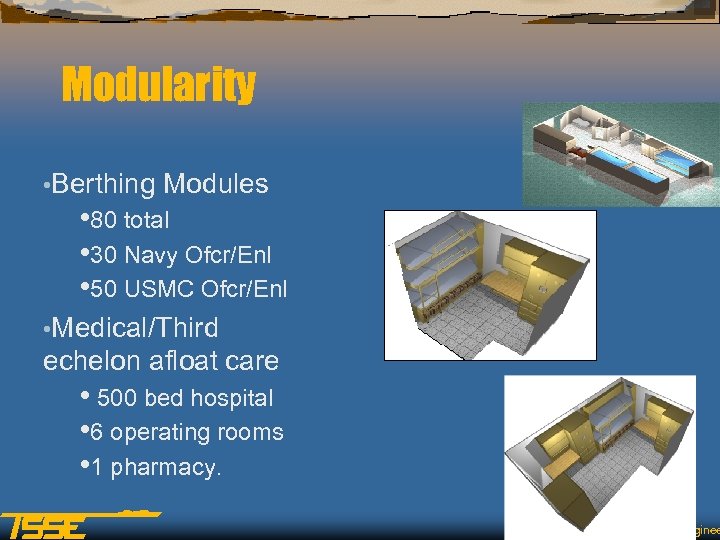 Modularity • Berthing Modules • 80 total • 30 Navy Ofcr/Enl • 50 USMC Ofcr/Enl • Medical/Third echelon afloat care • 500 bed hospital • 6 operating rooms • 1 pharmacy. Total Ship Systems Enginee
 Modularity • Space Conversion from Combatant to Supply Configuration • • C 4 I/CS/Weapons • Retain SEARAM, DAR, SPS-73, Comms, Flight Deck control, and Countermeasures • Total Converted Volume – 201, 000 ft 3 Berthing – All USMC and a percentage of Navy • Total Converted Volume – 1, 540, 000 ft 3 Hospital/Medical – 219, 000 ft 3 Available for containers/pallets/ammo – ~ 5. 7 million ft 3 • Includes Half the Hangar, Vehicle Decks, Warehouse Total Ship Systems Enginee
 Supply Configuration • Weight limited vice volume limited design: • More room for containers than weight allowed • Allows for 25 days of sustainment load • Areas Reduced– • Maintenance (IMA), Food Preparation, Aviation, Admin, Flight Deck, and Engineering Total Ship Systems Enginee
 Survivability • Signature Reduction • Exhausts expended between hulls and water misted • Carbon Composite covering steel hull structure • Radar absorbent paint • Redundant systems/Distributed C 4 I • Elevator • Combat Systems Weapons and Sensors • CBR Protective Measures Total Ship Systems Enginee
 Manning • Manning levels determined based on • Watch Stations - 50 • Maintenance - 146 • Logistics Operations - 242 Total Ship Systems Enginee
 Manning - Summary • Manning reduction – Combat Variant • 35% (based on LHD) • 50% (based on displacement of US Warship) • Total Ship Manning (Combat Ship) - 724 • 51 Officers, 41 CPOs and 632 Enlisted • Total Ship Manning (Supply Ship) – 145 • Civilian and Military Mix • 30 Civilians, 115 Military Total Ship Systems Enginee
 Low Maintenance Design • Conditioned Based Maintenance • Integrated Electric Drive • Electrical Distribution System - Power Electronic Building Blocks • SWAN • Automated Identification Technology Total Ship Systems Enginee
 Damage Control • Integrated into the shipboard SWAN • Advance Real-Time Sensing • Pre-emptive (“flinch”) capability • Intelligent distributed control architecture – robust DC-ARM Supervisory Control System • Display sensory information • Isolate/recover zones as a result of attack • Optimized the distribution and separation of redundant vital systems and control stations Total Ship Systems Enginee
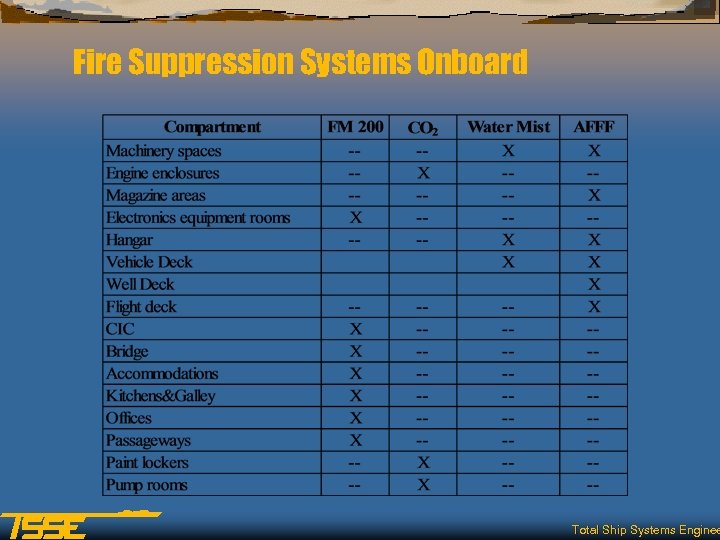 Fire Suppression Systems Onboard Total Ship Systems Enginee
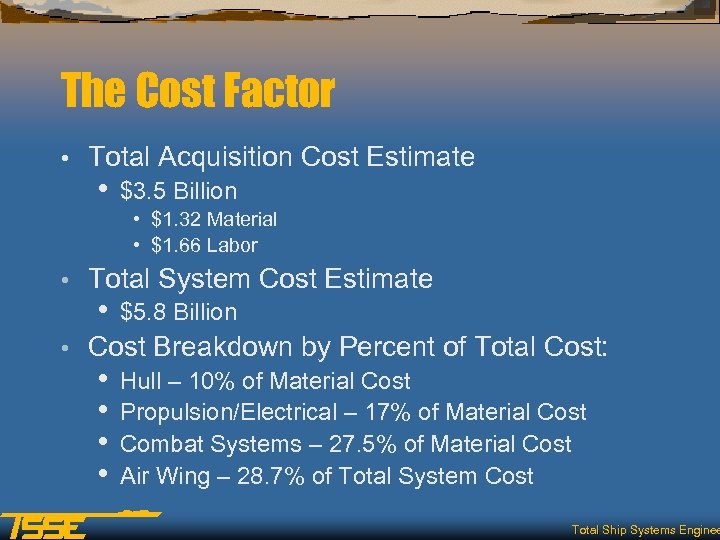 The Cost Factor • Total Acquisition Cost Estimate • $3. 5 Billion • $1. 32 Material • $1. 66 Labor • • Total System Cost Estimate • $5. 8 Billion Cost Breakdown by Percent of Total Cost: • • Hull – 10% of Material Cost Propulsion/Electrical – 17% of Material Cost Combat Systems – 27. 5% of Material Cost Air Wing – 28. 7% of Total System Cost Total Ship Systems Enginee
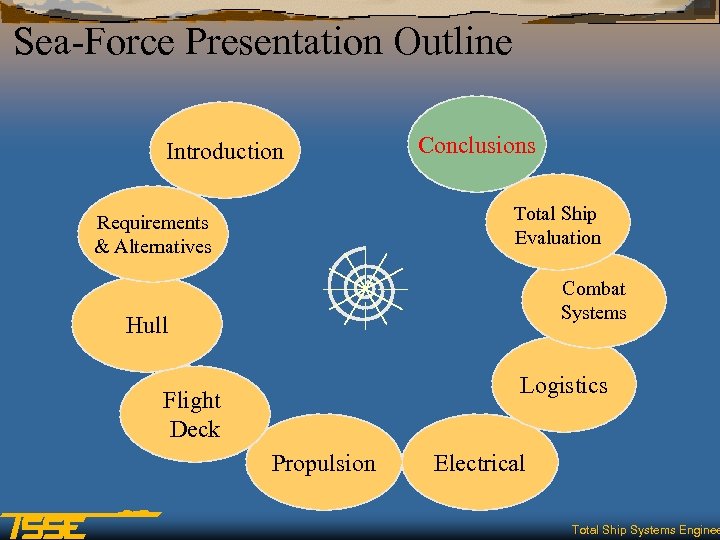 Sea-Force Presentation Outline Introduction Conclusions Total Ship Evaluation Requirements & Alternatives Combat Systems Hull Logistics Flight Deck Propulsion Electrical Total Ship Systems Enginee
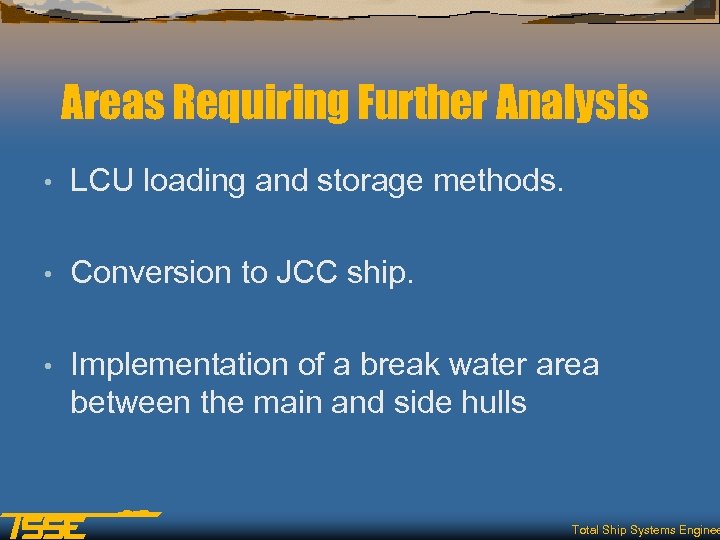 Areas Requiring Further Analysis • LCU loading and storage methods. • Conversion to JCC ship. • Implementation of a break water area between the main and side hulls Total Ship Systems Enginee
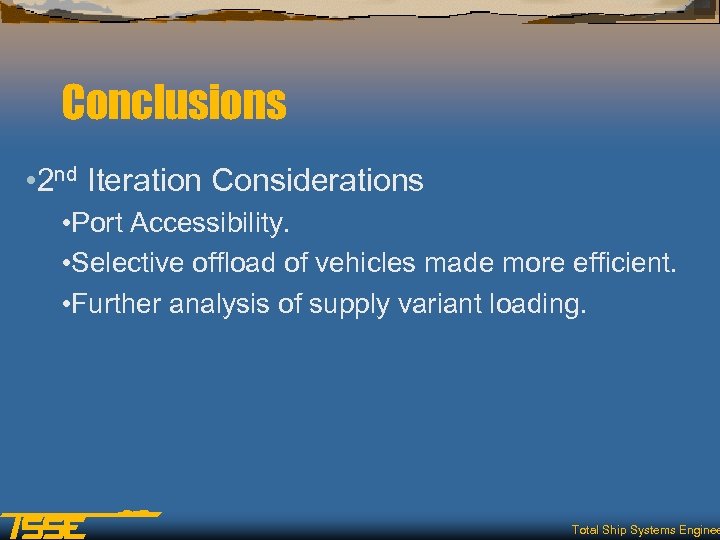 Conclusions • 2 nd Iteration Considerations • Port Accessibility. • Selective offload of vehicles made more efficient. • Further analysis of supply variant loading. Total Ship Systems Enginee
 Conclusions • Key enabler to successful implementation of sea basing concept. • Large flight deck to support STOM. • Large internal volume for logistics support • • and selective offload. Supply configured variant capable of supporting troops ashore without transfer to ships in the sea base. Capable of force reconstitution. Total Ship Systems Enginee