 Скачать презентацию SCS-SGP Partnership Implementation Review Timeline November 2007 signature
f390a9c4bb400b334b87bcd4e15a62a8.ppt
- Количество слайдов: 14



SCS-SGP Partnership Implementation Review Timeline November 2007 signature of Communiqué - SCS & SGP September 2008 signature of Agreement - UNDP & UNEP September 2008 transfer of funds to UNOPS Projects implemented between May 2009 and May 2011 Agreement to: Fund an equal number of SGP projects (12 each) Follow priorities of the SAP Provide training to SGP national co-ordinators in TDA and SAP priorities
SCS-SGP Partnership Implementation Review A total of 31 projects in six countries were executed under the partnership SCS Funds = $ 554, 702 SGP Funds = $ 541, 574 Co-financing = $ 808, 495 Total = $1, 904, 771 Mean Project Size $35, 364 grant funds $26, 080 co-financing Total $61, 444
SCS-SGP Partnership Implementation Review Rationale for the Partnership • Difficult for full-sized IW projects to deal with all levels from Central Government down to communities; • SGP has an existing delivery mechanism at the national level to engage communities; • SCS had an inter-governmentally approved SAP with clearly defined targets; • SGP has no framework for IW community level projects; • SCS had various regional fora to engage national co-ordinators with local governments, scientists and regional experts
SCS-SGP Partnership Implementation Review Strategic Action Programme for the South China Sea • Top priority loss and degradation of coastal habitats, primarily mangrove, seagrass and coral reefs but also coastal lagoons, and coastal freshwater swamp forest. • Second priority issue management failures with respect to the linkage between fish stocks and critical habitats • Pollution neither a priority issue, nor a transboundary one since 10 x present nutrient loads would not impact the basin measurably. • However among pollution sources domestic wastes top priority; and, • Nutrients the priority contaminant
SCS-SGP Partnership Implementation Review SAP Targets • Seagrass: • 21 areas totaling 26, 576 ha to be sustainably managed by 2025; adopt 7 new MPAs focused on seagrass • Mangroves: • 57, 361 ha to be transferred to National Parks and MPA • 21, 000 ha deforested mangrove land to be replanted; • 11, 200 ha degraded forest to be subject to enrichment planting • Coral Reefs: • 53, 130 ha in identified sites to be managed by 2015
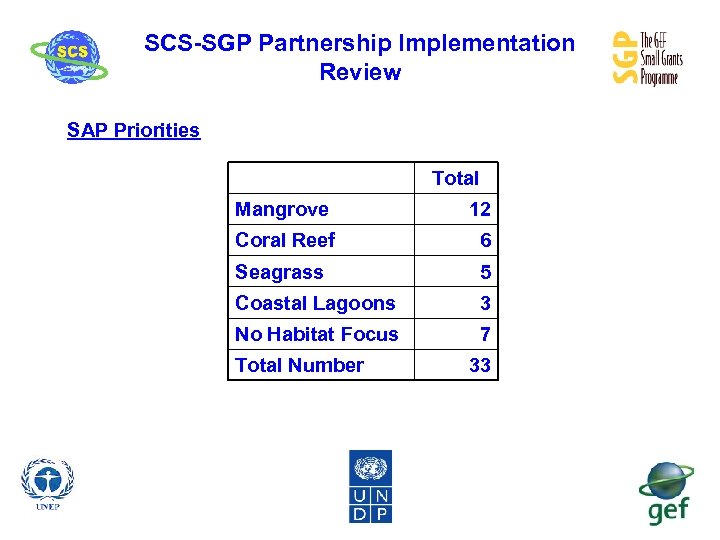
SCS-SGP Partnership Implementation Review SAP Priorities Total Mangrove 12 Coral Reef 6 Seagrass 5 Coastal Lagoons 3 No Habitat Focus 7 Total Number 33
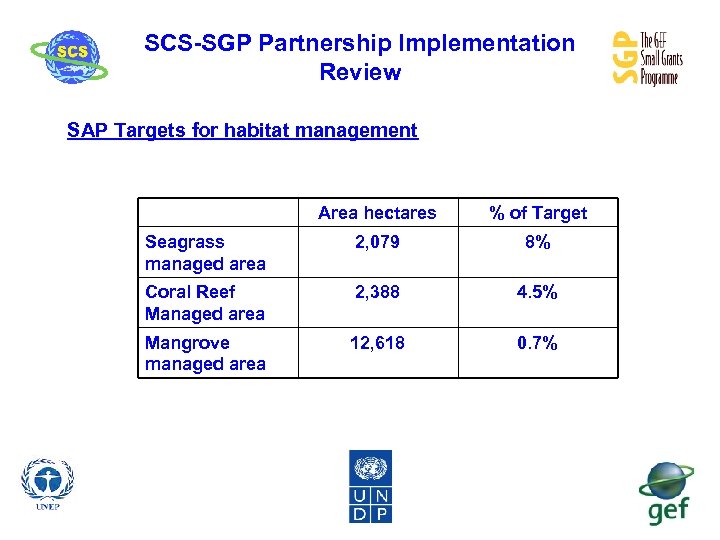
SCS-SGP Partnership Implementation Review SAP Targets for habitat management Area hectares % of Target Seagrass managed area 2, 079 8% Coral Reef Managed area 2, 388 4. 5% Mangrove managed area 12, 618 0. 7%
SCS-SGP Partnership Implementation Review The Impacts of SGP Projects - Community awareness • Meetings, discussions presentation of basic information • Creation of quasi management bodies with: • regular meetings • responsibilities such as mangrove replanting, fisheries patrolling • Exchange between neighbouring communities
SCS-SGP Partnership Implementation Review The Impacts of SGP Projects - Socioeconomic benefits • Countering illegal fishing through; physical barriers, and patrolling increases artisanal fish catch; • Sustainable management of swimming crab and land crab; Nypa palm; • Value added to local products including aquarium fish; fish paste; • Development of new sources of income from ecotourism & “home stay
SCS-SGP Partnership Implementation Review The Impacts of SGP Projects - Environmental benefits More difficult to measure except: • some monitoring of habitats; • Increased % cover; • Increased biodiversity • implied environmental improvement by increased; fish catch; • in cases of mangrove and coral reef replanting
SCS-SGP Partnership Implementation Review The Impacts of SGP Projects - Wider impacts/replication • Exchange between neighbouring communities: • 4 projects Cambodia, 3 in Indonesia, 1 in Thailand 3 in Viet Nam • Designation of project individuals as resource persons by provincial and national governments • Recognition of projects as learning or demonstration centres e. g. China project designated as “provincial science popularisation base”; 1 in Thailand selected as a model for mangrove management; 1 in Viet Nam model for community fisheries management
SCS-SGP Partnership Implementation Review CONCLUSIONS The partnership has been effective and beneficial to partners, specifically to: • the national SGP programmes involved, through the provision of an inter-governmentally approved framework for nationally executed international waters projects; • the implementation of the SAP for the South China Sea in terms of significant contributions towards the achievement of the SAP priorities and targets
SCS-SGP Partnership Implementation Review CONCLUSIONS The effectiveness of the partnership reflects the fact that: • the SCS project was able to make use of a GEF approved mechanism for engaging local communities in activities in support of the SAP; • choice of the SGP projects and oversight of their execution was left to the national committees and the SGP operational procedures; • language and communication difficulties were avoided since SGP operates in the national languages of the countries concerned; and, • the SGP mechanism for fund committal and disbursement is rapid and efficient. .
SCS-SGP Partnership Implementation Review On the basis of this analysis it may be concluded that: • partnerships between the SGP programme and full-sized GEF international waters projects can be highly effective in mobilizing community involvement in the achievement of SAP targets; • the SGP SCS partnership could be used as a model for future partnerships in other regions.
Скачать презентацию SCS-SGP Partnership Implementation Review Timeline November 2007 signature
f390a9c4bb400b334b87bcd4e15a62a8.ppt