


 Скачать презентацию Script Forum Warszawa 2009 Funding Issues Evaluation and
86cdd053770b060726286768ce45e797.ppt
- Количество слайдов: 27
 Script Forum Warszawa, 2009 Funding Issues Evaluation and Decision-making © PRIMEHOUSE Gmb. H, Kantstrasse 149, 10623 Berlin
 The European Film Funding Industry specific economic nature of the cultural industries cultural diversity legitimacy of public support to the cultural industries in competition to the still dominating US Film Industry © PRIME HOUSE Gmb. H, Berlin, 2009
 The European Film Industry Support to the film industry is motivated by cultural arguments. In smaller Countries Cultural criteria are the leading evaluation and economic indicators. © PRIME HOUSE Gmb. H, Berlin, 2009
 The European Film Industry Legal basis of the public support in most of the bigger European countries are also motivated, and legally organised, as industrial programmes. The objectives are mainly industrial, the criteria of evaluation and the indicators used should of course mainly be of an economic nature. © PRIME HOUSE Gmb. H, Berlin, 2009
 The European Film Industry Public support is allocated, in most cases, to individual projects, not to companies and not in strategically manners in terms of strengthen the hole European market. Public support is more an accumulation of microeconomic decisions respectively to the need of the economic and cultural reasons to regions, then made in respect to the macro-economic analysis. © PRIME HOUSE Gmb. H, Berlin, 2009
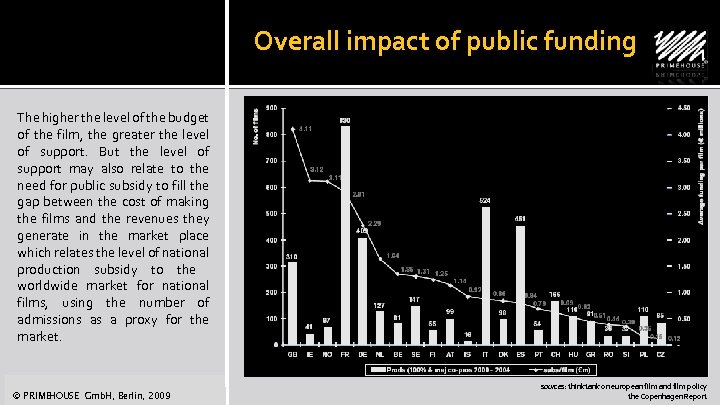 Overall impact of public funding The higher the level of the budget of the film, the greater the level of support. But the level of support may also relate to the need for public subsidy to fill the gap between the cost of making the films and the revenues they generate in the market place which relates the level of national production subsidy to the worldwide market for national films, using the number of admissions as a proxy for the market. © PRIME HOUSE Gmb. H, Berlin, 2009 sources: thinktank on european film and film policy the Copenhagen Report
 4 main issues what the money is given for? who takes the decisions? how the decisions are taken? the nature of the interaction between the decision-makers and the people to whom they give the money © PRIME HOUSE Gmb. H, Berlin, 2009
 Main objectives of national funding bodies Secure national film production Support the building of a sustainable film industry Secure production of quality films Add value to projects throughout the evaluation and production process Stimulate employment and commercial activity © PRIME HOUSE Gmb. H, Berlin, 2009
 Main Public supported schemes Automatic funding based on a set of objective criteria Selective funding based on individual assessment of projects Script development Project development Production Distribution Promotion © PRIME HOUSE Gmb. H, Berlin, 2009
 Qualifying criteria for granting Subjective criteria Distinctive artistic quality of the script Entertainment qualities Innovative qualities “breaking new ground” Audience potential based on script Cultural importance “National” characteristics © PRIME HOUSE Gmb. H, Berlin, 2009
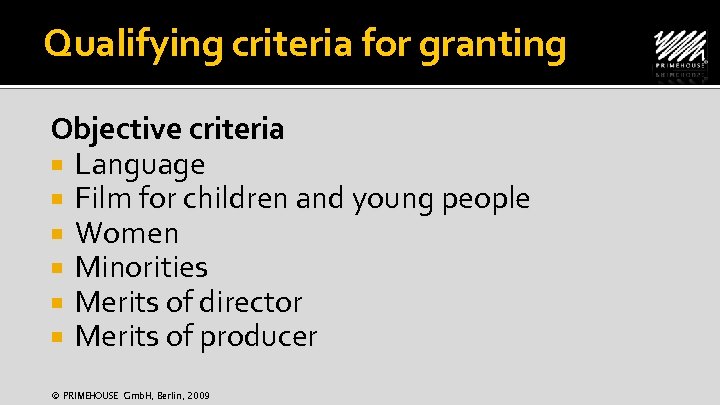 Qualifying criteria for granting Objective criteria Language Film for children and young people Women Minorities Merits of director Merits of producer © PRIME HOUSE Gmb. H, Berlin, 2009
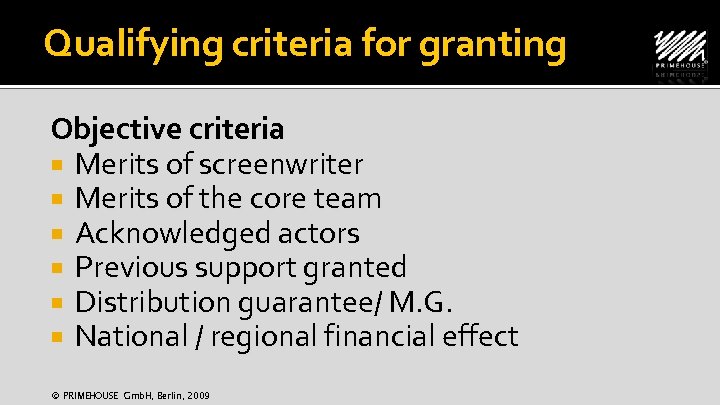 Qualifying criteria for granting Objective criteria Merits of screenwriter Merits of the core team Acknowledged actors Previous support granted Distribution guarantee/ M. G. National / regional financial effect © PRIME HOUSE Gmb. H, Berlin, 2009
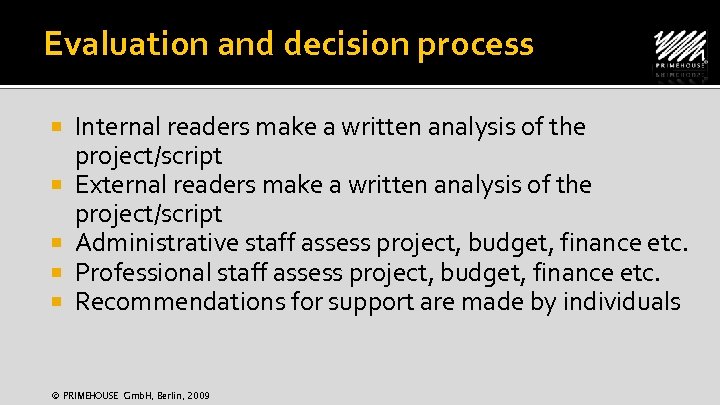 Evaluation and decision process Internal readers make a written analysis of the project/script External readers make a written analysis of the project/script Administrative staff assess project, budget, finance etc. Professional staff assess project, budget, finance etc. Recommendations for support are made by individuals © PRIME HOUSE Gmb. H, Berlin, 2009
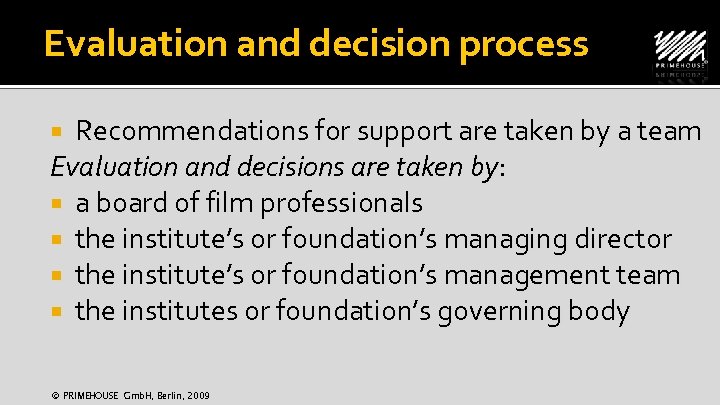 Evaluation and decision process Recommendations for support are taken by a team Evaluation and decisions are taken by: a board of film professionals the institute’s or foundation’s managing director the institute’s or foundation’s management team the institutes or foundation’s governing body © PRIME HOUSE Gmb. H, Berlin, 2009
 Eligible Applicants Writer Director Producer Distributor © PRIME HOUSE Gmb. H, Berlin, 2009
 The negotiation partners Professional staff (readers, producers, marketing/ distribution people) Administrative staff Decision makers © PRIME HOUSE Gmb. H, Berlin, 2009
 Types of grants offered for production repayable loan “soft” loan, repayable after the private investment has been recovered grant, not repayable grant dependent on the commercial success of the film, paid upon cinema admissions grant dependent on previous performance (“reference system” support) © PRIME HOUSE Gmb. H, Berlin, 2009
 Tax incentives Tax subsidy programmes Production-related tax discount Discounts on production related expenditure Tax shelter programmes Investor tax deduction (e. g. sale-and-lease back) Tax deduction related to future income © PRIME HOUSE Gmb. H, Berlin, 2009
 The purpose of tax incentives attract private funding for domestic production attract foreign production bolster employment in the audiovisual sector attract risk capital © PRIME HOUSE Gmb. H, Berlin, 2009
 Effect of the supported schemes Critical acclaim Festival selections and awards Audience response – theatrical release Audience response – television release The film’s profitability Return of public support Employment in the production sector Distribution to other countries/territories © PRIME HOUSE Gmb. H, Berlin, 2009
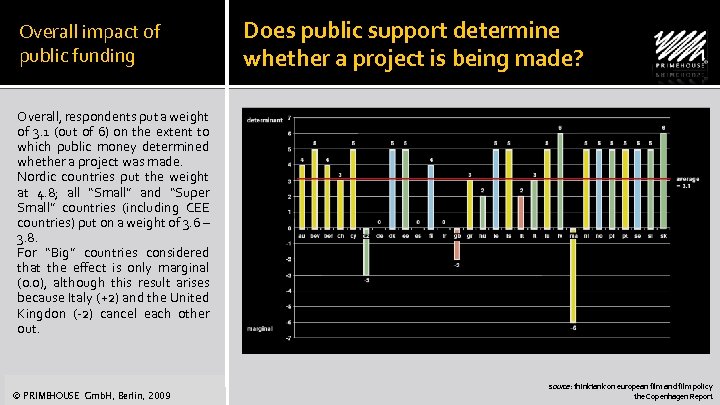 Overall impact of public funding Does public support determine whether a project is being made? Overall, respondents put a weight of 3. 1 (out of 6) on the extent to which public money determined whether a project was made. Nordic countries put the weight at 4. 8; all “Small” and “Super Small” countries (including CEE countries) put on a weight of 3. 6 – 3. 8. For “Big” countries considered that the effect is only marginal (0. 0), although this result arises because Italy (+2) and the United Kingdon (-2) cancel each other out. © PRIME HOUSE Gmb. H, Berlin, 2009 source: thinktank on european film and film policy the Copenhagen Report
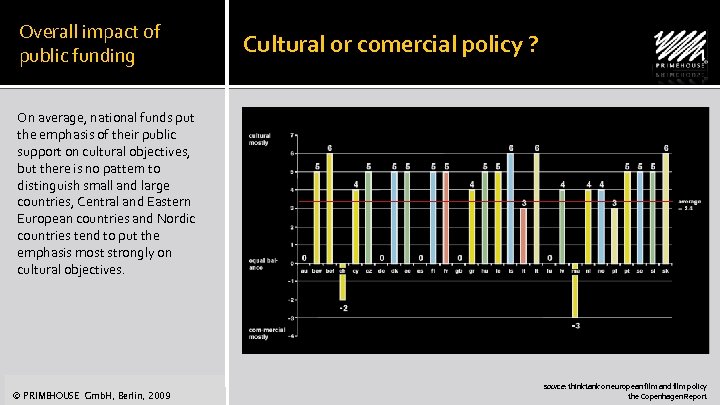 Overall impact of public funding Cultural or comercial policy ? On average, national funds put the emphasis of their public support on cultural objectives, but there is no pattern to distinguish small and large countries, Central and Eastern European countries and Nordic countries tend to put the emphasis most strongly on cultural objectives. © PRIME HOUSE Gmb. H, Berlin, 2009 source: thinktank on european film and film policy the Copenhagen Report
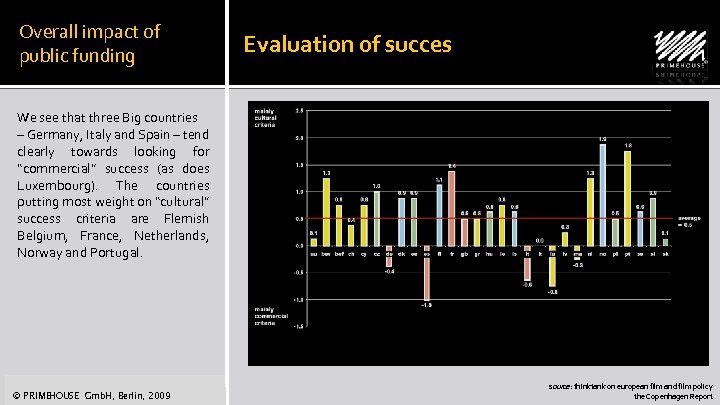 Overall impact of public funding Evaluation of succes We see that three Big countries – Germany, Italy and Spain – tend clearly towards looking for “commercial” success (as does Luxembourg). The countries putting most weight on “cultural” success criteria are Flemish Belgium, France, Netherlands, Norway and Portugal. © PRIME HOUSE Gmb. H, Berlin, 2009 source: thinktank on european film and film policy the Copenhagen Report
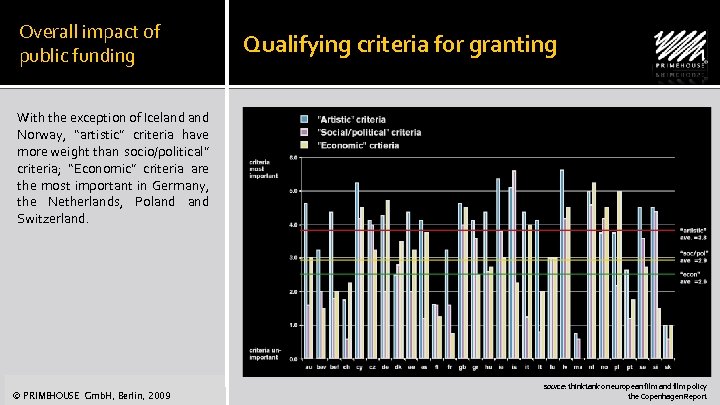 Overall impact of public funding Qualifying criteria for granting With the exception of Iceland Norway, “artistic” criteria have more weight than socio/political” criteria; “Economic” criteria are the most important in Germany, the Netherlands, Poland Switzerland. © PRIME HOUSE Gmb. H, Berlin, 2009 source: thinktank on european film and film policy the Copenhagen Report
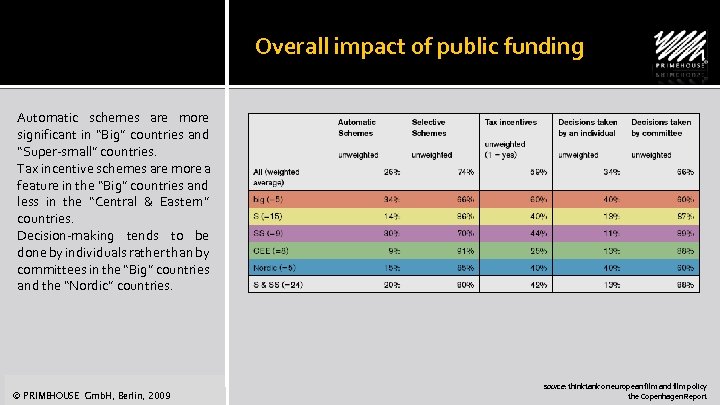 Overall impact of public funding Automatic schemes are more significant in “Big” countries and “Super-small” countries. Tax incentive schemes are more a feature in the “Big” countries and less in the “Central & Eastern” countries. Decision-making tends to be done by individuals rather than by committees in the “Big” countries and the “Nordic” countries. © PRIME HOUSE Gmb. H, Berlin, 2009 source: thinktank on european film and film policy the Copenhagen Report
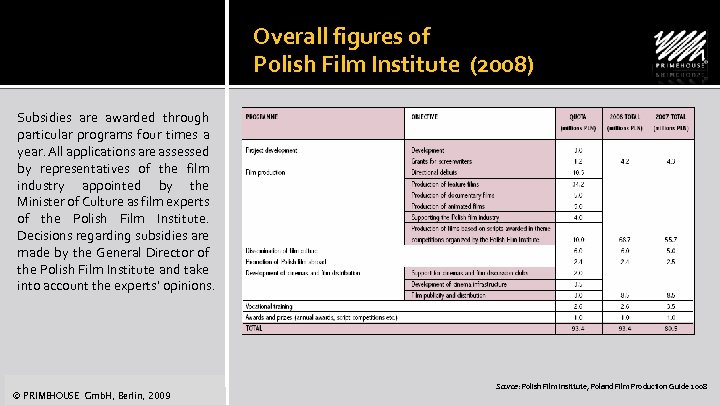 Overall figures of Polish Film Institute (2008) Subsidies are awarded through particular programs four times a year. All applications are assessed by representatives of the film industry appointed by the Minister of Culture as film experts of the Polish Film Institute. Decisions regarding subsidies are made by the General Director of the Polish Film Institute and take into account the experts’ opinions. © PRIME HOUSE Gmb. H, Berlin, 2009 Source: Polish Film Insittute, Poland Film Production Guide 2008
 Contact: Frank Stehling, f. stehling@prime-house. eu www. prime-house. eu Thank you for your attention © PRIMEHOUSE Gmb. H, Kantstrasse 149, 10623 Berlin