 Скачать презентацию Screening and Brief Intervention for Alcohol Misuse in
72ed976efb8d925d1d8af1ba42ec8a9a.ppt
- Количество слайдов: 77



Screening and Brief Intervention for Alcohol Misuse in Primary Care: What Comes After the Screening Validation Studies and RCT’s CJ 556; 10/17/07 Dan Kivlahan, Ph. D. daniel. kivlahan@va. gov VA Puget Sound & University of Washington

VA Motto: Lincoln’s 2 nd Inaugural March 4, 1865 “With malice toward none, with charity for all, with firmness in the right as God gives us to see the right, let us strive on to finish the work we are in, to bind up the nation’s wounds, to care for him [sic] who shall have borne the battle and for his [sic] widow, and his [sic] orphan, to do all which may achieve and cherish a just and lasting peace among ourselves and with all nations. ”
Veterans Health Administration - US largest integrated healthcare system - >5 M veterans served in FY 07 - 157 medical centers - 721 community-based outpatient clinics - 21 regions
Infrastructure Advantages of VA National systems for administrative data Integrated electronic health record VA Office of Quality and Performance - Incentivized performance monitoring - Evidence-based treatment guidelines VA Health Services Research - QUERI

Quality Enhancement Research Initiative
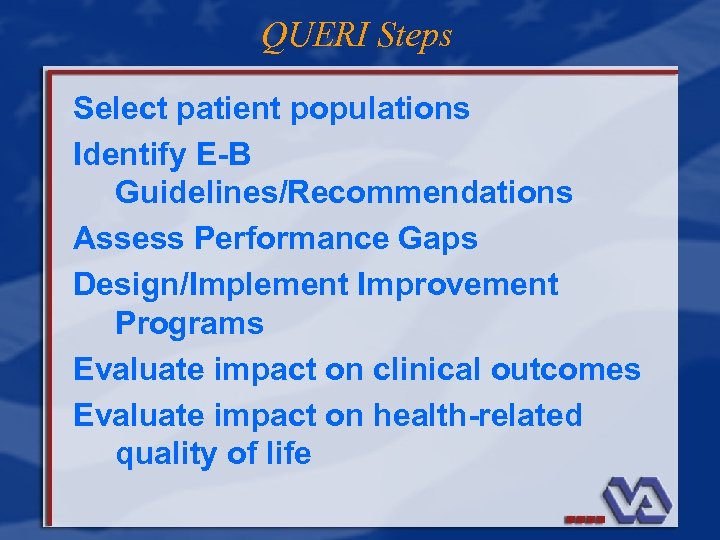
QUERI Steps Select patient populations Identify E-B Guidelines/Recommendations Assess Performance Gaps Design/Implement Improvement Programs Evaluate impact on clinical outcomes Evaluate impact on health-related quality of life
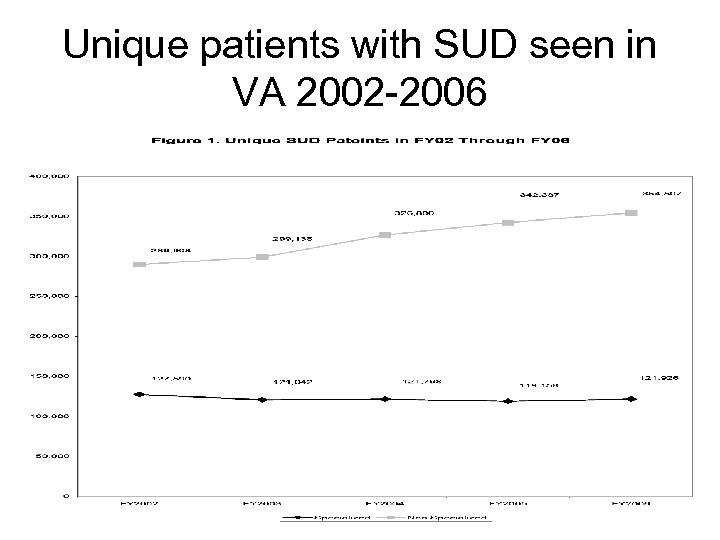
Unique patients with SUD seen in VA 2002 -2006
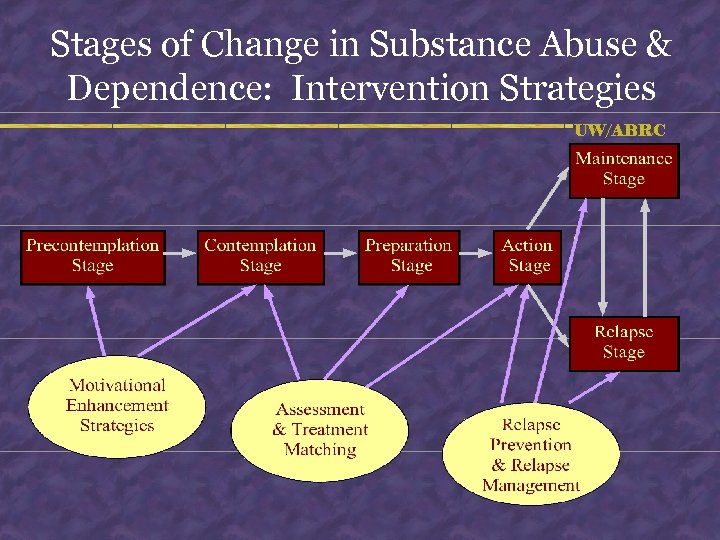
Stages of Change in Substance Abuse & Dependence: Intervention Strategies UW/ABRC
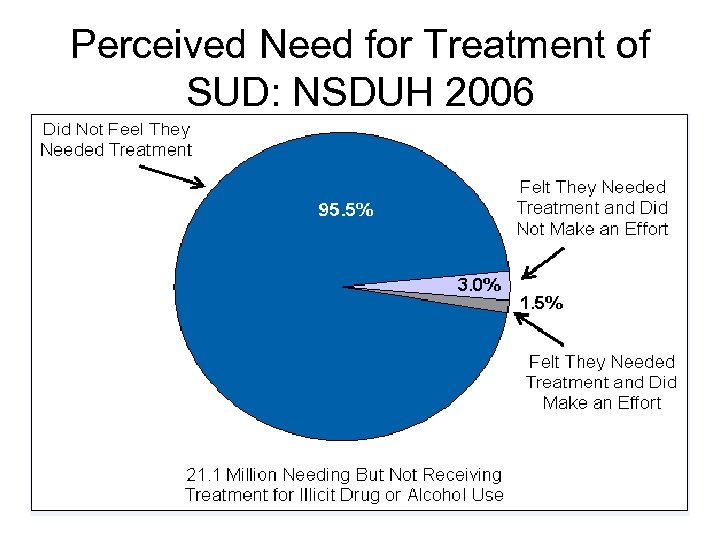
Perceived Need for Treatment of SUD: NSDUH 2006
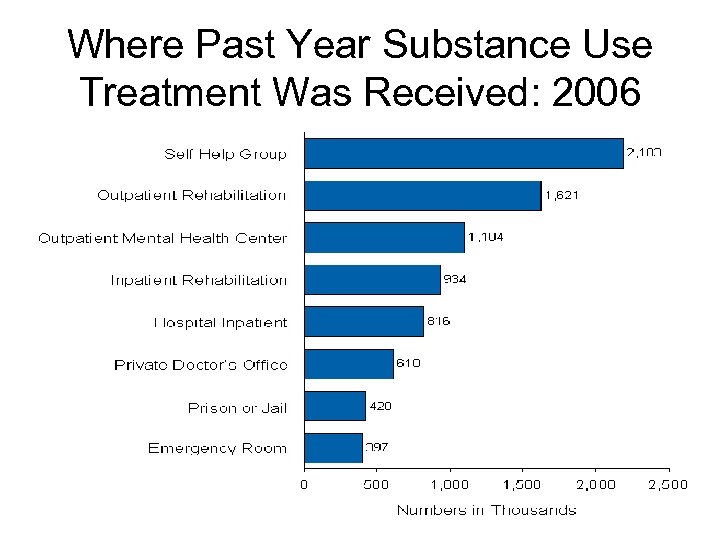
Where Past Year Substance Use Treatment Was Received: 2006
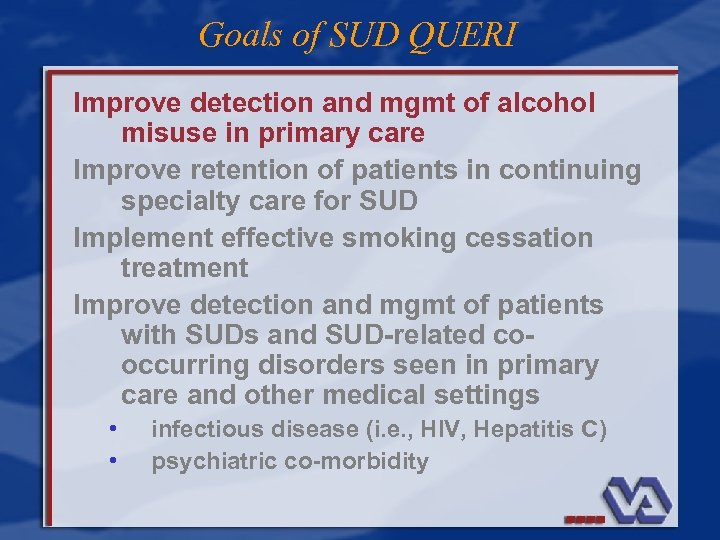
Goals of SUD QUERI Improve detection and mgmt of alcohol misuse in primary care Improve retention of patients in continuing specialty care for SUD Implement effective smoking cessation treatment Improve detection and mgmt of patients with SUDs and SUD-related cooccurring disorders seen in primary care and other medical settings • • infectious disease (i. e. , HIV, Hepatitis C) psychiatric co-morbidity
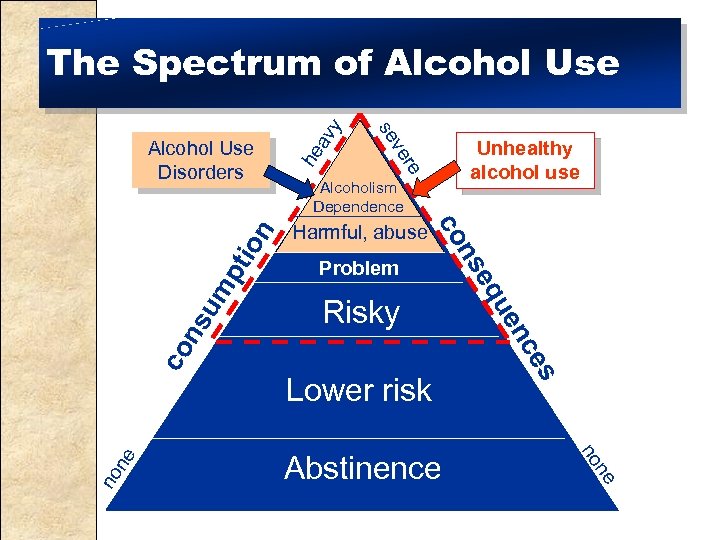
n he Harmful, abuse Problem ne no Abstinence s Lower risk e nc ue Risky eq ns pt io Alcoholism Dependence co co ns um re ne Unhealthy alcohol use ve no se Alcohol Use Disorders av y The Spectrum of Alcohol Use
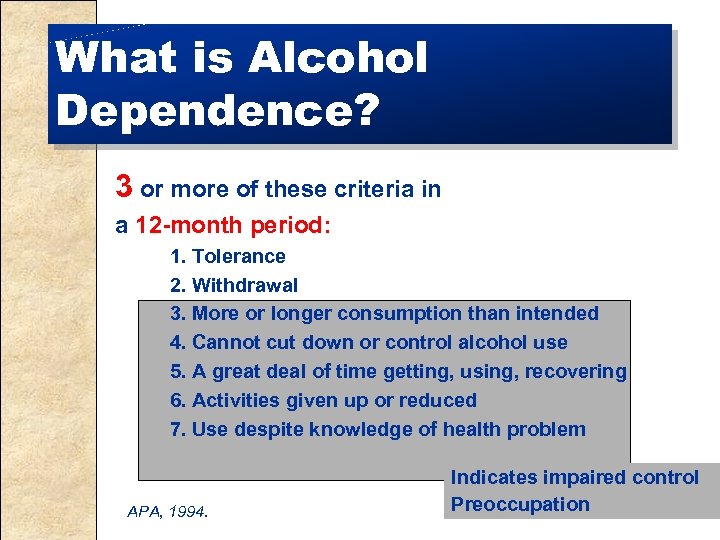
What is Alcohol Dependence? 3 or more of these criteria in a 12 -month period: 1. Tolerance 2. Withdrawal 3. More or longer consumption than intended 4. Cannot cut down or control alcohol use 5. A great deal of time getting, using, recovering 6. Activities given up or reduced 7. Use despite knowledge of health problem APA, 1994. Indicates impaired control Preoccupation
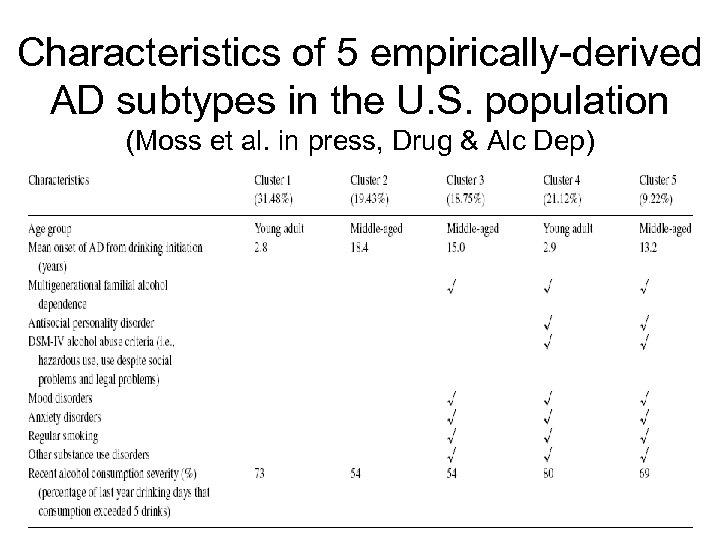
Characteristics of 5 empirically-derived AD subtypes in the U. S. population (Moss et al. in press, Drug & Alc Dep)
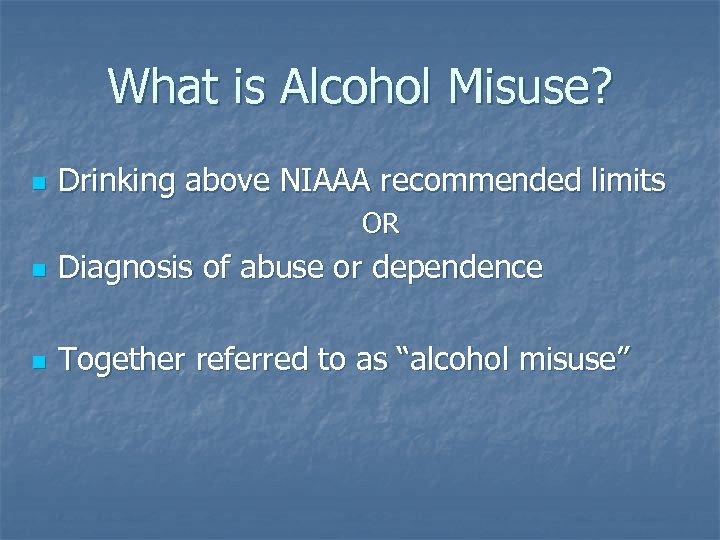
What is Alcohol Misuse? n Drinking above NIAAA recommended limits OR n Diagnosis of abuse or dependence n Together referred to as “alcohol misuse”
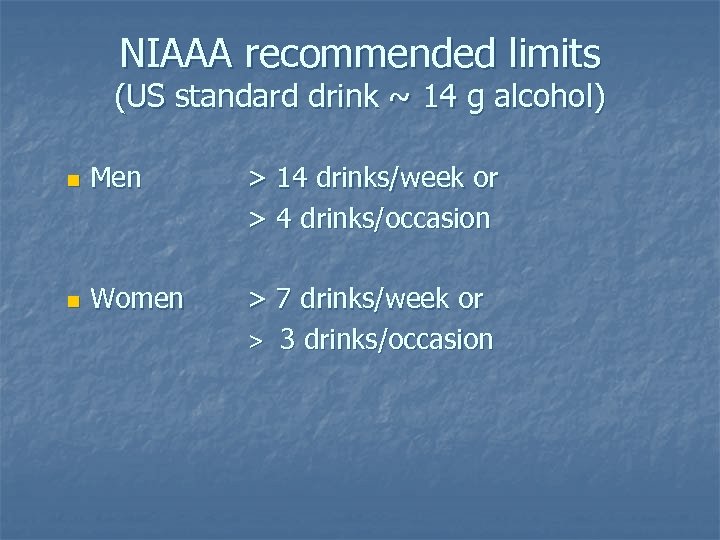
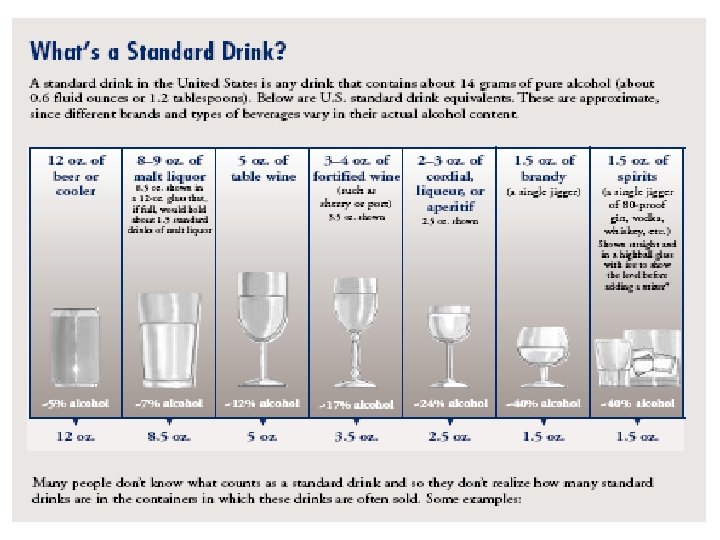
NIAAA recommended limits (US standard drink ~ 14 g alcohol) n Men > 14 drinks/week or > 4 drinks/occasion n Women > 7 drinks/week or > 3 drinks/occasion
How to Detect Alcohol Misuse? n n Biomarkers Self-report
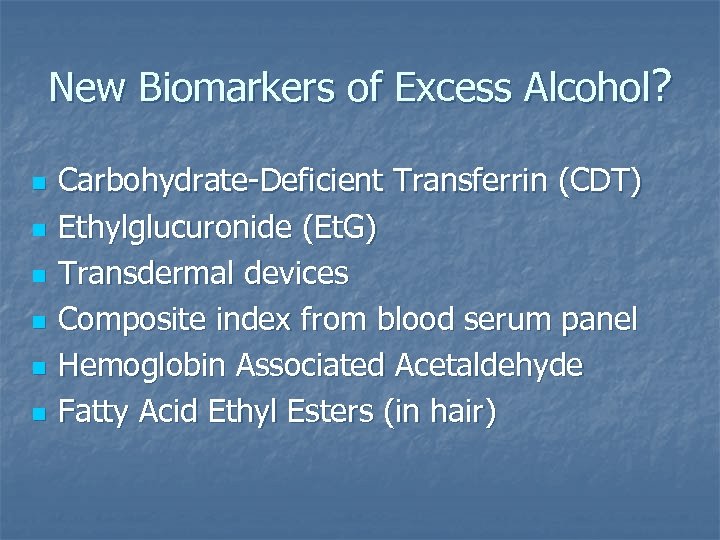
New Biomarkers of Excess Alcohol? n n n Carbohydrate-Deficient Transferrin (CDT) Ethylglucuronide (Et. G) Transdermal devices Composite index from blood serum panel Hemoglobin Associated Acetaldehyde Fatty Acid Ethyl Esters (in hair)

Limitations of biological assays n n n Cost and logistics Invasiveness Lack of sensitivity - timing
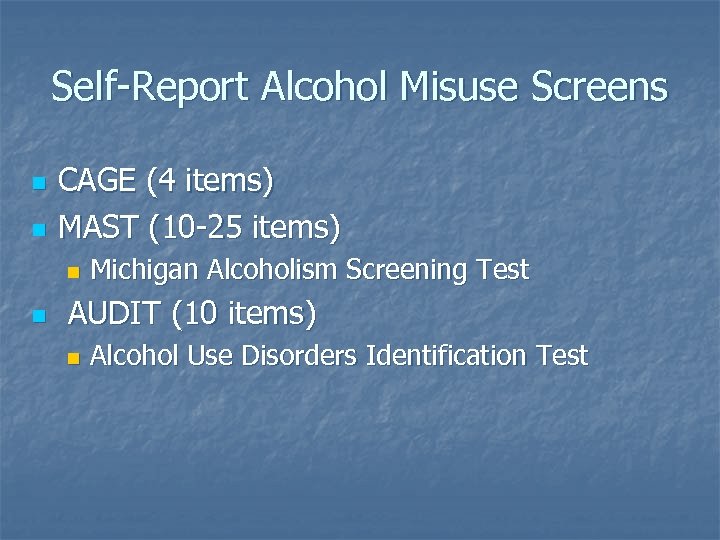
Self-Report Alcohol Misuse Screens n n CAGE (4 items) MAST (10 -25 items) n n Michigan Alcoholism Screening Test AUDIT (10 items) n Alcohol Use Disorders Identification Test
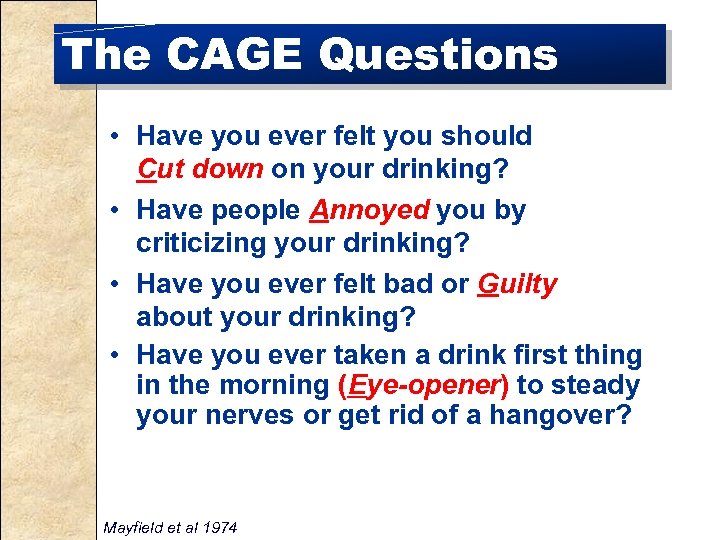
The CAGE Questions • Have you ever felt you should Cut down on your drinking? • Have people Annoyed you by criticizing your drinking? • Have you ever felt bad or Guilty about your drinking? • Have you ever taken a drink first thing in the morning (Eye-opener) to steady your nerves or get rid of a hangover? Mayfield et al 1974
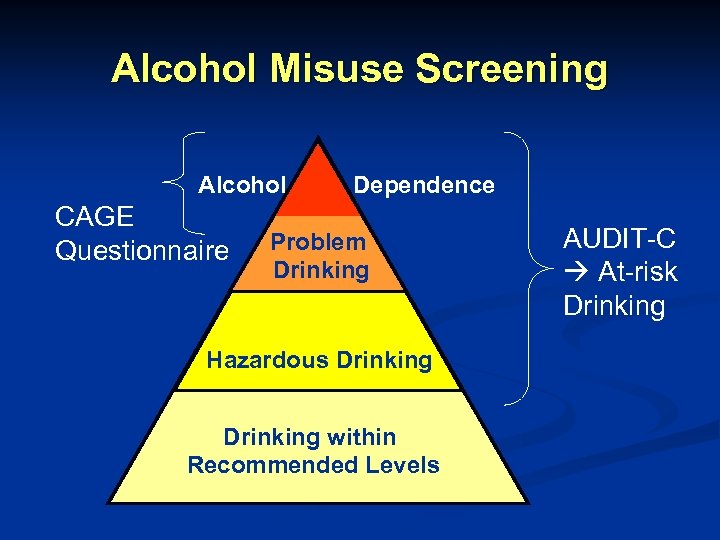
Alcohol Misuse Screening Alcohol CAGE Questionnaire Dependence Problem Drinking Hazardous Drinking within Recommended Levels AUDIT-C At-risk Drinking
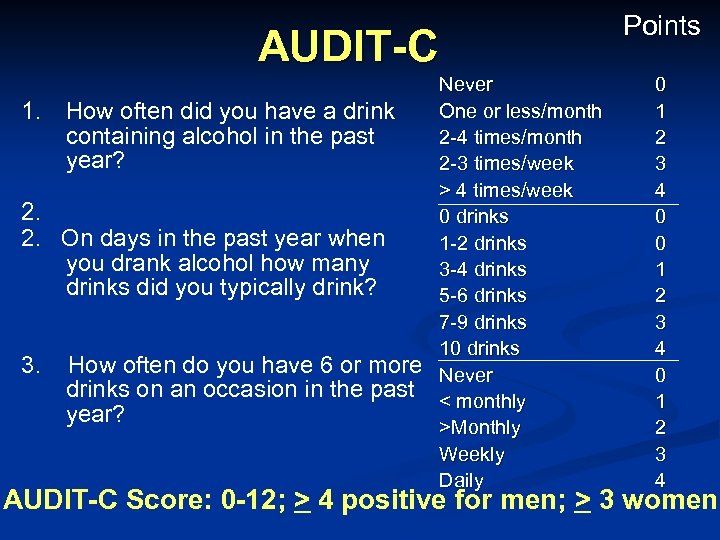
AUDIT-C 1. How often did you have a drink containing alcohol in the past year? 2. 2. On days in the past year when you drank alcohol how many drinks did you typically drink? 3. How often do you have 6 or more drinks on an occasion in the past year? Never One or less/month 2 -4 times/month 2 -3 times/week > 4 times/week 0 drinks 1 -2 drinks 3 -4 drinks 5 -6 drinks 7 -9 drinks 10 drinks Never < monthly >Monthly Weekly Daily Points 0 1 2 3 4 AUDIT-C Score: 0 -12; > 4 positive for men; > 3 women
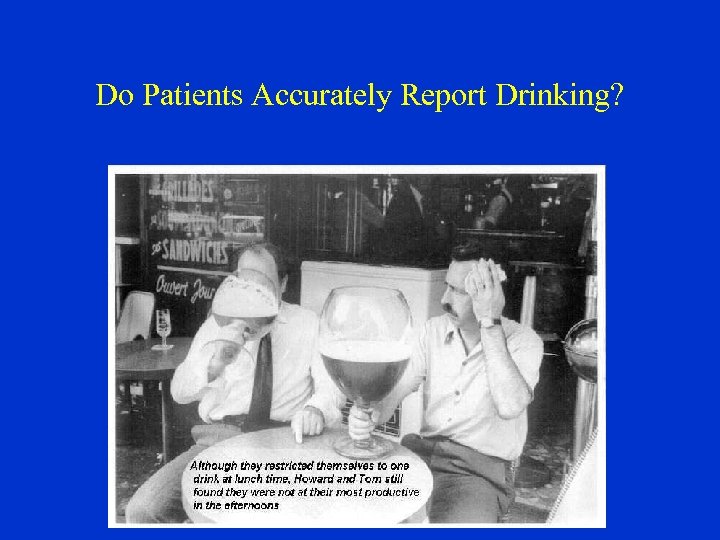
Do Patients Accurately Report Drinking?
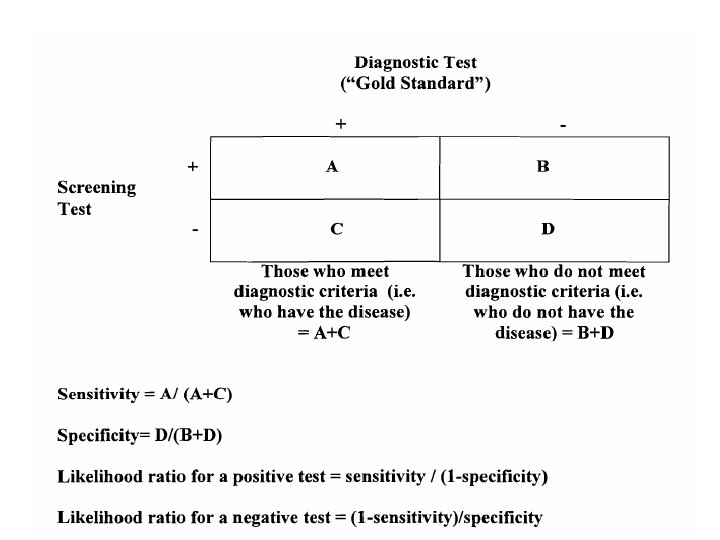
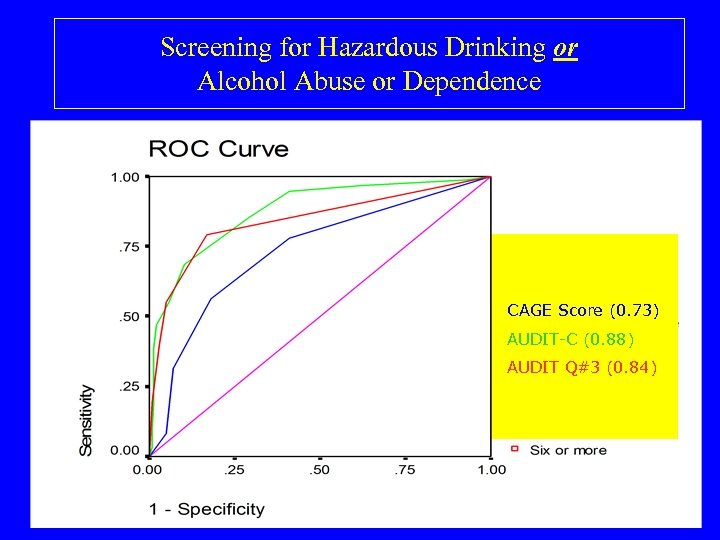
Screening for Hazardous Drinking or Alcohol Abuse or Dependence CAGE Score (0. 73) AUDIT-C (0. 88) AUDIT Q#3 (0. 84)
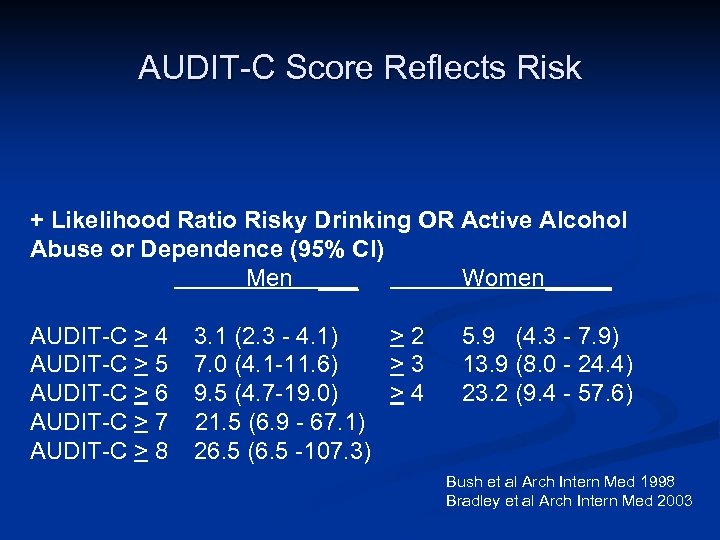
AUDIT-C Score Reflects Risk + Likelihood Ratio Risky Drinking OR Active Alcohol Abuse or Dependence (95% CI) Men ___ Women_____ AUDIT-C > 4 AUDIT-C > 5 AUDIT-C > 6 AUDIT-C > 7 AUDIT-C > 8 3. 1 (2. 3 - 4. 1) >2 7. 0 (4. 1 -11. 6) >3 9. 5 (4. 7 -19. 0) >4 21. 5 (6. 9 - 67. 1) 26. 5 (6. 5 -107. 3) 5. 9 (4. 3 - 7. 9) 13. 9 (8. 0 - 24. 4) 23. 2 (9. 4 - 57. 6) Bush et al Arch Intern Med 1998 Bradley et al Arch Intern Med 2003
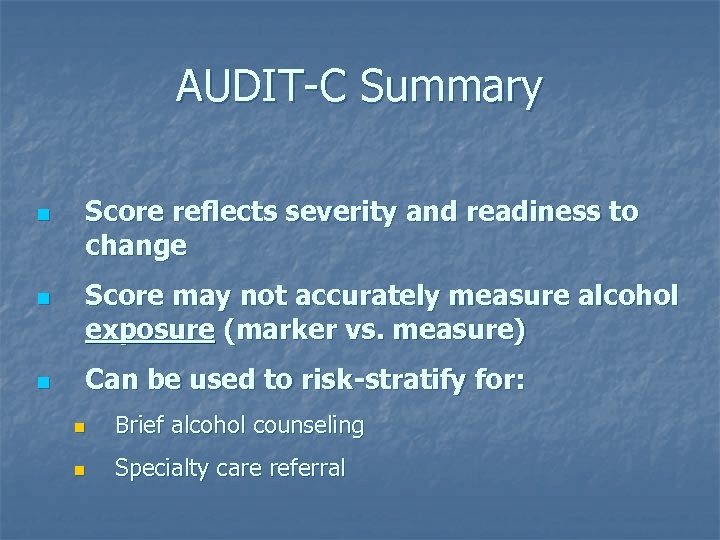
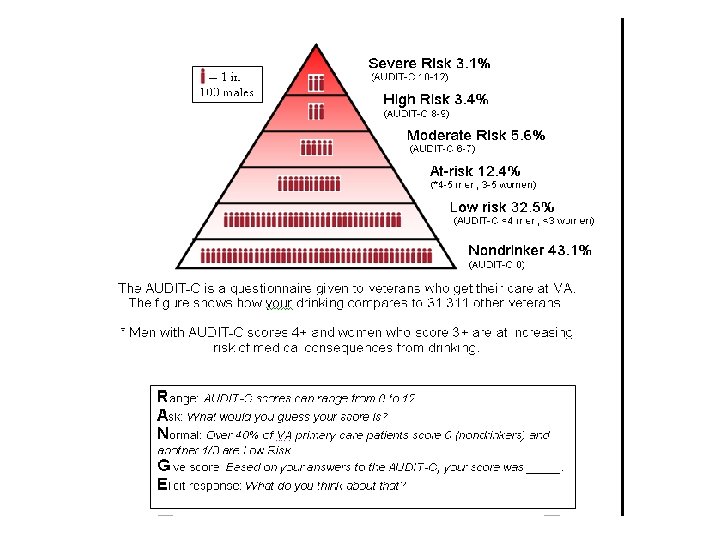
AUDIT-C Summary n n n Score reflects severity and readiness to change Score may not accurately measure alcohol exposure (marker vs. measure) Can be used to risk-stratify for: n Brief alcohol counseling n Specialty care referral
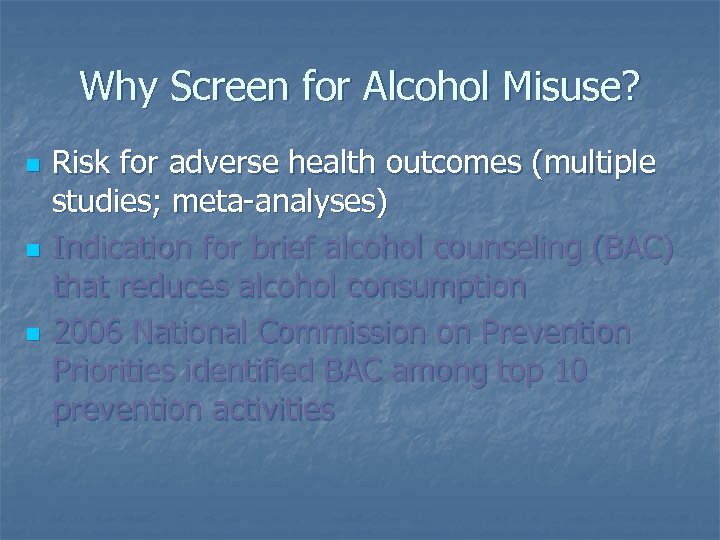
Why Screen for Alcohol Misuse? n n n Risk for adverse health outcomes (multiple studies; meta-analyses) Indication for brief alcohol counseling (BAC) that reduces alcohol consumption 2006 National Commission on Prevention Priorities identified BAC among top 10 prevention activities
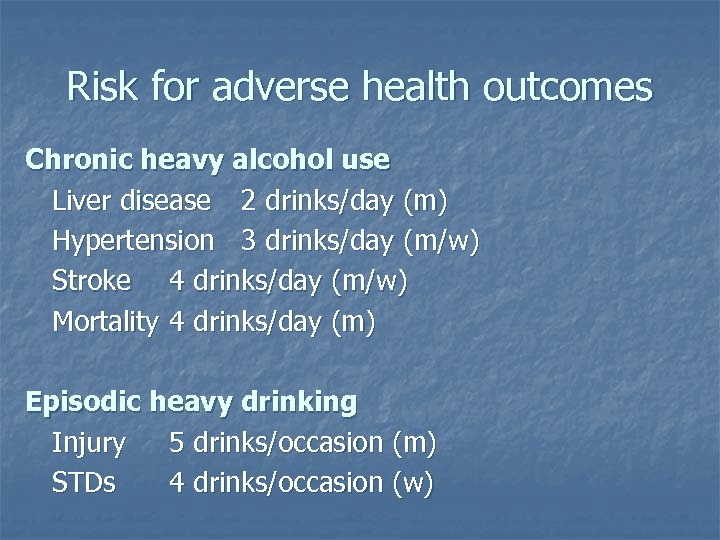
Risk for adverse health outcomes Chronic heavy alcohol use Liver disease 2 drinks/day (m) Hypertension 3 drinks/day (m/w) Stroke 4 drinks/day (m/w) Mortality 4 drinks/day (m) Episodic heavy drinking Injury 5 drinks/occasion (m) STDs 4 drinks/occasion (w)
Why Screen for Alcohol Misuse? n n n Risk for adverse health outcomes (multiple studies; meta-analyses) Indication for brief alcohol counseling (BAC) that reduces drinking risk 2006 National Commission on Prevention Priorities identified BAC among top 10 prevention activities
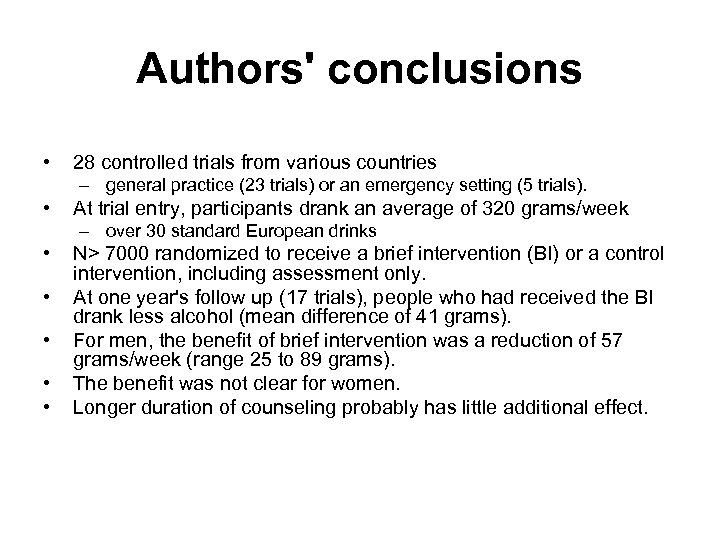
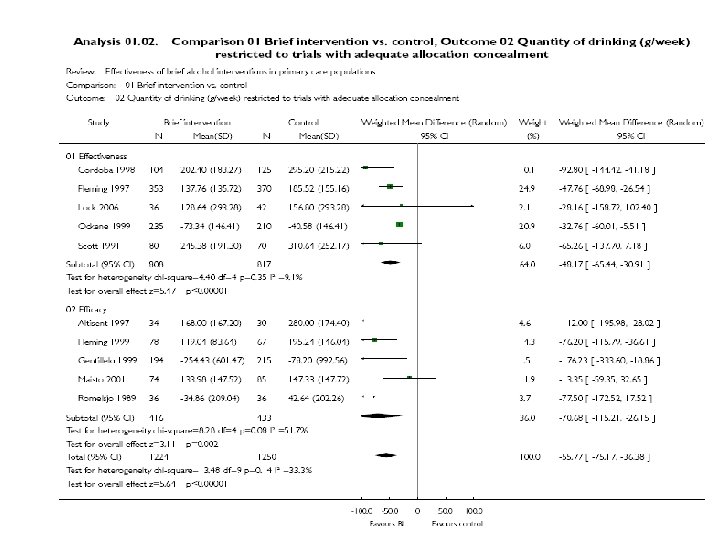
Authors' conclusions • 28 controlled trials from various countries – general practice (23 trials) or an emergency setting (5 trials). • At trial entry, participants drank an average of 320 grams/week – over 30 standard European drinks • • • N> 7000 randomized to receive a brief intervention (BI) or a control intervention, including assessment only. At one year's follow up (17 trials), people who had received the BI drank less alcohol (mean difference of 41 grams). For men, the benefit of brief intervention was a reduction of 57 grams/week (range 25 to 89 grams). The benefit was not clear for women. Longer duration of counseling probably has little additional effect.
Why Screen for Alcohol Misuse? n n n Risk for adverse health outcomes (multiple studies; meta-analyses) Indication for brief alcohol counseling (BAC) that reduces drinking risk 2006 National Commission on Prevention Priorities identified BAC among top 10 prevention activities
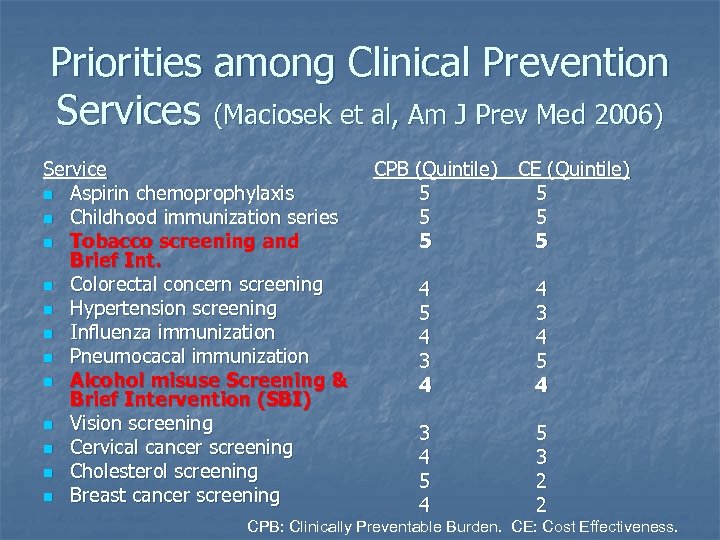
Priorities among Clinical Prevention Services (Maciosek et al, Am J Prev Med 2006) Service n Aspirin chemoprophylaxis n Childhood immunization series n Tobacco screening and Brief Int. n Colorectal concern screening n Hypertension screening n Influenza immunization n Pneumocacal immunization n Alcohol misuse Screening & Brief Intervention (SBI) n Vision screening n Cervical cancer screening n Cholesterol screening n Breast cancer screening CPB (Quintile) CE (Quintile) 5 5 5 4 5 4 3 4 5 3 2 2 CPB: Clinically Preventable Burden. CE: Cost Effectiveness.
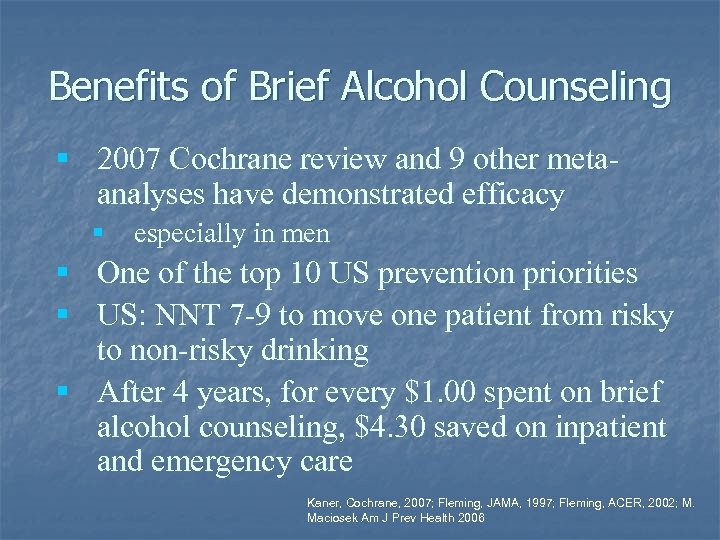
Benefits of Brief Alcohol Counseling § 2007 Cochrane review and 9 other metaanalyses have demonstrated efficacy § especially in men § One of the top 10 US prevention priorities § US: NNT 7 -9 to move one patient from risky to non-risky drinking § After 4 years, for every $1. 00 spent on brief alcohol counseling, $4. 30 saved on inpatient and emergency care Kaner, Cochrane, 2007; Fleming, JAMA, 1997; Fleming, ACER, 2002; M. Maciosek Am J Prev Health 2006
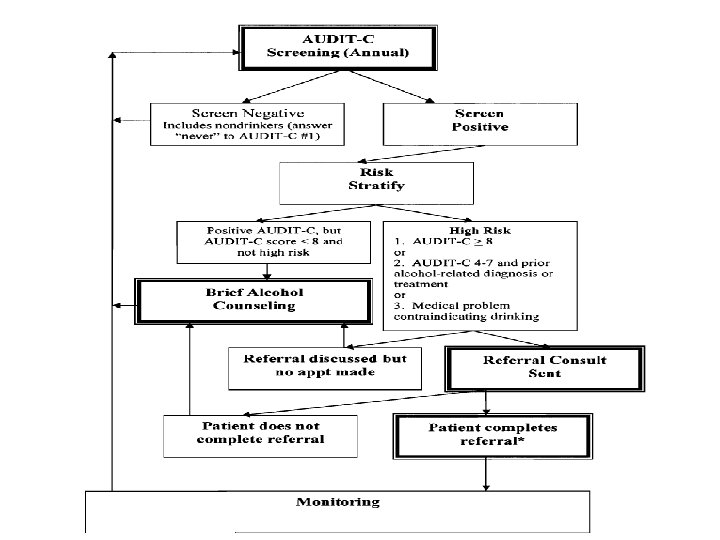
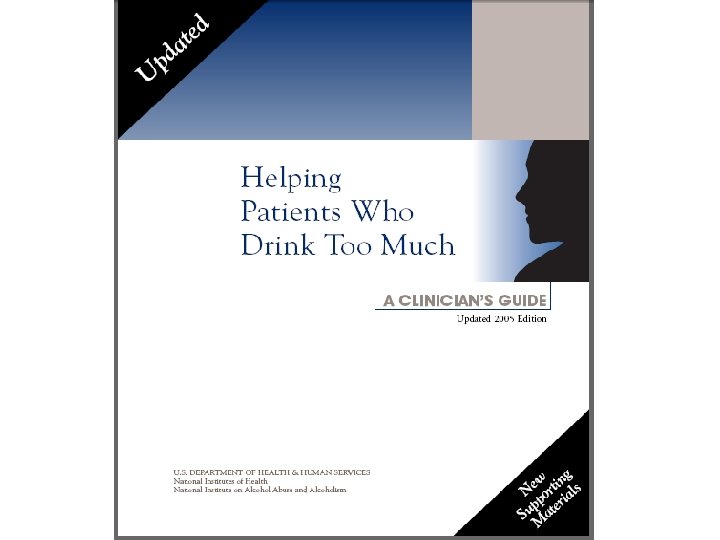
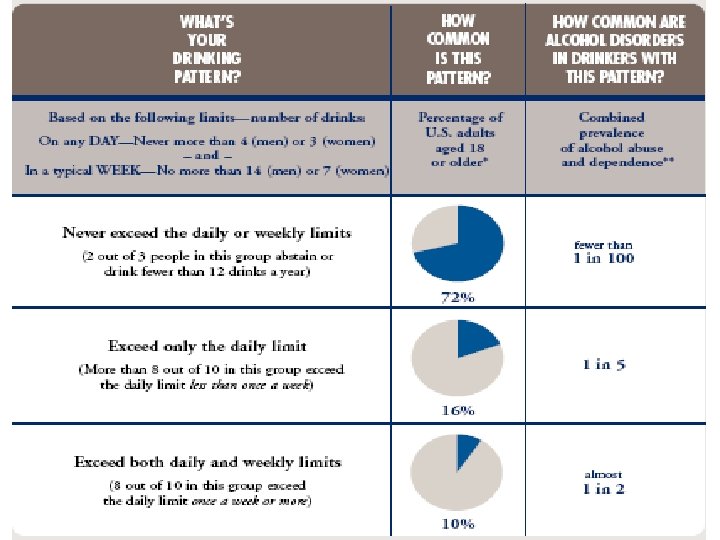
Helping Patients Who Drink Too Much: 5 A’s • ASK about alcohol use • ASSESS severity and readiness to change • ADVISE cutting down or abstinence, and assist in goal setting • ASSIST with further treatment when necessary • ARRANGE follow-up to monitor progress
Five General Principles UW/ABRC § Express Empathy § Develop Discrepancy § Avoid Argumentation § Roll with Resistance § Support Self-Efficacy
PRINCIPLES OF MOTIVATIONAL INTERVIEWING • • • Respect client autonomy, culture and choices. Acknowledge client as the active decision maker. Negotiate an agenda for change. Offer information in a neutral, non-personal manner. Ask open-ended questions. Practice reflective listening to encourage patients to talk about their drinking and the barriers to change. • Accept resistance as a normal response. • Avoid confrontation, labeling, stereotyping and forcing patients to accept a label or diagnosis.
Demystifying Motivational Interviewing for SUD • “So this weekend I went into a store to buy some paint…The fellow at the counter…saw ‘CASAA’ on my shirt and asked what it is. I told him it’s an addiction treatment research center…he said, ‘I help people with that problem sometimes. ’ • “Really? What do you do? ” Bill Miller e-mail to MI Network of Trainers 3/29/05
Demystifying Motivational Interviewing for SUD • “I just talk to them… I just do volunteer counseling. I help them see that they have a choice. We lay out the two sides – what happens if they continue on as they are, and what else they could do. And then I ask them which way they want to go. I don’t tell them what to do. It has to come from them. That’s what I do, and it just seems to help. ” • He had a 6 th grade education Bill Miller e-mail to MI Network of Trainers 3/29/05
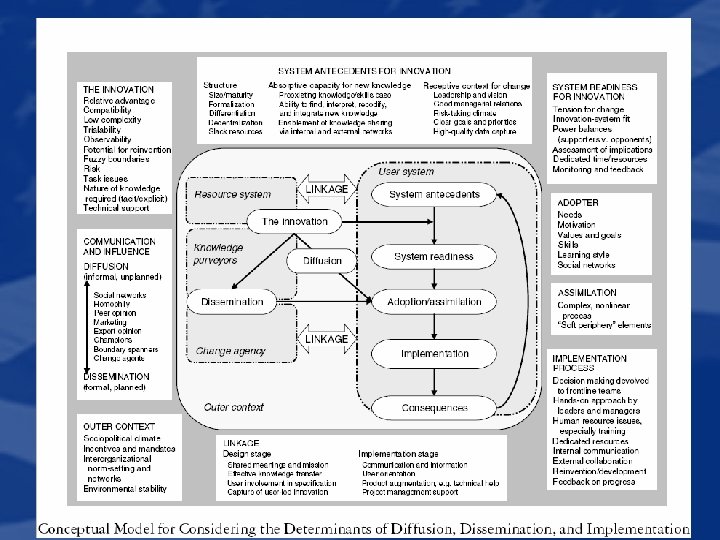
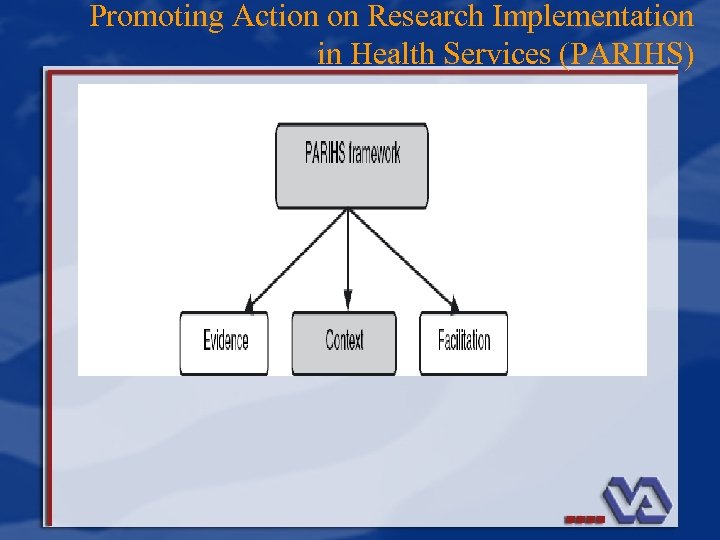
Promoting Action on Research Implementation in Health Services (PARIHS)
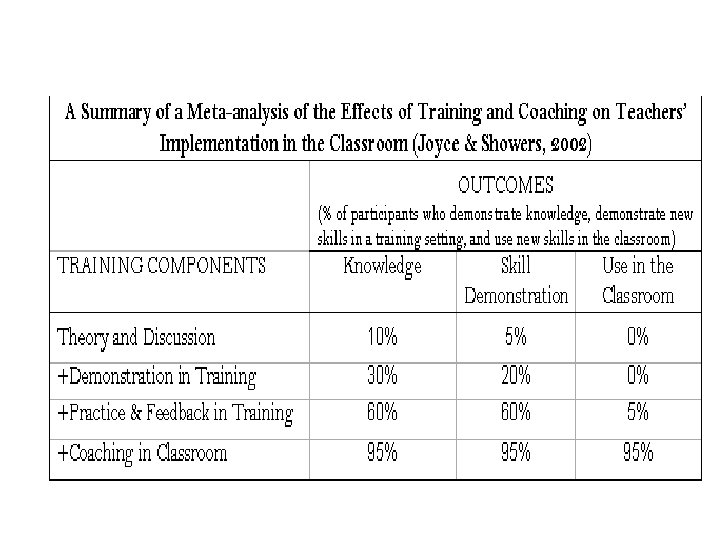
2 “Simple” Principles of Facilitation Feedback on local performance • • • carefully defined accurately measured ongoing Accessible supervision or “coaching” from someone with more expertise about improvement Miller, Sorensen, Selzer, Brigham. JSAT, 2006; 21: 25 -39
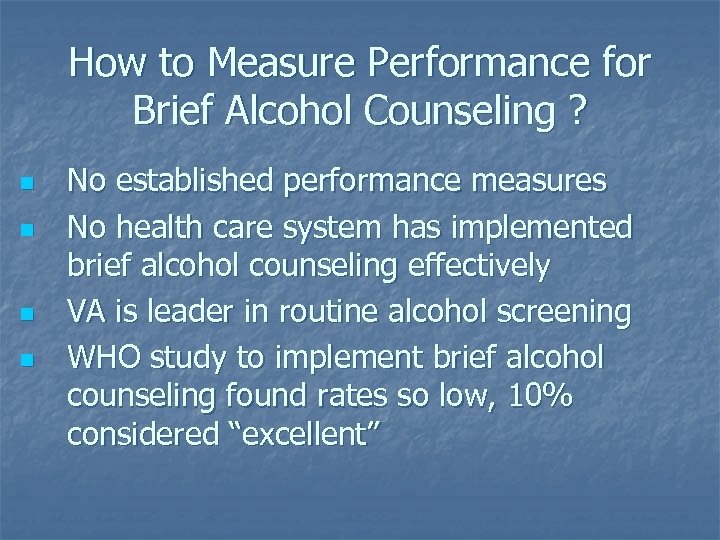
How to Measure Performance for Brief Alcohol Counseling ? n n No established performance measures No health care system has implemented brief alcohol counseling effectively VA is leader in routine alcohol screening WHO study to implement brief alcohol counseling found rates so low, 10% considered “excellent”
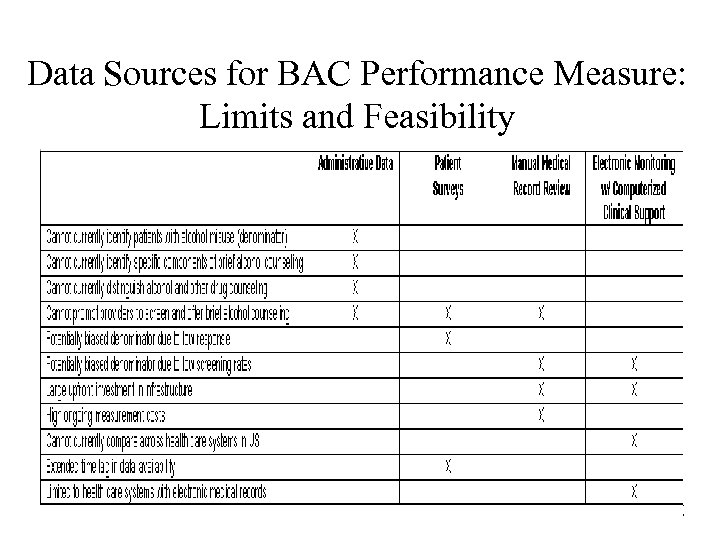
Data Sources for BAC Performance Measure: Limits and Feasibility

Self-reported Alcohol-related Advice If Screen+ for Alcohol Misuse
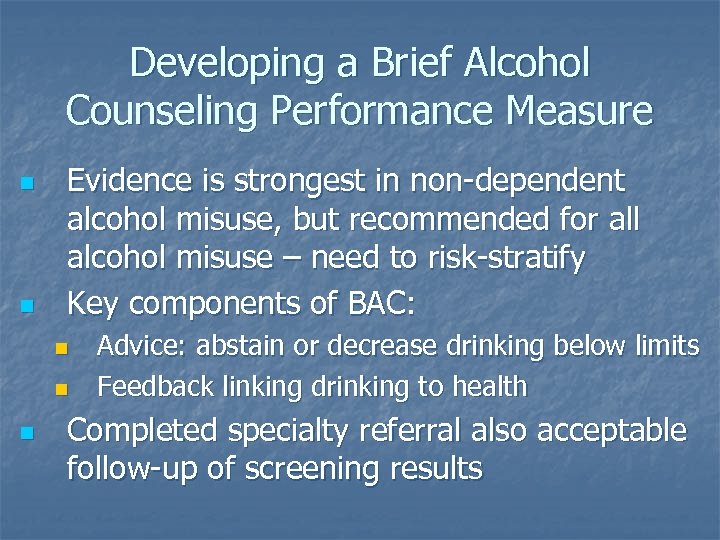
Developing a Brief Alcohol Counseling Performance Measure n n Evidence is strongest in non-dependent alcohol misuse, but recommended for all alcohol misuse – need to risk-stratify Key components of BAC: n n n Advice: abstain or decrease drinking below limits Feedback linking drinking to health Completed specialty referral also acceptable follow-up of screening results
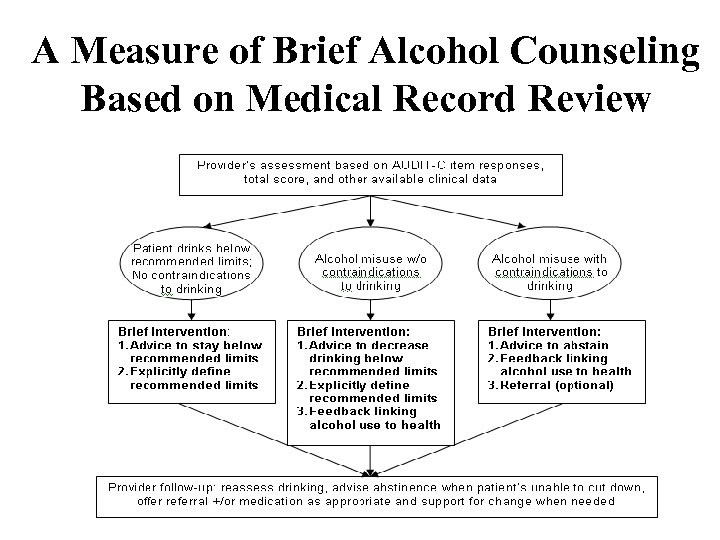
A Measure of Brief Alcohol Counseling Based on Medical Record Review
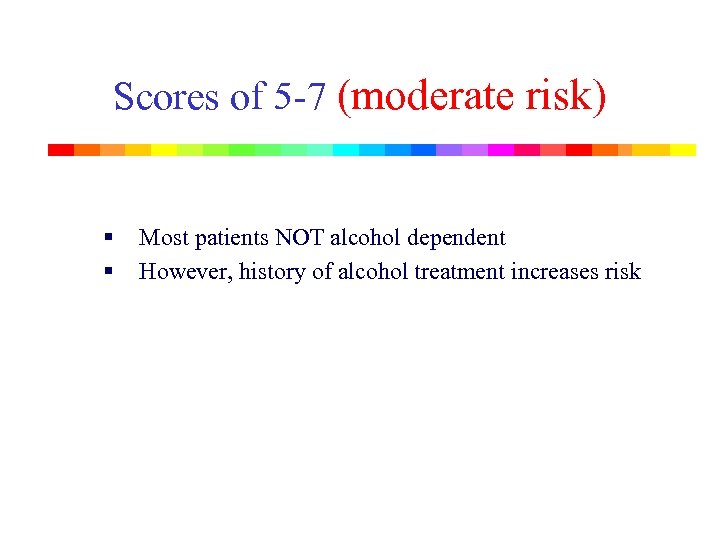
Scores of 5 -7 (moderate risk) § § Most patients NOT alcohol dependent However, history of alcohol treatment increases risk
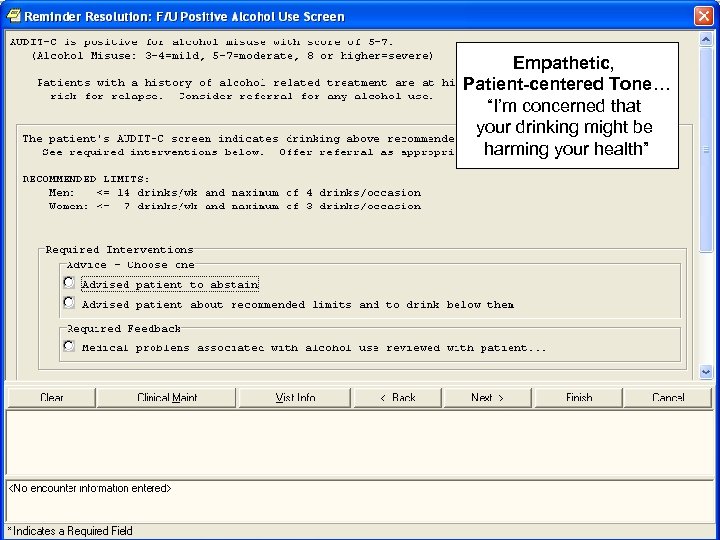
Empathetic, Patient-centered Tone… “I’m concerned that your drinking might be harming your health”
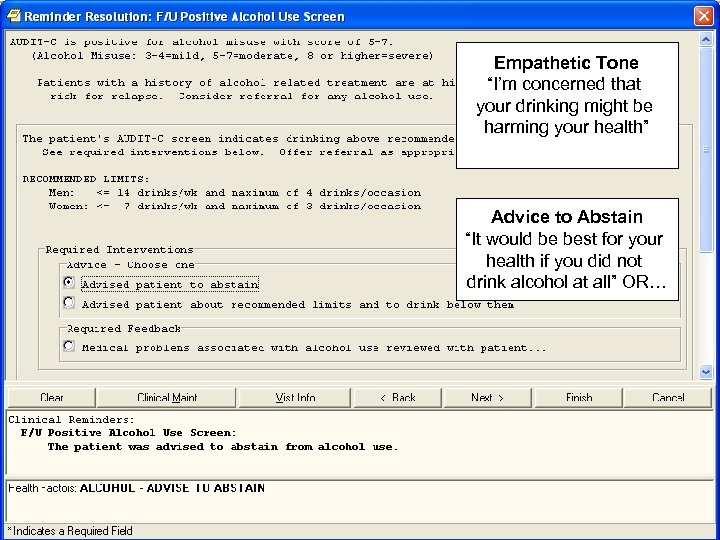
Empathetic Tone “I’m concerned that your drinking might be harming your health” Advice to Abstain “It would be best for your health if you did not drink alcohol at all” OR…
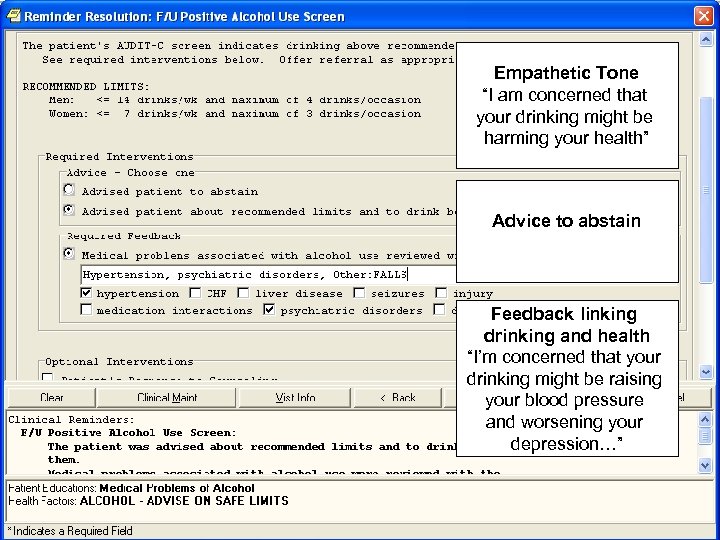
Empathetic Tone “I am concerned that your drinking might be harming your health” Advice to abstain Feedback linking drinking and health “I’m concerned that your drinking might be raising your blood pressure and worsening your depression…”
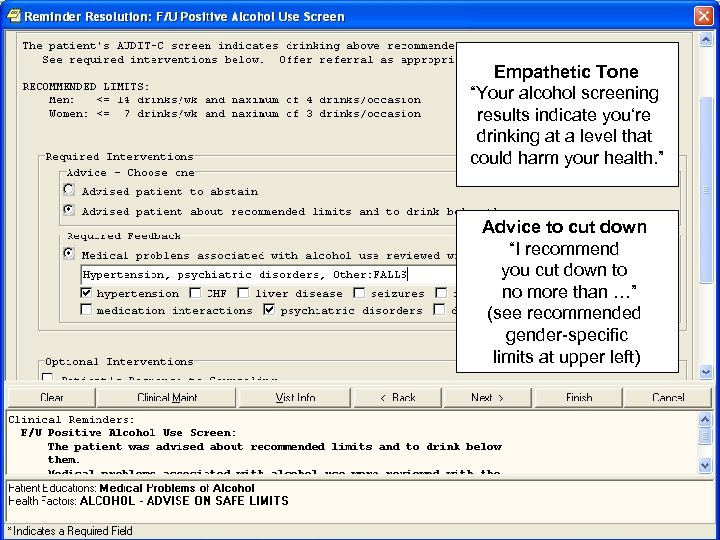
Empathetic Tone “Your alcohol screening results indicate you‘re drinking at a level that could harm your health. ” Advice to cut down “I recommend you cut down to no more than …” (see recommended gender-specific limits at upper left)
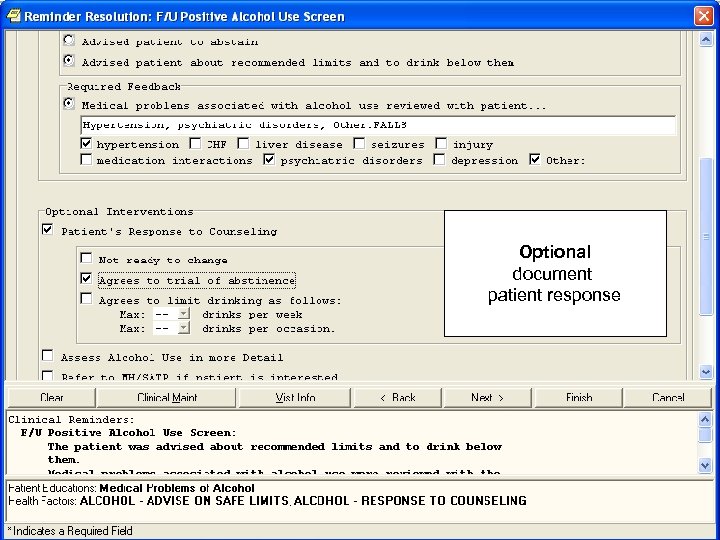
Optional document patient response
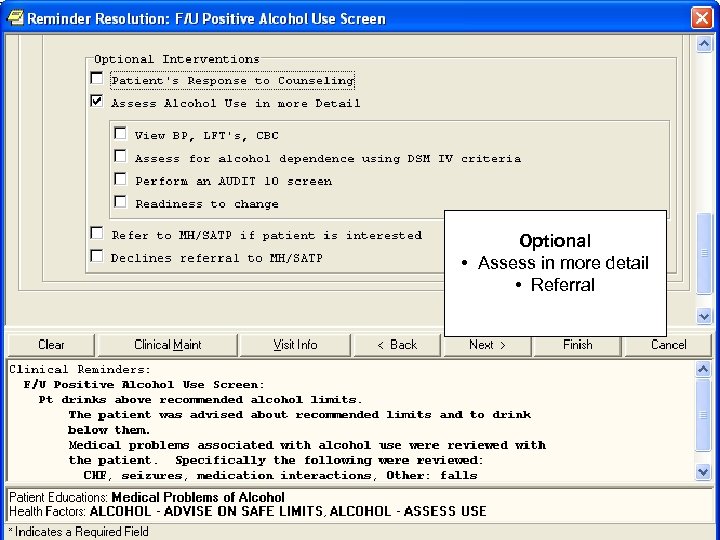
Optional • Assess in more detail • Referral
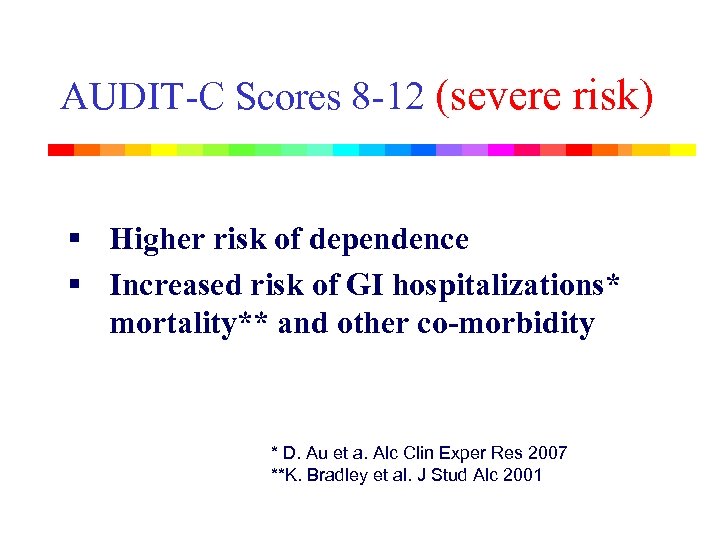
AUDIT-C Scores 8 -12 (severe risk) § Higher risk of dependence § Increased risk of GI hospitalizations* mortality** and other co-morbidity * D. Au et a. Alc Clin Exper Res 2007 **K. Bradley et al. J Stud Alc 2001
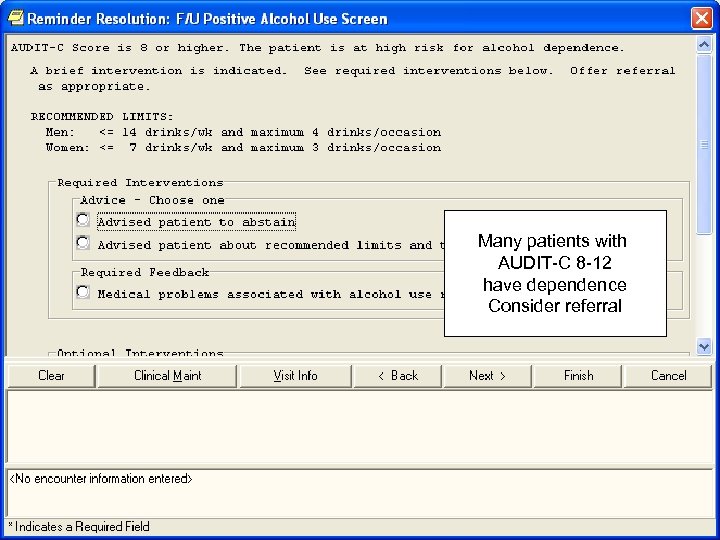
Many patients with AUDIT-C 8 -12 have dependence Consider referral
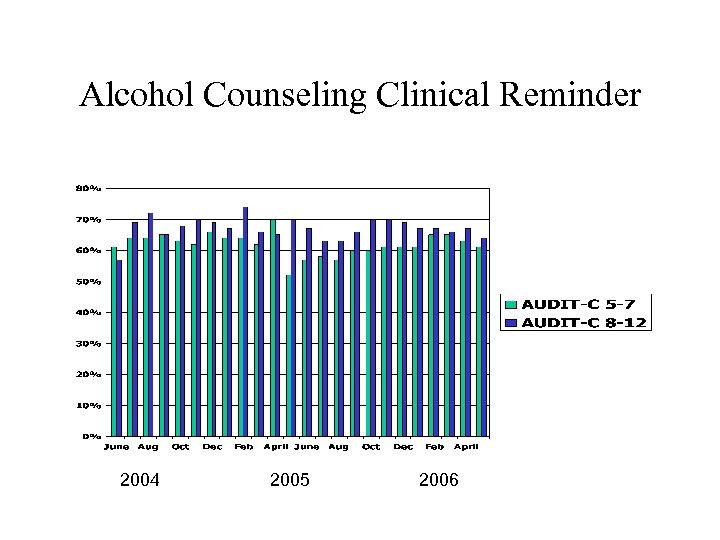
Alcohol Counseling Clinical Reminder 2004 2005 2006
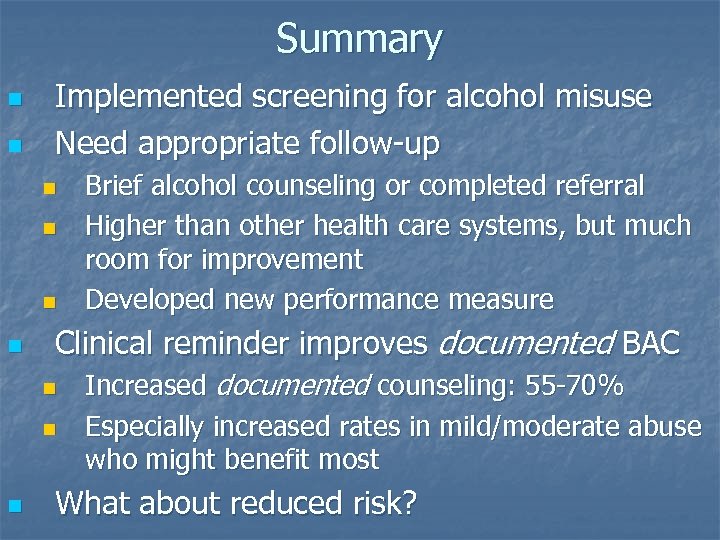
Summary n n Implemented screening for alcohol misuse Need appropriate follow-up n n Clinical reminder improves documented BAC n n n Brief alcohol counseling or completed referral Higher than other health care systems, but much room for improvement Developed new performance measure Increased documented counseling: 55 -70% Especially increased rates in mild/moderate abuse who might benefit most What about reduced risk?
If you cannot measure it, you cannot improve it. “If you can measure that of which you speak and express it in numbers, you know something about your subject; but if you cannot measure it, your knowledge is of a very meager and unsatisfactory kind. ” (1883) William Thomson (Lord Kelvin) (18241907).
Research Team Kathy Bradley, MD Carol Achtmeyer, ARNP Anna De. Benedetti, BA Gwen Greiner, MPH Eric Hawkins, Ph. D Emily Williams, MPH Funding from • CESATE • VA HSR&D • NIAAA R 21 AA 14672
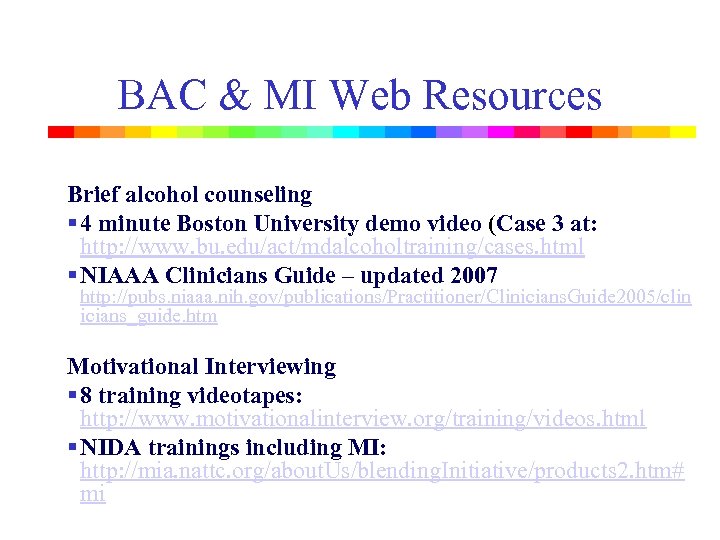
BAC & MI Web Resources Brief alcohol counseling § 4 minute Boston University demo video (Case 3 at: http: //www. bu. edu/act/mdalcoholtraining/cases. html § NIAAA Clinicians Guide – updated 2007 http: //pubs. niaaa. nih. gov/publications/Practitioner/Clinicians. Guide 2005/clin icians_guide. htm Motivational Interviewing § 8 training videotapes: http: //www. motivationalinterview. org/training/videos. html § NIDA trainings including MI: http: //mia. nattc. org/about. Us/blending. Initiative/products 2. htm# mi
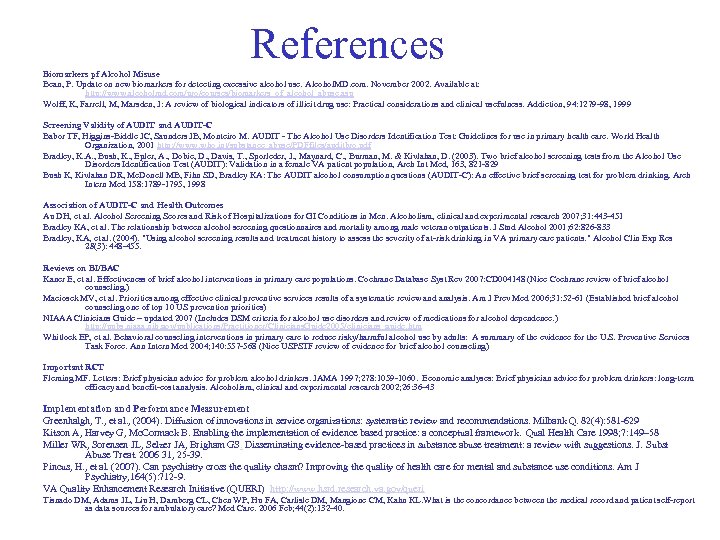
References Biomarkers pf Alcohol Misuse Bean, P. Update on new biomarkers for detecting excessive alcohol use. Alcohol. MD. com. November 2002. Available at: http: //www. alcoholmd. com/pro/courses/biomarkers_of_alcohol_abuse. asp Wolff, K, Farrell, M, Marsden, J: A review of biological indicators of illicit drug use: Practical considerations and clinical usefulness. Addiction, 94: 1279 -98, 1999 Screening Validity of AUDIT and AUDIT-C Babor TF, Higgins-Biddle JC, Saunders JB, Monteiro M. AUDIT - The Alcohol Use Disorders Identification Test: Guidelines for use in primary health care. World Health Organization, 2001 http: //www. who. int/substance_abuse/PDFfiles/auditbro. pdf Bradley, K. A. , Bush, K. , Epler, A. , Dobie, D. , Davis, T. , Sporleder, J. , Maynard, C. , Burman, M. & Kivlahan, D. (2003). Two brief alcohol screening tests from the Alcohol Use Disorders Identification Test (AUDIT): Validation in a female VA patient population, Arch Int Med, 163, 821 -829 Bush K, Kivlahan DR, Mc. Donell MB, Fihn SD, Bradley KA: The AUDIT alcohol consumption questions (AUDIT-C): An effective brief screening test for problem drinking. Arch Intern Med 158: 1789 -1795, 1998 Association of AUDIT-C and Health Outcomes Au DH, et al. Alcohol Screening Scores and Risk of Hospitalizations for GI Conditions in Men. Alcoholism, clinical and experimental research 2007; 31: 443 -451 Bradley KA, et al. The relationship between alcohol screening questionnaires and mortality among male veteran outpatients. J Stud Alcohol 2001; 62: 826 -833 Bradley, KA, et al. (2004). "Using alcohol screening results and treatment history to assess the severity of at-risk drinking in VA primary care patients. " Alcohol Clin Exp Res 28(3): 448 -455. Reviews on BI/BAC Kaner E, et al. Effectiveness of brief alcohol interventions in primary care populations. Cochrane Database Syst Rev 2007: CD 004148 (Nice Cochrane review of brief alcohol counseling. ) Maciosek MV, et al. Priorities among effective clinical preventive services results of a systematic review and analysis. Am J Prev Med 2006; 31: 52 -61 (Established brief alcohol counseling one of top 10 US prevention priorities) NIAAA Clinicians Guide – updated 2007 (Includes DSM criteria for alcohol use disorders and review of medications for alcohol dependence. ) http: //pubs. niaaa. nih. gov/publications/Practitioner/Clinicians. Guide 2005/clinicians_guide. htm Whitlock EP, et al. Behavioral counseling interventions in primary care to reduce risky/harmful alcohol use by adults: A summary of the evidence for the U. S. Preventive Services Task Force. Ann Intern Med 2004; 140: 557 -568 (Nice USPSTF review of evidence for brief alcohol counseling) Important RCT Fleming MF. Letters: Brief physician advice for problem alcohol drinkers. JAMA 1997; 278: 1059 -1060. Economic analyses: Brief physician advice for problem drinkers: long-term efficacy and benefit-cost analysis. Alcoholism, clinical and experimental research 2002; 26: 36 -43 Implementation and Performance Measurement Greenhalgh, T. , et al. , (2004). Diffusion of innovations in service organizations: systematic review and recommendations. Milbank Q. 82(4): 581 -629 Kitson A, Harvey G, Mc. Cormack B. Enabling the implementation of evidence based practice: a conceptual framework. Qual Health Care 1998; 7: 149– 58 Miller WR, Sorensen JL, Selzer JA, Brigham GS. Disseminating evidence-based practices in substance abuse treatment: a review with suggestions. J. Subst Abuse Treat. 2006 31, 25 -39. Pincus, H. , et al. (2007). Can psychiatry cross the quality chasm? Improving the quality of health care for mental and substance use conditions. Am J Psychiatry, 164(5): 712 -9. VA Quality Enhancement Research Initiative (QUERI) http: //www. hsrd. research. va. gov/queri Tisnado DM, Adams JL, Liu H, Damberg CL, Chen WP, Hu FA, Carlisle DM, Mangione CM, Kahn KL. What is the concordance between the medical record and patient self-report as data sources for ambulatory care? Med Care. 2006 Feb; 44(2): 132 -40.
Contact information Daniel Kivlahan, Ph. D Director, CESATE Clinical Coordinator, SUD QUERI VA Puget Sound Health Care System Phone: 206 -768 -5483 E-Mail: Daniel. Kivlahan@va. gov
Appendix
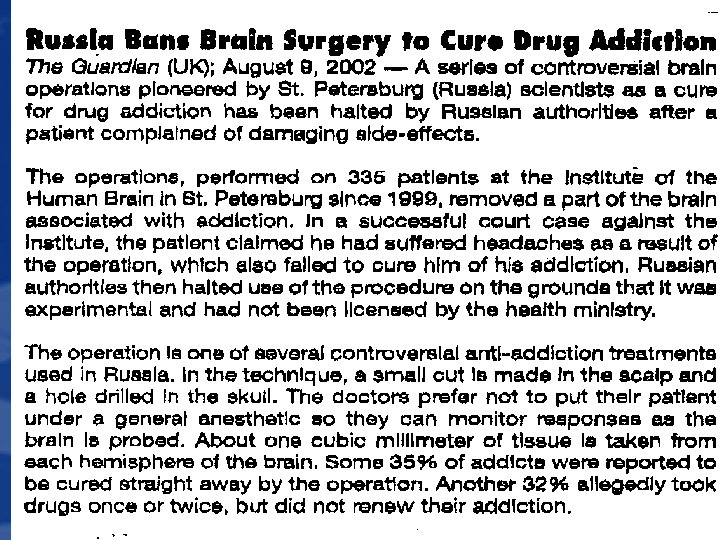
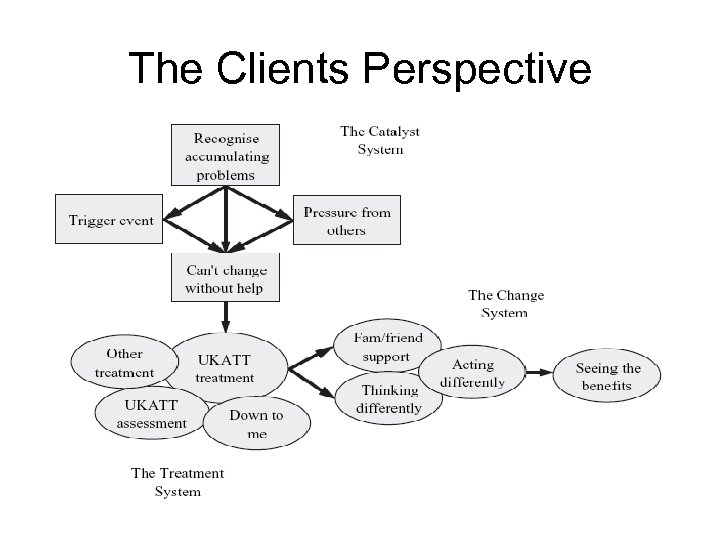
The Clients Perspective
Скачать презентацию Screening and Brief Intervention for Alcohol Misuse in
72ed976efb8d925d1d8af1ba42ec8a9a.ppt