


 Скачать презентацию Scottish Living Wage Campaign EAPN Task Force 11
6503d538d06151bf474f9e2e64fbd3b1.ppt
- Количество слайдов: 10
 Scottish Living Wage Campaign EAPN Task Force 11 December 2013
 Low Pay & the Scottish Living Wage Campaign • Developing the campaign in Scotland • Key priorities and challenges • Next Steps in Scotland
 Scottish Living Wage Campaign - origins • Poverty Alliance has long interest in issues of low pay emerging from engagement with grassroots groups • Scottish Living Wage Campaign launched in 2007 • Poverty Alliance, STUC and Church of Scotland established campaign steering group • Steering Group now involves Unison, Oxfam, STUC, Church of Scotland, CPAG, Unite, PCS,
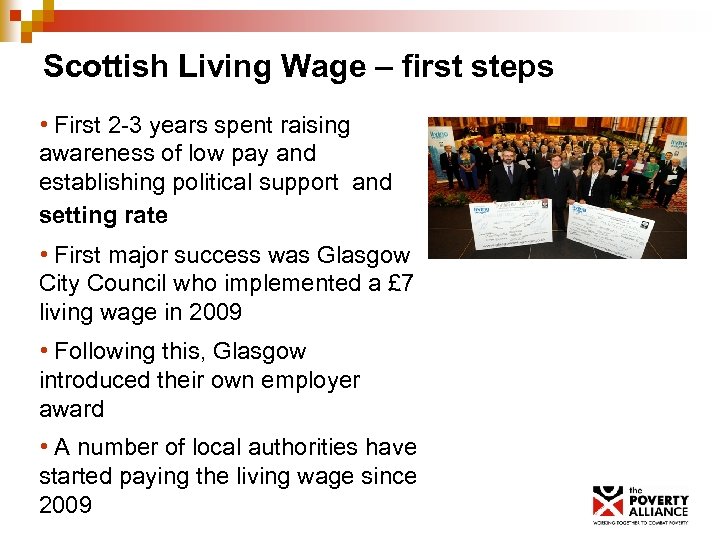 Scottish Living Wage – first steps • First 2 -3 years spent raising awareness of low pay and establishing political support and setting rate • First major success was Glasgow City Council who implemented a £ 7 living wage in 2009 • Following this, Glasgow introduced their own employer award • A number of local authorities have started paying the living wage since 2009
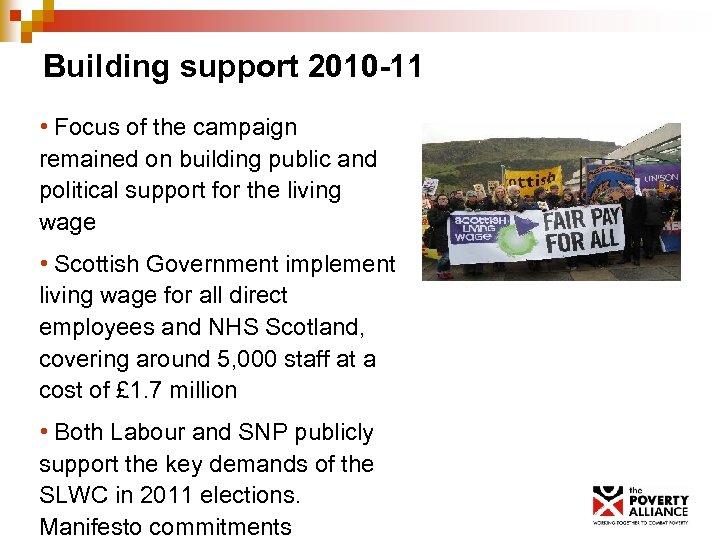 Building support 2010 -11 • Focus of the campaign remained on building public and political support for the living wage • Scottish Government implement living wage for all direct employees and NHS Scotland, covering around 5, 000 staff at a cost of £ 1. 7 million • Both Labour and SNP publicly support the key demands of the SLWC in 2011 elections. Manifesto commitments
 Public Sector – progress being made • Around 20, 000 directly employed workers now benefit from the living wage. • Includes the NHS, all Scottish Government agencies and a majority of local authorities. • Scottish Government committed to Living Wage at least for lifetime of this Parliament • Wholesale buy in from public sector unions and has been included in bargaining. • Living Wage offered as part of Local Government pay deal but there are issues…. .
 Procurement: opportunities to extend Living Wage • Campaign argue that living wage should be included as a condition in awarding public sector contracts. • Scottish Government position is that it would be in breach of EU law. • Debate polarised around different legal opinions. • Procurement Reform Bill an opportunity for change. • Members Bill also likely • Business representatives opposed
 Private Sector – a hard nut to crack • Majority of low pay in retail and hospitality. • Retailers argue that hourly rate should not be the focus. Employee benefits as important. • Private sector unions slower to sign up to campaign although recent support from USDAW • Some good examples of high profile supporters but not getting to hardcore low payers
 Next Steps • Maintaining the integrity of the living wage – ensuring that the rate is robust and realistic. • Better co-ordination and support for the living wage from Scottish Government – beginning with new Living Wage Accreditation Project in 2014 • Make progress in extending to the interface between public and private sector (i. e. procurement) • Sign up more private sector organisations to be living wage employers
 Key Lessons • Need for a robust and clear method for setting the level of the LW, and ensuring it can be updated regularly • Need for anti-poverty NGOs to build coalitions with others, especially Trades Unions and faith groups • LW is attractive to a broad range of political positions, this can help in building support but also has some dangers • Need to find ways to have the discussion with private sector, and to target those who can pay a living wage