 Скачать презентацию Scottish Humor By Don L F Nilsen and
e6829697faed57dea2705ef4dc2811c7.ppt
- Количество слайдов: 25



Scottish Humor By Don L. F. Nilsen and Alleen Pace Nilsen 1
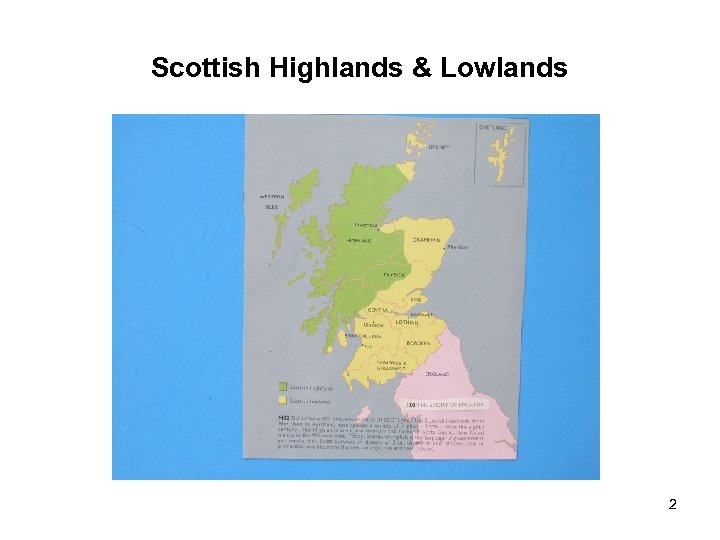
Scottish Highlands & Lowlands 2
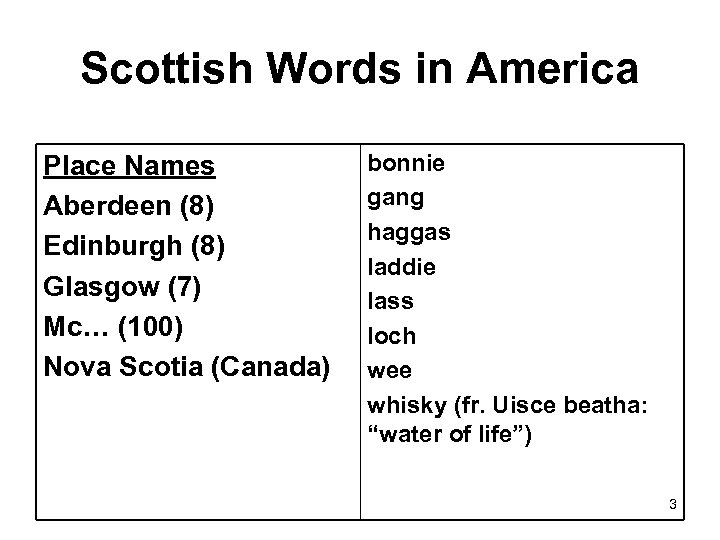
Scottish Words in America Place Names Aberdeen (8) Edinburgh (8) Glasgow (7) Mc… (100) Nova Scotia (Canada) bonnie gang haggas laddie lass loch wee whisky (fr. Uisce beatha: “water of life”) 3
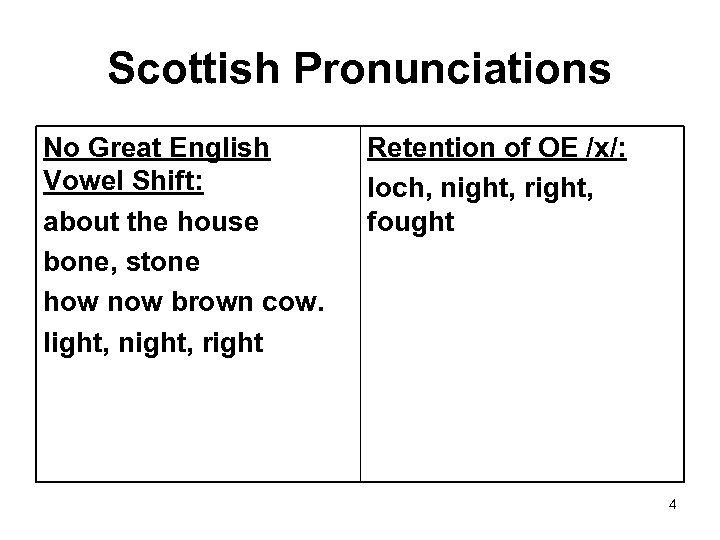
Scottish Pronunciations No Great English Vowel Shift: about the house bone, stone how now brown cow. light, night, right Retention of OE /x/: loch, night, right, fought 4
Samuel Johnson’s Dictionary • Because England does not have a language academy (like the “acadamie française”) we use dictionaries to settle language issues. • The rise of dictionaries correlates with the rise of the Middle Class. • Up through Webster’s II with labels like “vulgar, ” “colloquial, ” “slang, ” “argot, ” “jargon, ” “Southern” etc. • But now there’s Webster’s III with no labels 5
Johnson’s Dictionary & The Battle of Culloden • Samuel Johnson’s Dictionary determined spellings, analogies, structures, meanings and significances. • 1746 was the year that Johnson’s dictionary was published. • 1746 was the year that the Jakobean Duke of Cumberland defeated Bonnie Prince Charlie at the Battle of Culloden. 6
After the Battle of Culloden (1746) Highland Scottish Culture was Outlawed: Carrying of firearms Hurling of Tabors Playing of bag pipes Speaking of Scots Gaelic Wearing of kilts & tartans So the teuchters fled to: Ireland America Australia New Zealand Africa 7
Robert Burns (1759 -1796) • Bobbie Burns is the author of “Auld Lang Syne. ” • Bobbie Burns is also the poet of “eating, drinking and wenching. ” (Mc. Crum 152) • • I hae been blythe wi’ comrades dear; I hae been merry drinking; I hae been joyfu’ gath’rin gear; I hae been happy thinking. 8
• But a’ the pleasures e’er I saw • Tho’ three times double’d fairly • That happy night was worth them a’, • Among the rigs o’ barley. 9
Sir Walter Scott (1771 -1831) • Sir Walter Scott wrote – Ivanhoe – The Heart of Midlothian – Rob Roy and – Quentin Durward 10
Robert Louis Stevenson (18501894) • Robert Louis Stevenson wrote – Treasure Island – Dr. Jekyll and Mr. Hyde 11
Scots Go To Ireland 12
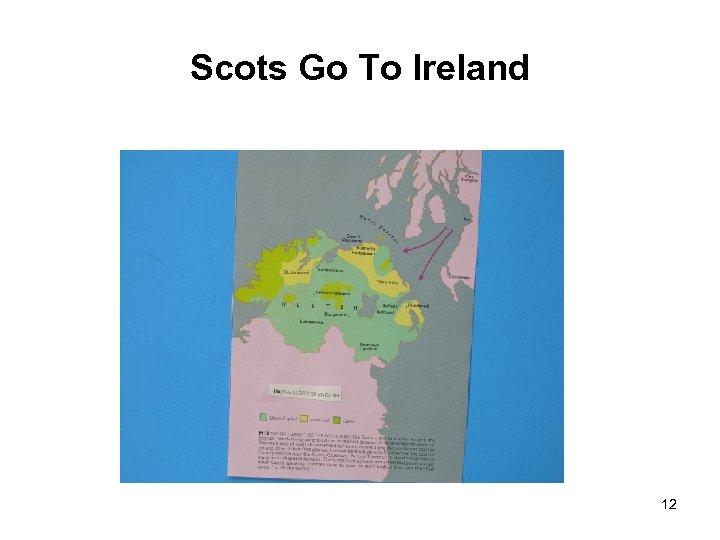
Scots Migrate to Northern Ireland • 200, 000 Scots migrated to Northern Ireland. • In turn, some two million of their descendants migrated to America during the 18 th, 19 th and the early part of the 20 th Centuries. 13
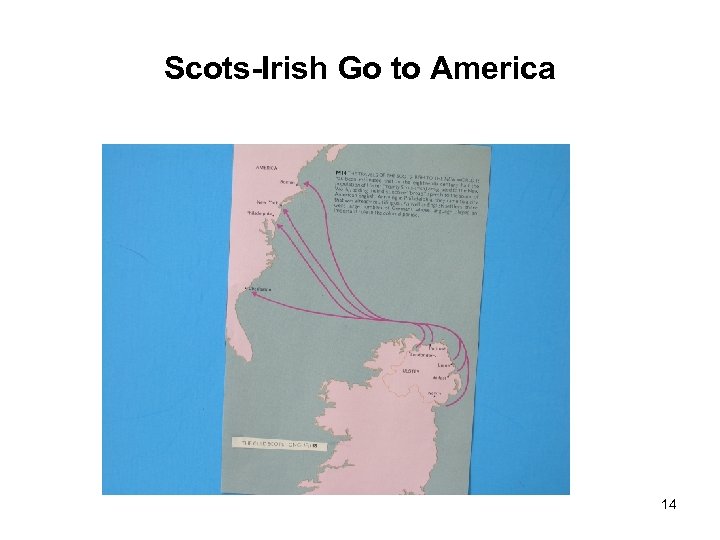
Scots-Irish Go to America 14
The Guid Scots Tongue • The Scottish language in Scotland, in Ulster (Ireland), in Nova Scotia (Canada) and Boston and Philadelphia (United States) was distinct: • “Bone” and “stone” were pronounced “bane” and “stane. ” • “Soft” “leave, ” “bath, ” “top” and “sick” were pronounced “saft, ” “lea’, ” “tap, ” and “seek. ” • “How now brown cow” would be pronounced “Hoo noo broon coo. ” 15
Many Scots-Irish Migrate to America • By 1776 (the year of America’s independence) almost half of Ulster had crossed the Atlantic. • In the United States, one out every seven colonists was Scots-Irish. 16
Scots-Irish in America • The Scots-Irish immigrants in Boston tended to be intolerant, violent, unruly and poverty stricken, so they weren’t too welcome. • They moved South to Philadelphia, Pennsylvania. • In 1760, Benjamin Franklin estimated that 1/3 of Philadelphia was English, 1/3 was German, and 1/3 was Scots-Irish. 17
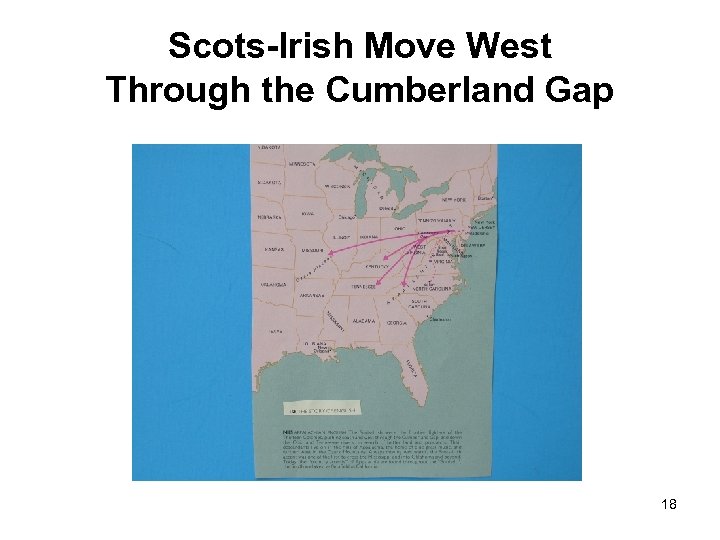
Scots-Irish Move West Through the Cumberland Gap 18
Scots-Irish Further Migration • Most of the Scots-Irish kept going South towards the Appalachian Mountains and on through the Cumberland Gap. • They were on the American frontier and bore the brunt of Indian hostilities. • They settled in the Southwestern frontier. • They tended to be fierce, clannish and unruly. • They wore coonskin caps, carried Kentucky rifles, and were really fond of whiskey. 19
• The Scots-Irish were ferocious Indian fighters, great boasters, and compulsive storytellers. They had a keen ear for a striking phrase. • Some of them made it all of the way west to Texas. Probably the most famous of them was Davy Crockett at the Alamo, who was part real, and part legend. Crockett described himself as… 20
• “…fresh from the backwoods, halfhorse, half-alligator, a little touched with snapping turtle, can wade the Mississippi, leap the Ohio, ride a streak of lightning, slide down a honey locust and not get scratched. ” 21
The Hillbillies • The Scotch-Irish Hillbillies made stills and brewed “moonshine. ” They used words like “afeared, ” “damnedest, ” “chaw u’ tabacker, ” “hex, ” “plum right” or “plum crazy. ” And they’re great story tellers. • They ate “bonny-clabber” (curdled sour milk) and “flannel-cake (a thin wheat cake). They provided English with the expression “youall. ” And when they called the cows home at night they used the Old-English “sūcan” meaning “suck. ” 22
• The Hillbillies said “tharr, ” “barr, ” and Herr” for “there, ” “bear, ” and “here. ” • They dropped their final –g, and used the Old -English “on” in front of –ing words, like “ahuntin, and a-fishin. ” They also used the Old -English form of “it, ” which was “hit. ” • These features are throughout the Southwest, but are most prominent in West Virginia, Kentucky, Tennessee and the Ozarks. 23
Hillbilly Culture Becomes Mainstream • Today about twenty million people (10 % of Americans) claim Scots-Irish ancestry. • The Scots-Irish ballads are currently imitated and reproduced throughout the United States. • Dolly Parton, Pat Boone, Kenny Rogers and Willie Nelson are four of these ballad singers. (Mc. Crum 168) • Blue-Collar TV (Bill Engvall and Jeff Foxworthy, etc. ) also are great “Hillbilly” story tellers • It is possible to see reruns of a sitcom called “The Beverly Hillbillies. ” It is about some hillbillies who struck oil and moved to Beverly Hills in California. 24
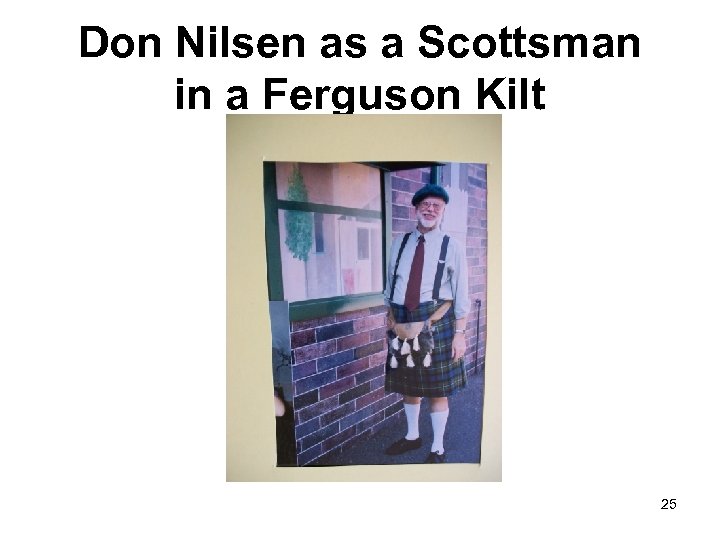
Don Nilsen as a Scottsman in a Ferguson Kilt 25
Скачать презентацию Scottish Humor By Don L F Nilsen and
e6829697faed57dea2705ef4dc2811c7.ppt