


 Скачать презентацию SCOPM Overview Performance Management The Game Changer SCOPT
cb222ecb3b66e2c00217b0d3ba3388c1.ppt
- Количество слайдов: 17
 SCOPM Overview Performance Management: The Game Changer SCOPT Business Meeting December 7, 2010 Savannah, GA
 Agenda 1. Introduction 2. Performance Measurement Framework 3. SCOPM Task Forces 4. Future Activities 5. Questions and Answers 2
 Introduction • History – Created in February 2008 – Charge: Provide State DOTs the expertise and resources to support performance based management and to create a results-driven environment to maximize the performance of both transportation systems and organizations. • 11 task forces created: – 9 technical task forces – 2 programmatic task forces – Each lead by a member of the SCOPM
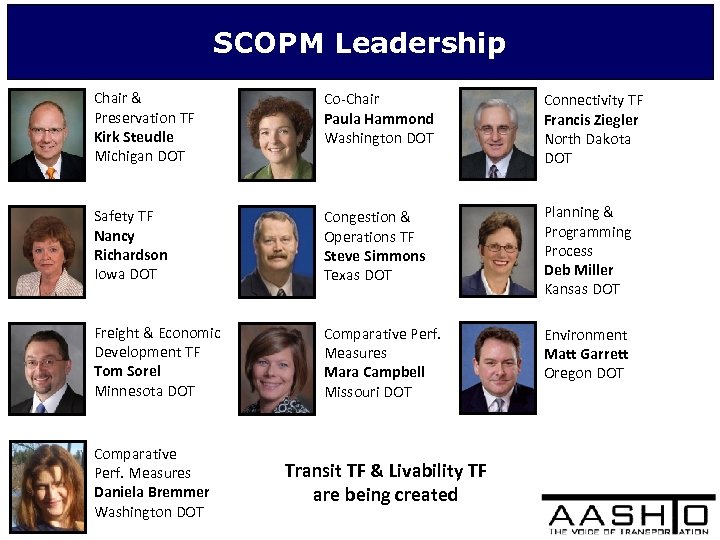 SCOPM Leadership Chair & Preservation TF Kirk Steudle Michigan DOT Co-Chair Paula Hammond Washington DOT Connectivity TF Francis Ziegler North Dakota DOT Safety TF Nancy Richardson Iowa DOT Congestion & Operations TF Steve Simmons Texas DOT Planning & Programming Process Deb Miller Kansas DOT Freight & Economic Development TF Tom Sorel Minnesota DOT Comparative Perf. Measures Mara Campbell Missouri DOT Environment Matt Garrett Oregon DOT Comparative Perf. Measures Daniela Bremmer Washington DOT Transit TF & Livability TF are being created
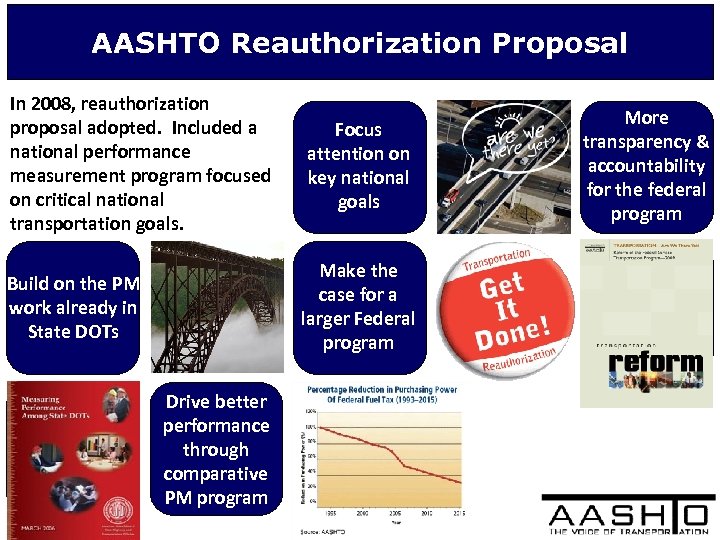 AASHTO Reauthorization Proposal In 2008, reauthorization proposal adopted. Included a national performance measurement program focused on critical national transportation goals. Focus attention on key national goals Build on the PM work already in State DOTs Make the case for a larger Federal program Drive better performance through comparative PM program More transparency & accountability for the federal program
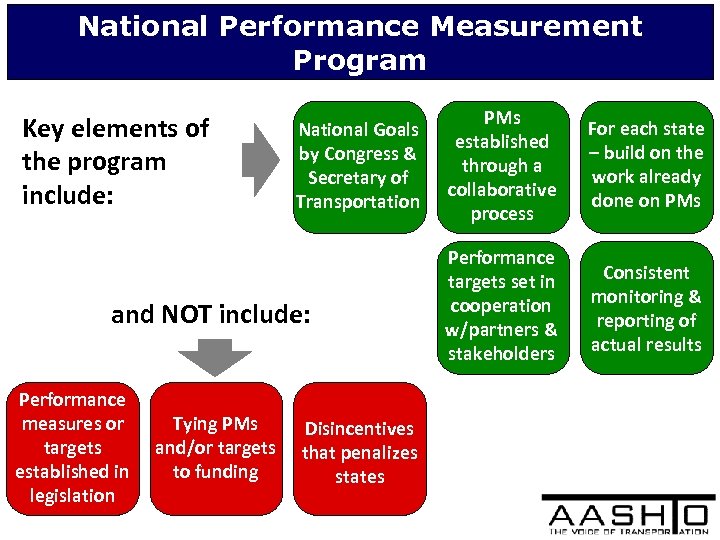 National Performance Measurement Program Key elements of the program include: National Goals by Congress & Secretary of Transportation and NOT include: Performance measures or targets established in legislation Tying PMs and/or targets to funding Disincentives that penalizes states PMs established through a collaborative process For each state – build on the work already done on PMs Performance targets set in cooperation w/partners & stakeholders Consistent monitoring & reporting of actual results
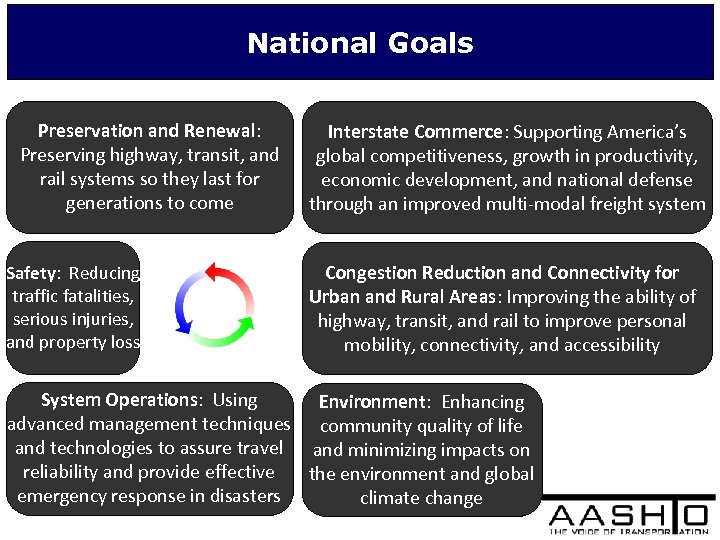 National Goals Preservation and Renewal: Preserving highway, transit, and rail systems so they last for generations to come Safety: Reducing traffic fatalities, serious injuries, and property loss Interstate Commerce: Supporting America’s global competitiveness, growth in productivity, economic development, and national defense through an improved multi-modal freight system Congestion Reduction and Connectivity for Urban and Rural Areas: Improving the ability of highway, transit, and rail to improve personal mobility, connectivity, and accessibility System Operations: Using Environment: Enhancing advanced management techniques community quality of life and technologies to assure travel and minimizing impacts on reliability and provide effective the environment and global emergency response in disasters climate change
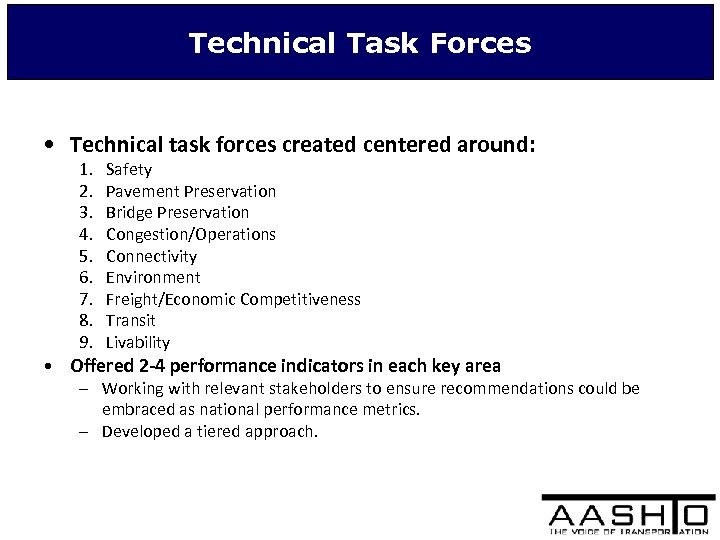 Technical Task Forces • Technical task forces created centered around: 1. 2. 3. 4. 5. 6. 7. 8. 9. Safety Pavement Preservation Bridge Preservation Congestion/Operations Connectivity Environment Freight/Economic Competitiveness Transit Livability • Offered 2 -4 performance indicators in each key area – Working with relevant stakeholders to ensure recommendations could be embraced as national performance metrics. – Developed a tiered approach.
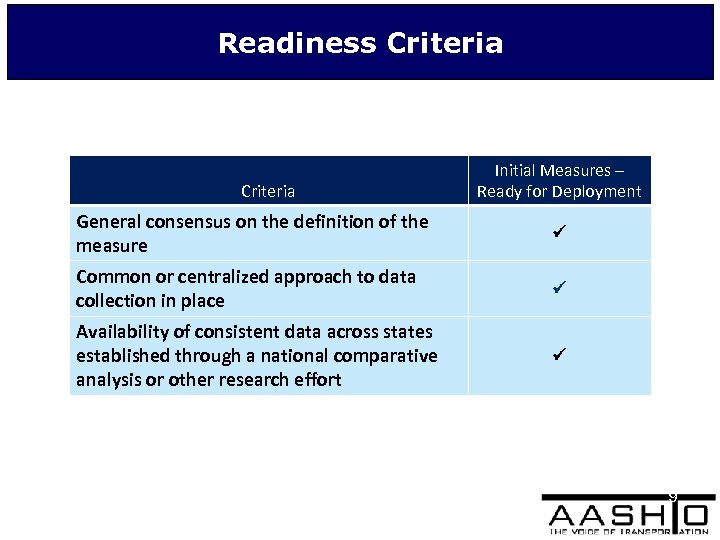 Readiness Criteria Initial Measures – Ready for Deployment General consensus on the definition of the measure Common or centralized approach to data collection in place Availability of consistent data across states established through a national comparative analysis or other research effort 9
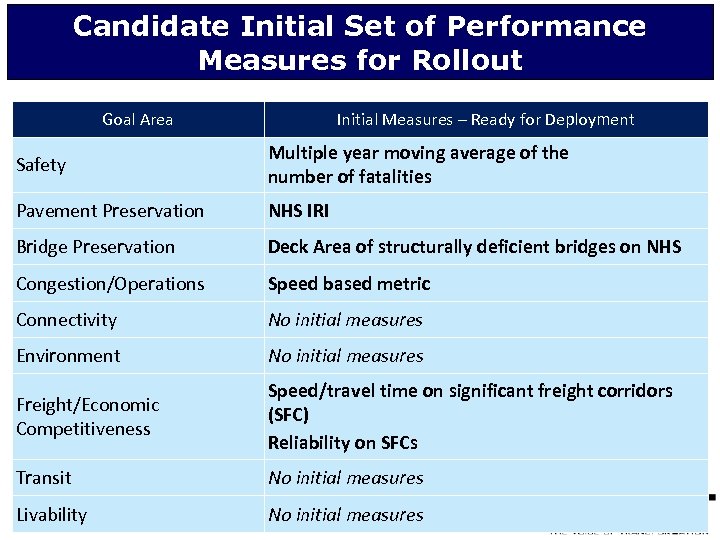 Candidate Initial Set of Performance Measures for Rollout Goal Area Initial Measures – Ready for Deployment Safety Multiple year moving average of the number of fatalities Pavement Preservation NHS IRI Bridge Preservation Deck Area of structurally deficient bridges on NHS Congestion/Operations Speed based metric Connectivity No initial measures Environment No initial measures Freight/Economic Competitiveness Speed/travel time on significant freight corridors (SFC) Reliability on SFCs Transit No initial measures Livability No initial measures 10
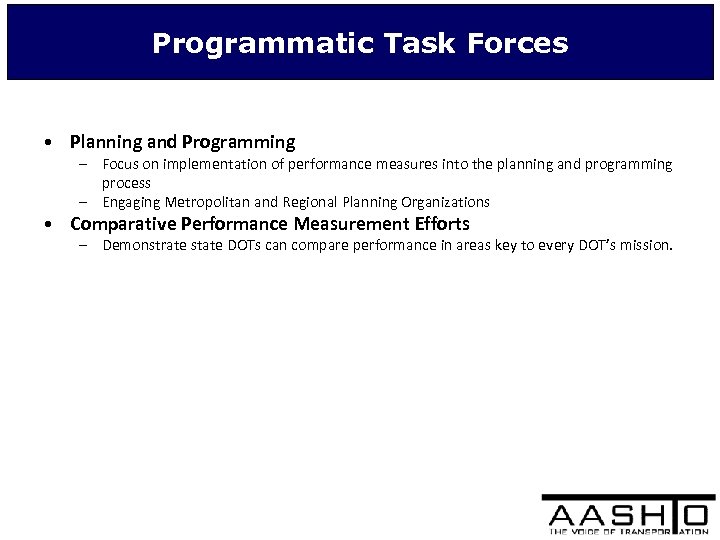 Programmatic Task Forces • Planning and Programming – Focus on implementation of performance measures into the planning and programming process – Engaging Metropolitan and Regional Planning Organizations • Comparative Performance Measurement Efforts – Demonstrate state DOTs can compare performance in areas key to every DOT’s mission.
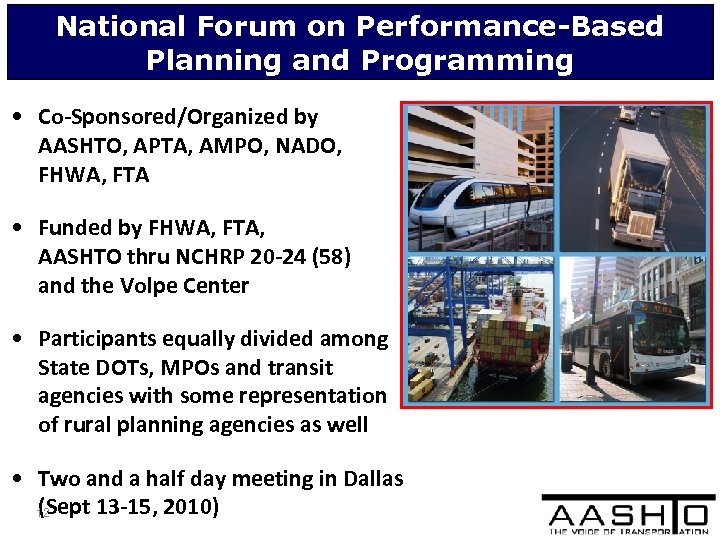 National Forum on Performance-Based Planning and Programming • Co-Sponsored/Organized by AASHTO, APTA, AMPO, NADO, FHWA, FTA • Funded by FHWA, FTA, AASHTO thru NCHRP 20 -24 (58) and the Volpe Center • Participants equally divided among State DOTs, MPOs and transit agencies with some representation of rural planning agencies as well • Two and a half day meeting in Dallas (Sept 13 -15, 2010) 12
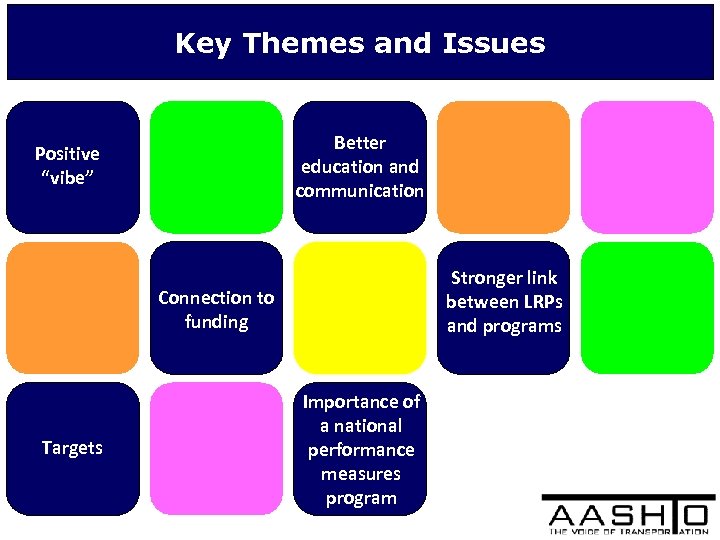 Key Themes and Issues Better education and communication Positive “vibe” Stronger link between LRPs and programs Connection to funding Targets Importance of a national performance measures program
 A Key Ingredient Collaboration
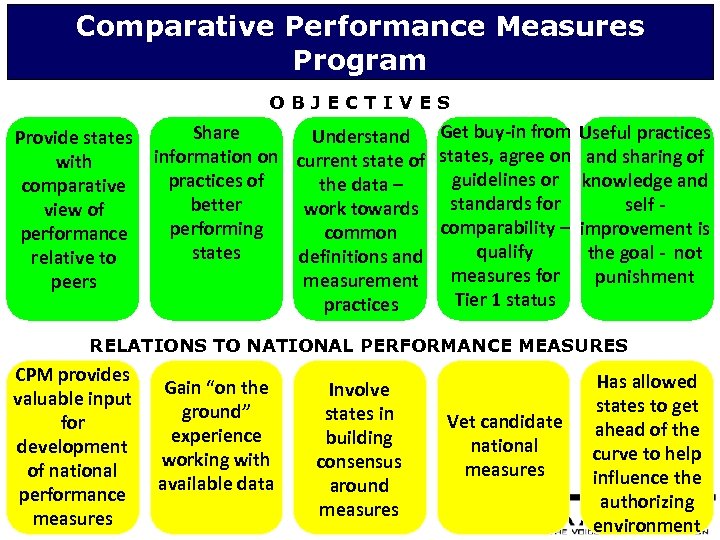 Comparative Performance Measures Program OBJECTIVES Provide states with comparative view of performance relative to peers Share Understand Get buy-in from information on current state of states, agree on guidelines or practices of the data – standards for better work towards comparability – performing common qualify states definitions and measures for measurement Tier 1 status practices Useful practices and sharing of knowledge and self improvement is the goal - not punishment RELATIONS TO NATIONAL PERFORMANCE MEASURES CPM provides valuable input for development of national performance measures Gain “on the ground” experience working with available data Involve states in building consensus around measures Vet candidate national measures Has allowed states to get ahead of the curve to help influence the authorizing 15 environment
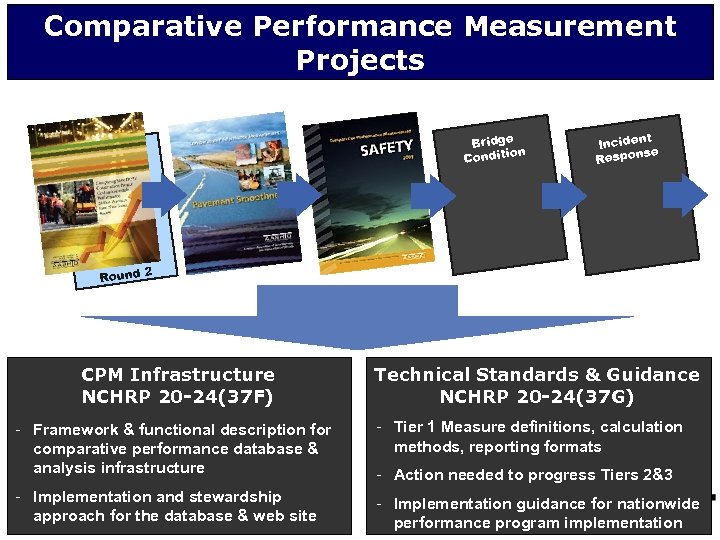 Comparative Performance Measurement Projects Bridge on Conditi Round t Inciden se Respon 2 CPM Infrastructure NCHRP 20 -24(37 F) - Framework & functional description for comparative performance database & analysis infrastructure - Implementation and stewardship approach for the database & web site Technical Standards & Guidance NCHRP 20 -24(37 G) - Tier 1 Measure definitions, calculation methods, reporting formats - Action needed to progress Tiers 2&3 16 - Implementation guidance for nationwide performance program implementation
 Future Activities • Complete technical guidance framework • Adopt technical guidance framework for each of the goal areas and performance measures • Support state data collection efforts • Operationalize/Implement the use of national performance measures in the decision-making process • SCOPM will collectively look at the integration of other modes in the performance measures