


 Скачать презентацию SCOPE-CM IOGEO GSICS GRWG GDWG March 2016
eec290e22b120ef25baec3c17c68ee99.ppt
- Количество слайдов: 22
 SCOPE-CM: IOGEO GSICS GRWG & GDWG, March 2016, Tsukuba, Japan Rob Roebeling, Viju John, Tim Hewison, Marie Doutriaux Boucher, and Joerg Schulz
 SCOPE-CM Introduction GSICS Meeting, March 2016, Tsukuba, Japan
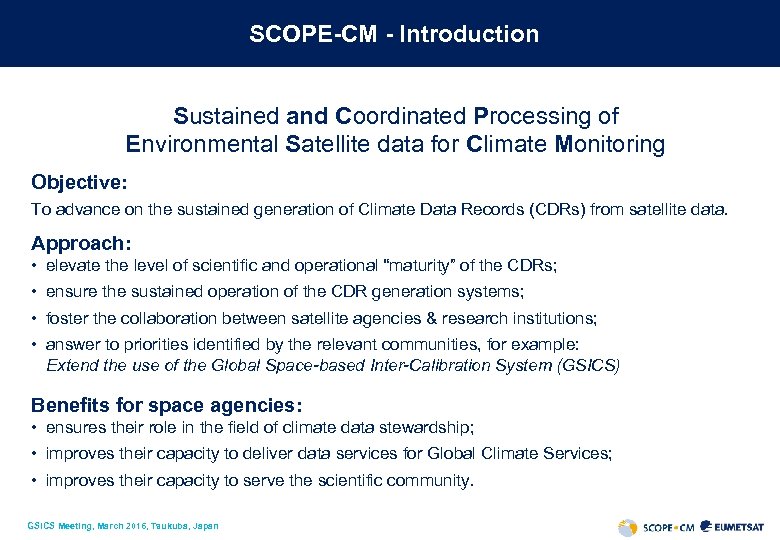 SCOPE-CM - Introduction Sustained and Coordinated Processing of Environmental Satellite data for Climate Monitoring Objective: To advance on the sustained generation of Climate Data Records (CDRs) from satellite data. Approach: • elevate the level of scientific and operational “maturity” of the CDRs; • ensure the sustained operation of the CDR generation systems; • foster the collaboration between satellite agencies & research institutions; • answer to priorities identified by the relevant communities, for example: Extend the use of the Global Space-based Inter-Calibration System (GSICS) Benefits for space agencies: • ensures their role in the field of climate data stewardship; • improves their capacity to deliver data services for Global Climate Services; • improves their capacity to serve the scientific community. GSICS Meeting, March 2016, Tsukuba, Japan
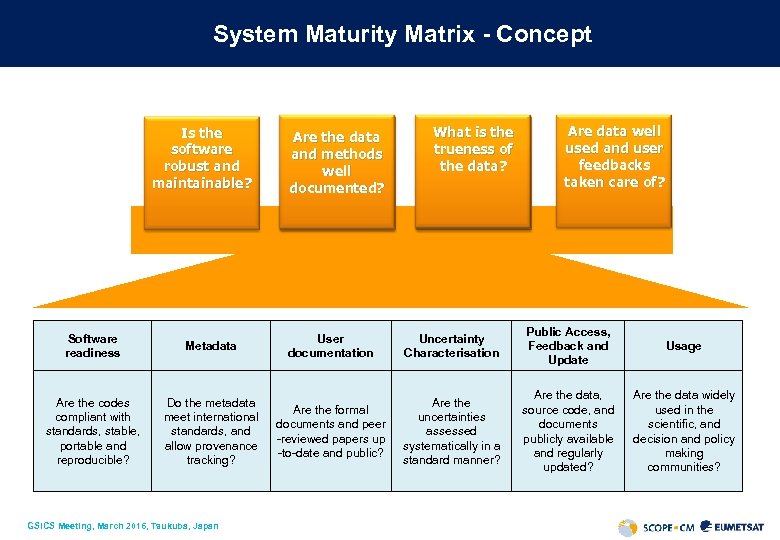 System Maturity Matrix - Concept Is the software robust and maintainable? Software readiness Metadata Are the codes compliant with standards, stable, portable and reproducible? Do the metadata meet international standards, and allow provenance tracking? GSICS Meeting, March 2016, Tsukuba, Japan What original Are the data observations were and methods used in the product? well documented? What methods were What is the used to create the trueness of product? the data? Are data well used and user feedbacks taken care of? User documentation Uncertainty Characterisation Public Access, Feedback and Update Usage Are the formal documents and peer -reviewed papers up -to-date and public? Are the uncertainties assessed systematically in a standard manner? Are the data, source code, and documents publicly available and regularly updated? Are the data widely used in the scientific, and decision and policy making communities?
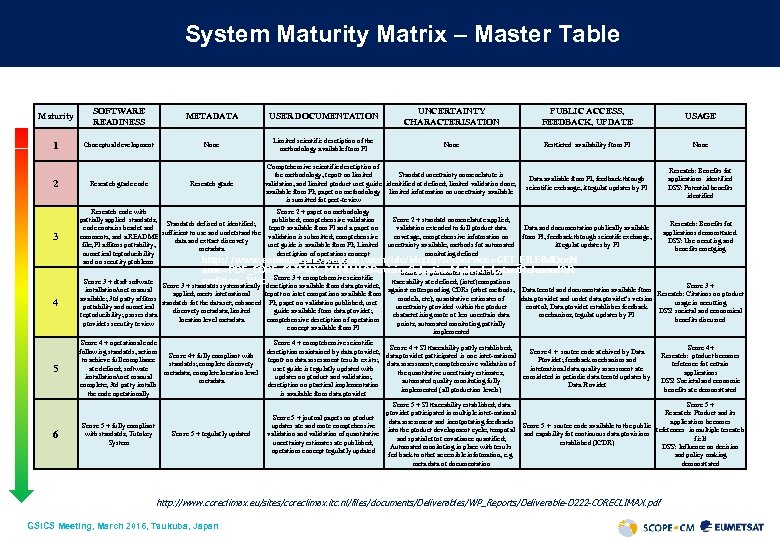 System Maturity Matrix – Master Table Maturity SOFTWARE READINESS METADATA USER DOCUMENTATION UNCERTAINTY CHARACTERISATION PUBLIC ACCESS, FEEDBACK, UPDATE USAGE 1 Conceptual development None Limited scientific description of the methodology available from PI None Restricted availability from PI None Data avaliable from PI, feedback through scientific exchange, irregular updates by PI Research: Benefits for applications identified DSS: Potential benefits identified 2 3 Research grade code Research grade Comprehensive scientific description of Standard uncertainty nomenclature is the methodology, report on limited validation, and limited product user guide idenitified or defined; limited validation done; available from PI; paper on methodology limited information on uncertainty available is sumitted for peer-review Research code with Score 2 + paper on methodology Score 2 + standard nomenclature applied; partially applied standards; published; comprehensive validation Standards defined or identified; Data and documentation publically available validation extended to full product data code contains header and report available from PI and a paper on sufficient to use and understand the from PI, feedback through scientifc exchange, coverage, comprehensive information on comments, and a README validation is submitted; comprehensive data and extract discovery irregular updates by PI file; PI affirms portability, user guide is available from PI; Limited uncertainty available; methods for automated metadata numerical reproducibility description of operations concept monitoring defined http: //www. eumetsat. int/website/wcm/idcplg? Idc. Service=GET_FILE&d. Doc. N and no security problems available from PI Research: Benefits for applications demonstrated. DSS: Use occuring and benefits emerging 4 ame=PDF_CORE_CLIMAX_MANUAL&Revision. Selection. Method=Latest. Released&R Score 3 + procedures to establish SI Score 3 + comprehensive scientific Score 3 + draft software traceability are defined; (inter)comparison endition=Web Score 3 + standards systematically description available from data provider; Score 3 + installation/user manual against corresponding CDRs (other methods, Data record and documentation available from applied; meets international Research: Citations on product report on inter comparison available from data provider and under data provider's version available; 3 rd party affirms models, etc); quantitative estimates of standards for the data set; enhanced PI; paper on validation published; user usage in occurring portability and numerical uncertainty provided within the product control; Data provider establishes feedback discovery metadata; limited guide available from data provider; DSS: societal and economical characterising more or less uncertain data reproducibility; passes data mechanism; regular updates by PI location level metadata comprehensive description of operations benefits discussed providers security review points; automated monitoring partially concept available from PI implemented 5 Score 4 + operational code following standards, actions Score 4+ fully compliant with to achieve full compliance standards; complete discovery are defined; software metadata; complete location level installation/user manual metadata complete; 3 rd party installs the code operationally 6 Score 5 + fully compliant with standards; Turnkey System Score 5 + regularly updated Score 4 + comprehensive scientific Score 4 + SI traceability partly established; description maintained by data provider; data provider participated in one inter-national report on data assessment results exists; data assessment; comprehensive validation of user guide is regularly updated with the quantitative uncertainty estimates; updates on product and validation; automated quality monitoring fully description on practical implementation implemented (all production levels) is available from data provider Score 5 + journal papers on product updates are and more comprehensive validation and validation of quantitative uncertainty estimates are published; operations concept regularly updated Score 4 + source code archived by Data Provider; feedback mechanism and international data quality assessment are considered in periodic data record updates by Data Provider Score 5 + SI traceability established; data Score 5 + provider participated in multiple inter-national Research: Product and its data assessment and incorporating feedbacks applications becomes Score 5 + source code available to the public into the product development cycle; temporal references in multiple research and capability for continuous data provisions and spatial error covariance quantified; field established (ICDR) Automated monitoring in place with results DSS: Influence on decision fed back to other accessible information, e. g. and policy making meta data or documentation demonstrated http: //www. coreclimax. eu/sites/coreclimax. itc. nl/files/documents/Deliverables/WP_Reports/Deliverable-D 222 -CORECLIMAX. pdf GSICS Meeting, March 2016, Tsukuba, Japan Score 4+ Research: product becomes reference for certain applications DSS: Societal and economic benefits are demonstrated
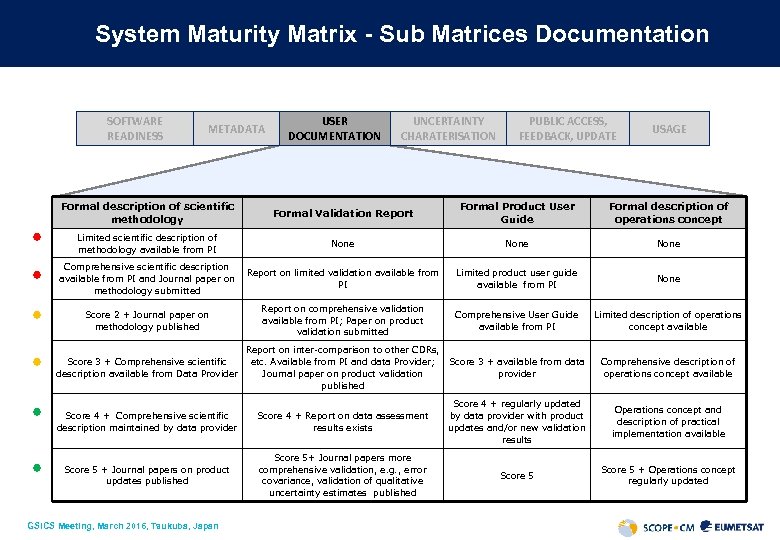 System Maturity Matrix - Sub Matrices Documentation SOFTWARE READINESS METADATA USER DOCUMENTATION UNCERTAINTY CHARATERISATION PUBLIC ACCESS, FEEDBACK, UPDATE USAGE Formal description of scientific methodology Formal Validation Report Formal Product User Guide Formal description of operations concept Limited scientific description of methodology available from PI None Comprehensive scientific description available from PI and Journal paper on methodology submitted Report on limited validation available from PI Limited product user guide available from PI None Score 2 + Journal paper on methodology published Report on comprehensive validation available from PI; Paper on product validation submitted Comprehensive User Guide available from PI Limited description of operations concept available Score 3 + Comprehensive scientific description available from Data Provider Report on inter-comparison to other CDRs, etc. Available from PI and data Provider; Journal paper on product validation published Score 3 + available from data provider Comprehensive description of operations concept available Score 4 + Comprehensive scientific description maintained by data provider Score 4 + Report on data assessment results exists Score 4 + regularly updated by data provider with product updates and/or new validation results Operations concept and description of practical implementation available Score 5 + Journal papers on product updates published Score 5+ Journal papers more comprehensive validation, e. g. , error covariance, validation of qualitative uncertainty estimates published Score 5 + Operations concept regularly updated GSICS Meeting, March 2016, Tsukuba, Japan
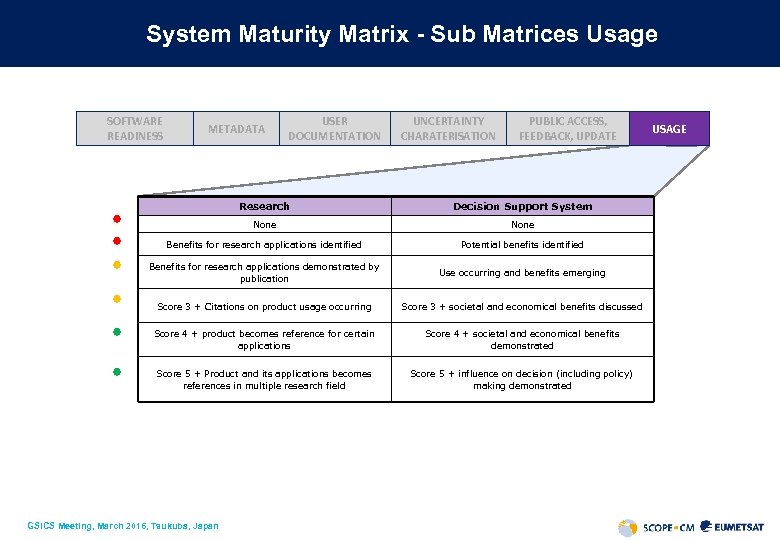 System Maturity Matrix - Sub Matrices Usage SOFTWARE READINESS METADATA USER DOCUMENTATION UNCERTAINTY CHARATERISATION PUBLIC ACCESS, FEEDBACK, UPDATE Research Decision Support System None Benefits for research applications identified Potential benefits identified Benefits for research applications demonstrated by publication Use occurring and benefits emerging Score 3 + Citations on product usage occurring Score 3 + societal and economical benefits discussed Score 4 + product becomes reference for certain applications Score 4 + societal and economical benefits demonstrated Score 5 + Product and its applications becomes references in multiple research field Score 5 + influence on decision (including policy) making demonstrated GSICS Meeting, March 2016, Tsukuba, Japan USAGE
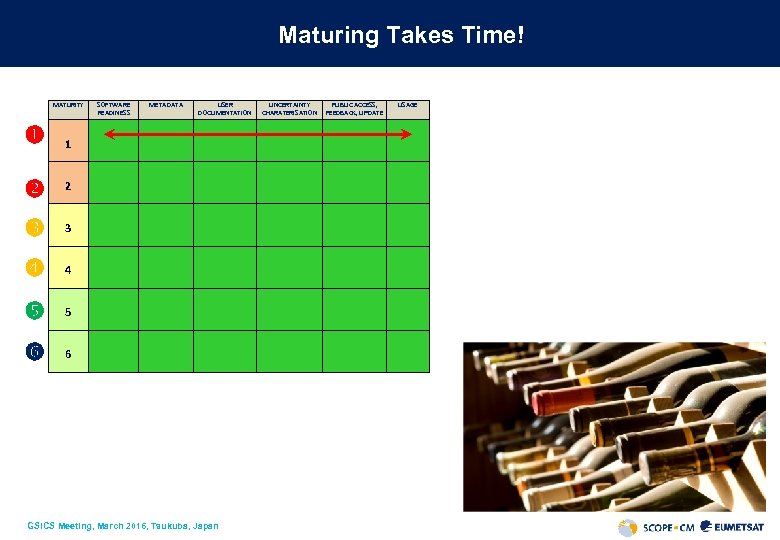 Maturing Takes Time! MATURITY SOFTWARE READINESS METADATA USER DOCUMENTATION 1 2 3 4 5 6 GSICS Meeting, March 2016, Tsukuba, Japan UNCERTAINTY CHARATERISATION PUBLIC ACCESS, FEEDBACK, UPDATE USAGE
 SCM-06 IOGEO* Towards a GEO ring Fundamental Climate Data Record (FCDR) of inter-calibrated Infrared, Water vapour and Visible radiances European Organisation for the Exploitation of Meteorological Satellites (Rob Roebeling, Tim Hewison) Japanese Meteorological Agency (Masaya Takahashi) National Oceanic and Atmospheric Administration (Kenneth Knapp, Anand Inamdar) Deutscher Wetterdienst (Marc Schroeder) China Meteorological Administration (Peng Zhang, Xiuqing Hu) Indian Meteorological Department (A. K. Sharma, Ashim Mitra) Korea Meteorological Administration (Dohyeong Kim, Hyesook Lee) *Inter-calibration GSICS Meeting, March 2016, Tsukuba, Japan of imager observations from time-series of geostationary satellites (IOGEO)
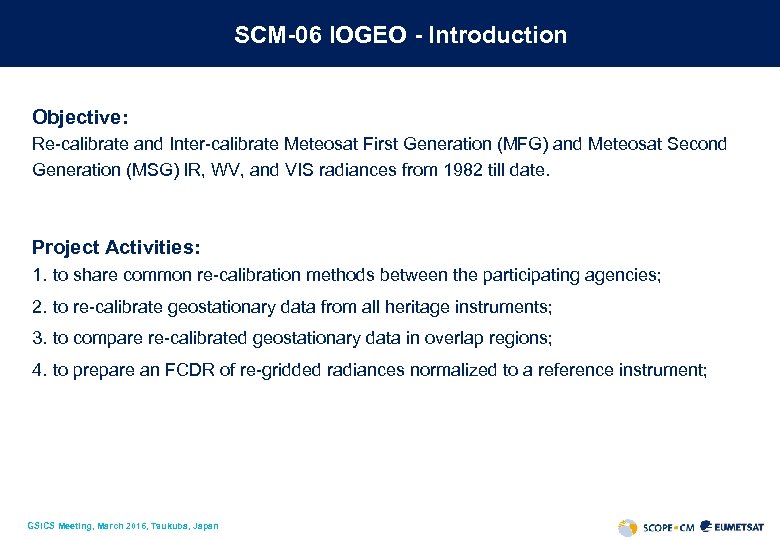 SCM-06 IOGEO - Introduction Objective: Re-calibrate and Inter-calibrate Meteosat First Generation (MFG) and Meteosat Second Generation (MSG) IR, WV, and VIS radiances from 1982 till date. Project Activities: 1. to share common re-calibration methods between the participating agencies; 2. to re-calibrate geostationary data from all heritage instruments; 3. to compare re-calibrated geostationary data in overlap regions; 4. to prepare an FCDR of re-gridded radiances normalized to a reference instrument; GSICS Meeting, March 2016, Tsukuba, Japan
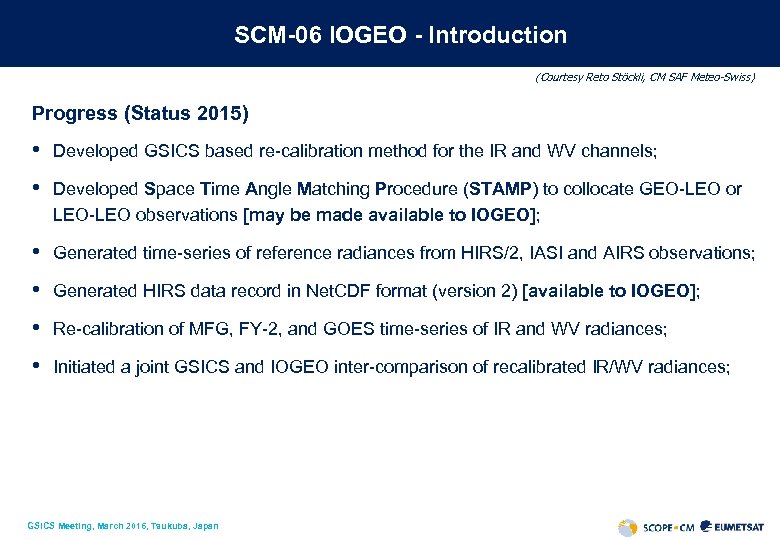 SCM-06 IOGEO - Introduction (Courtesy Reto Stöckli, CM SAF Meteo-Swiss) Progress (Status 2015) • Developed GSICS based re-calibration method for the IR and WV channels; • Developed Space Time Angle Matching Procedure (STAMP) to collocate GEO-LEO or LEO-LEO observations [may be made available to IOGEO]; • Generated time-series of reference radiances from HIRS/2, IASI and AIRS observations; • Generated HIRS data record in Net. CDF format (version 2) [available to IOGEO]; • Re-calibration of MFG, FY-2, and GOES time-series of IR and WV radiances; • Initiated a joint GSICS and IOGEO inter-comparison of recalibrated IR/WV radiances; GSICS Meeting, March 2016, Tsukuba, Japan
 Some Results GSICS Meeting, March 2016, Tsukuba, Japan
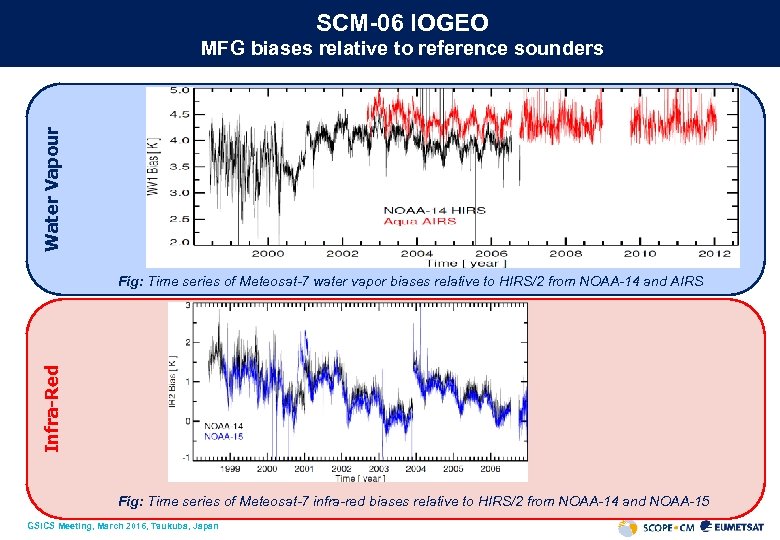 SCM-06 IOGEO Water Vapour MFG biases relative to reference sounders Infra-Red Fig: Time series of Meteosat-7 water vapor biases relative to HIRS/2 from NOAA-14 and AIRS Fig: Time series of Meteosat-7 infra-red biases relative to HIRS/2 from NOAA-14 and NOAA-15 GSICS Meeting, March 2016, Tsukuba, Japan
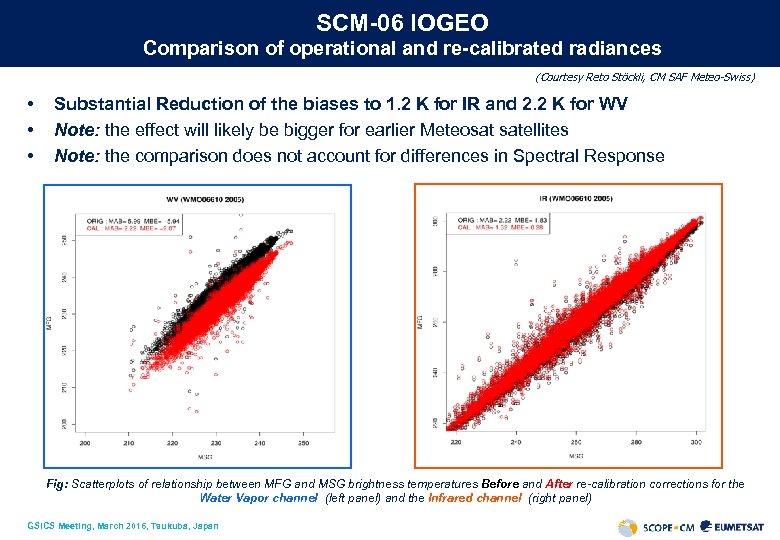 SCM-06 IOGEO Comparison of operational and re-calibrated radiances (Courtesy Reto Stöckli, CM SAF Meteo-Swiss) • • • Substantial Reduction of the biases to 1. 2 K for IR and 2. 2 K for WV Note: the effect will likely be bigger for earlier Meteosat satellites Note: the comparison does not account for differences in Spectral Response Fig: Scatterplots of relationship between MFG and MSG brightness temperatures Before and After re-calibration corrections for the Water Vapor channel (left panel) and the Infrared channel (right panel) GSICS Meeting, March 2016, Tsukuba, Japan
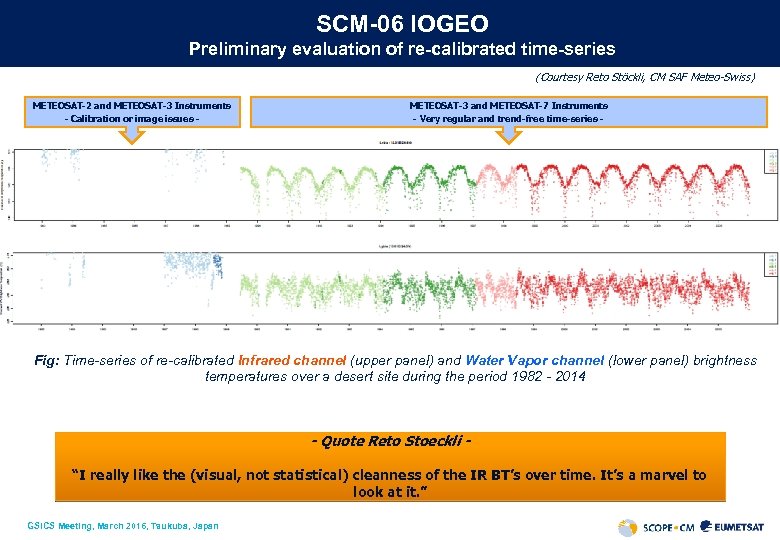 SCM-06 IOGEO Preliminary evaluation of re-calibrated time-series (Courtesy Reto Stöckli, CM SAF Meteo-Swiss) METEOSAT-2 and METEOSAT-3 Instruments METEOSAT-3 and METEOSAT-7 Instruments - Calibration or image issues - - Very regular and trend-free time-series - Fig: Time-series of re-calibrated Infrared channel (upper panel) and Water Vapor channel (lower panel) brightness temperatures over a desert site during the period 1982 - 2014 - Quote Reto Stoeckli “I really like the (visual, not statistical) cleanness of the IR BT’s over time. It’s a marvel to look at it. ” GSICS Meeting, March 2016, Tsukuba, Japan
 Joint GSICS and IOGEO inter-comparison re-calibrated IR and WV radiances GSICS Meeting, March 2016, Tsukuba, Japan
 IOGEO and GSICS inter-comparison - Introduction Objective IOGEO and GSICS partners to compare their sensor equivalent radiances* for the water vapor (WV) and infrared (IR) channels on the heritage geostationary satellites. Method • To collect re-calibrated WV and IR data from all partners for a Common Test Period: ‒ WV and IR channels on COMS, GOES, Feng-Yun, Himawari, Kalpana, METEOSAT ‒ 1 March 2014 and 20 March 2014 ‒ 3 hourly images (00, 03, 06, 09, 12, 15, 18, 21 GMT) • To encourage IOGEO partners to all use HIRS as reference instrument (Eumetsat can provide HIRS record (1982 -2014) in standard Net. CDF format) • To inter-compare re-calibrated data in overlapping regions; • To compare re-calibrated data against IASI observations; • To compare re-calibrated data against simulated radiances from ECMWF. Data Exchange An FTP site has been set up at EUMETSAT where all IOGEO and GSICS partners can upload their test data (details on the next slide) GSICS Meeting, March 2016, Tsukuba, Japan
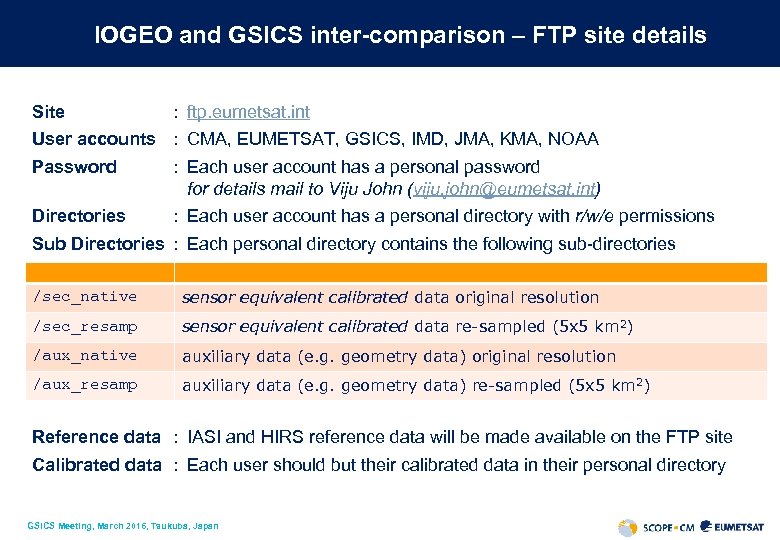 IOGEO and GSICS inter-comparison – FTP site details Site : ftp. eumetsat. int User accounts : CMA, EUMETSAT, GSICS, IMD, JMA, KMA, NOAA Password : Each user account has a personal password for details mail to Viju John (viju. john@eumetsat. int) Directories : Each user account has a personal directory with r/w/e permissions Sub Directories : Each personal directory contains the following sub-directories /sec_native sensor equivalent calibrated data original resolution /sec_resamp sensor equivalent calibrated data re-sampled (5 x 5 km 2) /aux_native auxiliary data (e. g. geometry data) original resolution /aux_resamp auxiliary data (e. g. geometry data) re-sampled (5 x 5 km 2) Reference data : IASI and HIRS reference data will be made available on the FTP site Calibrated data : Each user should but their calibrated data in their personal directory GSICS Meeting, March 2016, Tsukuba, Japan
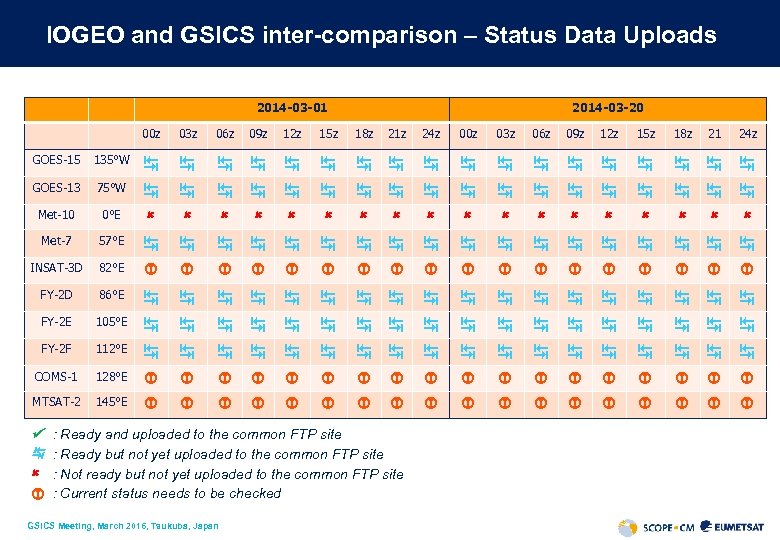 IOGEO and GSICS inter-comparison – Status Data Uploads 2014 -03 -01 09 z 2014 -03 -20 00 z 03 z 06 z 12 z 15 z 18 z 21 z 24 z 00 z 03 z 06 z 09 z 12 z 15 z 18 z 21 24 z GOES-15 135°W GOES-13 75°W Met-10 0°E Met-7 57°E INSAT-3 D 82°E FY-2 D 86°E FY-2 E 105°E FY-2 F 112°E COMS-1 128°E MTSAT-2 145°E : Ready and uploaded to the common FTP site : Ready but not yet uploaded to the common FTP site : Not ready but not yet uploaded to the common FTP site : Current status needs to be checked GSICS Meeting, March 2016, Tsukuba, Japan
 Planning GSICS Meeting, March 2016, Tsukuba, Japan
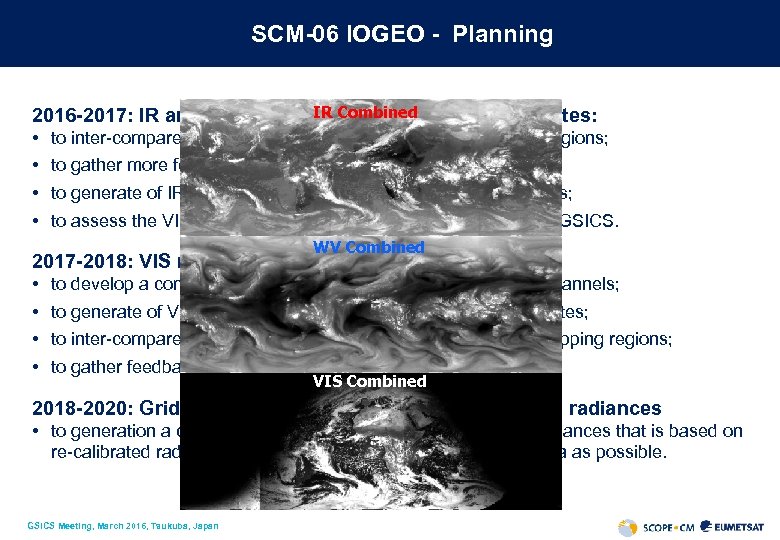 SCM-06 IOGEO - Planning IR Combined 2016 -2017: IR and WV recalibration geostationary satellites: • • to inter-compare FCDRs of IR & WV radiances in overlapping regions; to gather more feedback from beta users; to generate of IR and WV radiance FCDRs for the GEO satellites; to assess the VIS inter-calibration methodologies developed by GSICS. WV Combined 2017 -2018: VIS recalibration geostationary satellites: • • to develop a consensus inter-calibration approach for the VIS channels; to generate of VIS reflected radiance FCDRs for the GEO satellites; to inter-compare the FCDRs of VIS reflected radiances in overlapping regions; to gather feedback from beta users. VIS Combined 2018 -2020: Gridded FCDR (GEO ring) of inter-calibrated radiances • to generation a combined product of gridded inter-calibrated radiances that is based on re-calibrated radiances from as many geostationary satellite data as possible. GSICS Meeting, March 2016, Tsukuba, Japan
 Questions How good should FCDRs be? http: //www. fiduceo. eu/content/how-good-should-fundamental-climate-data-record-be