 Скачать презентацию SCOPE-CM Inter-calibration Projects Rob Roebeling Marie Bouchez Doutriaux
11dabb2d590715af17b2f422fa7f9b27.ppt
- Количество слайдов: 23



SCOPE-CM: Inter-calibration Projects Rob Roebeling, Marie Bouchez Doutriaux, Alessio Lattanzio, Viju John, Sebastien Wagner, and Tim Hewison EUMETSAT
Introduction GSICS Meeting, March 2014, Darmstadt, Germany
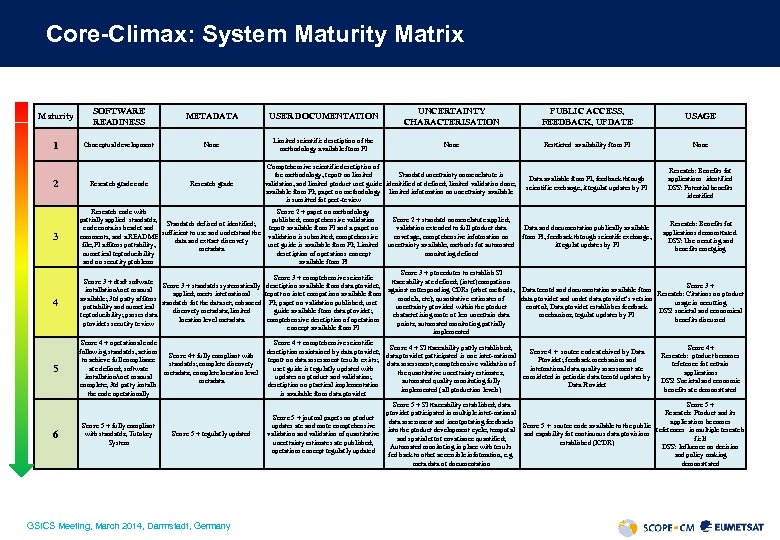
Core-Climax: System Maturity Matrix Maturity SOFTWARE READINESS METADATA USER DOCUMENTATION UNCERTAINTY CHARACTERISATION PUBLIC ACCESS, FEEDBACK, UPDATE USAGE 1 Conceptual development None Limited scientific description of the methodology available from PI None Restricted availability from PI None Data avaliable from PI, feedback through scientific exchange, irregular updates by PI Research: Benefits for applications identified DSS: Potential benefits identified Data and documentation publically available from PI, feedback through scientifc exchange, irregular updates by PI Research: Benefits for applications demonstrated. DSS: Use occuring and benefits emerging 2 Research grade code Research grade Comprehensive scientific description of Standard uncertainty nomenclature is the methodology, report on limited validation, and limited product user guide idenitified or defined; limited validation done; available from PI; paper on methodology limited information on uncertainty available is sumitted for peer-review 3 Research code with Score 2 + paper on methodology partially applied standards; published; comprehensive validation Standards defined or identified; code contains header and report available from PI and a paper on sufficient to use and understand the comments, and a README validation is submitted; comprehensive data and extract discovery file; PI affirms portability, user guide is available from PI; Limited metadata numerical reproducibility description of operations concept and no security problems available from PI 4 Score 3 + procedures to establish SI Score 3 + comprehensive scientific Score 3 + draft software traceability are defined; (inter)comparison Score 3 + standards systematically description available from data provider; Score 3 + installation/user manual against corresponding CDRs (other methods, Data record and documentation available from applied; meets international Research: Citations on product report on inter comparison available from data provider and under data provider's version available; 3 rd party affirms models, etc); quantitative estimates of standards for the data set; enhanced PI; paper on validation published; user usage in occurring portability and numerical uncertainty provided within the product control; Data provider establishes feedback discovery metadata; limited guide available from data provider; DSS: societal and economical characterising more or less uncertain data reproducibility; passes data mechanism; regular updates by PI location level metadata comprehensive description of operations benefits discussed providers security review points; automated monitoring partially concept available from PI implemented 5 Score 4 + operational code following standards, actions Score 4+ fully compliant with to achieve full compliance standards; complete discovery are defined; software metadata; complete location level installation/user manual metadata complete; 3 rd party installs the code operationally 6 Score 5 + fully compliant with standards; Turnkey System Score 5 + regularly updated GSICS Meeting, March 2014, Darmstadt, Germany Score 2 + standard nomenclature applied; validation extended to full product data coverage, comprehensive information on uncertainty available; methods for automated monitoring defined Score 4 + comprehensive scientific Score 4 + SI traceability partly established; description maintained by data provider; data provider participated in one inter-national report on data assessment results exists; data assessment; comprehensive validation of user guide is regularly updated with the quantitative uncertainty estimates; updates on product and validation; automated quality monitoring fully description on practical implementation implemented (all production levels) is available from data provider Score 5 + journal papers on product updates are and more comprehensive validation and validation of quantitative uncertainty estimates are published; operations concept regularly updated Score 4 + source code archived by Data Provider; feedback mechanism and international data quality assessment are considered in periodic data record updates by Data Provider Score 4+ Research: product becomes reference for certain applications DSS: Societal and economic benefits are demonstrated Score 5 + SI traceability established; data Score 5 + provider participated in multiple inter-national Research: Product and its data assessment and incorporating feedbacks applications becomes Score 5 + source code available to the public into the product development cycle; temporal references in multiple research and capability for continuous data provisions and spatial error covariance quantified; field established (ICDR) Automated monitoring in place with results DSS: Influence on decision fed back to other accessible information, e. g. and policy making meta data or documentation demonstrated
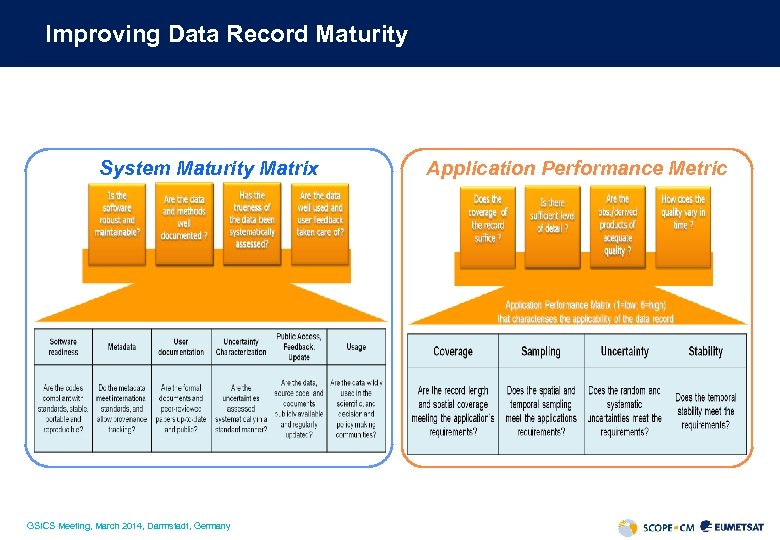
Improving Data Record Maturity System Maturity Matrix GSICS Meeting, March 2014, Darmstadt, Germany Application Performance Metric
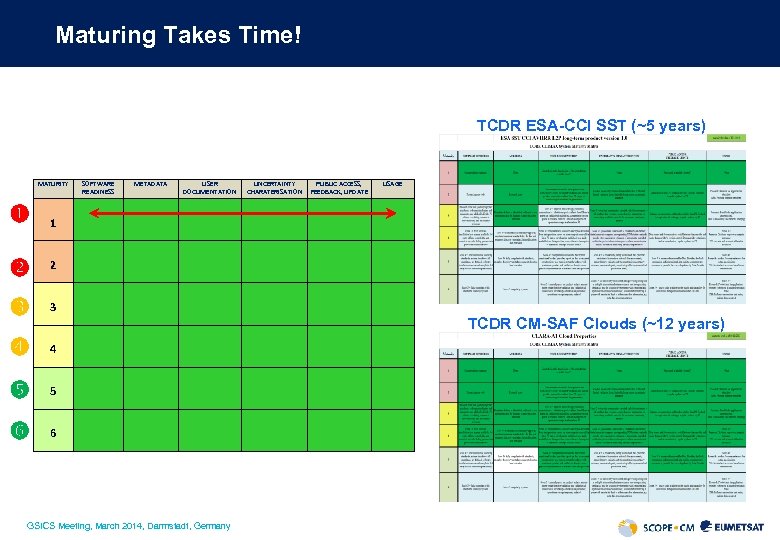
Maturing Takes Time! TCDR ESA-CCI SST (~5 years) MATURITY SOFTWARE READINESS METADATA USER DOCUMENTATION UNCERTAINTY CHARATERISATION PUBLIC ACCESS, FEEDBACK, UPDATE USAGE 1 2 3 4 5 6 TCDR CM-SAF Clouds (~12 years) Fig: Evolution of the SMM levels with time GSICS Meeting, March 2014, Darmstadt, Germany
SCOPE-CM inter-calibration projects SCM-06: Inter-calibration of passive imager observations from time-series of geostationary satellites (IOGEO) SCM-05: Advancing the status of the AVHRR FCDR GSICS Meeting, March 2014, Darmstadt, Germany
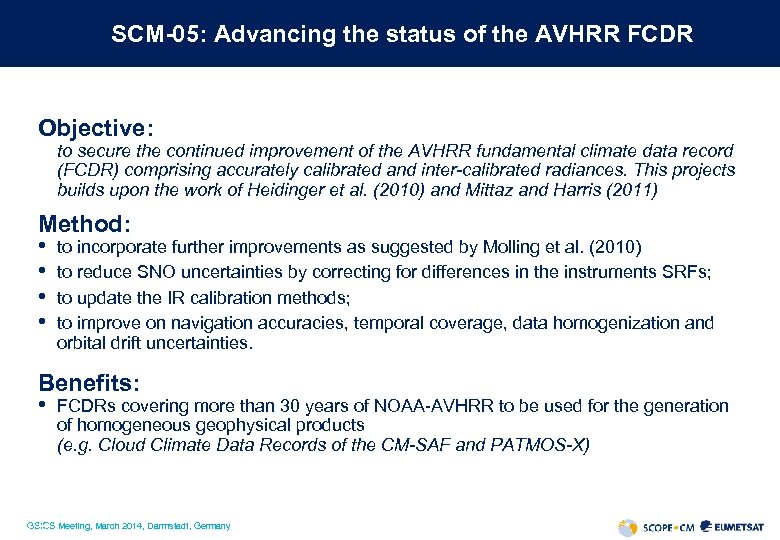
SCM-05: Advancing the status of the AVHRR FCDR Objective: to secure the continued improvement of the AVHRR fundamental climate data record (FCDR) comprising accurately calibrated and inter-calibrated radiances. This projects builds upon the work of Heidinger et al. (2010) and Mittaz and Harris (2011) Method: • to incorporate further improvements as suggested by Molling et al. (2010) • to reduce SNO uncertainties by correcting for differences in the instruments SRFs; • to update the IR calibration methods; • to improve on navigation accuracies, temporal coverage, data homogenization and orbital drift uncertainties. Benefits: • FCDRs covering more than 30 years of NOAA-AVHRR to be used for the generation of homogeneous geophysical products (e. g. Cloud Climate Data Records of the CM-SAF and PATMOS-X) Slide GSICS Meeting, March 2014, Darmstadt, Germany : 7
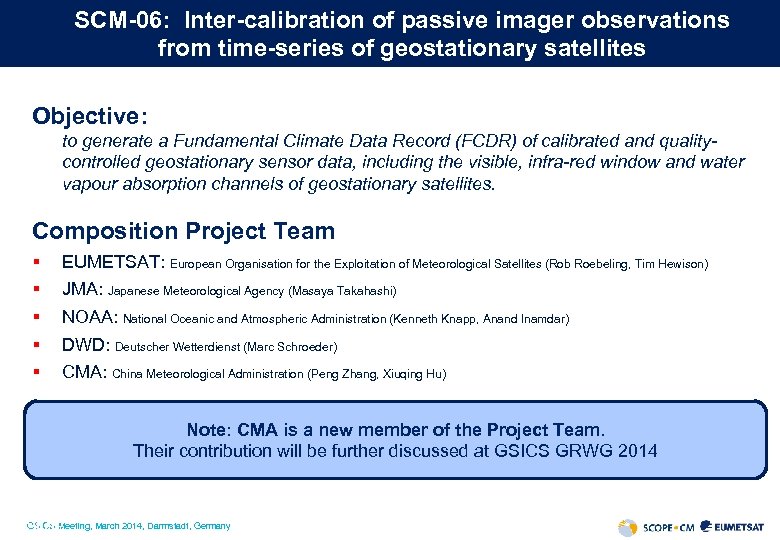
SCM-06: Inter-calibration of passive imager observations from time-series of geostationary satellites Objective: to generate a Fundamental Climate Data Record (FCDR) of calibrated and qualitycontrolled geostationary sensor data, including the visible, infra-red window and water vapour absorption channels of geostationary satellites. Composition Project Team § § § EUMETSAT: European Organisation for the Exploitation of Meteorological Satellites (Rob Roebeling, Tim Hewison) JMA: Japanese Meteorological Agency (Masaya Takahashi) NOAA: National Oceanic and Atmospheric Administration (Kenneth Knapp, Anand Inamdar) DWD: Deutscher Wetterdienst (Marc Schroeder) CMA: China Meteorological Administration (Peng Zhang, Xiuqing Hu) Note: CMA is a new member of the Project Team. Their contribution will be further discussed at GSICS GRWG 2014 GSICS Meeting, March 2014, Darmstadt, Germany Slide
SCM-06: Inter-calibration of passive imager observations from time-series of geostationary satellites Method IR and WV recalibration: • to utilise the inter-satellite methodology developed by GSICS; • to tie time series of IR and WV satellite data to the High Resolution Infrared Sounder (HIRS) data using Double Differencing; • to monitor quality and stability of the HIRS observations with observations from IASI and AIRS; • to adopt a common recalibration approach at NOAA, JMA and EUMETSAT; • to generate FCDRs of IR & WV radiances for the GEO satellites; • to inter-compare FCDRs of IR & WV radiances in overlapping regions, and compare them against output from observational feedback archive at ECMWF; Slide GSICS Meeting, March 2014, Darmstadt, Germany : 9
SCM-06: Inter-calibration of passive imager observations from time-series of geostationary satellites Method VIS recalibration: • to assess the VIS inter-calibration methodologies developed by GSICS; • to develop a consensus inter-calibration approach for the VIS channels; • to implement the consensus VIS inter-calibration approach at the 3 agencies; • to generate of VIS reflected radiance FCDRs for the GEO satellites; • to inter-compare the FCDRs of VIS reflected radiance for the 3 agencies; • to gather feedback from beta users; Slide GSICS Meeting, March 2014, Darmstadt, Germany : 10
Status SCM-06: IOGEO GSICS Meeting, March 2014, Darmstadt, Germany
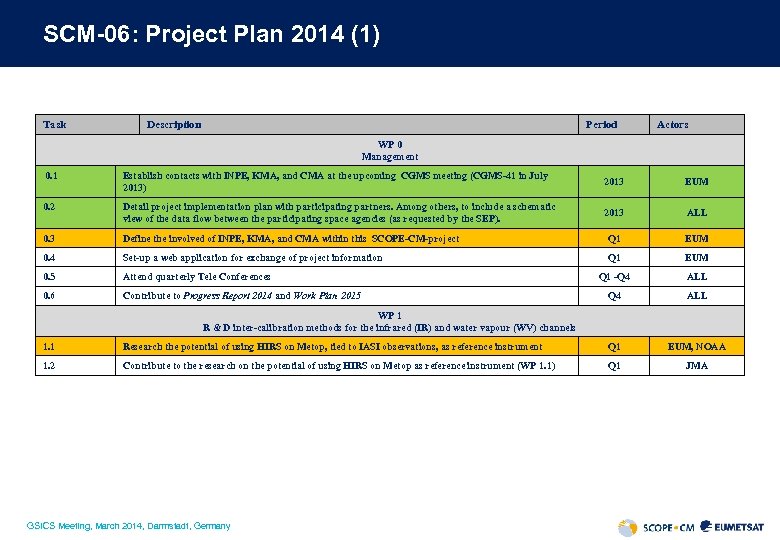
SCM-06: Project Plan 2014 (1) Task Description Period Actors WP 0 Management 0. 1 Establish contacts with INPE, KMA, and CMA at the upcoming CGMS meeting (CGMS-41 in July 2013) 2013 EUM 0. 2 Detail project implementation plan with participating partners. Among others, to include a schematic view of the data flow between the participating space agencies (as requested by the SEP). 2013 ALL 0. 3 Define the involved of INPE, KMA, and CMA within this SCOPE-CM-project Q 1 EUM 0. 4 Set-up a web application for exchange of project information Q 1 EUM 0. 5 Attend quarterly Tele Conferences Q 1 -Q 4 ALL 0. 6 Contribute to Progress Report 2014 and Work Plan 2015 Q 4 ALL WP 1 R & D inter-calibration methods for the infrared (IR) and water vapour (WV) channels 1. 1 Research the potential of using HIRS on Metop, tied to IASI observations, as reference instrument Q 1 EUM, NOAA 1. 2 Contribute to the research on the potential of using HIRS on Metop as reference instrument (WP 1. 1) Q 1 JMA GSICS Meeting, March 2014, Darmstadt, Germany
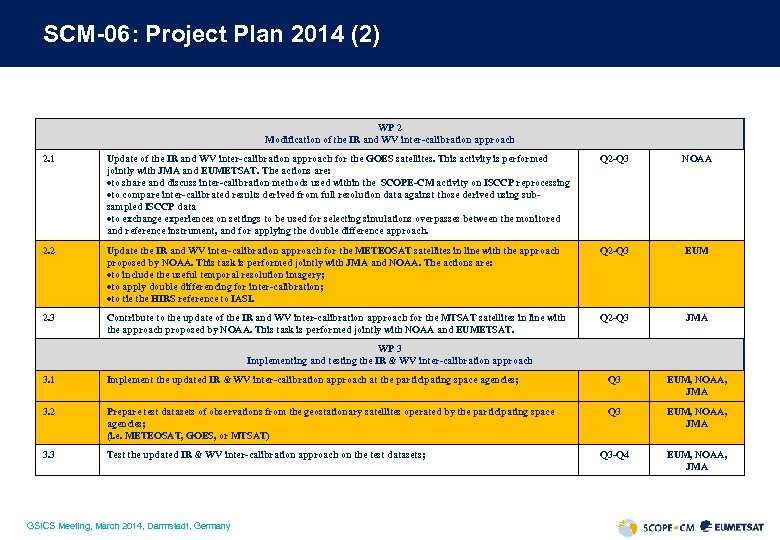
SCM-06: Project Plan 2014 (2) WP 2 Modification of the IR and WV inter-calibration approach 2. 1 Update of the IR and WV inter-calibration approach for the GOES satellites. This activity is performed jointly with JMA and EUMETSAT. The actions are: to share and discuss inter-calibration methods used within the SCOPE-CM activity on ISCCP reprocessing to compare inter-calibrated results derived from full resolution data against those derived using subsampled ISCCP data to exchange experiences on settings to be used for selecting simulations overpasses between the monitored and reference instrument, and for applying the double difference approach. Q 2 -Q 3 NOAA 2. 2 Update the IR and WV inter-calibration approach for the METEOSAT satellites in line with the approach proposed by NOAA. This task is performed jointly with JMA and NOAA. The actions are: to include the useful temporal resolution imagery; to apply double differencing for inter-calibration; to tie the HIRS reference to IASI. Q 2 -Q 3 EUM 2. 3 Contribute to the update of the IR and WV inter-calibration approach for the MTSAT satellites in line with the approach proposed by NOAA. This task is performed jointly with NOAA and EUMETSAT. Q 2 -Q 3 JMA WP 3 Implementing and testing the IR & WV inter-calibration approach 3. 1 Implement the updated IR & WV inter-calibration approach at the participating space agencies; Q 3 EUM, NOAA, JMA 3. 2 Prepare test datasets of observations from the geostationary satellites operated by the participating space agencies; (i. e. METEOSAT, GOES, or MTSAT) Q 3 EUM, NOAA, JMA 3. 3 Test the updated IR & WV inter-calibration approach on the test datasets; Q 3 -Q 4 EUM, NOAA, JMA GSICS Meeting, March 2014, Darmstadt, Germany
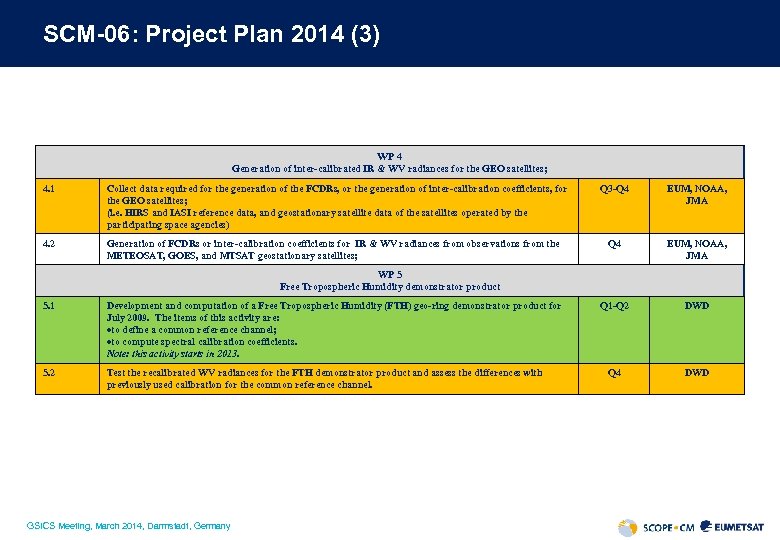
SCM-06: Project Plan 2014 (3) WP 4 Generation of inter-calibrated IR & WV radiances for the GEO satellites; 4. 1 Collect data required for the generation of the FCDRs, or the generation of inter-calibration coefficients, for the GEO satellites; (i. e. HIRS and IASI reference data, and geostationary satellite data of the satellites operated by the participating space agencies) 4. 2 Generation of FCDRs or inter-calibration coefficients for IR & WV radiances from observations from the METEOSAT, GOES, and MTSAT geostationary satellites; Q 3 -Q 4 EUM, NOAA, JMA Q 1 -Q 2 DWD Q 4 DWD WP 5 Free Tropospheric Humidity demonstrator product 5. 1 Development and computation of a Free Tropospheric Humidity (FTH) geo-ring demonstrator product for July 2009. The items of this activity are: to define a common reference channel; to compute spectral calibration coefficients. Note: this activity starts in 2013. 5. 2 Test the recalibrated WV radiances for the FTH demonstrator product and assess the differences with previously used calibration for the common reference channel. GSICS Meeting, March 2014, Darmstadt, Germany
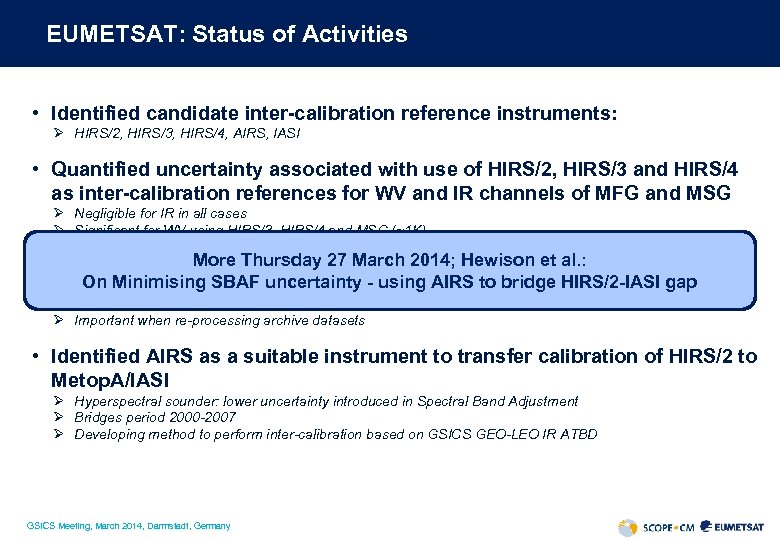
EUMETSAT: Status of Activities • Identified candidate inter-calibration reference instruments: Ø HIRS/2, HIRS/3, HIRS/4, AIRS, IASI • Quantified uncertainty associated with use of HIRS/2, HIRS/3 and HIRS/4 as inter-calibration references for WV and IR channels of MFG and MSG Ø Negligible for IR in all cases Ø Significant for WV using HIRS/3, HIRS/4 and MSG (~1 K) More Thursday 27 March 2014; Hewison et • Developed Simultaneous Nadir Overpass Tool (SNOT)al. : On fast selection SBAF uncertainty - using AIRS to bridge Ø Allows. Minimisingof collocations from GEO-LEO satellites Ø Based on 2 -D histograms binned to sampling interval of LEO sounder Ø Important when re-processing archive datasets HIRS/2 -IASI gap • Identified AIRS as a suitable instrument to transfer calibration of HIRS/2 to Metop. A/IASI Ø Hyperspectral sounder: lower uncertainty introduced in Spectral Band Adjustment Ø Bridges period 2000 -2007 Ø Developing method to perform inter-calibration based on GSICS GEO-LEO IR ATBD GSICS Meeting, March 2014, Darmstadt, Germany
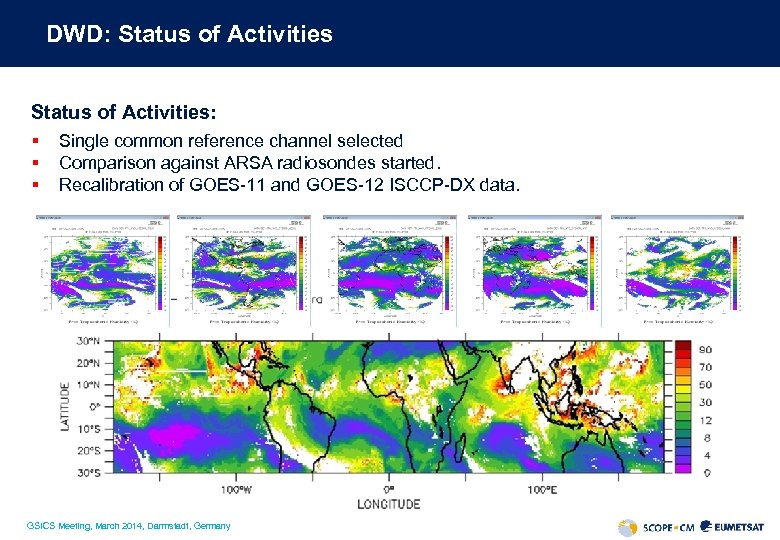
DWD: Status of Activities: § § § Single common reference channel selected Comparison against ARSA radiosondes started. Recalibration of GOES-11 and GOES-12 ISCCP-DX data. GSICS Meeting, March 2014, Darmstadt, Germany
NOAA: Status of Activities NOAA contributes through discussions and collaborations on: § § § SNO matchup limits Previous NCDC inter calibration of HIRS at NCDC and also from the CDR project Visible calibration results Comparison of NOAA results against results from other SCM-06 members NCDC efforts to produce inter-calibrated product (Grid. Sat-B 1) Discussion § § Is the end result a FCDR of calibrated radiances or a set of correction coefficients? Does SCM-06 plan to provide a combined product with better specs than Grid. Sat-B 1 (e. g. radiances and/or BTs at pixel resolution, hourly, VZA corrected)? GSICS Meeting, March 2014, Darmstadt, Germany
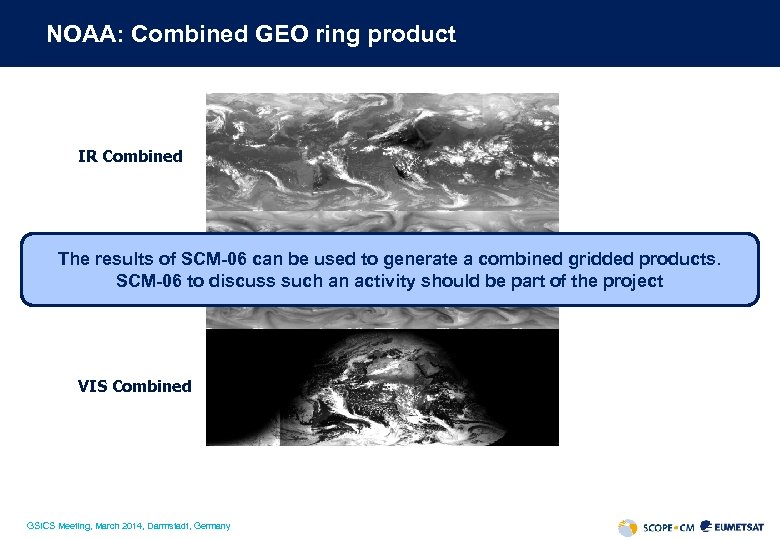
NOAA: Combined GEO ring product IR Combined The results of SCM-06 can be used to generate a combined gridded products. WV Combined SCM-06 to discuss such an activity should be part of the project VIS Combined GSICS Meeting, March 2014, Darmstadt, Germany 18
JMA: Status of Activities: § § JMA will collaborate with EUMETSAT and NOAA on the IR/WV re-calibration, and adopt the method that is developed within SCM-06 (2014 -2015) JMA will re-calibrate the IR/WV channels of the GMS satellites (planned 2015) JMA did much research on using visible calibration methods in combination, and will exchange this information with the members of SCM-06. JMAs visiting scientist at EUMETSAT (2014) is the SCM-06 representative. This helps to make the collaboration more effective. GSICS Meeting, March 2014, Darmstadt, Germany
SCM-06: Dependencies and Links SCM-06: Internal dependencies • Provide inter-calibrated WV radiances (or recalibration coefficients) from GEO’s timeseries to DWD (2014 -2015) • Provide inter-calibrated HIRS radiances for selection of channels to DWD (2014 -2015) SCM-06: Links to external projects § § § § § SCOPE-CM Albedo (requires re-calibrated VIS radiances GEO’s) SCOPE-CM ISCCP (advices on IR, and VIS inter-calibration) SCOPE-CM FCDR (SMHI) (requires inter-calibrated HIRS data record) EUM-CM SAF (compare WV products CM SAF and NOAA) ISCCP (NOAA Project that requires inter-calibrated IR and VIS radiances) EU QA 4 ECV (requires re-calibrated VIS radiances METEOSATs) Potential link to EU-H 2020 projects (e. g. EO-02 call related to re-calibration) ESA-CCI GSICS Ø Ø Developing best practises to define reference instrument Developing best practises to define Spectral Band Adjustment Factors GSICS Meeting, March 2014, Darmstadt, Germany

Plans 2014 -2015 GSICS Meeting, March 2014, Darmstadt, Germany
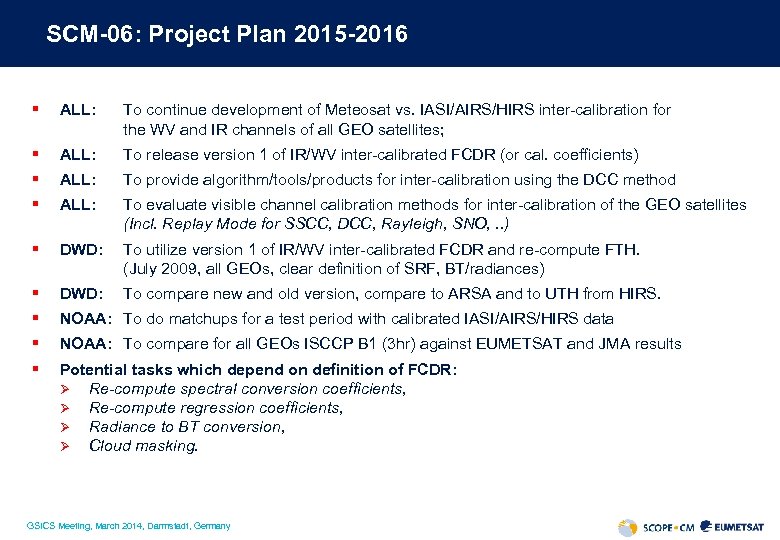
SCM-06: Project Plan 2015 -2016 § ALL: To continue development of Meteosat vs. IASI/AIRS/HIRS inter-calibration for the WV and IR channels of all GEO satellites; § ALL: To release version 1 of IR/WV inter-calibrated FCDR (or cal. coefficients) § ALL: To provide algorithm/tools/products for inter-calibration using the DCC method § ALL: To evaluate visible channel calibration methods for inter-calibration of the GEO satellites (Incl. Replay Mode for SSCC, DCC, Rayleigh, SNO, . . ) § DWD: To utilize version 1 of IR/WV inter-calibrated FCDR and re-compute FTH. (July 2009, all GEOs, clear definition of SRF, BT/radiances) § DWD: To compare new and old version, compare to ARSA and to UTH from HIRS. § NOAA: To do matchups for a test period with calibrated IASI/AIRS/HIRS data § NOAA: To compare for all GEOs ISCCP B 1 (3 hr) against EUMETSAT and JMA results § Potential tasks which depend on definition of FCDR: Ø Re-compute spectral conversion coefficients, Ø Re-compute regression coefficients, Ø Radiance to BT conversion, Ø Cloud masking. GSICS Meeting, March 2014, Darmstadt, Germany

Thank You Any Questions?
Скачать презентацию SCOPE-CM Inter-calibration Projects Rob Roebeling Marie Bouchez Doutriaux
11dabb2d590715af17b2f422fa7f9b27.ppt