


 Скачать презентацию Scoliosis and Syringomyelia M ZERAH Department of Pediatric
fe0592fdf39c89f34bd587a8e78a4d7e.ppt
- Количество слайдов: 42
 Scoliosis and Syringomyelia M. ZERAH Department of Pediatric Neurosurgery. Hopital Necker Enfants-Malades. Université Paris V. France
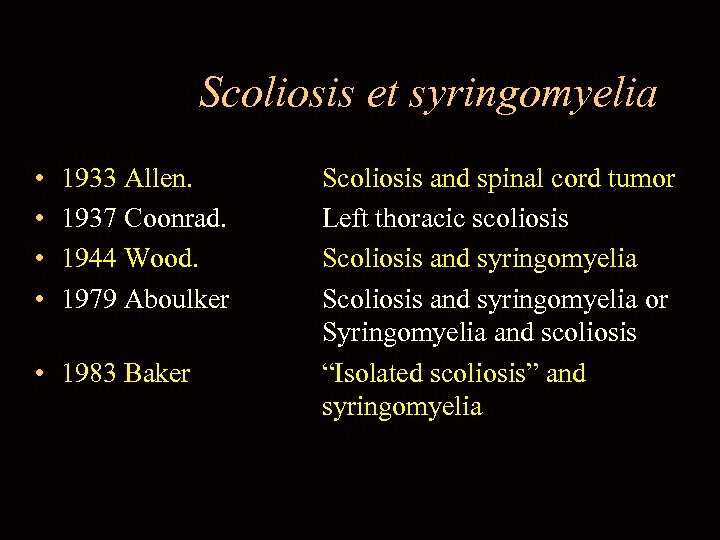 Scoliosis et syringomyelia • • 1933 Allen. 1937 Coonrad. 1944 Wood. 1979 Aboulker • 1983 Baker Scoliosis and spinal cord tumor Left thoracic scoliosis Scoliosis and syringomyelia or Syringomyelia and scoliosis “Isolated scoliosis” and syringomyelia
 Neurosurgeon Point of View Syringomyelia and Scoliosis
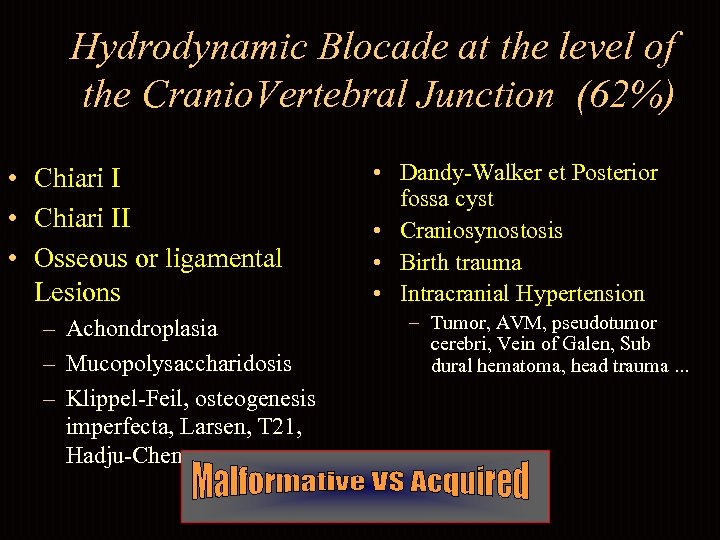 Hydrodynamic Blocade at the level of the Cranio. Vertebral Junction (62%) • Chiari II • Osseous or ligamental Lesions – Achondroplasia – Mucopolysaccharidosis – Klippel-Feil, osteogenesis imperfecta, Larsen, T 21, Hadju-Cheney…. • Dandy-Walker et Posterior fossa cyst • Craniosynostosis • Birth trauma • Intracranial Hypertension – Tumor, AVM, pseudotumor cerebri, Vein of Galen, Sub dural hematoma, head trauma. . .
 Spinal and spinal cord lesions (38%) • Malformation – Diastematomyelia – Lipoma – Neurenteric cyst • Spinal cord compression – Spinal tumor – Spinal cord tumor • Post traumatic syrinx • Spinal Arachnoiditis • Chiari II
 Our Series (1984 - 1998) P<0. 0001 P<0. 05 Zerah. Neurochirurgie 1999
 Our Series (1984 - 1998) 399 syrinx , 313 operated
 Chiari I. Initial symptoms
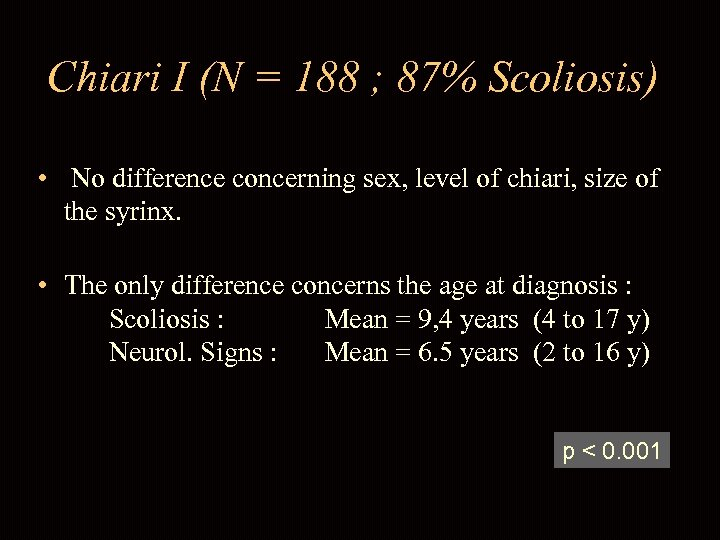 Chiari I (N = 188 ; 87% Scoliosis) • No difference concerning sex, level of chiari, size of the syrinx. • The only difference concerns the age at diagnosis : Scoliosis : Mean = 9, 4 years (4 to 17 y) Neurol. Signs : Mean = 6. 5 years (2 to 16 y) p < 0. 001
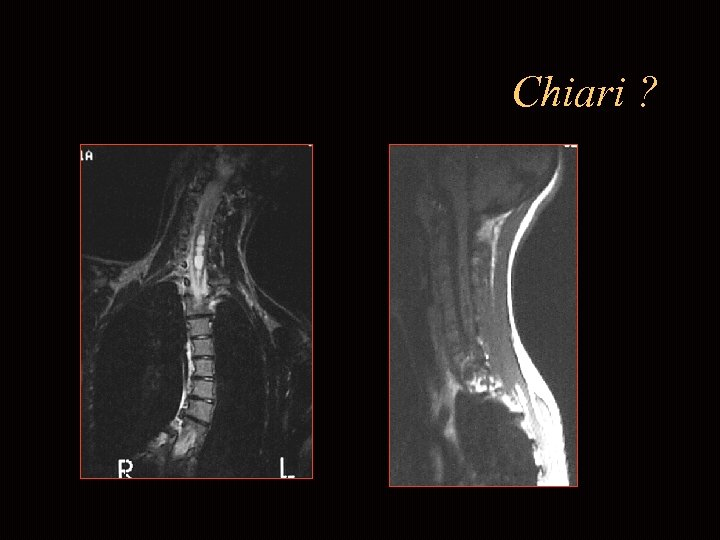
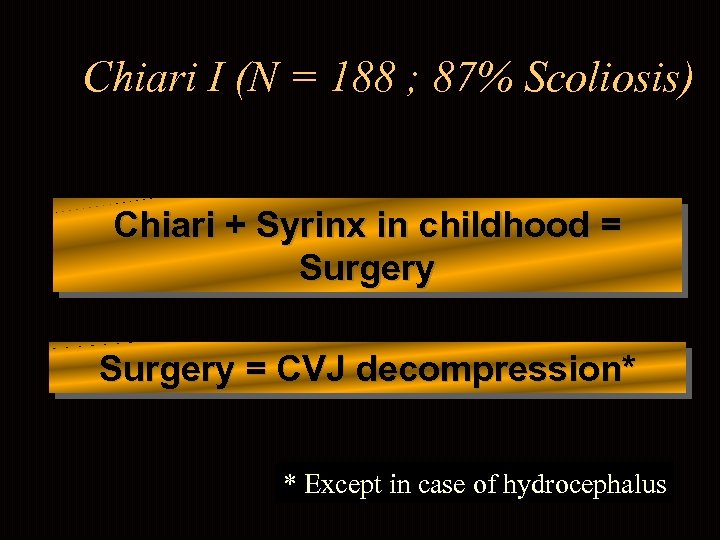 Chiari I (N = 188 ; 87% Scoliosis) Chiari + Syrinx in childhood = Surgery = CVJ decompression* * Except in case of hydrocephalus
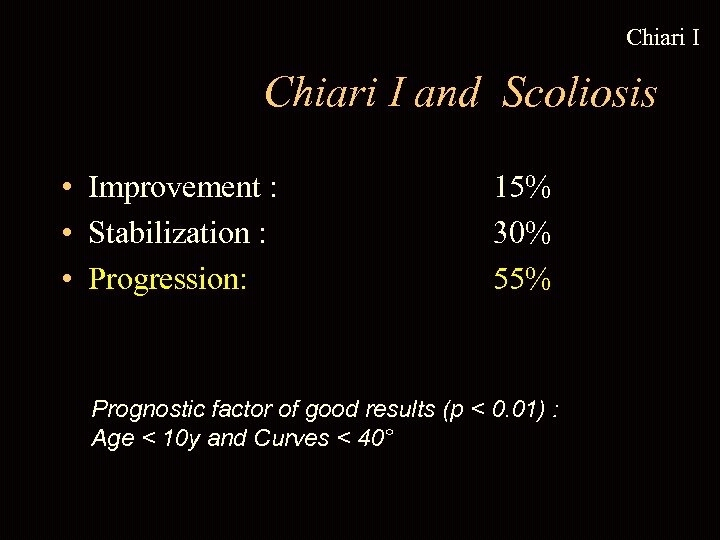 Chiari I and Scoliosis • Improvement : • Stabilization : • Progression: 15% 30% 55% Prognostic factor of good results (p < 0. 01) : Age < 10 y and Curves < 40°
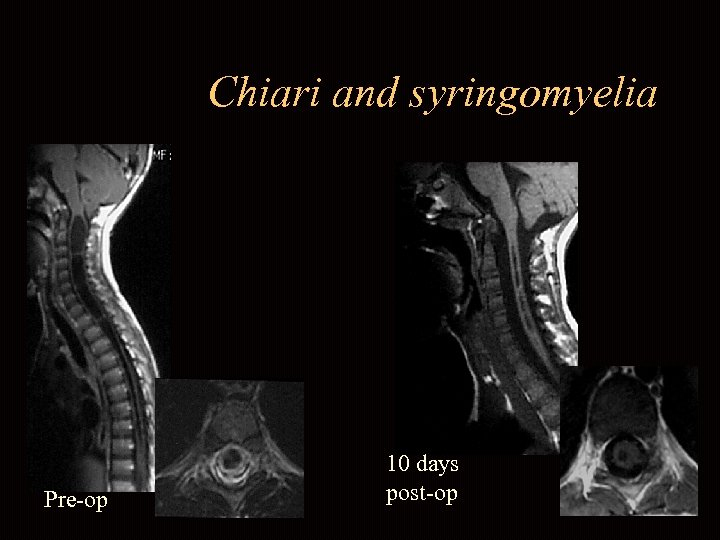 Chiari and syringomyelia Pre-op 10 days post-op
 Chiari ?
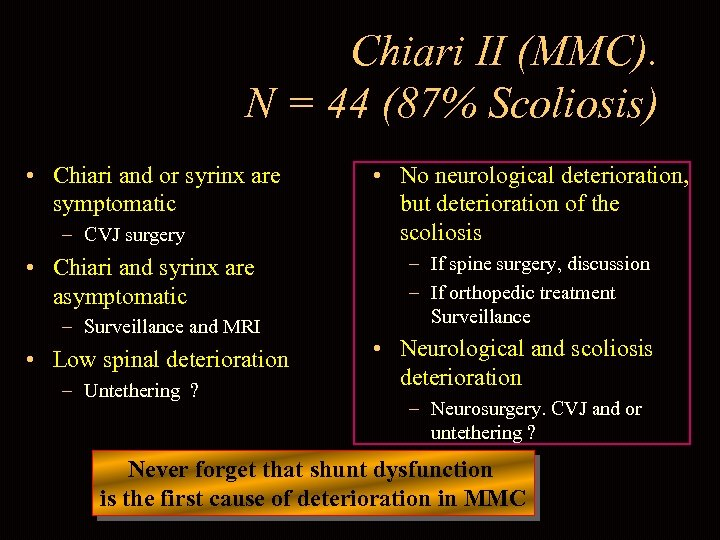 Chiari II (MMC). N = 44 (87% Scoliosis) • Chiari and or syrinx are symptomatic – CVJ surgery • Chiari and syrinx are asymptomatic – Surveillance and MRI • Low spinal deterioration – Untethering ? • No neurological deterioration, but deterioration of the scoliosis – If spine surgery, discussion – If orthopedic treatment Surveillance • Neurological and scoliosis deterioration – Neurosurgery. CVJ and or untethering ? Never forget that shunt dysfunction is the first cause of deterioration in MMC
 Chiari II
 Arachnoiditis
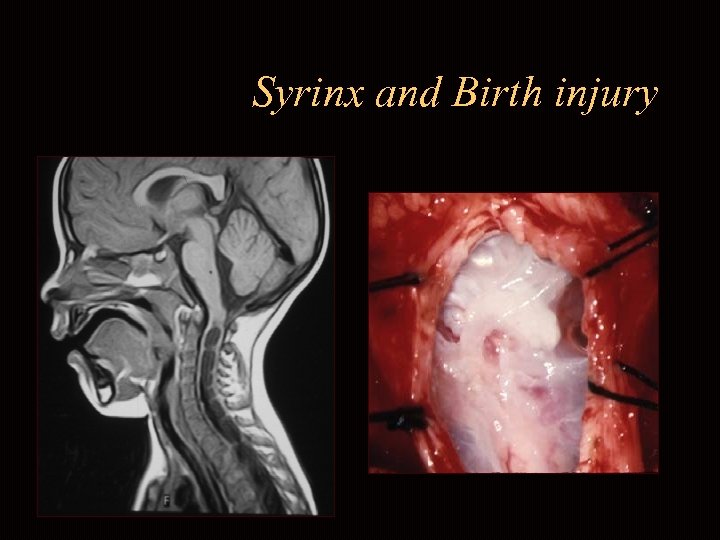 Syrinx and Birth injury
 Frequency • 106 adults with syrinx • 54 history of birth injury B. Williams (1979)
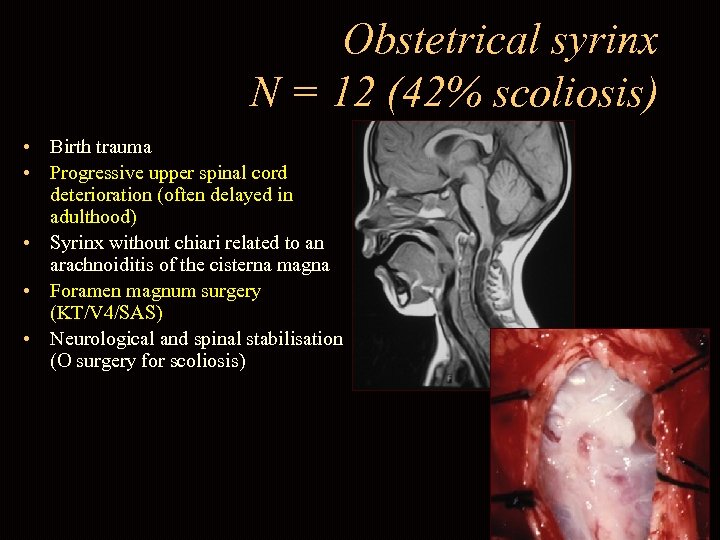 Obstetrical syrinx N = 12 (42% scoliosis) • Birth trauma • Progressive upper spinal cord deterioration (often delayed in adulthood) • Syrinx without chiari related to an arachnoiditis of the cisterna magna • Foramen magnum surgery (KT/V 4/SAS) • Neurological and spinal stabilisation (O surgery for scoliosis)
 Syrinx and Diastematomyelia
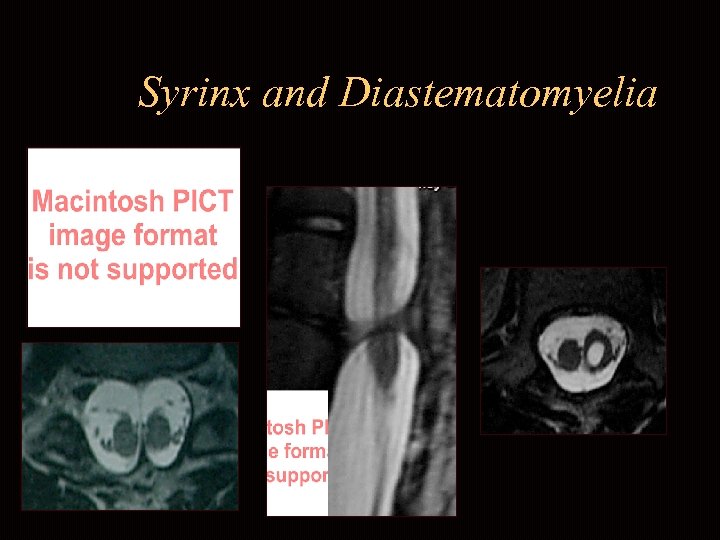 Syrinx and Diastematomyelia
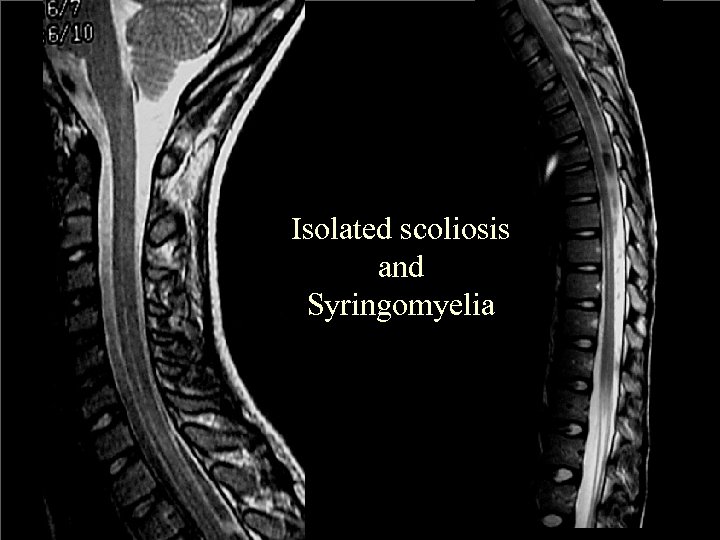
 Isolated syrinx N = 68 (100% Scoliosis) • • Scoliosis +/- minimal neurological signs Dorsal or lumbar syrinx. Never cervical Never “under pressure syrinx” Never evolutive Needs one or two control MRI (one with gadolinium) Never needs neurosurgery The presence of such a cavity must not modify the management of the scoliosis.
 Syrinx et Isolated scoliosis (n = 68)
 Syrinx Isolated scoliosis (n = 68)
 Isolated scoliosis and Syringomyelia
 The Orthopedic (Spinal) Surgeon point of view Scoliosis and Syringomyelia
 3 Main Questions • What is the real risk to have a “Neurologic Scoliosis” in front of a “Adolescent Idiopathic Scoliosis (AIS)” ? • Does it need a systematic neurosurgical surgery (prior to the scoliosis one). Does it improve the risk of scoliosis surgery ? • What is the real impact on the Scoliosis Progression ?
 What is the real risk to have a “Neurologic Scoliosis” in front of a “Adolescent Idiopathic Scoliosis (AIS)” ?
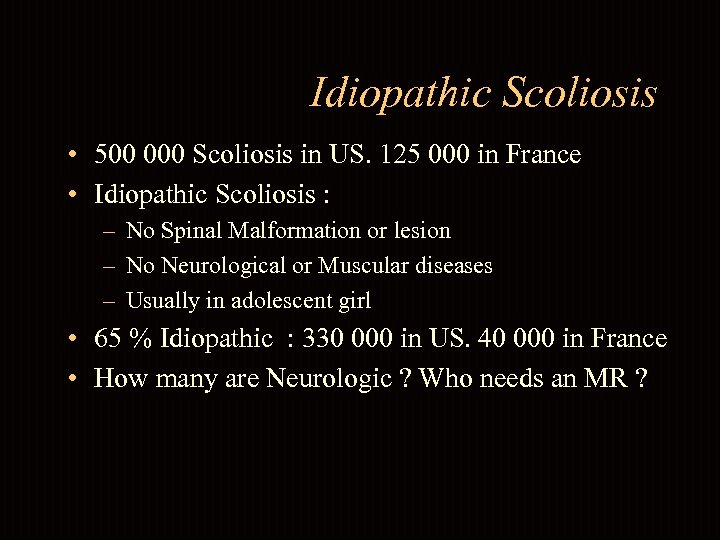 Idiopathic Scoliosis • 500 000 Scoliosis in US. 125 000 in France • Idiopathic Scoliosis : – No Spinal Malformation or lesion – No Neurological or Muscular diseases – Usually in adolescent girl • 65 % Idiopathic : 330 000 in US. 40 000 in France • How many are Neurologic ? Who needs an MR ?
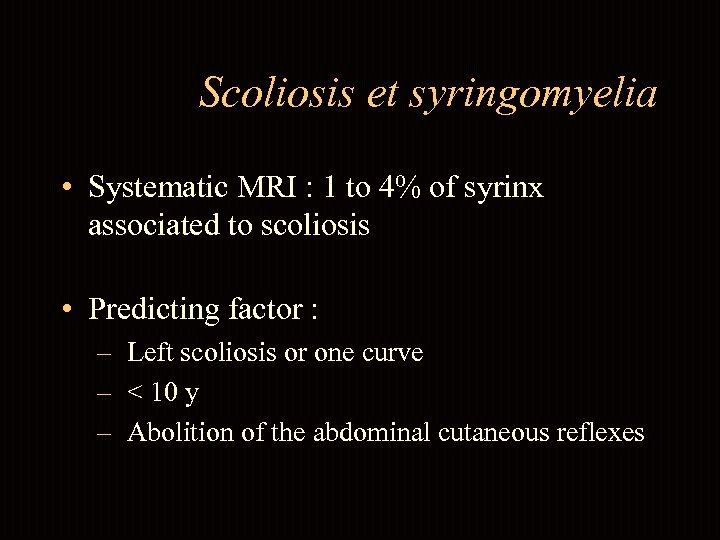 Scoliosis et syringomyelia • Systematic MRI : 1 to 4% of syrinx associated to scoliosis • Predicting factor : – Left scoliosis or one curve – < 10 y – Abolition of the abdominal cutaneous reflexes
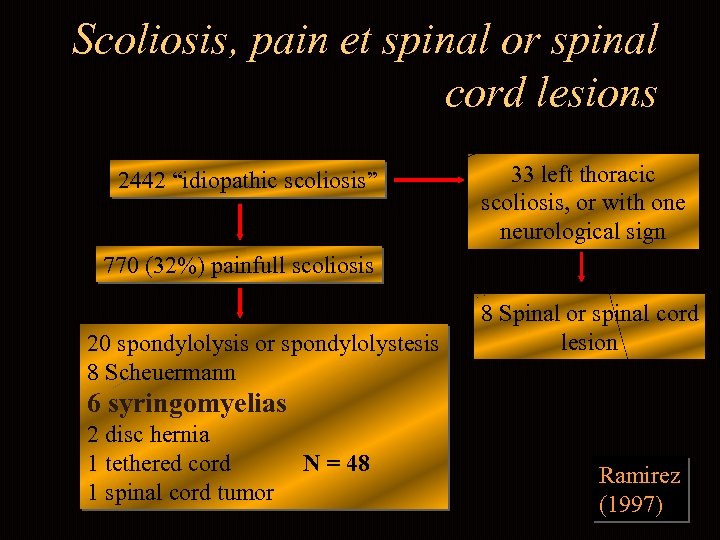 Scoliosis, pain et spinal or spinal cord lesions 2442 “idiopathic scoliosis” 33 left thoracic scoliosis, or with one neurological sign 770 (32%) painfull scoliosis 20 spondylolysis or spondylolystesis 8 Scheuermann 8 Spinal or spinal cord lesion 6 syringomyelias 2 disc hernia 1 tethered cord 1 spinal cord tumor N = 48 Ramirez (1997)
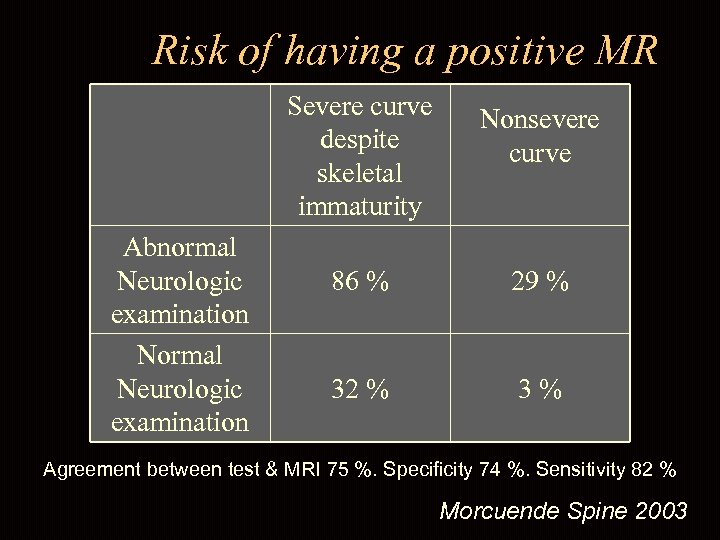 Risk of having a positive MR Severe curve despite skeletal immaturity Abnormal Neurologic examination Nonsevere curve 86 % 29 % 32 % 3% Agreement between test & MRI 75 %. Specificity 74 %. Sensitivity 82 % Morcuende Spine 2003
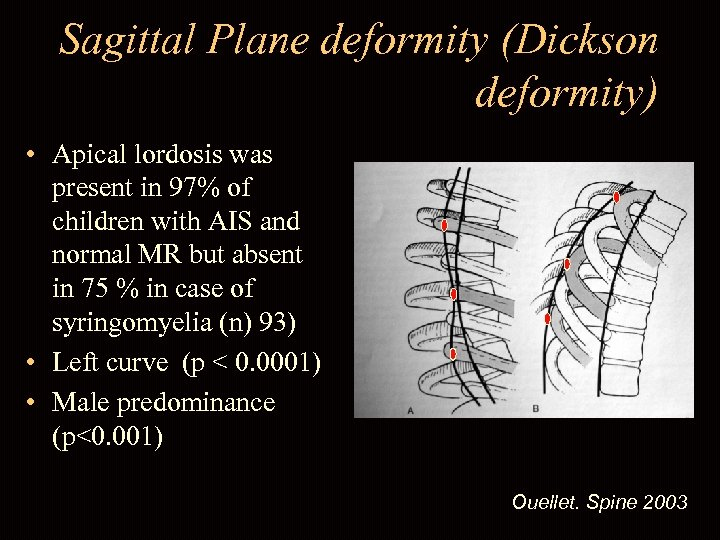 Sagittal Plane deformity (Dickson deformity) • Apical lordosis was present in 97% of children with AIS and normal MR but absent in 75 % in case of syringomyelia (n) 93) • Left curve (p < 0. 0001) • Male predominance (p<0. 001) Ouellet. Spine 2003
 AIS. Familial Genetic disease ? • 71 patients with AIS • 9 (13%) showed neurologic abnormality in MRI (Syrinx and/ or Chiari or tonsillar ectopia) • Among the relative of these patients 4 /15 affected with scoliosis also showed neurologic abnormality on MR Inoue. Spine 2003
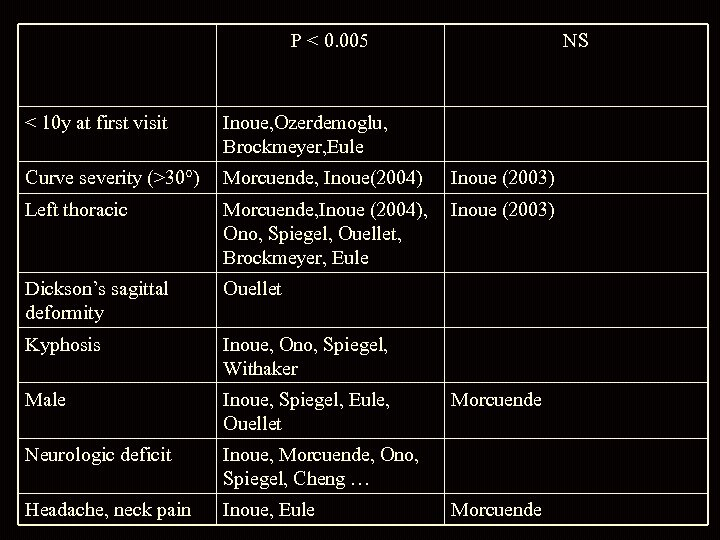 P < 0. 005 NS < 10 y at first visit Inoue, Ozerdemoglu, Brockmeyer, Eule Curve severity (>30°) Morcuende, Inoue(2004) Inoue (2003) Left thoracic Morcuende, Inoue (2004), Ono, Spiegel, Ouellet, Brockmeyer, Eule Inoue (2003) Dickson’s sagittal deformity Ouellet Kyphosis Inoue, Ono, Spiegel, Withaker Male Inoue, Spiegel, Eule, Ouellet Neurologic deficit Inoue, Morcuende, Ono, Spiegel, Cheng … Headache, neck pain Inoue, Eule Morcuende
 Does it need a systematic neurosurgical surgery (prior to the scoliosis one). Does it improve the risk of scoliosis surgery ?
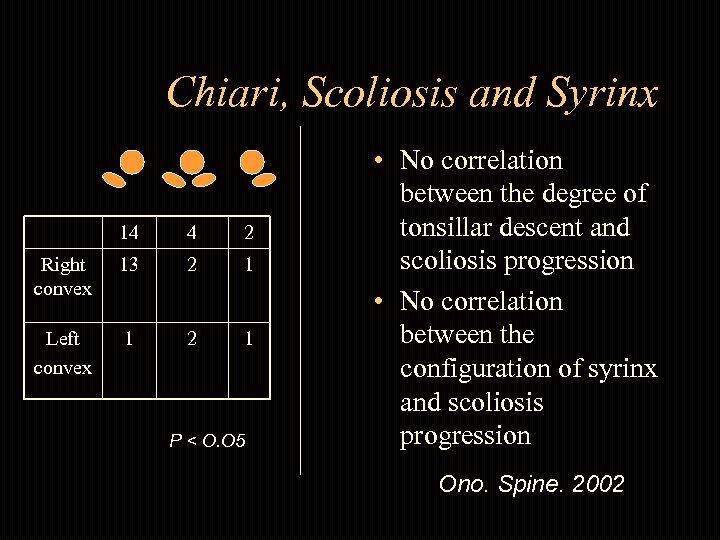 Chiari, Scoliosis and Syrinx 14 4 2 Right convex 13 2 1 Left convex 1 2 1 P < O. O 5 • No correlation between the degree of tonsillar descent and scoliosis progression • No correlation between the configuration of syrinx and scoliosis progression Ono. Spine. 2002
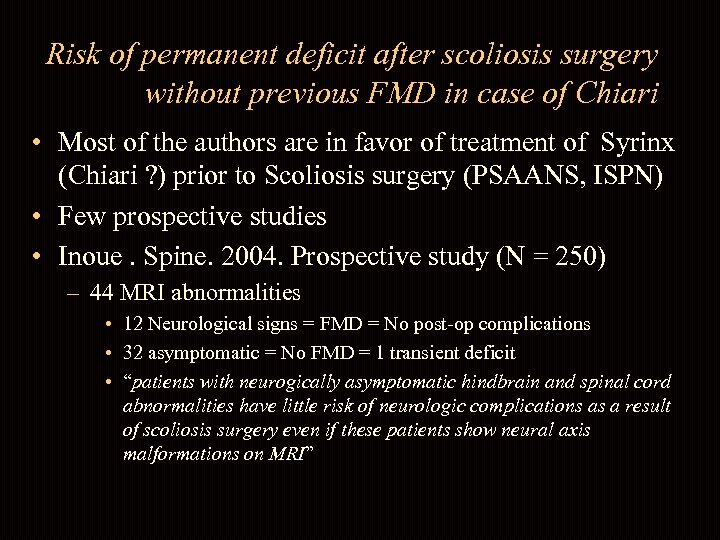 Risk of permanent deficit after scoliosis surgery without previous FMD in case of Chiari • Most of the authors are in favor of treatment of Syrinx (Chiari ? ) prior to Scoliosis surgery (PSAANS, ISPN) • Few prospective studies • Inoue. Spine. 2004. Prospective study (N = 250) – 44 MRI abnormalities • 12 Neurological signs = FMD = No post-op complications • 32 asymptomatic = No FMD = 1 transient deficit • “patients with neurogically asymptomatic hindbrain and spinal cord abnormalities have little risk of neurologic complications as a result of scoliosis surgery even if these patients show neural axis malformations on MRI”
 What is the real impact on the Scoliosis Progression ?
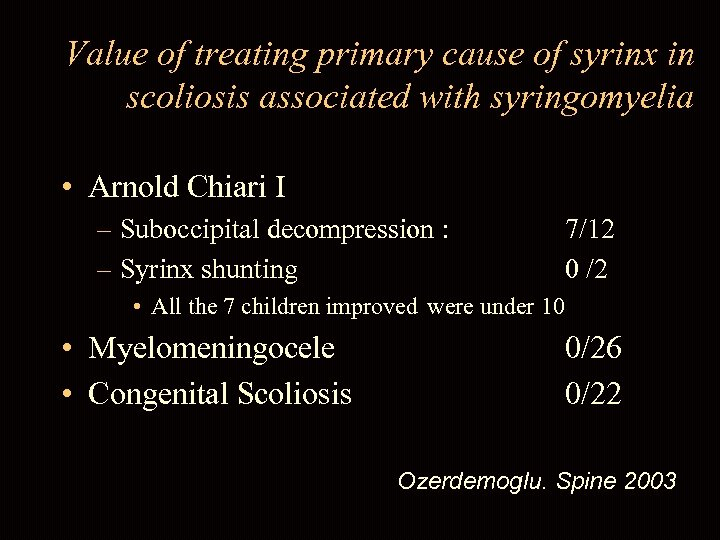 Value of treating primary cause of syrinx in scoliosis associated with syringomyelia • Arnold Chiari I – Suboccipital decompression : – Syrinx shunting 7/12 0 /2 • All the 7 children improved were under 10 • Myelomeningocele • Congenital Scoliosis 0/26 0/22 Ozerdemoglu. Spine 2003
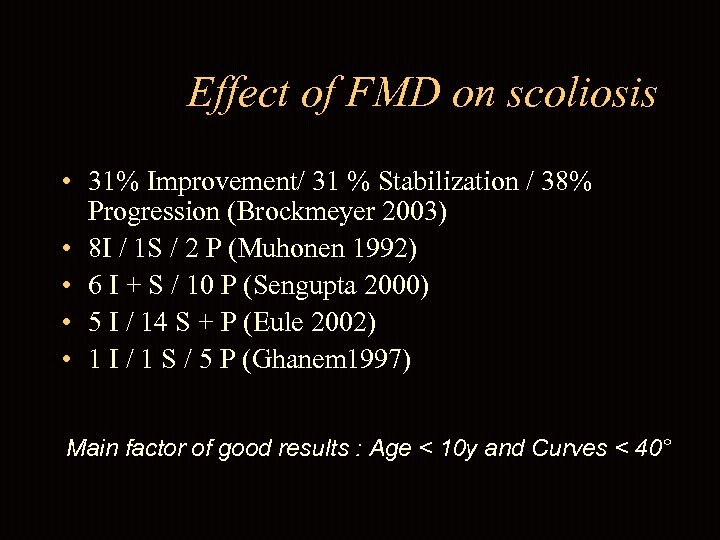 Effect of FMD on scoliosis • 31% Improvement/ 31 % Stabilization / 38% Progression (Brockmeyer 2003) • 8 I / 1 S / 2 P (Muhonen 1992) • 6 I + S / 10 P (Sengupta 2000) • 5 I / 14 S + P (Eule 2002) • 1 I / 1 S / 5 P (Ghanem 1997) Main factor of good results : Age < 10 y and Curves < 40°
 Conclusion • Idiopathic scoliosis in case of pain and /or neurological signs and/or abnormal X-Rays (left, kyphosis…) must have an MRI • The consensus is still in favor of neurosurgery prior to spine surgery but … • It is difficult to appraise the real impact of this surgery on the progresion of the scoliosis • Progress on the understanding of the “primum movens” of the scoliosis