


 Скачать презентацию SCINDA Status Plans LISN Workshop Sao José
d1aa5ff1157cdf5b5d642f898426d6a0.ppt
- Количество слайдов: 24
 SCINDA Status & Plans LISN Workshop Sao José dos Campos S. P. , Brasil 7 -10 November 2011 Dr. Keith Groves Institute for Space Research Boston College Chestnut Hill, MA USA keith. groves@bc. edu 1
 Acknowledgments to the Team Santimay Basu Ronald Caton Charlie Carrano Chris Bridgwood Isseyas Mengistu John Quinn Robert Livingston Stephen Jimenez Cesar Valladares Randy Cicale Ben Heruska Peter Ning Mike Verlinden Dean Anneser Rui Fernandes Patrick Roddy Nelson Bonito Ted Erickson AND a long list of instrument hosts!
 OUTLINE • SCINDA Purpose & Status − Equipment Description − Global Scintillation & Ionospheric Monitoring • African Initiative • Plans & Summary • A bit about COPEX… PRN 7
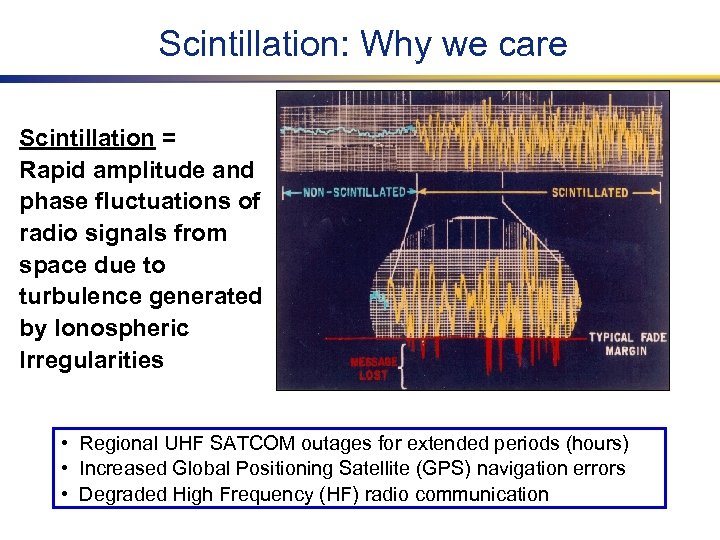 Scintillation: Why we care Scintillation = Rapid amplitude and phase fluctuations of radio signals from space due to turbulence generated by Ionospheric Irregularities • Regional UHF SATCOM outages for extended periods (hours) • Increased Global Positioning Satellite (GPS) navigation errors • Degraded High Frequency (HF) radio communication
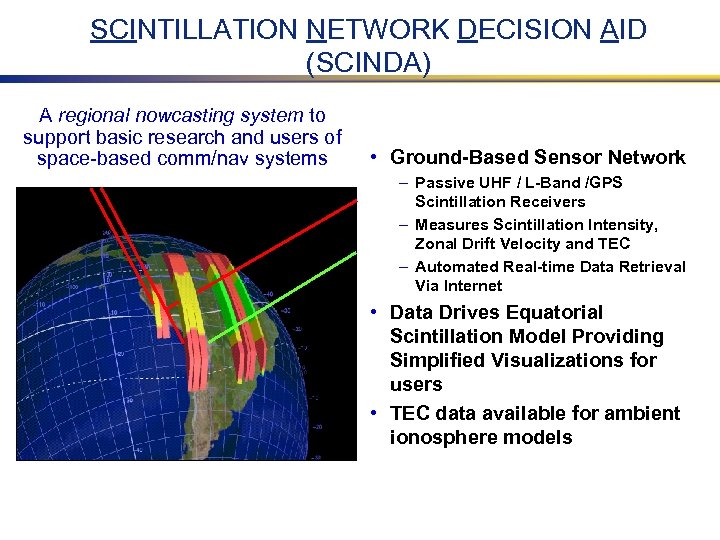 SCINTILLATION NETWORK DECISION AID (SCINDA) A regional nowcasting system to support basic research and users of space-based comm/nav systems • Ground-Based Sensor Network – Passive UHF / L-Band /GPS Scintillation Receivers – Measures Scintillation Intensity, Zonal Drift Velocity and TEC – Automated Real-time Data Retrieval Via Internet • Data Drives Equatorial Scintillation Model Providing Simplified Visualizations for users • TEC data available for ambient ionosphere models
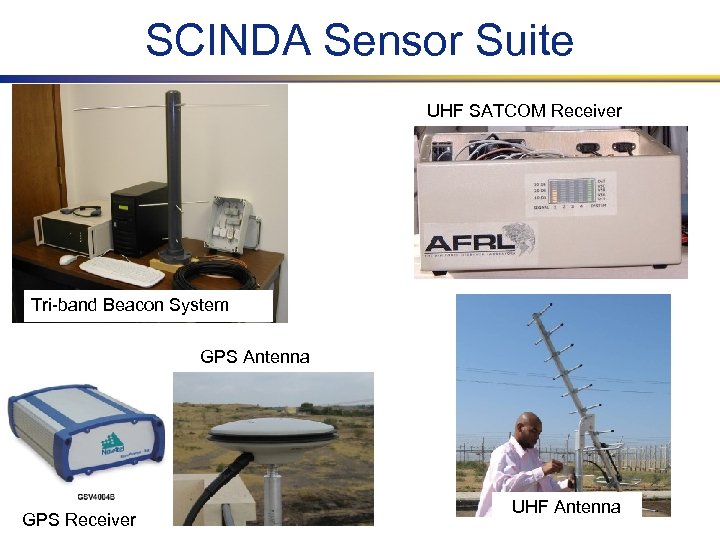 SCINDA Sensor Suite UHF SATCOM Receiver Tri-band Beacon System GPS Antenna GPS Receiver UHF Antenna
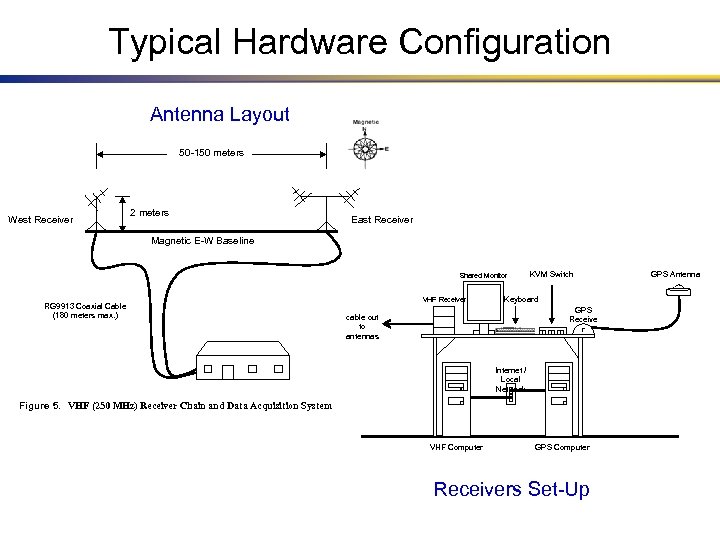 Typical Hardware Configuration Antenna Layout 50 -150 meters West Receiver 2 meters East Receiver Magnetic E-W Baseline Shared Monitor RG 9913 Coaxial Cable (180 meters max. ) VHF Receiver KVM Switch Keyboard GPS Receive r cable out to antennas Internet / Local Network Figure 5. VHF (250 MHz) Receiver Chain and Data Acquisition System VHF Computer GPS Computer Receivers Set-Up GPS Antenna
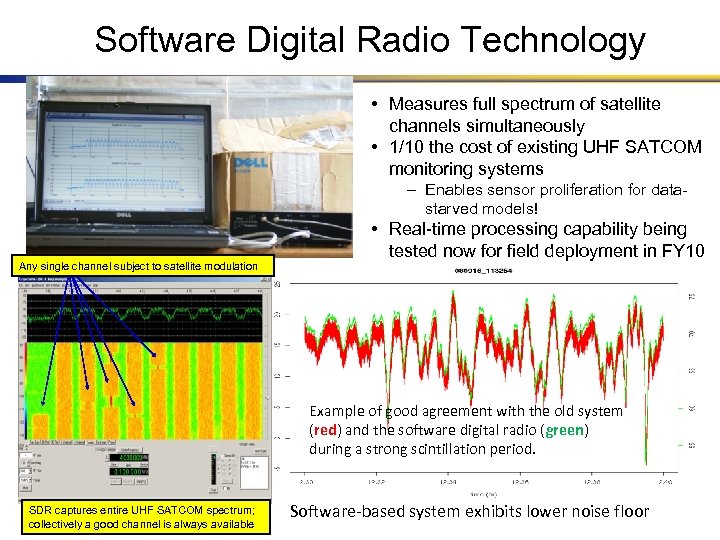 Software Digital Radio Technology • Measures full spectrum of satellite channels simultaneously • 1/10 the cost of existing UHF SATCOM monitoring systems – Enables sensor proliferation for datastarved models! Any single channel subject to satellite modulation • Real-time processing capability being tested now for field deployment in FY 10 Example of good agreement with the old system (red) and the software digital radio (green) during a strong scintillation period. SDR captures entire UHF SATCOM spectrum; collectively a good channel is always available Software-based system exhibits lower noise floor
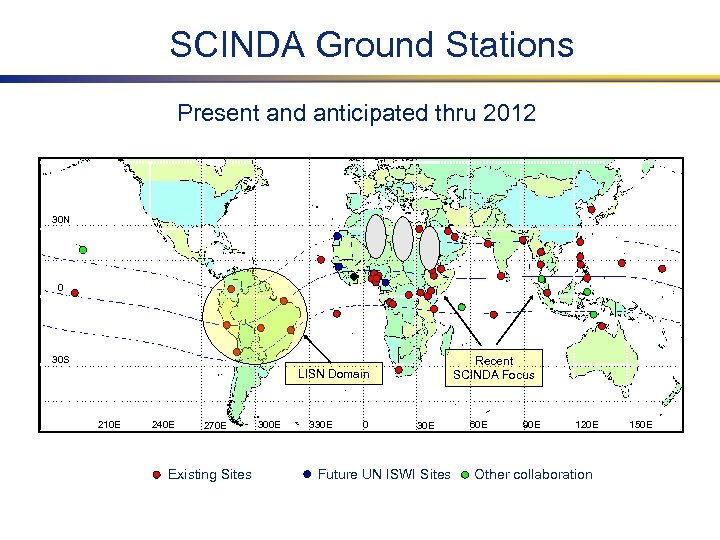 SCINDA Ground Stations Present and anticipated thru 2012 30 N 0 Recent SCINDA Focus 30 S LISN Domain 210 E 240 E 270 E Existing Sites 300 E 330 E 0 30 E Future UN ISWI Sites 60 E 90 E 120 E Other collaboration 150 E
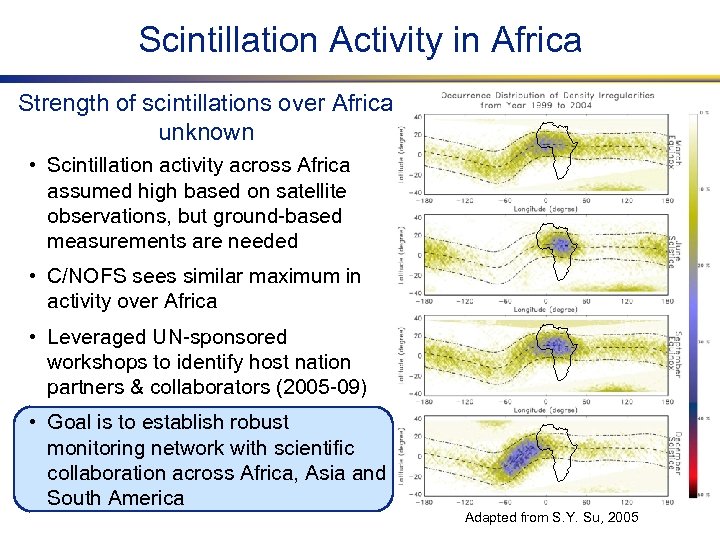 Scintillation Activity in Africa Strength of scintillations over Africa unknown • Scintillation activity across Africa assumed high based on satellite observations, but ground-based measurements are needed • C/NOFS sees similar maximum in activity over Africa • Leveraged UN-sponsored workshops to identify host nation partners & collaborators (2005 -09) • Goal is to establish robust monitoring network with scientific collaboration across Africa, Asia and South America Adapted from S. Y. Su, 2005
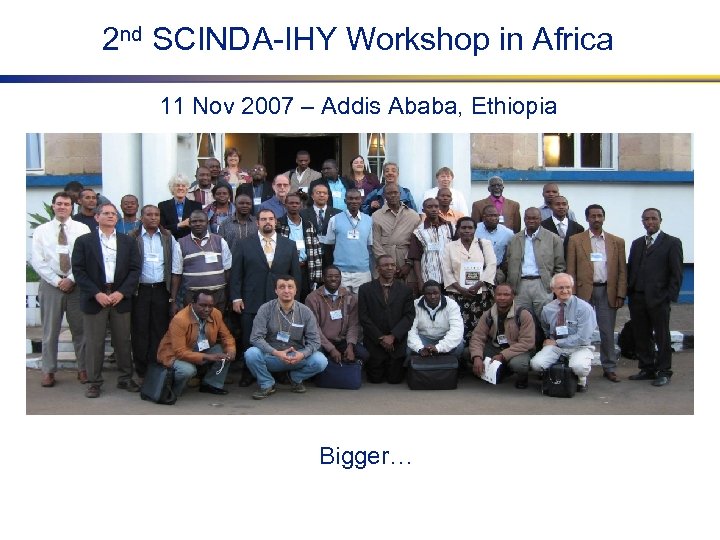
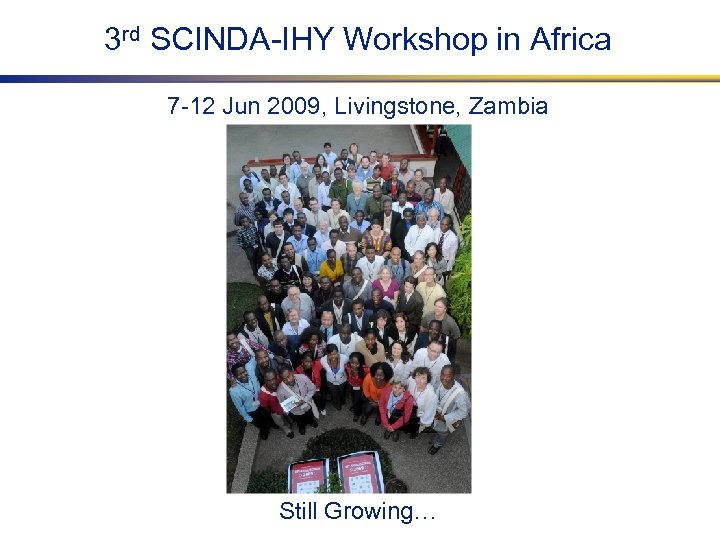
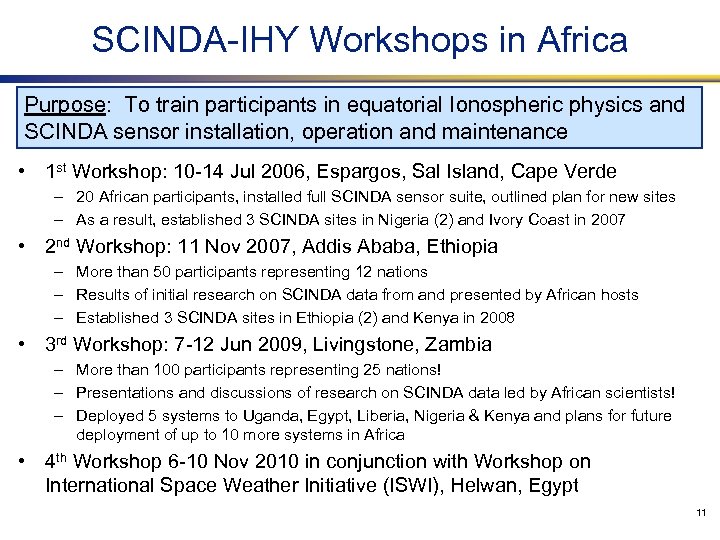 SCINDA-IHY Workshops in Africa Purpose: To train participants in equatorial Ionospheric physics and SCINDA sensor installation, operation and maintenance • 1 st Workshop: 10 -14 Jul 2006, Espargos, Sal Island, Cape Verde – 20 African participants, installed full SCINDA sensor suite, outlined plan for new sites – As a result, established 3 SCINDA sites in Nigeria (2) and Ivory Coast in 2007 • 2 nd Workshop: 11 Nov 2007, Addis Ababa, Ethiopia – More than 50 participants representing 12 nations – Results of initial research on SCINDA data from and presented by African hosts – Established 3 SCINDA sites in Ethiopia (2) and Kenya in 2008 • 3 rd Workshop: 7 -12 Jun 2009, Livingstone, Zambia – More than 100 participants representing 25 nations! – Presentations and discussions of research on SCINDA data led by African scientists! – Deployed 5 systems to Uganda, Egypt, Liberia, Nigeria & Kenya and plans for future deployment of up to 10 more systems in Africa • 4 th Workshop 6 -10 Nov 2010 in conjunction with Workshop on International Space Weather Initiative (ISWI), Helwan, Egypt 11
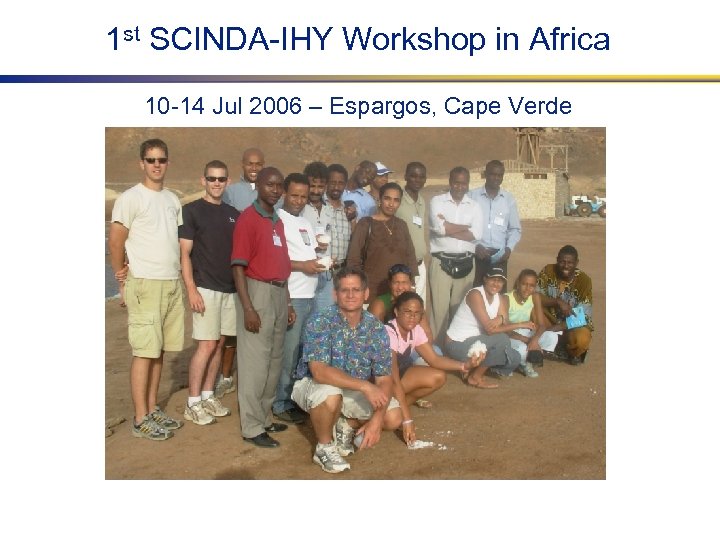 1 st SCINDA-IHY Workshop in Africa 10 -14 Jul 2006 – Espargos, Cape Verde
 2 nd SCINDA-IHY Workshop in Africa 11 Nov 2007 – Addis Ababa, Ethiopia Bigger…
 3 rd SCINDA-IHY Workshop in Africa 7 -12 Jun 2009, Livingstone, Zambia Still Growing…
 2011 -2013 Plans (unofficial) • Install an additional 4 -5 sites in Africa, 2 -3 other locations in S. E. Asia/Pacific • Improve infrastructure/capability at functional sites in Africa – Solar panels, robust power systems, mobile data transfer – Add VHF scintillation/drift sensors • Develop improved multi-frequency LEO beacon receiver systems focused on next-generation beacon design (still TBD); up to six equatorial satellites in constellation (2015) – New sensors useful throughout SCINDA & LISN networks
 Basic Infrastructure Needs Congo Brazzaville, 2 -6 Nov 2011
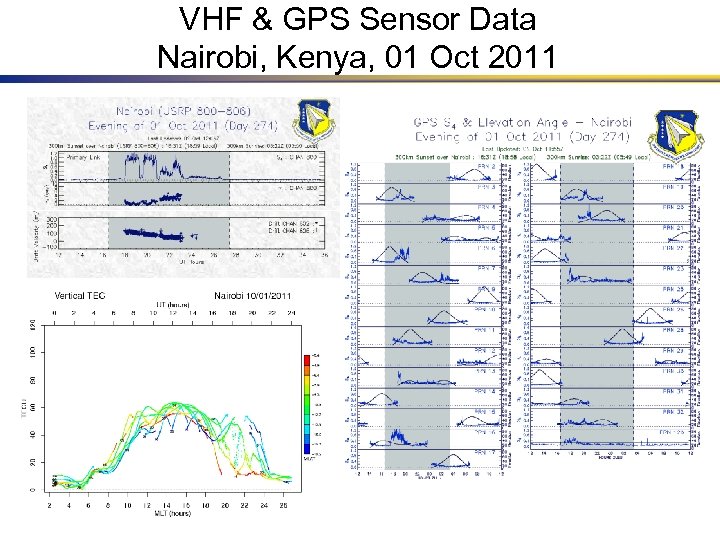 VHF & GPS Sensor Data Nairobi, Kenya, 01 Oct 2011
 2011 -2013 Plans (unofficial) • Exploit data for more scientific studies on both local and global scintillation phenomena – Storm-time behavior, 4 -cell pattern in TEC/scintillation, local gradients, anomaly characteristics – Ultimate goal is to forecast equatorial Spread F
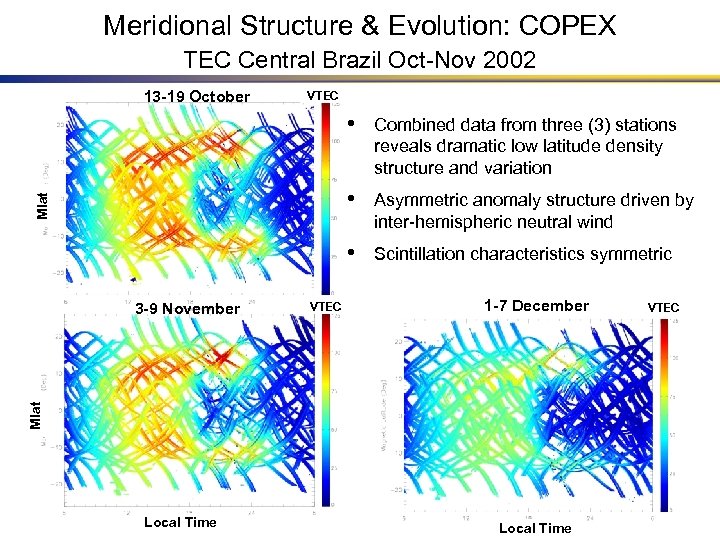 Meridional Structure & Evolution: COPEX TEC Central Brazil Oct-Nov 2002 13 -19 October VTEC Scintillation characteristics symmetric 1 -7 December Mlat VTEC Asymmetric anomaly structure driven by inter-hemispheric neutral wind • 3 -9 November Combined data from three (3) stations reveals dramatic low latitude density structure and variation • Mlat • Local Time VTEC
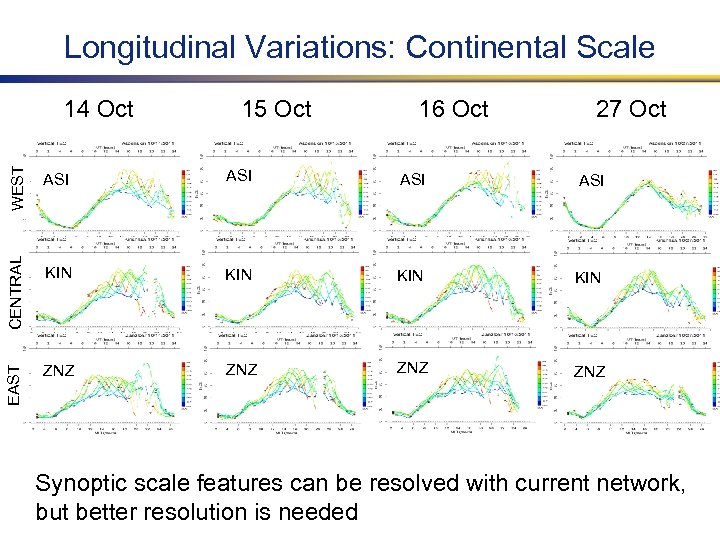 Longitudinal Variations: Continental Scale 27 Oct WEST 16 Oct ASI ASI CENTRAL 15 Oct KIN KIN EAST 14 Oct ZNZ ZNZ Synoptic scale features can be resolved with current network, but better resolution is needed
 2011 -2013 Plans (unofficial) • Continue to support LISN initiative—South America is critical region and offers excellent observing opportunities
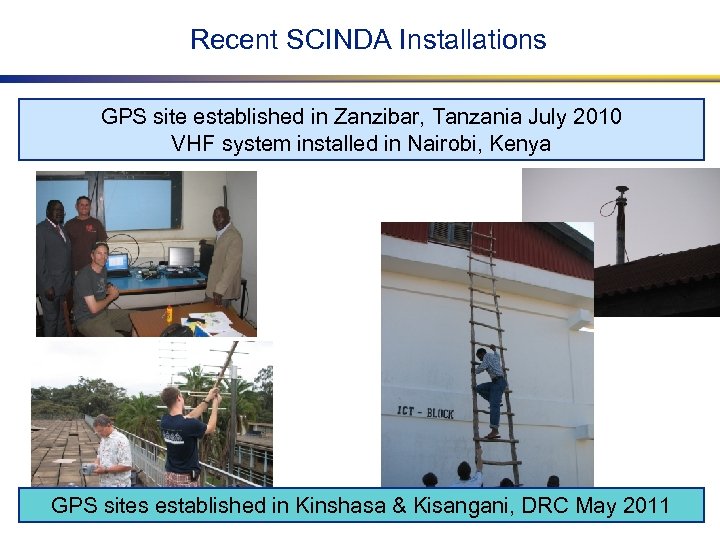 Recent SCINDA Installations GPS site established in Zanzibar, Tanzania July 2010 VHF system installed in Nairobi, Kenya GPS sites established in Kinshasa & Kisangani, DRC May 2011
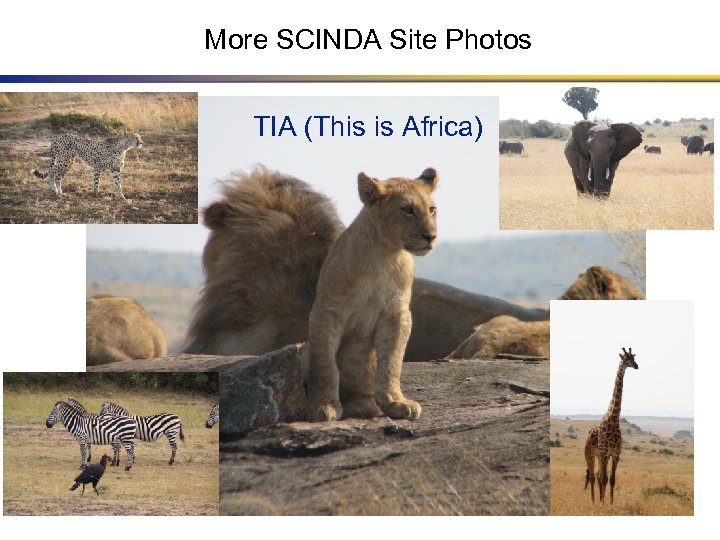 More SCINDA Site Photos TIA (This is Africa)
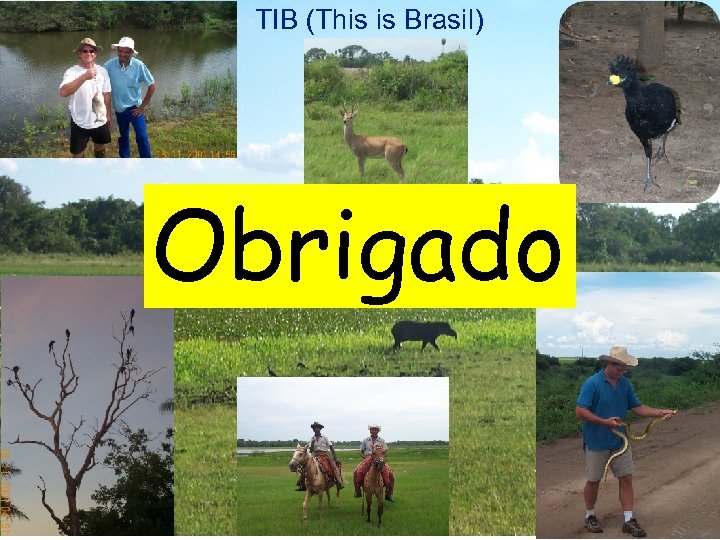 TIB (This is Brasil) Obrigado