 Скачать презентацию Scientist Involvement in Education and Public Outreach Making
de0701103a8ff44deddb56cac05933e3.ppt
- Количество слайдов: 30



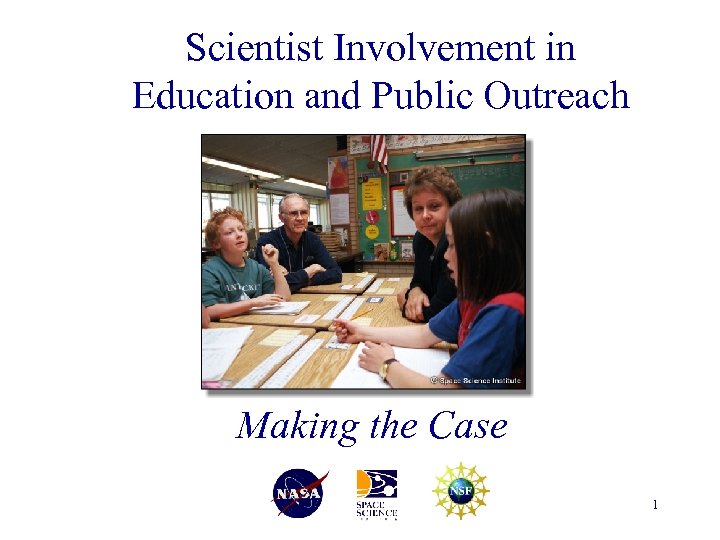
Scientist Involvement in Education and Public Outreach Making the Case 1
NASA/NSF Scientist Involvement in EPO Research directorates of funding agencies like NASA and NSF are increasingly encouraging (and in some cases requiring) the integration of science and education and greater scientist involvement in Education and Public Outreach (EPO). C. A. Morrow camorrow@colorado. edu 2
NASA/NSF Scientists Increase EPO Involvement ØNASA Office of Space Science (OSS) now requires every flight project (e. g. , Hubble Space Telescope, Mars Pathfinder), to have a significant EPO program, totaling 1 -2% of the overall mission budget. ØNASA’s Earth Science Enterprise (ESE) is likely to enact a similar policy. ØNSF/GEO is now holding funding competitions for increased geoscience outreach to teachers, students, and the public. C. A. Morrow camorrow@colorado. edu 3
Goldin Advocates EPO Involvement “The NASA Strategic Plan makes it the responsibility of each of our Strategic Enterprises to "embed" education into its program. No longer is it an acceptable practice to say, "we are too busy. " Research, knowledge generation and education are all equal components of the NASA mission. We must combine our traditional methods of involving the education community with new and innovative ways so that the impact NASA has on education is greater. ” --Daniel S. Goldin, NASA Administrator, before the Committee on Science, United States House of Representatives, 28 April 1999 C. A. Morrow camorrow@colorado. edu 4
Colwell Advocates EPO Involvement “In science and math education, the links among inquiry, discovery and learning is omnipresent. All researchers - whether at a university, a national lab or circling the Earth in a space station - should link their inquiries with the education of the next generation. ” --Dr. Rita Colwell, Director, National Science Foundation, before the House Science Committee, 28 April 1999 C. A. Morrow camorrow@colorado. edu 5
NASA & NSF Advocate EPO Training for Scientists “OSS must provide focused opportunities (through workshops or other appropriate means) for training to allow members of the space science research community to become more useful partners in education and effective contributors to the public understanding of science. ” --NASA Office of Space Science Education/Public Outreach Strategy Implementation Plan, 1996 “GEO should help sponsor regular workshops for training geoscientists in educational issues that address a range of level of scientists involvement. ” --NSF Directorate for Geosciences, Geoscience Education Strategy, 1997 C. A. Morrow camorrow@colorado. edu 6
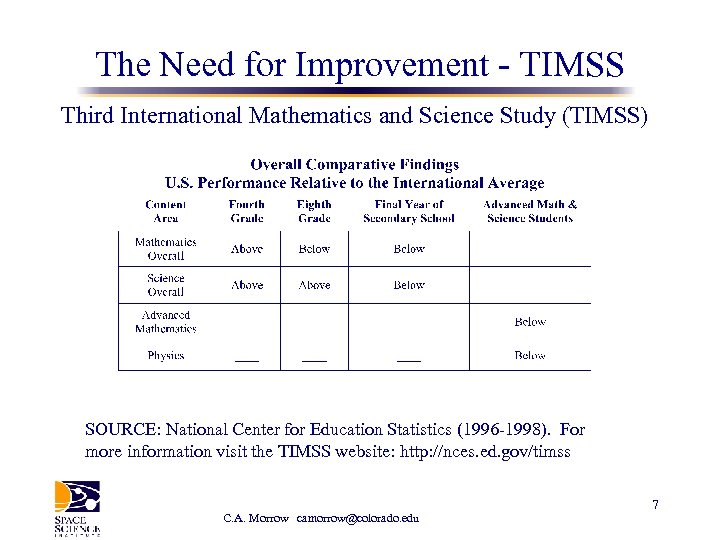
The Need for Improvement - TIMSS Third International Mathematics and Science Study (TIMSS) SOURCE: National Center for Education Statistics (1996 -1998). For more information visit the TIMSS website: http: //nces. ed. gov/timss C. A. Morrow camorrow@colorado. edu 7
The Need for Improvement - Seasons Ø According to NSF’s Science & Engineering Indicators -- 1996, 53% of a sample population surveyed did not know that Earth orbits the Sun once per year. Ø 21 out of 23 randomly selected students, faculty and alumni of Harvard University could not correctly explain Earth’s seasons. C. A. Morrow camorrow@colorado. edu 8
The Need for Improvement - Kansas Ø In August 1999, the Kansas State Board of Education voted 6 to 4 to remove the teaching of evolution from the state standards. Ø Scientists are needed to become advocates of sound policies and standards in science education. C. A. Morrow camorrow@colorado. edu 9
Scientists Rise to the Occasion in Kansas Ø “Scientists and school board candidates – even the governor – said Kansas would seem embarrassingly backward if the new science standards stayed in place. ” Ø “Steve Case, a biologist at the University of Kansas and a leader of the drive to restore evolution to the curriculum said that he and others brought in speakers like Kenneth R. Miller, a Brown University microbiologist and author of “Finding Darwin’s God: A Scientist’s Search for Common Ground between God and Evolution. ” Ø “In the election, voters defeated those candidates who last year supported removing the mention of evolution from the state science curriculum. ” Source: “Science Expands, Religion Contracts” by Pam Belluck, New York Times, 13 August 2000 C. A. Morrow camorrow@colorado. edu 10
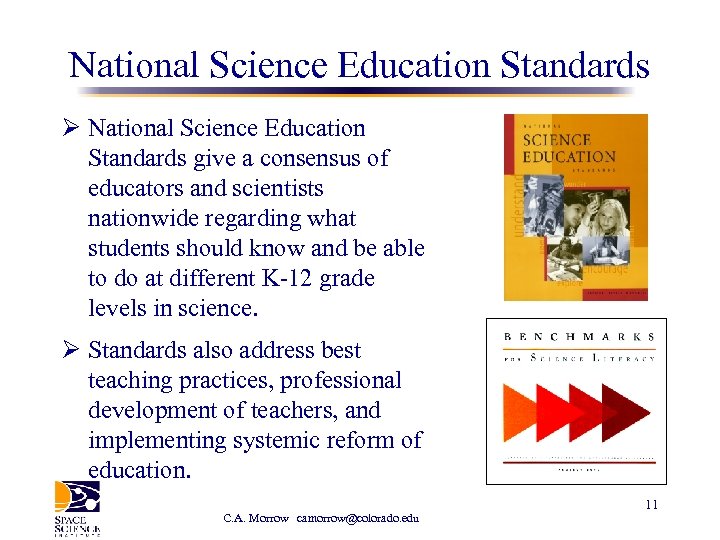
National Science Education Standards Ø National Science Education Standards give a consensus of educators and scientists nationwide regarding what students should know and be able to do at different K-12 grade levels in science. Ø Standards also address best teaching practices, professional development of teachers, and implementing systemic reform of education. C. A. Morrow camorrow@colorado. edu 11

Importance of Partnerships - Alberts “I now view effective science education partnerships between scientists and precollege education science teachers in a completely different light - as the only hope for lasting systemic change in precollege science education and, therefore, as an important national priority for the United States. ” -Bruce Alberts, President of the National Academy of Sciences, 1993 C. A. Morrow camorrow@colorado. edu 12
What Scientists Can Contribute Scientists offer much that is needed to contribute to the realm of education and public outreach: • Respect and influence in community • • Deep knowledge of science & scientific process Exciting connections to real world exploration Access to data and facilities Role modeling for students C. A. Morrow camorrow@colorado. edu 13
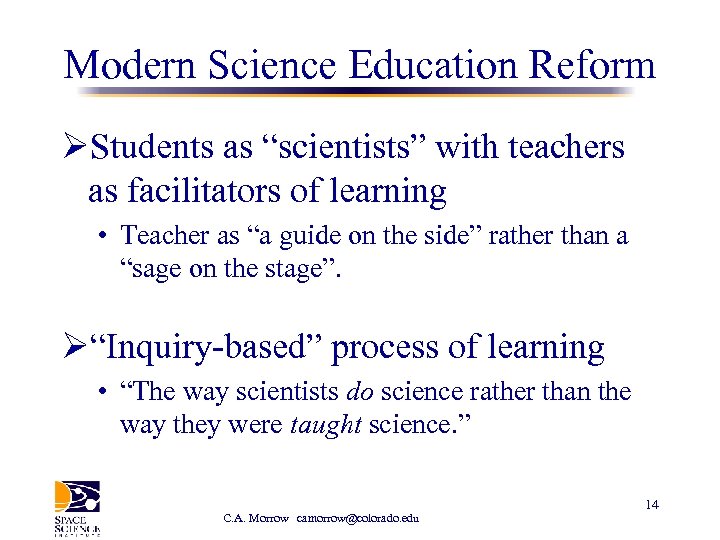
Modern Science Education Reform ØStudents as “scientists” with teachers as facilitators of learning • Teacher as “a guide on the side” rather than a “sage on the stage”. Ø“Inquiry-based” process of learning • “The way scientists do science rather than the way they were taught science. ” C. A. Morrow camorrow@colorado. edu 14
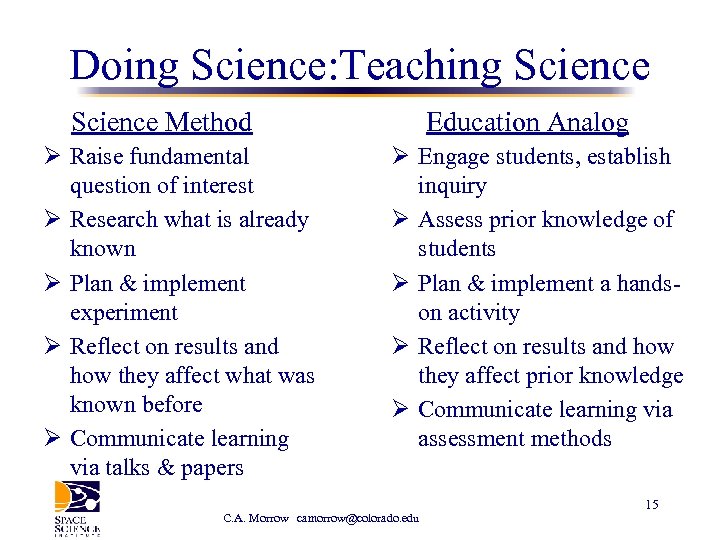
Doing Science: Teaching Science Method Ø Raise fundamental question of interest Ø Research what is already known Ø Plan & implement experiment Ø Reflect on results and how they affect what was known before Ø Communicate learning via talks & papers Education Analog Ø Engage students, establish inquiry Ø Assess prior knowledge of students Ø Plan & implement a handson activity Ø Reflect on results and how they affect prior knowledge Ø Communicate learning via assessment methods C. A. Morrow camorrow@colorado. edu 15
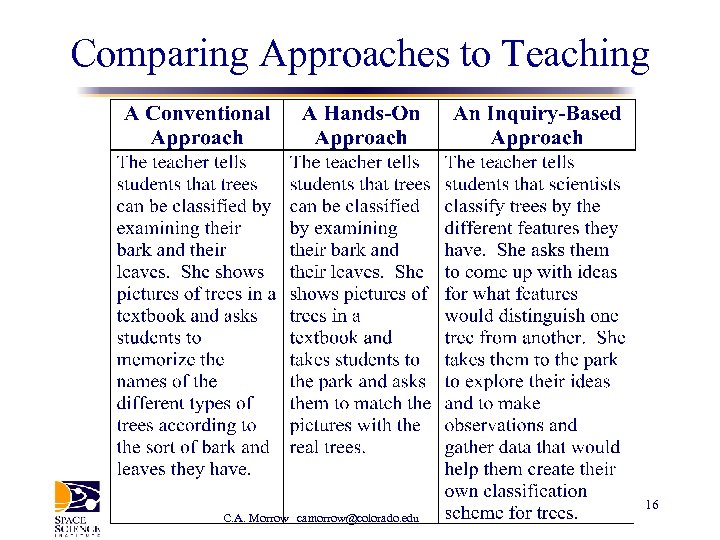
Comparing Approaches to Teaching C. A. Morrow camorrow@colorado. edu 16
Variety of EPO Roles for Scientists Ø Presentations in a classroom or a public setting are not the only way to contribute to education and public outreach. Ø There are many other roles scientists can play in education and public outreach that are suited to a diversity of talents and interests. C. A. Morrow camorrow@colorado. edu 17
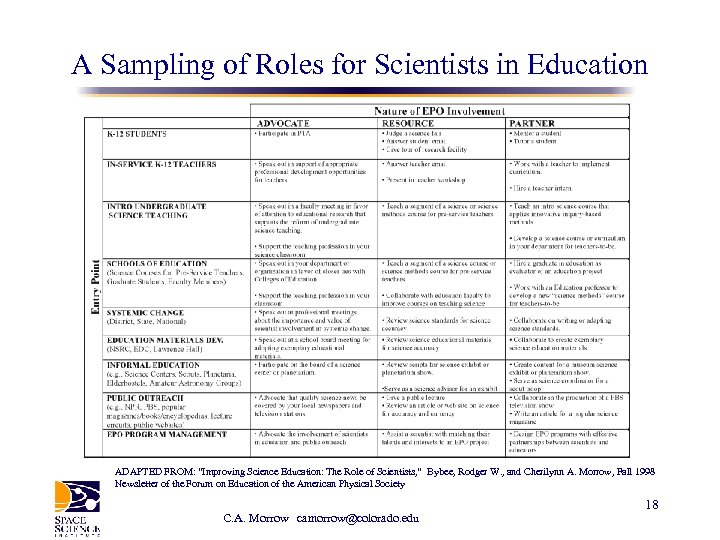
A Sampling of Roles for Scientists in Education ADAPTED FROM: “Improving Science Education: The Role of Scientists, ” Bybee, Rodger W. , and Cherilynn A. Morrow, Fall 1998 Newsletter of the Forum on Education of the American Physical Society C. A. Morrow camorrow@colorado. edu 18
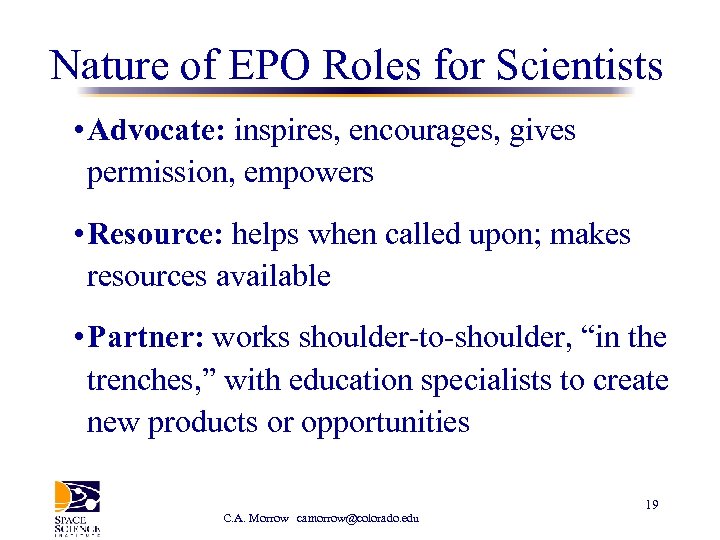
Nature of EPO Roles for Scientists • Advocate: inspires, encourages, gives permission, empowers • Resource: helps when called upon; makes resources available • Partner: works shoulder-to-shoulder, “in the trenches, ” with education specialists to create new products or opportunities C. A. Morrow camorrow@colorado. edu 19
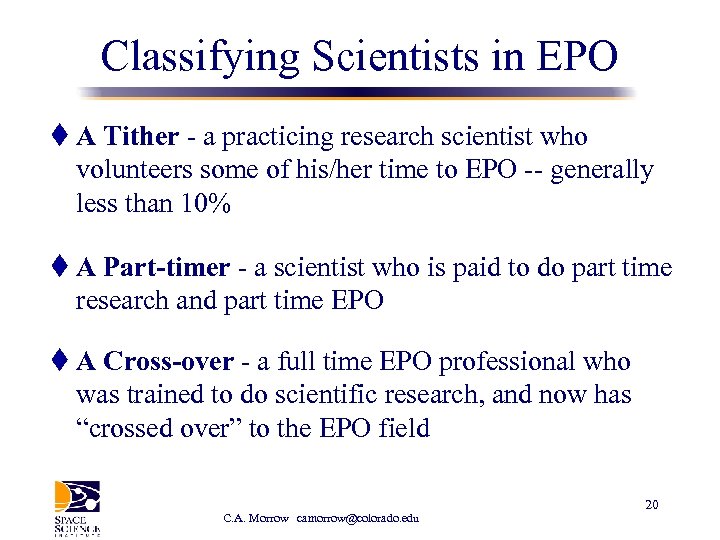
Classifying Scientists in EPO t A Tither - a practicing research scientist who volunteers some of his/her time to EPO -- generally less than 10% t A Part-timer - a scientist who is paid to do part time research and part time EPO t A Cross-over - a full time EPO professional who was trained to do scientific research, and now has “crossed over” to the EPO field C. A. Morrow camorrow@colorado. edu 20
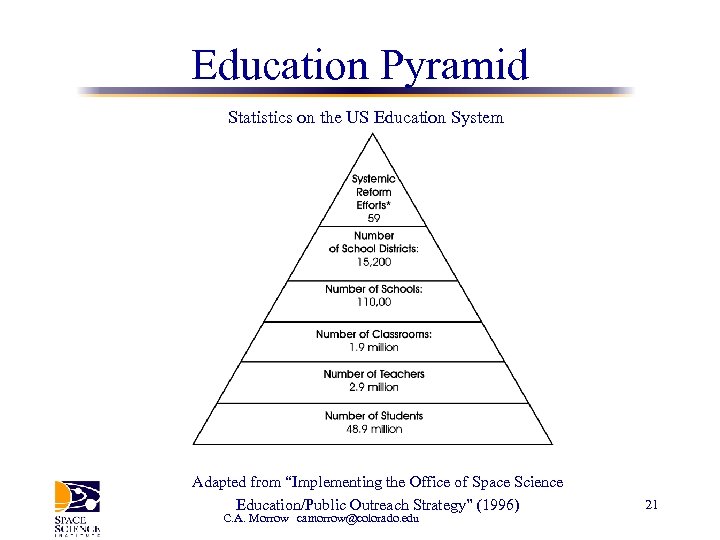
Education Pyramid Statistics on the US Education System Adapted from “Implementing the Office of Space Science Education/Public Outreach Strategy” (1996) C. A. Morrow camorrow@colorado. edu 21
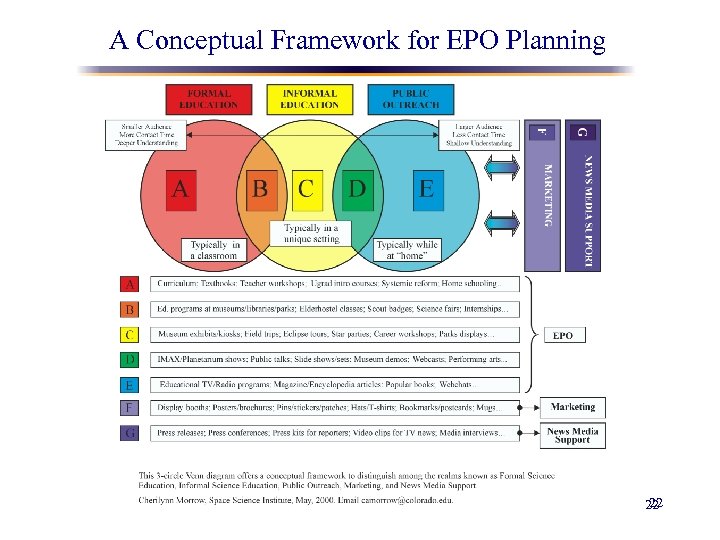
A Conceptual Framework for EPO Planning 22 22
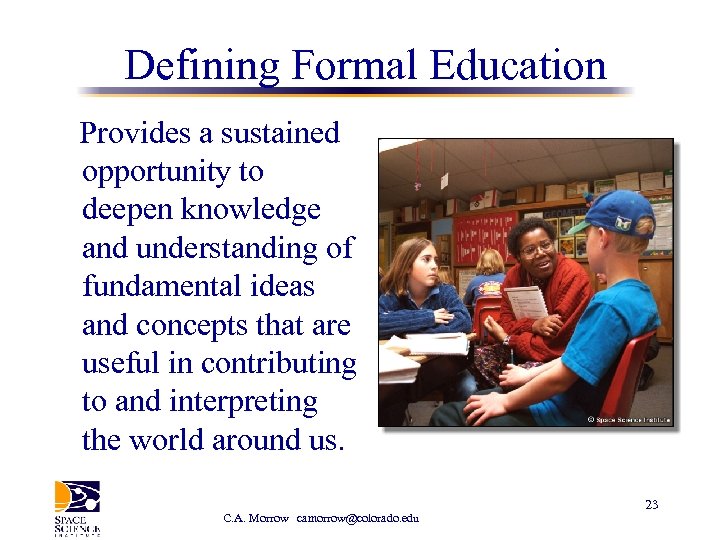
Defining Formal Education Provides a sustained opportunity to deepen knowledge and understanding of fundamental ideas and concepts that are useful in contributing to and interpreting the world around us. C. A. Morrow camorrow@colorado. edu 23
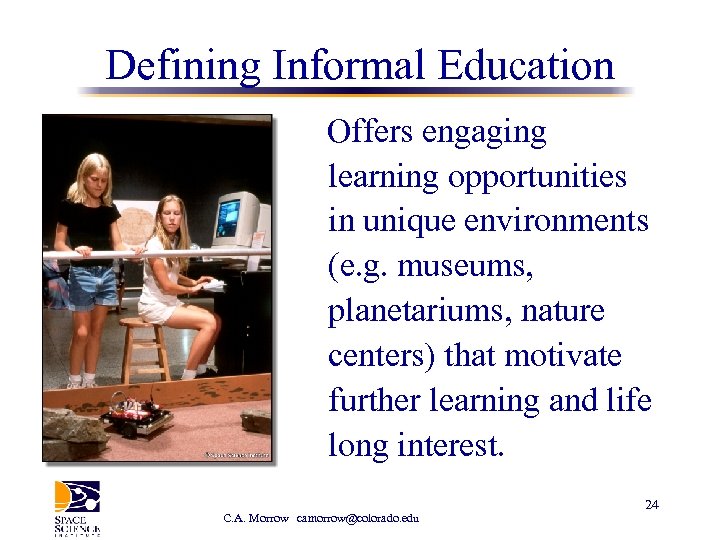
Defining Informal Education Offers engaging learning opportunities in unique environments (e. g. museums, planetariums, nature centers) that motivate further learning and life long interest. C. A. Morrow camorrow@colorado. edu 24
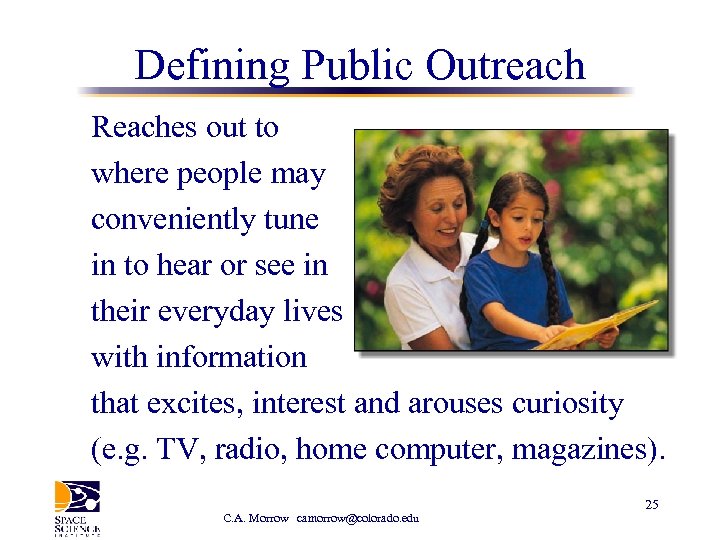
Defining Public Outreach Reaches out to where people may conveniently tune in to hear or see in their everyday lives with information that excites, interest and arouses curiosity (e. g. TV, radio, home computer, magazines). C. A. Morrow camorrow@colorado. edu 25
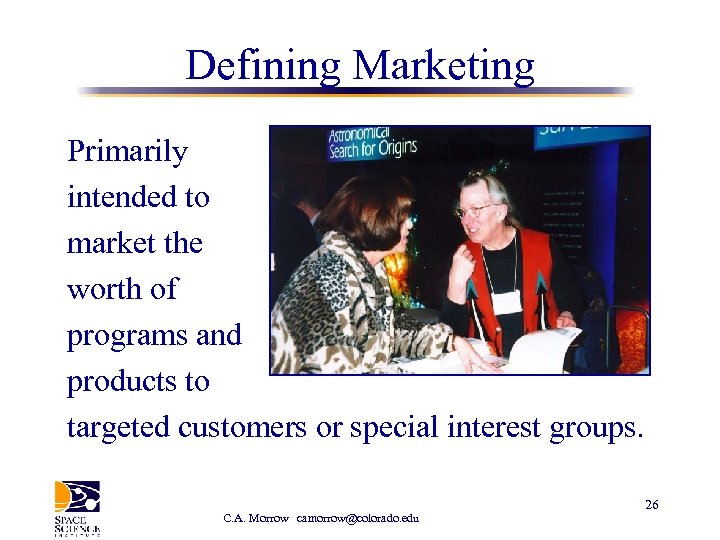
Defining Marketing Primarily intended to market the worth of programs and products to targeted customers or special interest groups. C. A. Morrow camorrow@colorado. edu 26
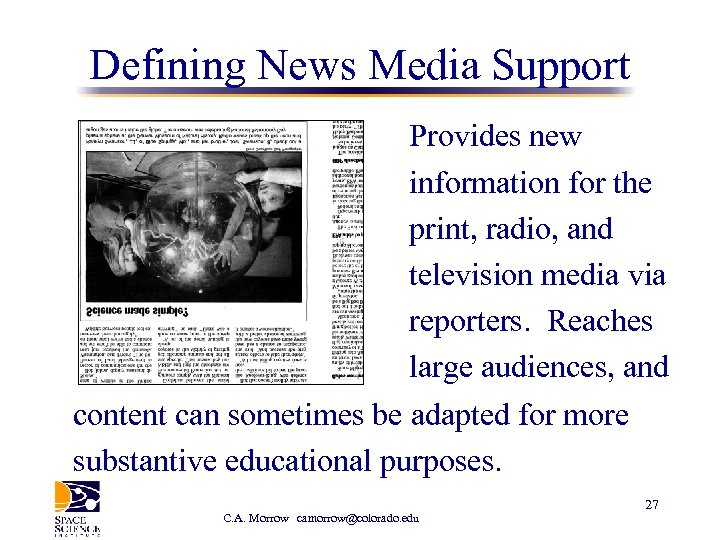
Defining News Media Support Provides new information for the print, radio, and television media via reporters. Reaches large audiences, and content can sometimes be adapted for more substantive educational purposes. C. A. Morrow camorrow@colorado. edu 27
Three C’s for Partnerships with Educators Ø COLLEGIALITY (find mutual respect with educators; acknowledge their expertise in education and the way it can complement your expertise in science) Ø COMMUNICATION (do not condescend or try to take over; be very conscious of scientific jargon) Ø COLLABORATIVE SPIRIT (collaborate rather than compete with educators) C. A. Morrow camorrow@colorado. edu 28
Ideas to Get Started in EPO Ø Attend workshop for scientists in education (e. g. SSI workshop; http: //www. spacescience. org/ Education/Resources. For. Scientists/Workshops/1. html) Ø Study the National Science Education Standards http: //www. nap. edu/readingroom/books/nses/ Ø Contact EPO support orgs. who can facilitate connections with the education community http: //www. hq. nasa. gov/office/oss/education/ecosystem. htm Ø Ask colleagues and/or EPO partners about existing EPO programs involving scientists C. A. Morrow camorrow@colorado. edu 29
Conclusions Ø There is a strong need to improve science education and science literacy in the US. Ø The participation of scientists in collegial partnership with educators and outreach specialists is vital to meeting this need. Ø There a wide variety of valuable EPO roles for a scientist depending on his or her particular talents and interests. C. A. Morrow camorrow@colorado. edu 30
Скачать презентацию Scientist Involvement in Education and Public Outreach Making
de0701103a8ff44deddb56cac05933e3.ppt