


 Скачать презентацию Scientific Ways of Knowing Raphael s School of Athens
7faf2ae6a916a03fb372699c5d73f19a.ppt
- Количество слайдов: 53
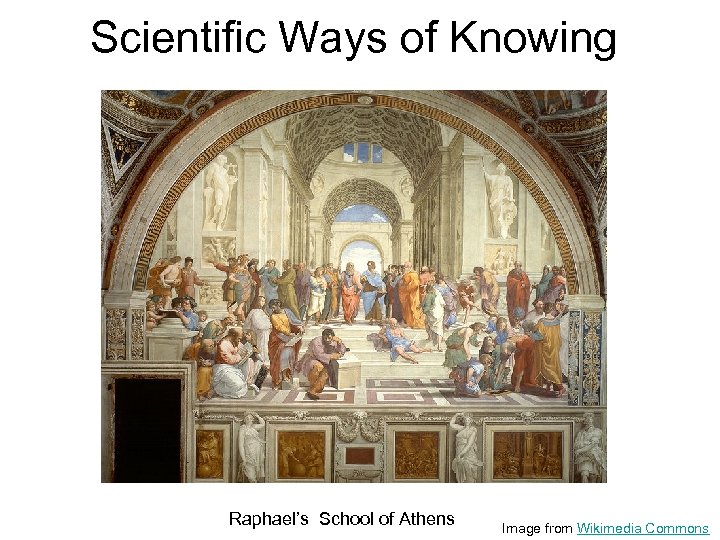 Scientific Ways of Knowing Raphael’s School of Athens Image from Wikimedia Commons
 The scientific method • • State the problem Gather information about the problem Form a hypothesis Perform an experiment to test the hypothesis • Record analyze your data • State a conclusion
 Don’t scientists just always use the scientific method? NO! State the problem Gather information about the problem Form a hypothesis Perform an experiment to test the hypothesis Record analyze your data State a conclusion Communicate your conclusions The problem is that it is pretty clear that there is not a single method that scientists use.
 Scientific Ways of Knowing Induction (or inductive logic) – Proceeding from examples to general rules or principles Induction leads to empirical approaches of understanding Deduction (or deductive logic) – Using rules to understand examples Deduction leads to theoretical approaches to understanding
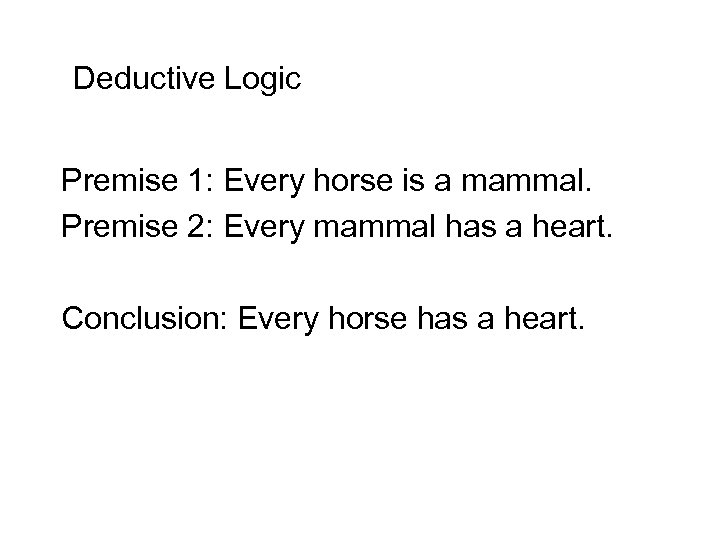 Deductive Logic Premise 1: Every horse is a mammal. Premise 2: Every mammal has a heart. Conclusion: Every horse has a heart.
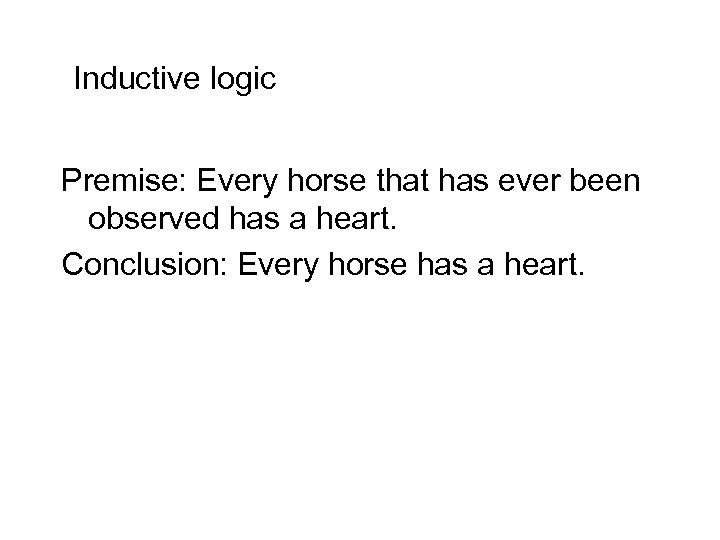 Inductive logic Premise: Every horse that has ever been observed has a heart. Conclusion: Every horse has a heart.
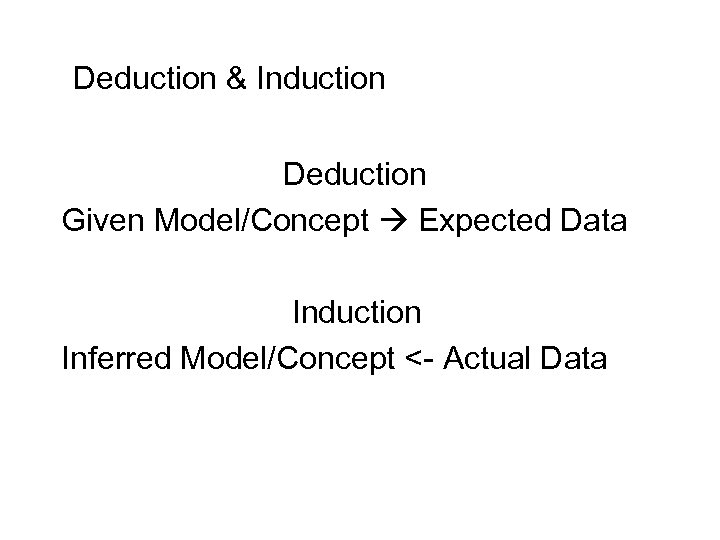 Deduction & Induction Deduction Given Model/Concept Expected Data Induction Inferred Model/Concept <- Actual Data
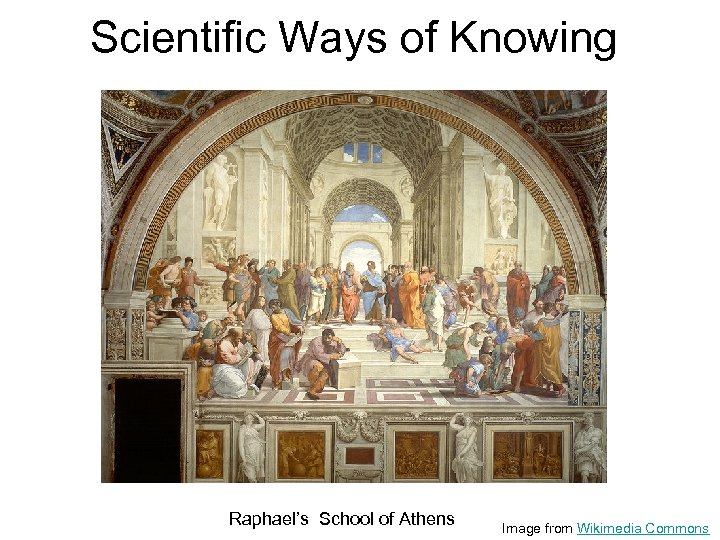 Scientific Ways of Knowing Raphael’s School of Athens Image from Wikimedia Commons
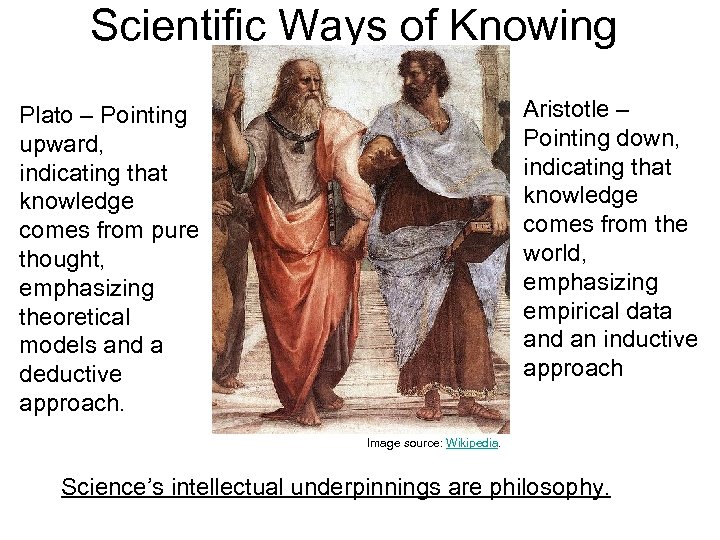 Scientific Ways of Knowing Aristotle – Pointing down, indicating that knowledge comes from the world, emphasizing empirical data and an inductive approach Plato – Pointing upward, indicating that knowledge comes from pure thought, emphasizing theoretical models and a deductive approach. Image source: Wikipedia. Science’s intellectual underpinnings are philosophy.
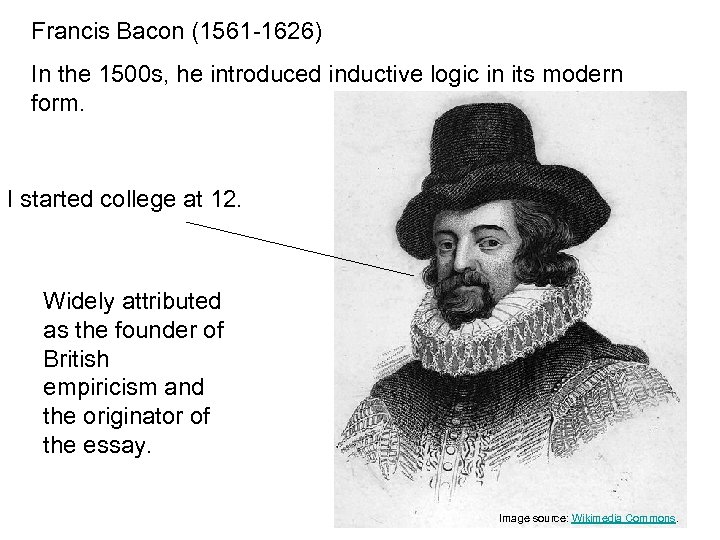 Francis Bacon (1561 -1626) In the 1500 s, he introduced inductive logic in its modern form. I started college at 12. Widely attributed as the founder of British empiricism and the originator of the essay. Image source: Wikimedia Commons.
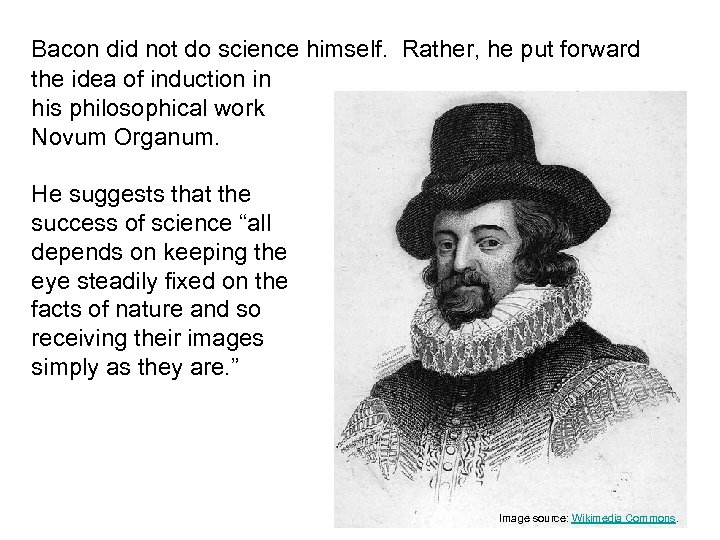 Bacon did not do science himself. Rather, he put forward the idea of induction in his philosophical work Novum Organum. He suggests that the success of science “all depends on keeping the eye steadily fixed on the facts of nature and so receiving their images simply as they are. ” Image source: Wikimedia Commons.
 Scientific Ways of Knowing Induction -> Approach is observing (Empiricists) 1. Natural Observation – observation of natural system without manipulation 2. Experimentation – observation of natural system with manipulation Deduction -> Approach is modeling (Theoreticians) 1. Theoretical modeling –quantitative models designed to make predictions of geometry or behavior of natural systems
 Empirical Approach Empirical approaches require that data is collected from the natural world. Consequently, scientists are very careful about observations (something that everyone will agree on) versus inferences/interpretation (something based both on observations and an individual’s perspective).
 Image removed due to copyright: Gary Larson “The Far Side” cartoon: Cavemen inside animal trap: “Shhhh, Zog!. . . Here come one now!! (copyright 1982) by Far. Works Inc.
 Make five observations about this cartoon. Image removed due to copyright: Gary Larson “The Far Side” cartoon: Cavemen inside animal trap: “Shhhh, Zog!. . . Here come one now!! (copyright 1982) by Far. Works Inc.
 Make five inferences based on your observations of this cartoon. Image removed due to copyright: Gary Larson “The Far Side” cartoon: Cavemen inside animal trap: “Shhhh, Zog!. . . Here come one now!! (copyright 1982) by Far. Works Inc.
 How do we know the Earth is round? Observation – Provide five observations Inferences/Interpretations – Provide five inferences that correspond to the observations
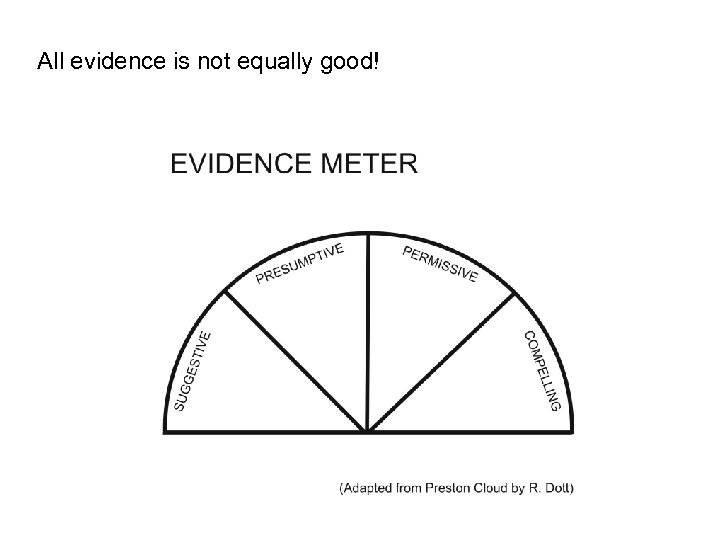 All evidence is not equally good!
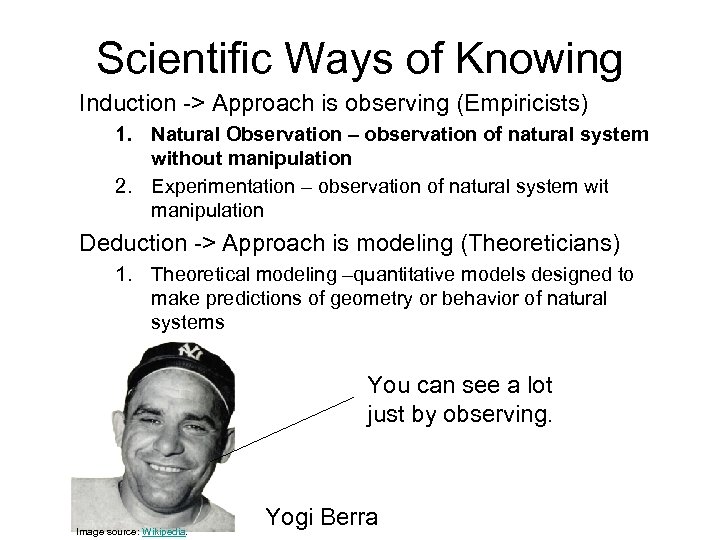 Scientific Ways of Knowing Induction -> Approach is observing (Empiricists) 1. Natural Observation – observation of natural system without manipulation 2. Experimentation – observation of natural system wit manipulation Deduction -> Approach is modeling (Theoreticians) 1. Theoretical modeling –quantitative models designed to make predictions of geometry or behavior of natural systems You can see a lot just by observing. Image source: Wikipedia. Yogi Berra
 Evidence = Relevant observations & interpretations
 Of all discoveries and opinions, none may have exerted a greater effect on the human spirit than the doctrine of Copernicus. The world had scarcely become known as round and complete in itself when it was asked to waive the tremendous privilege of being the center of the universe. Never, perhaps, was a greater demand made on mankind - for by this admission so many things vanished in mist and smoke! What became of our Eden, our world of innocence, piety and poetry; the testimony of the senses; the conviction of a poetic - religious faith? No wonder his contemporaries did not wish to let all this go and offered every possible resistance to a doctrine which in its converts authorized and demanded a freedom of view and greatness of thought so far unknown, indeed not even dreamed of. -J. W. Goethe
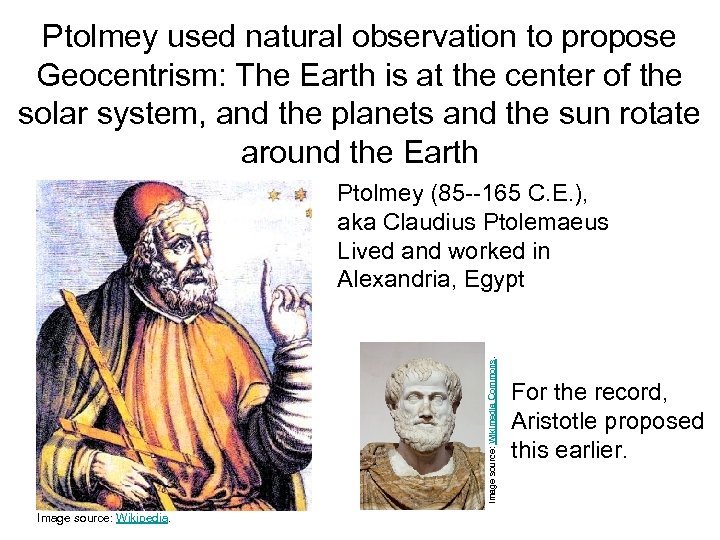 Ptolmey used natural observation to propose Geocentrism: The Earth is at the center of the solar system, and the planets and the sun rotate around the Earth Image source: Wikimedia Commons. Ptolmey (85 --165 C. E. ), aka Claudius Ptolemaeus Lived and worked in Alexandria, Egypt Image source: Wikipedia. For the record, Aristotle proposed this earlier.
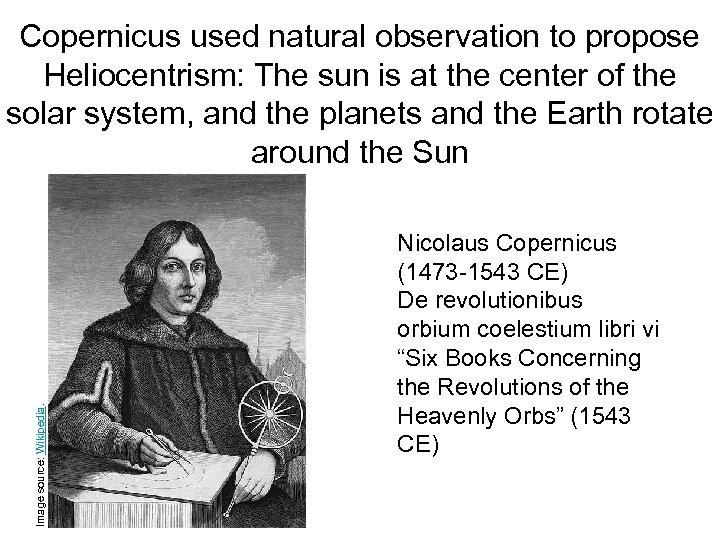 Image source: Wikipedia. Copernicus used natural observation to propose Heliocentrism: The sun is at the center of the solar system, and the planets and the Earth rotate around the Sun Nicolaus Copernicus (1473 -1543 CE) De revolutionibus orbium coelestium libri vi “Six Books Concerning the Revolutions of the Heavenly Orbs” (1543 CE)
 Geocentrism and Heliocentrism are both theories Scientific theory – Systematic sets of concepts that provide explanations for observing patterns in nature. Theories provide frameworks for relating data & guiding future research. Theories change as new data become available. Scientific hypotheses – a tentative explanation that accounts for a set of facts and can be tested by further investigation. The colloquial use of “theory” is very different from a “scientific theory”: A everyday “theory” is a scientific hypothesis.
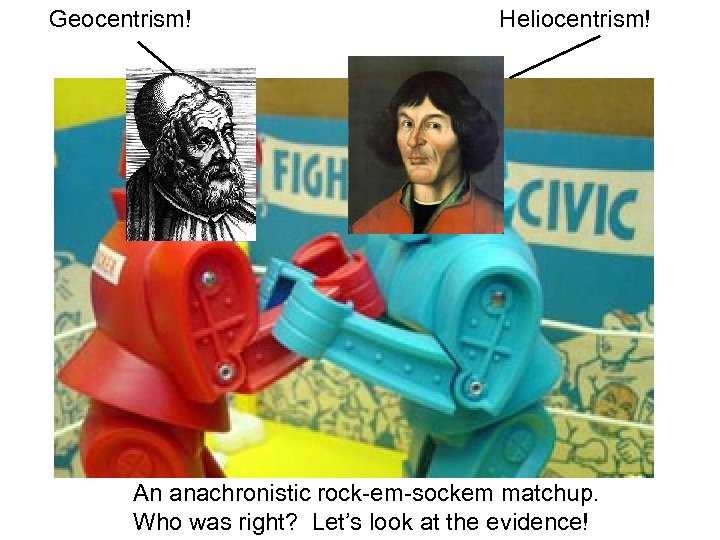 Geocentrism! Heliocentrism! An anachronistic rock-em-sockem matchup. Who was right? Let’s look at the evidence!
 What are the relevant observations that can be used as evidence for geocentrism or heliocentrism? 1) The sun rises and sets every day (each 24 hours)
 2) The moon goes from fully illuminated to dark to fully illuminated every ~29 days. Image removed due to copyright: 29 phases of the moon. Available through USNO.
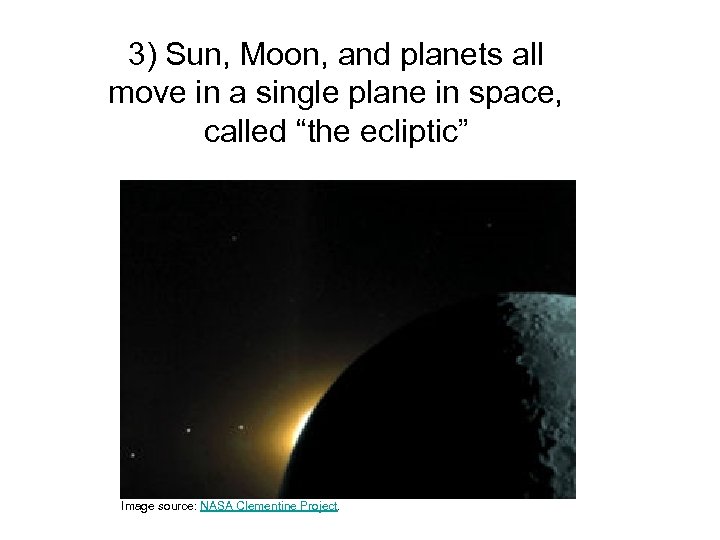 3) Sun, Moon, and planets all move in a single plane in space, called “the ecliptic” Image source: NASA Clementine Project.
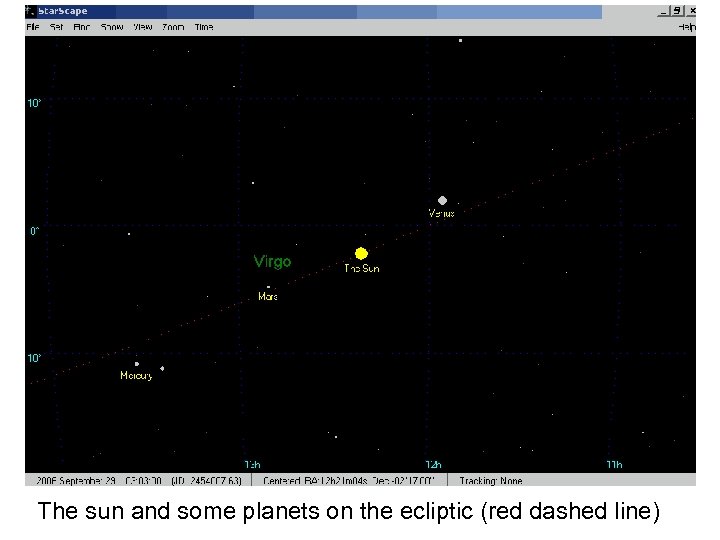 The sun and some planets on the ecliptic (red dashed line)
 4) The Sun does not always cover the same stars in the sky. In fact, we can divide the sky into 12 more -or-less equal parts that lie along the ecliptic. These are the signs of the zodiacs. It takes the sun ~365 days to make it through all the signs of the zodiac.
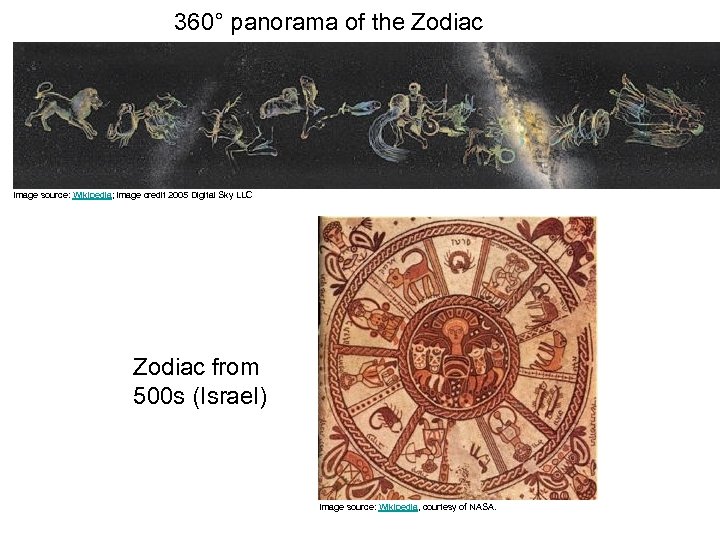 360° panorama of the Zodiac Image source: Wikipedia; image credit 2005 Digital Sky LLC Zodiac from 500 s (Israel) Image source: Wikipedia, courtesy of NASA.
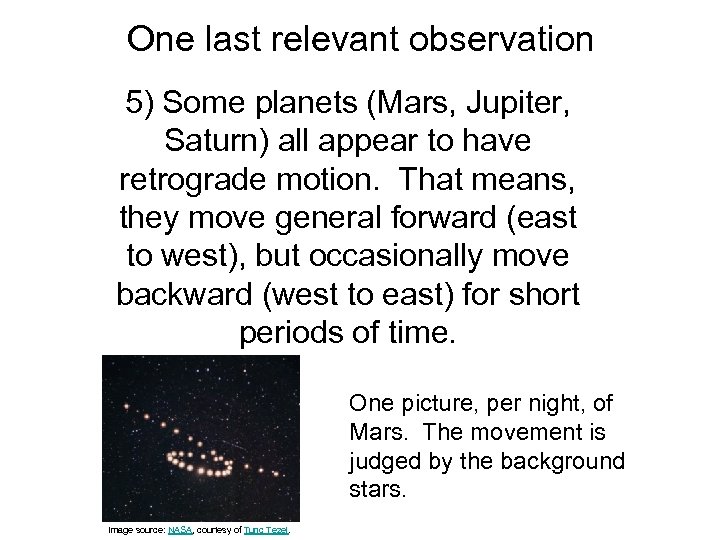 One last relevant observation 5) Some planets (Mars, Jupiter, Saturn) all appear to have retrograde motion. That means, they move general forward (east to west), but occasionally move backward (west to east) for short periods of time. One picture, per night, of Mars. The movement is judged by the background stars. Image source: NASA, courtesy of Tunc Tezel.
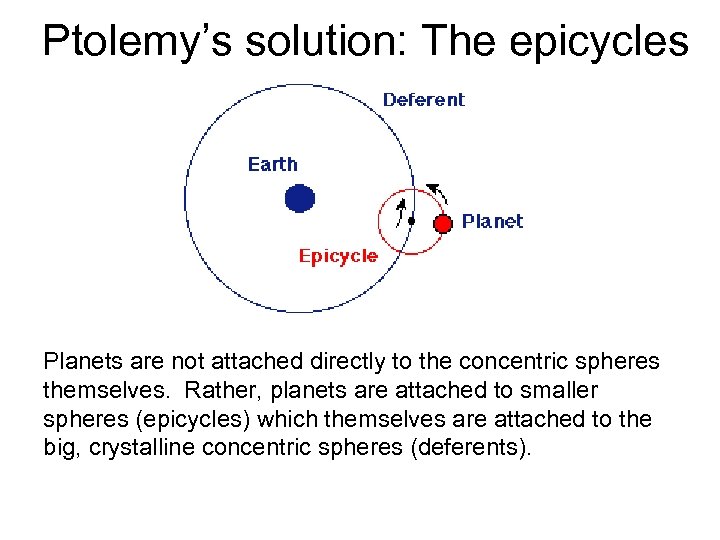 Ptolemy’s solution: The epicycles Planets are not attached directly to the concentric spheres themselves. Rather, planets are attached to smaller spheres (epicycles) which themselves are attached to the big, crystalline concentric spheres (deferents).
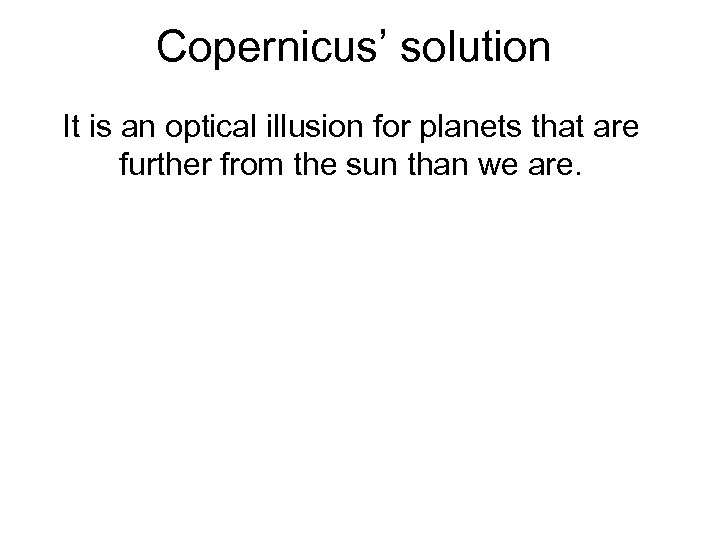 Copernicus’ solution It is an optical illusion for planets that are further from the sun than we are.
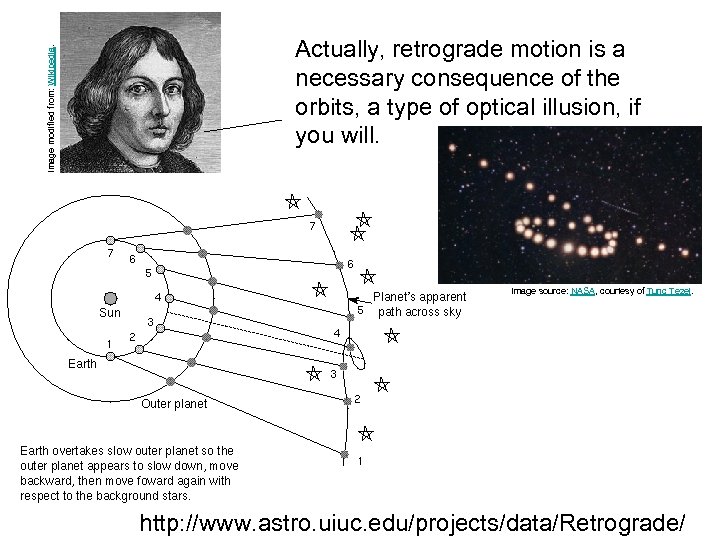 Image modified from: Wikipedia. Actually, retrograde motion is a necessary consequence of the orbits, a type of optical illusion, if you will. Image source: NASA, courtesy of Tunc Tezel. http: //www. astro. uiuc. edu/projects/data/Retrograde/
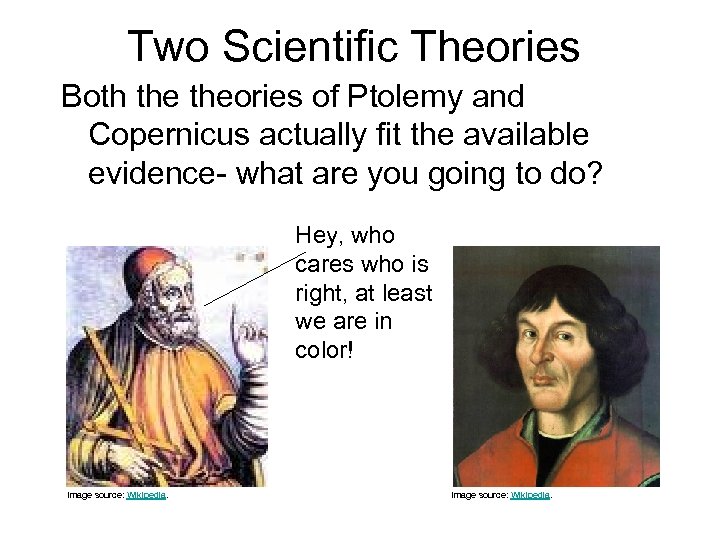 Two Scientific Theories Both theories of Ptolemy and Copernicus actually fit the available evidence- what are you going to do? Hey, who cares who is right, at least we are in color! Image source: Wikipedia.
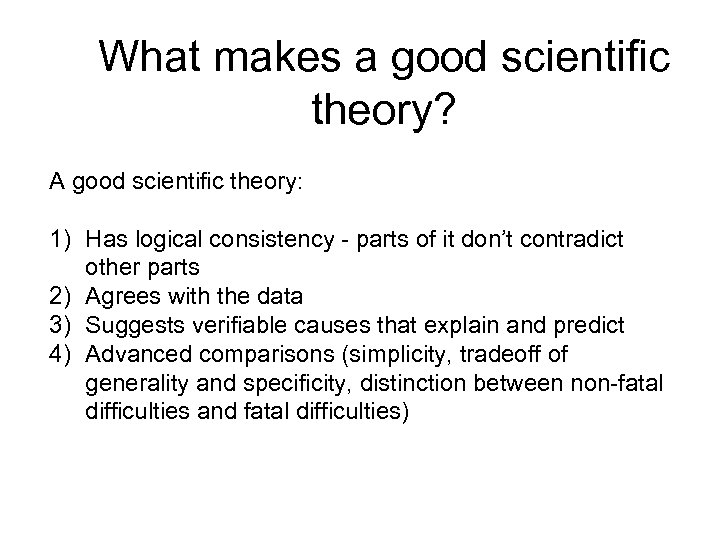 What makes a good scientific theory? A good scientific theory: 1) Has logical consistency - parts of it don’t contradict other parts 2) Agrees with the data 3) Suggests verifiable causes that explain and predict 4) Advanced comparisons (simplicity, tradeoff of generality and specificity, distinction between non-fatal difficulties and fatal difficulties)
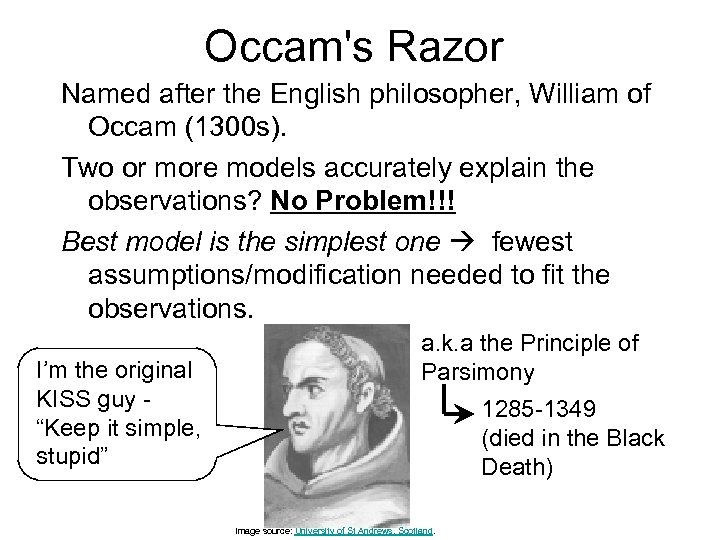 Occam's Razor Named after the English philosopher, William of Occam (1300 s). Two or more models accurately explain the observations? No Problem!!! Best model is the simplest one fewest assumptions/modification needed to fit the observations. I’m the original KISS guy “Keep it simple, stupid” a. k. a the Principle of Parsimony 1285 -1349 (died in the Black Death) Image source: University of St Andrews, Scotland.
 Ptolemy vs. Copernicus So, what theory is most acceptable? Occam says Copernicus Won’t really know until Galileo We have a winner! Image source: University of St Andrews, Scotland.
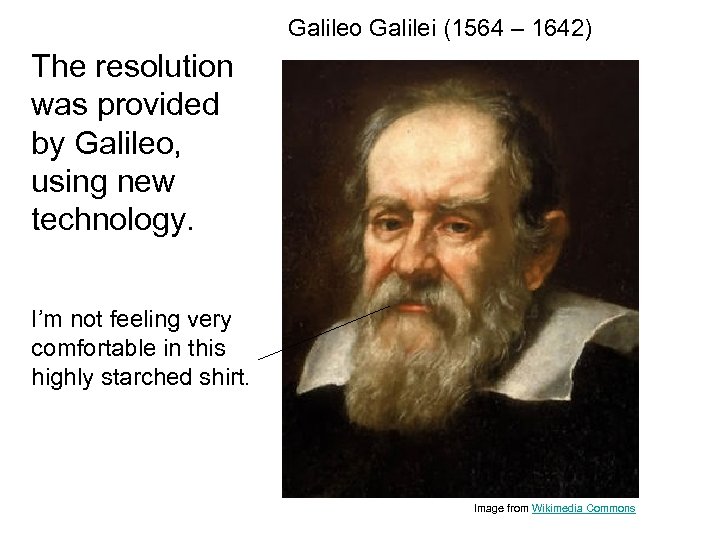 Galileo Galilei (1564 – 1642) The resolution was provided by Galileo, using new technology. I’m not feeling very comfortable in this highly starched shirt. Image from Wikimedia Commons
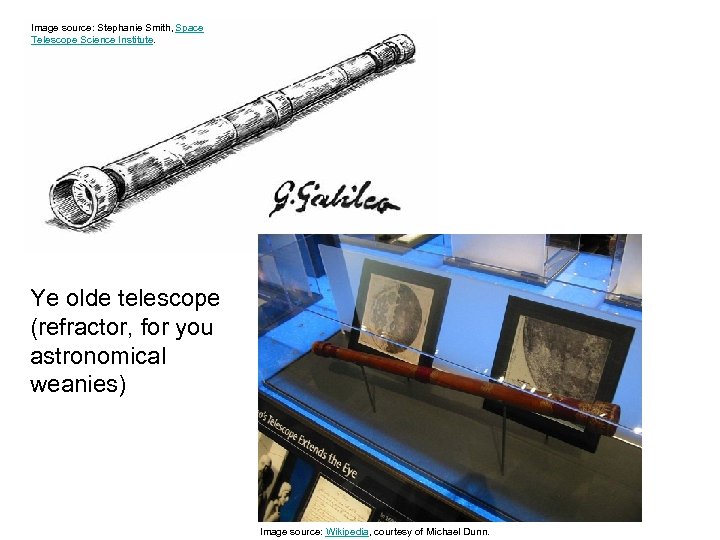 Image source: Stephanie Smith, Space Telescope Science Institute. Ye olde telescope (refractor, for you astronomical weanies) Image source: Wikipedia, courtesy of Michael Dunn.
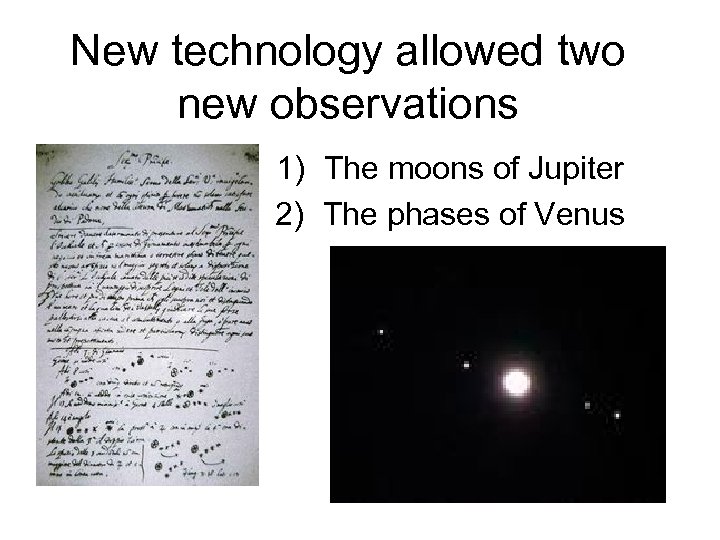 New technology allowed two new observations 1) The moons of Jupiter 2) The phases of Venus
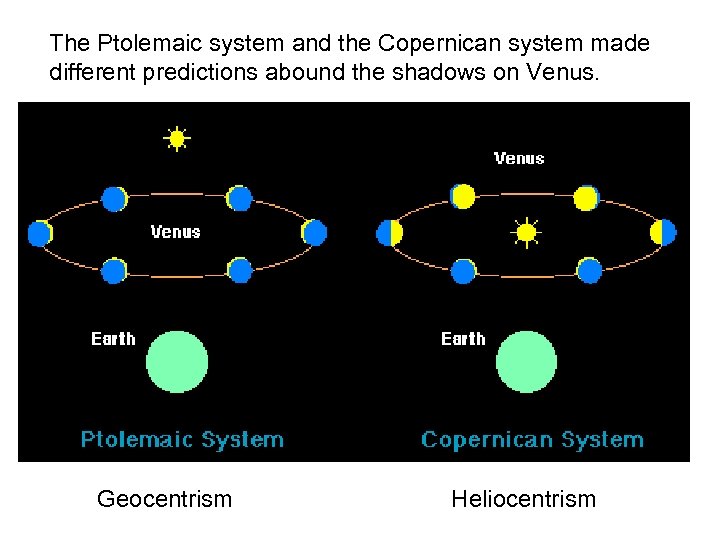 The Ptolemaic system and the Copernican system made different predictions abound the shadows on Venus. Geocentrism Heliocentrism
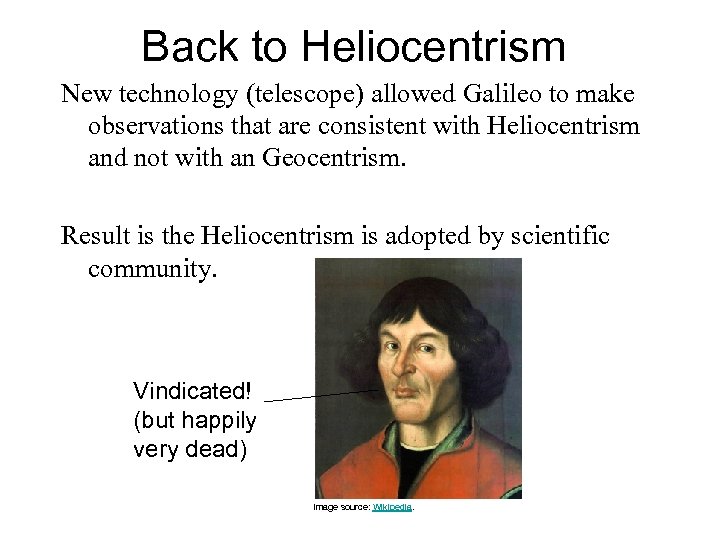 Back to Heliocentrism New technology (telescope) allowed Galileo to make observations that are consistent with Heliocentrism and not with an Geocentrism. Result is the Heliocentrism is adopted by scientific community. Vindicated! (but happily very dead) Image source: Wikipedia.
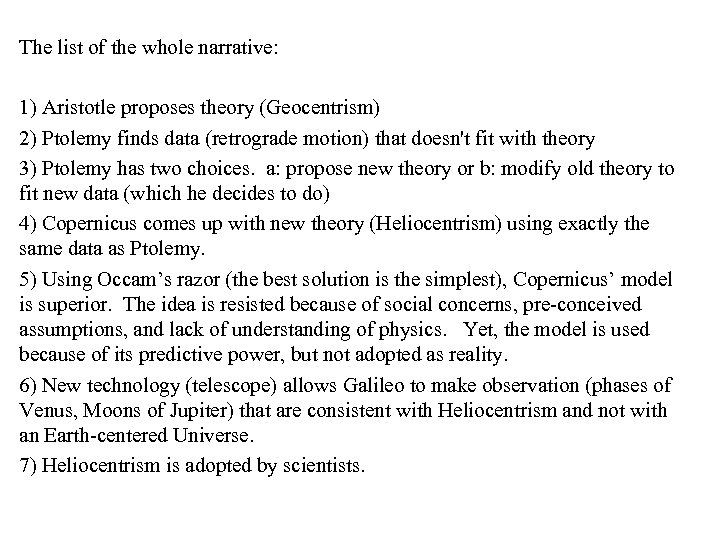 The list of the whole narrative: 1) Aristotle proposes theory (Geocentrism) 2) Ptolemy finds data (retrograde motion) that doesn't fit with theory 3) Ptolemy has two choices. a: propose new theory or b: modify old theory to fit new data (which he decides to do) 4) Copernicus comes up with new theory (Heliocentrism) using exactly the same data as Ptolemy. 5) Using Occam’s razor (the best solution is the simplest), Copernicus’ model is superior. The idea is resisted because of social concerns, pre-conceived assumptions, and lack of understanding of physics. Yet, the model is used because of its predictive power, but not adopted as reality. 6) New technology (telescope) allows Galileo to make observation (phases of Venus, Moons of Jupiter) that are consistent with Heliocentrism and not with an Earth-centered Universe. 7) Heliocentrism is adopted by scientists.
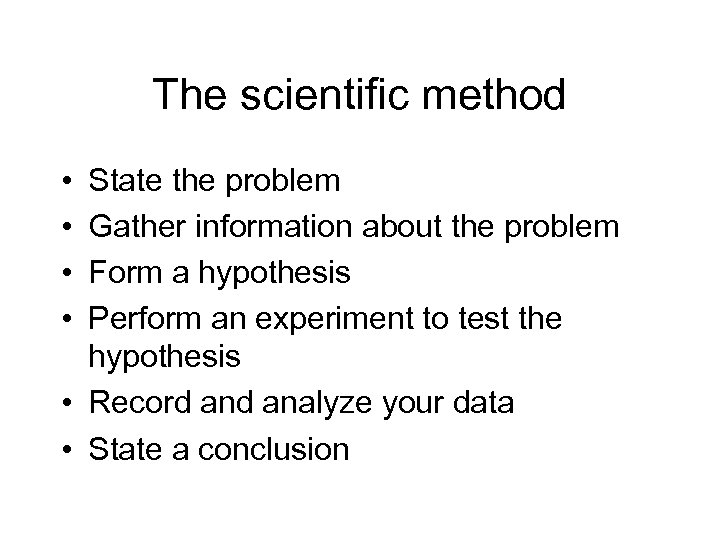 The scientific method • • State the problem Gather information about the problem Form a hypothesis Perform an experiment to test the hypothesis • Record analyze your data • State a conclusion
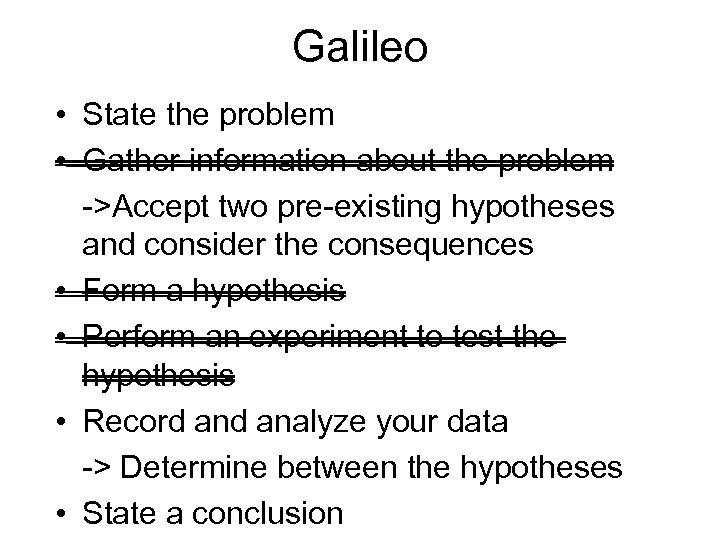 Galileo • State the problem • Gather information about the problem ->Accept two pre-existing hypotheses and consider the consequences • Form a hypothesis • Perform an experiment to test the hypothesis • Record analyze your data -> Determine between the hypotheses • State a conclusion
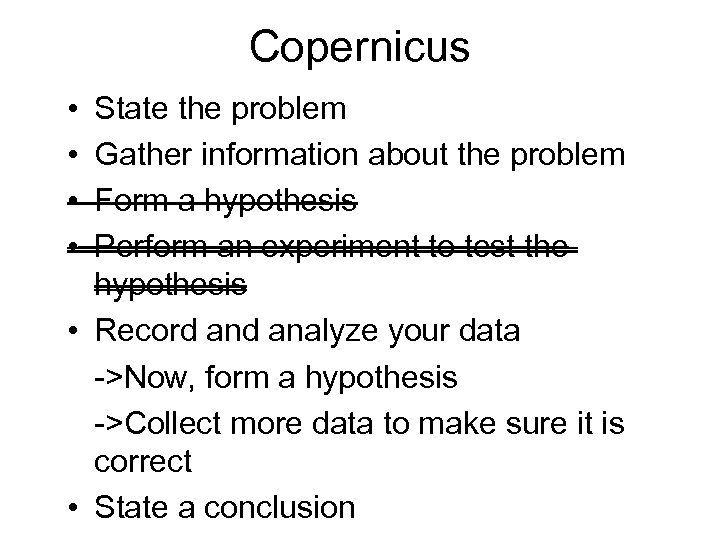 Copernicus • • State the problem Gather information about the problem Form a hypothesis Perform an experiment to test the hypothesis • Record analyze your data ->Now, form a hypothesis ->Collect more data to make sure it is correct • State a conclusion
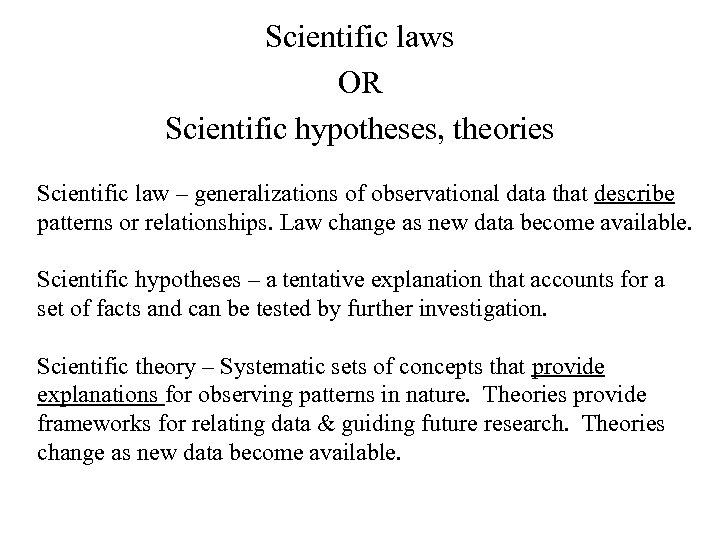 Scientific laws OR Scientific hypotheses, theories Scientific law – generalizations of observational data that describe patterns or relationships. Law change as new data become available. Scientific hypotheses – a tentative explanation that accounts for a set of facts and can be tested by further investigation. Scientific theory – Systematic sets of concepts that provide explanations for observing patterns in nature. Theories provide frameworks for relating data & guiding future research. Theories change as new data become available.
 What are the points of this example:
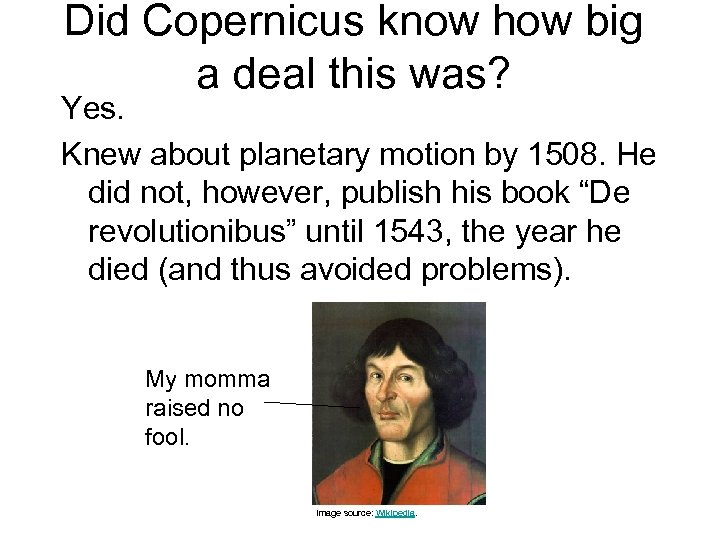 Did Copernicus know how big a deal this was? Yes. Knew about planetary motion by 1508. He did not, however, publish his book “De revolutionibus” until 1543, the year he died (and thus avoided problems). My momma raised no fool. Image source: Wikipedia.
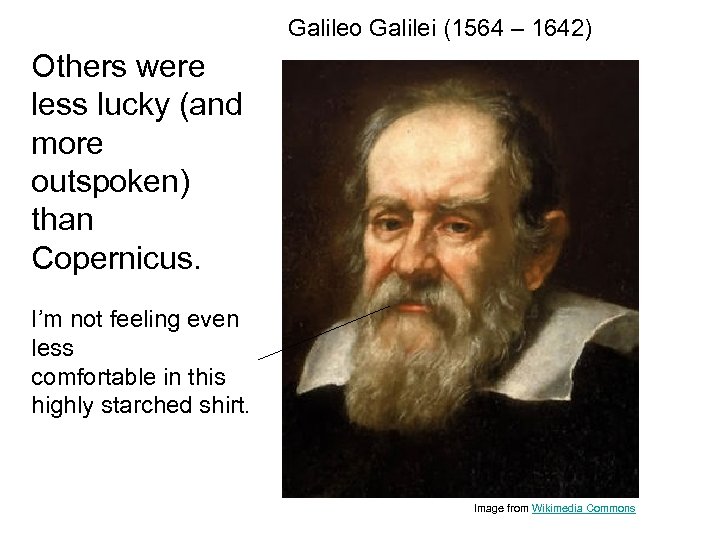 Galileo Galilei (1564 – 1642) Others were less lucky (and more outspoken) than Copernicus. I’m not feeling even less comfortable in this highly starched shirt. Image from Wikimedia Commons
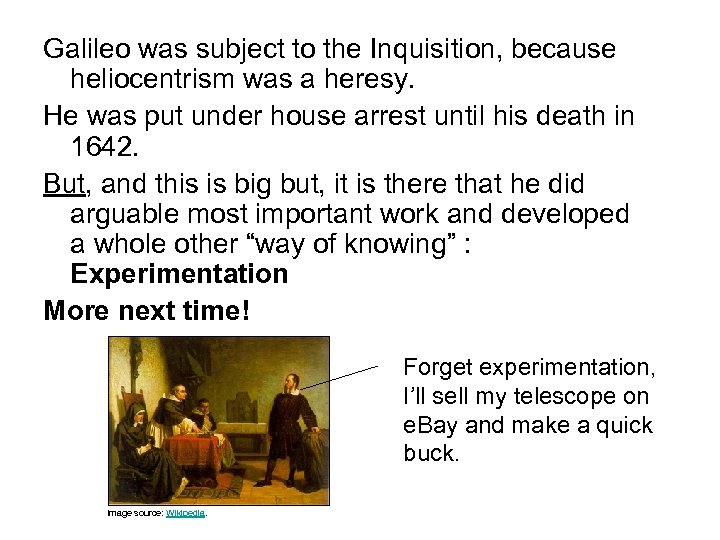 Galileo was subject to the Inquisition, because heliocentrism was a heresy. He was put under house arrest until his death in 1642. But, and this is big but, it is there that he did arguable most important work and developed a whole other “way of knowing” : Experimentation More next time! Forget experimentation, I’ll sell my telescope on e. Bay and make a quick buck. Image source: Wikipedia.