 Скачать презентацию Scientific Method Bias Reasoning Truth is sought
326a1f565799f5d889315de89b6077a7.ppt
- Количество слайдов: 43



Scientific Method, Bias & Reasoning “Truth is sought for its own sake. And those who are engaged upon the quest for anything for its own sake are not interested in other things. Finding the truth is difficult, and the road to it is rough. "
The Hallmark of any Successful Crime Scene Investigation q Teamwork q Leadership § Employing the scientific method “Evidence interpretation is a complex process, and the § Inductive and deductive reasoning less one understands about the nature of physical evidence, the principlesthinking § Critically and creative of forensic science, analytical logic, and the scientificsubordinates simpler crime § Communication with method, the reconstruction may seem. ” – Chisum and Turvey § Logic and reasoning q Open mindedness § Removed subjectivity and biases
Crime Scene Investigation More than the application of science It is a complex scientific endeavor q A step-wise process of knowledge and information building § About understanding what happened ü Who might have done it and what probative evidence is there. § Also a problem solving exercise. ü For example, why did this happen and in what sequence? q Obtaining as precise an answer as possible § Illustrates why crime scene investigation is particularly suited to the application of the scientific method ü Just as scientists attempt to explain observations through a series of constantly tested and revised hypotheses, the ultimate feedback mechanism, using what is called the scientific method v So must scene scientists
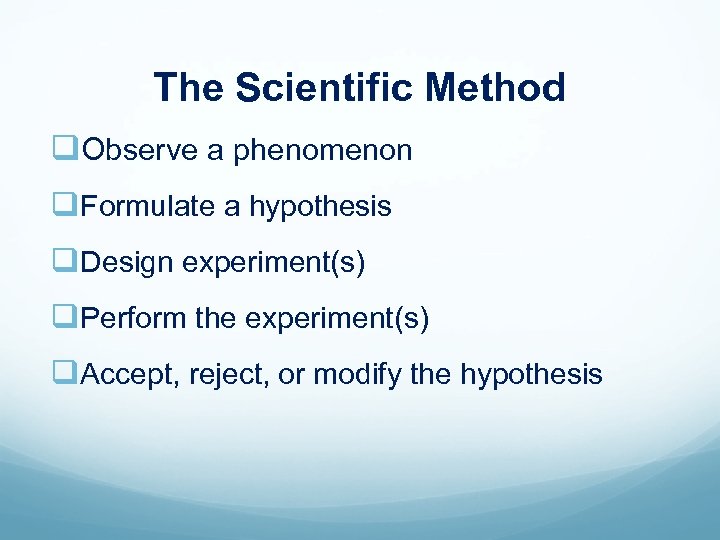
The Scientific Method q. Observe a phenomenon q. Formulate a hypothesis q. Design experiment(s) q. Perform the experiment(s) q. Accept, reject, or modify the hypothesis
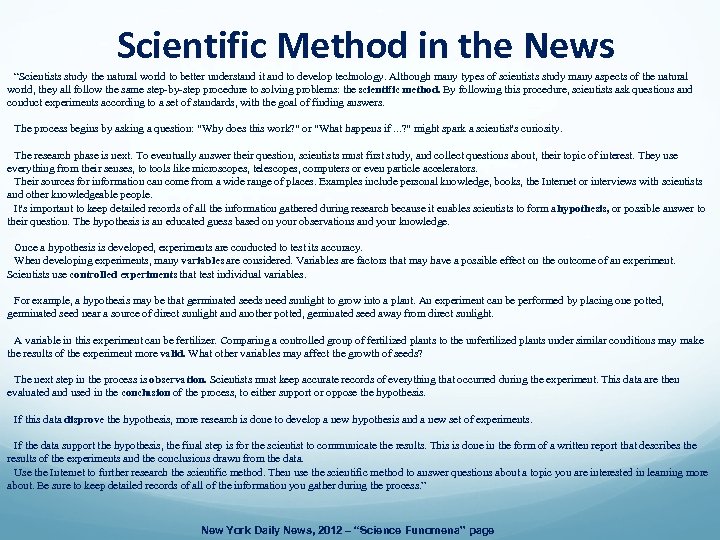
Scientific Method in the News “Scientists study the natural world to better understand it and to develop technology. Although many types of scientists study many aspects of the natural world, they all follow the same step-by-step procedure to solving problems: the scientific method. By following this procedure, scientists ask questions and conduct experiments according to a set of standards, with the goal of finding answers. The process begins by asking a question: "Why does this work? " or "What happens if. . . ? " might spark a scientist's curiosity. The research phase is next. To eventually answer their question, scientists must first study, and collect questions about, their topic of interest. They use everything from their senses, to tools like microscopes, telescopes, computers or even particle accelerators. Their sources for information can come from a wide range of places. Examples include personal knowledge, books, the Internet or interviews with scientists and other knowledgeable people. It's important to keep detailed records of all the information gathered during research because it enables scientists to form a hypothesis, or possible answer to their question. The hypothesis is an educated guess based on your observations and your knowledge. Once a hypothesis is developed, experiments are conducted to test its accuracy. When developing experiments, many variables are considered. Variables are factors that may have a possible effect on the outcome of an experiment. Scientists use controlled experiments that test individual variables. For example, a hypothesis may be that germinated seeds need sunlight to grow into a plant. An experiment can be performed by placing one potted, germinated seed near a source of direct sunlight and another potted, geminated seed away from direct sunlight. A variable in this experiment can be fertilizer. Comparing a controlled group of fertilized plants to the unfertilized plants under similar conditions may make the results of the experiment more valid. What other variables may affect the growth of seeds? The next step in the process is observation. Scientists must keep accurate records of everything that occurred during the experiment. This data are then evaluated and used in the conclusion of the process, to either support or oppose the hypothesis. If this data disprove the hypothesis, more research is done to develop a new hypothesis and a new set of experiments. If the data support the hypothesis, the final step is for the scientist to communicate the results. This is done in the form of a written report that describes the results of the experiments and the conclusions drawn from the data. Use the Internet to further research the scientific method. Then use the scientific method to answer questions about a topic you are interested in learning more about. Be sure to keep detailed records of all of the information you gather during the process. ” New York Daily News, 2012 – “Science Funomena” page
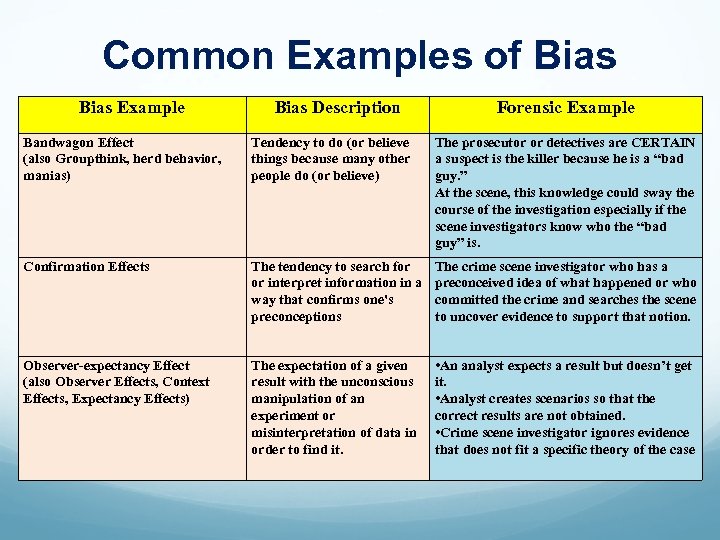
Common Examples of Bias Example Bias Description Forensic Example Bandwagon Effect (also Groupthink, herd behavior, manias) Tendency to do (or believe things because many other people do (or believe) The prosecutor or detectives are CERTAIN a suspect is the killer because he is a “bad guy. ” At the scene, this knowledge could sway the course of the investigation especially if the scene investigators know who the “bad guy” is. Confirmation Effects The tendency to search for or interpret information in a way that confirms one's preconceptions The crime scene investigator who has a preconceived idea of what happened or who committed the crime and searches the scene to uncover evidence to support that notion. Observer-expectancy Effect (also Observer Effects, Context Effects, Expectancy Effects) The expectation of a given result with the unconscious manipulation of an experiment or misinterpretation of data in order to find it. • An analyst expects a result but doesn’t get it. • Analyst creates scenarios so that the correct results are not obtained. • Crime scene investigator ignores evidence that does not fit a specific theory of the case
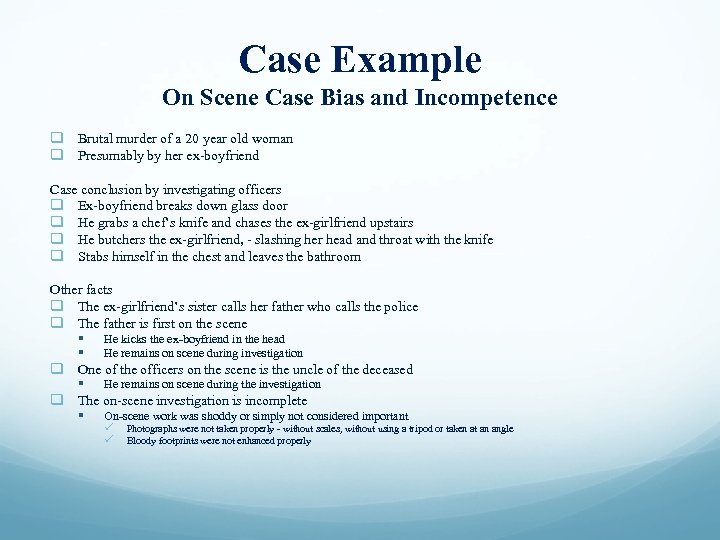
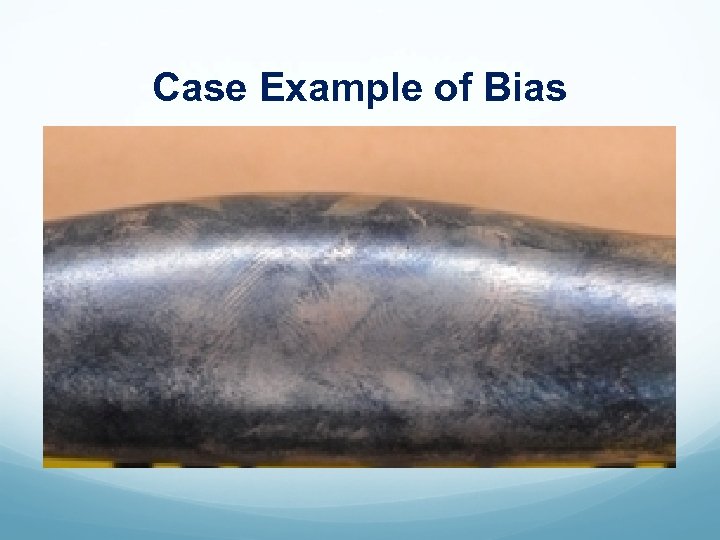
Case Example On Scene Case Bias and Incompetence q Brutal murder of a 20 year old woman q Presumably by her ex-boyfriend Case conclusion by investigating officers q Ex-boyfriend breaks down glass door q He grabs a chef’s knife and chases the ex-girlfriend upstairs q He butchers the ex-girlfriend, - slashing her head and throat with the knife q Stabs himself in the chest and leaves the bathroom Other facts q The ex-girlfriend’s sister calls her father who calls the police q The father is first on the scene § He kicks the ex-boyfriend in the head § He remains on scene during investigation q One of the officers on the scene is the uncle of the deceased § He remains on scene during the investigation q The on-scene investigation is incomplete § On-scene work was shoddy or simply not considered important ü ü Photographs were not taken properly - without scales, without using a tripod or taken at an angle Bloody footprints were not enhanced properly
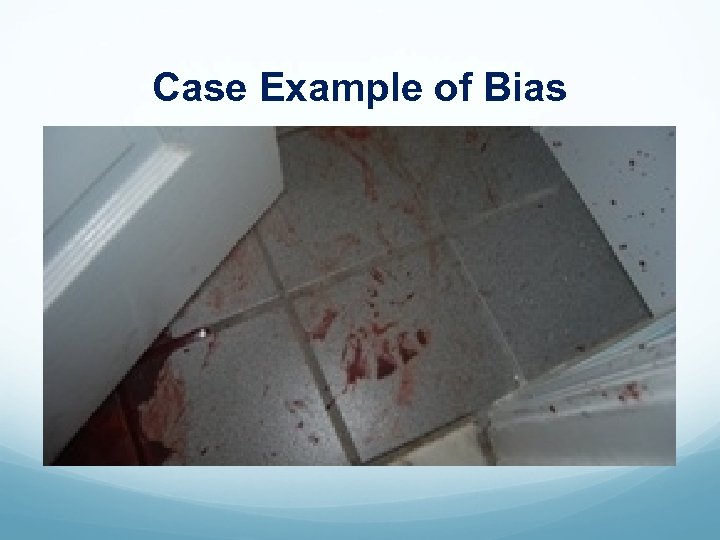
Case Example of Bias
Case Example of Bias
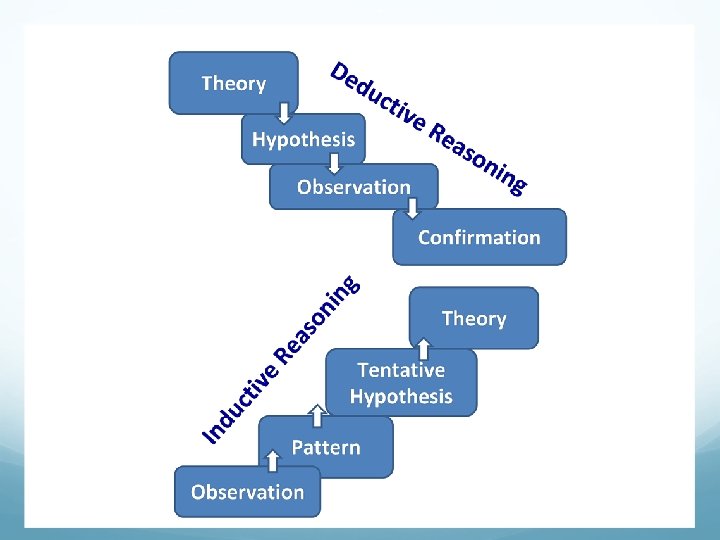
Logic & Reasoning Deductive reasoning q General to Specific § Starts with a theory § More structural Inductive reasoning q Specific to general § Begins with an observation § A theory is derived AND must be confirmed § More open ended
Management Basics: The Investigative Glue How many times have you read in the financial section of a newspaper that the company failed because of poor management?
Management q Management is the glue that holds the investigation together § § § The manager = The team leader Success depends on leadership Learning to manage a crime scene is a critical skill § Broad experience in scene investigation § Knowledge of police and legal procedures § Knowledge of scene forensics/criminalistics ü Understanding of the value of physical evidence, ü Knowing the limitations of the science, ü Applying the scientific method, ü Recognizing, collecting and preserving evidence, § Management skills § Know how to manage the scene ü Know where to obtain scarce resources in unusual situations and ü Know how to expedite the investigation without compromising quality.
Contemporary Problem q Rapidly changing dynamics of scene investigation related to modern scene science and technology. q Firm foundation in science is a critical prerequisite for successful scene investigations. q Crime scene team leader … regardless of the experience base or the scientific backgrounds of the scene members, … must have scene management expertise, q Investigation will fail or be botched, and critical evidence might be lost forever.
Learning Scene Management q Typically, learn scene management on-the-job or in police academies § Training can be defective - perpetuate bad habits, poor skills and faulty knowledge q Appropriate models of scene management do not exist
The First Responding Officer q Scene management is an evolving or stepwise progression § Begins with the first official or responding officer to the scene q The responsibilities of the first responder: § § Preserve life Secure, preserve and protect the scene Document the scene as it was found until relieved by an investigator in charge Hand off the scene to the investigator in charge via debriefing q A first officer’s responsibilities can be placed into discrete categories. § § § Observations § What happened here? § Who should respond? Actions taken Documentation
Other Important Information q Is the scene active - is the perpetrator on the scene? q Is the scene clear? q Victims § Injured & alive? ü EMS §Deceased? ü ME q Witnesses/contact information § § Are there witnesses? Are they available? Are they separated/sequestered? Are the witnesses potential suspects? q What is the scope of the scene? § Boundaries § Indoor/outdoor/both
Second Level Observations Archive Observations: Digital or tape recording device, note pad, or point-and-shoot camera Cognizant of the following. q Fleeting evidence § Odors – cooking, gunshot, cigarette/cigar smoke § Ice cubes melting q Entry/exit points § Doors – locked unlocked - tampered § Windows – locked unlocked - tampered q Signs of activity § Struggle § TV/radio on § Meals – dishes in the sink § Food on the table § Partially eaten food q Date/time indicators § Newspapers § Stopped clocks § Spoiled food § Hot/cold items § Wet blood q Other observations might include: § Account for moved or out of place objects (furniture) § Monitor evidence moved/altered by EMT’s as they attend to living victims § Protect obvious critical evidence ü Fingerprints on dusty surfaces or dry residue prints on the floor or furniture ü Cartridge cases ü Spent bullets ü Wet and dry residue footwear impressions ü Broken glass
Major Do-Nots q Responding officers should be extremely careful that evidence is not compromised, damaged or destroyed q DO NOT § § § Move anything Touch anything Use the toilets Use the sinks Turn on water Eat or drink q All crime scenes are contaminated
Scene Security q The first officer: Must protect the scene until relieved by the investigator who assumes official responsibility for the subsequent ongoing investigation q With respect to security, the following are possible considerations for indoor scenes: § § Establish scene boundaries Protect possible entrance/egress points Protect possible probative evidence or evidence location points Protect potentially fragile evidence
Outdoor Scenes q Protect entrance/exit points § Along paths, tire tracks on driveways, etc. q Be cognizant of weather restrictions q Cordon off large areas § Get help from others q Establish boundaries § Witnesses and other voyeurs must be removed and segregated q The media is also a concern and should be removed from the scene § Sophisticated listening devices cannot hear discussions among investigators § Powerful cameras cannot grab photographs of salacious material § Dead bodies do not end up on the evening news
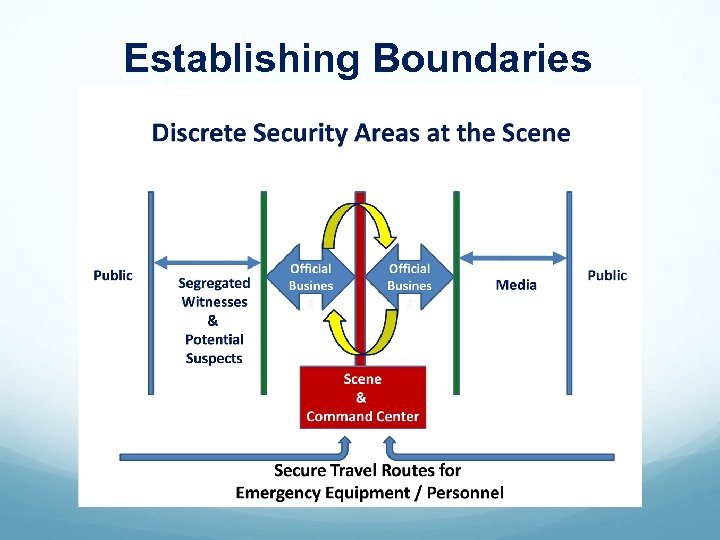
Establishing Boundaries
Team Leader’s Role
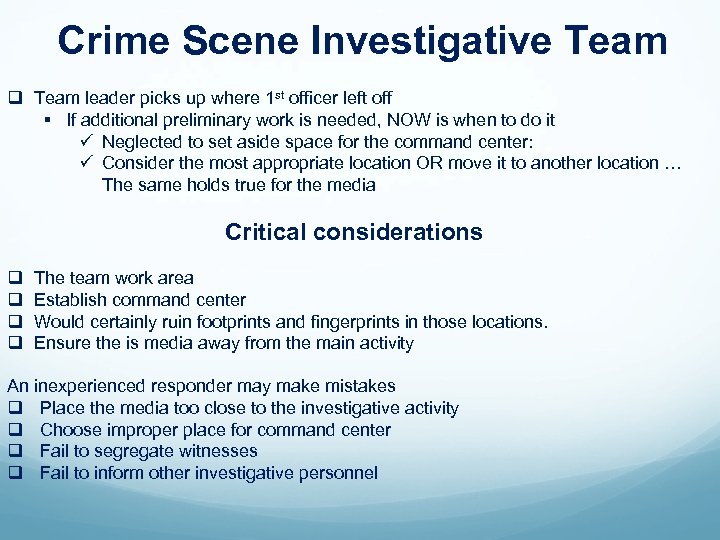
Crime Scene Investigative Team q Team leader picks up where 1 st officer left off § If additional preliminary work is needed, NOW is when to do it ü Neglected to set aside space for the command center: ü Consider the most appropriate location OR move it to another location … The same holds true for the media Critical considerations q q The team work area Establish command center Would certainly ruin footprints and fingerprints in those locations. Ensure the is media away from the main activity An inexperienced responder may make mistakes q Place the media too close to the investigative activity q Choose improper place for command center q Fail to segregate witnesses q Fail to inform other investigative personnel
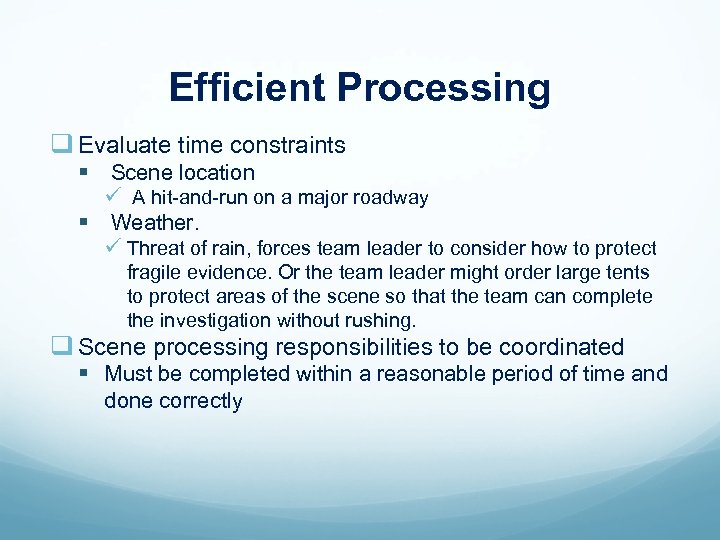
Efficient Processing q Evaluate time constraints § Scene location ü A hit-and-run on a major roadway § Weather. ü Threat of rain, forces team leader to consider how to protect fragile evidence. Or the team leader might order large tents to protect areas of the scene so that the team can complete the investigation without rushing. q Scene processing responsibilities to be coordinated § Must be completed within a reasonable period of time and done correctly
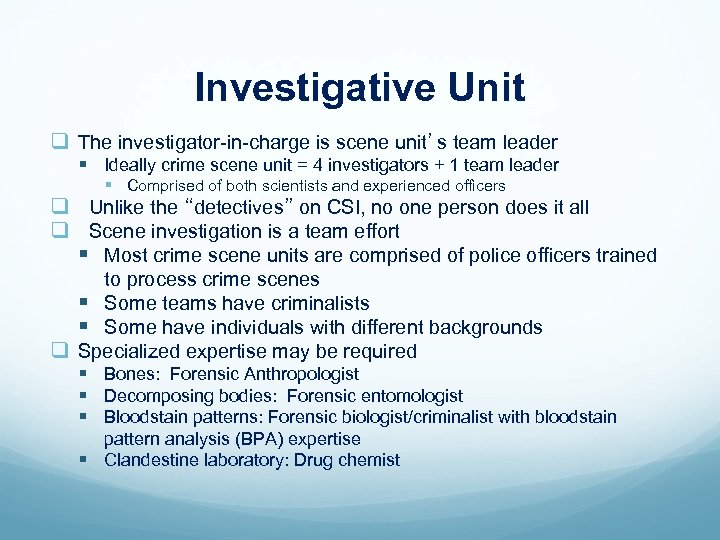
Investigative Unit q The investigator-in-charge is scene unit’s team leader § Ideally crime scene unit = 4 investigators + 1 team leader § Comprised of both scientists and experienced officers q Unlike the “detectives” on CSI, no one person does it all q Scene investigation is a team effort § Most crime scene units are comprised of police officers trained to process crime scenes § Some teams have criminalists § Some have individuals with different backgrounds q Specialized expertise may be required § Bones: Forensic Anthropologist § Decomposing bodies: Forensic entomologist § Bloodstain patterns: Forensic biologist/criminalist with bloodstain pattern analysis (BPA) expertise § Clandestine laboratory: Drug chemist
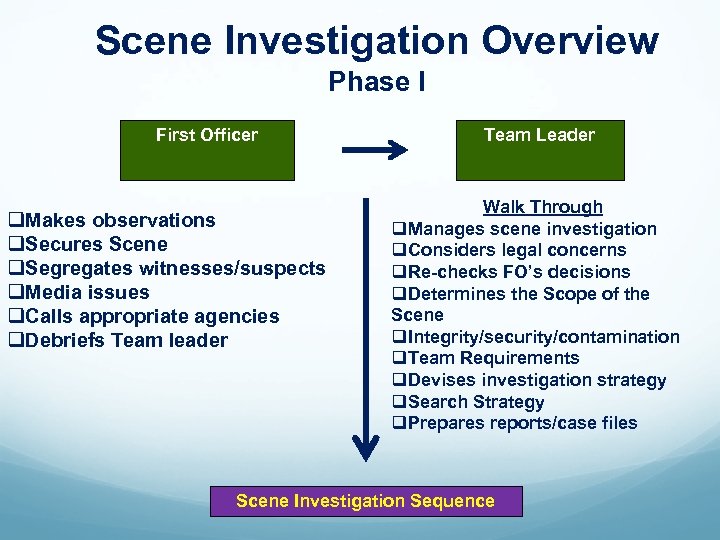
Scene Investigation Overview Phase I First Officer q. Makes observations q. Secures Scene q. Segregates witnesses/suspects q. Media issues q. Calls appropriate agencies q. Debriefs Team leader Team Leader Walk Through q. Manages scene investigation q. Considers legal concerns q. Re-checks FO’s decisions q. Determines the Scope of the Scene q. Integrity/security/contamination q. Team Requirements q. Devises investigation strategy q. Search Strategy q. Prepares reports/case files Scene Investigation Sequence
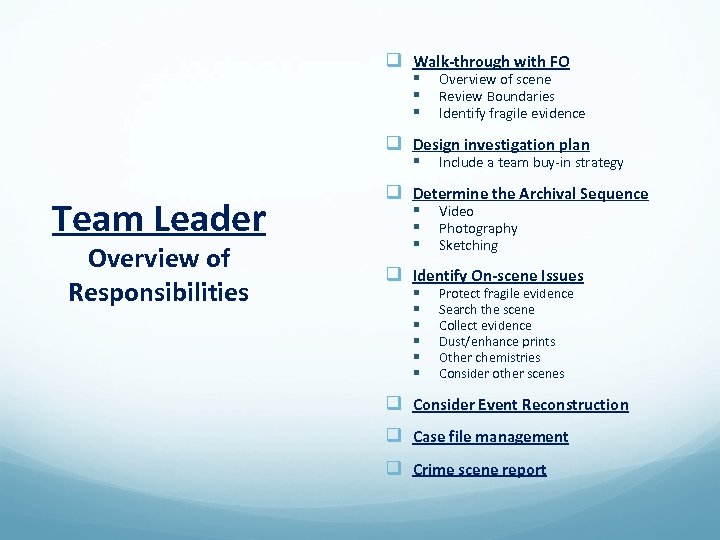
q Walk-through with FO § § § Overview of scene Review Boundaries Identify fragile evidence q Design investigation plan § Team Leader Overview of Responsibilities Include a team buy-in strategy q Determine the Archival Sequence § § § Video Photography Sketching q Identify On-scene Issues § § § Protect fragile evidence Search the scene Collect evidence Dust/enhance prints Other chemistries Consider other scenes q Consider Event Reconstruction q Case file management q Crime scene report
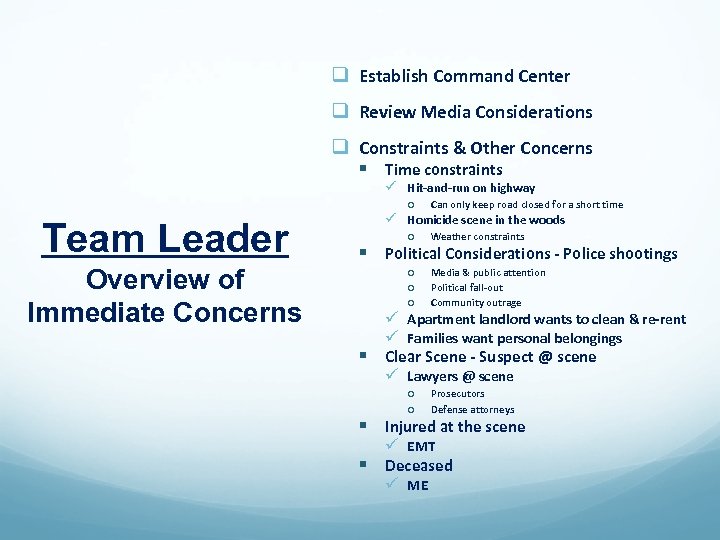
q Establish Command Center q Review Media Considerations q Constraints & Other Concerns § Time constraints ü Hit-and-run on highway Team Leader Overview of Immediate Concerns o Can only keep road closed for a short time ü Homicide scene in the woods o Weather constraints § Political Considerations - Police shootings o o o § Media & public attention Political fall-out Community outrage Prosecutors Defense attorneys ü Apartment landlord wants to clean & re-rent ü Families want personal belongings Clear Scene - Suspect @ scene ü Lawyers @ scene § Injured at the scene § ü EMT Deceased ü ME
Managing The Scene Establishing Teams
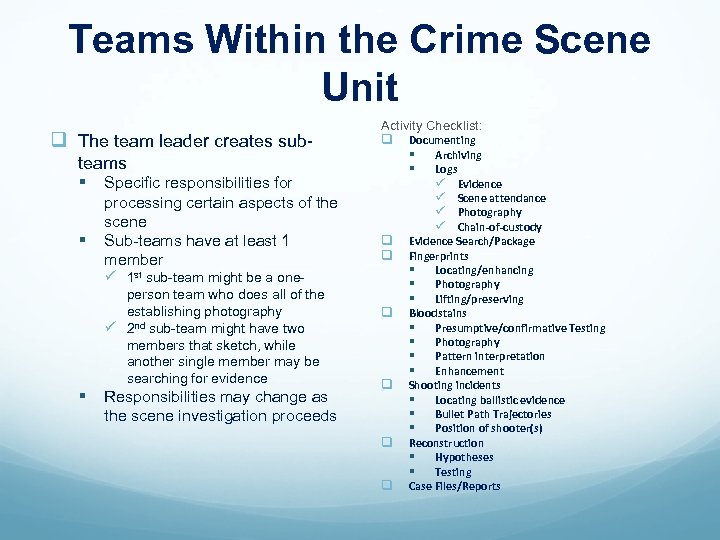
Teams Within the Crime Scene Unit q The team leader creates sub- Activity Checklist: q teams § Specific responsibilities for § § processing certain aspects of the scene Sub-teams have at least 1 member ü 1 st sub-team might be a oneperson team who does all of the establishing photography ü 2 nd sub-team might have two members that sketch, while another single member may be searching for evidence Responsibilities may change as the scene investigation proceeds q q q Documenting § Archiving § Logs ü Evidence ü Scene attendance ü Photography ü Chain-of-custody Evidence Search/Package Fingerprints § Locating/enhancing § Photography § Lifting/preserving Bloodstains § Presumptive/confirmative Testing § Photography § Pattern interpretation § Enhancement Shooting incidents § Locating ballistic evidence § Bullet Path Trajectories § Position of shooter(s) Reconstruction § Hypotheses § Testing Case Files/Reports
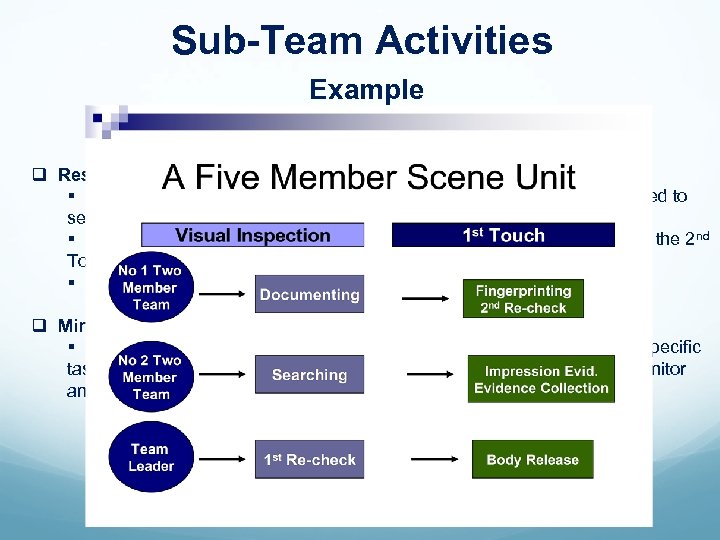
Sub-Team Activities Example q Responsibilities of sub-teams: § A two-member sub-team might be assigned to sketching then reassigned to searching for evidence, collecting and then packaging § Another two-member team might be to photography then reassigned to the 2 nd Touch phase (to be discussed) and then on scene processing § The team leader could be performing the re-checks (to be discussed) q Minimum number of team members: 3 including the team leader. § If the team had five members, two-member sub-teams would perform specific tasks, moving from one activity to another, and the team leader would monitor and perform specific duties as well.
Protecting Evidence
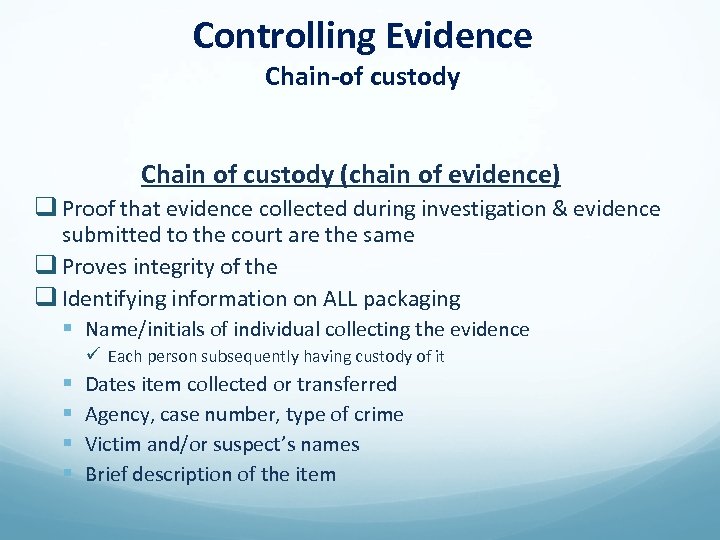
Controlling Evidence Chain-of custody Chain of custody (chain of evidence) q Proof that evidence collected during investigation & evidence submitted to the court are the same q Proves integrity of the q Identifying information on ALL packaging § Name/initials of individual collecting the evidence ü Each person subsequently having custody of it § § Dates item collected or transferred Agency, case number, type of crime Victim and/or suspect’s names Brief description of the item
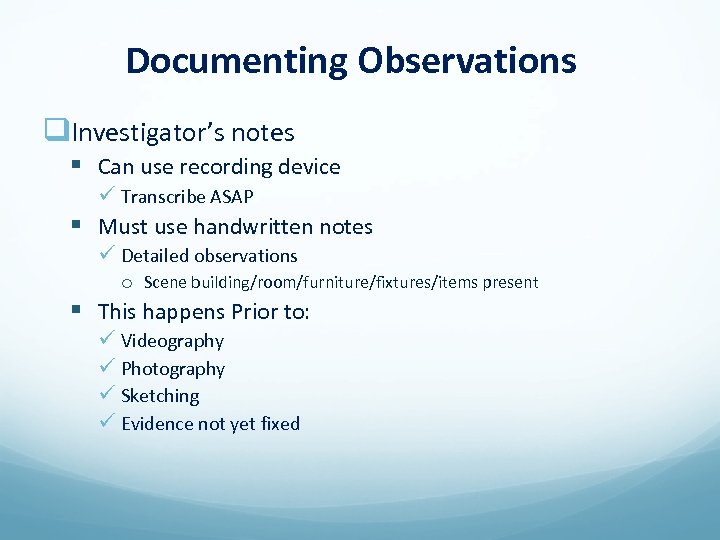
Documenting Observations q. Investigator’s notes § Can use recording device ü Transcribe ASAP § Must use handwritten notes ü Detailed observations o Scene building/room/furniture/fixtures/items present § This happens Prior to: ü Videography ü Photography ü Sketching ü Evidence not yet fixed
Scene Investigative Cascade
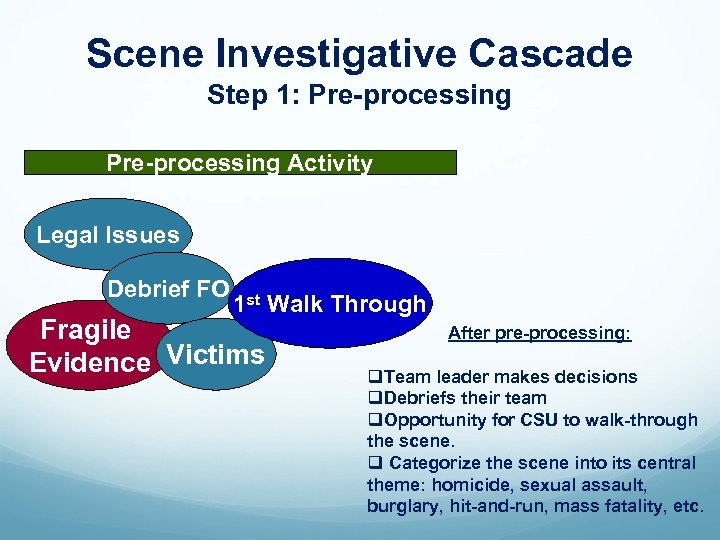
Scene Investigative Cascade Step 1: Pre-processing Activity Legal Issues Debrief FO 1 st Walk Through Fragile Evidence Victims After pre-processing: q. Team leader makes decisions q. Debriefs their team q. Opportunity for CSU to walk-through the scene. q Categorize the scene into its central theme: homicide, sexual assault, burglary, hit-and-run, mass fatality, etc.
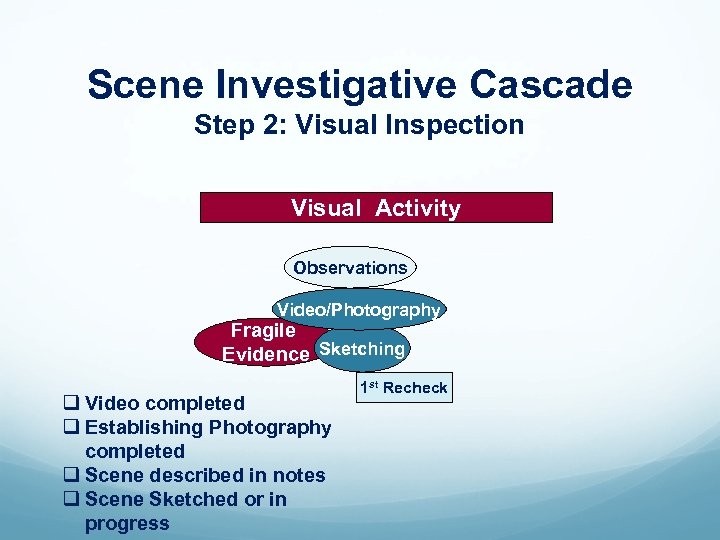
Scene Investigative Cascade Step 2: Visual Inspection Visual Activity Observations Video/Photography Fragile Evidence Sketching q Video completed q Establishing Photography completed q Scene described in notes q Scene Sketched or in progress 1 st Recheck
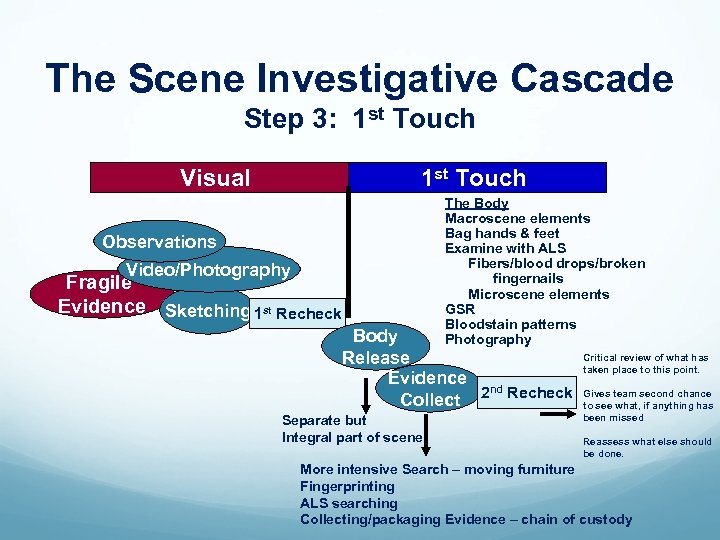
The Scene Investigative Cascade Step 3: 1 st Touch Visual 1 st Touch Observations Video/Photography Fragile Evidence Sketching 1 st Recheck The Body Macroscene elements Bag hands & feet Examine with ALS Fibers/blood drops/broken fingernails Microscene elements GSR Bloodstain patterns Photography Body Release Evidence nd Collect 2 Recheck Separate but Integral part of scene Critical review of what has taken place to this point. Gives team second chance to see what, if anything has been missed Reassess what else should be done. More intensive Search – moving furniture Fingerprinting ALS searching Collecting/packaging Evidence – chain of custody
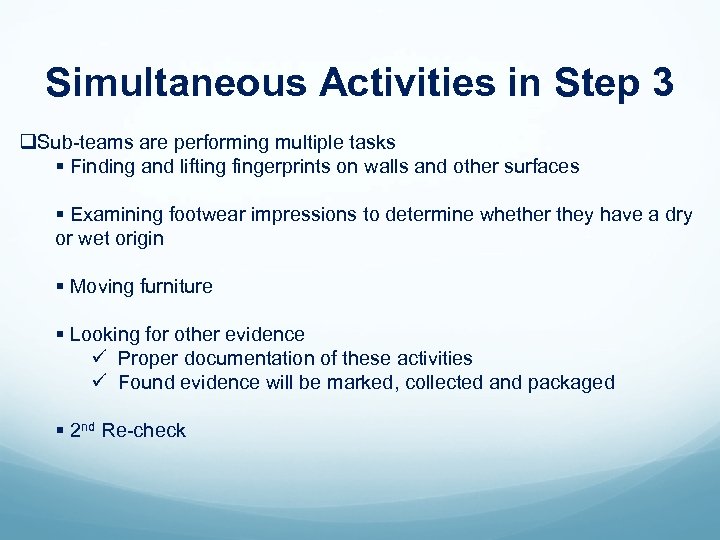
Simultaneous Activities in Step 3 q. Sub-teams are performing multiple tasks § Finding and lifting fingerprints on walls and other surfaces § Examining footwear impressions to determine whether they have a dry or wet origin § Moving furniture § Looking for other evidence ü Proper documentation of these activities ü Found evidence will be marked, collected and packaged § 2 nd Re-check
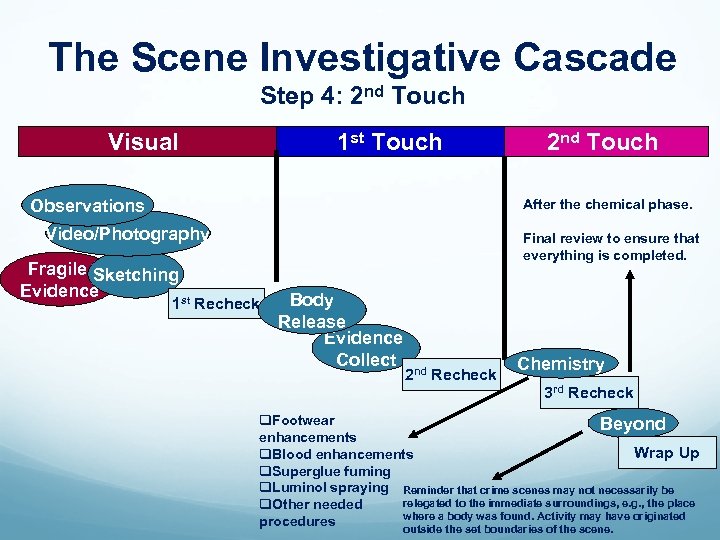
The Scene Investigative Cascade Step 4: 2 nd Touch Visual 1 st Touch Observations 2 nd Touch After the chemical phase. Video/Photography Fragile Sketching Evidence st Final review to ensure that everything is completed. 1 Recheck Body Release Evidence Collect 2 nd Recheck Chemistry 3 rd Recheck q. Footwear Beyond enhancements Wrap Up q. Blood enhancements q. Superglue fuming q. Luminol spraying Reminder that crime scenes may not necessarily be relegated to the immediate surroundings, e. g. , the place q. Other needed where a body was found. Activity may have originated procedures outside the set boundaries of the scene.
The Scene Investigative Cascade and The Scientific Method q Scene Processing Cascade: § Designed by the Military (non scientists) § A road map to help prevent investigators from making critical mistakes § Scientific method - feedback mechanism during 1 st, 2 nd, and 3 rd rechecks § Criminalistic logic as embodied in the scientific method is missing § “Criminalistics is an holistic process that embraces the scientific method, reasoning and critical thinking with respect to the analysis and interpretation of evidence associated with an set of alleged facts. ” q Incorporating the scientific method helps to ensure that the investigation will be successful § Needs to be the foundation of the cascade § Attempting to disprove your hypotheses
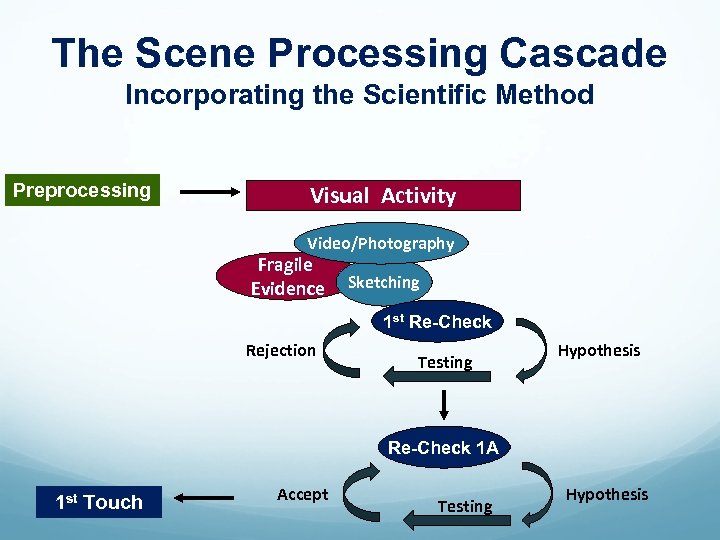
The Scene Processing Cascade Incorporating the Scientific Method Preprocessing Visual Activity Video/Photography Fragile Evidence Sketching 1 st Re-Check Rejection Testing Hypothesis Re-Check 1 A 1 st Touch Accept Testing Hypothesis
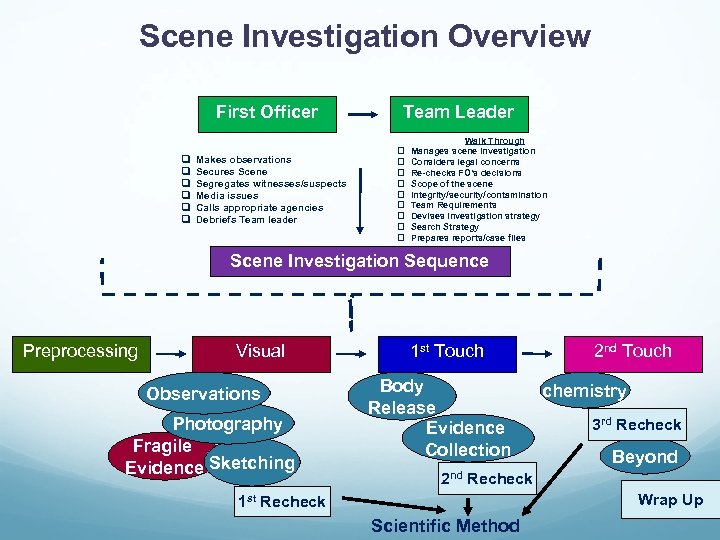
Scene Investigation Overview First Officer q q q Makes observations Secures Scene Segregates witnesses/suspects Media issues Calls appropriate agencies Debriefs Team leader Team Leader q q q q q Walk Through Manages scene investigation Considers legal concerns Re-checks FO’s decisions Scope of the scene Integrity/security/contamination Team Requirements Devises investigation strategy Search Strategy Prepares reports/case files Scene Investigation Sequence Preprocessing Visual Observations Photography Fragile Evidence Sketching 1 st Touch Body Release Evidence Collection 2 nd Touch chemistry 3 rd Recheck Beyond 2 nd Recheck Wrap Up 1 st Recheck Scientific Method
Скачать презентацию Scientific Method Bias Reasoning Truth is sought
326a1f565799f5d889315de89b6077a7.ppt