


 Скачать презентацию Scientific Computing with Quantum Computers Colin P Williams
a89626f87d3a629c187670f0c2a49cfb.ppt
- Количество слайдов: 48
 Scientific Computing with Quantum Computers Colin P. Williams Jet Propulsion Laboratory, California Institute of Technology Pasadena, CA 91109 -8099 Email: Colin. P. Williams@jpl. nasa. gov, Tel: (818) 393 6998
 Quantum Algorithms Today • After 10 years and ~$1 B worldwide spending, most significant quantum algorithm is still Shor’s algorithm (1994) –Factoring composite integers (breaking public-key cryptosystems) –Computing discrete logarithms (breaking elliptic curve cryptosystems) • Most U. S. $$$ on QC spent on: –Designing and implementing QC hardware that is scalable to run Shor’s algorithm –Relatively little being spent developing new quantum algorithms • Why? –Main funding agency has its “killer-ap” already. Weakens incentive for exploration. –Sponsors strive for exponential speedups. Less glory in polynomial speedups. –Culture: academic QC community not knowledgeable about HPC interests and issues –Real-world computing data-dominated. QCs must encode data prior to processing it • Hidden cost can undermine any quantum complexity advantage • In this talk … –Quick overview of quantum computing –Can quantum computers address scientific computing? • Quantum signal, image, data processing • Quantum algorithms for NP-Complete problems • Quantum simulation / quantum chemistry –Discuss national strategy for finding significant new applications of QCs
 Overview of Quantum Computing
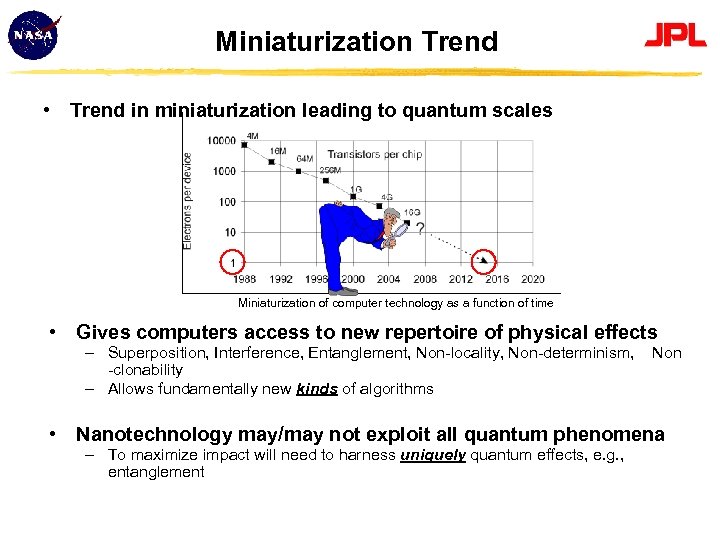 Miniaturization Trend • Trend in miniaturization leading to quantum scales Miniaturization of computer technology as a function of time • Gives computers access to new repertoire of physical effects – Superposition, Interference, Entanglement, Non-locality, Non-determinism, -clonability – Allows fundamentally new kinds of algorithms Non • Nanotechnology may/may not exploit all quantum phenomena – To maximize impact will need to harness uniquely quantum effects, e. g. , entanglement
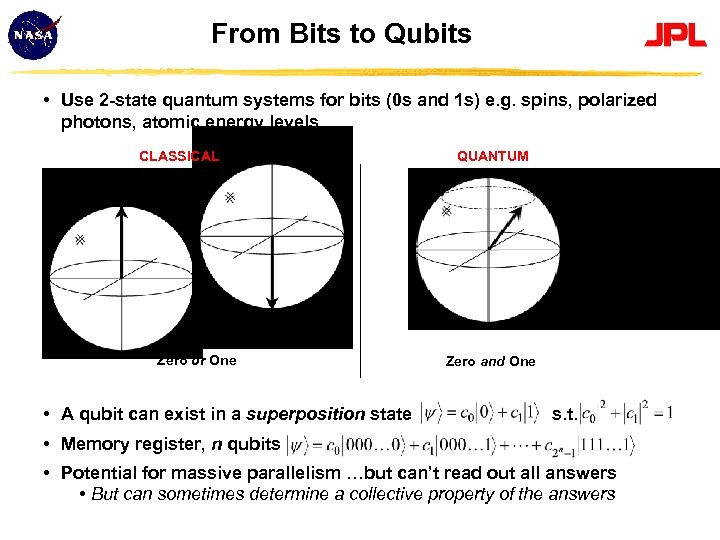 From Bits to Qubits • Use 2 -state quantum systems for bits (0 s and 1 s) e. g. spins, polarized photons, atomic energy levels CLASSICAL Zero or One • A qubit can exist in a superposition state QUANTUM Zero and One s. t. • Memory register, n qubits • Potential for massive parallelism …but can’t read out all answers • But can sometimes determine a collective property of the answers
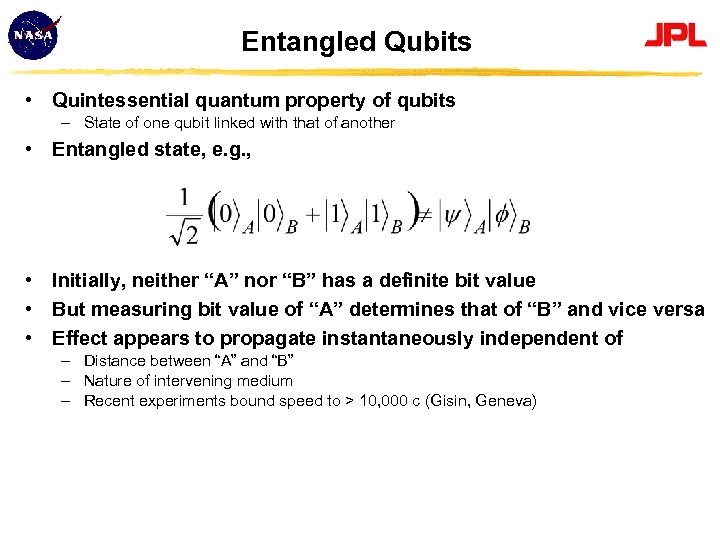 Entangled Qubits • Quintessential quantum property of qubits – State of one qubit linked with that of another • Entangled state, e. g. , • Initially, neither “A” nor “B” has a definite bit value • But measuring bit value of “A” determines that of “B” and vice versa • Effect appears to propagate instantaneously independent of – Distance between “A” and “B” – Nature of intervening medium – Recent experiments bound speed to > 10, 000 c (Gisin, Geneva)
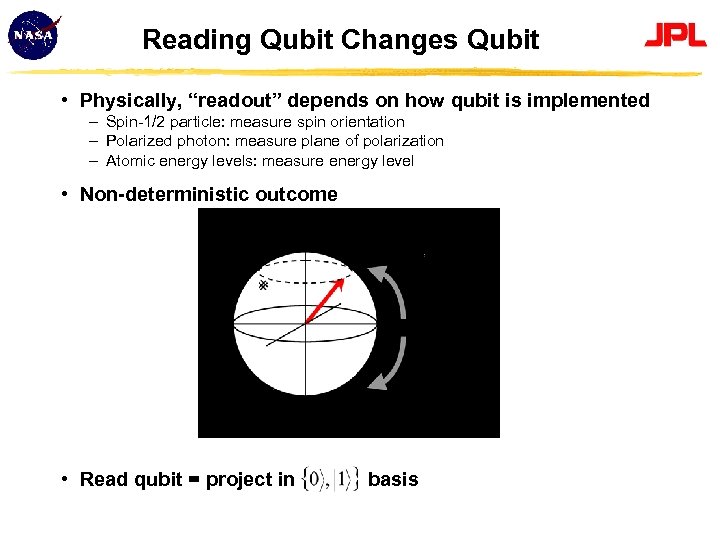 Reading Qubit Changes Qubit • Physically, “readout” depends on how qubit is implemented Spin-1/2 particle: measure spin orientation Polarized photon: measure plane of polarization Atomic energy levels: measure energy level • Non-deterministic outcome • Read qubit = project in basis
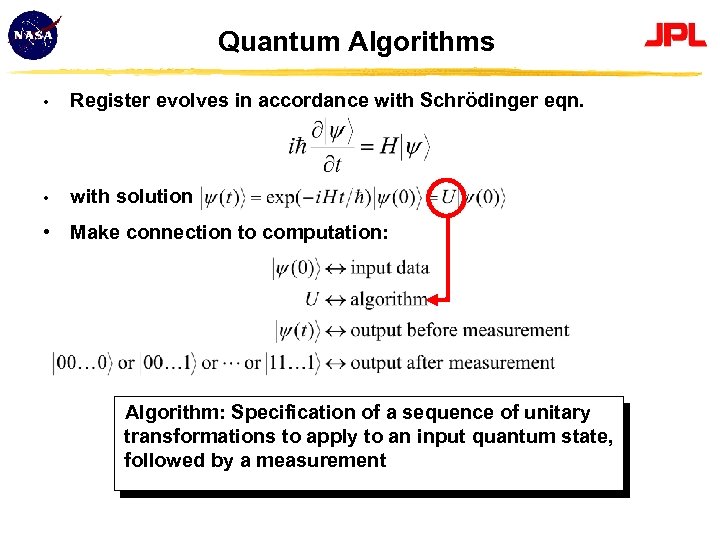 Quantum Algorithms • Register evolves in accordance with Schrödinger eqn. • with solution • Make connection to computation: Algorithm: Specification of a sequence of unitary transformations to apply to an input quantum state, followed by a measurement
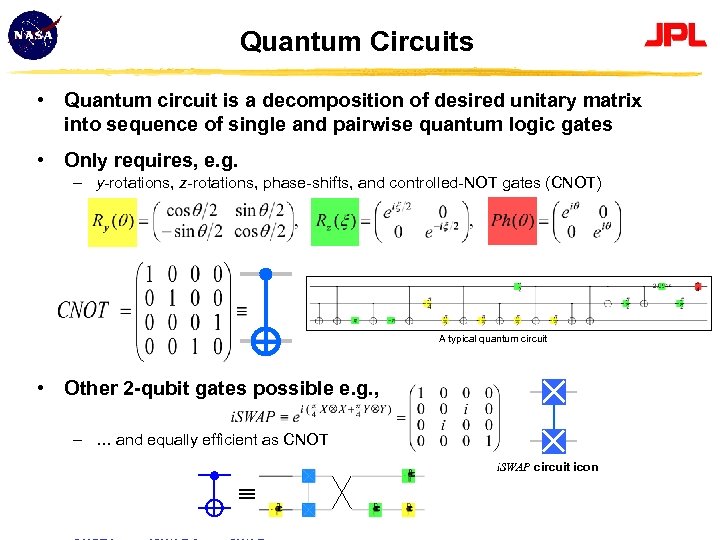 Quantum Circuits • Quantum circuit is a decomposition of desired unitary matrix into sequence of single and pairwise quantum logic gates • Only requires, e. g. – y-rotations, z-rotations, phase-shifts, and controlled-NOT gates (CNOT) A typical quantum circuit • Other 2 -qubit gates possible e. g. , – … and equally efficient as CNOT i. SWAP circuit icon
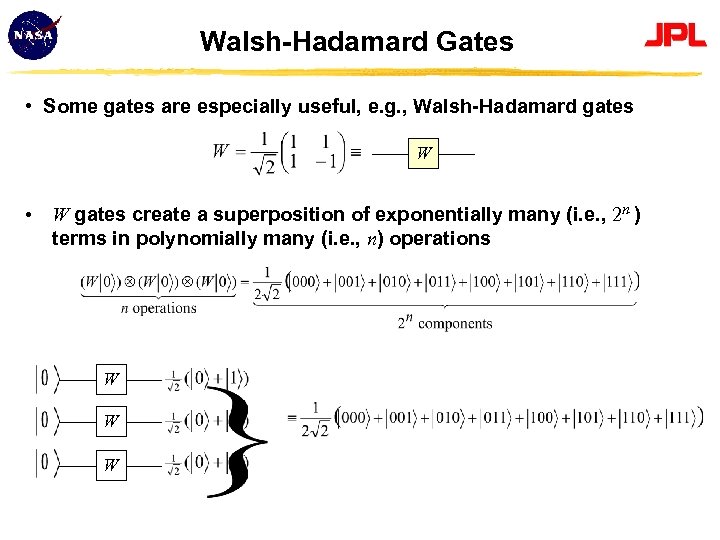 Walsh-Hadamard Gates • Some gates are especially useful, e. g. , Walsh-Hadamard gates W • W gates create a superposition of exponentially many (i. e. , 2 n ) terms in polynomially many (i. e. , n) operations W W W
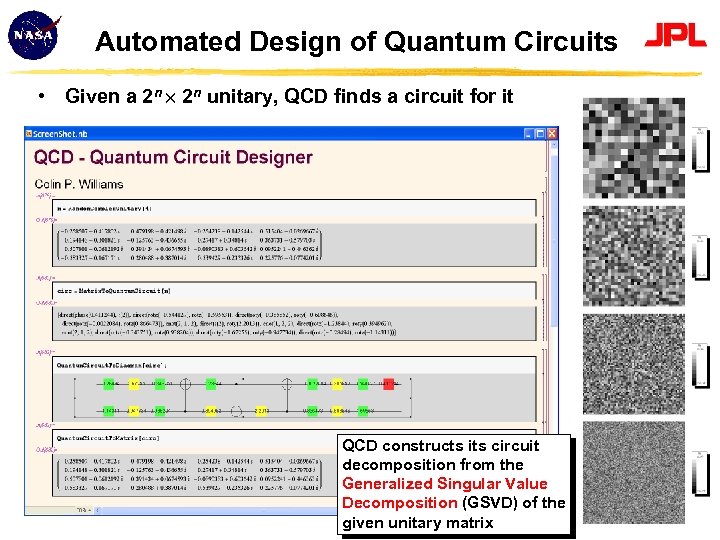 Automated Design of Quantum Circuits • Given a 2 n unitary, QCD finds a circuit for it QCD constructs its circuit decomposition from the Generalized Singular Value Decomposition (GSVD) of the given unitary matrix
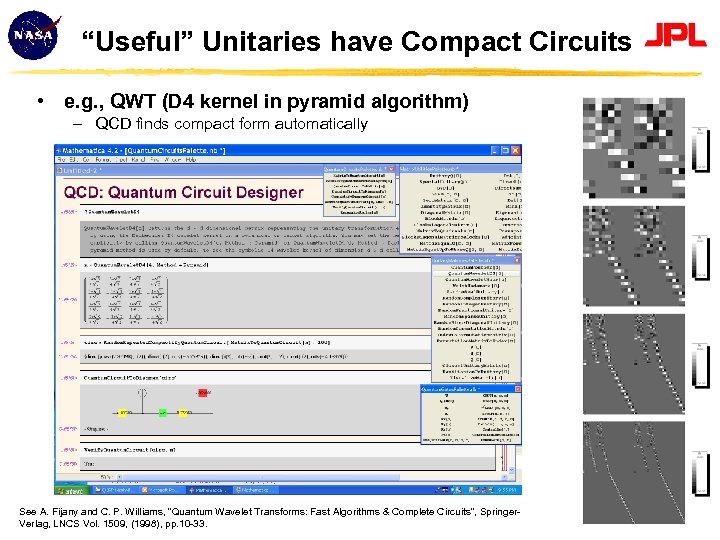 “Useful” Unitaries have Compact Circuits • e. g. , QWT (D 4 kernel in pyramid algorithm) – QCD finds compact form automatically See A. Fijany and C. P. Williams, “Quantum Wavelet Transforms: Fast Algorithms & Complete Circuits”, Springer. Verlag, LNCS Vol. 1509, (1998), pp. 10 -33.
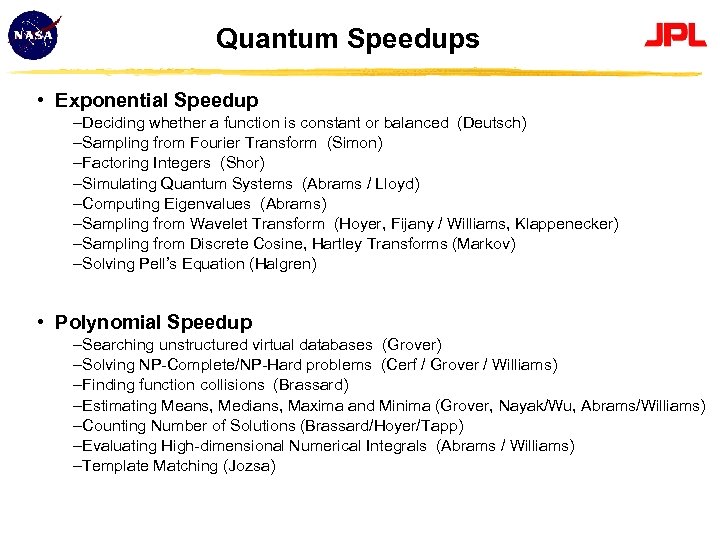 Quantum Speedups • Exponential Speedup –Deciding whether a function is constant or balanced (Deutsch) –Sampling from Fourier Transform (Simon) –Factoring Integers (Shor) –Simulating Quantum Systems (Abrams / Lloyd) –Computing Eigenvalues (Abrams) –Sampling from Wavelet Transform (Hoyer, Fijany / Williams, Klappenecker) –Sampling from Discrete Cosine, Hartley Transforms (Markov) –Solving Pell’s Equation (Halgren) • Polynomial Speedup –Searching unstructured virtual databases (Grover) –Solving NP-Complete/NP-Hard problems (Cerf / Grover / Williams) –Finding function collisions (Brassard) –Estimating Means, Medians, Maxima and Minima (Grover, Nayak/Wu, Abrams/Williams) –Counting Number of Solutions (Brassard/Hoyer/Tapp) –Evaluating High-dimensional Numerical Integrals (Abrams / Williams) –Template Matching (Jozsa)
 Quantum Signal, Image and Data Processing
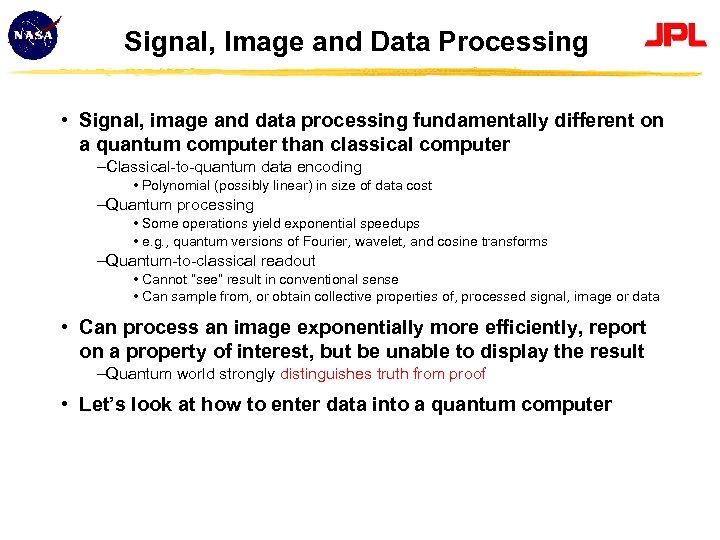 Signal, Image and Data Processing • Signal, image and data processing fundamentally different on a quantum computer than classical computer –Classical-to-quantum data encoding • Polynomial (possibly linear) in size of data cost –Quantum processing • Some operations yield exponential speedups • e. g. , quantum versions of Fourier, wavelet, and cosine transforms –Quantum-to-classical readout • Cannot “see” result in conventional sense • Can sample from, or obtain collective properties of, processed signal, image or data • Can process an image exponentially more efficiently, report on a property of interest, but be unable to display the result –Quantum world strongly distinguishes truth from proof • Let’s look at how to enter data into a quantum computer
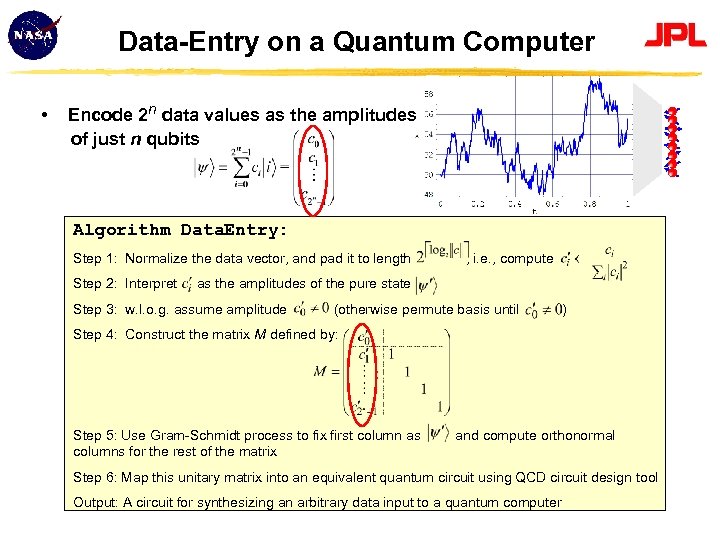 Data-Entry on a Quantum Computer • Encode 2 n data values as the amplitudes of just n qubits Algorithm Data. Entry: Step 1: Normalize the data vector, and pad it to length Step 2: Interpret , i. e. , compute as the amplitudes of the pure state Step 3: w. l. o. g. assume amplitude (otherwise permute basis until ) Step 4: Construct the matrix M defined by: Step 5: Use Gram-Schmidt process to fix first column as columns for the rest of the matrix and compute orthonormal Step 6: Map this unitary matrix into an equivalent quantum circuit using QCD circuit design tool Output: A circuit for synthesizing an arbitrary data input to a quantum computer
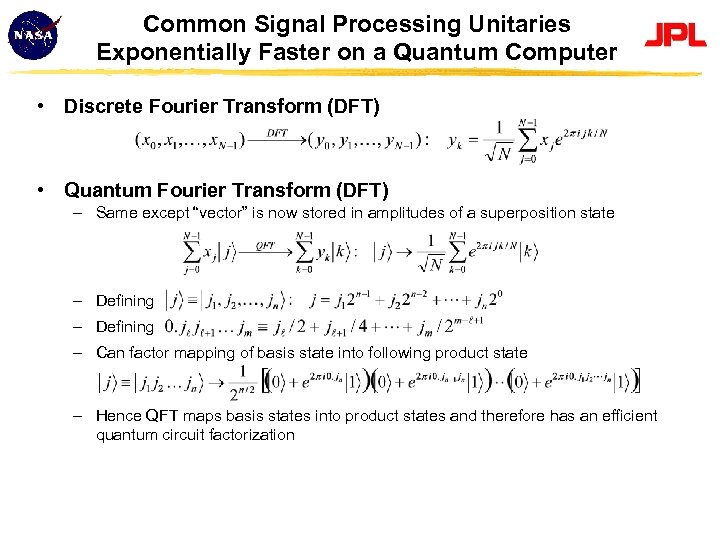 Common Signal Processing Unitaries Exponentially Faster on a Quantum Computer • Discrete Fourier Transform (DFT) • Quantum Fourier Transform (DFT) – Same except “vector” is now stored in amplitudes of a superposition state – Defining – Can factor mapping of basis state into following product state – Hence QFT maps basis states into product states and therefore has an efficient quantum circuit factorization
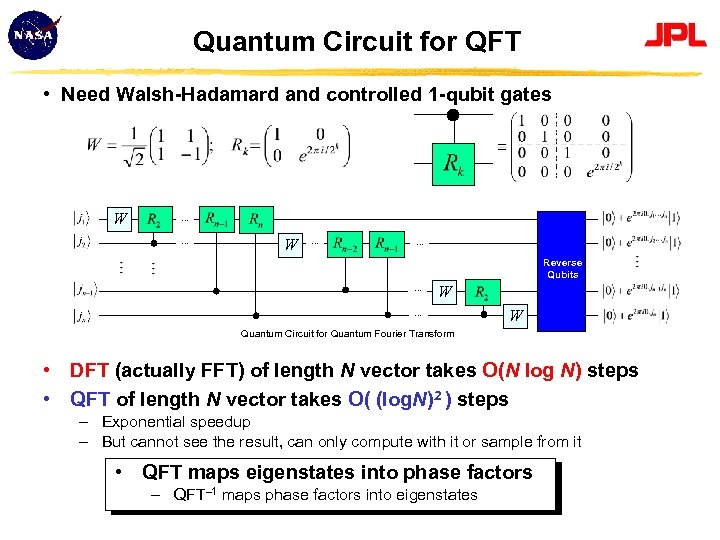 Quantum Circuit for QFT • Need Walsh-Hadamard and controlled 1 -qubit gates W … … Reverse Qubits … W Quantum Circuit for Quantum Fourier Transform • DFT (actually FFT) of length N vector takes O(N log N) steps • QFT of length N vector takes O( (log. N)2 ) steps – Exponential speedup – But cannot see the result, can only compute with it or sample from it • QFT maps eigenstates into phase factors – QFT 1 maps phase factors into eigenstates
 Quantum Algorithms for NP-Complete Problems
 Foundation is Quantum Search Algorithm • Invented by Lov Grover, Bell Labs, in 1996 –L. Grover, “A Fast Quantum Mechanical Algorithm for Database Search”, in Proceedings of the 28 th Annual ACM Symposium on the Theory of Computing (1996) pp 212 -219. –G. Brassard, “Searching a Quantum Phone Book”, Science, January 31 st (1997) pp. 627 -628. • Problem: Find the name of the person in a (virtual) telephone directory who has a prescribed telephone number –Suppose N entries in directory –Classical: need O(N) queries in worst case –Quantum: need O(N 1/2) queries in worst case • Gives polynomial speedup • Use as subroutine in higher-level quantum algorithms • To use quantum search to search real datasets must … –Replace the “oracle” in Grover’s original algorithm with a polynomial cost tester circuit (returns true if input is a solution, false otherwise)
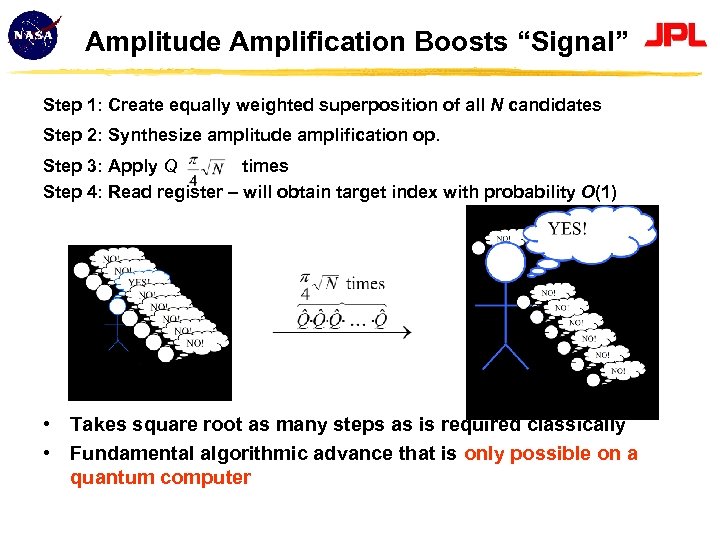 Amplitude Amplification Boosts “Signal” Step 1: Create equally weighted superposition of all N candidates Step 2: Synthesize amplitude amplification op. Step 3: Apply Q times Step 4: Read register – will obtain target index with probability O(1) • Takes square root as many steps as is required classically • Fundamental algorithmic advance that is only possible on a quantum computer
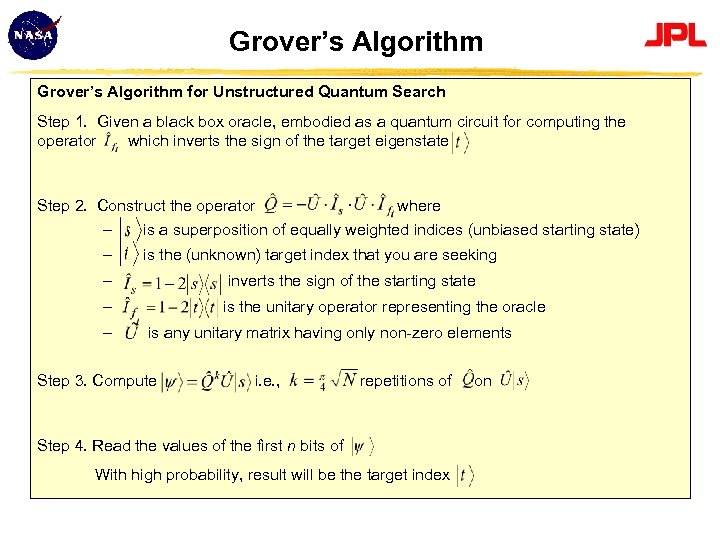 Grover’s Algorithm for Unstructured Quantum Search Step 1. Given a black box oracle, embodied as a quantum circuit for computing the operator which inverts the sign of the target eigenstate Step 2. Construct the operator where – is a superposition of equally weighted indices (unbiased starting state) – is the (unknown) target index that you are seeking – inverts the sign of the starting state – is the unitary operator representing the oracle – is any unitary matrix having only non-zero elements Step 3. Compute i. e. , repetitions of Step 4. Read the values of the first n bits of With high probability, result will be the target index on
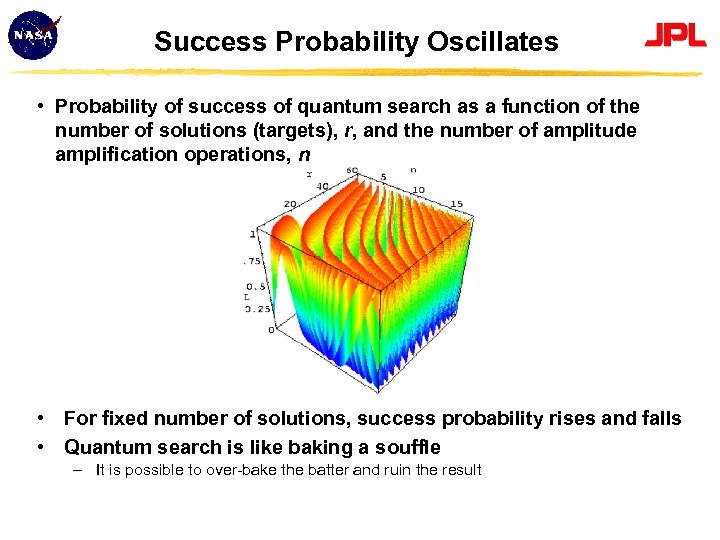 Success Probability Oscillates • Probability of success of quantum search as a function of the number of solutions (targets), r, and the number of amplitude amplification operations, n • For fixed number of solutions, success probability rises and falls • Quantum search is like baking a souffle – It is possible to over-bake the batter and ruin the result
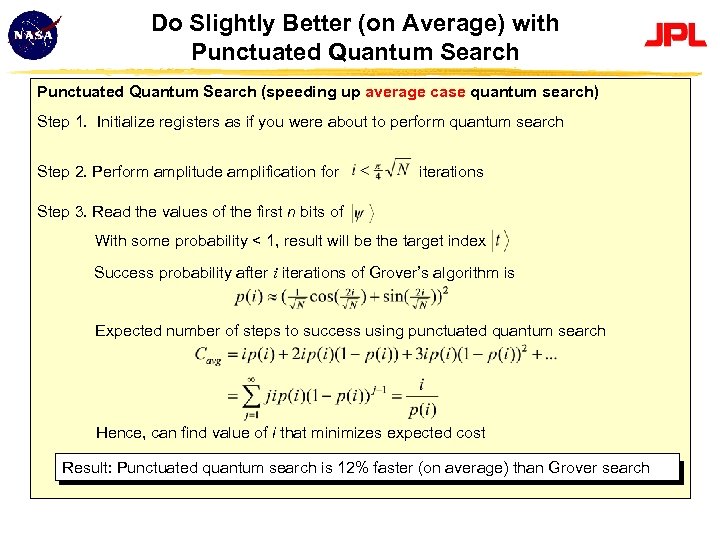 Do Slightly Better (on Average) with Punctuated Quantum Search (speeding up average case quantum search) Step 1. Initialize registers as if you were about to perform quantum search Step 2. Perform amplitude amplification for iterations Step 3. Read the values of the first n bits of With some probability < 1, result will be the target index Success probability after i iterations of Grover’s algorithm is Expected number of steps to success using punctuated quantum search Hence, can find value of i that minimizes expected cost Result: Punctuated quantum search is 12% faster (on average) than Grover search
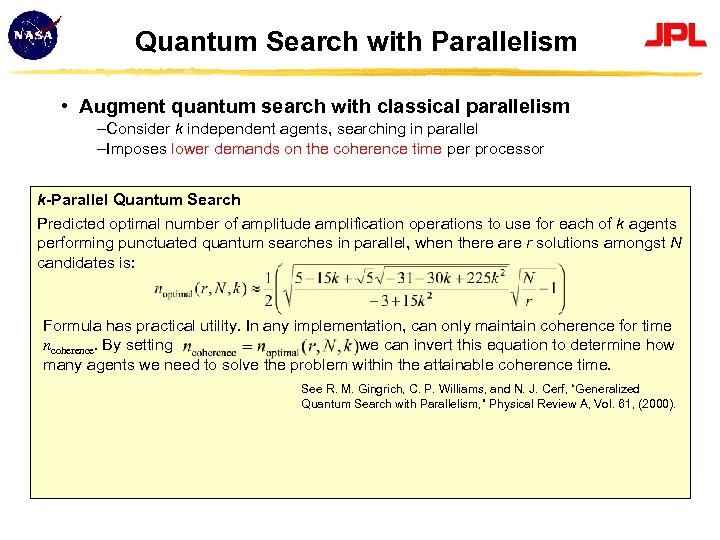 Quantum Search with Parallelism • Augment quantum search with classical parallelism –Consider k independent agents, searching in parallel –Imposes lower demands on the coherence time per processor k-Parallel Quantum Search Predicted optimal number of amplitude amplification operations to use for each of k agents performing punctuated quantum searches in parallel, when there are r solutions amongst N candidates is: Formula has practical utility. In any implementation, can only maintain coherence for time ncoherence. By setting we can invert this equation to determine how many agents we need to solve the problem within the attainable coherence time. See R. M. Gingrich, C. P. Williams, and N. J. Cerf, “Generalized Quantum Search with Parallelism, ” Physical Review A, Vol. 61, (2000).
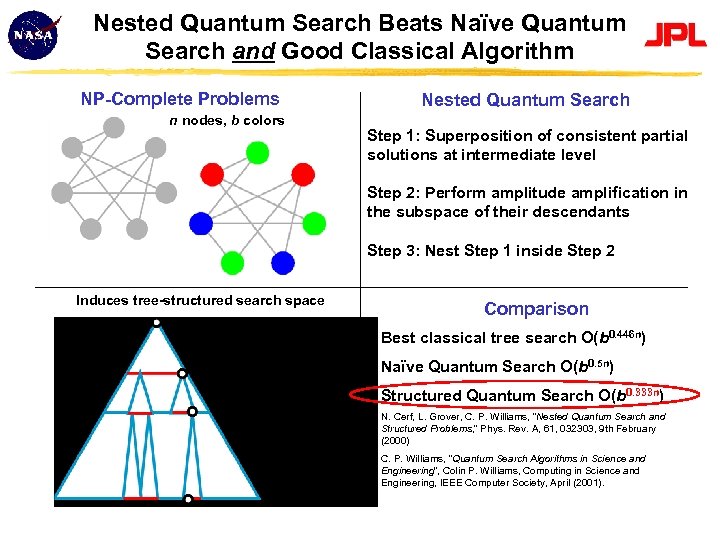 Nested Quantum Search Beats Naïve Quantum Search and Good Classical Algorithm NP-Complete Problems n nodes, b colors Nested Quantum Search Step 1: Superposition of consistent partial solutions at intermediate level Step 2: Perform amplitude amplification in the subspace of their descendants Step 3: Nest Step 1 inside Step 2 Induces tree-structured search space Comparison • Best classical tree search O(b 0. 446 n) • Naïve Quantum Search O(b 0. 5 n) • Structured Quantum Search O(b 0. 333 n) • N. Cerf, L. Grover, C. P. Williams, “Nested Quantum Search and Structured Problems, ” Phys. Rev. A, 61, 032303, 9 th February (2000) • C. P. Williams, “Quantum Search Algorithms in Science and Engineering”, Colin P. Williams, Computing in Science and Engineering, IEEE Computer Society, April (2001).
 Quantum Simulation
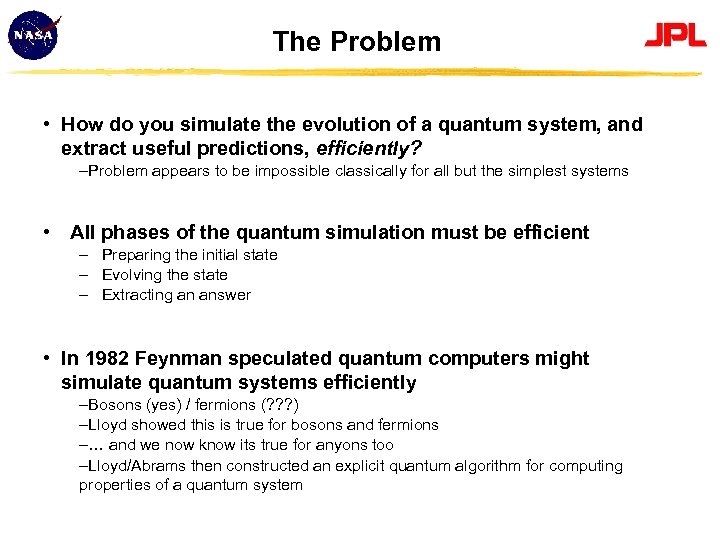 The Problem • How do you simulate the evolution of a quantum system, and extract useful predictions, efficiently? –Problem appears to be impossible classically for all but the simplest systems • All phases of the quantum simulation must be efficient – Preparing the initial state – Evolving the state – Extracting an answer • In 1982 Feynman speculated quantum computers might simulate quantum systems efficiently –Bosons (yes) / fermions (? ? ? ) –Lloyd showed this is true for bosons and fermions –… and we now know its true for anyons too –Lloyd/Abrams then constructed an explicit quantum algorithm for computing properties of a quantum system
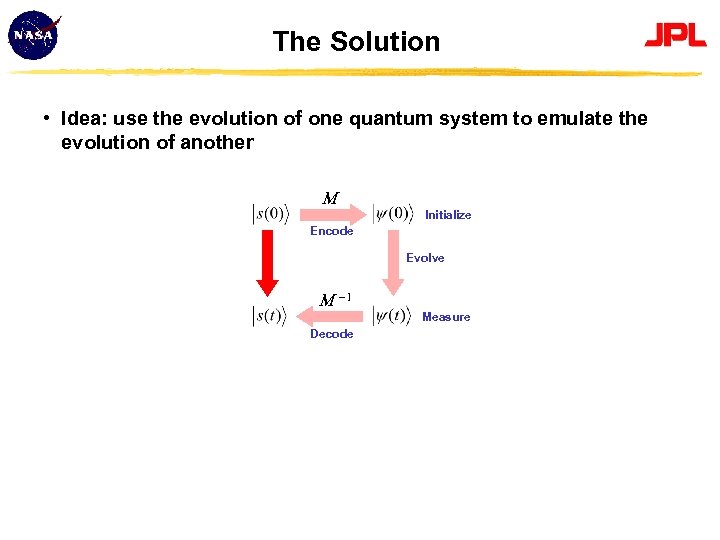 The Solution • Idea: use the evolution of one quantum system to emulate the evolution of another M Initialize Encode Evolve M 1 Decode Measure
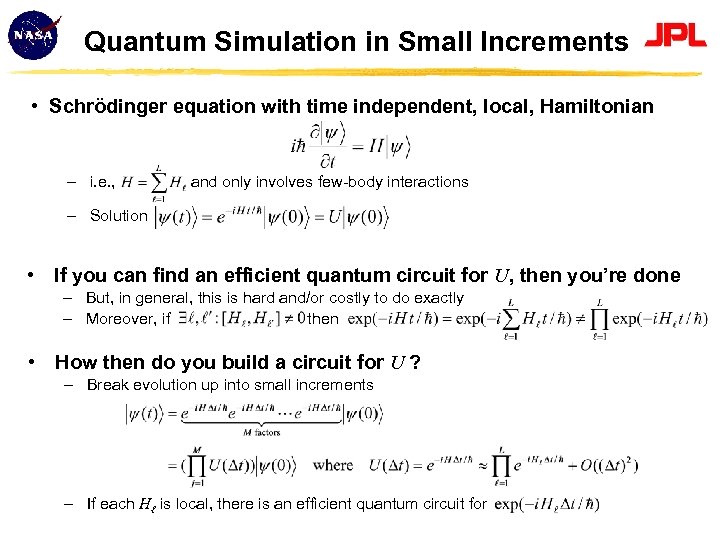 Quantum Simulation in Small Increments • Schrödinger equation with time independent, local, Hamiltonian – i. e. , and only involves few-body interactions – Solution • If you can find an efficient quantum circuit for U, then you’re done – But, in general, this is hard and/or costly to do exactly – Moreover, if then • How then do you build a circuit for U ? – Break evolution up into small increments – If each Hℓ is local, there is an efficient quantum circuit for
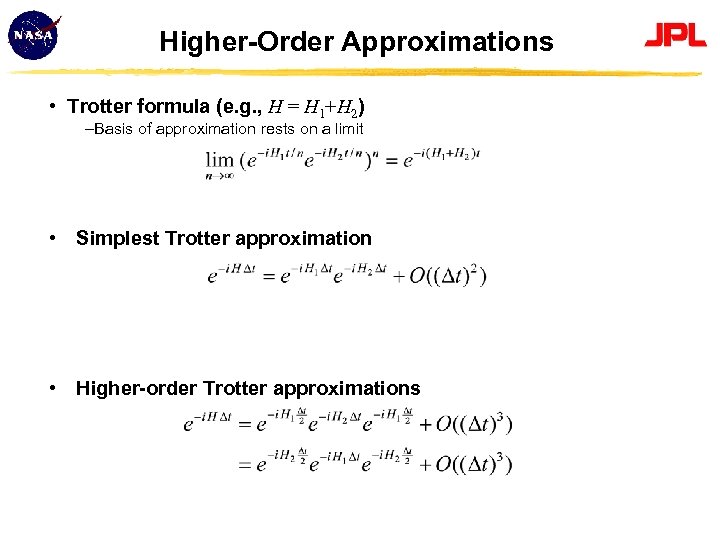 Higher-Order Approximations • Trotter formula (e. g. , H = H 1+H 2) –Basis of approximation rests on a limit • Simplest Trotter approximation • Higher-order Trotter approximations
 Extracting Answers Efficiently from Quantum Simulations
 Extracting Answers from Quantum Simulations • You cannot “read” the answer, i. e. , the full solution –It is stored in a quantum state –If you try to read it, you collapse the state • What can you do with it? –You can sample from it –You can repeat the simulation and perform state tomography to estimate –… but this is likely to be inefficient –You can use it as an input to another quantum algorithm (the key!!) • If we feed into another quantum algorithm, we can … –Obtain mean values of operators efficiently –Calculate correlation functions –Measure (some) spectral properties –Estimate a ground state eigenvalue / eigenvector
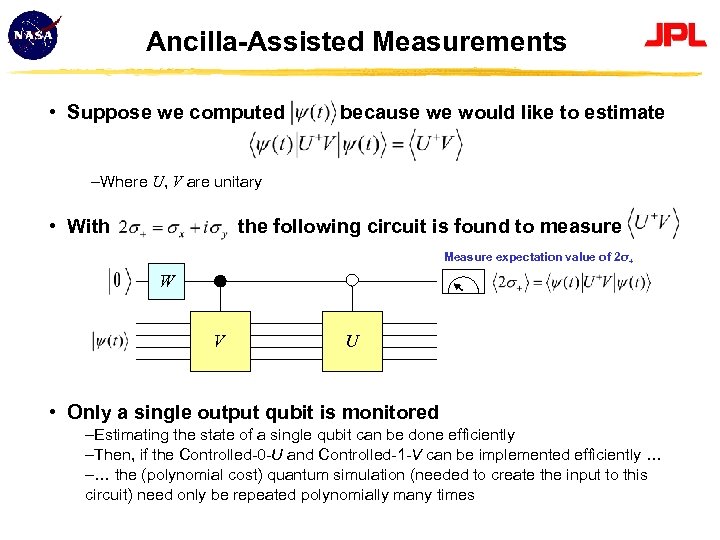 Ancilla-Assisted Measurements • Suppose we computed because we would like to estimate –Where U, V are unitary • With the following circuit is found to measure Measure expectation value of 2σ+ W V U • Only a single output qubit is monitored –Estimating the state of a single qubit can be done efficiently –Then, if the Controlled-0 -U and Controlled-1 -V can be implemented efficiently … –… the (polynomial cost) quantum simulation (needed to create the input to this circuit) need only be repeated polynomially many times
![Tomography c. f. Spectroscopy • Circuits for measuring Re[Tr(ρU)] and Im[Tr(ρU)] for any unitary](https://present5.com/presentation/a89626f87d3a629c187670f0c2a49cfb/image-35.jpg "Tomography c. f. Spectroscopy • Circuits for measuring Re[Tr(ρU)] and Im[Tr(ρU)] for any unitary") Tomography c. f. Spectroscopy • Circuits for measuring Re[Tr(ρU)] and Im[Tr(ρU)] for any unitary operator U –Find and Measure expectation value of σz W W U • N. B. polarization measurement reveals a property that depends on both ρ and U –Hence can use this circuit to extract information about ρ is U is known (tomography) –Or to extract information about U if ρ is known (spectroscopy)
Tomography c. f. Spectroscopy • Circuits for measuring Re[Tr(ρU)] and Im[Tr(ρU)] for any unitary operator U –Find and Measure expectation value of σz W W U • N. B. polarization measurement reveals a property that depends on both ρ and U –Hence can use this circuit to extract information about ρ is U is known (tomography) –Or to extract information about U if ρ is known (spectroscopy)
 Quantum Algorithm VI Eigenvalue Estimation “…quantum computers of tens to hundreds of qubits can match and exceed the capabilities of classical full configuration interaction (FCI) calculations” Prof. A. Aspuru-Guzik, Dept. Chemistry UC Berkeley
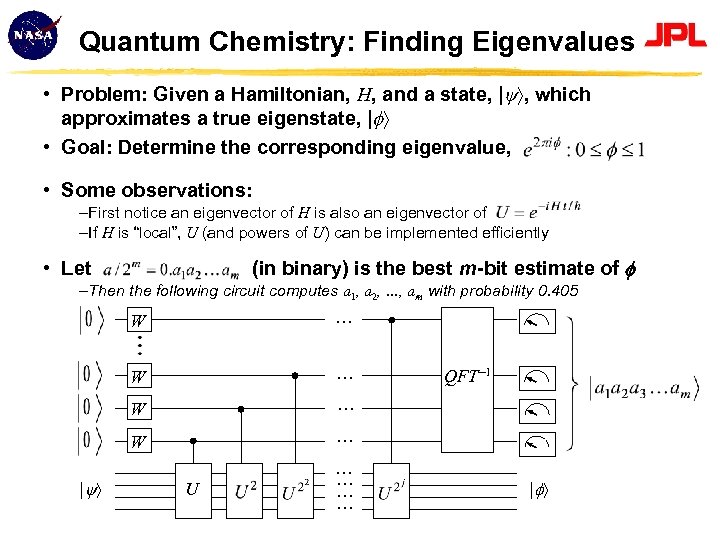 Quantum Chemistry: Finding Eigenvalues • Problem: Given a Hamiltonian, H, and a state, | , which approximates a true eigenstate, | • Goal: Determine the corresponding eigenvalue, • Some observations: –First notice an eigenvector of H is also an eigenvector of –If H is “local”, U (and powers of U) can be implemented efficiently (in binary) is the best m-bit estimate of • Let –Then the following circuit computes a 1, a 2, …, am with probability 0. 405 W W | U QFT 1 |
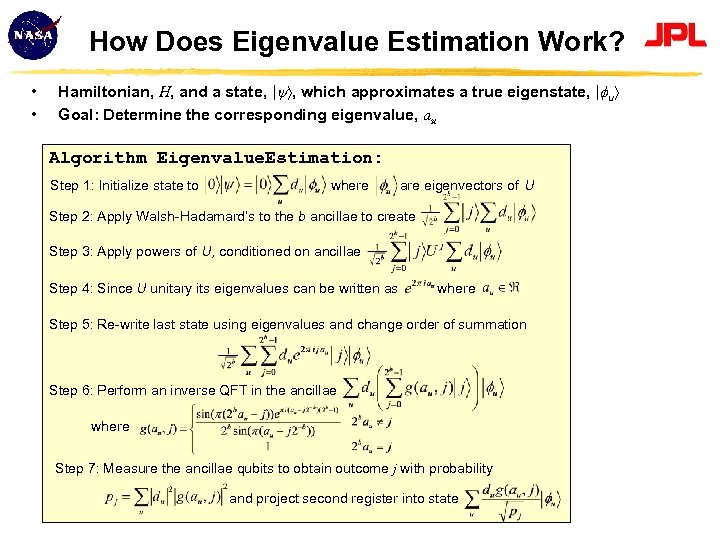 How Does Eigenvalue Estimation Work? • • Hamiltonian, H, and a state, | , which approximates a true eigenstate, | u Goal: Determine the corresponding eigenvalue, au Algorithm Eigenvalue. Estimation: Step 1: Initialize state to where are eigenvectors of U Step 2: Apply Walsh-Hadamard’s to the b ancillae to create Step 3: Apply powers of U, conditioned on ancillae Step 4: Since U unitary its eigenvalues can be written as where Step 5: Re-write last state using eigenvalues and change order of summation Step 6: Perform an inverse QFT in the ancillae where Step 7: Measure the ancillae qubits to obtain outcome j with probability and project second register into state
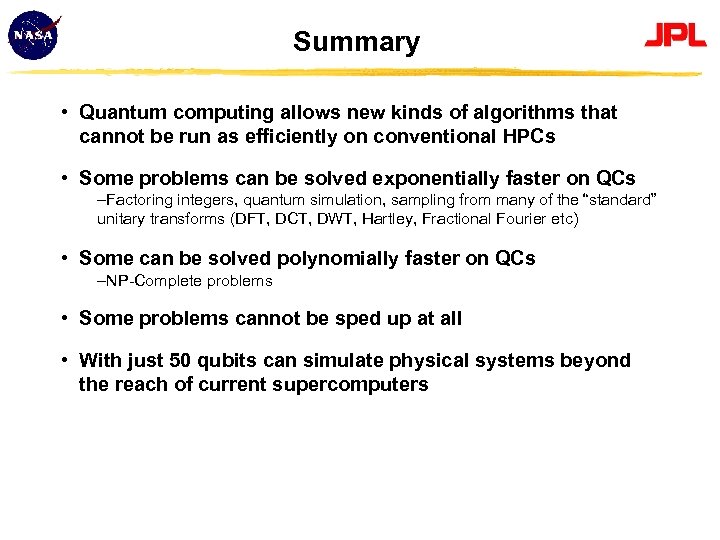 Summary • Quantum computing allows new kinds of algorithms that cannot be run as efficiently on conventional HPCs • Some problems can be solved exponentially faster on QCs –Factoring integers, quantum simulation, sampling from many of the “standard” unitary transforms (DFT, DCT, DWT, Hartley, Fractional Fourier etc) • Some can be solved polynomially faster on QCs –NP-Complete problems • Some problems cannot be sped up at all • With just 50 qubits can simulate physical systems beyond the reach of current supercomputers
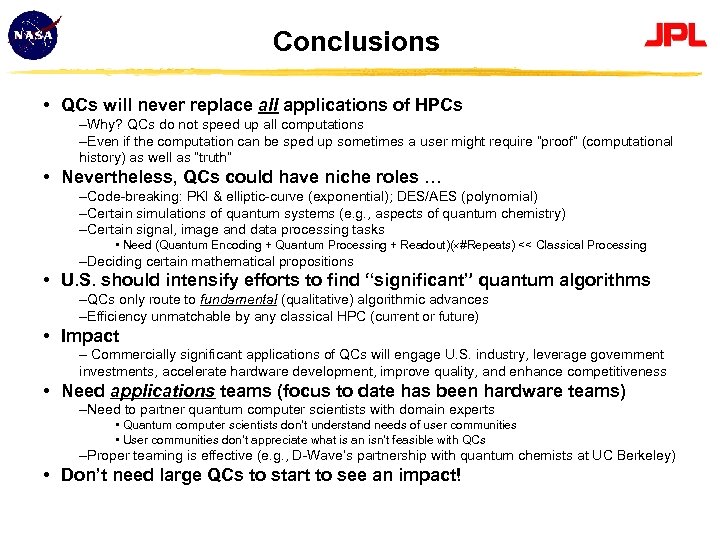 Conclusions • QCs will never replace all applications of HPCs –Why? QCs do not speed up all computations –Even if the computation can be sped up sometimes a user might require “proof” (computational history) as well as “truth” • Nevertheless, QCs could have niche roles … –Code-breaking: PKI & elliptic-curve (exponential); DES/AES (polynomial) –Certain simulations of quantum systems (e. g. , aspects of quantum chemistry) –Certain signal, image and data processing tasks • Need (Quantum Encoding + Quantum Processing + Readout)( #Repeats) << Classical Processing –Deciding certain mathematical propositions • U. S. should intensify efforts to find “significant” quantum algorithms –QCs only route to fundamental (qualitative) algorithmic advances –Efficiency unmatchable by any classical HPC (current or future) • Impact – Commercially significant applications of QCs will engage U. S. industry, leverage government investments, accelerate hardware development, improve quality, and enhance competitiveness • Need applications teams (focus to date has been hardware teams) –Need to partner quantum computer scientists with domain experts • Quantum computer scientists don’t understand needs of user communities • User communities don’t appreciate what is an isn’t feasible with QCs –Proper teaming is effective (e. g. , D-Wave’s partnership with quantum chemists at UC Berkeley) • Don’t need large QCs to start to see an impact!
 Quantum Algorithm I Shor’s Algorithm for Factoring Composite Integers
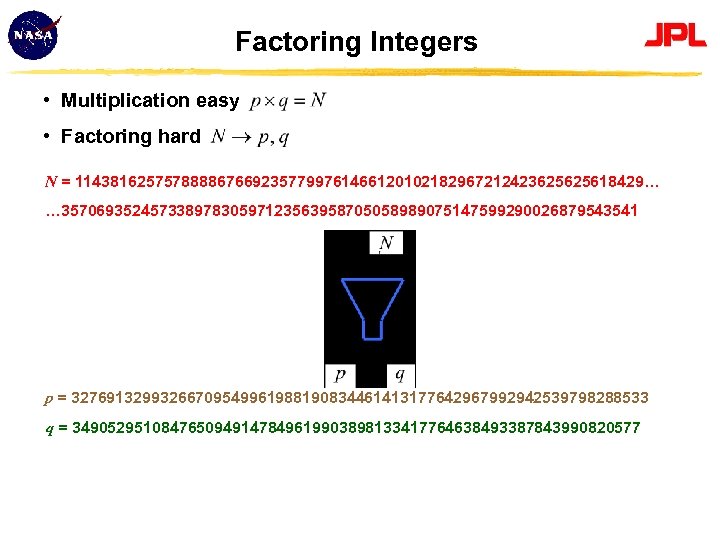 Factoring Integers • Multiplication easy • Factoring hard N = 1143816257578888676692357799761466120102182967212423625625618429… … 35706935245733897830597123563958705058989075147599290026879543541 p = 32769132993266709549961988190834461413177642967992942539798288533 q = 3490529510847650949147849619903898133417764638493387843990820577
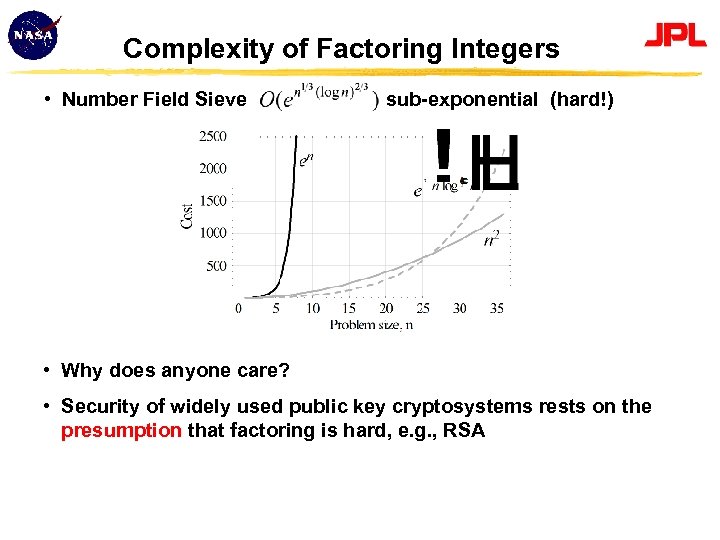 Complexity of Factoring Integers • Number Field Sieve sub-exponential (hard!) • Why does anyone care? • Security of widely used public key cryptosystems rests on the presumption that factoring is hard, e. g. , RSA
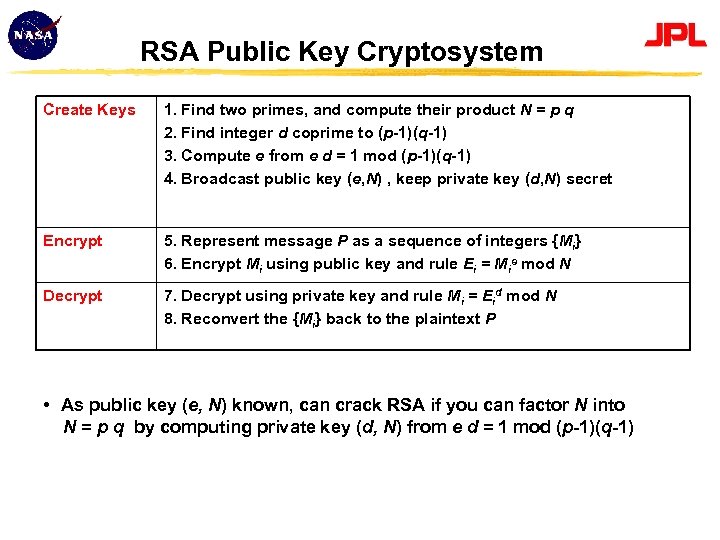 RSA Public Key Cryptosystem Create Keys 1. Find two primes, and compute their product N = p q 2. Find integer d coprime to (p-1)(q-1) 3. Compute e from e d = 1 mod (p-1)(q-1) 4. Broadcast public key (e, N) , keep private key (d, N) secret Encrypt 5. Represent message P as a sequence of integers {Mi} 6. Encrypt Mi using public key and rule Ei = Mie mod N Decrypt 7. Decrypt using private key and rule Mi = Eid mod N 8. Reconvert the {Mi} back to the plaintext P • As public key (e, N) known, can crack RSA if you can factor N into N = p q by computing private key (d, N) from e d = 1 mod (p-1)(q-1)
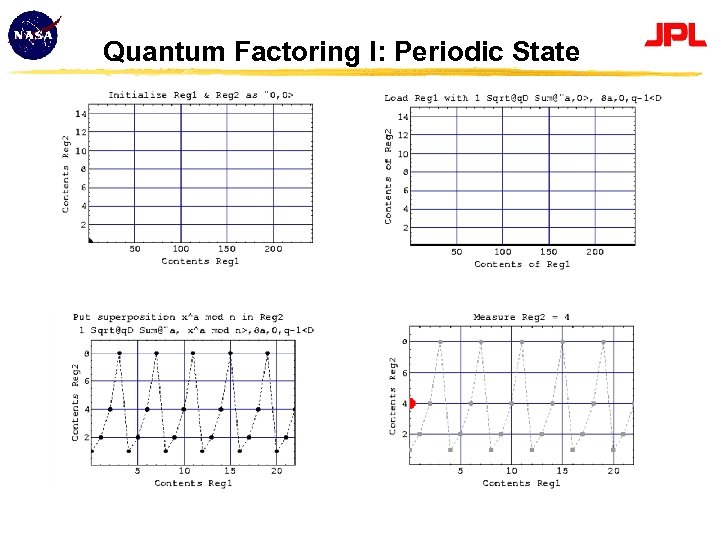
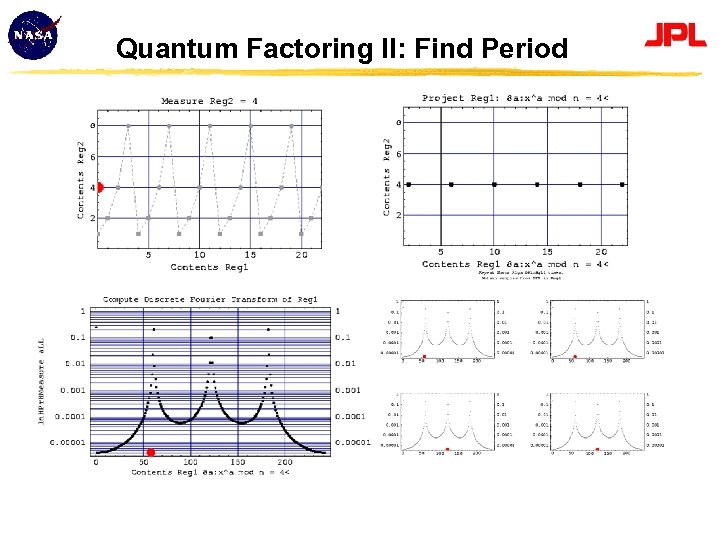
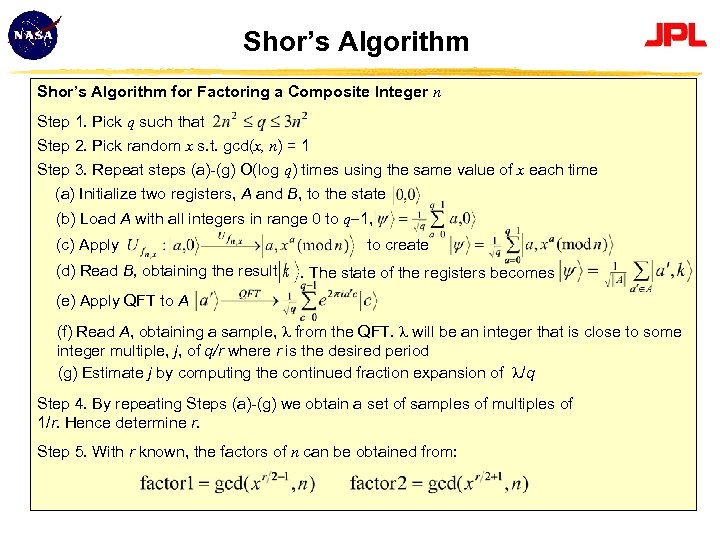
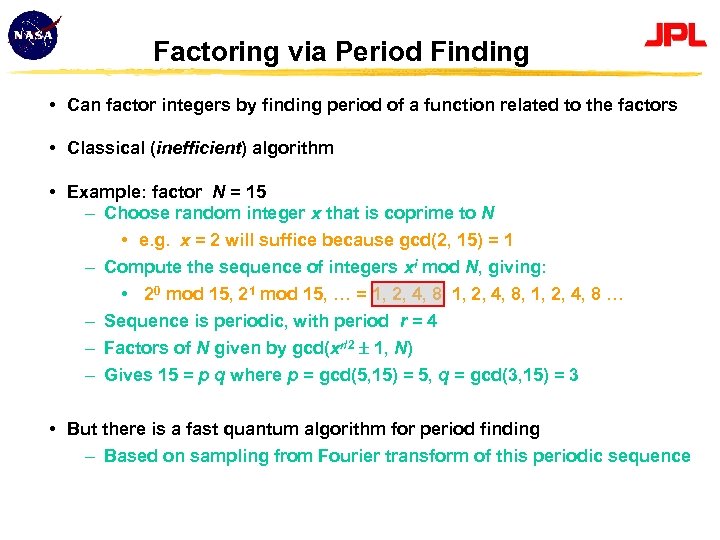 Factoring via Period Finding • Can factor integers by finding period of a function related to the factors • Classical (inefficient) algorithm • Example: factor N = 15 Choose random integer x that is coprime to N • e. g. x = 2 will suffice because gcd(2, 15) = 1 Compute the sequence of integers xi mod N, giving: • 20 mod 15, 21 mod 15, … = 1, 2, 4, 8, 1, 2, 4, 8 … Sequence is periodic, with period r = 4 Factors of N given by gcd(xr/2 1, N) Gives 15 = p q where p = gcd(5, 15) = 5, q = gcd(3, 15) = 3 • But there is a fast quantum algorithm for period finding Based on sampling from Fourier transform of this periodic sequence
 Quantum Factoring I: Periodic State
 Quantum Factoring II: Find Period
 Shor’s Algorithm for Factoring a Composite Integer n Step 1. Pick q such that Step 2. Pick random x s. t. gcd(x, n) = 1 Step 3. Repeat steps (a)-(g) O(log q) times using the same value of x each time (a) Initialize two registers, A and B, to the state (b) Load A with all integers in range 0 to q 1, (c) Apply (d) Read B, obtaining the result to create. The state of the registers becomes (e) Apply QFT to A (f) Read A, obtaining a sample, from the QFT. will be an integer that is close to some integer multiple, j, of q/r where r is the desired period (g) Estimate j by computing the continued fraction expansion of /q Step 4. By repeating Steps (a)-(g) we obtain a set of samples of multiples of 1/r. Hence determine r. Step 5. With r known, the factors of n can be obtained from: