


 Скачать презентацию Sciences What are the sciences What are the
Sciences.pptx
- Количество слайдов: 10
 Sciences What are the sciences? What are the process skills? Assessment criteria.
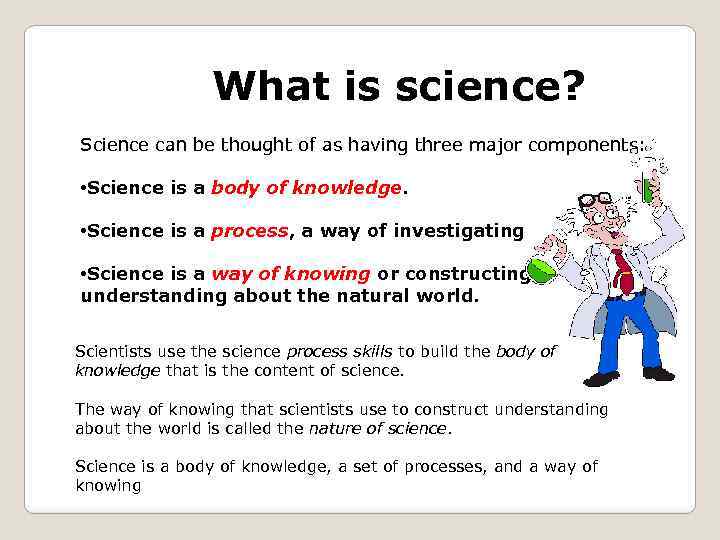 What is science? Science can be thought of as having three major components: • Science is a body of knowledge. • Science is a process, a way of investigating • Science is a way of knowing or constructing understanding about the natural world. Scientists use the science process skills to build the body of knowledge that is the content of science. The way of knowing that scientists use to construct understanding about the world is called the nature of science. Science is a body of knowledge, a set of processes, and a way of knowing
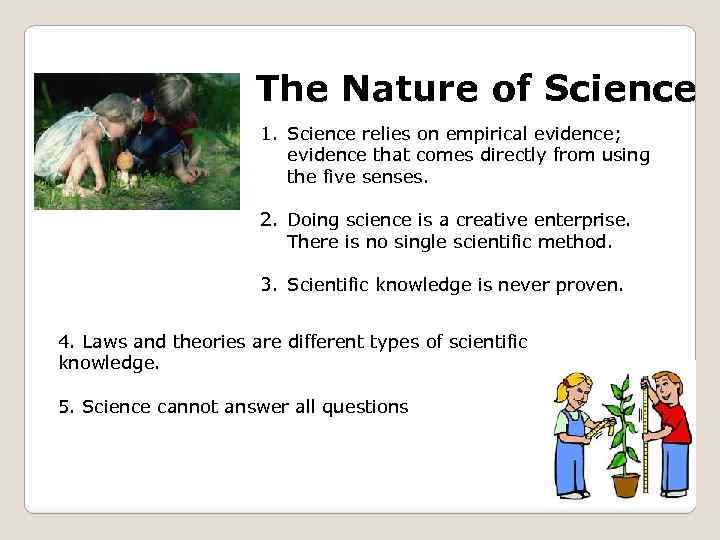 The Nature of Science 1. Science relies on empirical evidence; evidence that comes directly from using the five senses. 2. Doing science is a creative enterprise. There is no single scientific method. 3. Scientific knowledge is never proven. 4. Laws and theories are different types of scientific knowledge. 5. Science cannot answer all questions
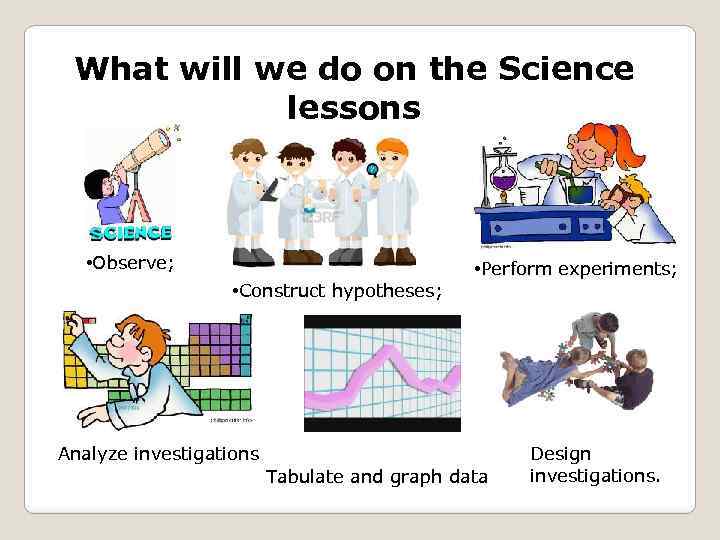 What will we do on the Science lessons • Observe; • Perform experiments; • Construct hypotheses; Analyze investigations Tabulate and graph data Design investigations.
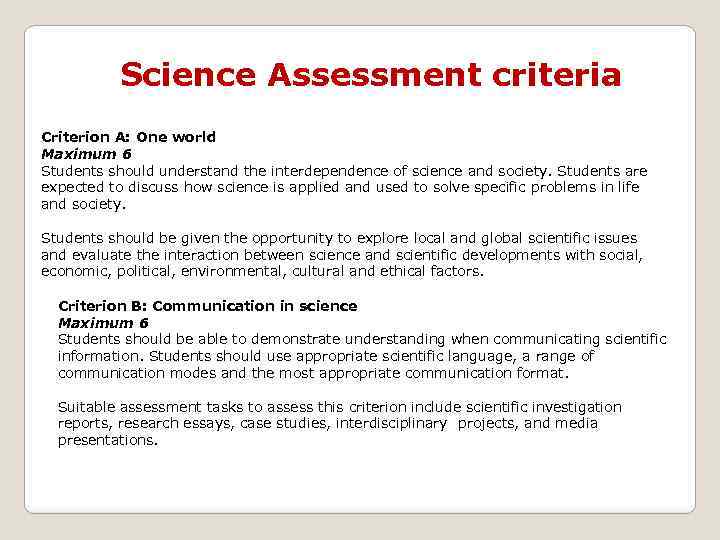 Science Assessment criteria Criterion A: One world Maximum 6 Students should understand the interdependence of science and society. Students are expected to discuss how science is applied and used to solve specific problems in life and society. Students should be given the opportunity to explore local and global scientific issues and evaluate the interaction between science and scientific developments with social, economic, political, environmental, cultural and ethical factors. Criterion B: Communication in science Maximum 6 Students should be able to demonstrate understanding when communicating scientific information. Students should use appropriate scientific language, a range of communication modes and the most appropriate communication format. Suitable assessment tasks to assess this criterion include scientific investigation reports, research essays, case studies, interdisciplinary projects, and media presentations.
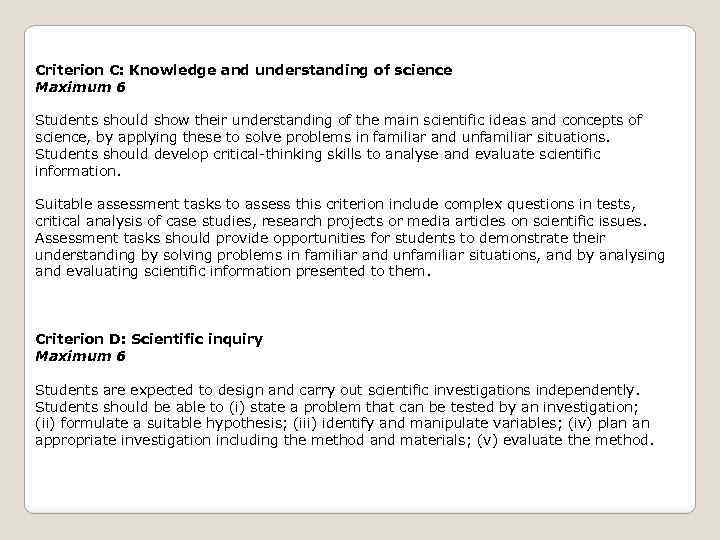 Criterion C: Knowledge and understanding of science Maximum 6 Students should show their understanding of the main scientific ideas and concepts of science, by applying these to solve problems in familiar and unfamiliar situations. Students should develop critical-thinking skills to analyse and evaluate scientific information. Suitable assessment tasks to assess this criterion include complex questions in tests, critical analysis of case studies, research projects or media articles on scientific issues. Assessment tasks should provide opportunities for students to demonstrate their understanding by solving problems in familiar and unfamiliar situations, and by analysing and evaluating scientific information presented to them. Criterion D: Scientific inquiry Maximum 6 Students are expected to design and carry out scientific investigations independently. Students should be able to (i) state a problem that can be tested by an investigation; (ii) formulate a suitable hypothesis; (iii) identify and manipulate variables; (iv) plan an appropriate investigation including the method and materials; (v) evaluate the method.
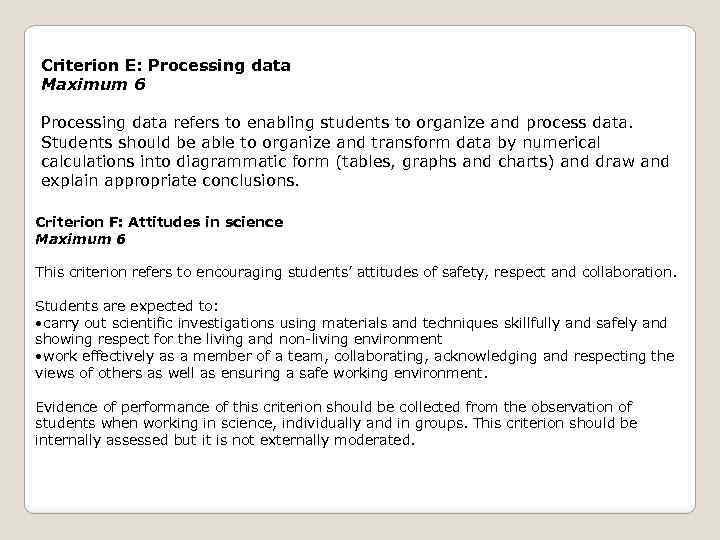 Criterion E: Processing data Maximum 6 Processing data refers to enabling students to organize and process data. Students should be able to organize and transform data by numerical calculations into diagrammatic form (tables, graphs and charts) and draw and explain appropriate conclusions. Criterion F: Attitudes in science Maximum 6 This criterion refers to encouraging students’ attitudes of safety, respect and collaboration. Students are expected to: • carry out scientific investigations using materials and techniques skillfully and safely and showing respect for the living and non-living environment • work effectively as a member of a team, collaborating, acknowledging and respecting the views of others as well as ensuring a safe working environment. Evidence of performance of this criterion should be collected from the observation of students when working in science, individually and in groups. This criterion should be internally assessed but it is not externally moderated.
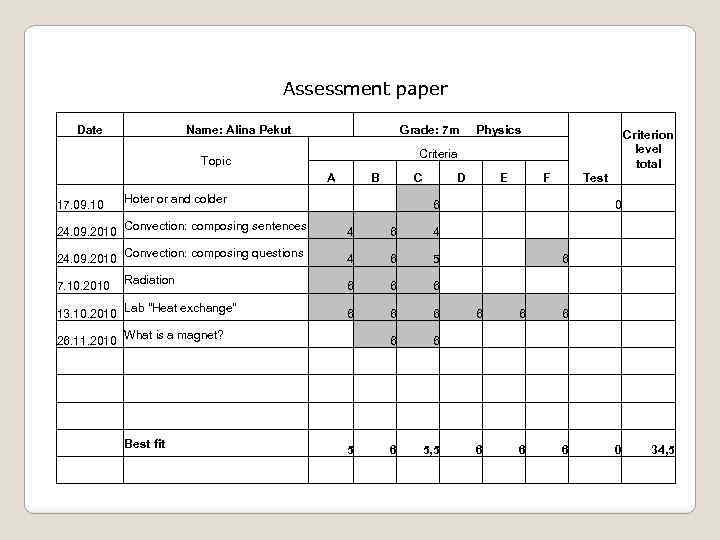 Assessment paper Date Name: Alina Pekut Grade: 7 m Physics Criteria Topic 17. 09. 10 24. 09. 2010 7. 10. 2010 13. 10. 2010 26. 11. 2010 A Hoter or and colder F 6 6 4 6 5 6 6 6 Test 6 6 0 6 6 Best fit E 6 Lab "Heat exchange" D 4 Radiation C 4 Convection: composing questions B Convection: composing sentences What is a magnet? Criterion level total 5 6 5, 5 6 6 6 0 34, 5
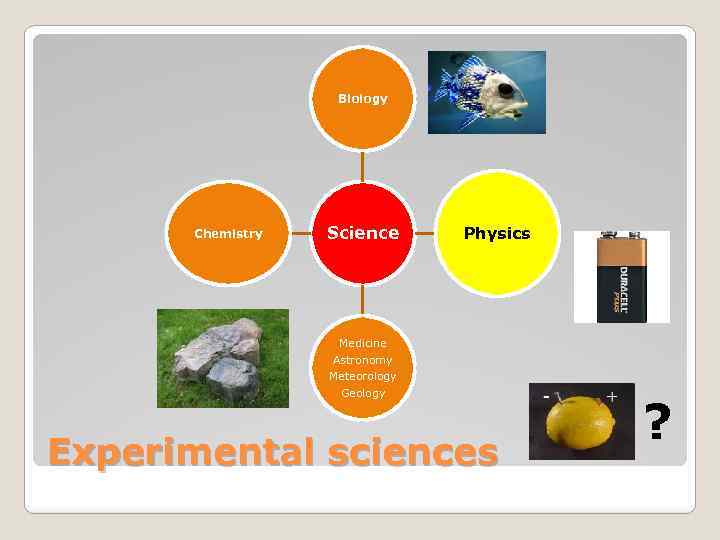 Biology Chemistry Science Physics Medicine Astronomy Meteorology Geology Experimental sciences ?
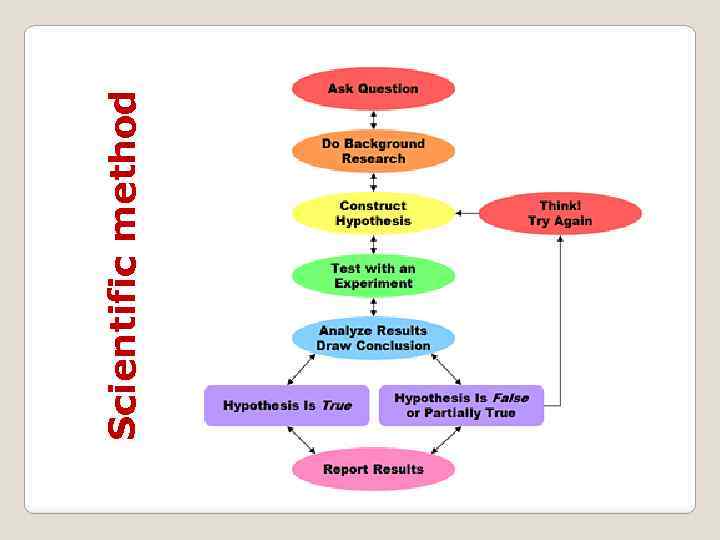 Scientific method