


 Скачать презентацию Science Technology Policy Institute Alternatives for Landmine
3345e0bb559ab49ed94d0e26638ee782.ppt
- Количество слайдов: 51
 Science & Technology Policy Institute Alternatives for Landmine Detection Jacqueline Mac. Donald J. R. Lockwood November 14, 2002 1 RAND
 Briefing Outline Science & Technology Policy Institute 1. Origins of this project 2. Project tasks and study method 3. Background on the scope of the landmine problem 4. Limitations of conventional mine detection technologies 5. Alternative mine detection technologies: capabilities and limitations 6. Recommendations for developing an advanced mine detection system 2 RAND
 Project Origins Science & Technology Policy Institute October 2001 memo from Gary Ellis to Helga Rippen, director of the Science and Technology Policy Institute (STPI): “With the number of buried mines exceeding 50 million worldwide, OSTP seeks an update on knowledge of how to clear these hazards. What new technologies are available? In specific, what is the best area of research and development to support, to make an order-ofmagnitude improvement in mine-clearing? ” 3 RAND
 Project Tasks Science & Technology Policy Institute 1. Identify antipersonnel mine detection technologies currently in the R&D stage. 2. Evaluate the potential for each to improve the reliability and safety, increase the speed, and decrease the costs of demining. 3. Identify any barriers to completing development of new technologies. 4. Recommend options for federal investments to speed development of key technologies. 5. Provide information on funding requirements to complete development of the new methods. 4 RAND
 Study Method Science & Technology Policy Institute Review literature on landmine detection technologies Identify leaders in the mine detection field Appoint Landmine Detection Task Force Identify innovative technologies (literature search and task force interviews) Identify two lead researchers on each technology Ask researchers to submit papers describing the potential of each technology (received 23 papers) 5 RAND
 Study Method (continued) Science & Technology Policy Institute 1. Meet with task force to review capabilities and limitations of each technology (two-day meeting held in May 2002) 2. Work with task force to refine evaluations and recommendations 3. Submit report to task force members for review 4. Submit report to additional peer reviewers who were not task force members 6 RAND
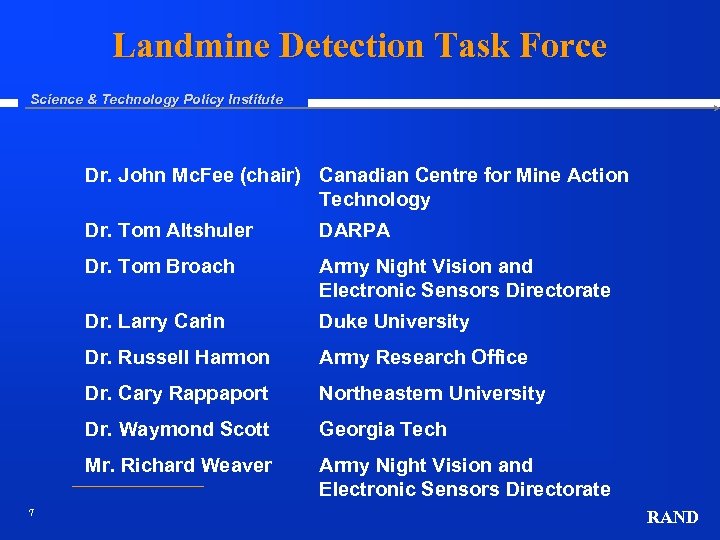 Landmine Detection Task Force Science & Technology Policy Institute Dr. John Mc. Fee (chair) Canadian Centre for Mine Action Technology Dr. Tom Altshuler Dr. Tom Broach Army Night Vision and Electronic Sensors Directorate Dr. Larry Carin Duke University Dr. Russell Harmon Army Research Office Dr. Cary Rappaport Northeastern University Dr. Waymond Scott Georgia Tech Mr. Richard Weaver 7 DARPA Army Night Vision and Electronic Sensors Directorate RAND
 Briefing Outline Science & Technology Policy Institute 1. Origins of this project 2. Project tasks and study method 3. Background on the scope of the landmine problem 4. Limitations of conventional mine detection technologies 5. Alternative mine detection technologies: capabilities and limitations 6. Recommendations for developing an advanced mine detection system 8 RAND
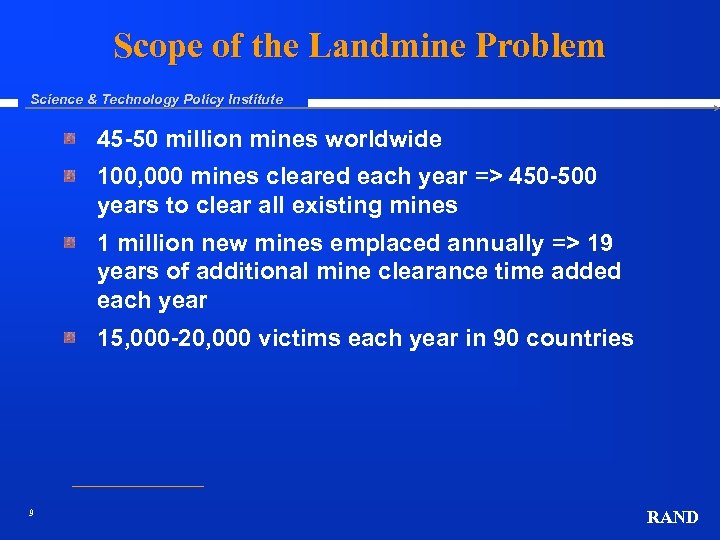 Scope of the Landmine Problem Science & Technology Policy Institute 45 -50 million mines worldwide 100, 000 mines cleared each year => 450 -500 years to clear all existing mines 1 million new mines emplaced annually => 19 years of additional mine clearance time added each year 15, 000 -20, 000 victims each year in 90 countries 9 RAND
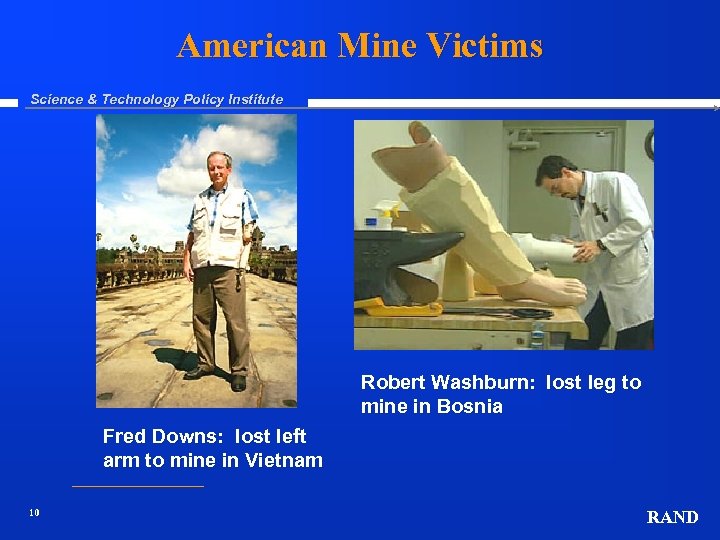 American Mine Victims Science & Technology Policy Institute Robert Washburn: lost leg to mine in Bosnia Fred Downs: lost left arm to mine in Vietnam 10 RAND
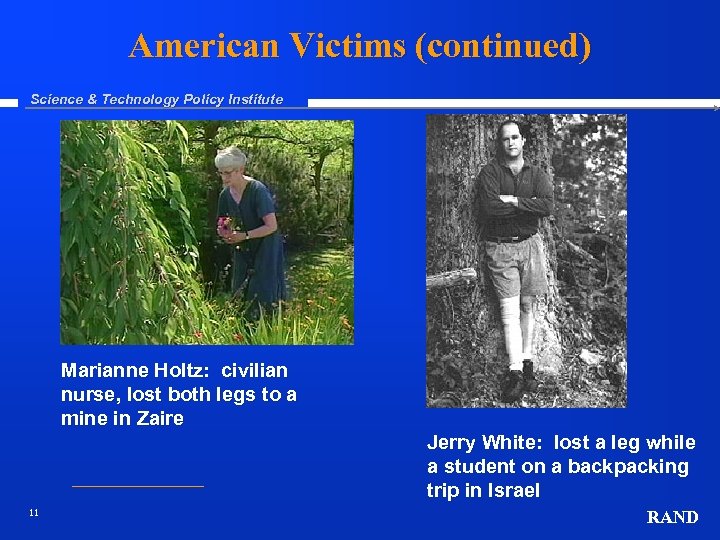 American Victims (continued) Science & Technology Policy Institute Marianne Holtz: civilian nurse, lost both legs to a mine in Zaire Jerry White: lost a leg while a student on a backpacking trip in Israel 11 RAND
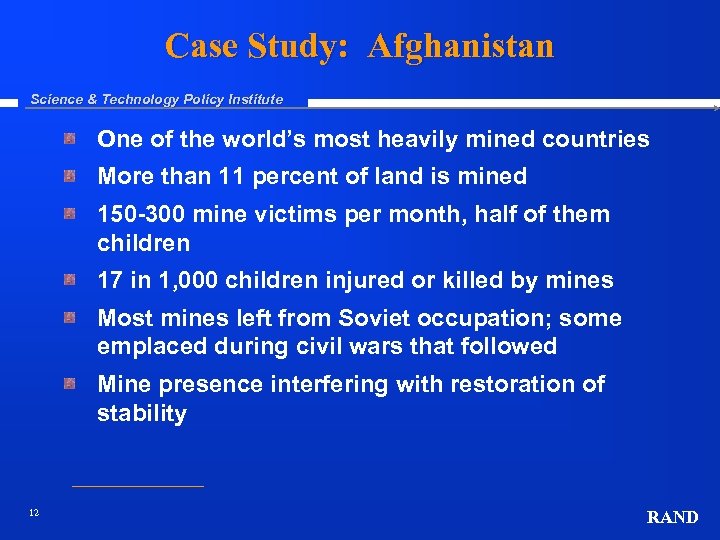 Case Study: Afghanistan Science & Technology Policy Institute One of the world’s most heavily mined countries More than 11 percent of land is mined 150 -300 mine victims per month, half of them children 17 in 1, 000 children injured or killed by mines Most mines left from Soviet occupation; some emplaced during civil wars that followed Mine presence interfering with restoration of stability 12 RAND
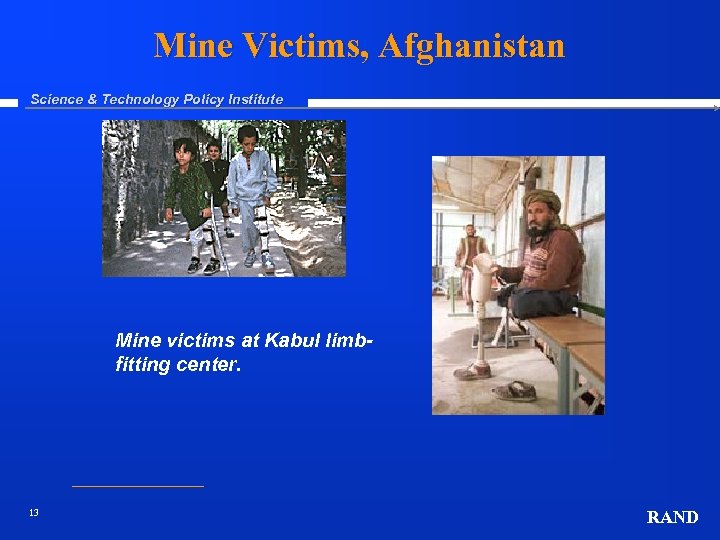 Mine Victims, Afghanistan Science & Technology Policy Institute Mine victims at Kabul limbfitting center. 13 RAND
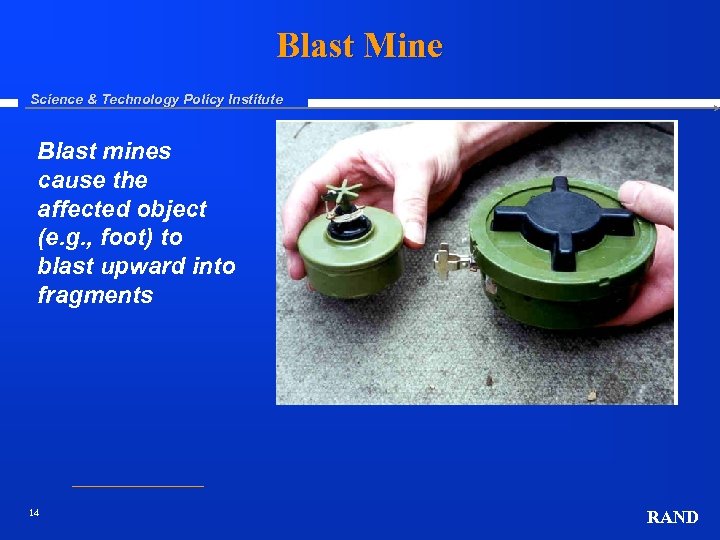 Blast Mine Science & Technology Policy Institute Blast mines cause the affected object (e. g. , foot) to blast upward into fragments 14 RAND
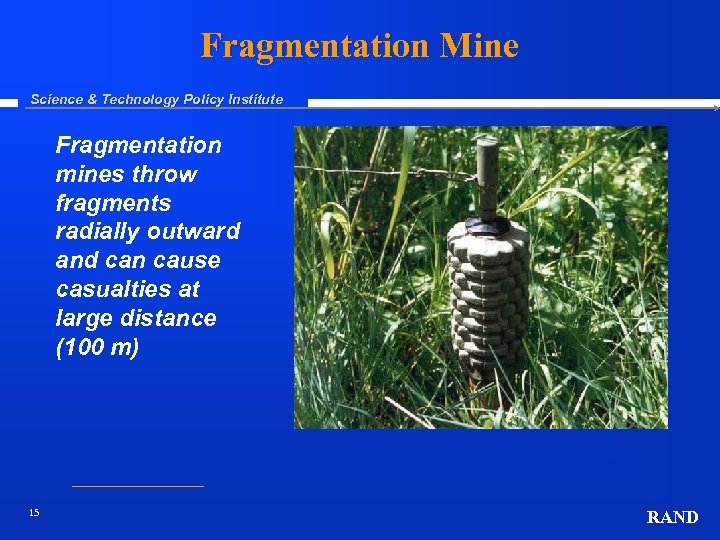 Fragmentation Mine Science & Technology Policy Institute Fragmentation mines throw fragments radially outward and can cause casualties at large distance (100 m) 15 RAND
 Briefing Outline Science & Technology Policy Institute 1. Origins of this project 2. Project tasks and study method 3. Background on the scope of the landmine problem 4. Limitations of conventional mine detection technologies 5. Alternative mine detection technologies: capabilities and limitations 6. Recommendations for developing an advanced mine detection system 16 RAND
 Reliable, Safe, Efficient Detection Methods Are Lacking Science & Technology Policy Institute Detection technologies have advanced little since World War II: “Today, highly trained, scared soldiers use all of their senses, augmented with a coin detector and a pointed stick. ” Col. Robert Greenwalt 17 RAND
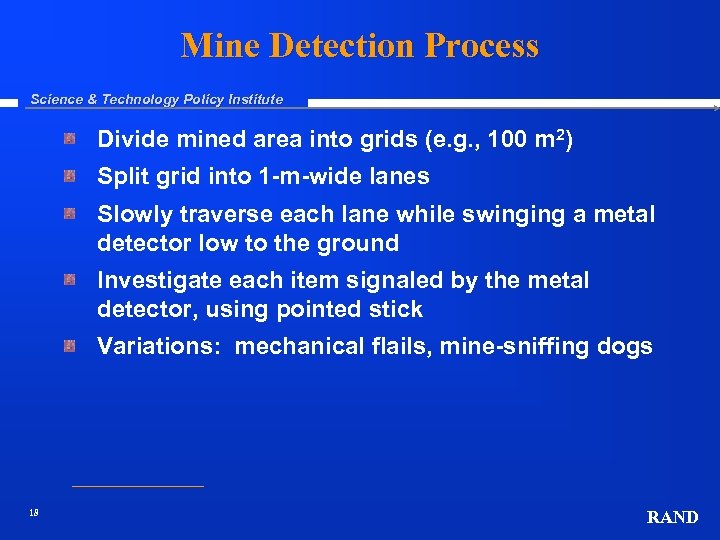 Mine Detection Process Science & Technology Policy Institute Divide mined area into grids (e. g. , 100 m 2) Split grid into 1 -m-wide lanes Slowly traverse each lane while swinging a metal detector low to the ground Investigate each item signaled by the metal detector, using pointed stick Variations: mechanical flails, mine-sniffing dogs 18 RAND
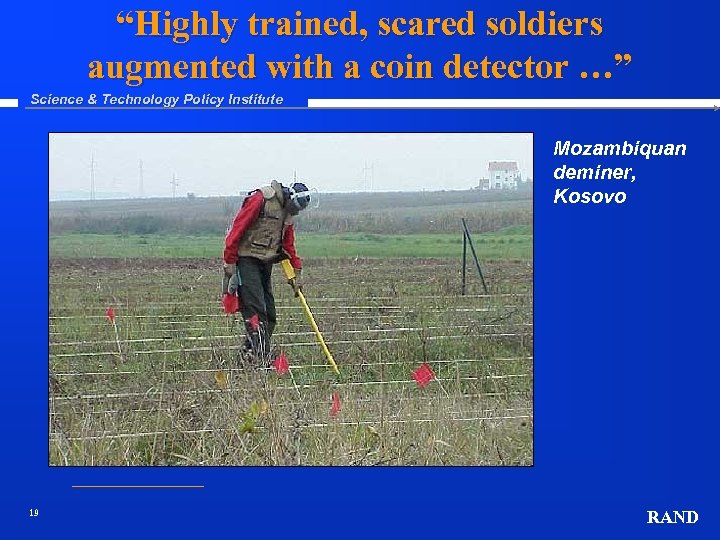 “Highly trained, scared soldiers augmented with a coin detector …” Science & Technology Policy Institute Mozambiquan deminer, Kosovo 19 RAND
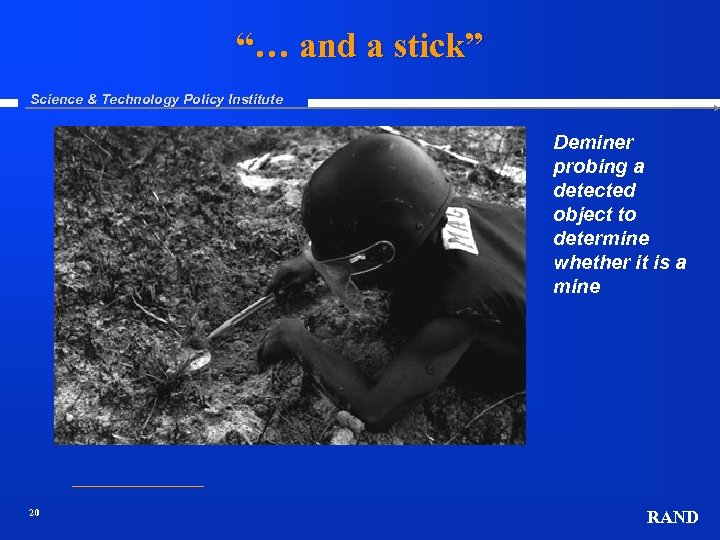 “… and a stick” Science & Technology Policy Institute Deminer probing a detected object to determine whether it is a mine 20 RAND
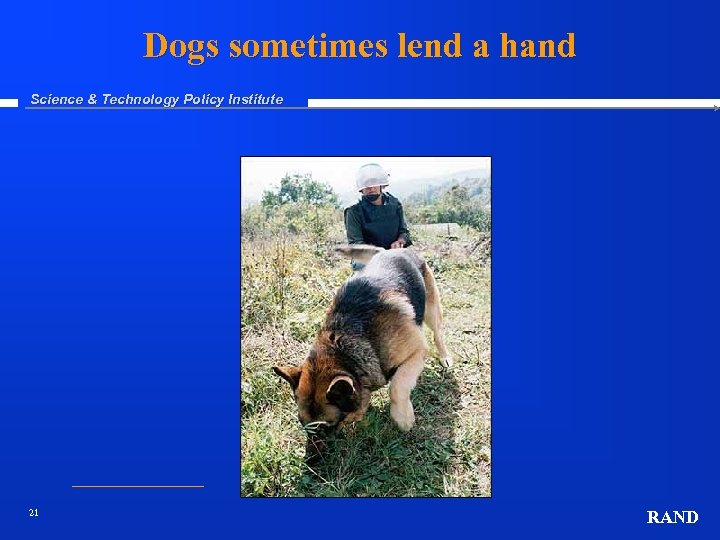 Dogs sometimes lend a hand Science & Technology Policy Institute 21 RAND
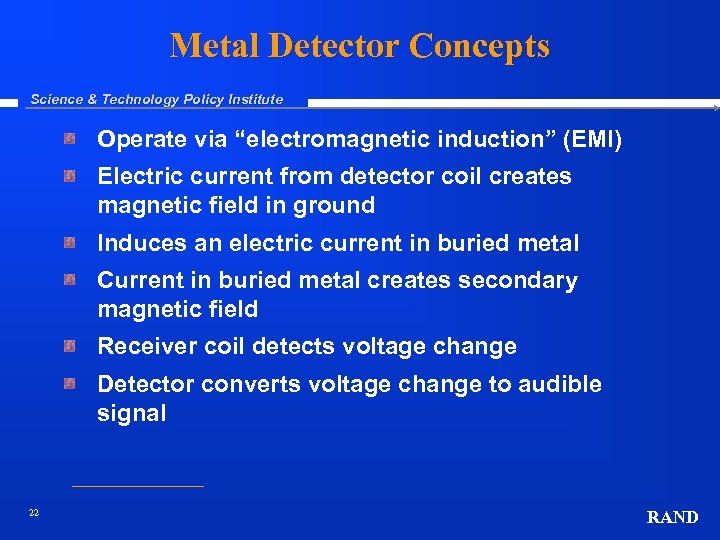 Metal Detector Concepts Science & Technology Policy Institute Operate via “electromagnetic induction” (EMI) Electric current from detector coil creates magnetic field in ground Induces an electric current in buried metal Current in buried metal creates secondary magnetic field Receiver coil detects voltage change Detector converts voltage change to audible signal 22 RAND
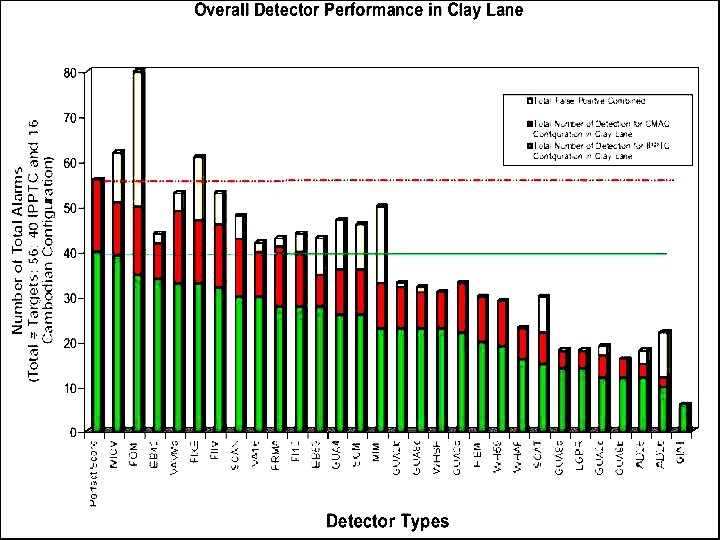
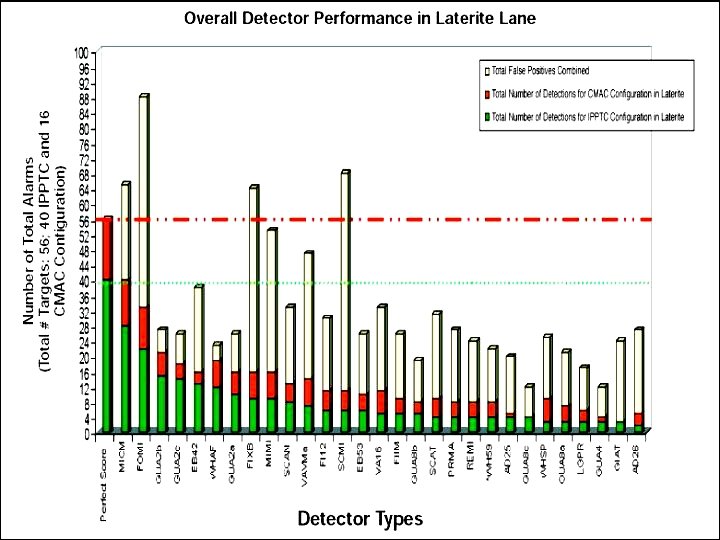
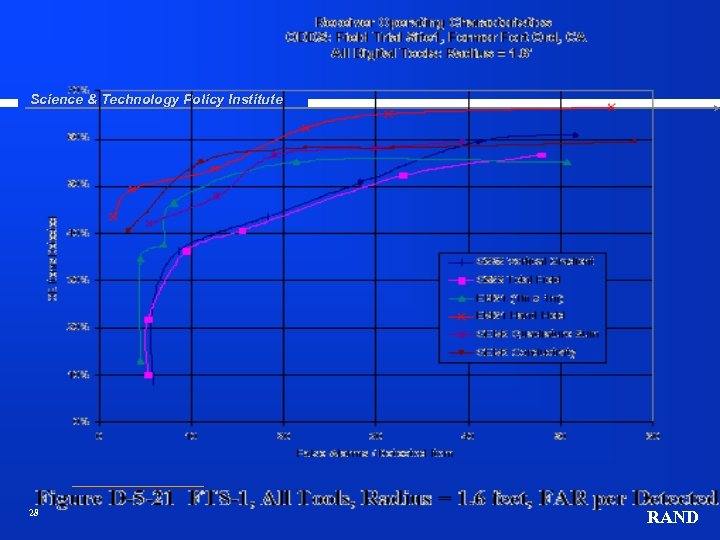
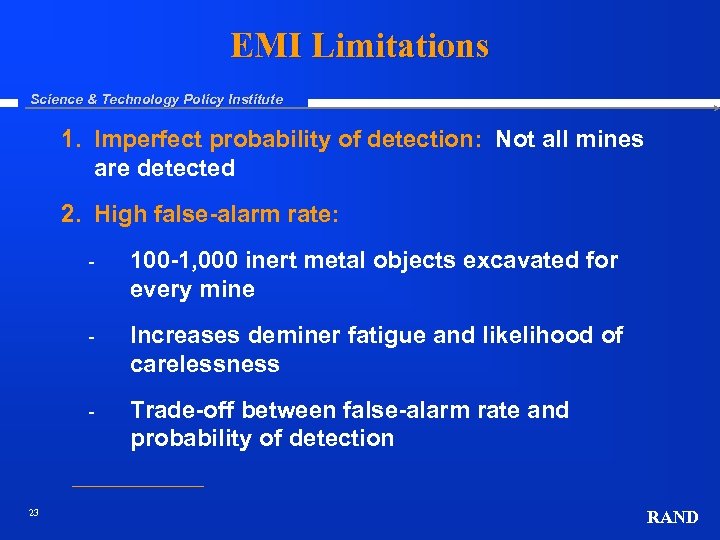 EMI Limitations Science & Technology Policy Institute 1. Imperfect probability of detection: Not all mines are detected 2. High false-alarm rate: - - Increases deminer fatigue and likelihood of carelessness - 23 100 -1, 000 inert metal objects excavated for every mine Trade-off between false-alarm rate and probability of detection RAND
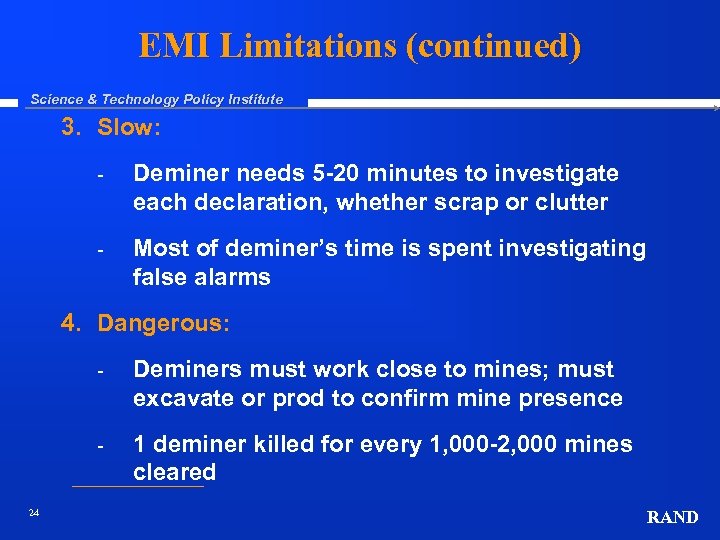 EMI Limitations (continued) Science & Technology Policy Institute 3. Slow: - Deminer needs 5 -20 minutes to investigate each declaration, whether scrap or clutter - Most of deminer’s time is spent investigating false alarms 4. Dangerous: - - 24 Deminers must work close to mines; must excavate or prod to confirm mine presence 1 deminer killed for every 1, 000 -2, 000 mines cleared RAND
 Science & Technology Policy Institute 25 RAND
 Science & Technology Policy Institute 26 RAND
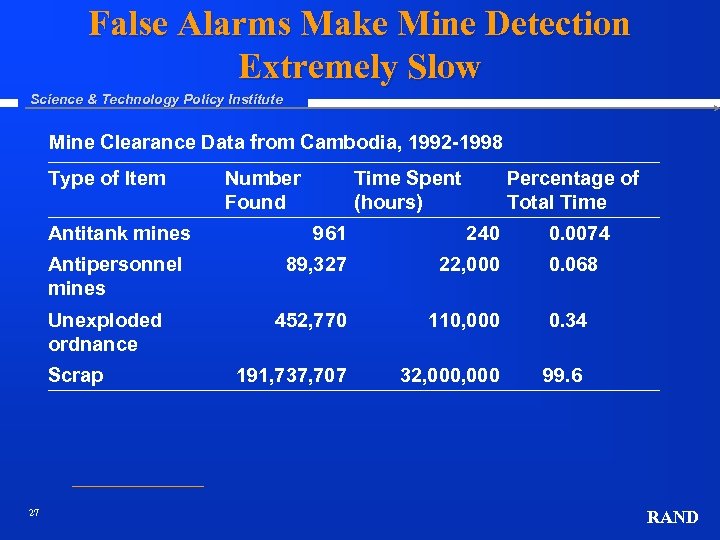 False Alarms Make Mine Detection Extremely Slow Science & Technology Policy Institute Mine Clearance Data from Cambodia, 1992 -1998 Type of Item Antitank mines Antipersonnel mines Unexploded ordnance Scrap 27 Number Found Time Spent (hours) Percentage of Total Time 961 240 0. 0074 89, 327 22, 000 0. 068 452, 770 110, 000 0. 34 191, 737, 707 32, 000 99. 6 RAND
 Science & Technology Policy Institute 28 RAND
 Briefing Outline Science & Technology Policy Institute 1. Origins of this project 2. Project tasks and study method 3. Background on the scope of the landmine problem 4. Limitations of conventional mine detection technologies 5. Alternative mine detection technologies: capabilities and limitations 6. Recommendations for developing an advanced mine detection system 29 RAND
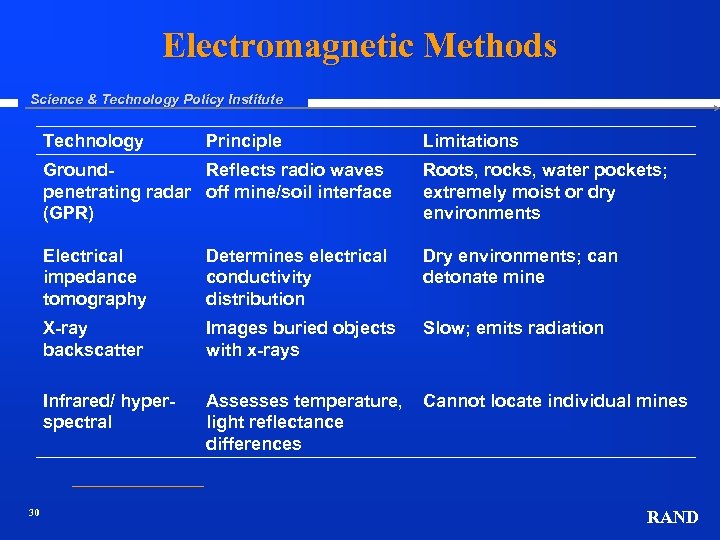 Electromagnetic Methods Science & Technology Policy Institute Technology Principle Limitations Ground. Reflects radio waves penetrating radar off mine/soil interface (GPR) Electrical impedance tomography Determines electrical conductivity distribution Dry environments; can detonate mine X-ray backscatter Images buried objects with x-rays Slow; emits radiation Infrared/ hyperspectral 30 Roots, rocks, water pockets; extremely moist or dry environments Assesses temperature, light reflectance differences Cannot locate individual mines RAND
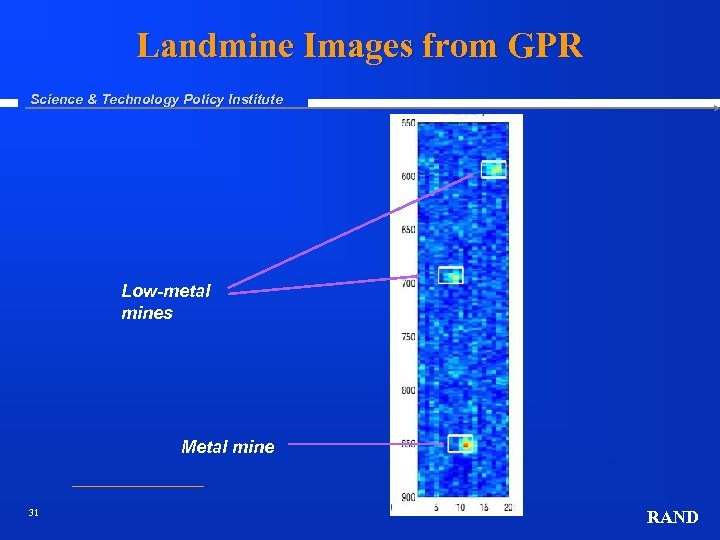 Landmine Images from GPR Science & Technology Policy Institute Low-metal mines Metal mine 31 RAND
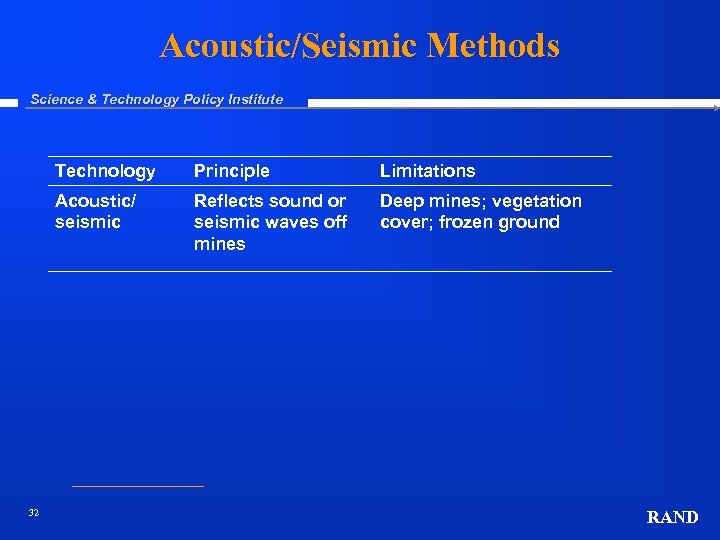 Acoustic/Seismic Methods Science & Technology Policy Institute Technology Limitations Acoustic/ seismic 32 Principle Reflects sound or seismic waves off mines Deep mines; vegetation cover; frozen ground RAND
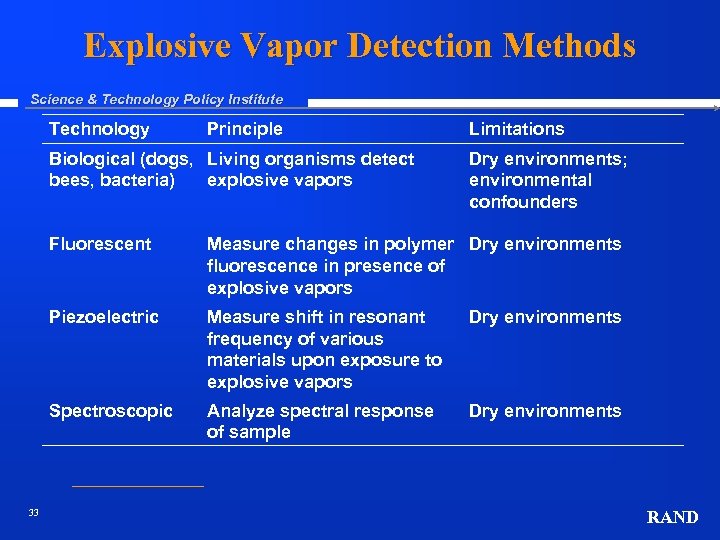 Explosive Vapor Detection Methods Science & Technology Policy Institute Technology Principle Biological (dogs, Living organisms detect bees, bacteria) explosive vapors Limitations Dry environments; environmental confounders Fluorescent Piezoelectric Measure shift in resonant frequency of various materials upon exposure to explosive vapors Dry environments Spectroscopic 33 Measure changes in polymer Dry environments fluorescence in presence of explosive vapors Analyze spectral response of sample Dry environments RAND
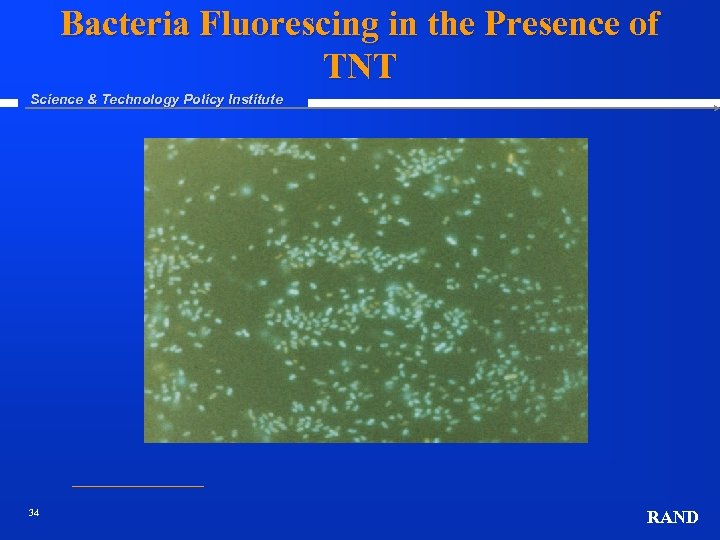 Bacteria Fluorescing in the Presence of TNT Science & Technology Policy Institute 34 RAND
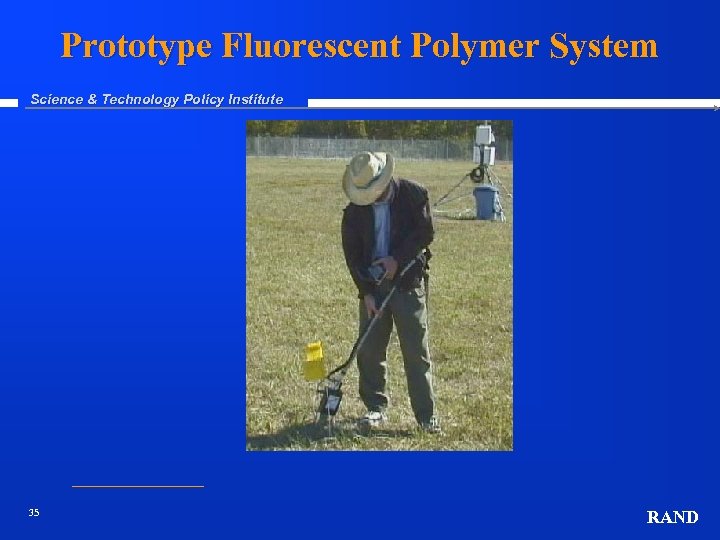 Prototype Fluorescent Polymer System Science & Technology Policy Institute 35 RAND
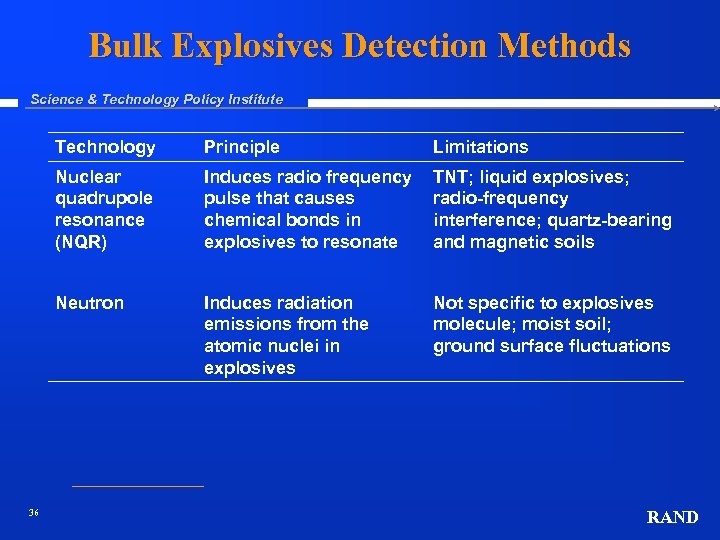 Bulk Explosives Detection Methods Science & Technology Policy Institute Technology Limitations Nuclear quadrupole resonance (NQR) Induces radio frequency pulse that causes chemical bonds in explosives to resonate TNT; liquid explosives; radio-frequency interference; quartz-bearing and magnetic soils Neutron 36 Principle Induces radiation emissions from the atomic nuclei in explosives Not specific to explosives molecule; moist soil; ground surface fluctuations RAND
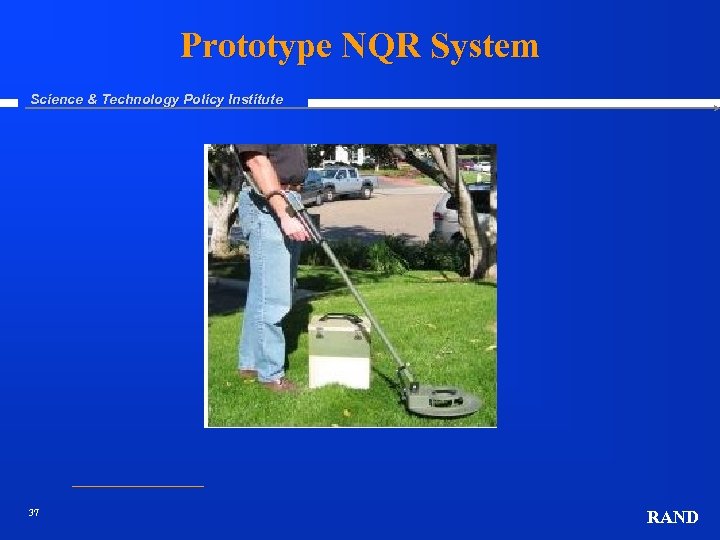 Prototype NQR System Science & Technology Policy Institute 37 RAND
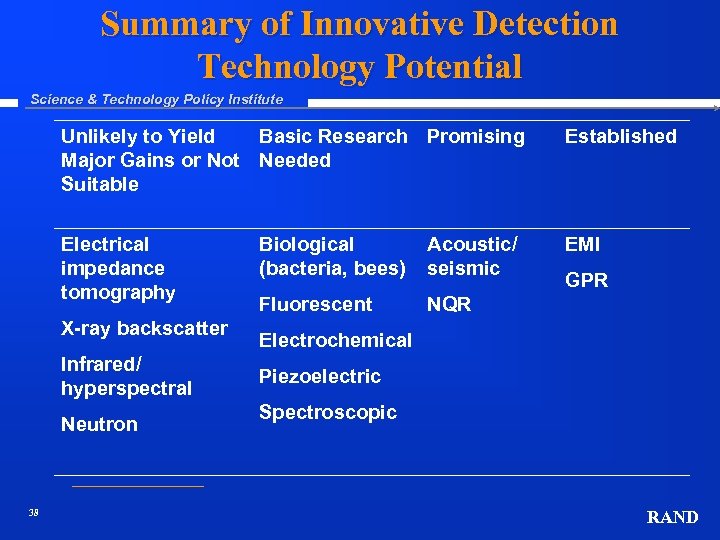 Summary of Innovative Detection Technology Potential Science & Technology Policy Institute Unlikely to Yield Basic Research Promising Major Gains or Not Needed Suitable Established Electrical impedance tomography EMI X-ray backscatter Infrared/ hyperspectral Neutron 38 Biological (bacteria, bees) Acoustic/ seismic Fluorescent NQR GPR Electrochemical Piezoelectric Spectroscopic RAND
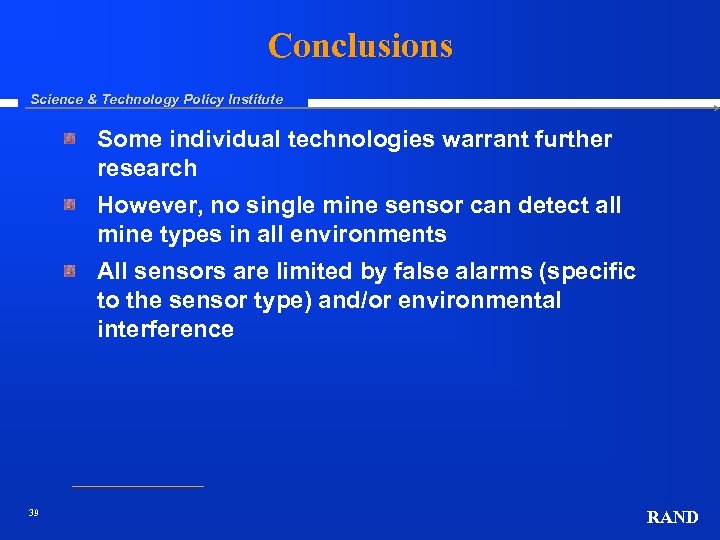 Conclusions Science & Technology Policy Institute Some individual technologies warrant further research However, no single mine sensor can detect all mine types in all environments All sensors are limited by false alarms (specific to the sensor type) and/or environmental interference 39 RAND
 Briefing Outline Science & Technology Policy Institute 1. Origins of this project 2. Project tasks and study method 3. Background on the scope of the landmine problem 4. Limitations of conventional mine detection technologies 5. Alternative mine detection technologies: capabilities and limitations 6. Recommendations for developing an advanced mine detection system 40 RAND
 Multi-Sensor Approach Is Needed Science & Technology Policy Institute Multi-sensor system would overcome limitations of single sensors: Multiple sensors with different false alarm sources would decrease false alarm rate Multiple sensors with different environmental confounders would increase probability of detection Advanced signal processing and/or decision algorithms would optimize operator decisions about whether or not item is a mine Design from first principles is needed 41 RAND
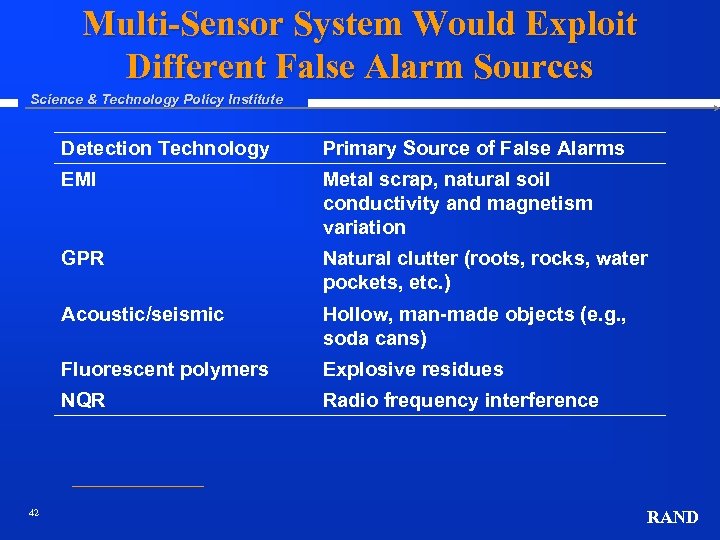 Multi-Sensor System Would Exploit Different False Alarm Sources Science & Technology Policy Institute Detection Technology EMI Metal scrap, natural soil conductivity and magnetism variation GPR Natural clutter (roots, rocks, water pockets, etc. ) Acoustic/seismic Hollow, man-made objects (e. g. , soda cans) Fluorescent polymers Explosive residues NQR 42 Primary Source of False Alarms Radio frequency interference RAND
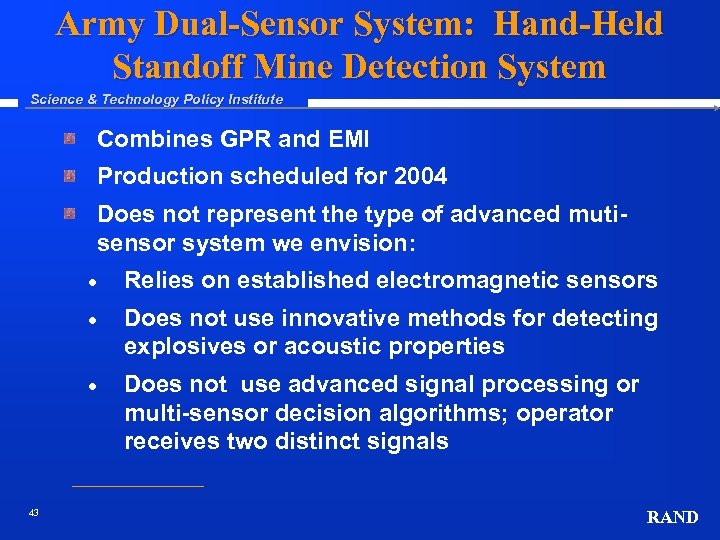 Army Dual-Sensor System: Hand-Held Standoff Mine Detection System Science & Technology Policy Institute Combines GPR and EMI Production scheduled for 2004 Does not represent the type of advanced mutisensor system we envision: Does not use innovative methods for detecting explosives or acoustic properties 43 Relies on established electromagnetic sensors Does not use advanced signal processing or multi-sensor decision algorithms; operator receives two distinct signals RAND
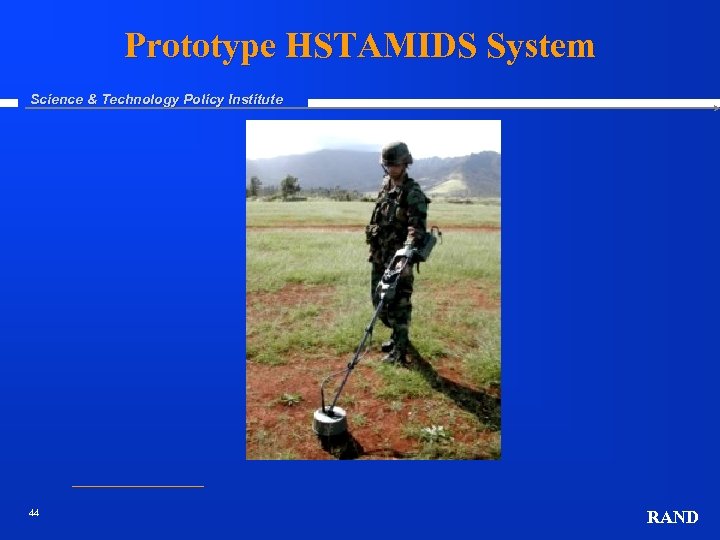 Prototype HSTAMIDS System Science & Technology Policy Institute 44 RAND
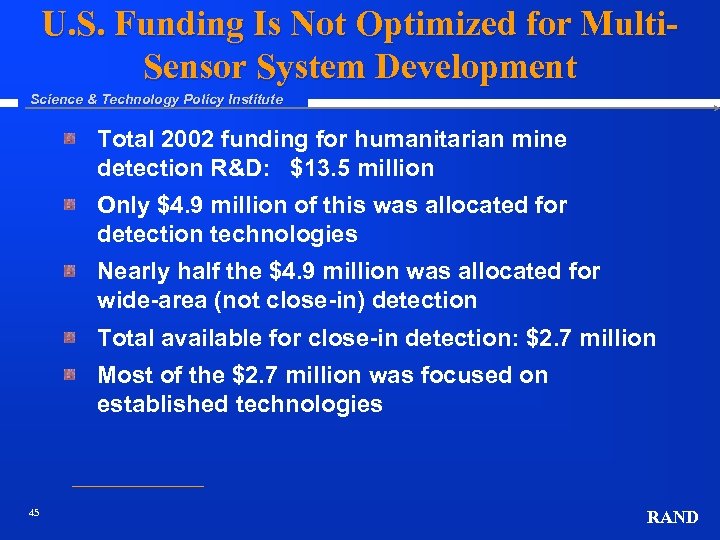 U. S. Funding Is Not Optimized for Multi. Sensor System Development Science & Technology Policy Institute Total 2002 funding for humanitarian mine detection R&D: $13. 5 million Only $4. 9 million of this was allocated for detection technologies Nearly half the $4. 9 million was allocated for wide-area (not close-in) detection Total available for close-in detection: $2. 7 million Most of the $2. 7 million was focused on established technologies 45 RAND
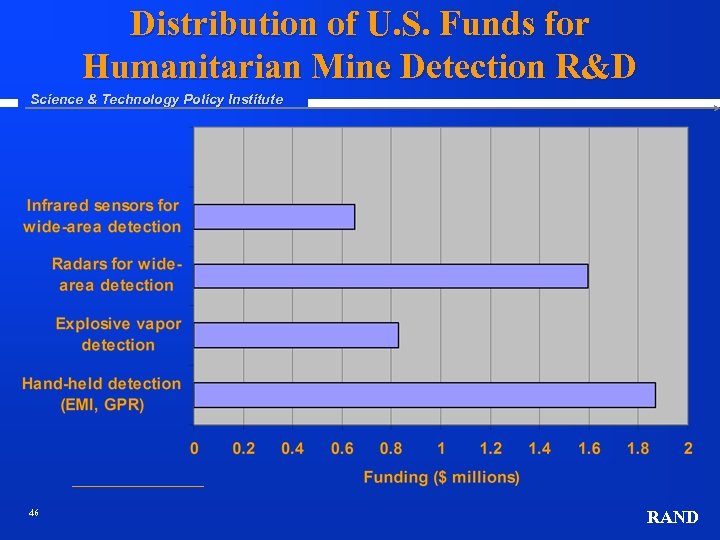 Distribution of U. S. Funds for Humanitarian Mine Detection R&D Science & Technology Policy Institute 46 RAND
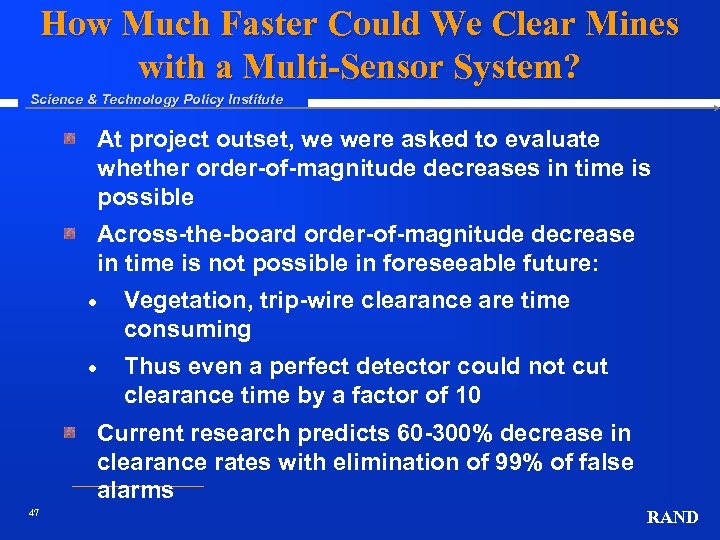 How Much Faster Could We Clear Mines with a Multi-Sensor System? Science & Technology Policy Institute At project outset, we were asked to evaluate whether order-of-magnitude decreases in time is possible Across-the-board order-of-magnitude decrease in time is not possible in foreseeable future: Vegetation, trip-wire clearance are time consuming Thus even a perfect detector could not cut clearance time by a factor of 10 Current research predicts 60 -300% decrease in clearance rates with elimination of 99% of false alarms 47 RAND
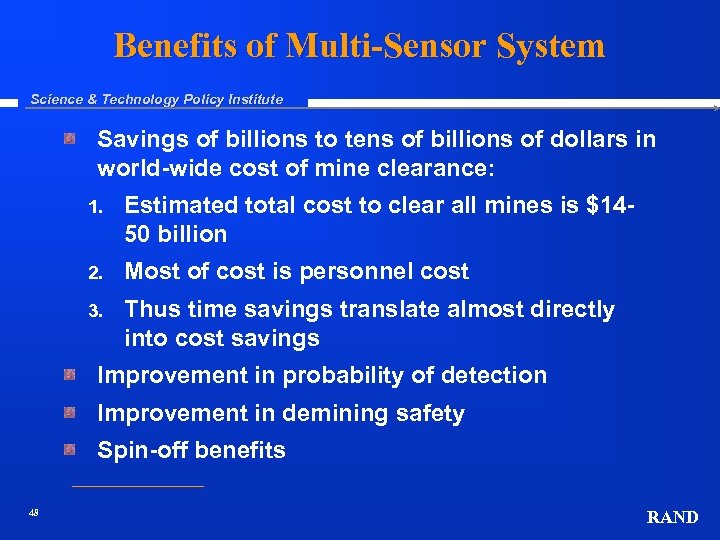 Benefits of Multi-Sensor System Science & Technology Policy Institute Savings of billions to tens of billions of dollars in world-wide cost of mine clearance: 1. Estimated total cost to clear all mines is $1450 billion 2. Most of cost is personnel cost 3. Thus time savings translate almost directly into cost savings Improvement in probability of detection Improvement in demining safety Spin-off benefits 48 RAND
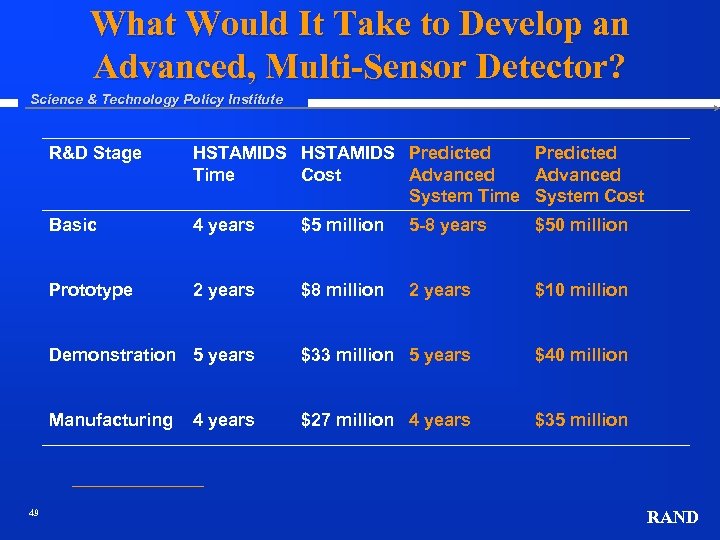 What Would It Take to Develop an Advanced, Multi-Sensor Detector? Science & Technology Policy Institute R&D Stage Basic 4 years $5 million 5 -8 years $50 million Prototype 2 years $8 million 2 years $10 million Demonstration 5 years $33 million 5 years $40 million Manufacturing 49 HSTAMIDS Predicted Time Cost Advanced System Time System Cost $27 million 4 years $35 million 4 years RAND
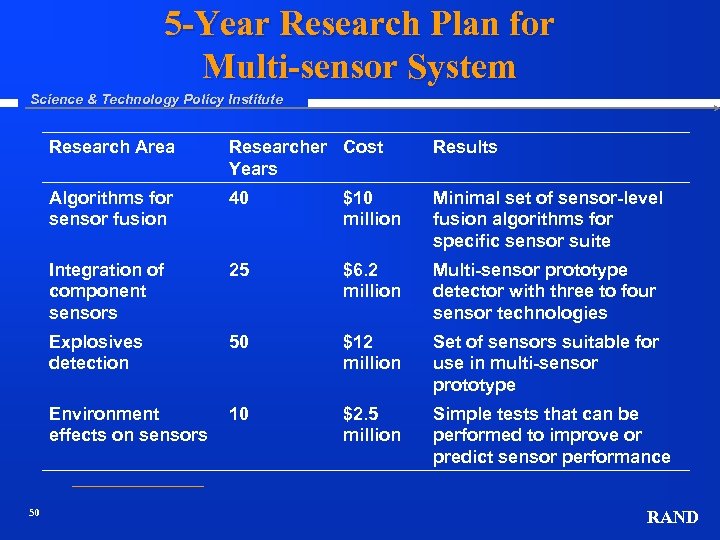 5 -Year Research Plan for Multi-sensor System Science & Technology Policy Institute Research Area Results Algorithms for sensor fusion 40 $10 million Minimal set of sensor-level fusion algorithms for specific sensor suite Integration of component sensors 25 $6. 2 million Multi-sensor prototype detector with three to four sensor technologies Explosives detection 50 $12 million Set of sensors suitable for use in multi-sensor prototype Environment effects on sensors 50 Researcher Cost Years 10 $2. 5 million Simple tests that can be performed to improve or predict sensor performance RAND
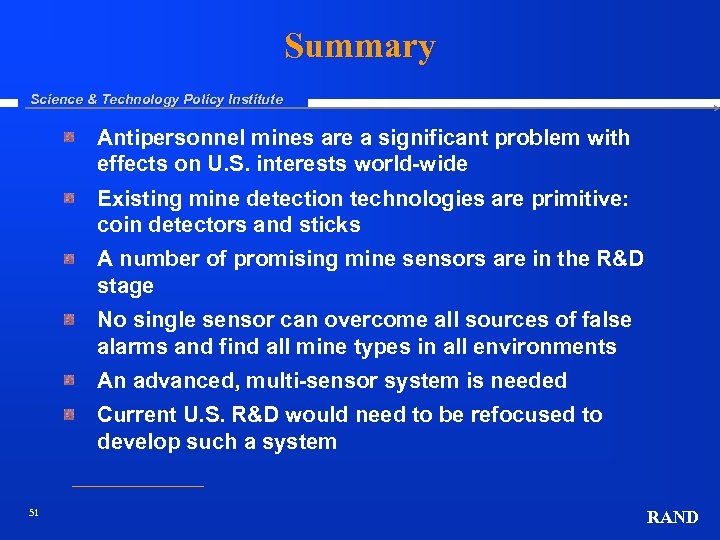 Summary Science & Technology Policy Institute Antipersonnel mines are a significant problem with effects on U. S. interests world-wide Existing mine detection technologies are primitive: coin detectors and sticks A number of promising mine sensors are in the R&D stage No single sensor can overcome all sources of false alarms and find all mine types in all environments An advanced, multi-sensor system is needed Current U. S. R&D would need to be refocused to develop such a system 51 RAND