 Скачать презентацию Science Parks and the Cambridge Phenomenon Cooperation for
fbdc8841592d47d7278860646107366c.ppt
- Количество слайдов: 44



Science Parks and the Cambridge Phenomenon Cooperation for Regional Innovation 2 nd Annual Conference of the Technopolicy Network Helsinki 2005 Professor Alan Barrell Slide 1
A Short Agenda • • • Is there a Cambridge Phenomenon ? The latest FACTS and MEASURES How did we get here ? A Chronology Science Parks and Innovation Centres Communities, Culture and Common Purpose • Some Conclusions Slide 2
Phenomenon “A remarkable or unusual person, thing or appearance” “A prodigy” Prodigy “Any person or thing that causes great wonder: A monster: A child of precocious genius or virtuosity” “Astonishing - more than usually large in size or degree” Slide 3
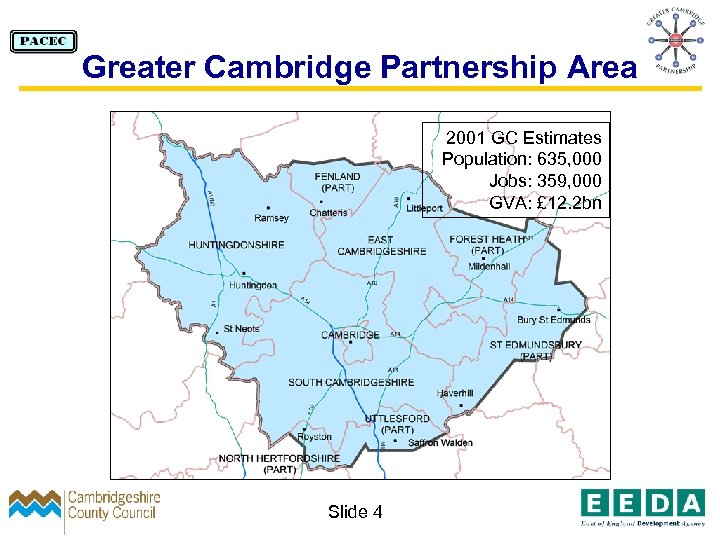
Greater Cambridge Partnership Area 2001 GC Estimates Population: 635, 000 Jobs: 359, 000 GVA: £ 12. 2 bn Slide 4
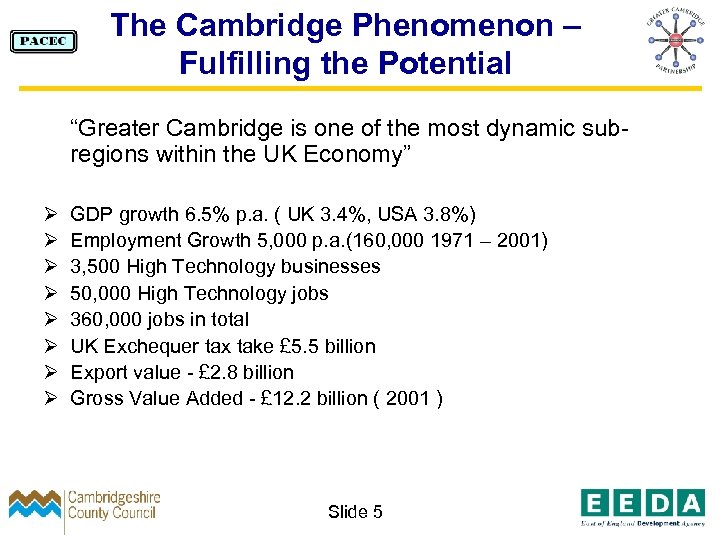
The Cambridge Phenomenon – Fulfilling the Potential “Greater Cambridge is one of the most dynamic subregions within the UK Economy” Ø Ø Ø Ø GDP growth 6. 5% p. a. ( UK 3. 4%, USA 3. 8%) Employment Growth 5, 000 p. a. (160, 000 1971 – 2001) 3, 500 High Technology businesses 50, 000 High Technology jobs 360, 000 jobs in total UK Exchequer tax take £ 5. 5 billion Export value - £ 2. 8 billion Gross Value Added - £ 12. 2 billion ( 2001 ) Slide 5
More on Greater Cambridge • • Rapid economic growth Near full employment 80% job growth in three decades (UK 16%) Knowledge-based jobs 1/3 of total jobs (30% higher than national average) Relatively high level of well-being University Science Base – R and D strength Genome Centre and Babraham Complex Numerous Institutes, Science Parks and Innovation Centres Slide 6
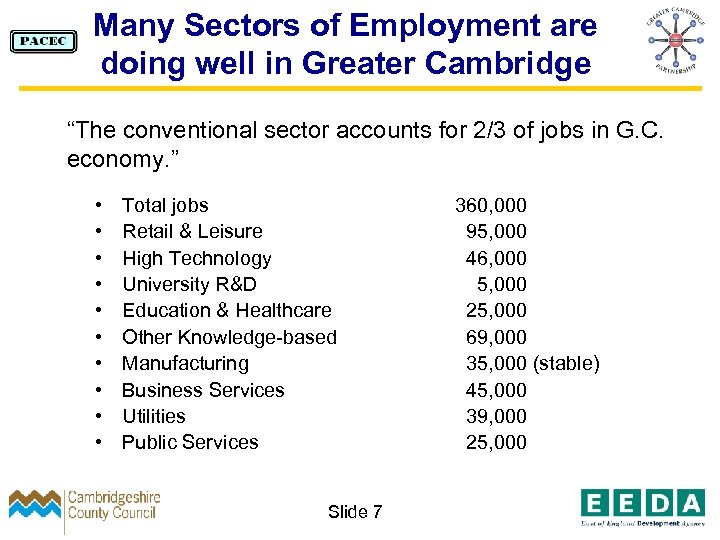
Many Sectors of Employment are doing well in Greater Cambridge “The conventional sector accounts for 2/3 of jobs in G. C. economy. ” • • • Total jobs Retail & Leisure High Technology University R&D Education & Healthcare Other Knowledge-based Manufacturing Business Services Utilities Public Services Slide 7 360, 000 95, 000 46, 000 5, 000 25, 000 69, 000 35, 000 (stable) 45, 000 39, 000 25, 000
And there is impact beyond hard facts and influence beyond Cambridge • First Microsoft R&D facility outside USA • Toshiba JV with Dept. of Physics – leading to first Toshiba spin-out – Teraview Ltd. • Other partnerships/ M&A/ embedded laboratories – examples. Hitachi, Monsanto, Incyte, Globespan-Virata, Convergys • Worldwide reach, influence and business success of “technology provider cluster” • Science Parks and Innovation Centres – models and outreach to other sub-regions and regions • CMI – Research base and Best Practice exchange • Entrepreneurship Centre – developing educational programs, exporting and migrating to other UK universities • Cambridge Enterprise – Technology Transfer and Commercialisation • Networks – most notably Cambridge Network – serving the local community and connecting with networks worldwide Slide 8
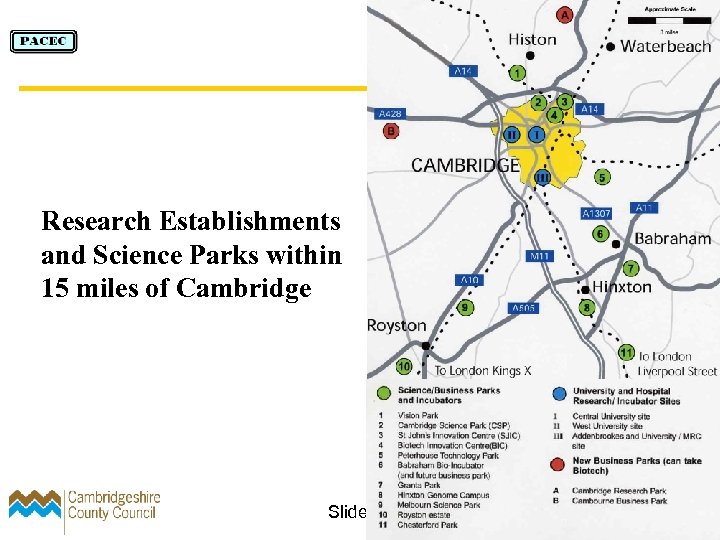
Research Establishments and Science Parks within 15 miles of Cambridge Slide 9
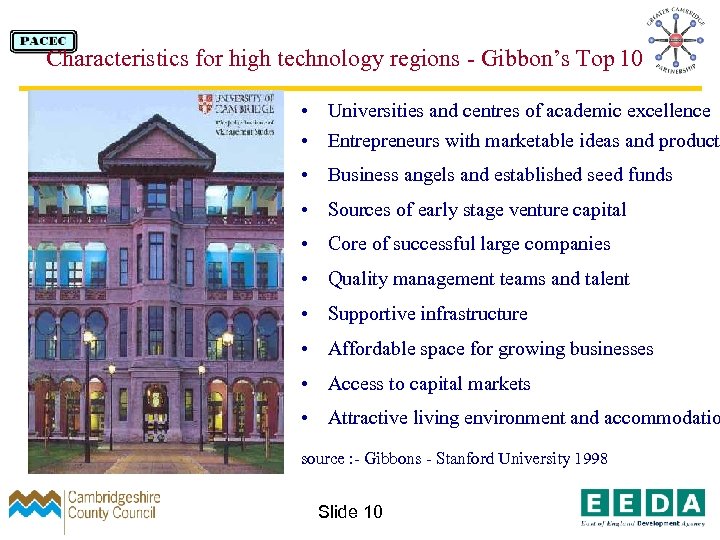
Characteristics for high technology regions - Gibbon’s Top 10 • Universities and centres of academic excellence • Entrepreneurs with marketable ideas and products • Business angels and established seed funds • Sources of early stage venture capital • Core of successful large companies • Quality management teams and talent • Supportive infrastructure • Affordable space for growing businesses • Access to capital markets • Attractive living environment and accommodatio source : - Gibbons - Stanford University 1998 Slide 10
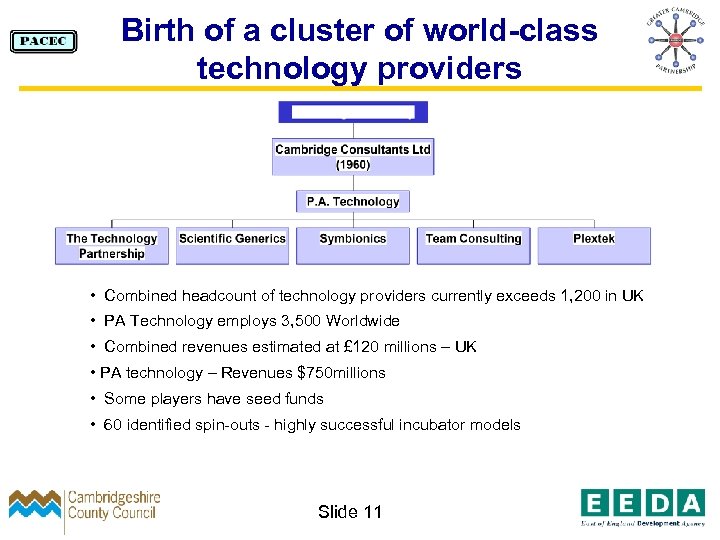
Birth of a cluster of world-class technology providers • Combined headcount of technology providers currently exceeds 1, 200 in UK • PA Technology employs 3, 500 Worldwide • Combined revenues estimated at £ 120 millions – UK • PA technology – Revenues $750 millions • Some players have seed funds • 60 identified spin-outs - highly successful incubator models Slide 11
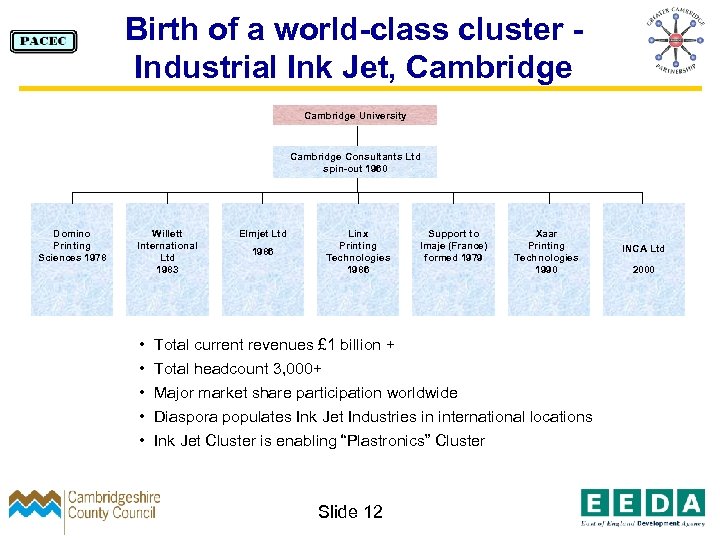
Birth of a world-class cluster Industrial Ink Jet, Cambridge University Cambridge Consultants Ltd spin-out 1960 Domino Printing Sciences 1978 Willett International Ltd 1983 • • • Elmjet Ltd Linx Printing Technologies 1986 Support to Imaje (France) formed 1979 Xaar Printing Technologies 1990 Total current revenues £ 1 billion + Total headcount 3, 000+ Major market share participation worldwide Diaspora populates Ink Jet Industries in international locations Ink Jet Cluster is enabling “Plastronics” Cluster Slide 12 INCA Ltd 2000
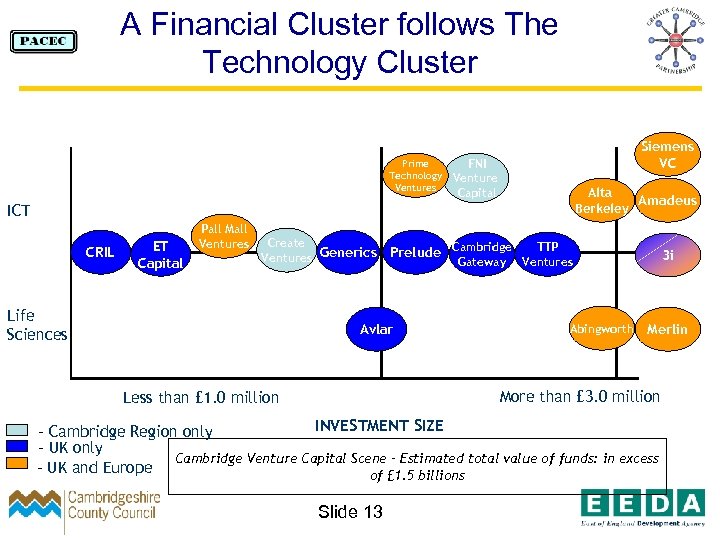
A Financial Cluster follows The Technology Cluster Prime Technology Ventures Siemens VC FNI Venture Capital Alta Amadeus Berkeley ICT CRIL ET Capital Pall Mall Ventures Create Ventures Generics Life Sciences Prelude Cambridge Avlar Gateway TTP Ventures Abingworth 3 i Merlin More than £ 3. 0 million Less than £ 1. 0 million INVESTMENT SIZE - Cambridge Region only - UK only Cambridge Venture Capital Scene – Estimated total value of funds: in excess - UK and Europe of £ 1. 5 billions Slide 13
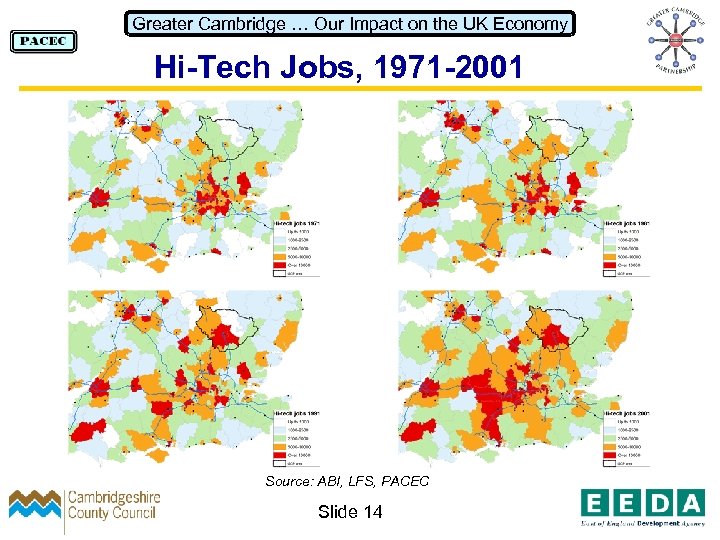
Greater Cambridge … Our Impact on the UK Economy Hi-Tech Jobs, 1971 -2001 Source: ABI, LFS, PACEC Slide 14
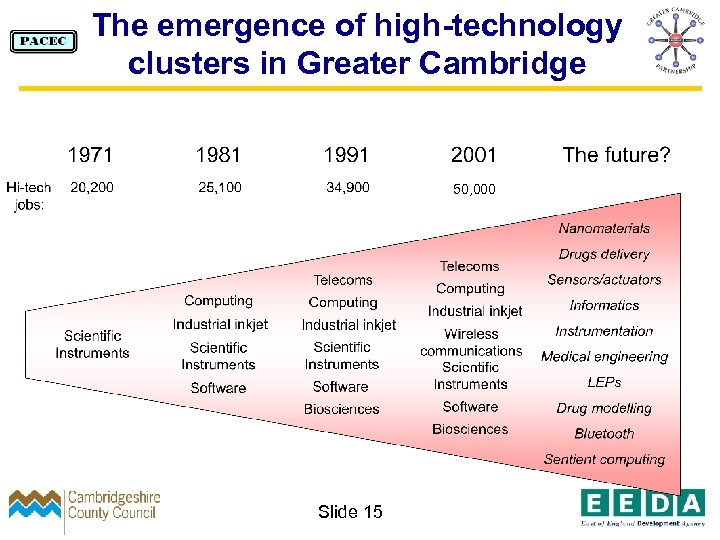
The emergence of high-technology clusters in Greater Cambridge 50, 000 Slide 15
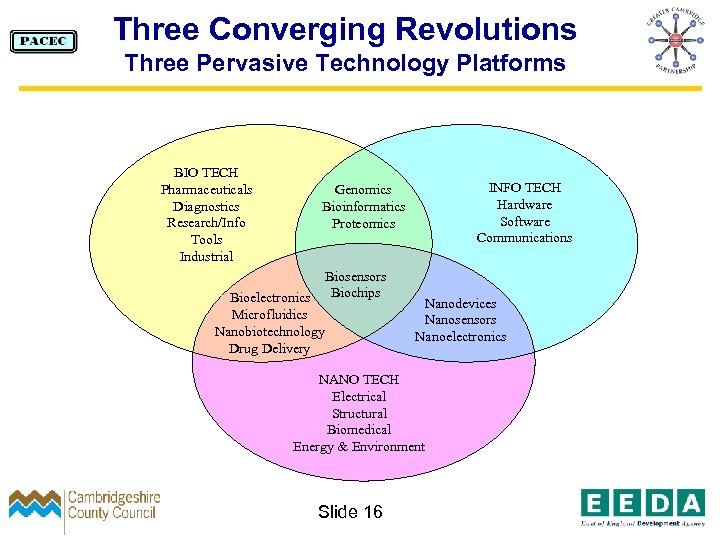
Three Converging Revolutions Three Pervasive Technology Platforms BIO TECH Pharmaceuticals Diagnostics Research/Info Tools Industrial INFO TECH Hardware Software Communications Genomics Bioinformatics Proteomics Bioelectronics Microfluidics Nanobiotechnology Drug Delivery Biosensors Biochips Nanodevices Nanosensors Nanoelectronics NANO TECH Electrical Structural Biomedical Energy & Environment Slide 16
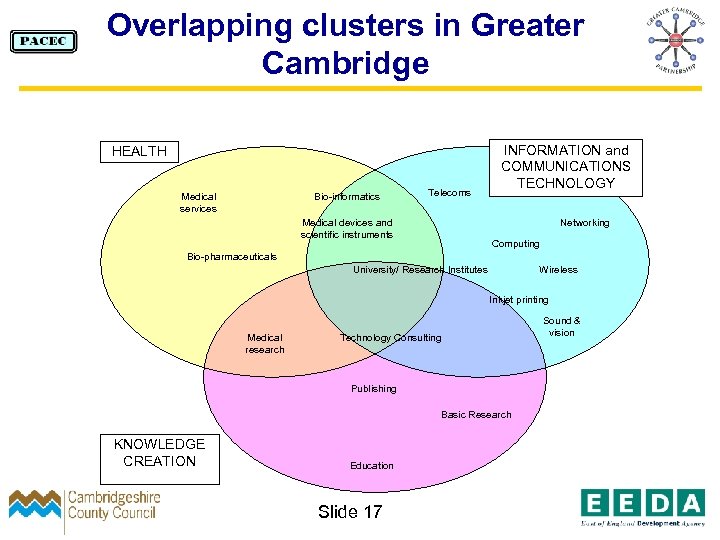
Overlapping clusters in Greater Cambridge HEALTH Medical services Bio-informatics Telecoms Medical devices and scientific instruments INFORMATION and COMMUNICATIONS TECHNOLOGY Networking Computing Bio-pharmaceuticals University/ Research Institutes Wireless Inkjet printing Medical research Technology Consulting Publishing Basic Research KNOWLEDGE CREATION Education Slide 17 Sound & vision
Sources of Competitive Advantage for Greater Cambridge • Capacity for innovation • Diverse science base and research infrastructure • Capability to diffuse knowledge and experience through collective learning and networking systems • Leading to a functioning knowledge-based cluster • Entrepreneurial business community – enthusiastic to participate in local, regional, national and international programmes of innovation, change and new business creation • Established Science Parks and Innovation Centres Slide 18
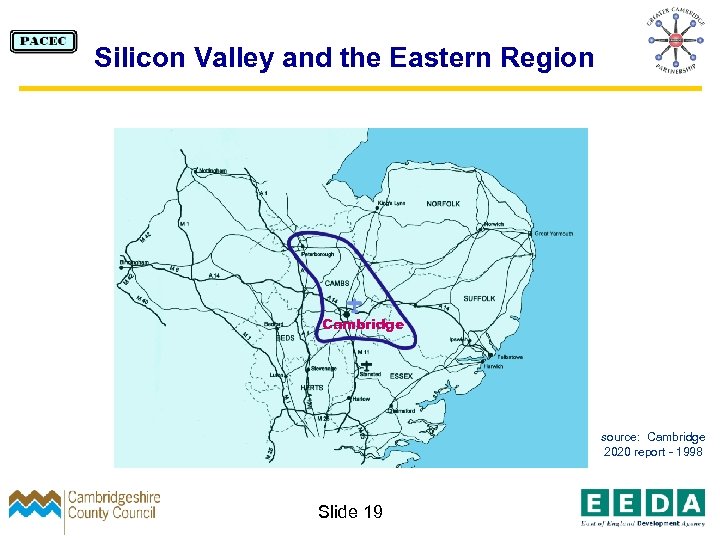
Silicon Valley and the Eastern Region Cambridge source: Cambridge 2020 report - 1998 Slide 19
BUT – there are constraints on growth and development………. • Issues of commercialisation of science and diffusion of knowledge • Still no large revenue and profit earning “local giants” • Inefficiencies and deficits in funding early stage businesses • Rising traffic congestion • Inadequate transportation links to other regions • Limited air transport connections to international destinations • Insufficient housing – quality and price issues • Tym Report 2001 – indicated £ 2 billion infrastructure deficit. Slide 20
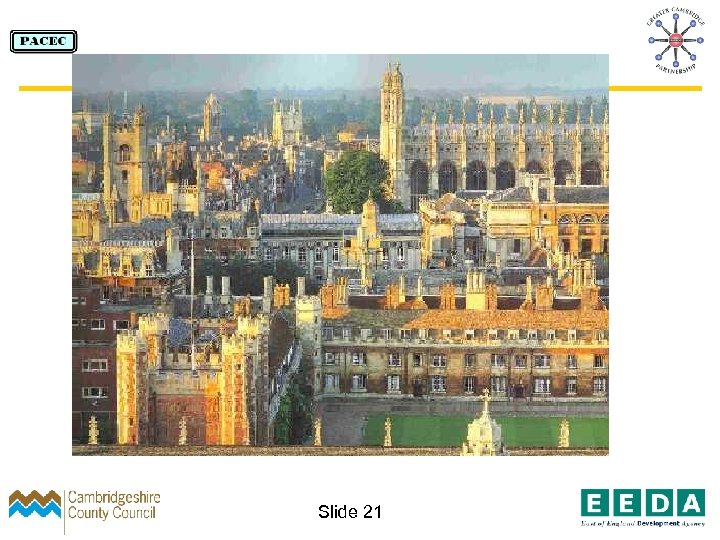
Slide 21
Cambridge University - Great Scientific and Technological Advances • 1600: Dr William Gilbert - Science of navigation, map making • 1687: Isaac Newton - ‘Principa Mathematica’ - fundamentals of nuclear physics, laws of gravity • 1704: First chair of astronomy - leading to first public observatory • 1812: Charles Babbage - first ‘calculating machine’ - heralded invention of modern computers • 1873: James Clark Maxwell - ‘Treatise on Electricity and Magnetism’ • 1887: JJ Thomson - Cavendish Labs - discovered the electron hence telephones, radio, television and computers • 1915: Lawrence and WH Bragg - X-ray diffraction • 1929: Frederick Gowland Hopkins - vitamins • 1932: Cockcroft, Walton and Rutherford - Atom first split Slide 22
Cambridge University - Great Scientific and Technological Advances • 1933: Paul Dirac - Quantum Theory and Position Emission Topography • 1934: Frank Whittle - work on jet propulsion • 1941: First jet flight • 1949: Maurice Wilkes - EDSAC (Electronic Delay Storage Automatic Calculator - first stored programme digital computer) • 1953: Crick and Watson - discovered structure of DNA • 1958: Frederick Sanger - insulin construction • 1960: Charles Oatley - first Scanning Electron Microscope • 1962: Max Peratz & John Kendrew - 3 dimensional structure of proteins • 1968: Anthony Hewish and Jocelyn Bell - discovery of ‘pulsars’ in astrophysics • 1982: Aaron Klug - molecular biology - viruses and RNA • 1985: Cesar Milstein - monoclonal antibodies Slide 23
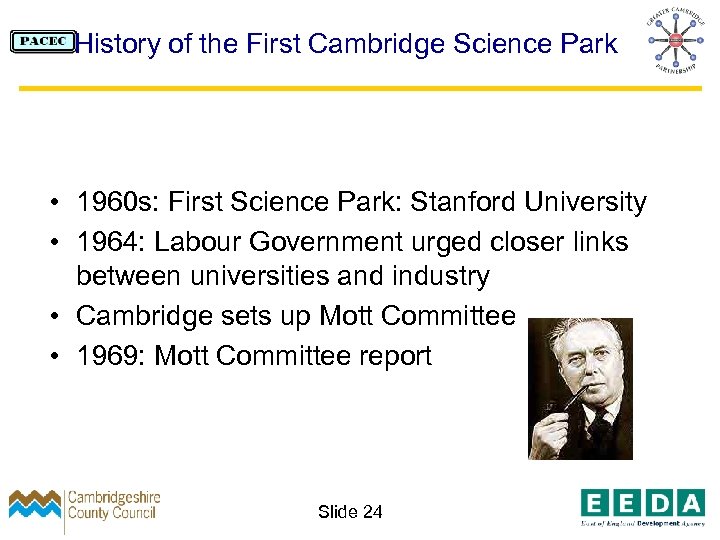
History of the First Cambridge Science Park • 1960 s: First Science Park: Stanford University • 1964: Labour Government urged closer links between universities and industry • Cambridge sets up Mott Committee • 1969: Mott Committee report Slide 24
TRINITY COLLEGE An ancient seat of learning…. stepping out into the unknown – and into Hi-Tech A significant act of faith by Dr John Bradfield Slide 25
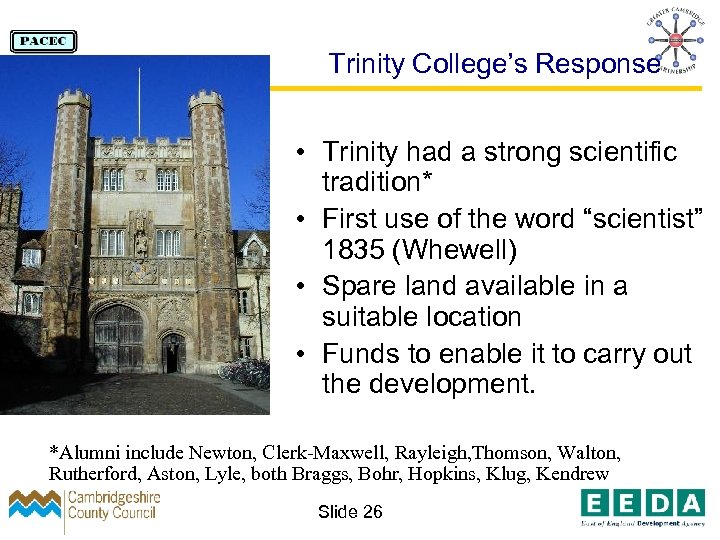
Trinity College’s Response • Trinity had a strong scientific tradition* • First use of the word “scientist” 1835 (Whewell) • Spare land available in a suitable location • Funds to enable it to carry out the development. *Alumni include Newton, Clerk-Maxwell, Rayleigh, Thomson, Walton, Rutherford, Aston, Lyle, both Braggs, Bohr, Hopkins, Klug, Kendrew Slide 26
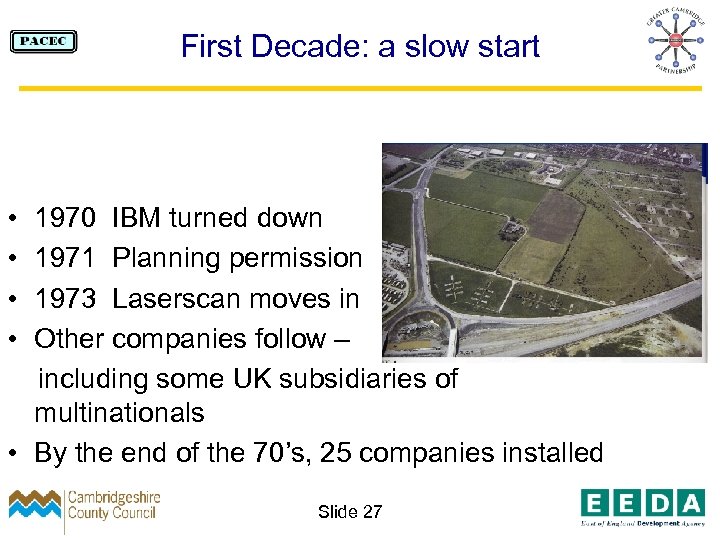
First Decade: a slow start • • 1970 IBM turned down 1971 Planning permission 1973 Laserscan moves in Other companies follow – including some UK subsidiaries of multinationals • By the end of the 70’s, 25 companies installed Slide 27
Second Decade: Clustering • Cluster developing - critical mass reached • 1984: The Trinity Centre • 3 i, Venture Capital company & Prelude VC Trust • Labour unions, BTG monopoly broken • Academics start companies (IPR relaxation) • Spin-outs & collaborative ventures from existing companies (e. g. Cambridge Consultants) Slide 28
Third Decade • Greater Cambridge cluster 3, 500 cos, (most with <10 staff) 50, 000 employees • More venture funds available • Strong sectors: Life Sciences, ICT • Fewer but larger companies, more Stock Exchange launches • Same mix of spin-outs, new ventures, & UK subsidiaries of multinationals Slide 30
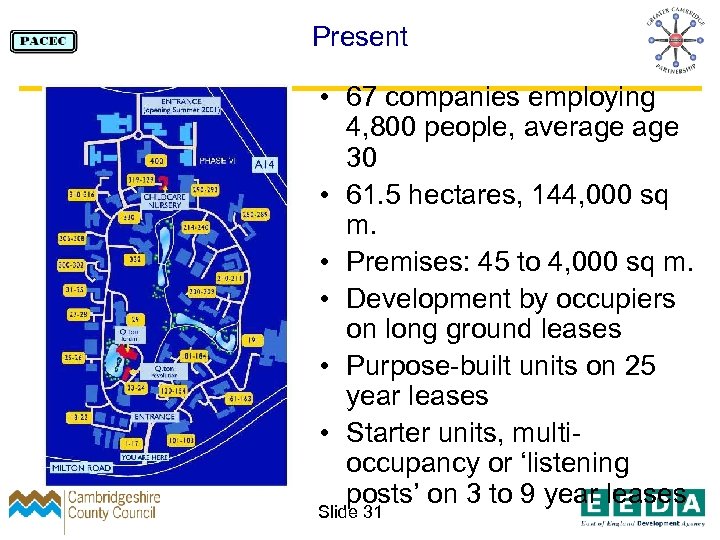
Present • 67 companies employing 4, 800 people, average 30 • 61. 5 hectares, 144, 000 sq m. • Premises: 45 to 4, 000 sq m. • Development by occupiers on long ground leases • Purpose-built units on 25 year leases • Starter units, multioccupancy or ‘listening posts’ on 3 to 9 year leases Slide 31
What type of tenants? • Scientific research linked to industrial production • Light industrial production closely associated with onsite or university research • Ancillary activities (e. g. Venture Capital companies, Patent & IPR law firms etc) • Not much manufacturing, except Napp, Heraeus, Polatis Trinity maintained these criteria during economic recession Slide 33
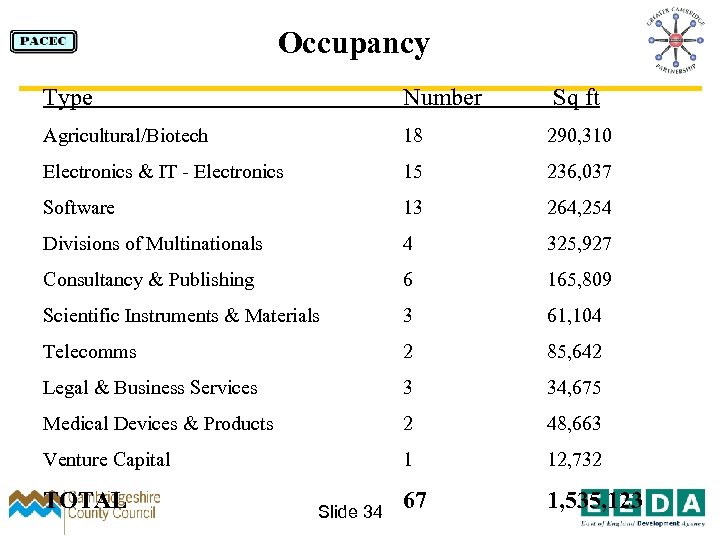
Occupancy Type Number Sq ft Agricultural/Biotech 18 290, 310 Electronics & IT - Electronics 15 236, 037 Software 13 264, 254 Divisions of Multinationals 4 325, 927 Consultancy & Publishing 6 165, 809 Scientific Instruments & Materials 3 61, 104 Telecomms 2 85, 642 Legal & Business Services 3 34, 675 Medical Devices & Products 2 48, 663 Venture Capital 1 12, 732 67 1, 535, 123 TOTAL Slide 34
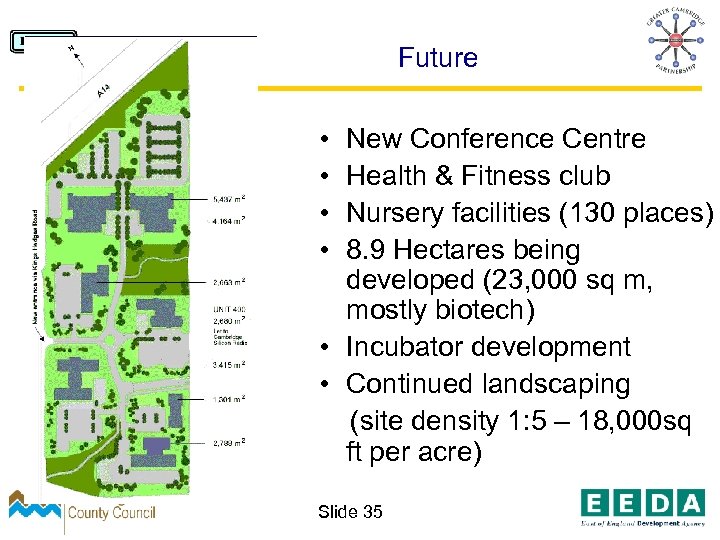
Future • • New Conference Centre Health & Fitness club Nursery facilities (130 places) 8. 9 Hectares being developed (23, 000 sq m, mostly biotech) • Incubator development • Continued landscaping (site density 1: 5 – 18, 000 sq ft per acre) Slide 35
Trinity’s role • • Promoting contacts & interchange, website Advertising university functions & seminars Research sponsorship CSP Newsletter (“Catalyst”) biannually Provision of Conference Centre etc Landscaping But: Rents at normal commercial rates, minimal bureaucracy, no central management company. • Management by Bidwells, local property Slide 36 specialists
St John’s Innovation Park A commercial operation established by St John’s College in 1987 to provide flexible accommodation and business support services to early-stage, knowledge-based companies. Managed by St John’s Innovation Centre Ltd. www. stjohns. co. uk Slide 38
St John’s Innovation Park offers: • “Virtual incubator” services • Unit-based accommodation for small businesses, on flexible terms • Larger-scale accommodation • Meeting, conference and restaurant facilities • Business advice • Regional, national and European networking Slide 39
Virtual incubator Services (1) The “Star Service” Ø 3 Star: Business address, postal & parcel handling, use of all support services Ø 5 Star: All the above plus a communal telephone line with message-taking facilities Ø 7 -Star: All the above plus a dedicated telephone number and calls answered in the client company name Slide 40
Virtual incubator services (2) A “business club” for small high-tech companies in Cambridgeshire, offering Business advice and Networking opportunities www. enterprise-link. co. uk Slide 41
Buildings Ø Innovation Centre + Dirac House (90 units, 5100 m 2) Ø Jeffreys Building (8 units, 3100 m 2) Ø Zeus Building (3600 m 2) Ø Bioscience Innovation Centre (12 units, 2500 m 2, owned and managed by MMI) Ø Platinum Building (4500 m 2, owned by Tality UK Ltd) Ø Vitrum Building (2800 m 2, owned by Bridehall) Slide 42
Typical tenants 1. Start-up companies researching and developing products 2. Technology based companies of 1 -5 years’ standing that bring some maturity to the Park and may produce spin-out companies. 3. Service companies that can provide support such as training, marketing, networking, public relations. Slide 43
Facilities • 4 small meeting rooms plus a boardroom • 4 conference rooms • Restaurant, open all day, also provides catering service for meetings and conferences • Lunchtime trolley service • Shared reception, postal handling, faxing • Telephone and broadband internet (100 Mb/s) • Community !! – Common Purpose !! Slide 44
Business support services Usually provided free • • • Business plan development Fundraising (private and public) Company management and development Networking contacts Technology transfer support Slide 45
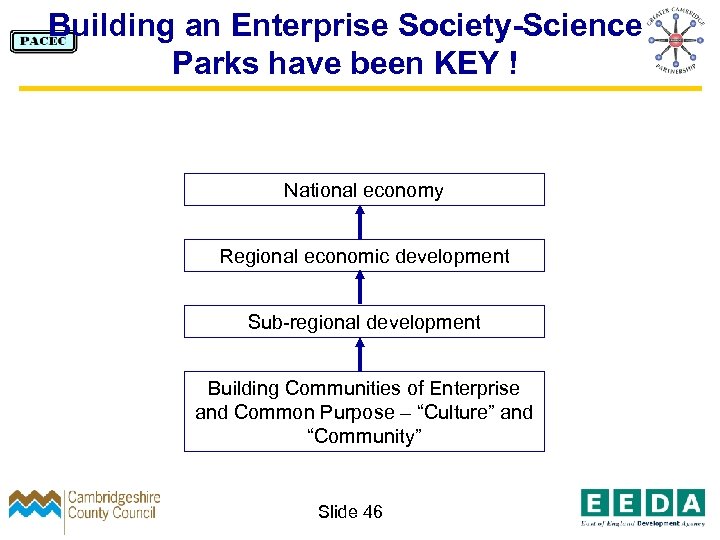
Building an Enterprise Society-Science Parks have been KEY ! National economy Regional economic development Sub-regional development Building Communities of Enterprise and Common Purpose – “Culture” and “Community” Slide 46
Many Sources of additional Information • www. alanbarrell. com • www. librrayhouse. net • www. gcp. uk. net • Contact me at alan@alanbarrell. com Slide 47
Скачать презентацию Science Parks and the Cambridge Phenomenon Cooperation for
fbdc8841592d47d7278860646107366c.ppt