


 Скачать презентацию Science in the Universe of the Matrix Elements
5d5697aafa8915f945398e20619df771.ppt
- Количество слайдов: 54
 Science in the Universe of the Matrix Elements 1. . n 2 Windsor 2007 June 1 -3 Peter Loly & Ian Cameron With Walter Trump, Adam Rogers & Daniel Schindel Critical funding from the Winnipeg Foundation in 2003.
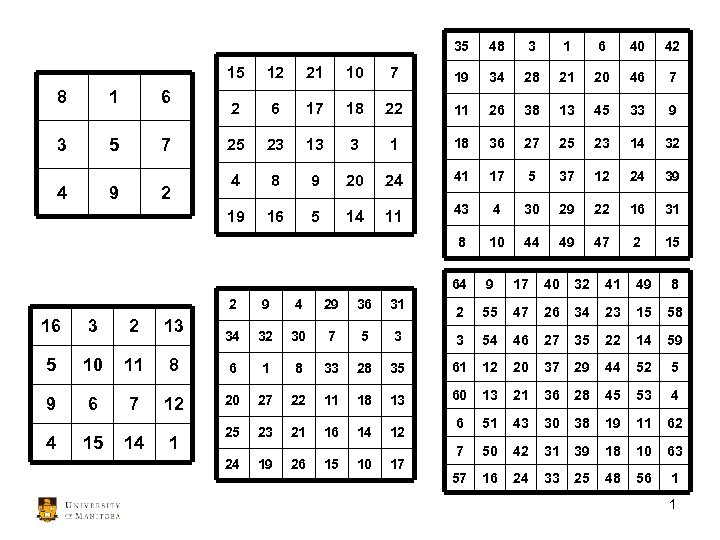 35 48 3 1 6 40 42 15 6 3 5 7 4 9 2 10 7 19 34 28 21 20 46 7 2 6 17 18 22 11 26 38 13 45 33 9 25 23 13 3 1 18 36 27 25 23 14 32 4 8 9 20 24 41 17 5 37 12 24 39 16 5 14 11 43 4 30 29 22 16 31 8 1 21 19 8 12 10 44 49 47 2 15 64 9 17 40 32 41 49 8 2 55 47 26 34 23 15 58 2 9 4 29 36 31 34 32 30 7 5 3 3 54 46 27 35 22 14 59 16 3 2 13 5 10 11 8 6 1 8 33 28 35 61 12 20 37 29 44 52 5 9 6 7 12 20 27 22 11 18 13 60 13 21 36 28 45 53 4 25 23 21 16 14 12 6 51 43 30 38 19 11 62 7 50 42 31 39 18 10 63 57 16 24 33 25 48 56 1 4 15 14 1 24 19 26 15 10 17 1
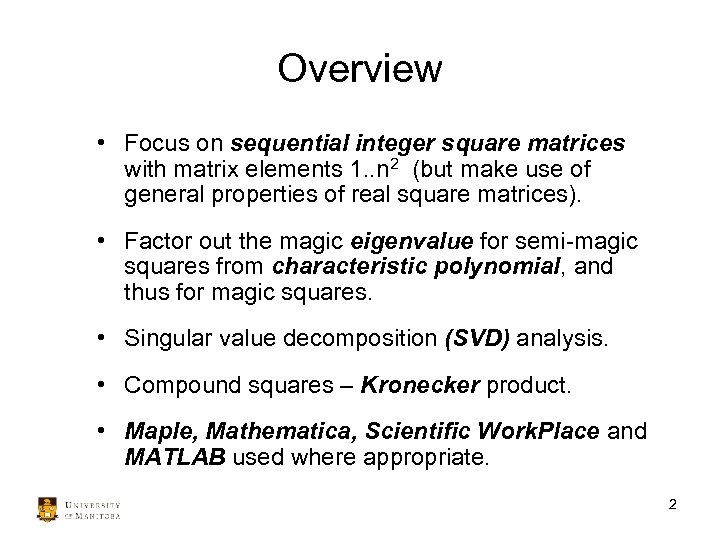 Overview • Focus on sequential integer square matrices with matrix elements 1. . n 2 (but make use of general properties of real square matrices). • Factor out the magic eigenvalue for semi-magic squares from characteristic polynomial, and thus for magic squares. • Singular value decomposition (SVD) analysis. • Compound squares – Kronecker product. • Maple, Mathematica, Scientific Work. Place and MATLAB used where appropriate. 2
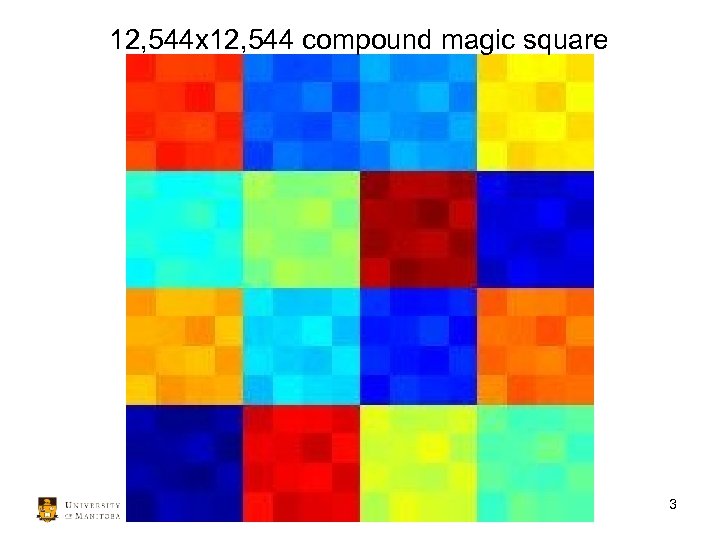 12, 544 x 12, 544 compound magic square 3
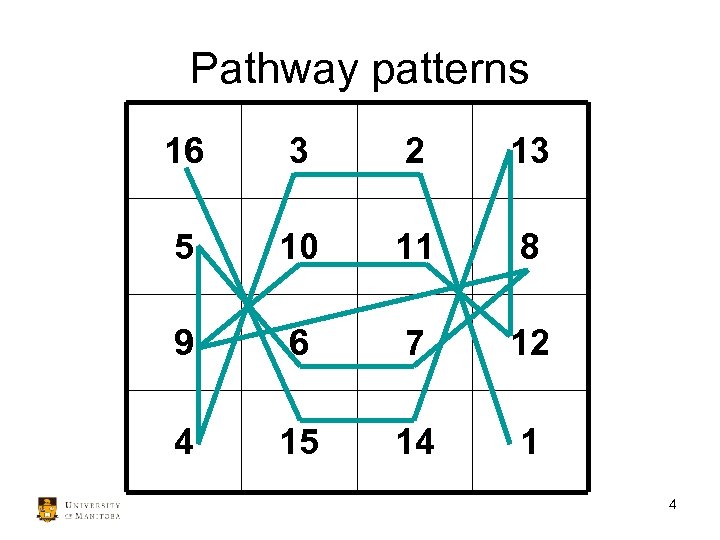 Pathway patterns 16 3 2 13 5 10 11 8 9 6 7 12 4 15 14 1 4
 The Manitoba Magicians [with apologies to the International Brotherhood of Magicians (IBM), founded in Winnipeg in 1922] • • • John Hendricks, meteorologist (retired to Victoria, British Columbia) Frank Hruska, Chemistry, University of Manitoba Vaclav Linek and John Cormie (antimagic squares) University of Winnipeg Peter Loly, retired December 2006, Senior Scholar, U Manitoba Ian Cameron, Planetarium and Observatory supervisor, U Manitoba Marcus Steeds, Frantic Films Wayne Chan, Centre for Earth Observation Science (CEOS) Adam Rogers, graduate student, genetic algorithms for astrophysics Daniel Schindel, Michigan State, East Lansing, nuclear theory Matthew Rempel, second degree in engineering Russell Holmes, Ph. D Princeton Gideon Garland, mass spectroscopy, Israel. 5
![Modern Combinatorics • Persis Diaconis (and company) • “Following Mac. Mahon [45] and Stanley](https://present5.com/presentation/5d5697aafa8915f945398e20619df771/image-7.jpg "Modern Combinatorics • Persis Diaconis (and company) • “Following Mac. Mahon [45] and Stanley") Modern Combinatorics • Persis Diaconis (and company) • “Following Mac. Mahon [45] and Stanley [52], what is referred to as magic squares in modern combinatorics are square matrices of order k, whose entries are nonnegative integers and whose rows and columns sum up to the same number j. ” • www. emis. ams. org/journals/EJC/Volume 11/PDF/v 11 i 2 r 2. pdf • Counting integer points in polyhedral cones (de Loera, Beck, Ahmed, . . . ). Difficult to handle matrix elements 1. . n 2. 6
Modern Combinatorics • Persis Diaconis (and company) • “Following Mac. Mahon [45] and Stanley [52], what is referred to as magic squares in modern combinatorics are square matrices of order k, whose entries are nonnegative integers and whose rows and columns sum up to the same number j. ” • www. emis. ams. org/journals/EJC/Volume 11/PDF/v 11 i 2 r 2. pdf • Counting integer points in polyhedral cones (de Loera, Beck, Ahmed, . . . ). Difficult to handle matrix elements 1. . n 2. 6
 Doubly stochastic matrices • Shin, Guibas and Zhao, CS dept. , Stanford: footnote 5: • “The doubly-stochastic matrix is a N x N non-negative matrix, whose rows and columns sum to one. ” http: //graphics. stanford. edu/projects/lgl/papers/sgz-ipsn 03/sgz-ipsn-03. pdf 7
 Normal (Classic) Magical Squares “magic” n-sum =n(n 2 +1)/2 • Semi-magic (SM) • All rows and columns • Magic squares (MS) include both diagonals • Antipodal constraint (local) associative or regular MS • Global constraints: pandiagonal MS, bent diagonal (Franklin), complete (Mc. Clintock), complement and pandiagonal. • “not even semimagic” • Non-magic pandiagonal • No rows or columns • Example: serial squares of any order • Example: logic squares of orders n=2 p • i. e. , n=2, 4, 8, 16, 32 8
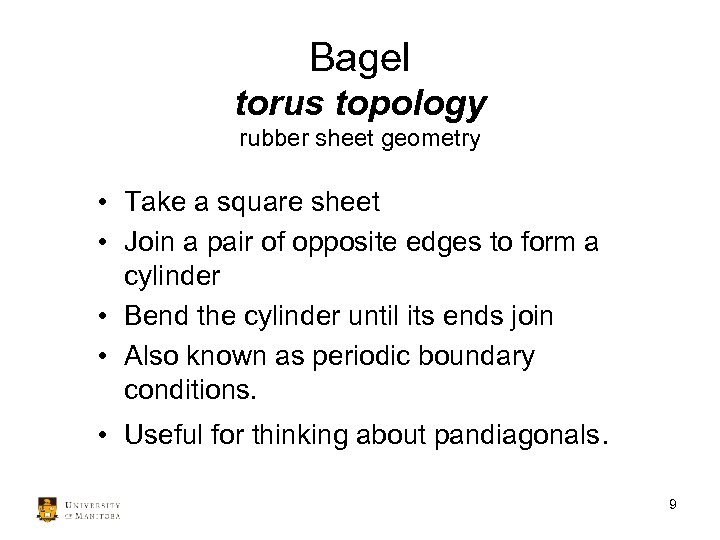 Bagel torus topology rubber sheet geometry • Take a square sheet • Join a pair of opposite edges to form a cylinder • Bend the cylinder until its ends join • Also known as periodic boundary conditions. • Useful for thinking about pandiagonals. 9
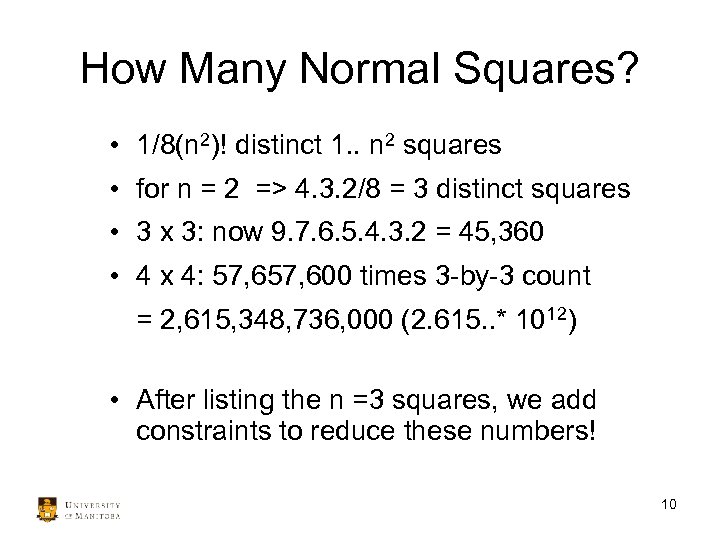 How Many Normal Squares? • 1/8(n 2)! distinct 1. . n 2 squares • for n = 2 => 4. 3. 2/8 = 3 distinct squares • 3 x 3: now 9. 7. 6. 5. 4. 3. 2 = 45, 360 • 4 x 4: 57, 600 times 3 -by-3 count = 2, 615, 348, 736, 000 (2. 615. . * 1012) • After listing the n =3 squares, we add constraints to reduce these numbers! 10
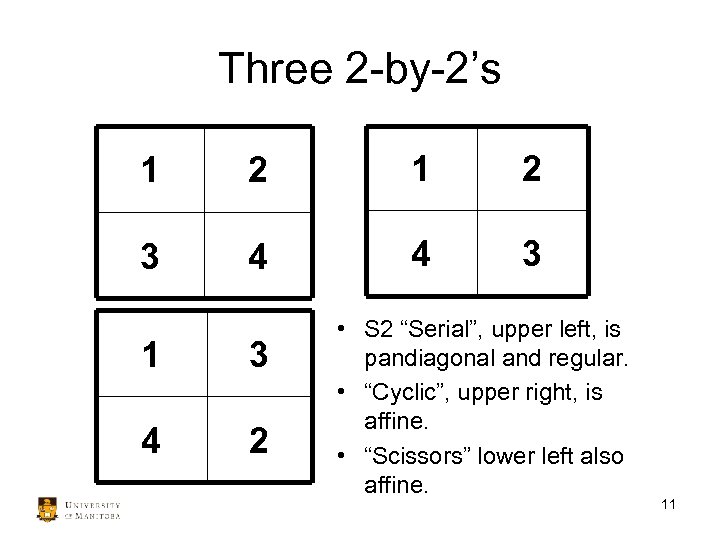 Three 2 -by-2’s 1 2 3 4 4 3 1 3 4 2 • S 2 “Serial”, upper left, is pandiagonal and regular. • “Cyclic”, upper right, is affine. • “Scissors” lower left also affine. 11
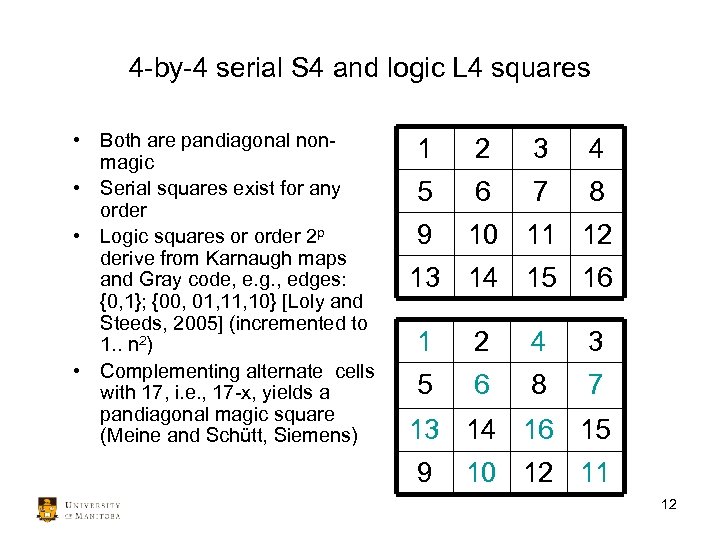 4 -by-4 serial S 4 and logic L 4 squares • Both are pandiagonal nonmagic • Serial squares exist for any order • Logic squares or order 2 p derive from Karnaugh maps and Gray code, e. g. , edges: {0, 1}; {00, 01, 10} [Loly and Steeds, 2005] (incremented to 1. . n 2) • Complementing alternate cells with 17, i. e. , 17 -x, yields a pandiagonal magic square (Meine and Schütt, Siemens) 1 2 3 4 5 6 7 8 9 10 11 12 13 14 15 16 1 2 4 3 5 6 8 7 13 14 16 15 9 10 12 11 12
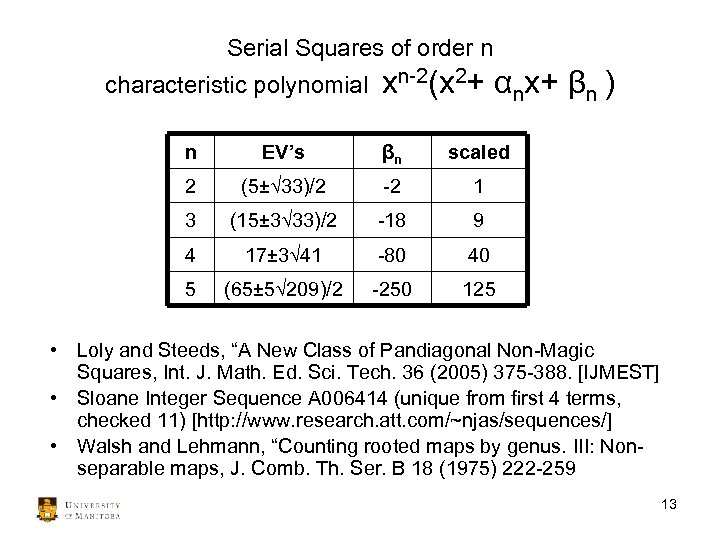 Serial Squares of order n characteristic polynomial xn-2(x 2+ αnx+ βn ) n EV’s βn scaled 2 (5±√ 33)/2 -2 1 3 (15± 3√ 33)/2 -18 9 4 17± 3√ 41 -80 40 5 (65± 5√ 209)/2 -250 125 • Loly and Steeds, “A New Class of Pandiagonal Non-Magic Squares, Int. J. Math. Ed. Sci. Tech. 36 (2005) 375 -388. [IJMEST] • Sloane Integer Sequence A 006414 (unique from first 4 terms, checked 11) [http: //www. research. att. com/~njas/sequences/] • Walsh and Lehmann, “Counting rooted maps by genus. III: Nonseparable maps, J. Comb. Th. Ser. B 18 (1975) 222 -259 13
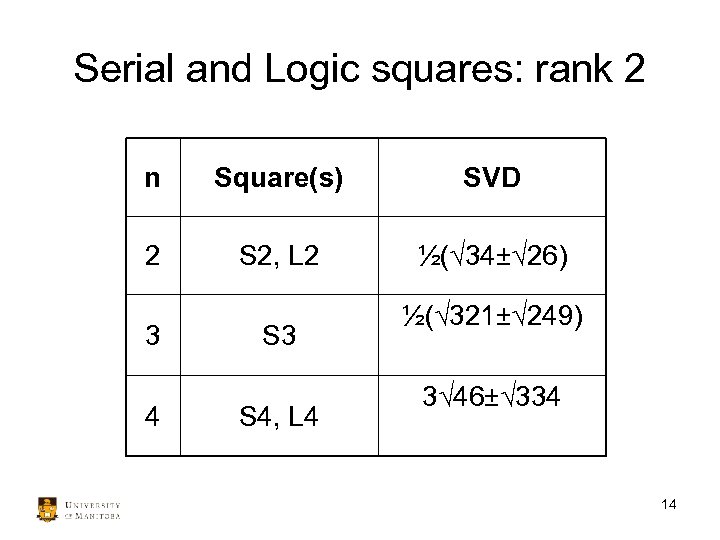 Serial and Logic squares: rank 2 n Square(s) SVD 2 S 2, L 2 ½(√ 34±√ 26) 3 4 S 3 S 4, L 4 ½(√ 321±√ 249) 3√ 46±√ 334 14
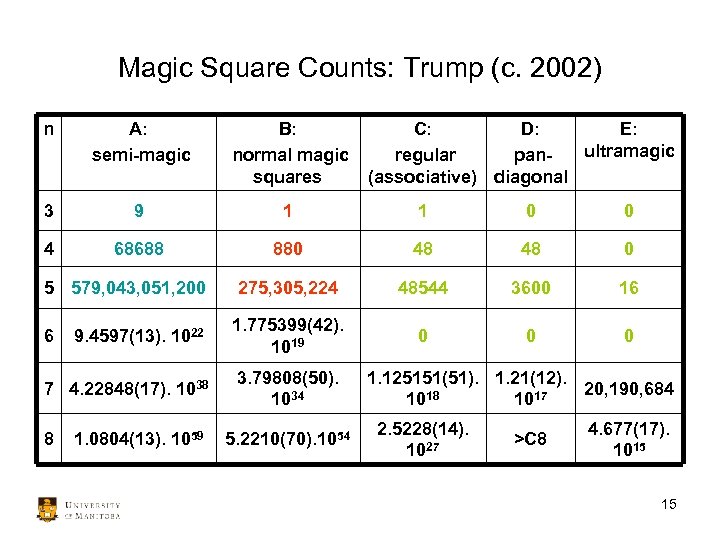 Magic Square Counts: Trump (c. 2002) n A: semi-magic B: normal magic squares 3 9 1 1 0 0 4 68688 880 48 48 0 275, 305, 224 48544 3600 16 9. 4597(13). 1022 1. 775399(42). 1019 0 0 0 7 4. 22848(17). 1038 3. 79808(50). 1034 5 579, 043, 051, 200 6 8 1. 0804(13). 1059 5. 2210(70). 1054 C: D: E: ultramagic regular pan(associative) diagonal 1. 125151(51). 1. 21(12). 20, 190, 684 1018 1017 2. 5228(14). 1027 >C 8 4. 677(17). 1015 15
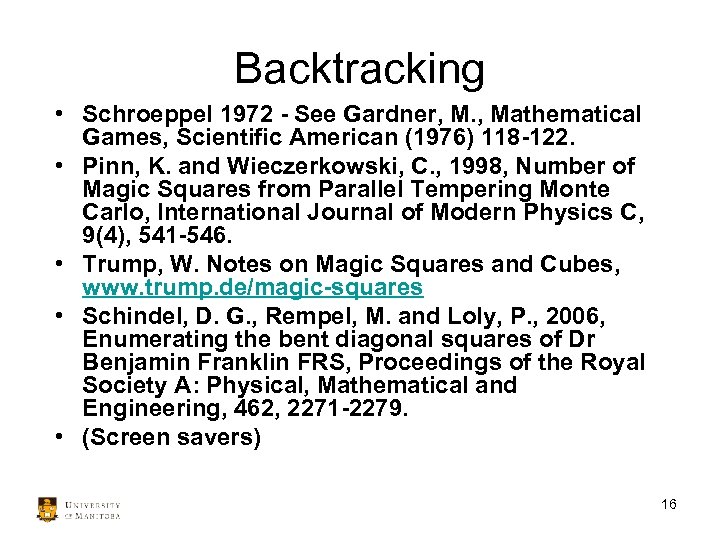 Backtracking • Schroeppel 1972 - See Gardner, M. , Mathematical Games, Scientific American (1976) 118 -122. • Pinn, K. and Wieczerkowski, C. , 1998, Number of Magic Squares from Parallel Tempering Monte Carlo, International Journal of Modern Physics C, 9(4), 541 -546. • Trump, W. Notes on Magic Squares and Cubes, www. trump. de/magic-squares • Schindel, D. G. , Rempel, M. and Loly, P. , 2006, Enumerating the bent diagonal squares of Dr Benjamin Franklin FRS, Proceedings of the Royal Society A: Physical, Mathematical and Engineering, 462, 2271 -2279. • (Screen savers) 16
 Vector Spaces of Magical Squares • General 3 x 3 Lucas 1891 • General 4 x 4 Bergholt 1910 • John Tromp & Peter Loly - Haskell/Maple 17
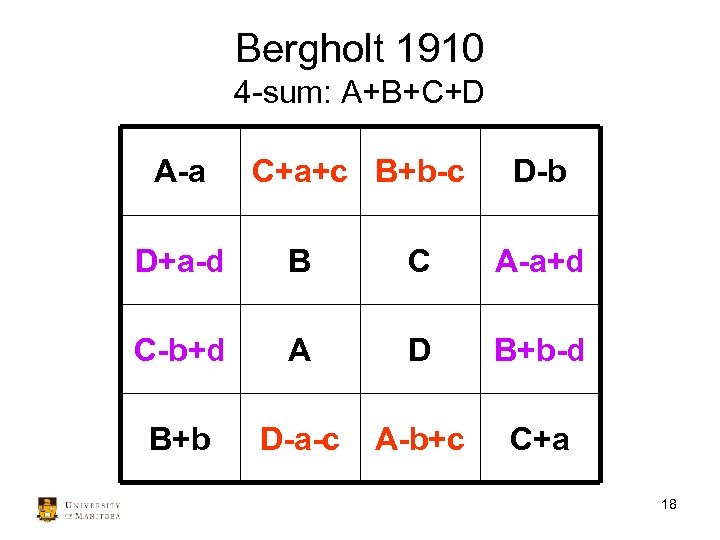 Bergholt 1910 4 -sum: A+B+C+D A-a C+a+c B+b-c D-b D+a-d B C A-a+d C-b+d A D B+b-d B+b D-a-c A-b+c C+a 18
 Rotation • A square has 8 phases obtained from any one by rotations and reflections. • It is convention to select one, but it turns out to be illuminating to study a second phase, either a 90° rotation or a flip. • This is illustrated next for the archetypal Lo. Shu n = 3 magic square from China – probably 2 millennia old. 19
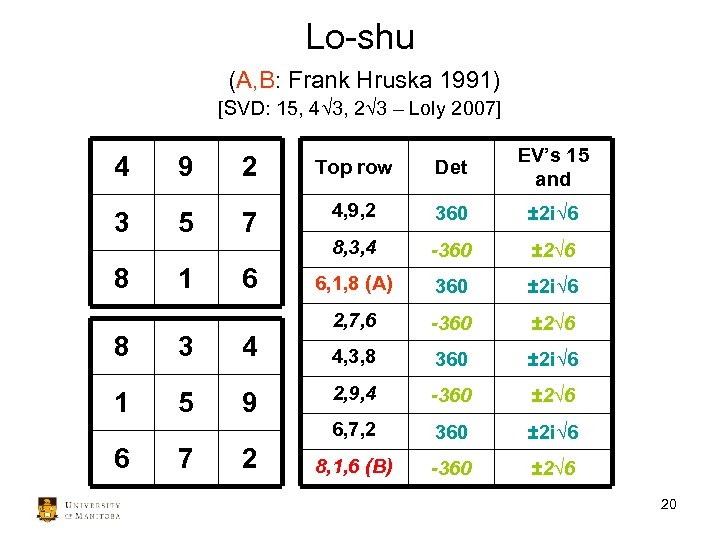 Lo-shu (A, B: Frank Hruska 1991) [SVD: 15, 4√ 3, 2√ 3 – Loly 2007] 4 3 8 8 1 6 9 5 1 3 5 7 2 Top row Det EV’s 15 and 7 4, 9, 2 360 ± 2 i√ 6 8, 3, 4 -360 ± 2√ 6 6, 1, 8 (A) 360 ± 2 i√ 6 2, 7, 6 -360 ± 2√ 6 4, 3, 8 360 ± 2 i√ 6 2, 9, 4 -360 ± 2√ 6 6, 7, 2 360 ± 2 i√ 6 8, 1, 6 (B) -360 ± 2√ 6 6 4 9 2 20
 MATLAB’s magic(n) • Separate algorithms for producing one square in each case [Cleve Moler, MATLAB’s Magical Mystery Tour, Winter 1993, Math. Works Newsletter 7(1) 8 -9] • Odd n – regular (associative) NONSINGULAR • Singly even – NOT regular, SINGULAR • Doubly even – regular, SINGULAR • 1995 Kirkland Neumann give EV’s and SVD formulae for n = 4 k [Lin. Alg. and its Appls. 220: 181213]. 21
 Mattingly singular even order regular magic squares • 1999 (preprint) Mattingly proof of singularity for even order [Am. Math. Monthly 107 (2000) 777 -782] • 1999 Loly already had studied all singular squares in the 4 th order set of 880 by Dudeney group, finding examples with just one non-zero eigenvalue. 22
 5 th order regular magic squares • Mattingly had conjectured odd orders were non -singular. • 2003 Schindel and Loly, using programming ideas from an n=6 hybrid backtracking code of Walter Trump, regenerated the 5 th order set of some 275 million magic squares and found that of the 48, 544 regular magic squares, 652 were singular with 2 zero EVs, AND four had 4 zero EVs. • The 16 ultramagic squares [Suzuki] are nonsingular. 23
 7 th order ultramagic squares Walter Trump • Trump found 20, 190, 684 of these squares, of which Schindel found 20, 604 to be singular, with a pair of zero eigenvalues. • Trump also found that less than 0. 06% of 7 th order regular squares are singular. • Kerry Brock, “How many singular squares are there? ” Math. Gaz. 89 (Nov. 2005) 378 -384. 24
 W-42 Götz Trenkler • “On the Moore-Penrose inverse of magic squares” • We leave this aspect of singular magic squares to GT. 25
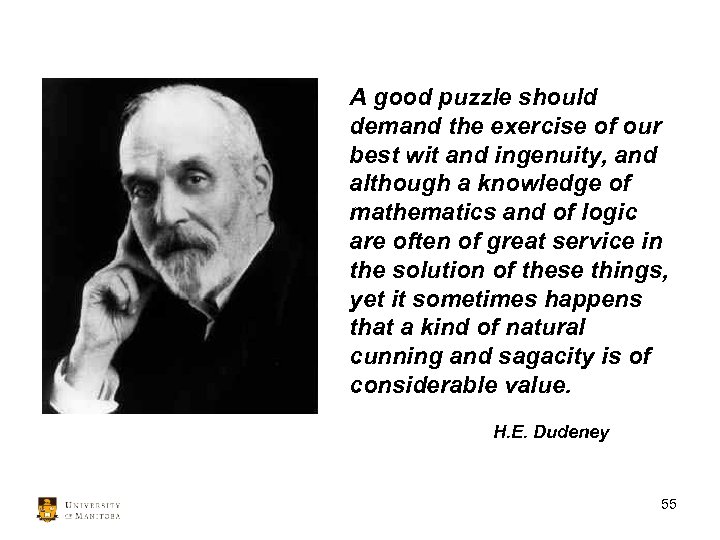
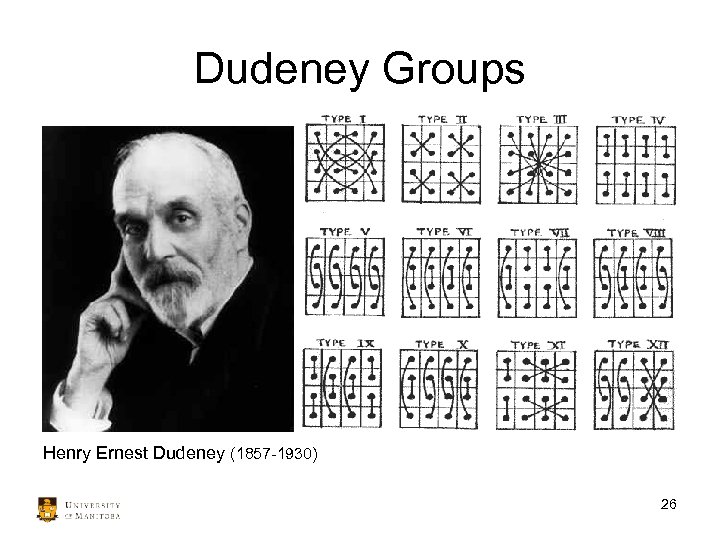 Dudeney Groups Henry Ernest Dudeney (1857 -1930) 26
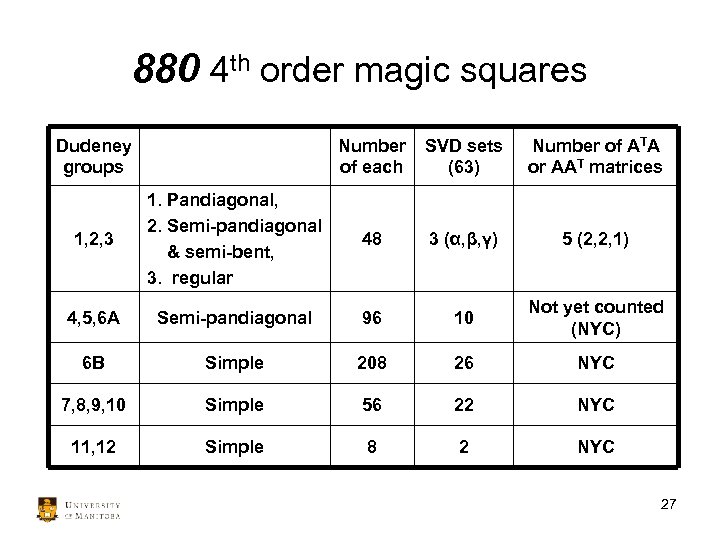 880 4 th order magic squares Dudeney groups Number of each SVD sets (63) Number of ATA or AAT matrices 1, 2, 3 1. Pandiagonal, 2. Semi-pandiagonal & semi-bent, 3. regular 48 3 (α, β, γ) 5 (2, 2, 1) 4, 5, 6 A Semi-pandiagonal 96 10 Not yet counted (NYC) 6 B Simple 208 26 NYC 7, 8, 9, 10 Simple 56 22 NYC 11, 12 Simple 8 2 NYC 27
 Talks W-44 and W-08 • Kimmo Vehkalahti will talk about the 640 singular magic squares in more detail than I can include in my talk. • La Lok Chu, in joint work with George Styan, will talk about various issues for the 880, including their work on odd powers of certain remarkable cases. • PDL will focus on a few examples and SVD. 28
 SVD • Since we have found many magic squares with only a single non-zero eigenvalue, but rank 3 (or more), SVD values give more information (akin to an X-ray). • Further, motivated by analytical results of Kirkland Neumann, we turned to examining the eigenvalues of ATA, the (observability) Gramian matrix, a symmetric matrix, where the square root of its (positive) eigenvalues gives the SVD values, with the largest being the linesum eigenvalue. 29
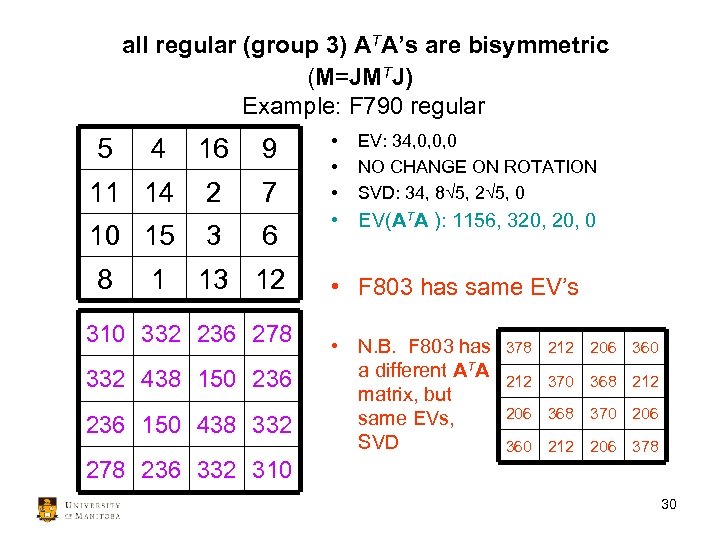 all regular (group 3) ATA’s are bisymmetric (M=JMTJ) Example: F 790 regular 5 4 16 9 11 14 2 7 10 15 3 8 13 12 1 6 310 332 236 278 332 438 150 236 150 438 332 • • • EV: 34, 0, 0, 0 NO CHANGE ON ROTATION SVD: 34, 8√ 5, 2√ 5, 0 • EV(ATA ): 1156, 320, 0 • F 803 has same EV’s • N. B. F 803 has a different ATA matrix, but same EVs, SVD 378 212 206 360 212 370 368 212 206 368 370 206 360 212 206 378 236 332 310 30
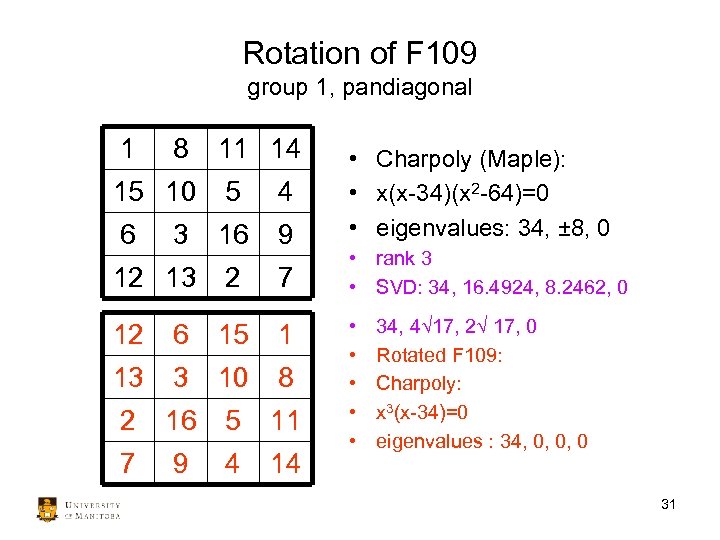 Rotation of F 109 group 1, pandiagonal 1 8 11 14 15 10 5 4 6 3 16 9 12 13 2 7 12 6 15 1 13 3 10 8 2 16 5 11 7 9 4 14 • Charpoly (Maple): • x(x-34)(x 2 -64)=0 • eigenvalues: 34, ± 8, 0 • rank 3 • SVD: 34, 16. 4924, 8. 2462, 0 • • • 34, 4√ 17, 2√ 17, 0 Rotated F 109: Charpoly: x 3(x-34)=0 eigenvalues : 34, 0, 0, 0 31
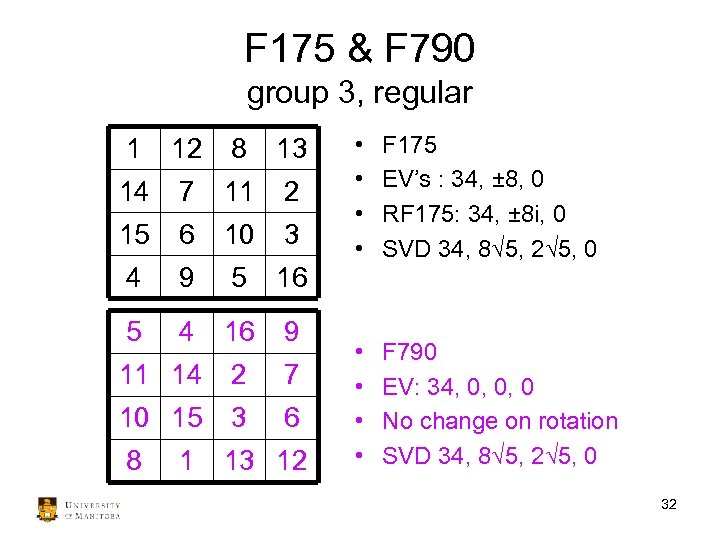 F 175 & F 790 group 3, regular 1 12 8 13 14 7 11 2 15 6 10 3 4 9 5 16 5 4 16 9 11 14 2 7 10 15 3 6 8 13 12 1 • • F 175 EV’s : 34, ± 8, 0 RF 175: 34, ± 8 i, 0 SVD 34, 8√ 5, 2√ 5, 0 • • F 790 EV: 34, 0, 0, 0 No change on rotation SVD 34, 8√ 5, 2√ 5, 0 32
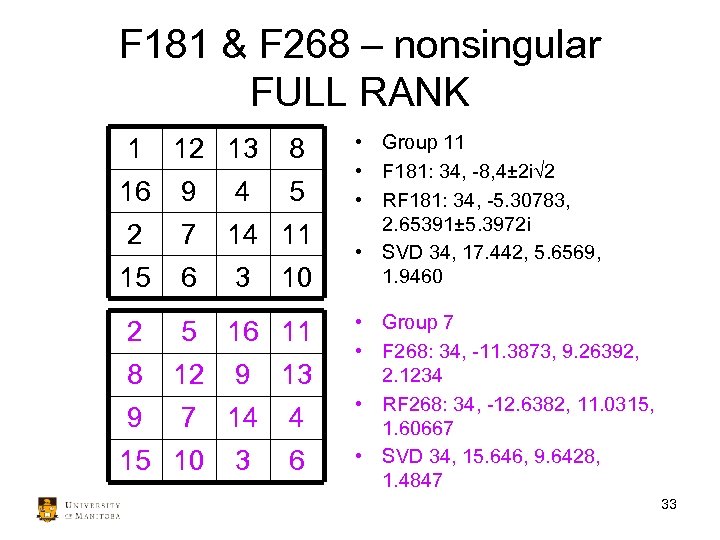 F 181 & F 268 – nonsingular FULL RANK 1 12 13 8 16 9 4 5 2 7 14 11 15 6 3 2 5 16 11 8 12 9 13 9 7 14 4 15 10 3 6 10 • Group 11 • F 181: 34, -8, 4± 2 i√ 2 • RF 181: 34, -5. 30783, 2. 65391± 5. 3972 i • SVD 34, 17. 442, 5. 6569, 1. 9460 • Group 7 • F 268: 34, -11. 3873, 9. 26392, 2. 1234 • RF 268: 34, -12. 6382, 11. 0315, 1. 60667 • SVD 34, 15. 646, 9. 6428, 1. 4847 33
 Parameterization – Vector Spaces • Bergholt had 8 variables which reduce with further constraints. • For groups 1, 2, 3 we have found 4 dimensional spaces, and have used Maple to factorize their characteristic polynomials. • We have also found algebraic formulae for the eigenvalues of the Gramian matrix, ATA, which gives the squares of the SVD values, for groups 1 and 3. 34
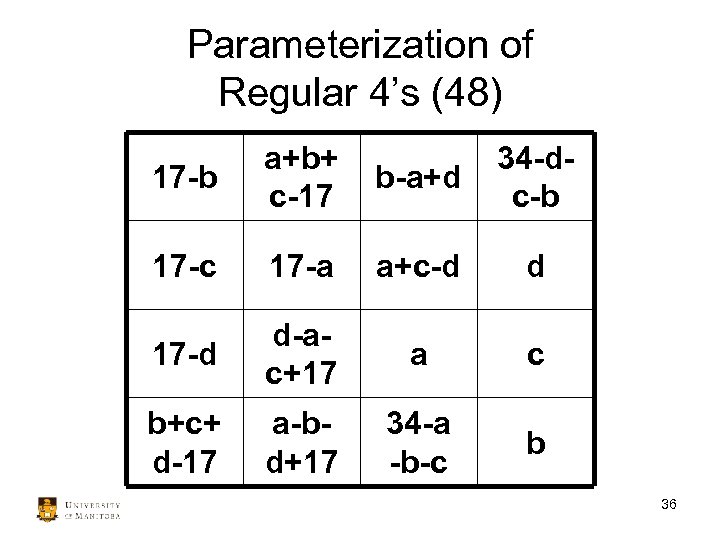 Parameterization of Regular 4’s (48) 17 -b a+b+ c-17 b-a+d 34 -dc-b 17 -c 17 -a a+c-d d 17 -d d-ac+17 a c b+c+ d-17 a-bd+17 34 -a -b-c b 36
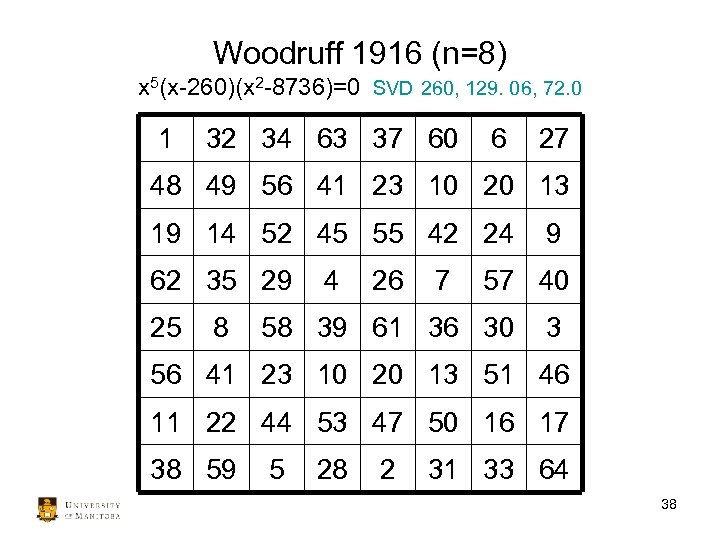 Woodruff 1916 (n=8) x 5(x-260)(x 2 -8736)=0 SVD 260, 129. 06, 72. 0 1 32 34 63 37 60 6 27 48 49 56 41 23 10 20 13 19 14 52 45 55 42 24 62 35 29 25 8 4 26 7 9 57 40 58 39 61 36 30 3 56 41 23 10 20 13 51 46 11 22 44 53 47 50 16 17 38 59 5 28 2 31 33 64 38
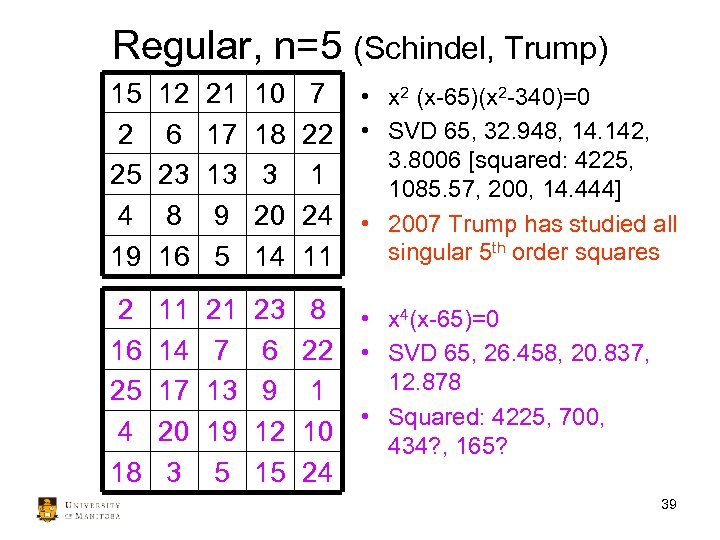 Regular, n=5 (Schindel, Trump) 15 2 25 4 19 12 6 23 8 16 21 17 13 9 5 10 18 3 20 14 7 • x 2 (x-65)(x 2 -340)=0 22 • SVD 65, 32. 948, 14. 142, 3. 8006 [squared: 4225, 1 1085. 57, 200, 14. 444] 24 • 2007 Trump has studied all singular 5 th order squares 11 2 16 25 4 18 11 14 17 20 3 21 7 13 19 5 23 6 9 12 15 8 • x 4(x-65)=0 22 • SVD 65, 26. 458, 20. 837, 12. 878 1 • Squared: 4225, 700, 10 434? , 165? 24 39
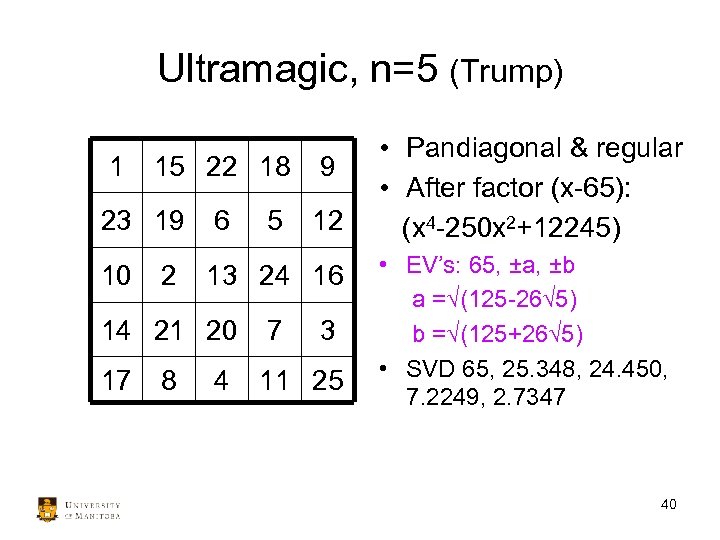 Ultramagic, n=5 (Trump) 1 15 22 18 23 19 6 10 13 24 16 2 5 9 12 14 21 20 7 17 11 25 8 4 3 • Pandiagonal & regular • After factor (x-65): (x 4 -250 x 2+12245) • EV’s: 65, ±a, ±b a =√(125 -26√ 5) b =√(125+26√ 5) • SVD 65, 25. 348, 24. 450, 7. 2249, 2. 7347 40
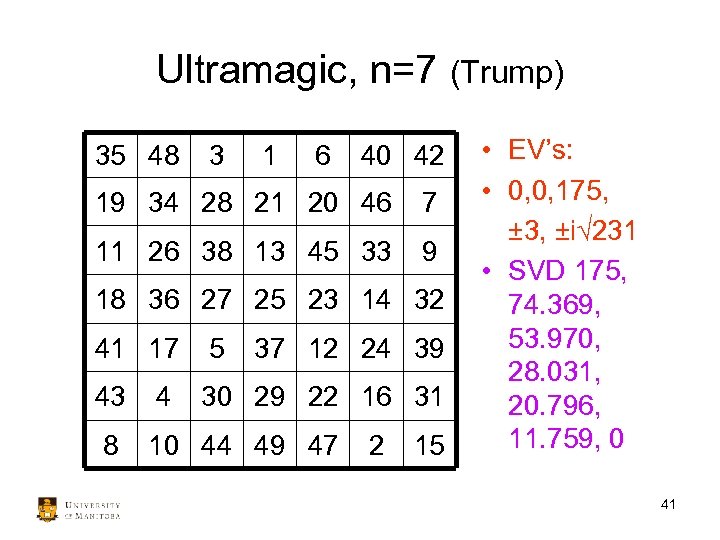 Ultramagic, n=7 35 48 3 1 6 40 42 19 34 28 21 20 46 7 11 26 38 13 45 33 9 18 36 27 25 23 14 32 41 17 5 37 12 24 39 43 4 30 29 22 16 31 8 10 44 49 47 2 15 (Trump) • EV’s: • 0, 0, 175, ± 3, ±i√ 231 • SVD 175, 74. 369, 53. 970, 28. 031, 20. 796, 11. 759, 0 41
 Compound Squares • Wayne Chan & Peter Loly, Mathematics Today 2002 • Harm Derksen, Christian Eggermont, Arno van den Essen, Am. Math. Monthly (in press) • Matt Rempel, Wayne Chan, and Peter Loly • Adam Rogers’ Kronecker product 42
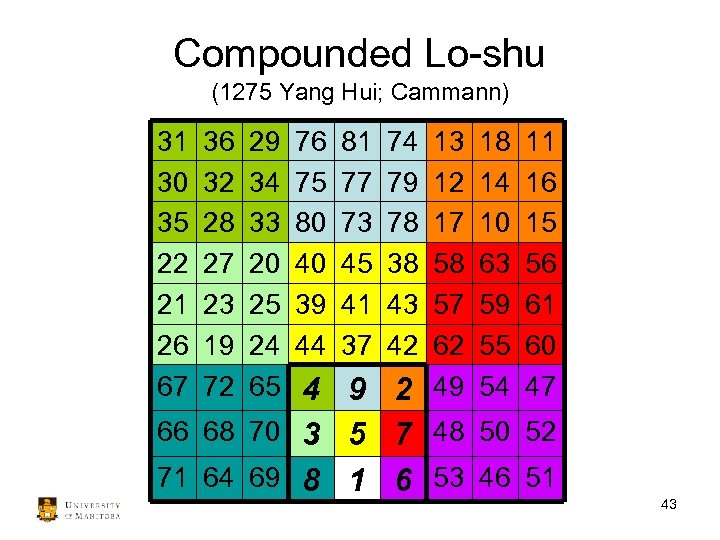 Compounded Lo-shu (1275 Yang Hui; Cammann) 31 30 35 22 21 26 67 36 32 28 27 23 19 72 29 34 33 20 25 24 65 76 75 80 40 39 44 81 77 73 45 41 37 74 79 78 38 43 42 13 12 17 58 57 62 2 49 7 48 18 14 10 63 59 55 54 11 16 15 56 61 60 47 4 9 66 68 70 3 5 50 52 71 64 69 8 1 6 53 46 51 43
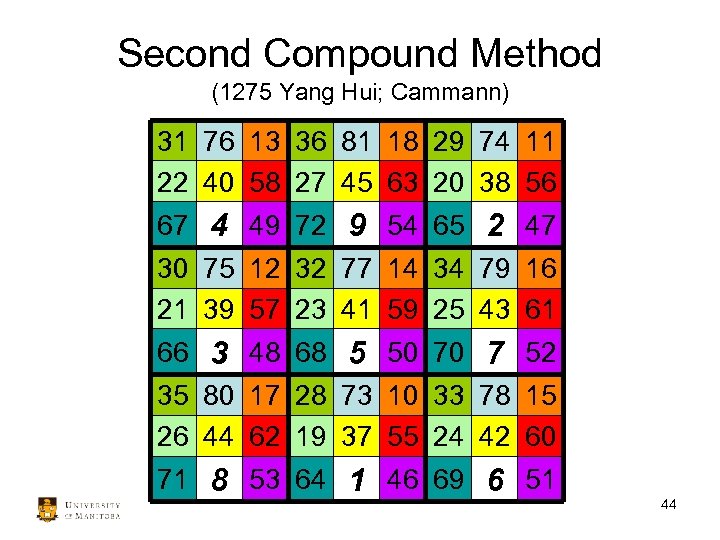 Second Compound Method (1275 Yang Hui; Cammann) 31 76 13 36 81 18 29 74 11 22 40 58 27 45 63 20 38 56 67 4 49 72 9 54 65 2 47 30 75 12 32 77 14 34 79 16 21 39 57 23 41 59 25 43 61 66 3 48 68 5 50 70 7 52 35 80 17 28 73 10 33 78 15 26 44 62 19 37 55 24 42 60 71 8 53 64 1 46 69 6 51 44
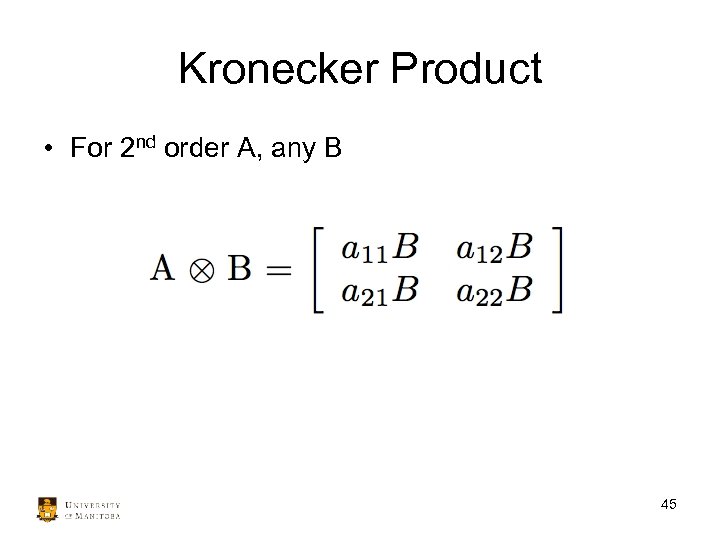 Kronecker Product • For 2 nd order A, any B 45
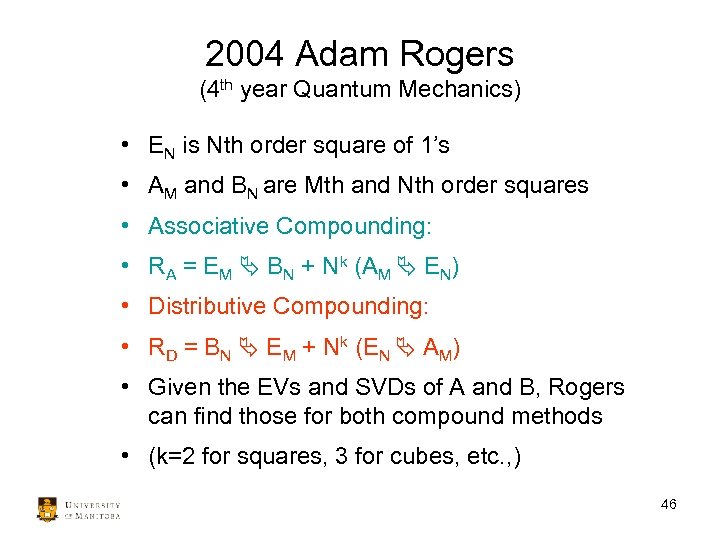 2004 Adam Rogers (4 th year Quantum Mechanics) • EN is Nth order square of 1’s • AM and BN are Mth and Nth order squares • Associative Compounding: • RA = EM BN + Nk (AM EN) • Distributive Compounding: • RD = BN EM + Nk (EN AM) • Given the EVs and SVDs of A and B, Rogers can find those for both compound methods • (k=2 for squares, 3 for cubes, etc. , ) 46
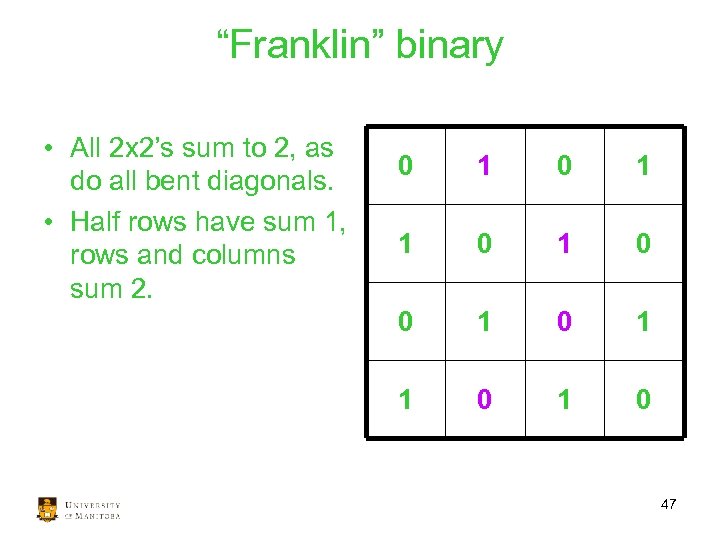 “Franklin” binary • All 2 x 2’s sum to 2, as do all bent diagonals. • Half rows have sum 1, rows and columns sum 2. 0 1 0 1 0 47
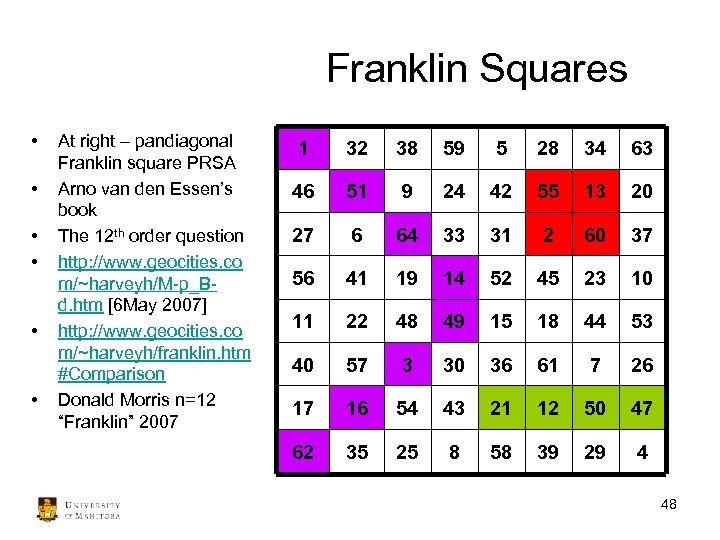 Franklin Squares • • • At right – pandiagonal Franklin square PRSA Arno van den Essen’s book The 12 th order question http: //www. geocities. co m/~harveyh/M-p_Bd. htm [6 May 2007] http: //www. geocities. co m/~harveyh/franklin. htm #Comparison Donald Morris n=12 “Franklin” 2007 1 32 38 59 5 28 34 63 46 51 9 24 42 55 13 20 27 6 64 33 31 2 60 37 56 41 19 14 52 45 23 10 11 22 48 49 15 18 44 53 40 57 3 30 36 61 7 26 17 16 54 43 21 12 50 47 62 35 25 8 58 39 29 4 48
 Franklin, Mc. Clintock, Ollerenshaw & Brée • Bent diagonal squares, half row/column squares 17. . n = 8, 16 • Complete squares 18. . • Most-Perfect Pandiagonal squares • 2006 exact count of Franklin squares for n = 8: 3*368, 640 = 1, 105, 920 • The problem of n = 12 • 22, 295, 347, 200 complete squares (O&B 1998) • Eggermont – no pandiagonal F’s at n = 12 • Donald Morris – 1/3 rows/cols for n = 12, 1/5 for n = 20, etc. 49
 Inertia Tensor • Moment of Inertia of magic squares – Loly Math. Gaz. 2004 • I = ∑mi (ri)2 => In = (1/12)n 2(n 4 -1) • Only need the semimagic constraints! • Inertia Tensor of Magic Cubes (Rogers and Loly, Am. J. Phys. 2004) • Folding magical squares to create magical cubes: 8*8 square => 4*4*4 cube • Kronecker products • Multiway arrays 50
 Issues • Constraint satisfaction problems (CSP’s) • Constraint Logic Programming (CLP), e. g. , Formula. One Compiler • Counting integer points in polyhedral cones (Maya Ahmed, Jesus de Loera, Matthias Beck, …) • Cryptography (O&B, Meine & Schuett) • Dither matrices (patents) 51
 Conclusion • Eigenvalues & SVD for small magic squares • SVD’s and “Music of the Squares”. • Compound squares (cubes, hypercubes) • Multimagic squares (Christian Boyer & Walter Trump) • Decoration – Claude Bragdon, architect • Applications – Chinese I Ching pattern! 52
 Conjectures • Normal magic squares have rank ≥ 3. • Normal non-magic pandiagonal squares have rank ≥ 2. (Unless they are deflated to zero sum squares, in which case they are no longer normal. ) 53
 finis Thank You
 A good puzzle should demand the exercise of our best wit and ingenuity, and although a knowledge of mathematics and of logic are often of great service in the solution of these things, yet it sometimes happens that a kind of natural cunning and sagacity is of considerable value. H. E. Dudeney 55