


 Скачать презентацию Science archives need to communicate more than data
ced03bbd122b995124e7b606da0c15f0.ppt
- Количество слайдов: 22
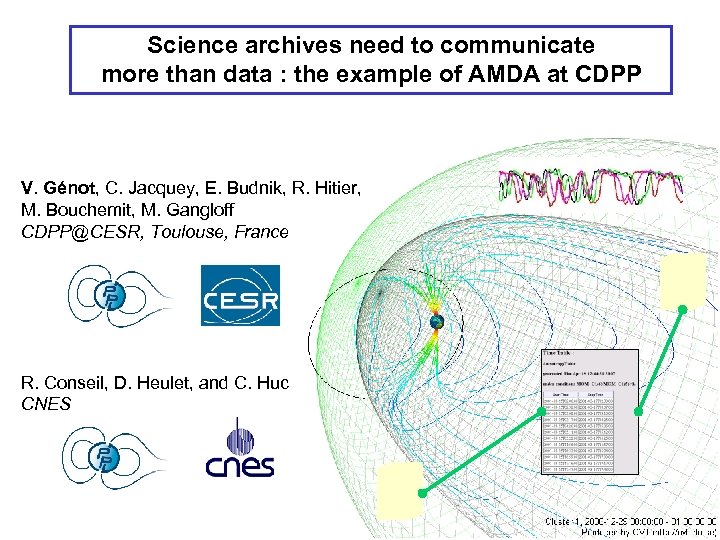 Science archives need to communicate more than data : the example of AMDA at CDPP V. Génot, C. Jacquey, E. Budnik, R. Hitier, M. Bouchemit, M. Gangloff CDPP@CESR, Toulouse, France R. Conseil, D. Heulet, and C. Huc CNES
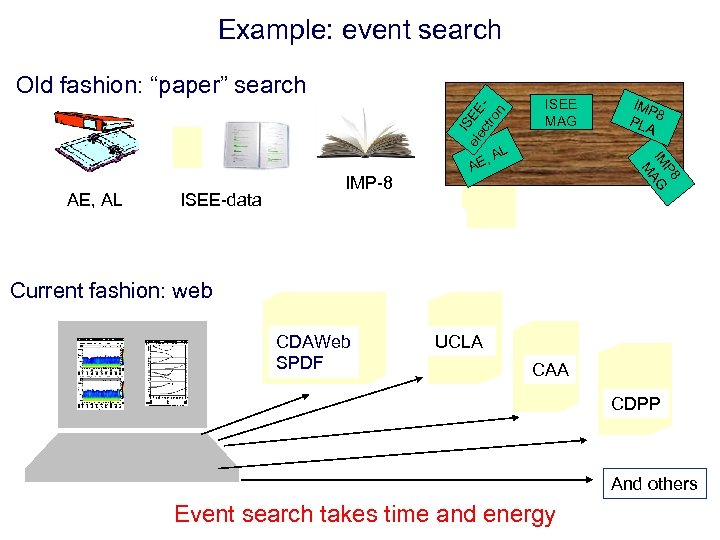 Example: event search I ele SEE ctr on Old fashion: “paper” search ISEE-data AL IMP PLA 8 P 8 IM AG M AE, AL IMP-8 , AE ISEE MAG Current fashion: web CDAWeb SPDF UCLA CAA CDPP And others Event search takes time and energy
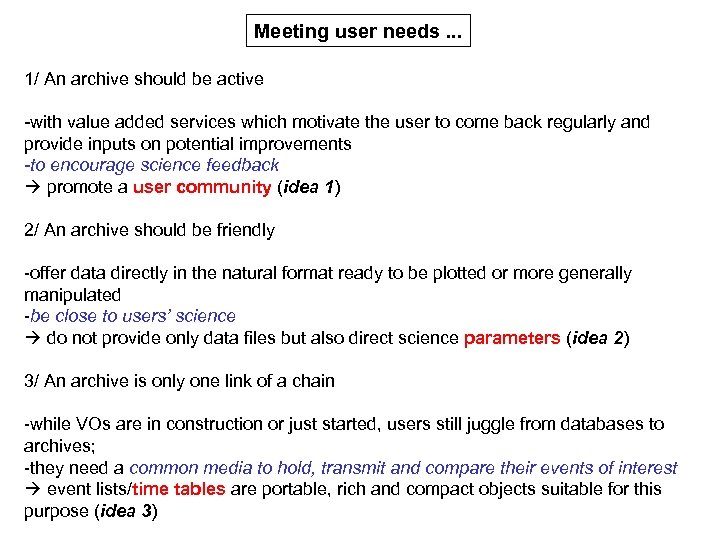 Meeting user needs. . . 1/ An archive should be active -with value added services which motivate the user to come back regularly and provide inputs on potential improvements -to encourage science feedback promote a user community (idea 1) 2/ An archive should be friendly -offer data directly in the natural format ready to be plotted or more generally manipulated -be close to users’ science do not provide only data files but also direct science parameters (idea 2) 3/ An archive is only one link of a chain -while VOs are in construction or just started, users still juggle from databases to archives; -they need a common media to hold, transmit and compare their events of interest event lists/time tables are portable, rich and compact objects suitable for this purpose (idea 3)
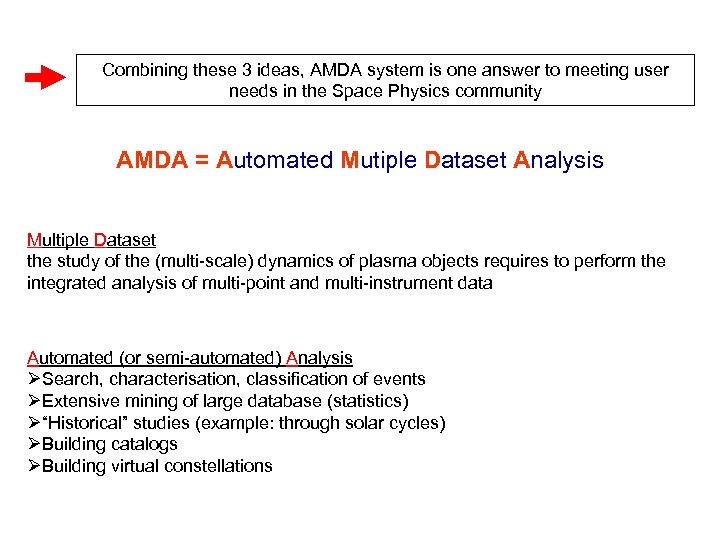 Combining these 3 ideas, AMDA system is one answer to meeting user needs in the Space Physics community AMDA = Automated Mutiple Dataset Analysis Multiple Dataset the study of the (multi-scale) dynamics of plasma objects requires to perform the integrated analysis of multi-point and multi-instrument data Automated (or semi-automated) Analysis ØSearch, characterisation, classification of events ØExtensive mining of large database (statistics) Ø“Historical” studies (example: through solar cycles) ØBuilding catalogs ØBuilding virtual constellations
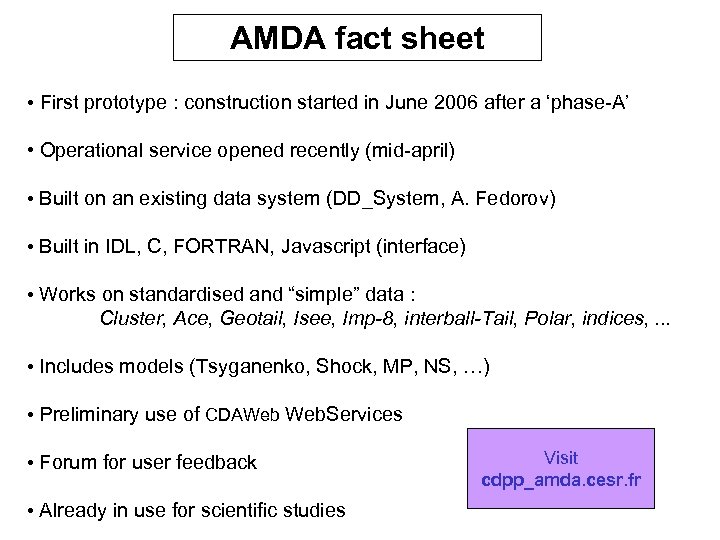 AMDA fact sheet • First prototype : construction started in June 2006 after a ‘phase-A’ • Operational service opened recently (mid-april) • Built on an existing data system (DD_System, A. Fedorov) • Built in IDL, C, FORTRAN, Javascript (interface) • Works on standardised and “simple” data : Cluster, Ace, Geotail, Isee, Imp-8, interball-Tail, Polar, indices, . . . • Includes models (Tsyganenko, Shock, MP, NS, …) • Preliminary use of CDAWeb Web. Services • Forum for user feedback • Already in use for scientific studies Visit cdpp_amda. cesr. fr
 Science with AMDA
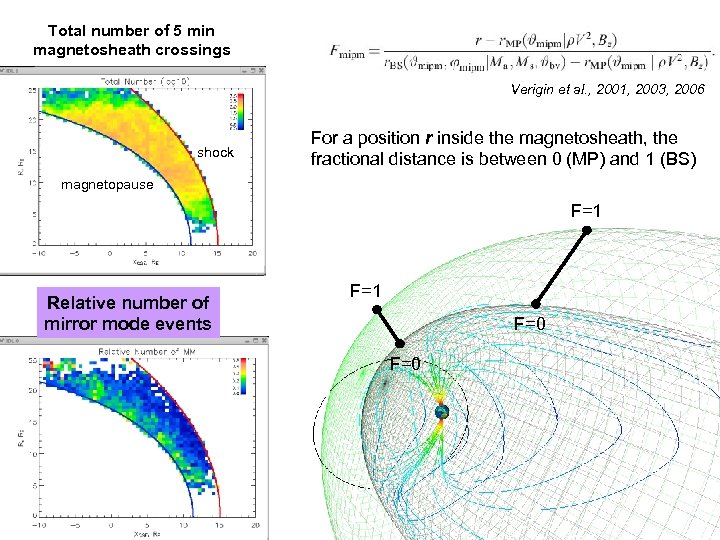 Total number of 5 min magnetosheath crossings Verigin et al. , 2001, 2003, 2006 shock For a position r inside the magnetosheath, the fractional distance is between 0 (MP) and 1 (BS) magnetopause F=1 Relative number of mirror mode events F=1 F=0
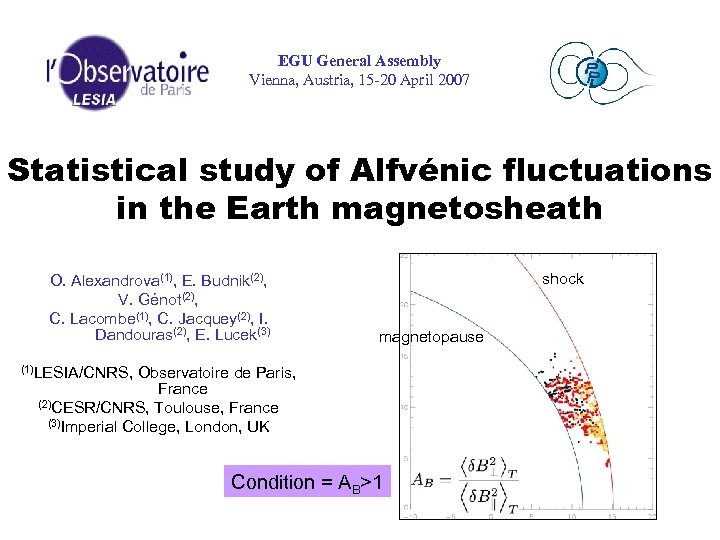 EGU General Assembly Vienna, Austria, 15 -20 April 2007 Statistical study of Alfvénic fluctuations in the Earth magnetosheath O. Alexandrova(1), E. Budnik(2), V. Génot(2), C. Lacombe(1), C. Jacquey(2), I. Dandouras(2), E. Lucek(3) shock magnetopause (1)LESIA/CNRS, Observatoire de Paris, France (2)CESR/CNRS, Toulouse, France (3)Imperial College, London, UK Condition = AB>1
 . . . other ways to make science with AMDA 1/ Multi-mission study of plasma sheet conditions minutes before substorm onsets (Jacquey et al. ) : - 25 years of data : ISEE, IMP, IRM, POLAR, GEOTAIL, WIND, ACE, CLUSTER - combined approach: -automatic search = mathematical description of the temporal change in the AL index -semi automatic = visual inspection to classify cases in different catalogues 2/ The active plasma sheet: definition of 'events' and statistical analysis (Louarn et al. , 2006, ICS 8) - define conditions : a lower threshold for the low frequency magnetic fluctuations and a minimal duration for each events - produce time tables accordingly - download a wide (resampled) dataset and work offline
 So, what’s inside AMDA ?
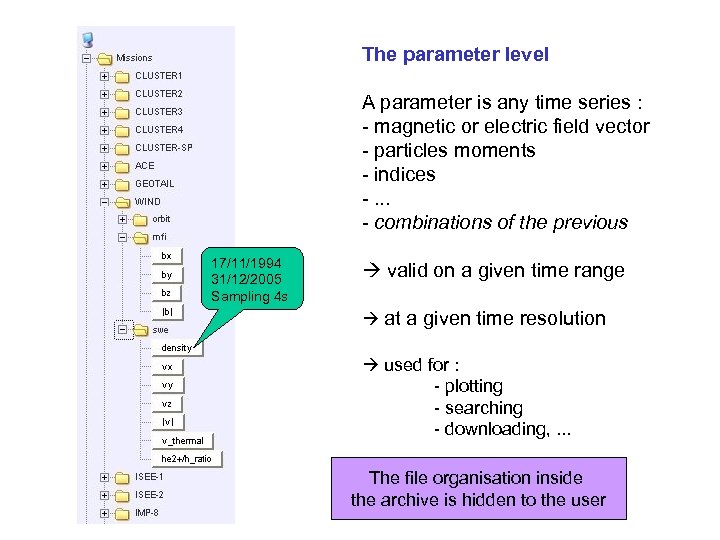 The parameter level A parameter is any time series : - magnetic or electric field vector - particles moments - indices -. . . - combinations of the previous 17/11/1994 31/12/2005 Sampling 4 s valid on a given time range at a given time resolution used for : - plotting - searching - downloading, . . . The file organisation inside the archive is hidden to the user
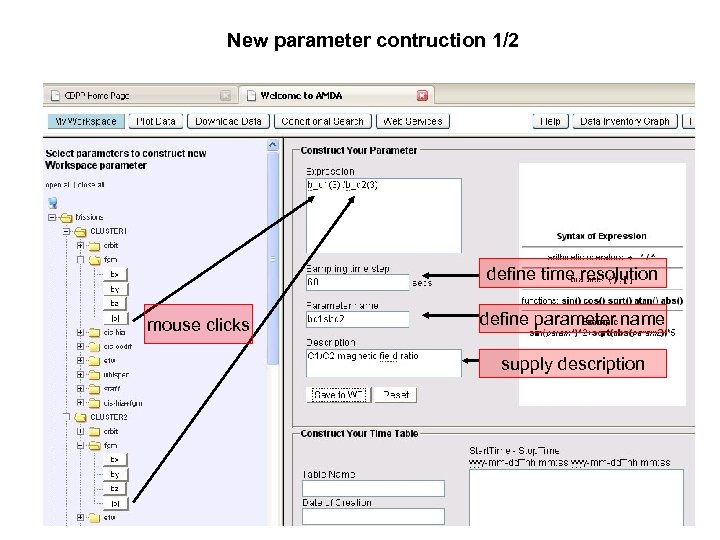 New parameter contruction 1/2 define time resolution mouse clicks define parameter name supply description
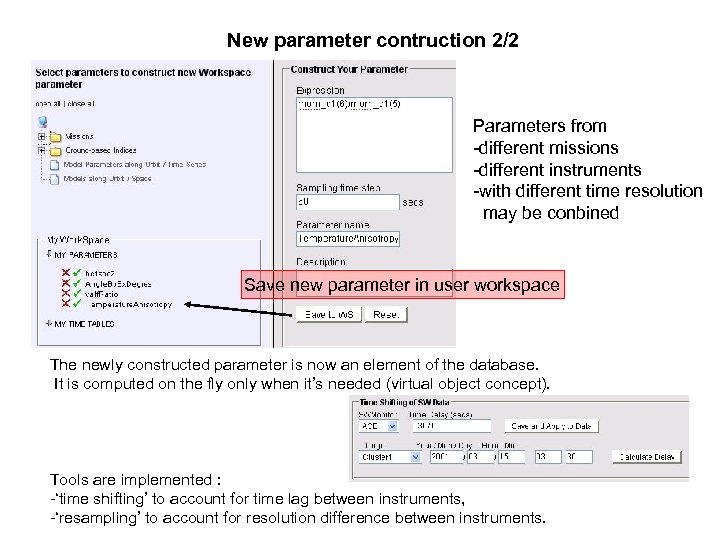 New parameter contruction 2/2 Parameters from -different missions -different instruments -with different time resolution may be conbined Save new parameter in user workspace The newly constructed parameter is now an element of the database. It is computed on the fly only when it’s needed (virtual object concept). Tools are implemented : -‘time shifting’ to account for time lag between instruments, -‘resampling’ to account for resolution difference between instruments.
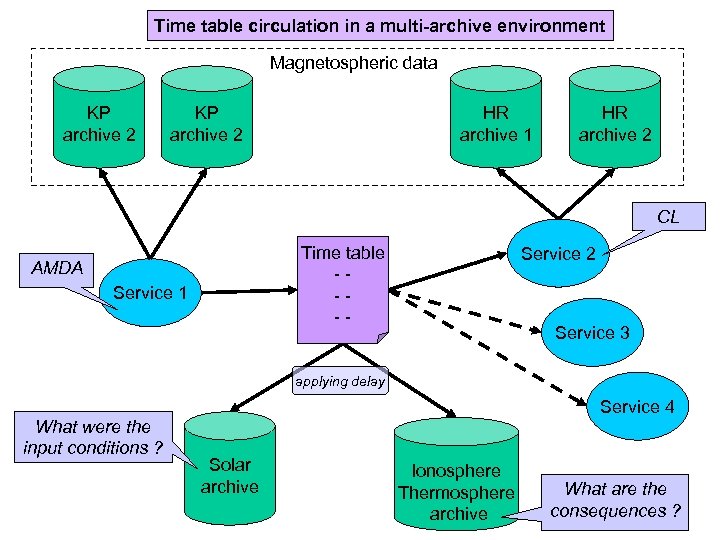
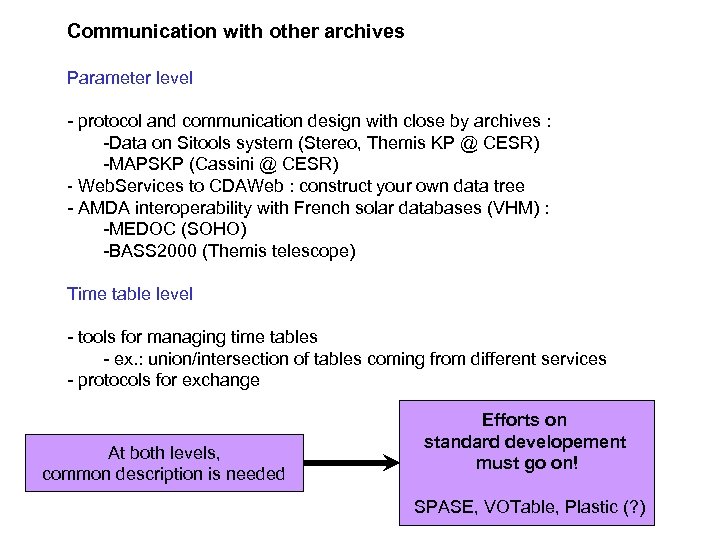
 The Time Table level an easy way to communicate information between archives - Time tables, or event lists, are a collection of times when ‘something’ happens or time spans when some conditions are true. - They are usually manually created and managed by scientists for their own need or the one of restricted community. - AMDA enhances the potentialities of these objects by offering a generic tool to create, handle and communicate them between databases/archives and users. These time-tables may be used for : - extracting subdatabases, - executing massive and/or interactive treatments, - creating catalogs, - serving as reference in the community
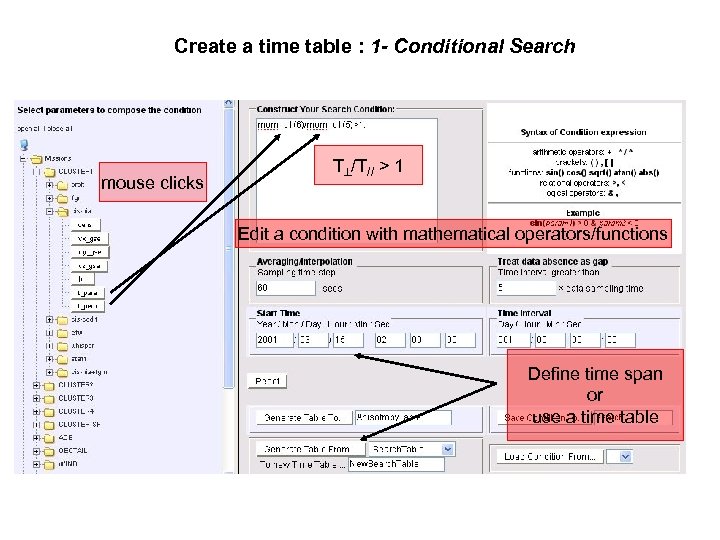 Create a time table : 1 - Conditional Search mouse clicks T /T// > 1 Edit a condition with mathematical operators/functions Define time span or use a time table
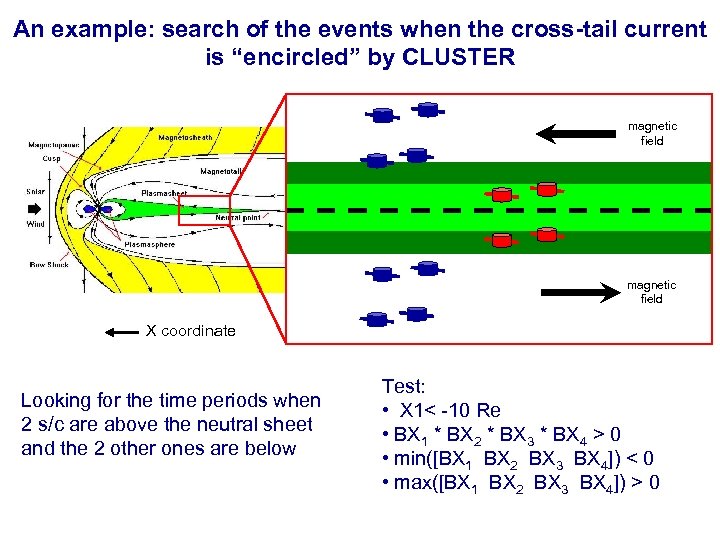 An example: search of the events when the cross-tail current is “encircled” by CLUSTER magnetic field X coordinate Looking for the time periods when 2 s/c are above the neutral sheet and the 2 other ones are below Test: • X 1< -10 Re • BX 1 * BX 2 * BX 3 * BX 4 > 0 • min([BX 1 BX 2 BX 3 BX 4]) < 0 • max([BX 1 BX 2 BX 3 BX 4]) > 0
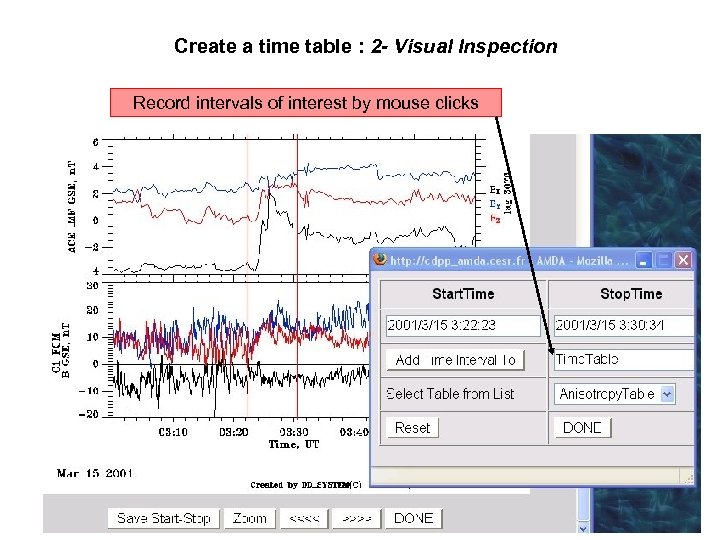 Create a time table : 2 - Visual Inspection Record intervals of interest by mouse clicks
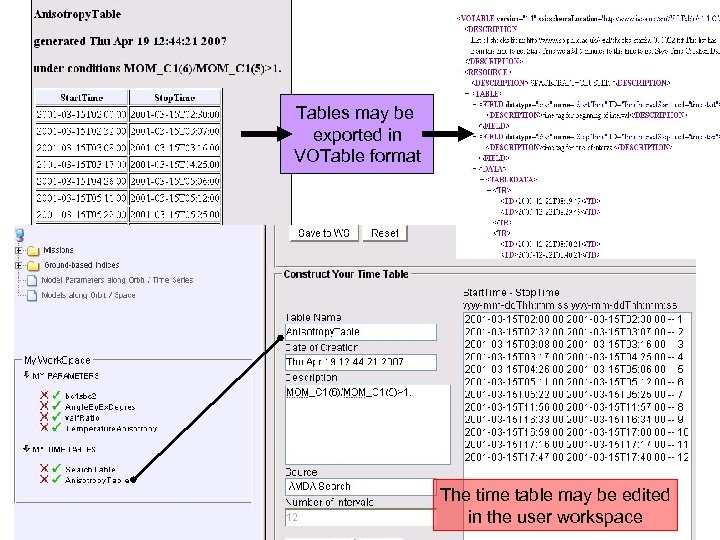 Tables may be exported in VOTable format The time table may be edited in the user workspace
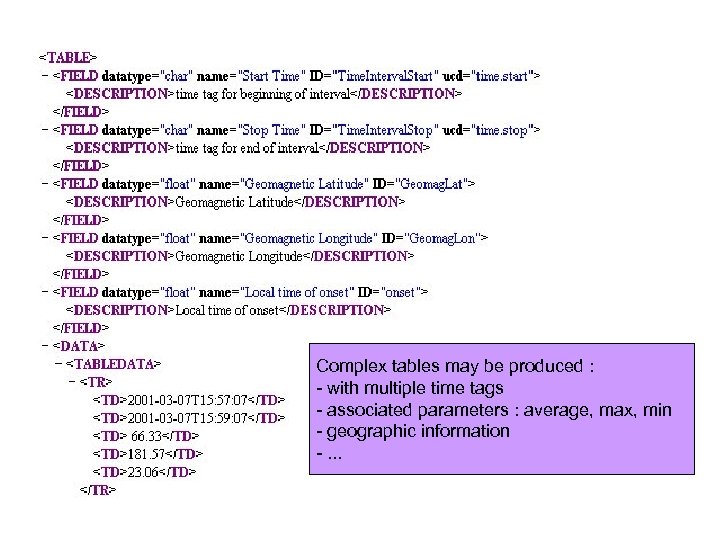 Complex tables may be produced : - with multiple time tags - associated parameters : average, max, min - geographic information -. . .
 Table description is a key issue for communication between archives Example : List of Cluster magnetosheath crossings when ACE velocity is greater than 500 km/s during at least 5 min with associated parameters such that maximum and average plasma beta and temperature anisotropy on these intervals. A careful description of this table would require : - data description (instrument, resolution, . . . ) - magnetosheath identification method (models, instrument modes, data) - Cluster-ACE delay method (constant velocity, iteration)
 Time table circulation in a multi-archive environment Magnetospheric data KP archive 2 HR archive 1 HR archive 2 CL Time table ---- AMDA Service 1 Service 2 Service 3 applying delay What were the input conditions ? Service 4 Solar archive Ionosphere Thermosphere archive What are the consequences ?
 Communication with other archives Parameter level - protocol and communication design with close by archives : -Data on Sitools system (Stereo, Themis KP @ CESR) -MAPSKP (Cassini @ CESR) - Web. Services to CDAWeb : construct your own data tree - AMDA interoperability with French solar databases (VHM) : -MEDOC (SOHO) -BASS 2000 (Themis telescope) Time table level - tools for managing time tables - ex. : union/intersection of tables coming from different services - protocols for exchange At both levels, common description is needed Efforts on standard developement must go on! SPASE, VOTable, Plastic (? )