


 Скачать презентацию Science and Technology U S -Russia relationship March
US-RUS programs for Perm.pptx
- Количество слайдов: 14
 Science and Technology U. S. -Russia relationship March 15, 2013 Mark Meyer, U. S. Embassy Moscow
 Outline § U. S. -Russia cooperation framework: BPC § Science Collaboration: What are U. S. -Rus projects? § Third-party groups for cooperation § How to get involved § NSF database and MOU § Priority Research areas in the U. S. 2
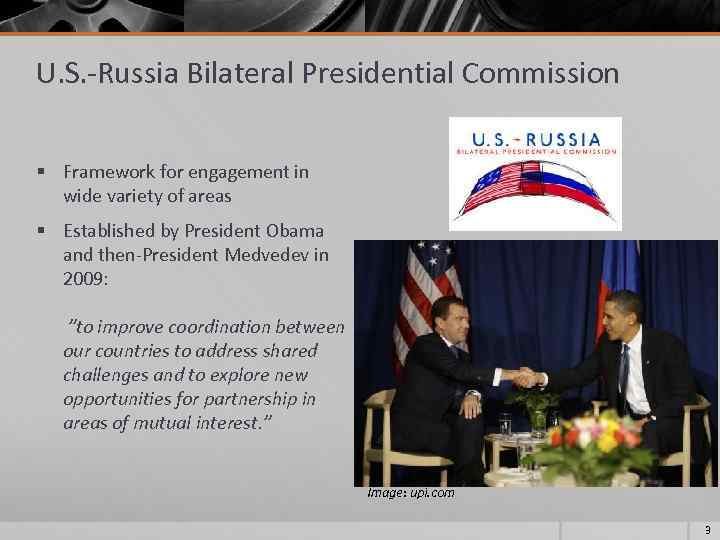 U. S. -Russia Bilateral Presidential Commission § Framework for engagement in wide variety of areas § Established by President Obama and then-President Medvedev in 2009: ”to improve coordination between our countries to address shared challenges and to explore new opportunities for partnership in areas of mutual interest. ” Image: upi. com 3
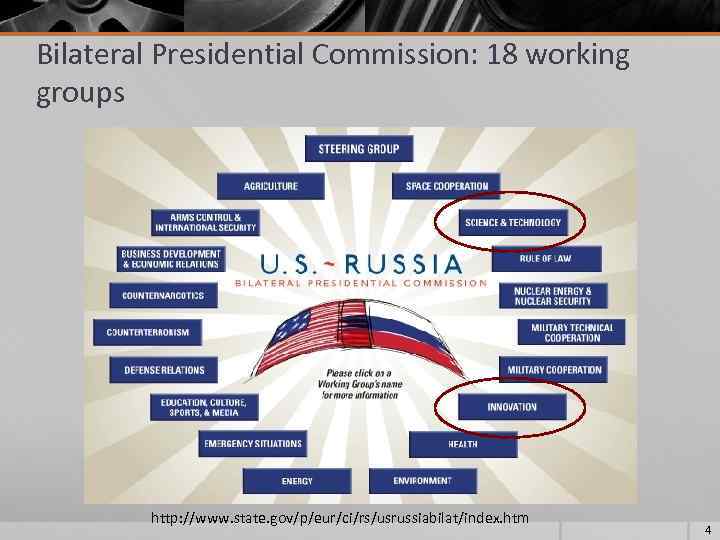 Bilateral Presidential Commission: 18 working groups http: //www. state. gov/p/eur/ci/rs/usrussiabilat/index. htm 4
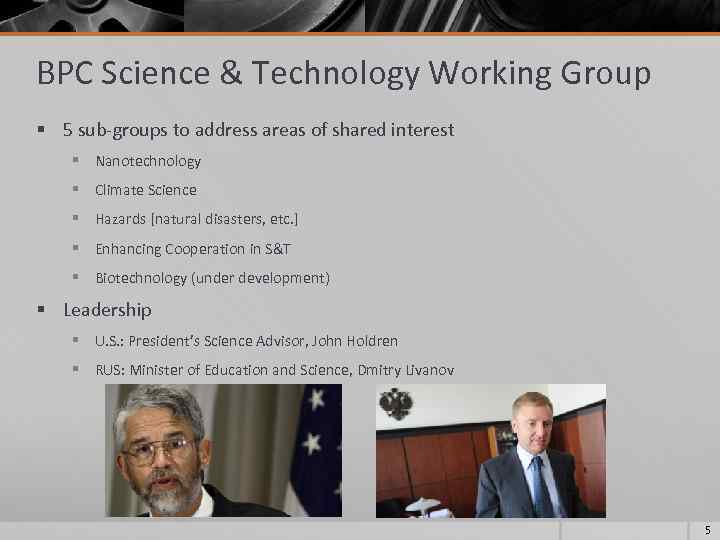 BPC Science & Technology Working Group § 5 sub-groups to address areas of shared interest § Nanotechnology § Climate Science § Hazards [natural disasters, etc. ] § Enhancing Cooperation in S&T § Biotechnology (under development) § Leadership § U. S. : President’s Science Advisor, John Holdren § RUS: Minister of Education and Science, Dmitry Livanov 5
 BPC Science & Technology Working Group § Participants: various government agencies § U. S. Office of Science and Technology Policy, State Department, NOAA, USGS, NIH, NSF § RUS Ministry of Education and Science, Ministry of Economic Development, Ministry of Foreign Affairs, Ministry of Health, EMMERCOM, Roshydromet, RAS, and more § Typically meet annually as full group § Next S&T WG: Moscow, April 2013 § Subgroups have ongoing discussions including video conference meetings § Discuss mutual projects, priorities, and ways to improve cooperation 6
 Example projects with BPC S&T WG support § Black Carbon monitoring in the arctic regions § Joint ocean research expeditions – e. g. : long term arctic survey § USGS-MES Memorandum of Understanding for Seismic Data exchange § Long-term stream flow trends monitoring using satellite data § Workshops § Wildfires § Carbon and mercury cycling § … 7
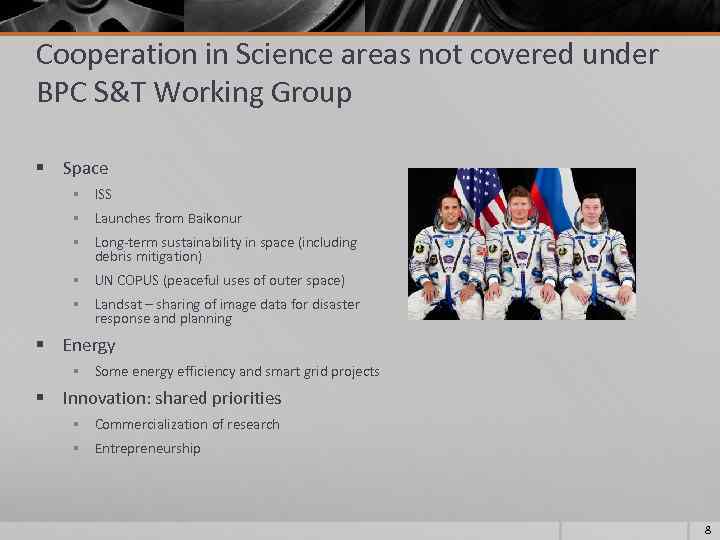 Cooperation in Science areas not covered under BPC S&T Working Group § Space § ISS § Launches from Baikonur § Long-term sustainability in space (including debris mitigation) § UN COPUS (peaceful uses of outer space) § Landsat – sharing of image data for disaster response and planning § Energy § Some energy efficiency and smart grid projects § Innovation: shared priorities § Commercialization of research § Entrepreneurship 8
 Some other formal collaborations from nongovernmental groups § MIT-Skolkovo Tech § Founding faculty members § “Benchmarking” trips to other universities § Design of Skol. Tech curriculum § Skolkovo Tech Research Centers: Require Russian and foreign partner joint projects § Arizona State University: Russian Science, Technology and Education Consortia (RUSTEC) § Collaboration with Altai State University to create joint research center, plus other universities and organizations § The technical focus areas: commercialization, research and education in nanoelectronics, photonics, renewable energy and energy efficiency, bio and information technology 9
 How to get involved: you can do it on your own! § Productive ongoing U. S. -Rus government agency projects § But best opportunity is self-arranged collaboration and co-authorship § But how to get connected? § International Conferences Meet others in your field; present your research; publish in proceedings § Publish in English § Search NSF database for awards in your research area (next slides) § Foreigners (U. S. scientists) may not be aware of all the science work that goes on in Russia! 10
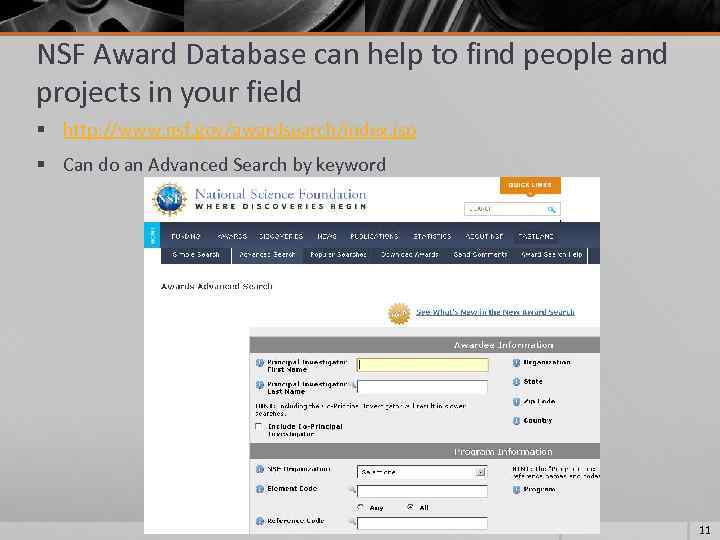 NSF Award Database can help to find people and projects in your field § http: //www. nsf. gov/awardsearch/index. jsp § Can do an Advanced Search by keyword 11
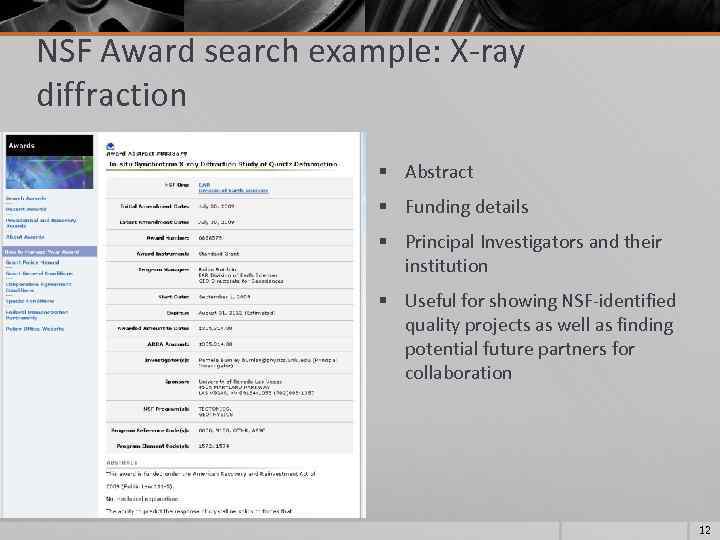 NSF Award search example: X-ray diffraction § Abstract § Funding details § Principal Investigators and their institution § Useful for showing NSF-identified quality projects as well as finding potential future partners for collaboration 12
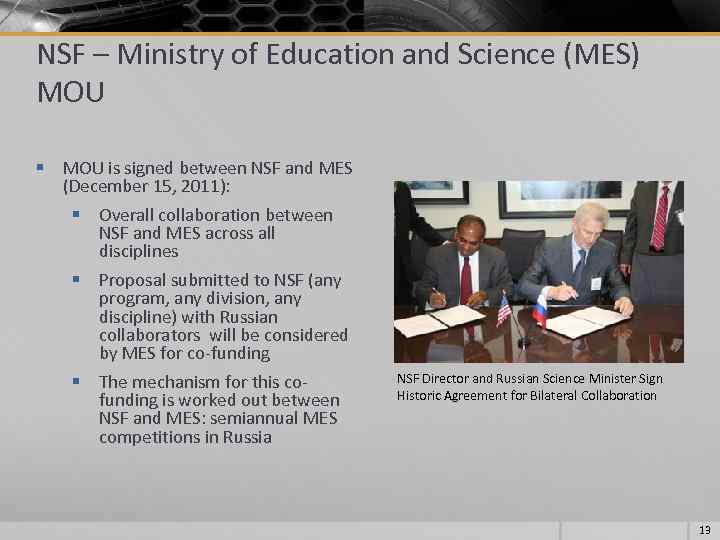 NSF – Ministry of Education and Science (MES) MOU § MOU is signed between NSF and MES (December 15, 2011): § Overall collaboration between NSF and MES across all disciplines § Proposal submitted to NSF (any program, any division, any discipline) with Russian collaborators will be considered by MES for co-funding § The mechanism for this cofunding is worked out between NSF and MES: semiannual MES competitions in Russia NSF Director and Russian Science Minister Sign Historic Agreement for Bilateral Collaboration 13
 U. S. Federal Research Priorities from OSTP for FY 2014 § Advanced Manufacturing § Clean Energy § Global Climate Change § R&D for informed policy-making and management § Information Technology § Nanotechnology § Biological Innovation § Science, technology, engineering, and mathematics (STEM) education § Innovation and commercialization Source: OSTP June 6, 2012 Memo “S&T Priorities for FY 2014 budget” http: //www. whitehouse. gov/administration/eop/ostp/rdbudgets 14