 Скачать презентацию Science and Society Canada Foundation for Innovation October
ac2cfc6f8d5c9b575319bced95c84a7a.ppt
- Количество слайдов: 58



Science and Society Canada Foundation for Innovation October 24, 2006
Science and Society Canada Foundation for Innovation – October 24, 2006 Why do we have science anyway? l To improve the human condition l To provide natural explanations of the nature and workings of the natural world l Whether we like the answers or not! 2
Science and Society Canada Foundation for Innovation – October 24, 2006 Science is limited to human cognition of the objective world…. Lu Yonxiang, President, Chinese Academy of Science, 2005 3
Science and Society Canada Foundation for Innovation – October 24, 2006 Baseline assertion: Science and technology are ever-more imbedded in every aspect of modern life! 4
Science and Society Canada Foundation for Innovation – October 24, 2006 Corollaries: l For people to prosper in modern society, they need fundamental understanding and comfort with S&T l For science to prosper and be maximally productive, the science-society relationship must be both positive and strong 5
Science and Society Canada Foundation for Innovation – October 24, 2006 We have a problem l The science-society relationship is experiencing substantial tension l Is at risk of significant erosion 6
Science and Society Canada Foundation for Innovation – October 24, 2006 As Charles Dickens would say…. . l We’re living in the best of times l And the worst of times 7
Science and Society Canada Foundation for Innovation – October 24, 2006 On the one hand We’re living in the best of scientific times 8
Science and Society Canada Foundation for Innovation – October 24, 2006 Advances in science are coming at a fantastic pace l The rate of incremental advance is accelerating l New technologies are enabling quantum jumps in understanding 9
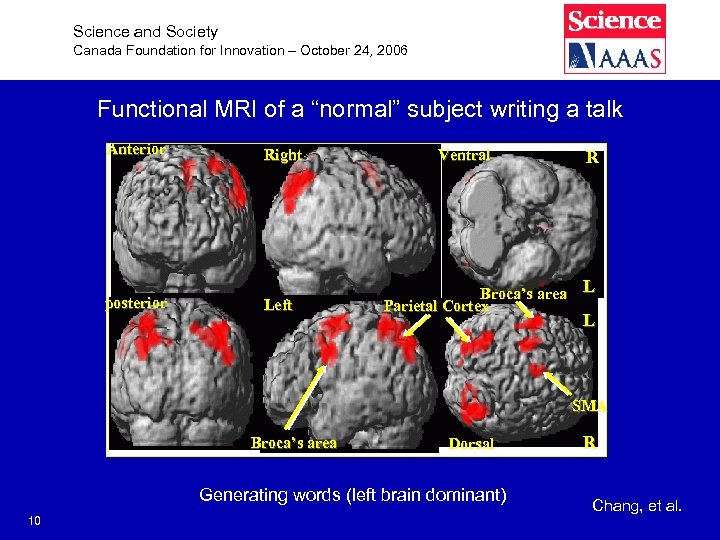
Science and Society Canada Foundation for Innovation – October 24, 2006 Functional MRI of a “normal” subject writing a talk Anterior posterior Right Left Ventral R Broca’s area L Parietal Cortex L SMA Broca’s area Dorsal R L. Chang, M. D. , T. Ernst, Ph. D. , O. Speck, Ph. D Generating words (left brain dominant) Harbor-UCLA Medical Center 10 Chang, et al.
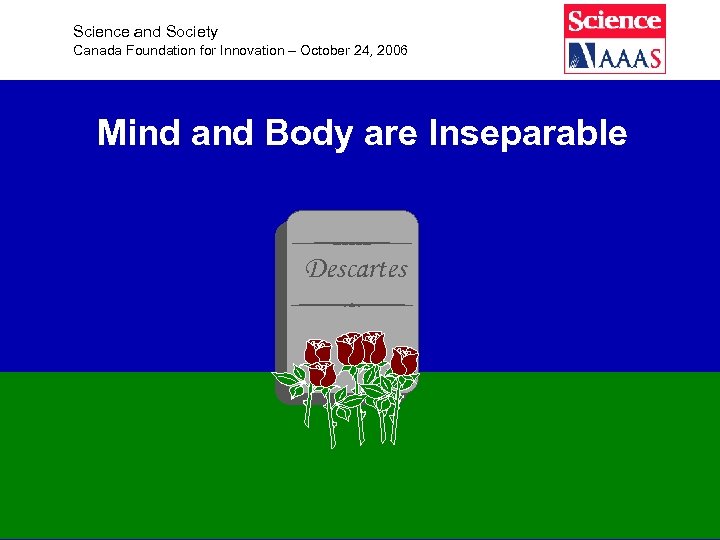
Science and Society Canada Foundation for Innovation – October 24, 2006 Mind and Body are Inseparable Descartes 11
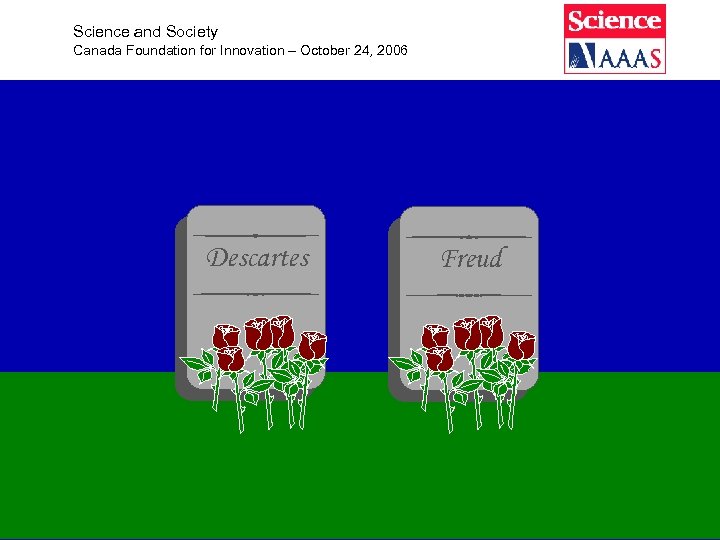
Science and Society Canada Foundation for Innovation – October 24, 2006 Descartes 12 Freud
Science and Society Canada Foundation for Innovation – October 24, 2006 On the other hand…. 13
Science and Society Canada Foundation for Innovation – October 24, 2006 Other issues within science are not going so well…and negatively affect the broader (societal) context for science l Incidents of scientific misconduct l Human subjects concerns l Animal welfare issues l Conflict of interest problems l “Publishing by press release” 14
Science and Society Canada Foundation for Innovation – October 24, 2006 These are factors internal to science… 15
Science and Society Canada Foundation for Innovation – October 24, 2006 The context for science and society is also influenced by external factors…. l Government regulations, priorities and funding 16
Science and Society Canada Foundation for Innovation – October 24, 2006 Events of 9/11/2001 dramatically affected science l Travel restrictions l New research priorities l Bioterrorism l Cybersecurity l Transportation safety l Food safety 17
Science and Society Canada Foundation for Innovation – October 24, 2006 Much is now being influenced by a resurgence of the “SCIENCE-INNOVATIONECONOMIC COMPETITIVENESS” factor 18
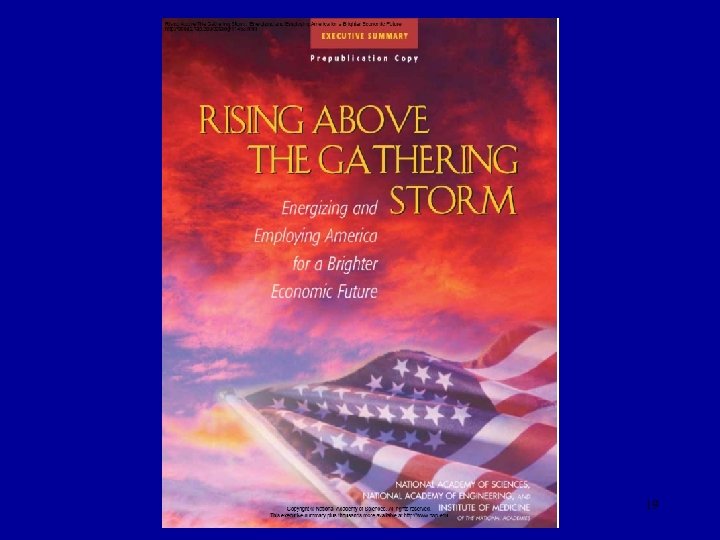
19
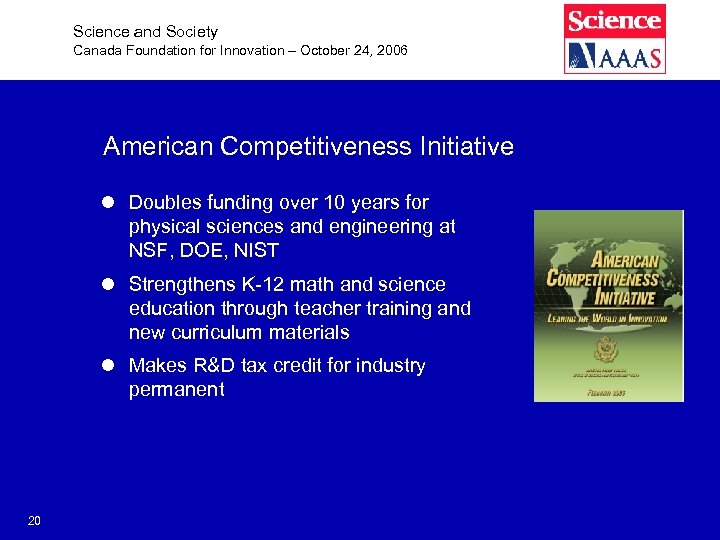
Science and Society Canada Foundation for Innovation – October 24, 2006 American Competitiveness Initiative l Doubles funding over 10 years for physical sciences and engineering at NSF, DOE, NIST l Strengthens K-12 math and science education through teacher training and new curriculum materials l Makes R&D tax credit for industry permanent 20
Science and Society Canada Foundation for Innovation – October 24, 2006 Many countries are recognizing the scienceeconomy (jobs) imperative l US l Canada l Japan l China l Australia l India l Belgium l European Union 21 l Israel l Sweden
Science and Society Canada Foundation for Innovation – October 24, 2006 The Canada Foundation for Innovation (CFI) is the epitome of a country recognizing this scienceeconomy relationship! 22
Science and Society Canada Foundation for Innovation – October 24, 2006 The science-innovation-economic factor emphasizes that all people need familiarity and comfort with science and technology 23
Science and Society Canada Foundation for Innovation – October 24, 2006 Something else is going on in how people relate to science and technology l There’s increased tension in the relationship 24
Science and Society Canada Foundation for Innovation – October 24, 2006 People generally still respect science and technology…. 25
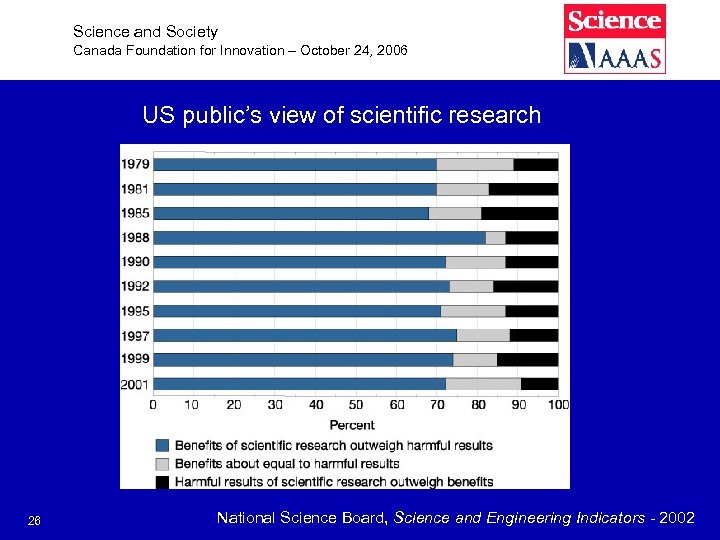
Science and Society Canada Foundation for Innovation – October 24, 2006 US public’s view of scientific research 26 National Science Board, Science and Engineering Indicators - 2002
Science and Society Canada Foundation for Innovation – October 24, 2006 But they have little understanding of what is and is not science l 60% of Americans believe in extrasensory perception l 41% think astrology is somewhat scientific l 47% still do not answer “true” to the statement: “Human beings developed from earlier species of animals” Science and Engineering Indicators, 2004 27
Science and Society Canada Foundation for Innovation – October 24, 2006 What do Europeans consider as scientific? l Medicine – 89% l Physics – 83% l Astronomy – 70% l History – 34% l Astrology – 41% l Homeopathy – 33% Source: Eurobarometer, 2005 28
There’s a lesson here! 29
Science and Society Canada Foundation for Innovation – October 24, 2006 People need to know about science as an enterprise l What makes something scientific? l The limits of scientific investigation l Natural explanations of the natural world 30
Science and Society Canada Foundation for Innovation – October 24, 2006 There is increasing tension in the science-society relationship, in part because l A new dimension has been added to the public’s view of and behavior toward science and technology 31
Science and Society Canada Foundation for Innovation – October 24, 2006 Historically, science and technology have been evaluated primarily on the basis of their costs/risks and benefits 32
Science and Society Canada Foundation for Innovation – October 24, 2006 Now, values (and politics) are being overlaid onto “simple” risk/benefit calculations 33
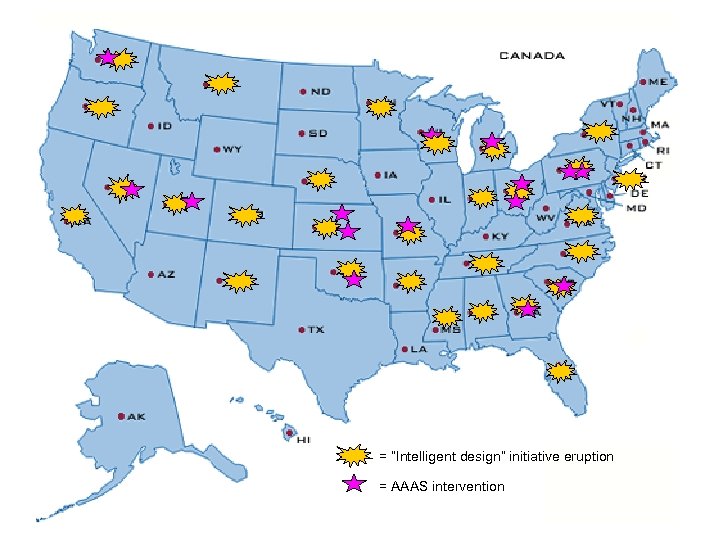
Science and Society Canada Foundation for Innovation – October 24, 2006 Scientific issues that abut against values l Embryonic stem cell research l Studying “personal” topics l Sex l “Intelligent Design” versus evolution in science classrooms and science museums 34
Science and Society Canada Foundation for Innovation – October 24, 2006 Intelligent design claims to believe in gradual change l But a supernatural being guided the process l Claims to be a scientific, alternative theory to evolution l Advocates argue “teach both theories” in science classes 35
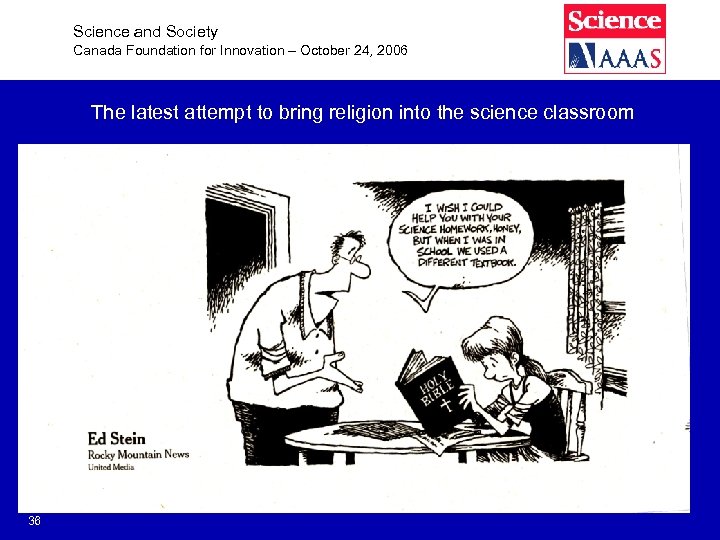
Science and Society Canada Foundation for Innovation – October 24, 2006 The latest attempt to bring religion into the science classroom 36
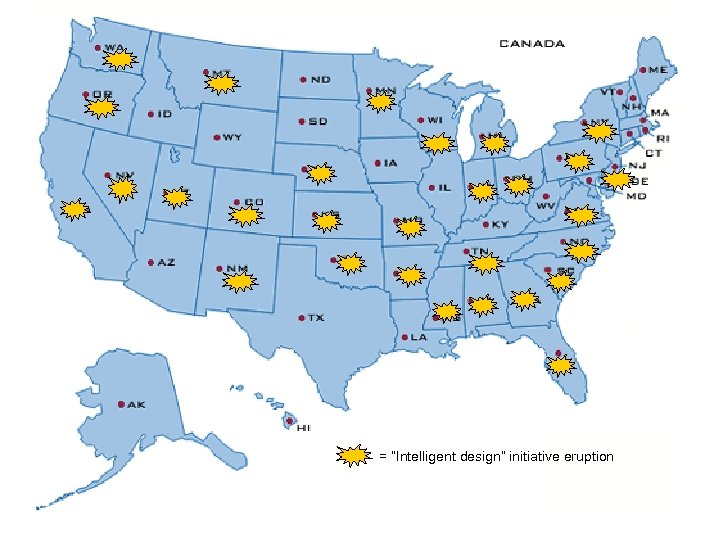
= “Intelligent design” initiative eruption 37
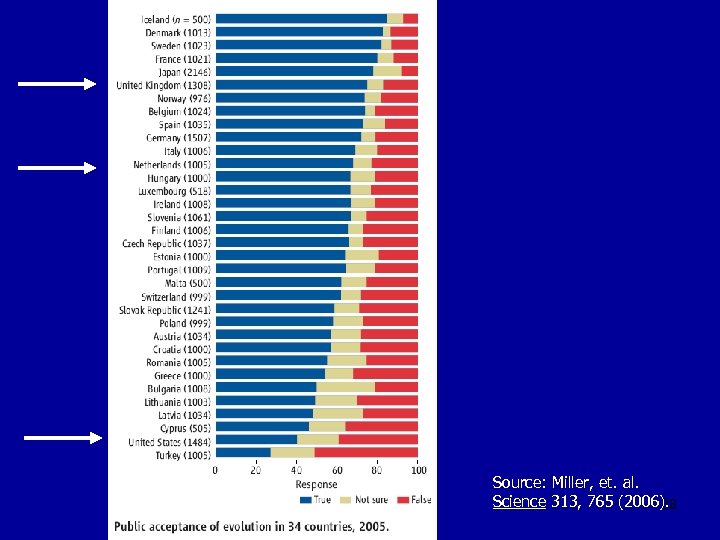
Source: Miller, et. al. Science 313, 765 (2006). 38
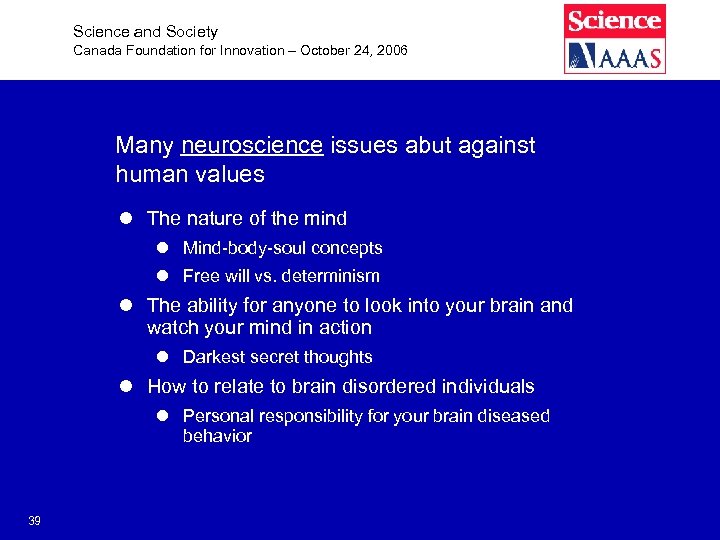
Science and Society Canada Foundation for Innovation – October 24, 2006 Many neuroscience issues abut against human values l The nature of the mind l Mind-body-soul concepts l Free will vs. determinism l The ability for anyone to look into your brain and watch your mind in action l Darkest secret thoughts l How to relate to brain disordered individuals l Personal responsibility for your brain diseased behavior 39
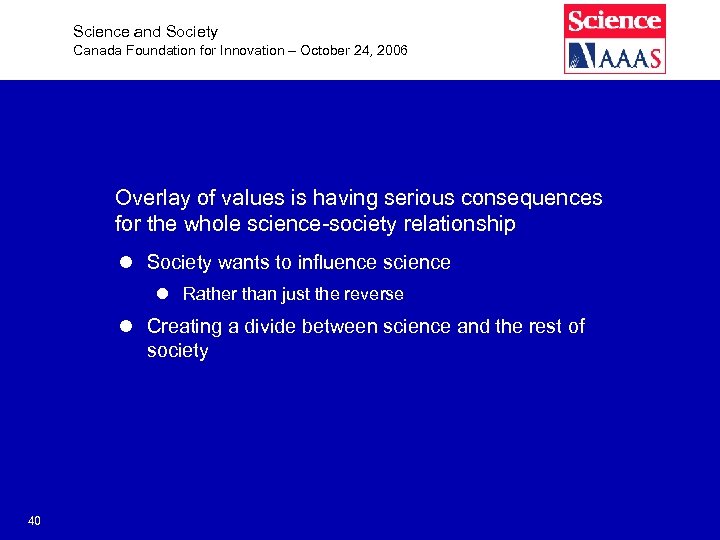
Science and Society Canada Foundation for Innovation – October 24, 2006 Overlay of values is having serious consequences for the whole science-society relationship l Society wants to influence science l Rather than just the reverse l Creating a divide between science and the rest of society 40
Science and Society Canada Foundation for Innovation – October 24, 2006 We can’t just “educate” our way out of it l The problem is not just lack of understanding l People do understand much of what we’re saying or want to do l They don’t like it l The conflict with their core values trumps their view of societal benefits l Only scientists are bound to “stick to the science” 41
Science and Society Canada Foundation for Innovation – October 24, 2006 What can we do? l Continue protesting/lamenting the situation l Adopt a more assertive strategy l Engage with the public on the issues l Try to find common ground 42
Science and Society Canada Foundation for Innovation – October 24, 2006 Public Understanding + 43
Science and Society Canada Foundation for Innovation – October 24, 2006 Public Education + 44
Science and Society Canada Foundation for Innovation – October 24, 2006 We need to change not only the style and content but also the intent of the conversation: Communicating to the public 45 Communicating with the public
Science and Society Canada Foundation for Innovation – October 24, 2006 We need to hear from the public about: l Their concerns about science and technology and their concomitants l Risks and benefits l Encroachment on human values l Their priorities among research areas l Questions they would like or need us to answer l Help frame the research agenda 46
Science and Society Canada Foundation for Innovation – October 24, 2006 The engagement movement is gathering substantial momentum l United Kingdom l European Union as a whole l Canada 47
Science and Society Canada Foundation for Innovation – October 24, 2006 Fundamentals of effective engagement of the public with S&T: l Build relationships with stakeholders, striving to foster mutual confidence and respect. l Be inclusive of diverse perspectives, sectors and cultures. l Practice “active listening” l Build communication around issues informed by S&T, rather than specifics of the S&T itself. l Practice openness l Put information, ideas and debate in the public realm 48 Science Communications and Opportunities for Public Engagement, Canadian Council of Science and Technology Advisors, 2003
Science and Society Canada Foundation for Innovation – October 24, 2006 One can’t deal with l Evangelical fundamentalists l Evangelical atheists l Militant agnostics 49
Science and Society Canada Foundation for Innovation – October 24, 2006 One can work with l Undecideds l Rational middle 50
Science and Society Canada Foundation for Innovation – October 24, 2006 AAAS Public Engagement Programs l Dialogue on Science, Ethics and Religion (Do. SER) l Center for Public Engagement with Science and Technology 51
Science and Society Canada Foundation for Innovation – October 24, 2006 AAAS Center for Public Engagement with Science and Technology l Town meetings l Family science days l Topical public workshops l Meet the scientists events l Broadcast opportunities l Partnerships with science museum and centers l Active outreach l Clubs l Residential communities l Religious institutions 52
Science and Society Canada Foundation for Innovation – October 24, 2006 AAAS “Glocal” strategy 53
Science and Society Canada Foundation for Innovation – October 24, 2006 Working with local opinion leaders and resources l Local media and op-eds l Clergy l School officials l Local government leaders/politicians l Science museums and centers l Community groups 54
= “Intelligent design” initiative eruption = AAAS intervention 55
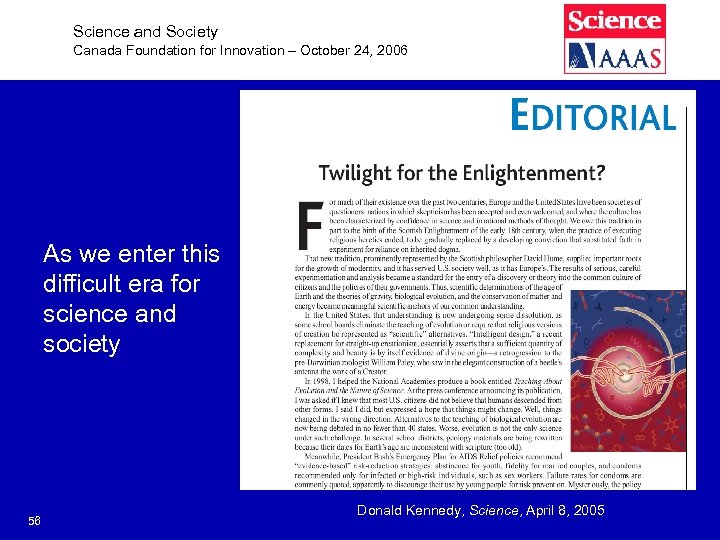
Science and Society Canada Foundation for Innovation – October 24, 2006 As we enter this difficult era for science and society 56 Donald Kennedy, Science, April 8, 2005
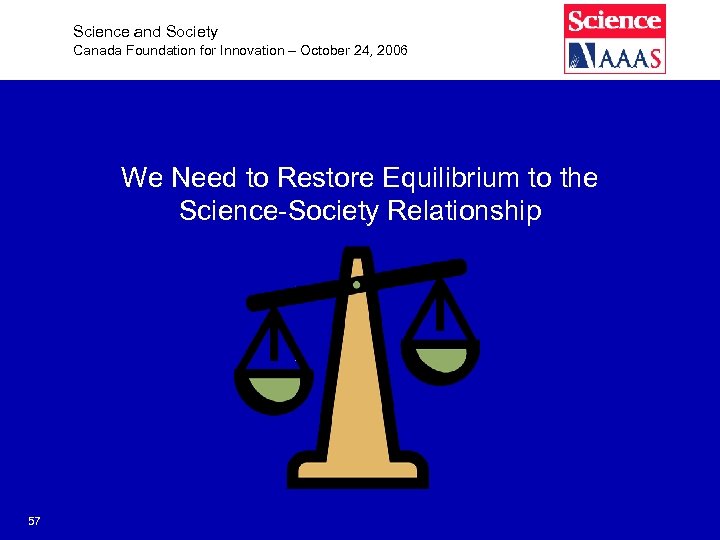
Science and Society Canada Foundation for Innovation – October 24, 2006 We Need to Restore Equilibrium to the Science-Society Relationship 57
Science and Society Canada Foundation for Innovation – October 24, 2006 58
Скачать презентацию Science and Society Canada Foundation for Innovation October
ac2cfc6f8d5c9b575319bced95c84a7a.ppt