 Скачать презентацию Science and Science Fiction Robert Scherrer Department of
e17cb8766520738a68e2fbb96d1106e7.ppt
- Количество слайдов: 45



Science and Science Fiction Robert Scherrer Department of Physics and Astronomy Vanderbilt University
How are ideas used and presented in science (theoretical physics) and science fiction? • The “ground rules” for introducing unproven ideas • The predictive power of science fiction vs. science • How are ideas presented? • Should scientists try to write science fiction?
Both SF writing and theoretical physics are a form of “disciplined daydreaming. ” Both involve the development of new ideas, but within tightlyconstrained boundaries.
Types of Theoretical Physics Data analysis n Comparison of models with data n Model building n “What if? ” n The last of these is closest to the process of doing science fiction.
• What if the speed of light is constant in all frames of reference? • What if the energies in a blackbody gas can be only discrete multiples of the frequency? • What if the universe entered a phase of exponential expansion at early times?
A New Idea in Theoretical Physics Must be consistent with known experimental results n Should fit into the pre-existing theoretical framework of physics (even quantum mechanics and relativity) n But, must go beyond what is already known/proposed n
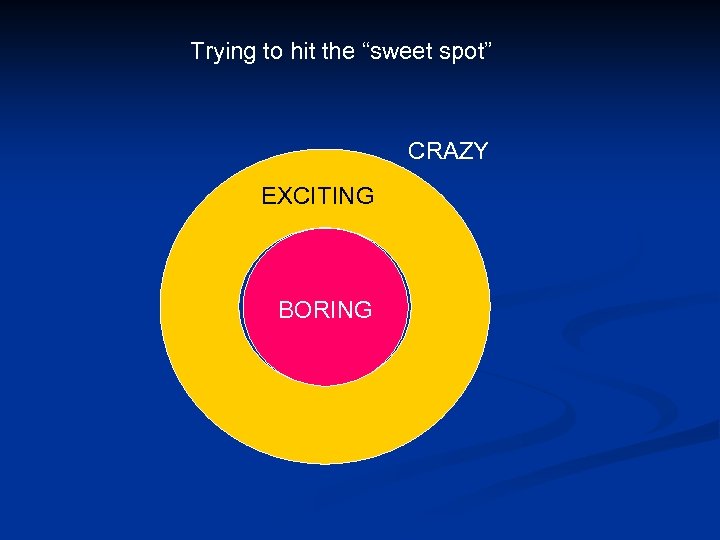
Trying to hit the “sweet spot” CRAZY EXCITING BORING
Can only invoke the Tooth Fairy Once This places a limit on the progress of physics – theory cannot get very far ahead of experimental data. Invoke multiple tooth fairies, and no one will believe you, even if you are correct! Example: 19 th century explanation of the source of the sun’s power But we have a modern counterexample, which will be interesting to watch to see how it turns out in the end. STRING THEORY
Much (but not all) of Science Fiction also uses the “What If” model. • What if our evolution had been guided by superior beings? (2001 A Space Odyssey, Arthur C. Clarke) • What if all living things on the planet suddenly experienced increased intelligence? (Brainwave, Poul Anderson) • What if dreams could change reality? (The Lathe of Heaven, Ursula K. Le Guin)
Science fiction, while obviously open to more speculative ideas than is theoretical physics, operates under similar constraints. • New ideas must be plausible, even if they are not rigorously scientific (must “sound like” science) • Only naturalistic explanations are acceptable • New ideas should be rationalized in some scientific way, but detailed explanation will slow down the story • However, some very implausible ideas have become part of the “fabric” of SF, to the extent they no longer require justification (time travel, faster-than-light travel) • Many of the strongest stories/novels invoke the tooth fairy only once
Even fantasy literature operates under a (much looser) set of constraints While supernatural events are allowed, and no explanations/apologies are required, normal rules of logic, and psychological consistency, still apply. The train of events must be coherent, and the characters must display understandable motivations. The latter is often more restrictive in fantasy than in science fiction. (This was not always the case – see the 19 th century, Gogol, Hoffmann, for “dream-like” fantasy).
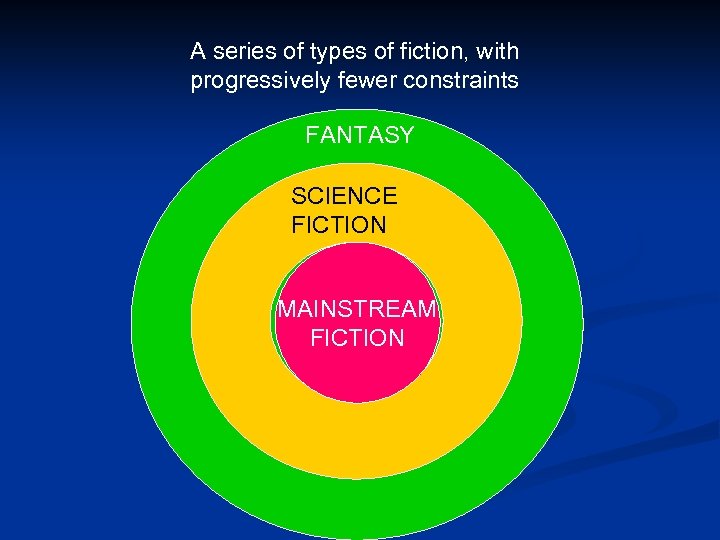
A series of types of fiction, with progressively fewer constraints FANTASY SCIENCE FICTION MAINSTREAM FICTION
The essential characteristic of new ideas in physics is their predictive character. Is science fiction similarly predictive?
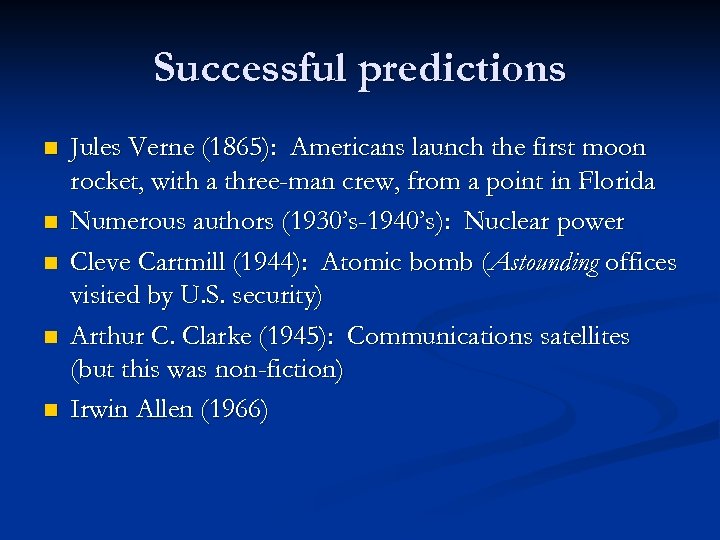
Successful predictions n n n Jules Verne (1865): Americans launch the first moon rocket, with a three-man crew, from a point in Florida Numerous authors (1930’s-1940’s): Nuclear power Cleve Cartmill (1944): Atomic bomb (Astounding offices visited by U. S. security) Arthur C. Clarke (1945): Communications satellites (but this was non-fiction) Irwin Allen (1966)
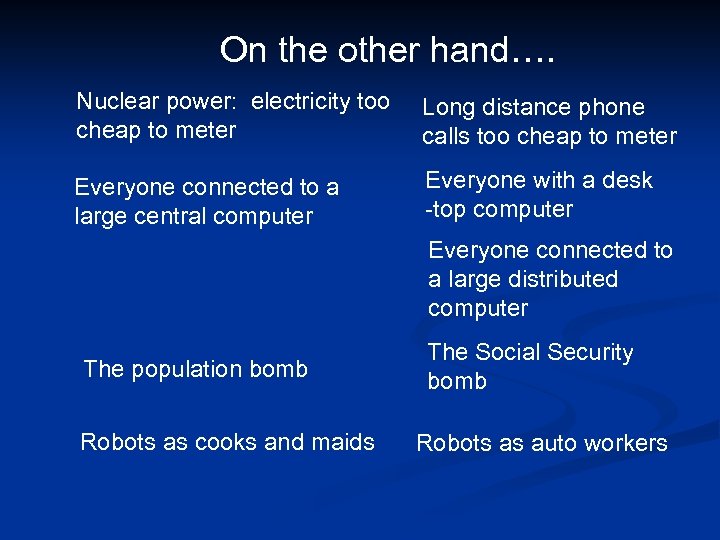
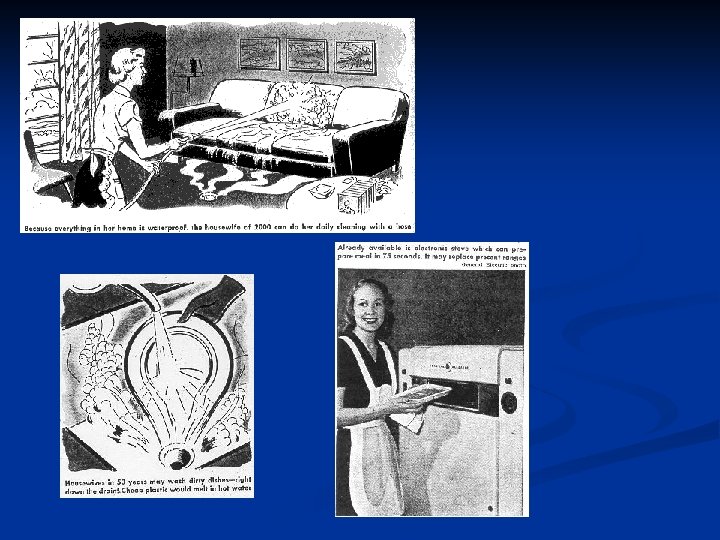
On the other hand…. Nuclear power: electricity too cheap to meter Long distance phone calls too cheap to meter Everyone connected to a large central computer Everyone with a desk -top computer Everyone connected to a large distributed computer The population bomb Robots as cooks and maids The Social Security bomb Robots as auto workers
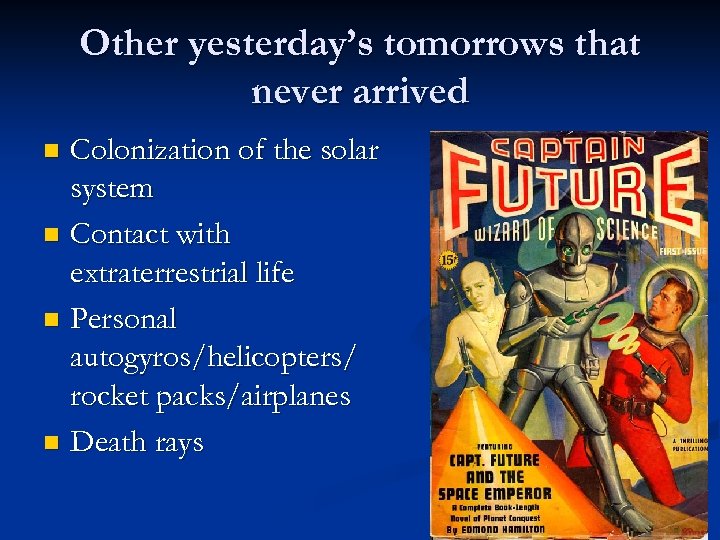
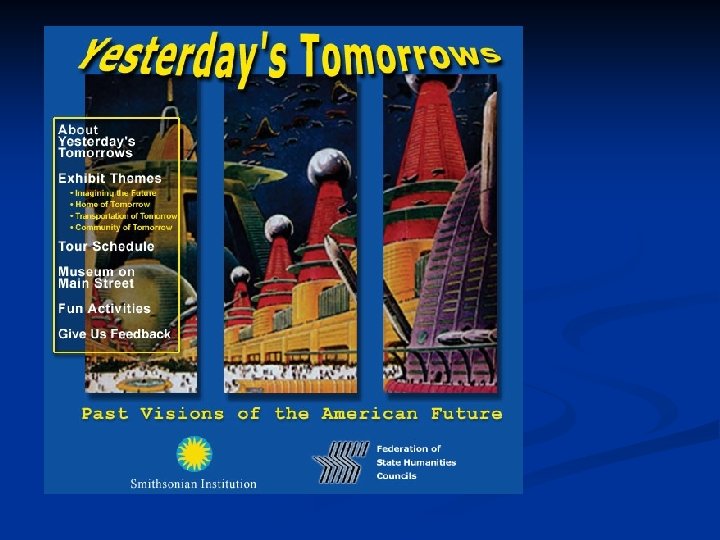
Other yesterday’s tomorrows that never arrived Colonization of the solar system n Contact with extraterrestrial life n Personal autogyros/helicopters/ rocket packs/airplanes n Death rays n
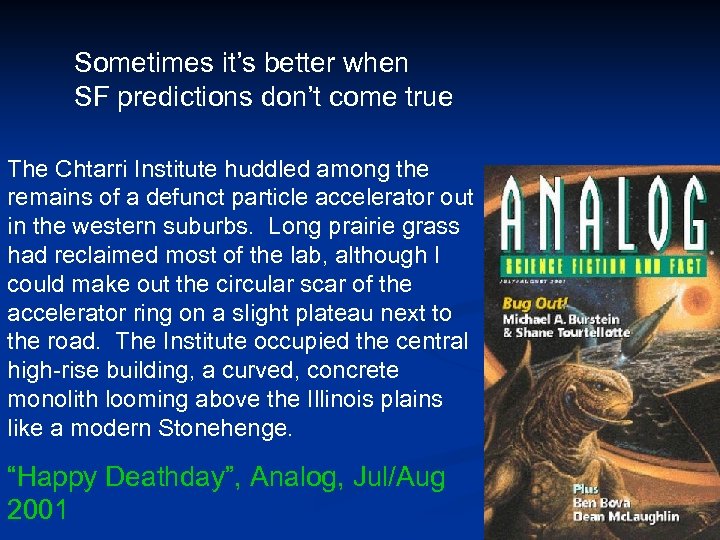
Sometimes it’s better when SF predictions don’t come true The Chtarri Institute huddled among the remains of a defunct particle accelerator out in the western suburbs. Long prairie grass had reclaimed most of the lab, although I could make out the circular scar of the accelerator ring on a slight plateau next to the road. The Institute occupied the central high-rise building, a curved, concrete monolith looming above the Illinois plains like a modern Stonehenge. “Happy Deathday”, Analog, Jul/Aug 2001
Science fiction is NOT predictive, nor does it pretend to be. The function of science fiction is to provide interesting stories – to entertain. Ideas are important insofar as they serve this purpose. Although science fiction has been called “The Literature of Ideas”, ideas are in fact secondary to this primary purpose.
Physics class joke: if you come up with an idea on unifying quantum mechanics and general relativity, let me know – I’ll help you write it up. Science fiction joke: I have this great idea. Why don’t you write a story about it and we’ll share the credit. Science: Idea is everything; development is secondary, and writing/presentation is tertiary Science Fiction: Writing/presentation is primary; idea is secondary
The exposition of a new idea does NOT make a science fiction story. Need characters/plot/something to keep the reader interested. Idea by itself is almost always insufficient to maintain interest. “Need to predict not the car, but the traffic jam” – in reality neither is sufficient to make a story.
Another limit to the predictive power of science fiction: The NSF Effect
How are ideas presented? In science, very straightforward: • Discuss background and motivation for the project • Discuss previous work (especially the author’s) • Present results • Summarize conclusions • Abstract at the beginning
In science fiction, it’s not so simple…
Joe Waltham burst into the ship’s control room. Klaxons wailed, and the neutrino gauges flickered wildly. “Bill, ” he shouted, “the solar neutrino detectors have gone crazy. ” The sun produces neutrinos in the course of its fusion reactions. Two protons bind to form deuterium, producing a positron and an electron neutrino. The electron neutrino can escape from the sun’s core. Bill rushed over to check the detector feeds. “I don’t see anything wrong at this end. ” INFODUMP
Joe Waltham burst into the ship’s control room. Klaxons wailed, and the neutrino gauges flickered wildly. “Bill, ” he shouted, “the solar neutrino detectors have gone crazy. ” Bill rushed over to check the detector feeds. “I don’t see anything wrong at this end. ” He turned to Joe. “As you know, Joe, the sun produces neutrinos in the course of its fusion reactions. ” “Yes, ” said Joe, “I know that. ” “And you also know that two protons bind to form deuterium, producing a positron and an electron neutrino. ” Joe nodded. “Yes, I know that too. But why are you telling me all of these things that I already know? ” As you know, Bob
Exposition is tricky. Need to introduce new information without interrupting the flow of the story. Usually done in bits and pieces, with an occasional expository chunk.
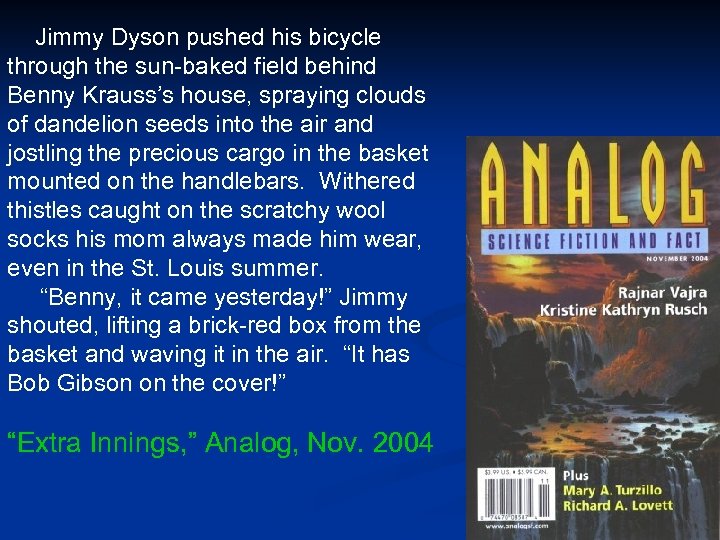
Jimmy Dyson pushed his bicycle through the sun-baked field behind Benny Krauss’s house, spraying clouds of dandelion seeds into the air and jostling the precious cargo in the basket mounted on the handlebars. Withered thistles caught on the scratchy wool socks his mom always made him wear, even in the St. Louis summer. “Benny, it came yesterday!” Jimmy shouted, lifting a brick-red box from the basket and waving it in the air. “It has Bob Gibson on the cover!” “Extra Innings, ” Analog, Nov. 2004
In science fiction (especially) it is important to establish setting and characters at the very beginning of the story, because the choices are so large: are we on Earth, or the moon, or some other planet? Is it the present day, the near future, or the far future. Is our protagonist human, or a slimy multi-tentacled creature? But this has to be done without interrupting the flow of the story.
“So Ben, what have you been up to? ” asked Jim, bouncing three-year old Evan on his knee, while Laura cleared the dishes from the dinner table. “We haven’t seen you in, how long, two years? ” “Been pretty busy at work, ” said Ben, settling into a frayed armchair. “It took a long time to set up the Neuro-AI Institute, and I’ve got to write grant proposals every year just to keep it going. MIT loves us, but they don’t give us much money. ”
Jim Dyson dragged himself up the hospital steps, wheezing and stopping every three steps to catch his breath. Each time he put weight on his left leg, his knee burned like someone had driven a hot knife under the knee -cap. At least the knee pain took his mind off of his constant backache. What was the point of living to 94 if you felt like death warmed over? But damned if he was going to discarnate until Laura did. You don’t always want to explain everything immediately.
My deathday is July 18 th. I spent it this year as I have every year for the past ten: at home in bed, with my wife nearby. I can’t afford a private doctor, and I’ve heard too many iatrogenic horror stories to check into the hospital for the day. So I just lay quietly, imagining all of the different ways it could happen. A sudden squeezing pain in my chest? Or maybe a jackhammer headache, announcing a burst blood vessel in my brain. “Happy Deathday”, Analog, Jul/Aug 2001
In science fiction, must strike a balance between giving too much information up front (BORING) and too little (INCOMPREHENSIBLE) In science, ALL the information goes up front (in the abstract). All terms are defined as soon as they are introduced (or should be). BORING is OK, INCOMPREHENSIBLE is not. But both types of writing have one goal in common: READ ME!
Writing Styles In Science writing: Passive voice Qualify everything Numerous parenthetical clauses Compound nouns (a relic of German? ) n In science fiction: Avoid passive constructions at all costs Emphasize vivid verbs/adjectives; avoid adverbs n
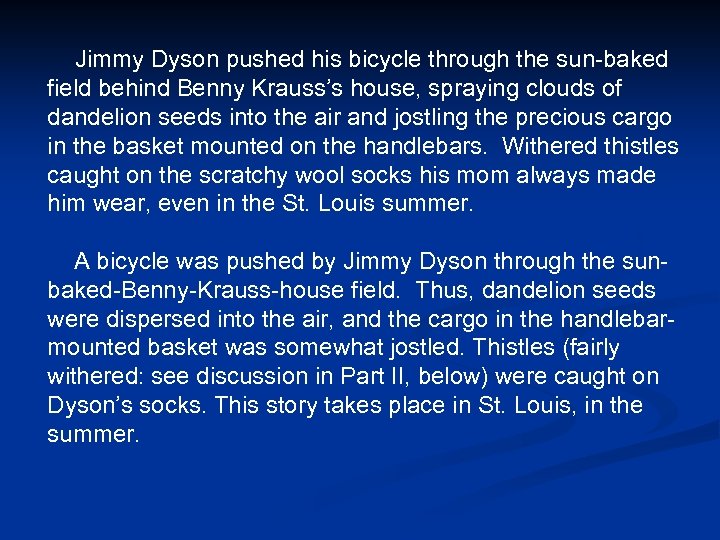
Jimmy Dyson pushed his bicycle through the sun-baked field behind Benny Krauss’s house, spraying clouds of dandelion seeds into the air and jostling the precious cargo in the basket mounted on the handlebars. Withered thistles caught on the scratchy wool socks his mom always made him wear, even in the St. Louis summer. A bicycle was pushed by Jimmy Dyson through the sunbaked-Benny-Krauss-house field. Thus, dandelion seeds were dispersed into the air, and the cargo in the handlebarmounted basket was somewhat jostled. Thistles (fairly withered: see discussion in Part II, below) were caught on Dyson’s socks. This story takes place in St. Louis, in the summer.
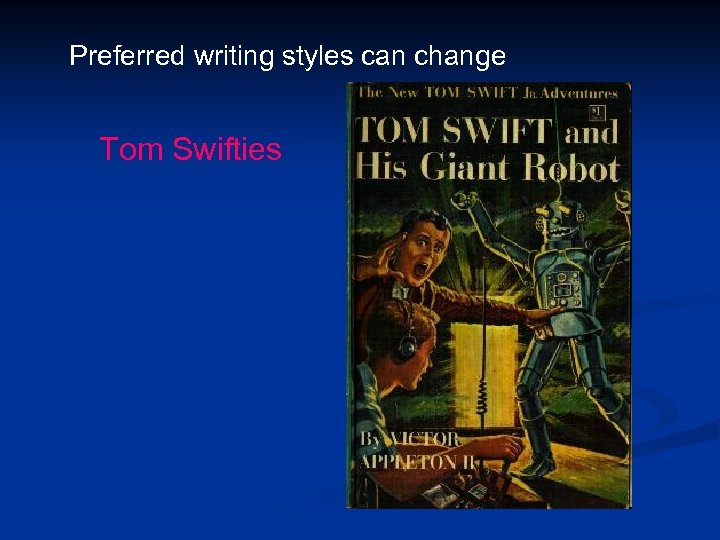
Preferred writing styles can change Tom Swifties
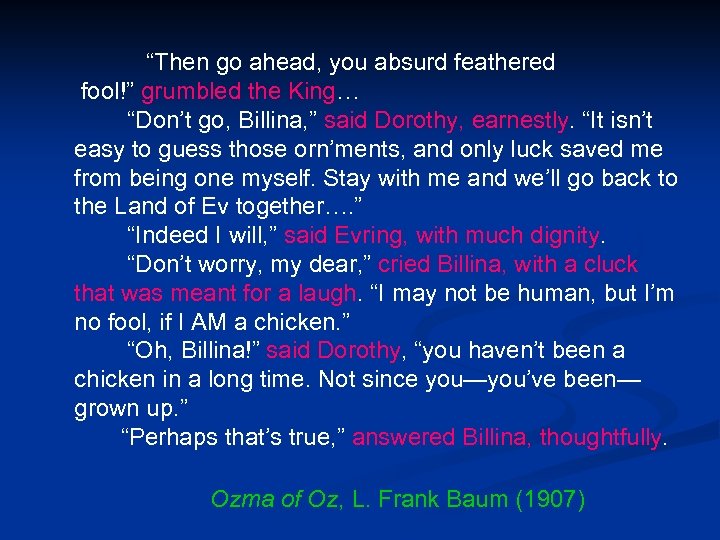
“Then go ahead, you absurd feathered fool!” grumbled the King… “Don’t go, Billina, ” said Dorothy, earnestly. “It isn’t easy to guess those orn’ments, and only luck saved me from being one myself. Stay with me and we’ll go back to the Land of Ev together…. ” “Indeed I will, ” said Evring, with much dignity. “Don’t worry, my dear, ” cried Billina, with a cluck that was meant for a laugh. “I may not be human, but I’m no fool, if I AM a chicken. ” “Oh, Billina!” said Dorothy, “you haven’t been a chicken in a long time. Not since you—you’ve been— grown up. ” “Perhaps that’s true, ” answered Billina, thoughtfully. Ozma of Oz, L. Frank Baum (1907)
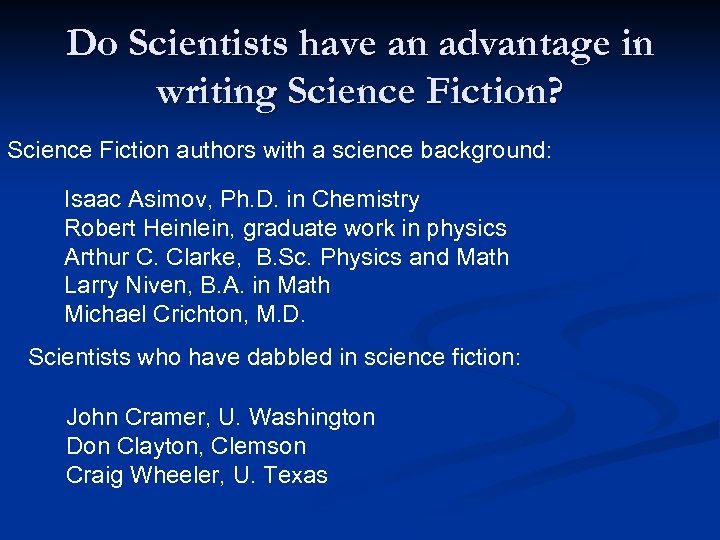
Do Scientists have an advantage in writing Science Fiction? Science Fiction authors with a science background: Isaac Asimov, Ph. D. in Chemistry Robert Heinlein, graduate work in physics Arthur C. Clarke, B. Sc. Physics and Math Larry Niven, B. A. in Math Michael Crichton, M. D. Scientists who have dabbled in science fiction: John Cramer, U. Washington Don Clayton, Clemson Craig Wheeler, U. Texas
Very few active research scientists have contributed significantly to Science Fiction Fred Hoyle, “Nobel-class” scientist, author of 10 influential SF novels Gregory Benford, (U. C. Irvine plasma physics)
Do Scientists have an advantage in writing Science Fiction? Yes, but not the advantages everyone thinks. Difficulties: It is actually HARDER to write about your own area of research, because you apply very high standards on what is “plausible”. Easier to speculate about things you know less about. Writing styles of science and science fiction are diametrically opposed: need to fight your natural writing tendencies.
But there advantages… A mundane, but important advantage: basic writing skills. Scientists have mastered the skills of extrapolating new ideas from known facts. Can be more realistic in writing about the process of doing science (if that’s what the story is about) [e. g. , scientists give “talks”, not “speeches”]
Should you try it? SF short story market is one of the few (perhaps only) outlet that still accepts, reads, and publishes unsolicited manuscripts. One last difference: credentials and previous performance count for very little – you’re only as good as your last performance….
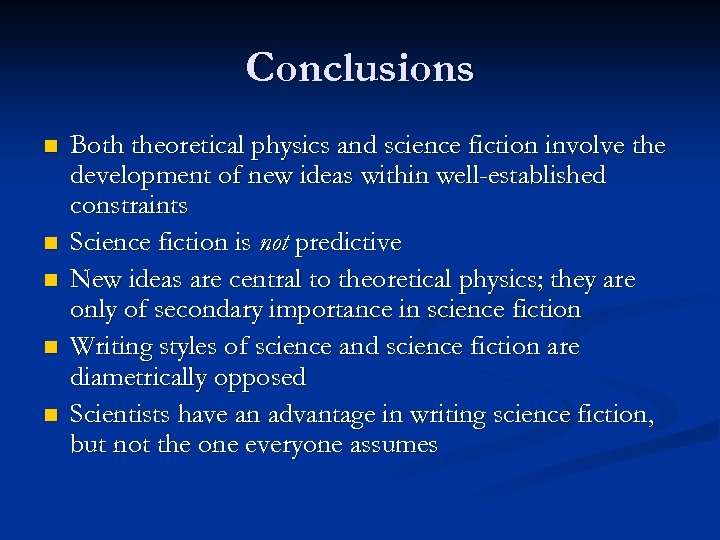
Conclusions n n n Both theoretical physics and science fiction involve the development of new ideas within well-established constraints Science fiction is not predictive New ideas are central to theoretical physics; they are only of secondary importance in science fiction Writing styles of science and science fiction are diametrically opposed Scientists have an advantage in writing science fiction, but not the one everyone assumes
Скачать презентацию Science and Science Fiction Robert Scherrer Department of
e17cb8766520738a68e2fbb96d1106e7.ppt