


 Скачать презентацию School System EC LEP Section 504 Testing Directors Coordinators
b3d7bbc66d8efc7f3e2b8ffa0296a956.ppt
- Количество слайдов: 187
 School System EC, LEP, Section 504, Testing Directors/Coordinators Joint Meeting September 14, 2010
 WELCOME Lou Fabrizio Rebecca Garland 2
 Considering the Needs of the Whole Child Ira Wolfe 3
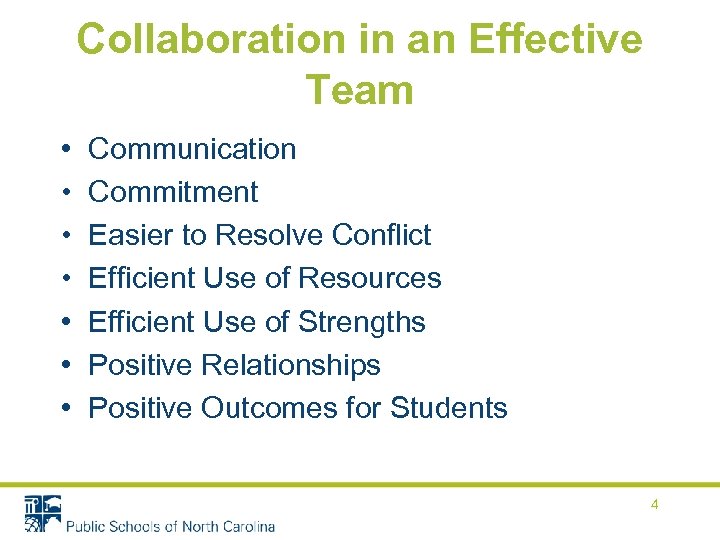 Collaboration in an Effective Team • Communication • Commitment • Easier to Resolve Conflict • Efficient Use of Resources • Efficient Use of Strengths • Positive Relationships • Positive Outcomes for Students 4
 “Coming together is a beginning. Keeping together is progress. Working together is success!” - Henry Ford 5
 Terminology Sarah Mc. Manus 6
 Clarifying the Terms • • • Universal Design for Learning Instruction Differentiated Instruction Construct Intervention Accommodation Modification IEP Section 504 LEP Transitory Impairment 7
 Universal Design for Learning A set of principles that give all individuals equal opportunities to learn. • Multiple means of representation, to give diverse learners options for acquiring information and knowledge, • Multiple means of action and expression, to provide learners options for demonstrating what they know, • Multiple means of engagement, to tap into learners' interests, offer appropriate challenges, and increase motivation Center for Applied Special Technology (CAST) 8
 Instruction Webster's New World College Dictionary – Knowledge, information, etc. given or taught – Any teaching, lesson, rule, or precept – Teaching skills, concepts Webster's New World College Dictionary Copyright © 2010 by Wiley Publishing, Inc. , Cleveland, Ohio. 9
 Differentiated Instruction – A process through which learning is enhanced by matching student characteristics to instruction and assessment. – Not a single strategy, but rather an approach to instruction that incorporates a variety of strategies. -Tiered assignment - Compacting - Learning Contracts - Choice Boards - Interest Centers - Flexible Grouping American Institutes for Research, U. S. Department of Education 10
 Construct The underlying trait assumed to be taught through instruction and measured by an assessment. 11
 Intervention An intervention is that which is above and beyond what is being received in the classroom. – It is in addition to a strong “core” experience – Goal is to accelerate growth “Additional, targeted, and intensive reading instruction provided to students who continue to struggle with learning to read and write despite conventional instruction. ” (Foorman & Torgesen, 2001) 12
 Accommodation: • Changes in the way a student accesses learning/testing • Construct does not change; assignment/content does not change • Gives students equal access to learning without "watering down" the content 13
 Accommodation: • Aligned or matched between classroom instruction, classroom testing and district or state tests • Accommodations for assessment and instruction are integrally intertwined Sandra J. Thompson, Ph. D. , Research Associate, National Center on Educational Outcomes, University of Minnesota 14
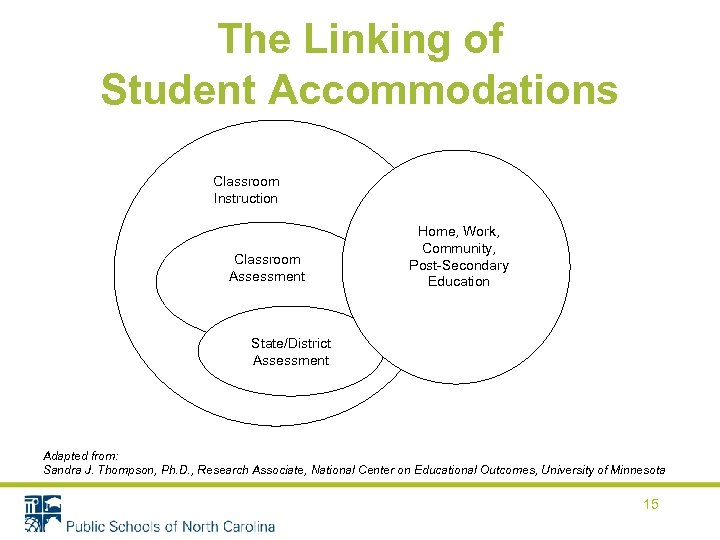 The Linking of Student Accommodations Classroom Instruction Classroom Assessment Home, Work, Community, Post-Secondary Education State/District Assessment Adapted from: Sandra J. Thompson, Ph. D. , Research Associate, National Center on Educational Outcomes, University of Minnesota 15
 Accommodations • Categories: • Accommodated Test Formats (i. e. , Braille) • Assistive Technology (AT) Devices and Special Arrangements • Special Test Environments 16
 Modifications are adjustments to the instruction/test that change the construct through one or more of the following: – Language Load – Content Complexity – Cognitive Complexity 17
 Modifications: • Different material – (e. g. , different objectives) • Reduced assignments – (e. g. , complete 6 of 12 math problems) • Revised assignments or tests – (e. g. , crossing out half of the response choices so that a student only has to pick from 2 options instead of 4). 18
 Student Plan Terminology • IEP = Individualized Education Program • Section 504 = Federal law designed to protect rights of individuals with disabilities • LEP = Limited English Proficient • Transitory Impairment = Impairment with actual or expected duration of 6 months or less 19
 How Does Responsiveness to Instruction Fit? Sherry Abernethy 20
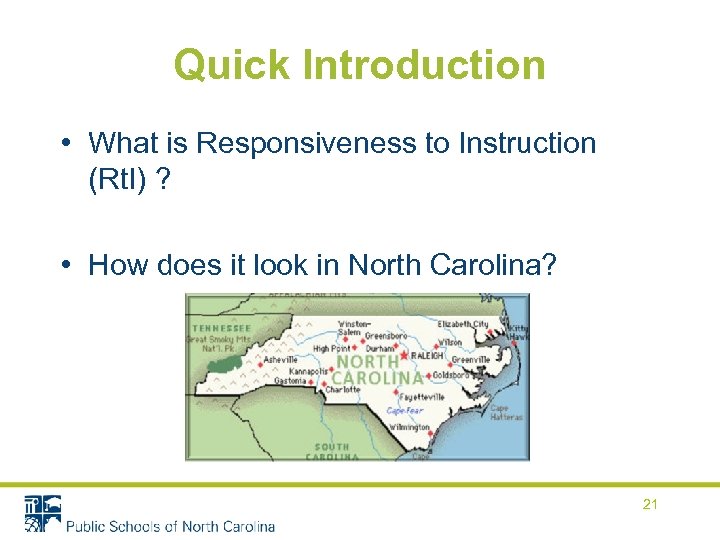 Quick Introduction • What is Responsiveness to Instruction (Rt. I) ? • How does it look in North Carolina? 21
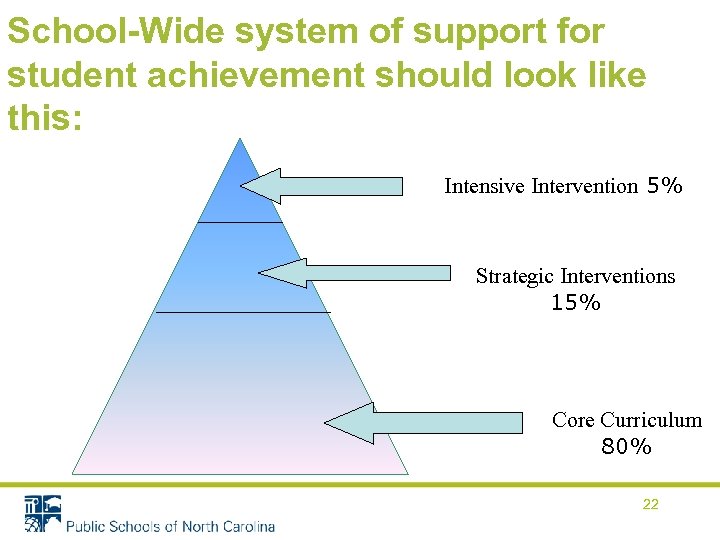 School-Wide system of support for student achievement should look like this: Intensive Intervention 5% Strategic Interventions 15% Core Curriculum 80% 22
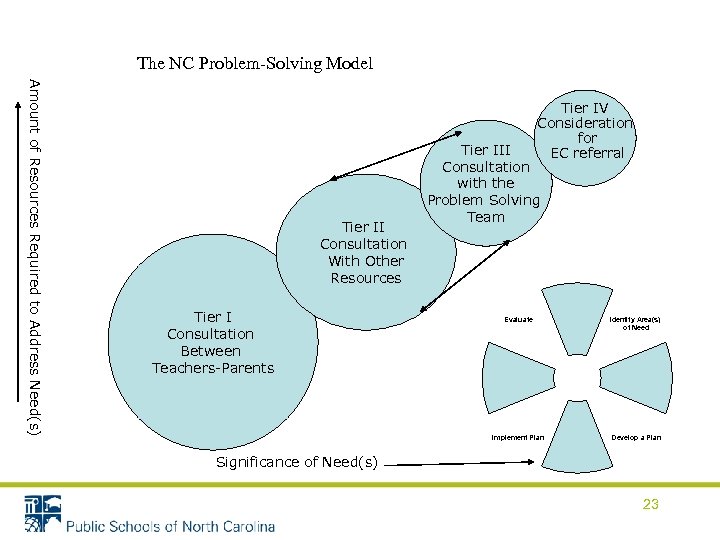 The NC Problem-Solving Model Amount of Resources Required to Address Need(s) Tier IV Consideration for EC referral Tier II Consultation With Other Resources Tier I Consultation Between Teachers-Parents Tier III Consultation with the Problem Solving Team Evaluate Identify Area(s) of Need Implement Plan Develop a Plan Significance of Need(s) 23
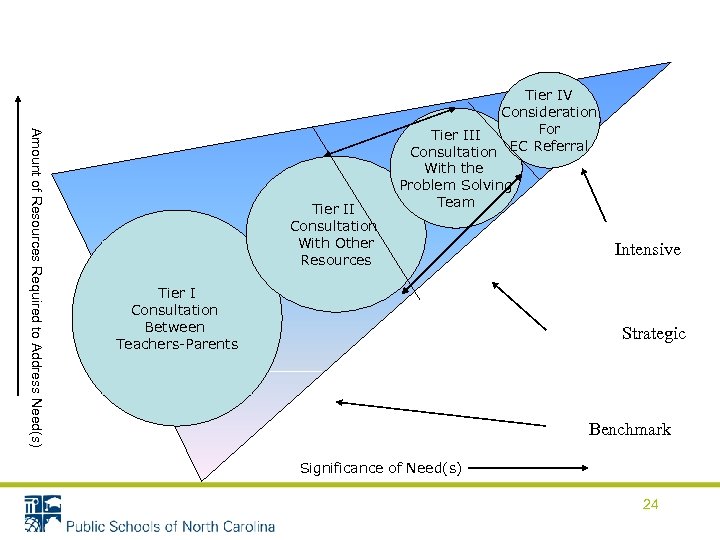 Amount of Resources Required to Address Need(s) Tier IV Consideration For Tier III Consultation EC Referral Tier II Consultation With Other Resources With the Problem Solving Team Tier I Consultation Between Teachers-Parents Intensive Strategic Benchmark Significance of Need(s) 24
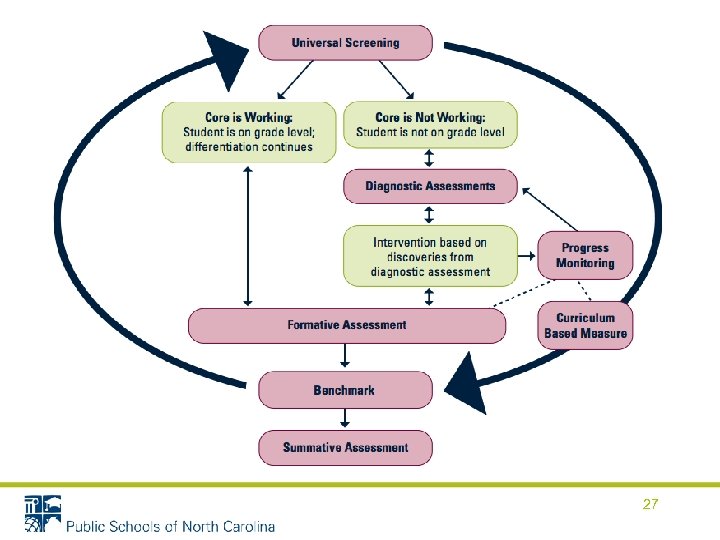
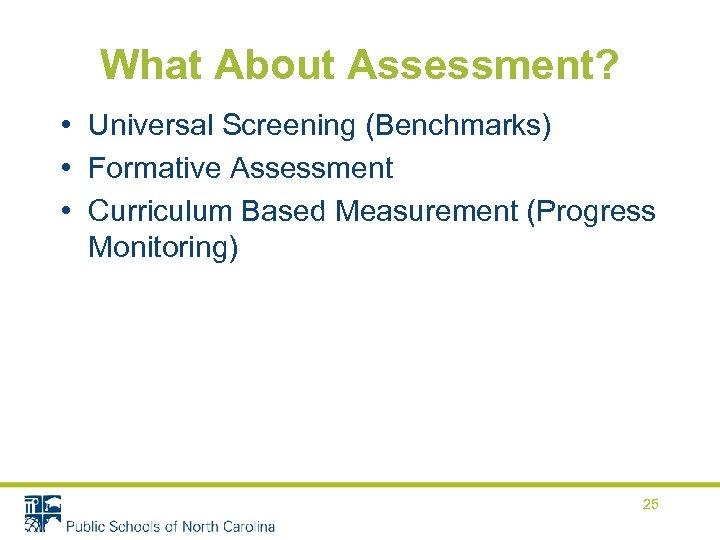 What About Assessment? • Universal Screening (Benchmarks) • Formative Assessment • Curriculum Based Measurement (Progress Monitoring) 25
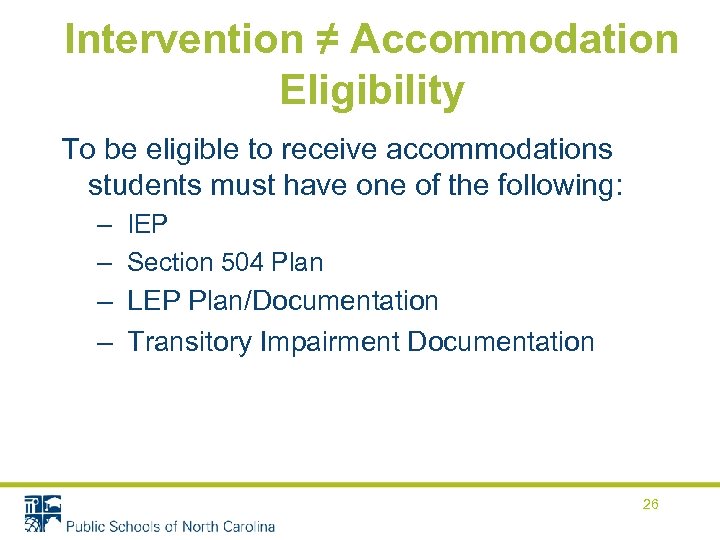 Intervention ≠ Accommodation Eligibility To be eligible to receive accommodations students must have one of the following: – IEP – Section 504 Plan – LEP Plan/Documentation – Transitory Impairment Documentation 26
 27
27
 Universal Screening • Given to determine how much learning has taken place at a particular point in time • Track progress toward meeting curriculum goals and objectives 28
 Curriculum Based Measurement Characteristics : • Simple • Accurate • Efficient • Generalizable • Reliable and valid • Predictive • Sensitive • Flexible 29
 Intervention – “Additional, targeted, and intensive reading instruction provided to students who continue to struggle with learning to read and write despite conventional instruction. ” (Foorman & Torgesen, 2001) – Is in addition to a strong “core” experience – Goal is to accelerate growth 30
 Instructional Accommodations Freda M. Lee 31
 Universal Design for Learning (UDL) is a framework for designing curricula that enable all individuals to gain knowledge, skills, and enthusiasm for learning. UDL provides rich supports for learning and reduces barriers to the curriculum while maintaining high achievement standards for all. (CAST, 2010) 32
 Universal Design for Learning Accommodates Everyone • Universal Design for Learning (UDL) Principles are the foundation for making learning accessible for all children. • Lessons and activities designed using UDL require fewer individual accommodations and provide greater access for all. 33
 Individualize Instructional Accommodations Teach to a student’s strengths rather than measure the depth of their disability 34
 Individualize Instructional Accommodations • Provide access and level the playing field • Address specific needs related to a student’s disability, rather than provide generic accommodations • Use age appropriate accommodations 35
 Accommodations Are Used to Make the Instructional Match Goal: Make the “match” between the students’ entry skills, prior knowledge and the demands of the curriculum/standards and classroom expectations. 36
 Practice Makes Perfect • Provide students direct instruction on how to use assistive devices and accommodations • Provide students daily opportunities to use or practice with their accommodations • Students must be taught to use accommodations across instructional settings • Students must be taught which instructional accommodations may/may not be used on state tests. 37
 Final Thoughts • Keep things simple and focus on ease of use • Ensure that students can articulate their needs and ask for their accommodations • Ensure that all teachers are aware of the student’s instructional accommodations • Make sure you have student and teacher buy-in • Remember things change over time and you may need to adapt 38
 Modifying Classroom Assessment Guiding Teaching, Reteaching, & Assessment to Ensure Mastery Joanne Marino 39
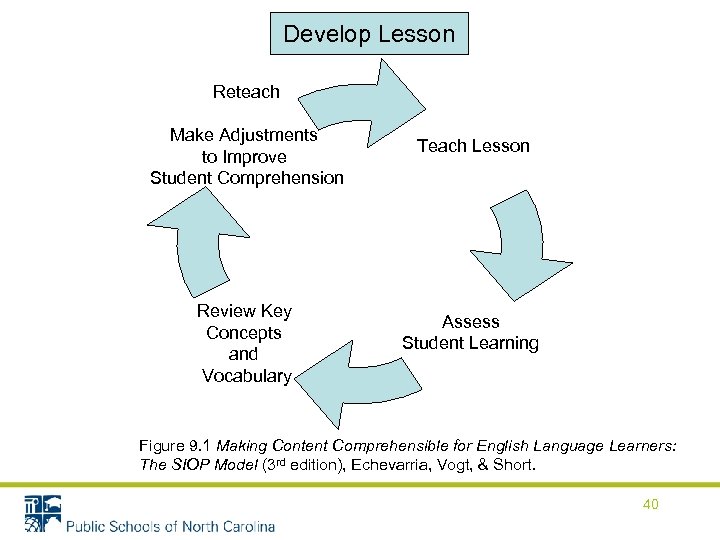 Develop Lesson Reteach Make Adjustments to Improve Student Comprehension Review Key Concepts and Vocabulary Teach Lesson Assess Student Learning Figure 9. 1 Making Content Comprehensible for English Language Learners: The SIOP Model (3 rd edition), Echevarria, Vogt, & Short. 40
 Meeting Student Needs in Classroom Assessments 41
 Use Authentic Assessment • Multiple forms of intelligence • • verbal/linguistic logical/mathematical visual/spatial musical/rhythmic bodily kinesthetic naturalistic interpersonal intrapersonal • Varied student readiness • Differing student interests 42
 Accommodations (examples) • Special arrangement: – Read aloud • Special test environments: – Increase time – Add breaks through multiple test sessions – Allow tools such as translation dictionaries – Individual/small group setting 43
 Modifying Classroom Assessments Modifications are adjustments to the instruction/test that change the construct through one or more of the following: – Language Load – Content Complexity – Cognitive Complexity 44
 Example: Modify Language Load on Summative Classroom Assessments • Match assessment with current language capability • Scaffold the academic language of the test – Make test directions and questions comprehensible – Provide prompts to access receptive language • Respect short term memory load • Keep student’s attention 45
 W? O Modify Language Load H 1. Clarify vocabulary – – Define unfamiliar words Highlight key words Use pictures/visuals Use native language 2. Simplify sentence structure – Reduce sentence length – Use present tense if possible – Use active, not passive voice 46
 W? O Modify Language Load H 3. Reduce language as appropriate – – – Limit number of items and distracters Cut test into smaller chunks Accept performance-based responses Reduce steps / give precise directions Add pictures/visuals Eliminate irrelevant data 47
 ? HOW Modify Language Load 4. Scaffold as appropriate – Tap prior knowledge – Lessen gaps in background knowledge – Allow an oral, pictorial, or physical response – Guide use of resources • • • Word bank / word wall Sentence starters / sentence frames Page numbers in text 48
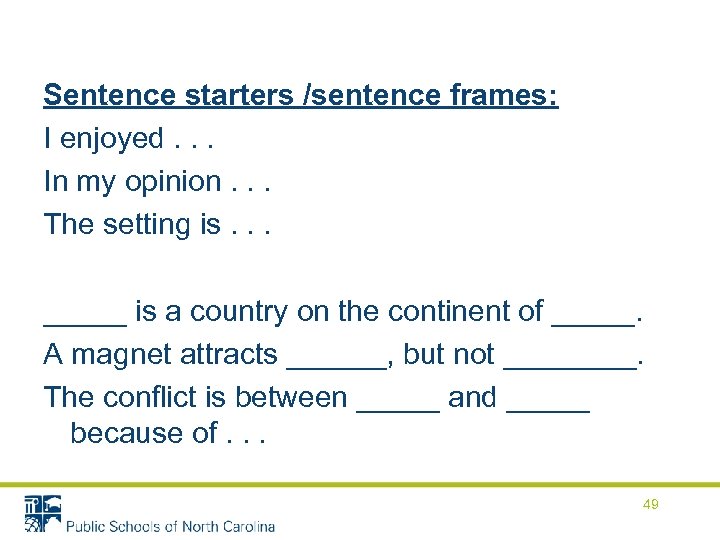 Sentence starters /sentence frames: I enjoyed. . . In my opinion. . . The setting is. . . _____ is a country on the continent of _____. A magnet attracts ______, but not ____. The conflict is between _____ and _____ because of. . . 49
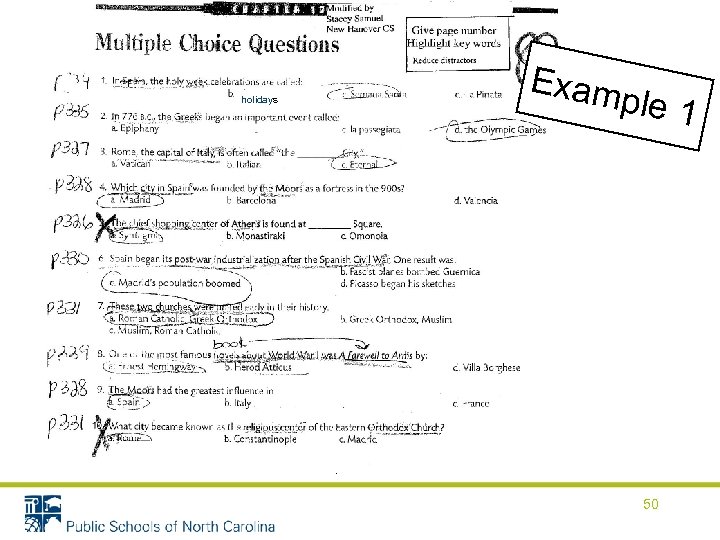 holidays Exam ple 1 50
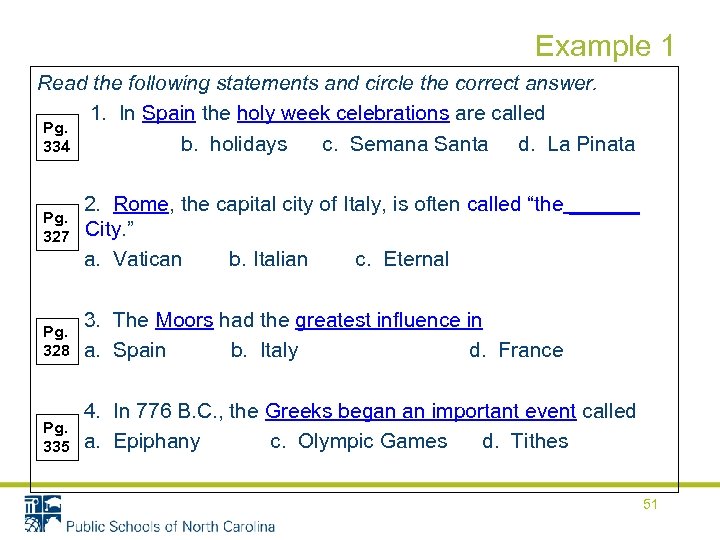 Example 1 Read the following statements and circle the correct answer. 1. In Spain the holy week celebrations are called Pg. b. holidays c. Semana Santa d. La Pinata 334 2. Rome, the capital city of Italy, is often called “the ______ Pg. 327 City. ” a. Vatican b. Italian c. Eternal 3. The Moors had the greatest influence in Pg. 328 a. Spain b. Italy d. France 4. In 776 B. C. , the Greeks began an important event called Pg. a. Epiphany c. Olympic Games d. Tithes 335 51
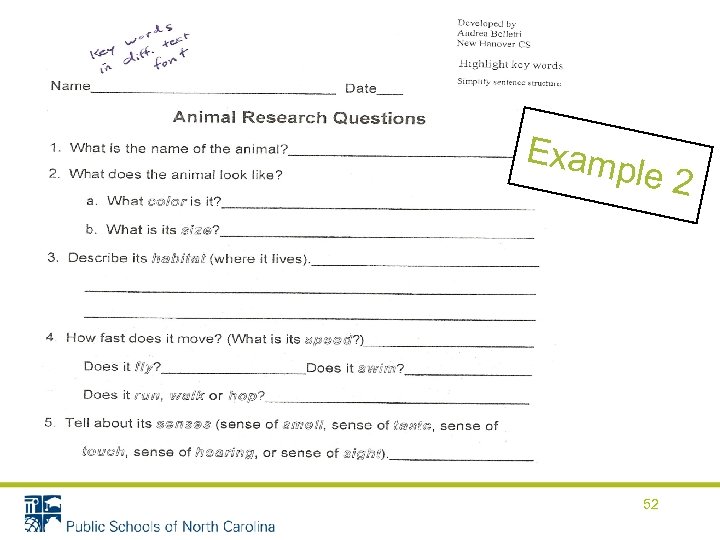 Exam ple 2 52
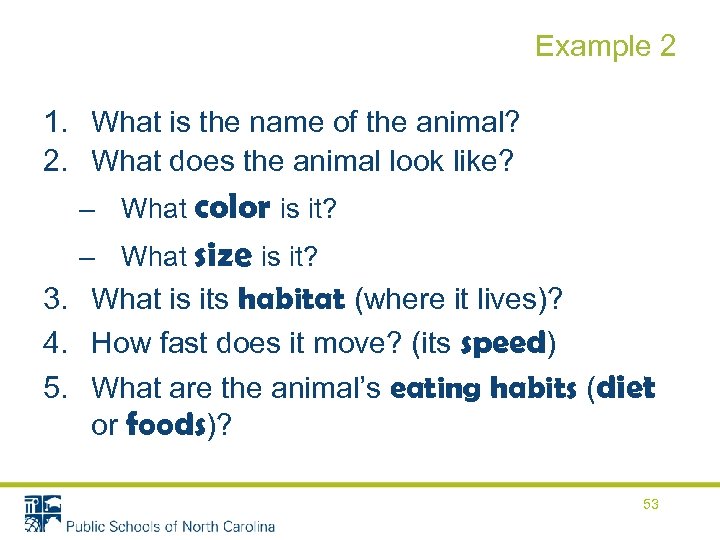 Example 2 1. What is the name of the animal? 2. What does the animal look like? – What color is it? – What size is it? 3. What is its habitat (where it lives)? 4. How fast does it move? (its speed) 5. What are the animal’s eating habits (diet or foods)? 53
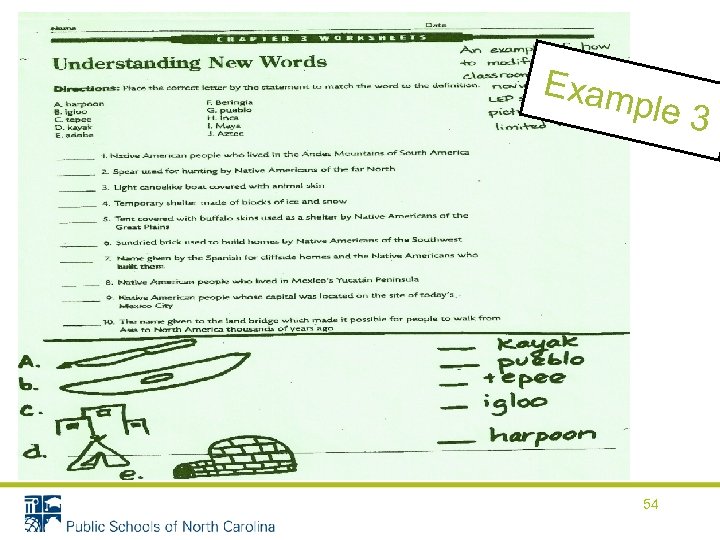 Exam ple 3 54
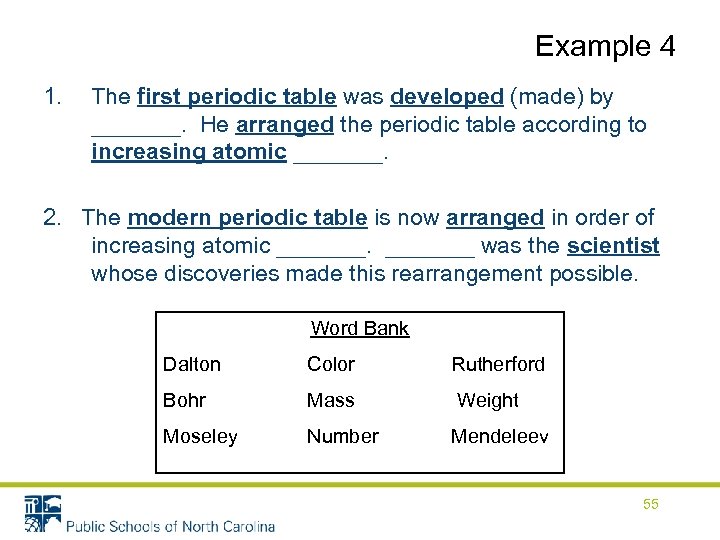 Example 4 1. The first periodic table was developed (made) by _______. He arranged the periodic table according to increasing atomic _______. 2. The modern periodic table is now arranged in order of increasing atomic _______ was the scientist whose discoveries made this rearrangement possible. Word Bank Dalton Color Rutherford Bohr Mass Weight Moseley Number Mendeleev 55
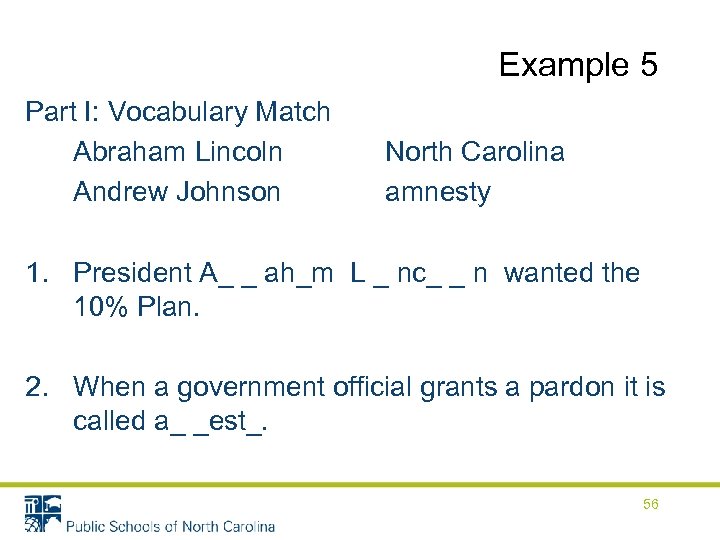 Example 5 Part I: Vocabulary Match Abraham Lincoln Andrew Johnson North Carolina amnesty 1. President A_ _ ah_m L _ nc_ _ n wanted the 10% Plan. 2. When a government official grants a pardon it is called a_ _est_. 56
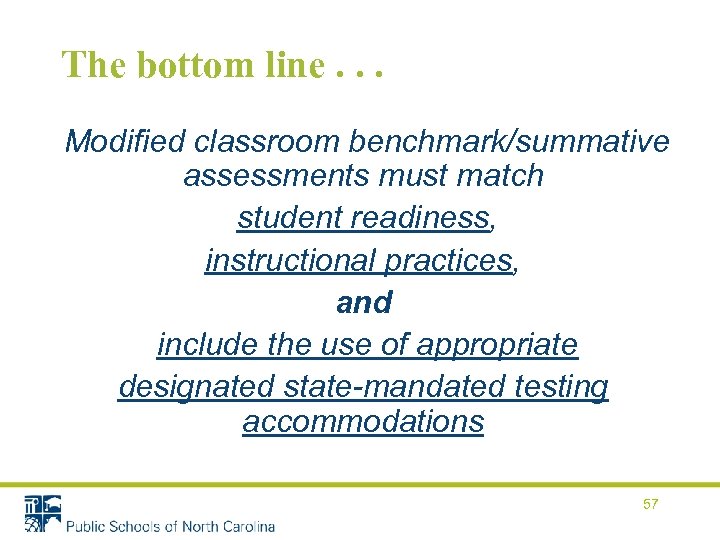 The bottom line. . . Modified classroom benchmark/summative assessments must match student readiness, instructional practices, and include the use of appropriate designated state-mandated testing accommodations 57
 Break (Put any Questions, Comments, or Concerns in the Parking Lot) 58
 Collaboration and Making Decisions Helga Fasciano Elissa Brown 59
 Collaboration in an Effective Team • Communication • Commitment • Easier to Resolve Conflict • Efficient Use of Resources • Efficient Use of Strengths • Positive Relationships • Positive Outcomes for Students 60
 “Coming together is a beginning. Keeping together is progress. Working together is success!” - Henry Ford 61
 Considerations for Committee Communication and Decision-Making • Base accommodations on student need • Integrate assessment accommodations into classroom instruction – Provide practice opportunities – Use as part of the regular instruction – Inform all relevant teachers 62
 Considerations for Committee Communication and Decision-Making • Use state list of approved testing accommodations – Understand purpose of the accommodation – Students may have overlapping identifications which may require specific accommodations based on area of need(s) and/or content – Make sure accommodation is appropriate for the student and the test 63
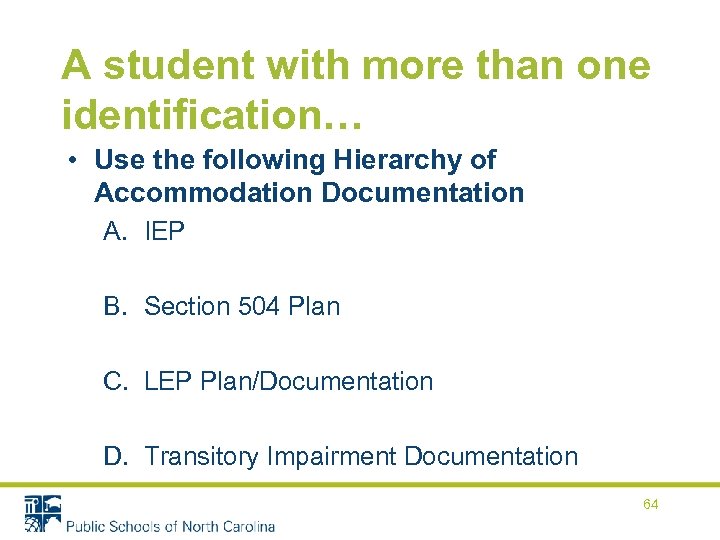 A student with more than one identification… • Use the following Hierarchy of Accommodation Documentation A. IEP B. Section 504 Plan C. LEP Plan/Documentation D. Transitory Impairment Documentation 64
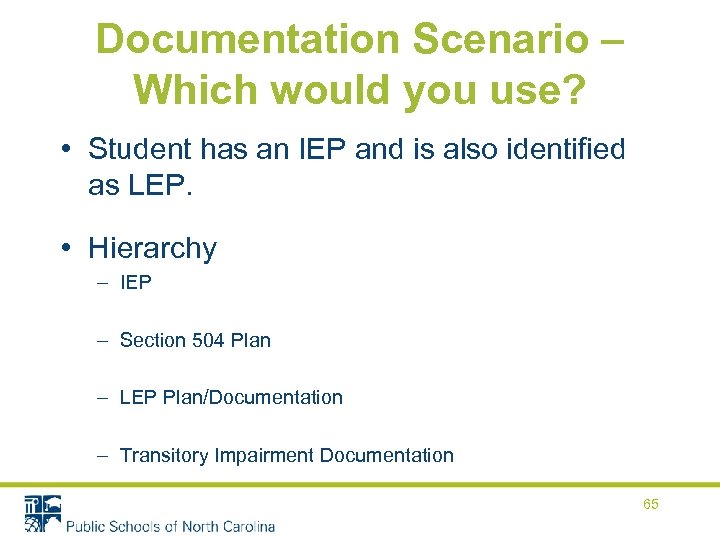 Documentation Scenario – Which would you use? • Student has an IEP and is also identified as LEP. • Hierarchy – IEP – Section 504 Plan – LEP Plan/Documentation – Transitory Impairment Documentation 65
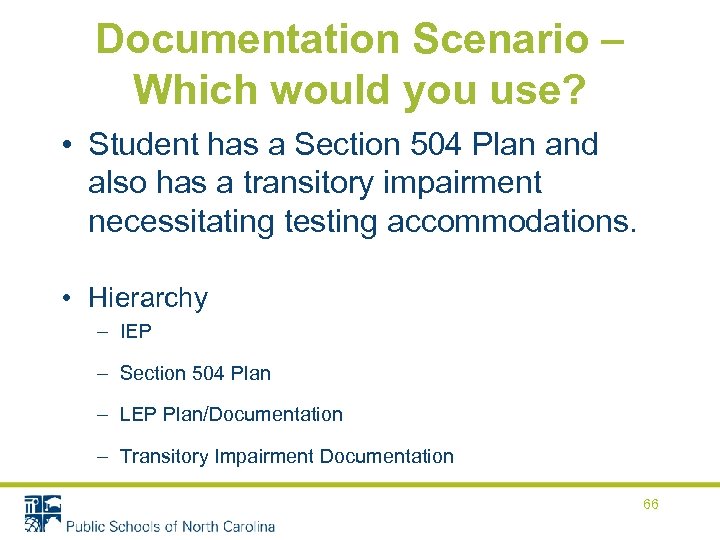 Documentation Scenario – Which would you use? • Student has a Section 504 Plan and also has a transitory impairment necessitating testing accommodations. • Hierarchy – IEP – Section 504 Plan – LEP Plan/Documentation – Transitory Impairment Documentation 66
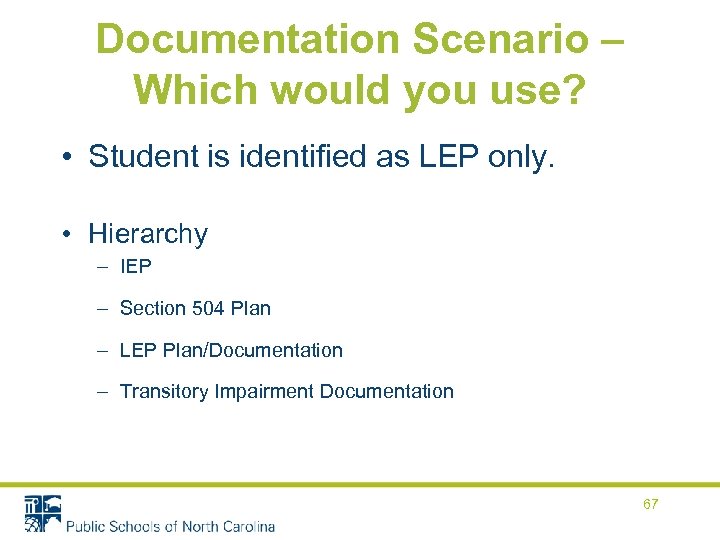 Documentation Scenario – Which would you use? • Student is identified as LEP only. • Hierarchy – IEP – Section 504 Plan – LEP Plan/Documentation – Transitory Impairment Documentation 67
 Be Consistent: Testing Accommodations Language • Must align with language of state-approved testing accommodations – IEP – Section 504 Plan – LEP Plan/Documentation – Transitory Impairment Documentation 68
 Authoritative Sources Gary Williamson 69
 State Testing Accommodations Audrey Martin-Mc. Coy Carrie Perkis 70
 State Testing Accommodations are practices and procedures that provide equitable access to state test content for both § Students with disabilities; and § Students identified as limited English proficient (LEP). 71
 State Testing Accommodations Students with disabilities and LEP students must be included in the testing program under one of the following conditions: § Standard test administration § Test administration with accommodations 72
 State Testing Accommodations State testing accommodations must be: § Documented in the student’s IEP, Section 504 Plan, LEP Plan/documentation, transitory impairment documentation, and § Used routinely during instruction and similar classroom assessments that measure the same construct. § Accommodations are not to be provided for test score enhancement. 73
 State Testing Accommodations State testing accommodations must be based on the following: • Decisions that are determined by a school-based team/committee; • Knowledge and consideration of the needs of the whole child; and • Recording and sharing the plan/documentation. 74
 State Testing Accommodations School systems must ensure: § Staff are trained in the appropriate use of the accommodation(s) during testing; § Students are provided with the appropriate testing accommodations based on their plan/documentation; and § Test security is maintained at all times. 75
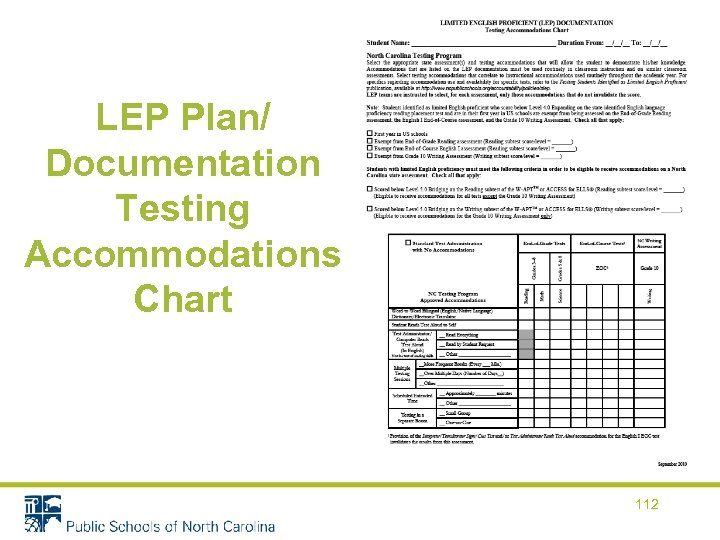
 TESTING ACCOMMODATIONS INFORMATION FOR: STUDENTS IDENTIFIED AS LIMITED ENGLISH PROFICIENT 76
 State LEP Testing Accommodations Eligibility LEP students who score below Level 5. 0 Bridging on the reading subtests of the W-APT/ ACCESS for ELLs are eligible to receive stateapproved LEP testing accommodations on all state tests except the state writing assessment at grade 10. 77
 State LEP Testing Accommodations Eligibility LEP students who score below Level 5. 0 Bridging on the writing subtest of the W- APT/ACCESS for ELLs, are eligible to receive state-approved LEP testing accommodations on the state writing assessment at grade 10. 78
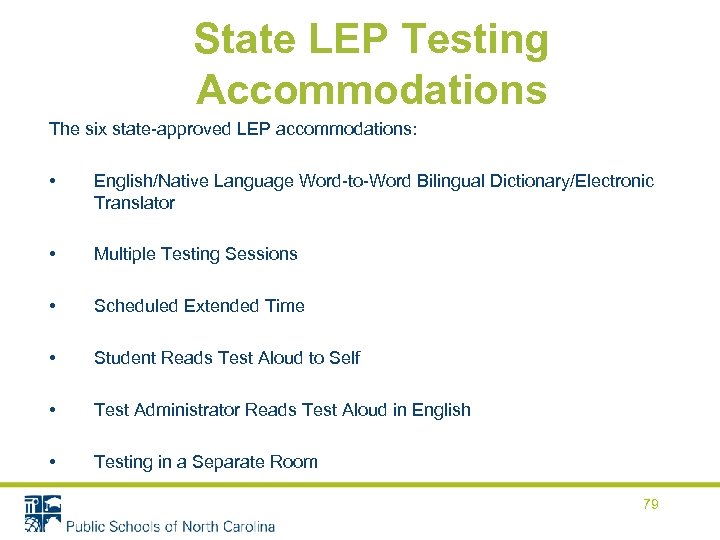 State LEP Testing Accommodations The six state-approved LEP accommodations: • English/Native Language Word-to-Word Bilingual Dictionary/Electronic Translator • Multiple Testing Sessions • Scheduled Extended Time • Student Reads Test Aloud to Self • Test Administrator Reads Test Aloud in English • Testing in a Separate Room 79
 TESTING ACCOMMODATIONS INFORMATION FOR: STUDENTS WITH DISABILITIES 80
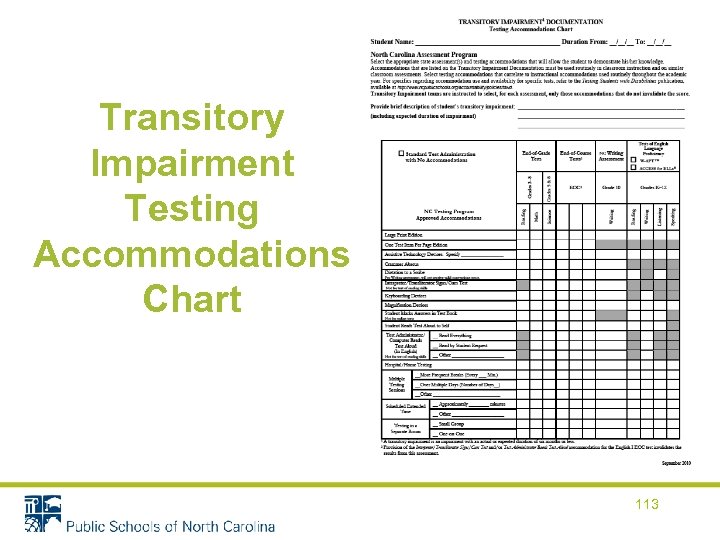
 Who is Eligible for Testing Accommodations? • Students with disabilities with a current Individualized Education Program (IEP) • Students with disabilities with a current Section 504 Plan • Students with a temporary disability with current Transitory Impairment documentation 81
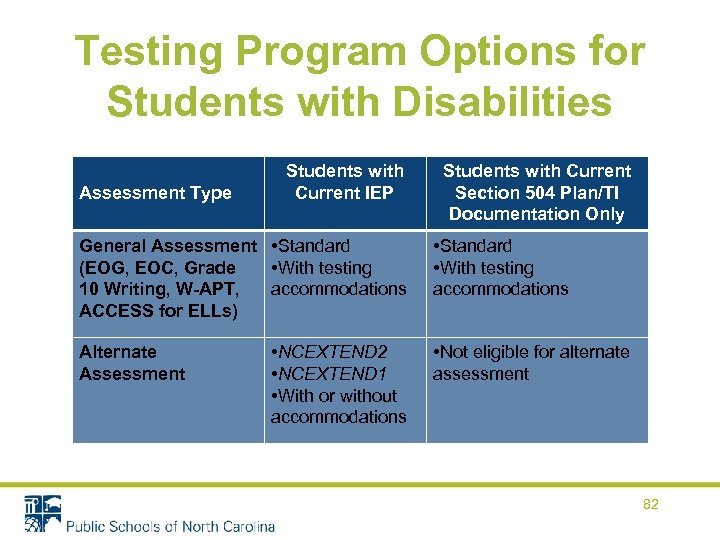 Testing Program Options for Students with Disabilities Assessment Type Students with Current IEP General Assessment • Standard (EOG, EOC, Grade • With testing 10 Writing, W-APT, accommodations ACCESS for ELLs) Alternate Assessment • NCEXTEND 2 • NCEXTEND 1 • With or without accommodations Students with Current Section 504 Plan/TI Documentation Only • Standard • With testing accommodations • Not eligible for alternate assessment 82
 What Types of Testing Accommodations are Available for Student with Disabilities? • Modified Test Formats • Assistive Technology (AT) Devices and Special Arrangements • Special Test Environments 83
 Modified Test Formats • Braille Edition • Large Print Edition • One Test Item Per Page Edition 84
 Assistive Technology Devices and Special Arrangements • • • Braille Writer/Slate and Stylus (Braille Paper) Cranmer Abacus Magnification Devices Student Marks Answers in Test Book Student Reads Test Aloud to Self 85
 Assistive Technology Devices and Special Arrangements • AT Devices • Dictation to a Scribe • Keyboarding Devices (May result in not receiving conventions score for Grade 10 Writing) • Interpreter/Transliterator Signs/Cues Test • Test Administrator Reads Test Aloud (In English) (Invalidate scores of state tests measuring reading comprehension) 86
 Assistive Technology Devices and Special Arrangements • • • Braille Writer/Slate and Stylus (Braille Paper) Cranmer Abacus Magnification Devices Student Marks Answers in Test Book Student Reads Test Aloud to Self 87
 Assistive Technology Devices and Special Arrangements • AT Devices • Dictation to a Scribe • Keyboarding Devices • Interpreter/Transliterator Signs/ Cues Test • Test Administrator Reads Test Aloud (In English) 88
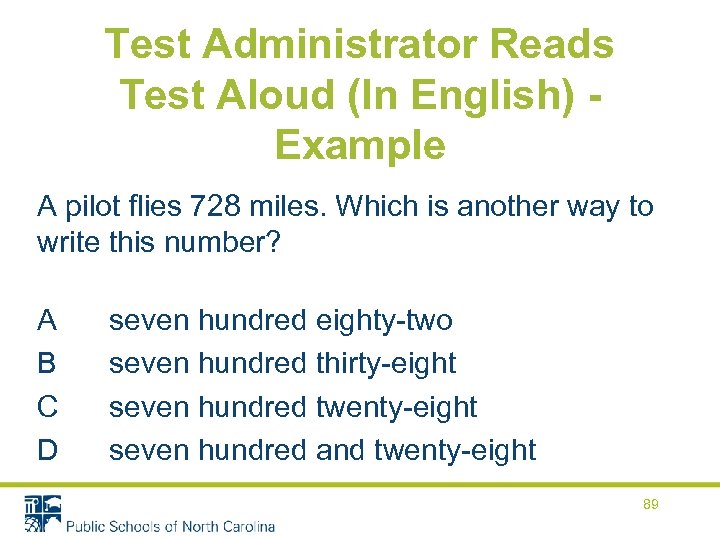 Test Administrator Reads Test Aloud (In English) Example A pilot flies 728 miles. Which is another way to write this number? A B C D seven hundred eighty-two seven hundred thirty-eight seven hundred twenty-eight seven hundred and twenty-eight 89
 Special Test Environments • • Hospital/Home Testing Multiple Testing Sessions Scheduled Extended Time Testing in a Separate Room 90
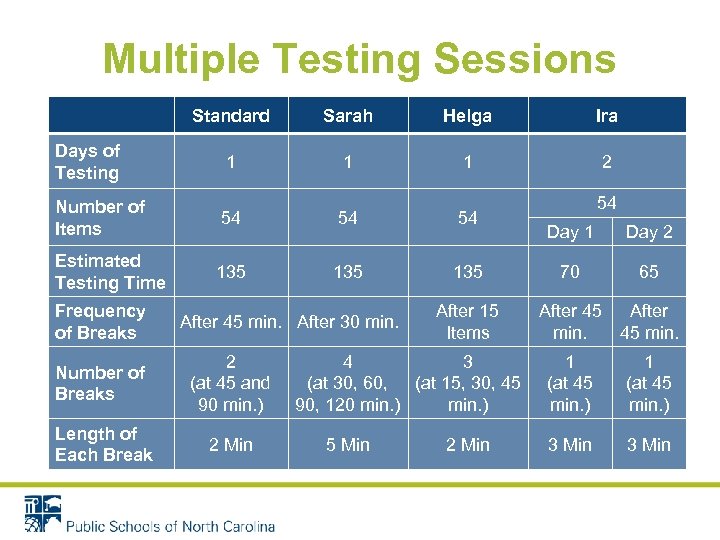 Multiple Testing Sessions Standard Sarah Helga Ira Days of Testing 1 1 1 2 Number of Items 54 54 54 Estimated Testing Time 135 135 Frequency of Breaks After 45 min. After 30 min. Number of Breaks 2 (at 45 and 90 min. ) Length of Each Break 2 Min After 15 Items 4 3 (at 30, 60, (at 15, 30, 45 90, 120 min. ) 5 Min 2 Min 54 Day 1 Day 2 70 65 After 45 After min. 45 min. 1 (at 45 min. ) 3 Min
 Testing Accommodations for NCEXTEND 1 • Responds with Use of an Augmentative Communication Device, Picture Board, etc. • Large Print Materials • Adaptations to NCDPI-Provided Manipulatives 92
 Special NCDPI Approved Testing Accommodations (SWD only) • Submit Accommodation Notification Form for NCDPI review/approval • New for 2010 -11: Accommodations Information Management System (AIMS) • Submit requests early in school year • Not available for LEP-only students 93
 Modifications on State Assessments Nadine Mc. Bride 94
 Introduction • In April 2007, the U. S. Department of Education issued regulations allowing the development of assessments based on “modified academic achievement standards” 95
 Defined as…. • “A modified academic achievement standard is an expectation of performance that is challenging for eligible students, but is less difficult than a grade-level academic achievement standard. ” – http: //www. ed. gov/policy/speced/guid/nclb/tw opercent. doc. 96
 Purpose and Use • Intended to bridge the gap between the 1% and the general assessment for a “limited group of students whose disability has prevented them from attaining gradelevel proficiency”. • By the end of 2009, nine states had already administered an Alternate Assessment based on Modified Academic Standards (AA-MAS). 97
 In North Carolina…. • NCEXTEND 2 introduced as an operational summative assessment in the AA-MAS category in 2005 -06. • Available in Math and Reading Grades 3 -8 and Science Grades 5 and 8. 98
 Modifications Made • Three response options for each item • Non-curricular language simplified – Restricted to two grade levels below • Fewer questions – No embedded field test items • Reading passages are shorter • Two items per page 99
 Modifications by Other States • • Bolding and highlighting of key words Bolding the item stem Boxing response options Breaking reading passages into smaller sections with relevant items below • Font size and type changed 100
 Studies on NCEXTEND 2 • A study conducted in 2006 confirmed that the NCEXTEND 2 was less difficult than the general assessment when given to the general student population • An alignment study found adequate alignment of the items with the SCS but that the cognitive complexity of items ranged from at or below the levels of cognitive complexity of the SCS 101
 Lunch on Your Own Return at 12: 45 102
 Accommodations Monitoring Sarah Mc. Manus Carrie Perkis 103
 USED Requirements • USED must approve the North Carolina Testing and Accountability Programs • The NCDPI must submit evidence of a system for monitoring the implementation and effectiveness of testing accommodations 104
 Components of the System • Resources for helping teams/committees make and document decisions about testing accommodations • Documentation of required accommodations • Documentation of provided accommodations • Documentation of usage of accommodations 105
 Monitoring for 2009 -10 Carrie Perkis 106
 2009– 10 Monitoring Update Thank you to participating LEAs and schools • Mooresville Graded School District – Mooresville High School • Public Schools of Robeson County – Magnolia Elementary School • Public Schools of Rockingham County – Holmes Middle School – Rockingham County High School • Public Schools of Tyrrell County – Tyrrell Elementary School – Columbia Middle School 107
 2009– 10 Monitoring Data • Review of student accommodations documentation • Observation of accommodated testing sessions • Interviews with school staff 108
 2009– 10 Monitoring Feedback: Accommodations Documentation • Data Collected – Discrepancies in accommodations documentation • Recommendations – System for ensuring accuracy and alignment of testing accommodations documentation – Consistent, state-approved language across all types of testing accommodations documentation 109
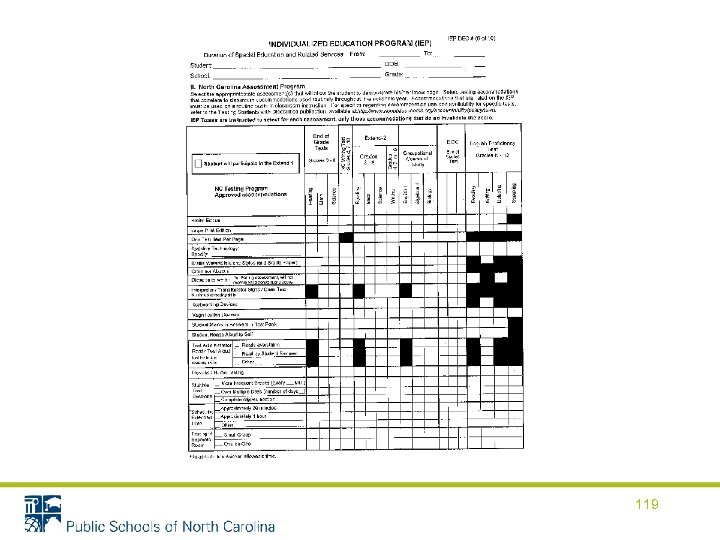
 2009– 10 Monitoring Feedback: Accommodations Documentation • Section 504 Plan, LEP Plan/Documentation, Transitory Impairment Documentation testing accommodations charts modeled after IEP testing accommodations chart (IEP DEC 4 page 6 of 10) 110
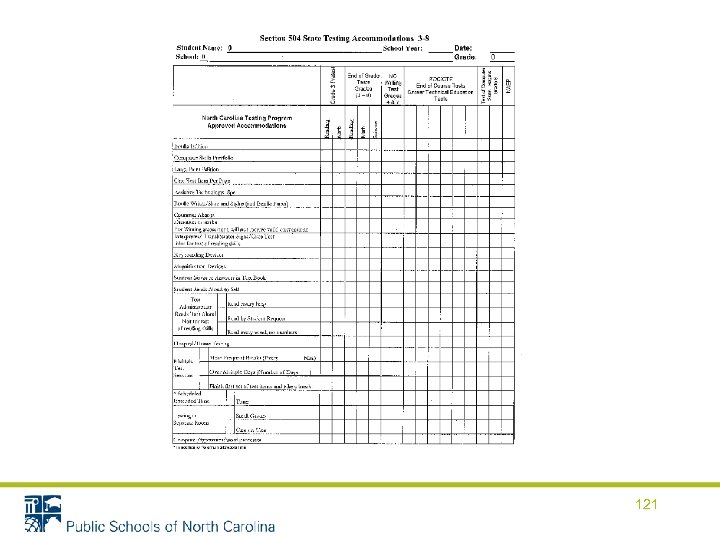
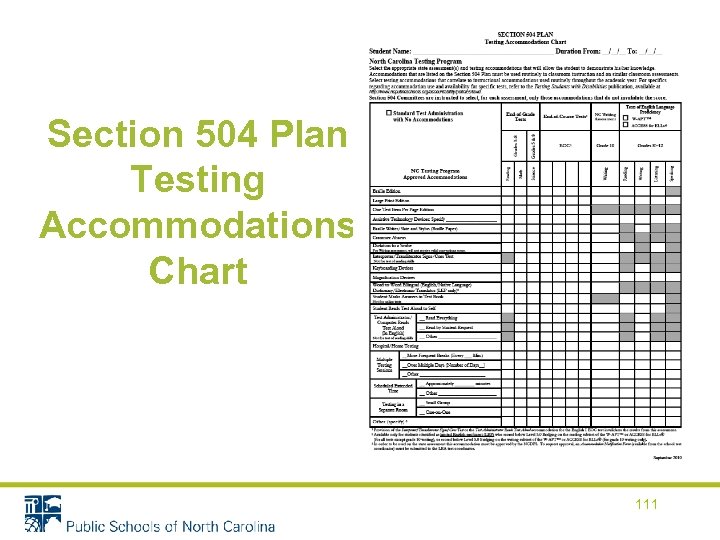 Section 504 Plan Testing Accommodations Chart 111
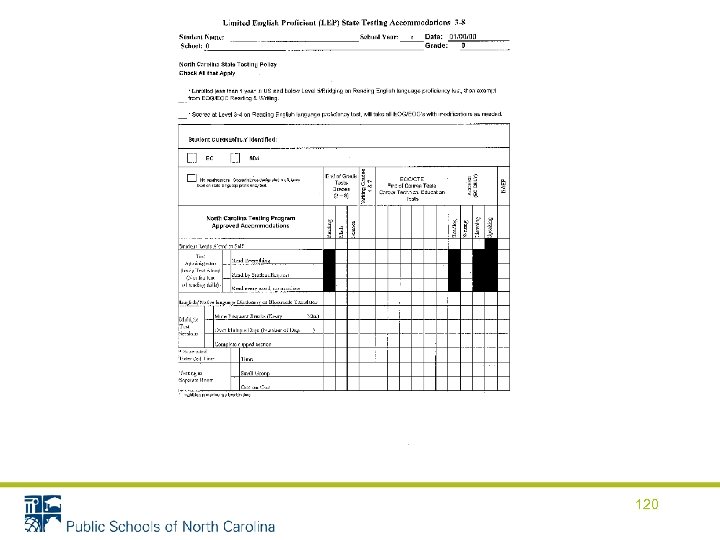
 LEP Plan/ Documentation Testing Accommodations Chart 112
 Transitory Impairment Testing Accommodations Chart 113
 2009– 10 Monitoring Feedback: Accommodations Decisions & Provision • Data Collected – Many provided testing accommodations were not used by students • Recommendations – Use information documented on Review of Accommodations forms to inform accommodations decisions at next IEP/Section 504/LEP team meeting 114
 2009– 10 Monitoring Feedback: Accommodations Systems and Training • Data Collected – Emphasis on state testing accommodations • Recommendations – Increased focus on overarching accommodations system (instructional and classroom testing accommodations) – Increased collaboration of school staff 115
 Accommodations Monitoring Plan Joanne Smith Susan Smith Jo Hopkins Tyrrell County Schools
 Procedures for monitoring the use of state testing accommodations ensure that accommodations are: • Appropriate for each student • Used regularly and routinely • Revised as needed • Provided during state testing
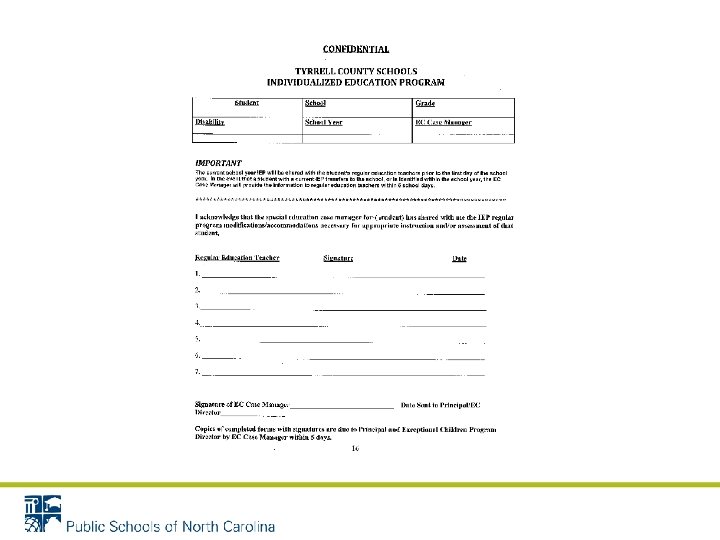
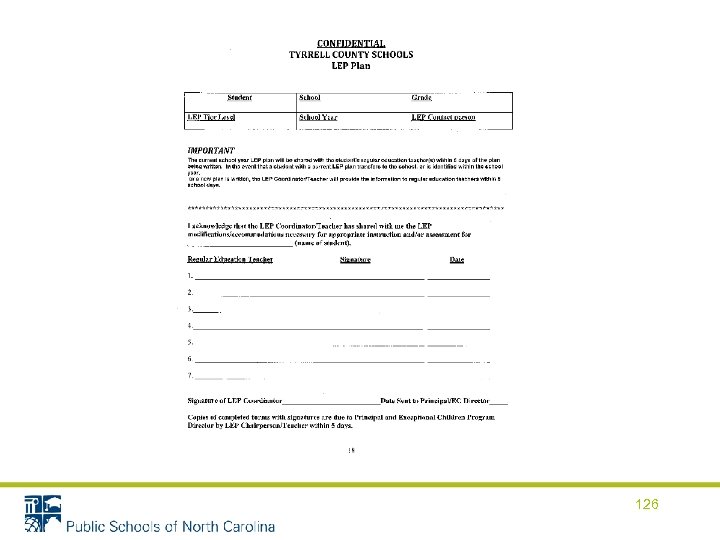
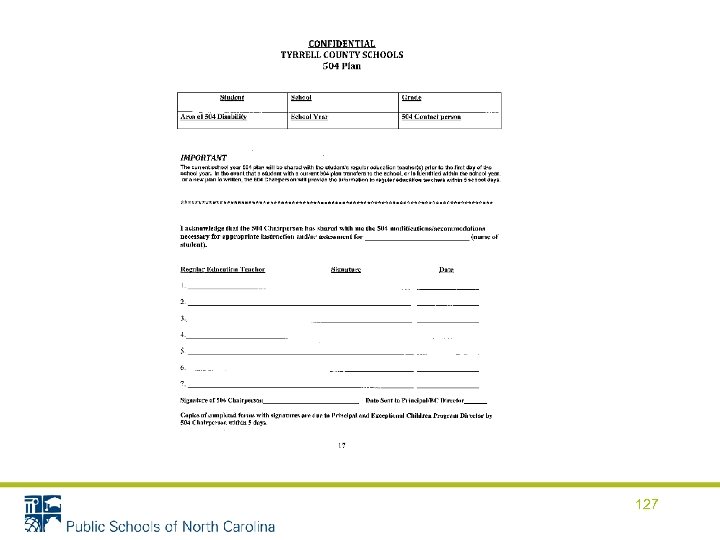
 Two things enable our county to accomplish this: Alignment of all documentation for EC, Section 504, and LEP (Creating forms and procedures that are similar for all areas. )
 119
119
 120
120
 121
121
 • Collaboration! Exceptional Children’s Director, Section 504 Coordinator, LEP Coordinator, Accountability Director and Instructional Leaders must work together and then collaborate efforts with Building Level Testing Coordinators (BTCs), EC Teachers and Regular Education Teachers. But ultimately, it is the regular education classroom teacher that must work collaboratively with all involved to ensure we are meeting the needs of our students! 122
 To Ensure Appropriate Accommodations are Provided for Students During Instruction: • Guidelines from Testing Students with Disabilities and Guidelines for Testing Students Identified as Limited English Proficient manuals are followed and thoroughly discussed during IEP, Section 504, and LEP meetings. • Required student accommodations are determined on a case-by-case basis. • EC Teachers, Section 504 Chairperson, and LEP Coordinator at each school verify accommodations against student plans at the beginning of each school year, when any changes are made, and when new students are identified.
 During Instruction (cont’d) § EC Teachers, Section 504 Chairperson, and LEP Coordinator provide documentation of instructional and testing accommodations to all regular education classroom teachers. Regular education teachers sign indicating they have received a copy of each student’s accommodations.
 126
126
 127
127
 During Instruction (cont’d) • Provide training to all instructional staff at the start of each school year on approved state testing accommodations (conducted by EC Director and/or LEA Testing Coordinator)
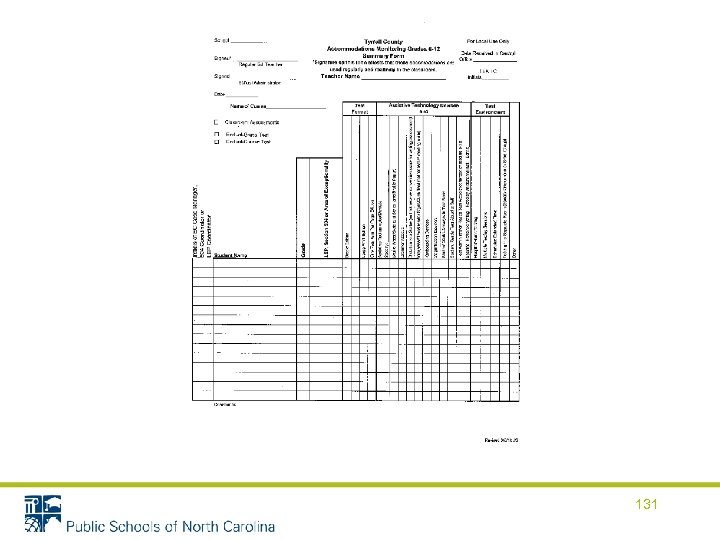
 To Ensure Accommodations are Use Regularly and Routinely in the Classroom: • Each marking period the regular classroom teacher completes and signs the Tyrrell County Accommodations Monitoring (TCAM) form attesting to providing the stated accommodation to each student during that quarter. • EC, Section 504, and LEP professionals at each building initial the form to verify the student is receiving documented accommodations. • This form also serves as a communication tools to request or suggest changes needed.
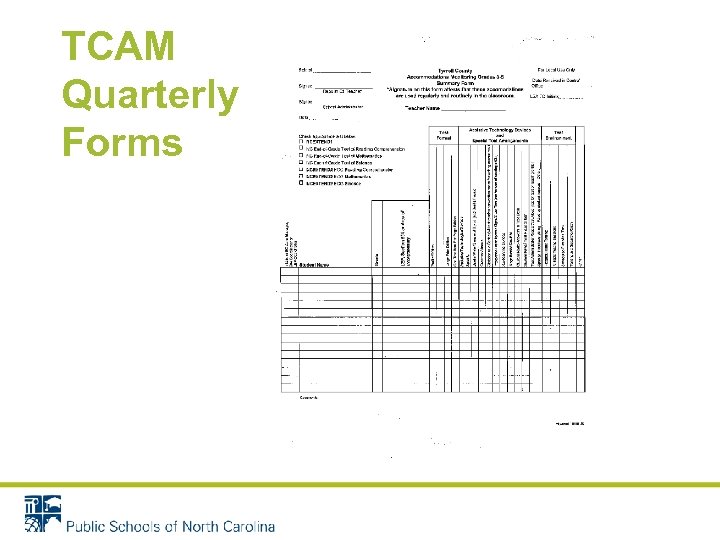 TCAM Quarterly Forms
 131
131
 Regularly and Routinely (cont’d) • Additionally, accommodations are documented on assessments that are maintained in students portfolio • Use of accommodations are documented and discussed with teachers during pre-observation conferences and during administrative observations
 Ensuring Accommodations are Provided Appropriately During State Testing: • Review of accommodations that will be provided (based on test schedule provided by BTC) will be conducted along with required state test administrator’s training during each testing cycle. • Test administrators receive copies of specific accommodations they are responsible for providing (from the Testing Students with Disabilities manual)
 During Test Administration (cont’d) • Proctors and administrators sign Modified Test Site Forms indicating the accommodation provided at that site • Test administrators complete Review of Accommodations Used during Testing form and these forms become part of the students’ IEP, Section 504 or LEP plans. • LEA TC and/or EC Director conduct monitoring visits to test sites as tests are administered and feedback is provided to building principals.
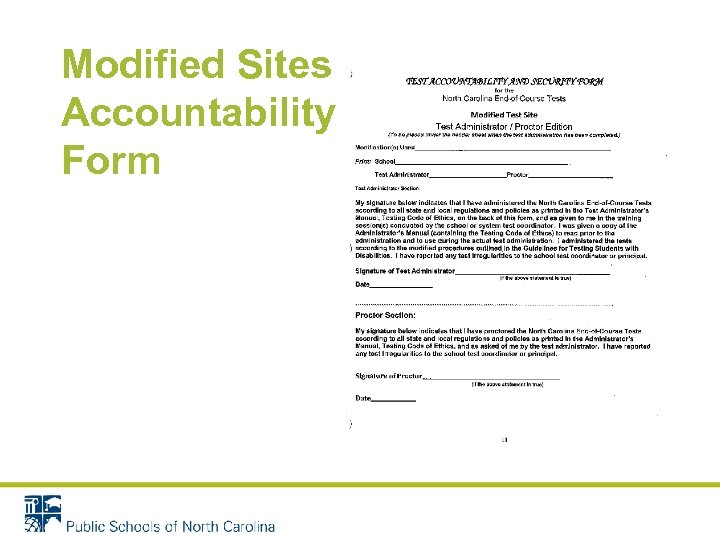 Modified Sites – Accountability Form
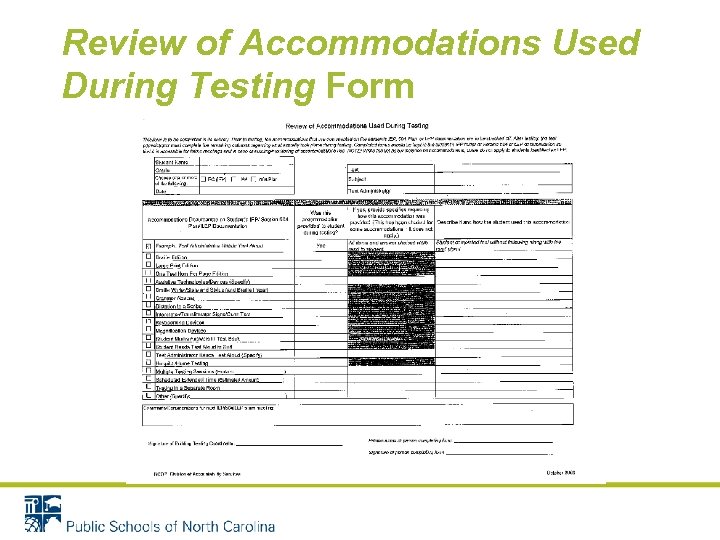 Review of Accommodations Used During Testing Form
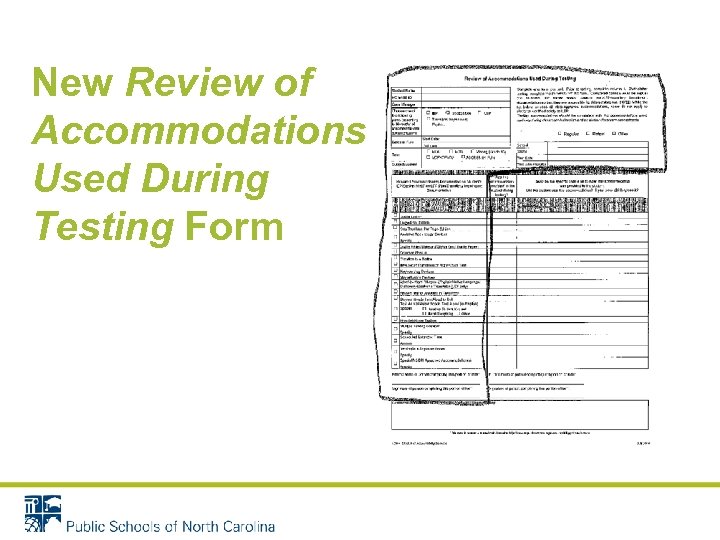 New Review of Accommodations Used During Testing Form
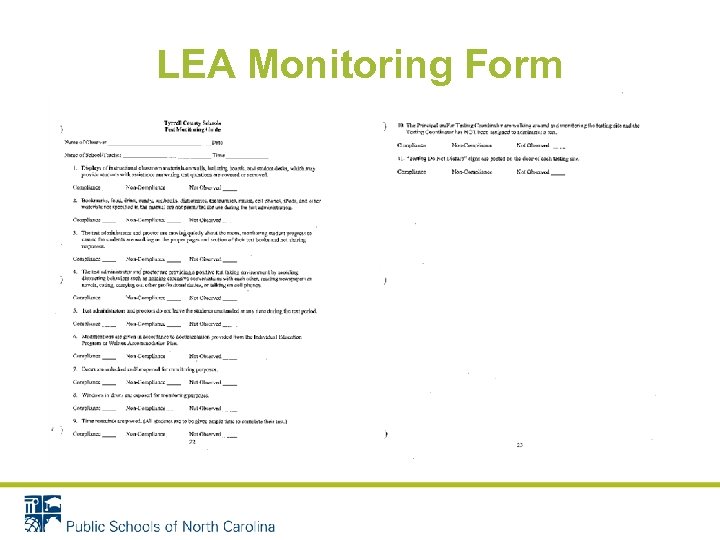 LEA Monitoring Form
 Break (Put any Questions, Comments, or Concerns in the Parking Lot) 139
 Monitoring for 2010 -11 Sarah Mc. Manus 140
 Documentation of Testing Accommodations for USED Fall 2010– 2011 • Required: School Improvement Plan in NC WISE and DEC 4 (IEP) in CECAS • Provided: Answer sheets (and later uploaded into NC WISE) • How Used: Review of Accommodations Used During Testing forms 141
 2010– 11 Accommodations Monitoring • Updated Review of Accommodations forms • Accommodations data in electronic systems must be current for October 1 data pull • NC WISE or CECAS 142
 2010– 11 On-Site Monitoring • Fall 2010 NCDPI on-site monitoring – EOC testing • Spring 2011 NCDPI on-site monitoring – EOC testing – EOG testing – NCEXTEND 2 testing 143
 NC Testing Program Updates Tammy Howard 144
 2010 -11 and 2011 -12 • The current assessments based on the current North Carolina Standard Course of Study will be administered: – 2003 English Language Arts – 2004 Mathematics – 2004 Science – 2006 Social Studies 145
 2010 -11 and 2011 -12 • OCS students will take the general assessments based on the current Standard Course of Study – English I – Biology – Algebra I • Item Tryouts and Field Tests for NCEXTEND 2 assessments based on new standards and implemented in 2012 -13 – English II – Biology – Algebra I 146
 Beginning in 2012 -13 • New assessments based on new content standards implemented – Common Core State Standards • Mathematics • English Language Arts – Essential Standards • Science • Social Studies • Same tests administered in 2013 -14 147
 2014 -15 • SMARTER Balanced consortium assessments integrated in the testing program – Online/computerized adaptive – Paper/pencil option for 2 years – Grade 11: ELA, math, science – Grades 3 -8: ELA, math, science (5/8) 148
 NCEXTEND 1 Audit Results Sarah Reives 149
 Introduction • The intent of the NCEXTEND 1 is to assess academic skills of students with significant cognitive disabilities and provide access to the general education curriculum using the North Carolina Extended Content Standards. 150
 Introduction The NCEXTEND 1 Audit took place during the Spring 2010 testing administration window: April 22, 2010 – June 18, 2010. 151
 Purposes of the Audit • 3 Main Purposes of the NCEXTEND 1 2010 Audit: – Ensure appropriate administration and scoring – Review eligibility requirements for the assessment – Monitor use of accommodations 152
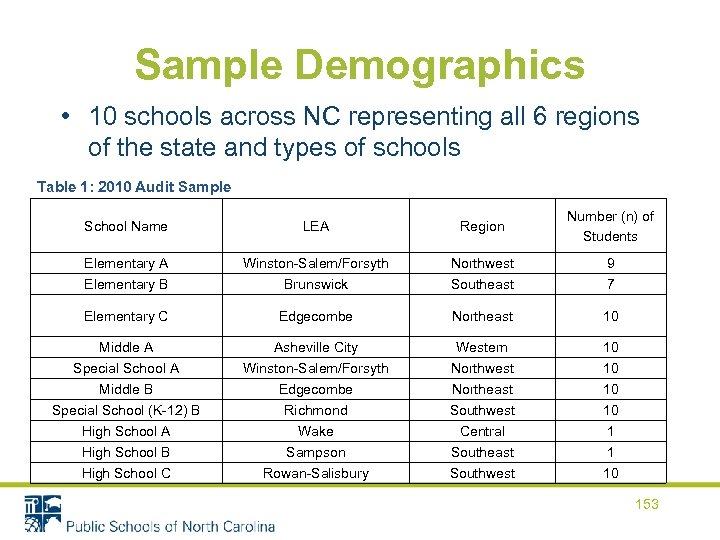 Sample Demographics • 10 schools across NC representing all 6 regions of the state and types of schools Table 1: 2010 Audit Sample School Name LEA Region Number (n) of Students Elementary A Elementary B Winston-Salem/Forsyth Brunswick Northwest Southeast 9 7 Elementary C Edgecombe Northeast 10 Middle A Special School A Middle B Special School (K-12) B High School A High School B High School C Asheville City Winston-Salem/Forsyth Edgecombe Richmond Wake Sampson Rowan-Salisbury Western Northwest Northeast Southwest Central Southeast Southwest 10 10 1 1 10 153
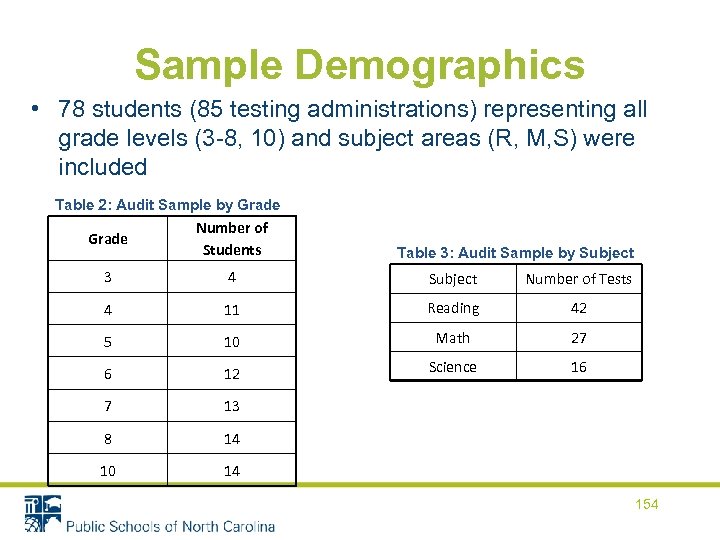 Sample Demographics • 78 students (85 testing administrations) representing all grade levels (3 -8, 10) and subject areas (R, M, S) were included Table 2: Audit Sample by Grade Number of Students 3 4 Subject Number of Tests 4 11 Reading 42 5 10 Math 27 6 12 Science 16 7 13 8 14 10 14 Table 3: Audit Sample by Subject 154
 Audit Process • Audit Teams consisted of NCDPI staff from Curriculum, Test Development (Accountability Services), Exceptional Children (EC) and NCSU - Technical Outreach for Public Schools 155
 Audit Process • Selected schools were given the option to have their observations completed through on-site monitoring or record their testing administrations and submit them to NCDPI for review • Data collection processes for both options were identical 156
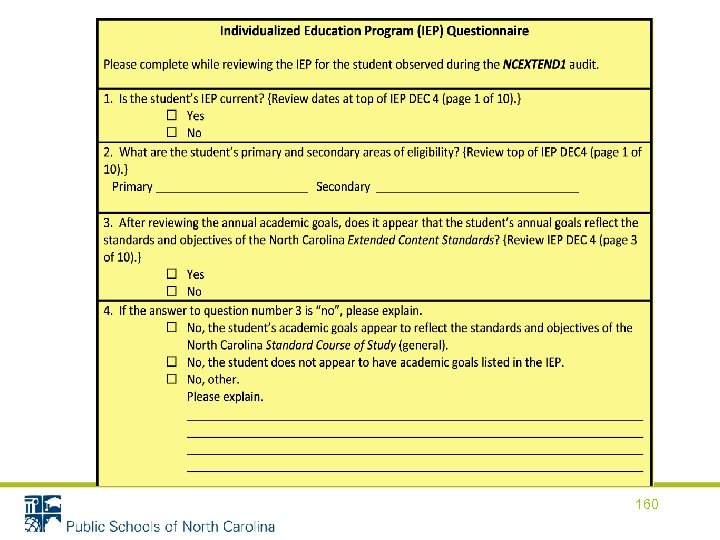
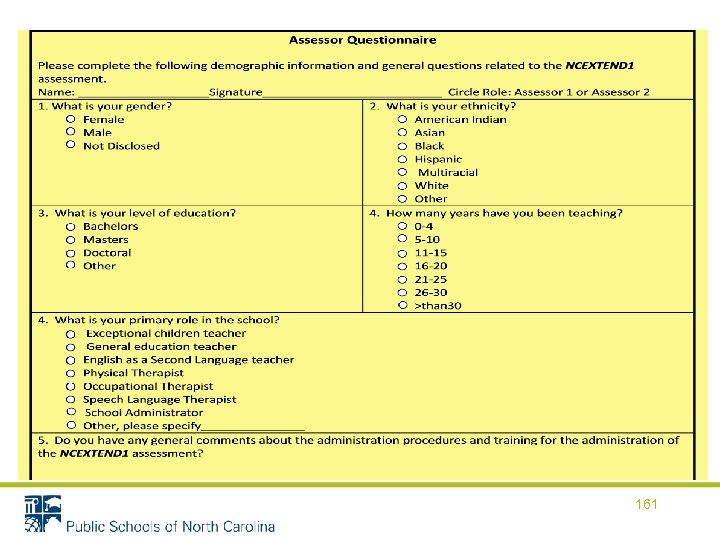
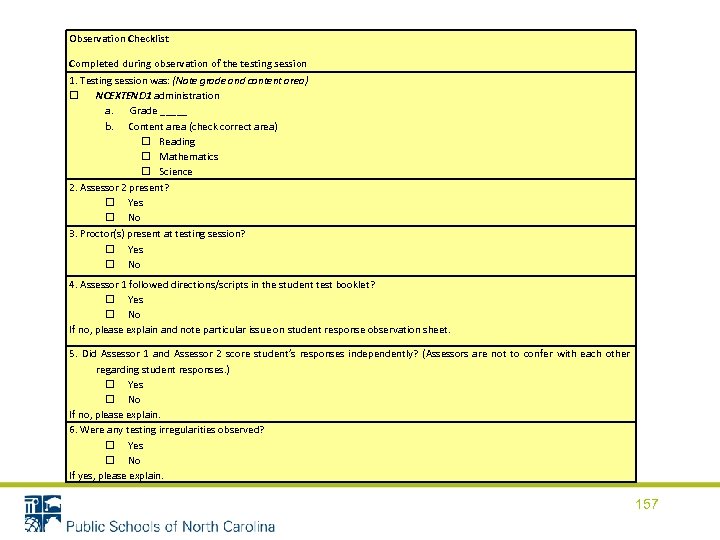 Observation Checklist Completed during observation of the testing session 1. Testing session was: (Note grade and content area) NCEXTEND 1 administration a. Grade _____ b. Content area (check correct area) Reading Mathematics Science 2. Assessor 2 present? Yes No 3. Proctor(s) present at testing session? Yes No 4. Assessor 1 followed directions/scripts in the student test booklet? Yes No If no, please explain and note particular issue on student response observation sheet. 5. Did Assessor 1 and Assessor 2 score student’s responses independently? (Assessors are not to confer with each other regarding student responses. ) Yes No If no, please explain. 6. Were any testing irregularities observed? Yes No If yes, please explain. 157
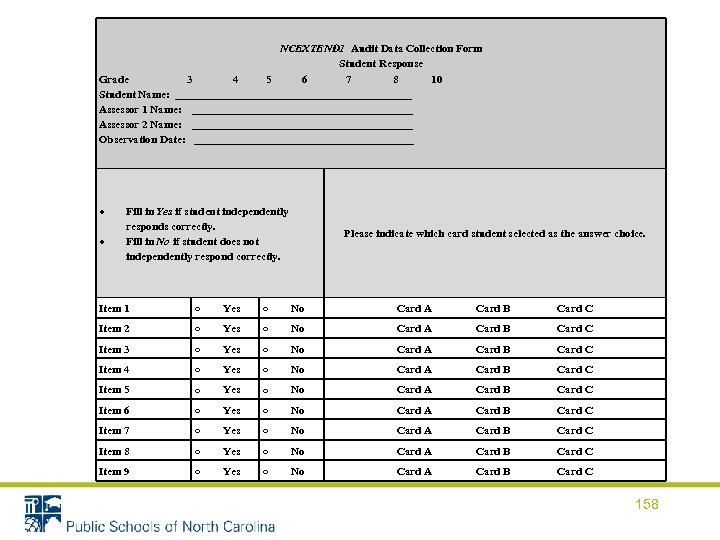 NCEXTEND 1 Audit Data Collection Form Student Response Grade 3 4 5 6 7 8 10 Student Name: ______________________ Assessor 1 Name: ____________________ Assessor 2 Name: ____________________ Observation Date: ____________________ Fill in Yes if student independently responds correctly. Fill in No if student does not independently respond correctly. Please indicate which card student selected as the answer choice. Item 1 ○ Yes ○ No Card A Card B Card C Item 2 ○ Yes ○ No Card A Card B Card C Item 3 ○ Yes ○ No Card A Card B Card C Item 4 ○ Yes ○ No Card A Card B Card C Item 5 ○ Yes ○ No Card A Card B Card C Item 6 ○ Yes ○ No Card A Card B Card C Item 7 ○ Yes ○ No Card A Card B Card C Item 8 ○ Yes ○ No Card A Card B Card C Item 9 ○ Yes ○ No Card A Card B Card C 158
 159
159
 160
160
 161
161
 Lessons Learned 162
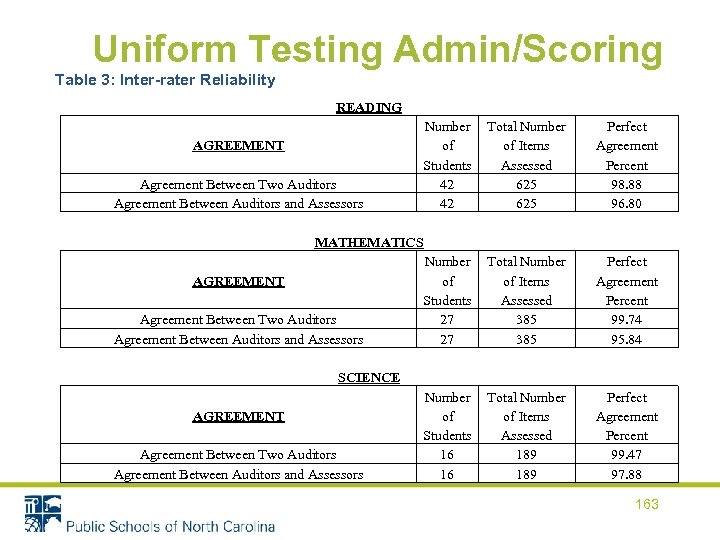 Uniform Testing Admin/Scoring Table 3: Inter-rater Reliability READING AGREEMENT Agreement Between Two Auditors Agreement Between Auditors and Assessors Number of Students 42 42 Total Number of Items Assessed 625 Perfect Agreement Percent 98. 88 96. 80 Number of Students 27 27 Total Number of Items Assessed 385 Perfect Agreement Percent 99. 74 95. 84 Number of Students 16 16 Total Number of Items Assessed 189 Perfect Agreement Percent 99. 47 97. 88 MATHEMATICS AGREEMENT Agreement Between Two Auditors Agreement Between Auditors and Assessors SCIENCE AGREEMENT Agreement Between Two Auditors Agreement Between Auditors and Assessors 163
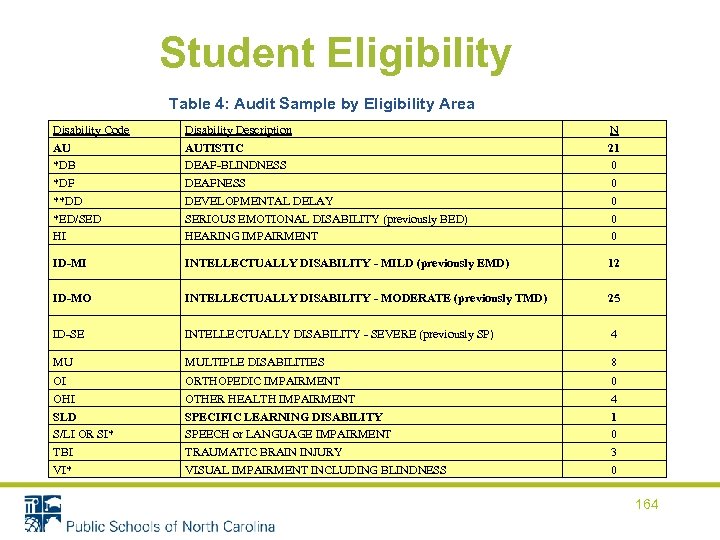 Student Eligibility Table 4: Audit Sample by Eligibility Area Disability Code AU *DB *DF **DD *ED/SED HI Disability Description AUTISTIC DEAF-BLINDNESS DEAFNESS DEVELOPMENTAL DELAY SERIOUS EMOTIONAL DISABILITY (previously BED) HEARING IMPAIRMENT N 21 0 0 0 ID-MI INTELLECTUALLY DISABILITY - MILD (previously EMD) 12 ID-MO INTELLECTUALLY DISABILITY - MODERATE (previously TMD) 25 ID-SE INTELLECTUALLY DISABILITY - SEVERE (previously SP) 4 MU MULTIPLE DISABILITIES 8 OI OHI SLD S/LI OR SI* TBI VI* ORTHOPEDIC IMPAIRMENT OTHER HEALTH IMPAIRMENT SPECIFIC LEARNING DISABILITY SPEECH or LANGUAGE IMPAIRMENT TRAUMATIC BRAIN INJURY VISUAL IMPAIRMENT INCLUDING BLINDNESS 0 4 1 0 3 0 164
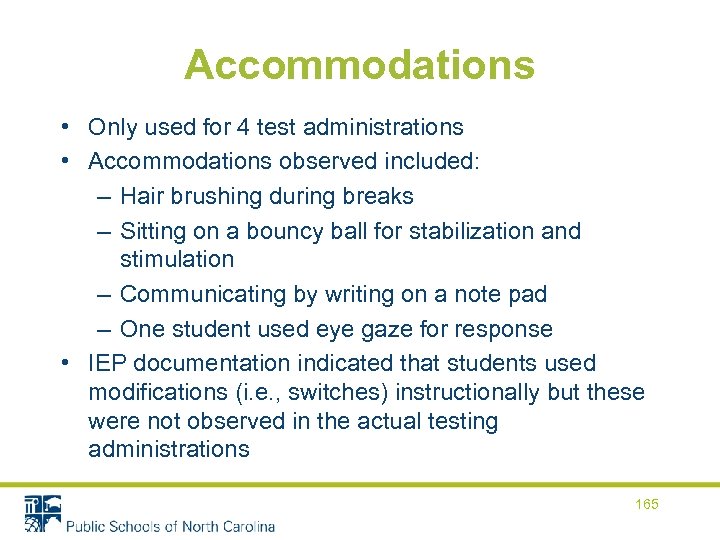 Accommodations • Only used for 4 test administrations • Accommodations observed included: – Hair brushing during breaks – Sitting on a bouncy ball for stabilization and stimulation – Communicating by writing on a note pad – One student used eye gaze for response • IEP documentation indicated that students used modifications (i. e. , switches) instructionally but these were not observed in the actual testing administrations 165
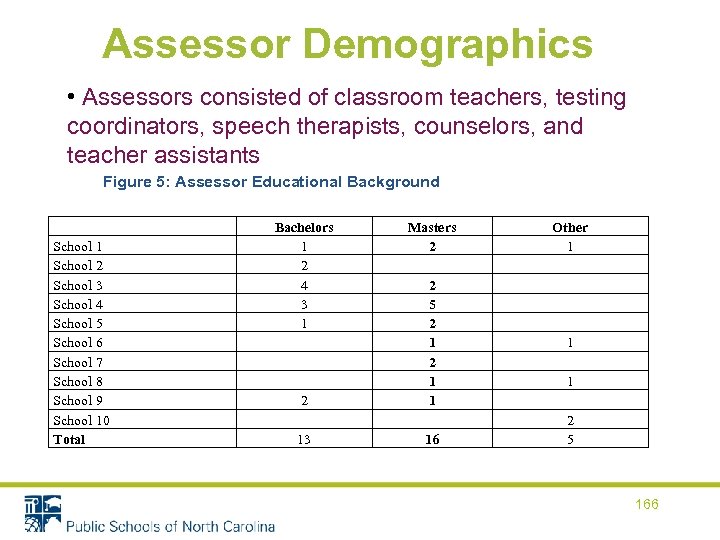 Assessor Demographics • Assessors consisted of classroom teachers, testing coordinators, speech therapists, counselors, and teacher assistants Figure 5: Assessor Educational Background School 1 School 2 School 3 School 4 School 5 School 6 School 7 School 8 School 9 School 10 Total Bachelors 1 2 4 3 1 2 13 Masters 2 Other 1 2 5 2 1 1 1 16 1 2 5 166
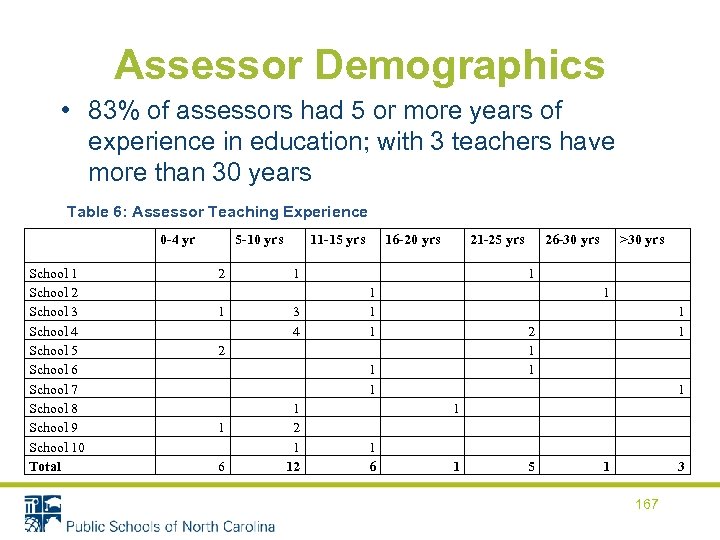 Assessor Demographics • 83% of assessors had 5 or more years of experience in education; with 3 teachers have more than 30 years Table 6: Assessor Teaching Experience 0 -4 yr School 1 School 2 School 3 School 4 School 5 School 6 School 7 School 8 School 9 School 10 Total 5 -10 yrs 2 1 11 -15 yrs 16 -20 yrs 21 -25 yrs 1 3 4 1 1 6 1 1 2 1 1 1 >30 yrs 1 2 1 12 26 -30 yrs 1 1 1 6 1 5 1 3 167
 Implications for Future Audits 168
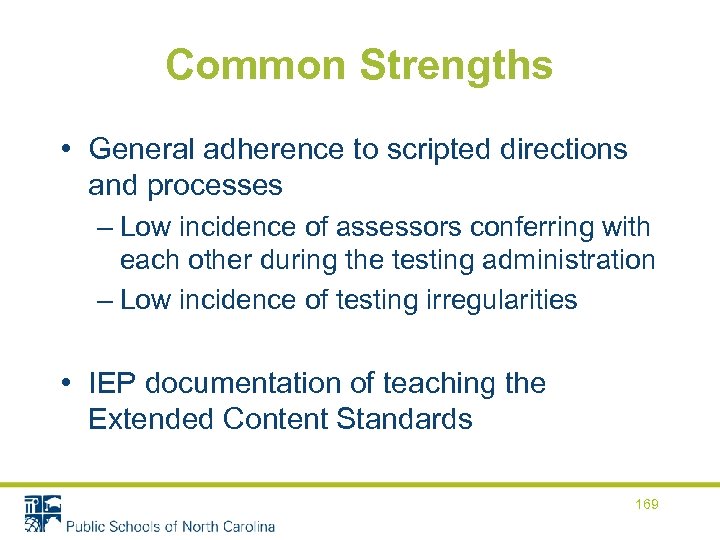 Common Strengths • General adherence to scripted directions and processes – Low incidence of assessors conferring with each other during the testing administration – Low incidence of testing irregularities • IEP documentation of teaching the Extended Content Standards 169
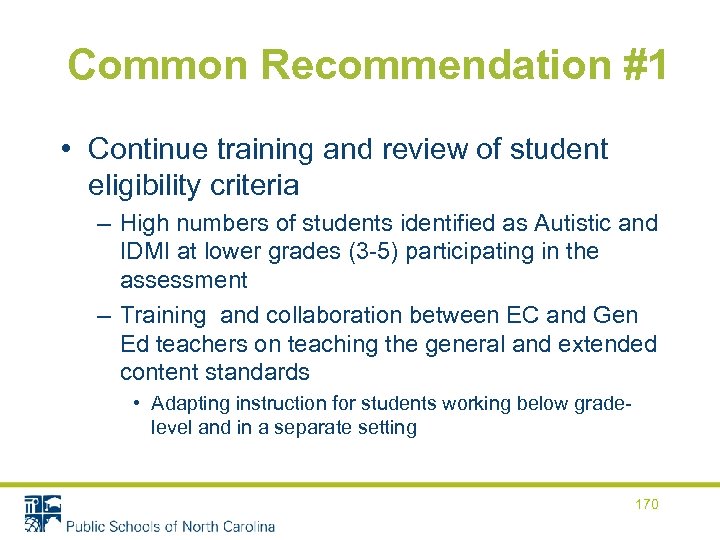 Common Recommendation #1 • Continue training and review of student eligibility criteria – High numbers of students identified as Autistic and IDMI at lower grades (3 -5) participating in the assessment – Training and collaboration between EC and Gen Ed teachers on teaching the general and extended content standards • Adapting instruction for students working below gradelevel and in a separate setting 170
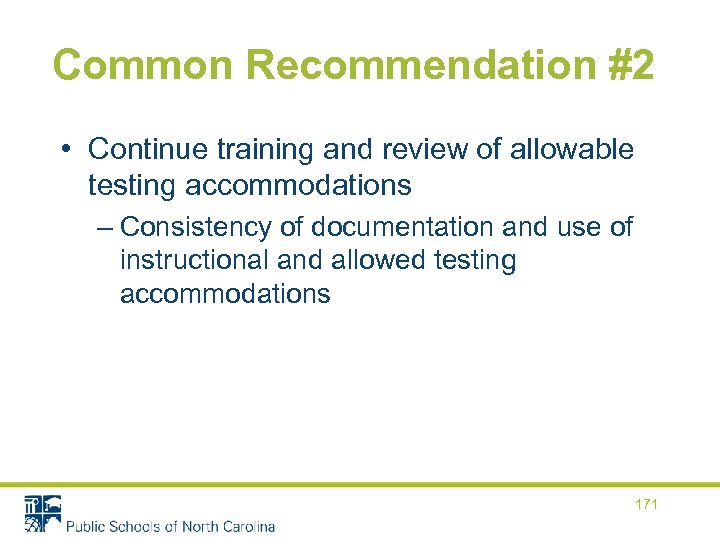 Common Recommendation #2 • Continue training and review of allowable testing accommodations – Consistency of documentation and use of instructional and allowed testing accommodations 171
 Conclusion • Adjustments will be made to training processes and information disseminated through the “train-the-trainer” model • The NCEXTEND 1 Audit will be conducted annually with each Spring testing administration window 172
 Closing Remarks Laura Snyder Cindy Bennett 173
 Questions/Comments/Concerns Helga Fasciano Sarah Mc. Manus Ira Wolfe 174
 References / Resources 175
 References / Resources • www. specialconnections. ku. edu • Webster's New World College Dictionary Copyright © 2010 by Wiley Publishing, Inc. , Cleveland, Ohio. • Hosp, Michelle K. , Hosp, John L. , and Wood, Kenneth W. (2007). The ABCs of CBM: A Practical Guide to Curriculum. Based Measurement. New York: Guilford Press. 176
 References / Resources (cont. ) • CAST-Center for Applied Special Technology http: //cast. org/, established in 1984 • National Center on UDL http: //www. udlcenter. org/ • National Center on Accessible Instructional Material http: //aim. cast. org/ 177
 References / Resources (cont. ) • RFB&D Recordings for the Blind and Dyslexic: Audio books in CD and downloadable formats http: //www. rfbd. org/ • Bookshare Accessible Books in downloadable formats http: //www. bookshare. org/ • Louis Database: Accessible materials file repository/Searchable database for all modified publications. http: //louis. aph. org/catalog/Category. Info. aspx? cid=152 • North Carolina Assistive Technology Program: Assistive Technology Centers throughout NC. http: //www. ncatp. org/ • UNC-Wilmington Assistive Technology Lending Library http: //uncw. edu/ed/assist/events. html 178
 References / Resources (cont. ) • http: //www. ncpublicschools. org/accountability/ policies/accom/ • http: //www. ed. gov/policy/speced/guid/nclb/two percent. doc. 179
 References / Resources (cont. ) • NCEO Resources on Modified Assessments: – http: //www. cehd. umn. edu/NCEO/Topic. Areas/ Alternate. Assessments/aa_mas. Resources. htm • Summary of Federal Regulations on Modified Assessments: – http: //www 2. ed. gov/policy/speced/guid/ modachieve-summary. html 180
 State Testing Accommodations Resources Publications: • Testing Students with Disabilities • Guidelines for Testing Students Identified as Limited English Proficient Additional Information: • Testing Accommodations web page - http: //www. ncpublicschools. org/accountability/ policies/accom 181
 Citations 182
 • Webster's New World College Dictionary Copyright © 2010 by Wiley Publishing, Inc. , Cleveland, Ohio. • American Institutes for Research, U. S. Department of Education • Sandra J. Thompson, Ph. D. , Research Associate, National Center on Educational Outcomes, University of Minnesota • Adapted from: Sandra J. Thompson, Ph. D. , Research Associate, National Center on Educational Outcomes, University of Minnesota • (CAST, 2010) 183
 Contact Information • Amy Scrinzi – amy. scrinzi@ncpublicschools. org – Consultant, Office of Early Learning • Audrey Martin-Mc. Coy – amccoy@dpi. state. nc. us – Consultant, Testing Policy & Operations • Carrie Perkis – cperkis@dpi. state. nc. us – Consultant, Testing Policy & Operations • Cindy Bennett, cbennett@dpi. state. nc. us – Director, K-12 Curriculum, Instruction & Technology • Elissa Brown – ebrown@dpi. state. nc. us – Middle/High Council Director 184
 Contact Information (cont. ) • Freda Lee – flee@dpi. state. nc. us – Consultant, Intellectual Disabilities, Secondary Education and Transition Services – Professional Development and Program Improvement Section, Exceptional Children Division • Helga Fasciano – hfasciano@dpi. state. nc. us – Section Chief, K-12 Program Areas • Ira Wolfe – iwolfe@dpi. state. nc. us – Section Chief, Policy, Monitoring & Audit • Joanne Marino – jmarino@dpi. state. nc. us – ESL/Title III Consultant, Curriculum & Instruction Division • Laura Snyder – lsnyder@dpi. state. nc. us – Director, Exceptional Children Division 185
 Contact Information (Cont. ) • Sarah Mc. Manus – smcmanus@dpi. state. nc. us – Section Chief, Testing Policy & Operations • Sarah Reives – sreives@dpi. state. nc. us – Science Test Measurement Specialist, Test Development • Sherry Abernethy – sabernethy@ncpublicschools. org – Consultant, Exceptional Children Division • Tammy Howard – thoward@dpi. state. nc. us – Section Chief, Testing Development • Gary Williamson – gwilliamson@dpi. state. nc. us – Director, Accountability Operations 186
 Thank You! 187