


 Скачать презентацию School of Nursing 25 -26 Sept 2008
401bc80d26e95926260ec1eb9def0cc2.ppt
- Количество слайдов: 36
 School of Nursing 25 -26 Sept 2008 – M. Higgins “I Have a Bunch of Data – Now What? ” Data Screening, Exploring and Clean-Up Melinda K. Higgins, Ph. D. 25 & 26 September 2008 Data Screening, Exploring and Clean-Up
 School of Nursing Outline Descriptive Statistics (univariate & bi-variate) I. I. Measures of Centrality II. Measures of Variability III. Distributions & Transformations IV. Tests of Normality V. Outliers VI. Missing Data VII. Correlations II. Overall Flow Charts III. Potential Statistical Analyses (Decision Tree) IV. Contact Info Data Screening, Exploring and Clean-Up 25 -26 Sept 2008 – M. Higgins
 School of Nursing 25 -26 Sept 2008 – M. Higgins A Few Initial Considerations • GROUPS – If data is to be evaluated by group – you will want to evaluate the descriptive statistics BY group (e. g. the data might not be skewed overall, but one group may be by itself) – may or may not want to transform. • LONGITUDINAL DATA – If variables were measured over time, you will need to consider all the time points (e. g. you would NOT want to transform one time point and not the others) • MULTIVARIATE MEASURES – additional screening measures in bi-variate/multivariate combinations (multicollinearity, influential cases, leverage, Mahalonobis distance) – not covered in this lecture. Data Screening, Exploring and Clean-Up
 School of Nursing 25 -26 Sept 2008 – M. Higgins Measures of Central Tendency • Mean = (Xi)/n • Median = 50% Below ≤ Median ≤ 50% Above • for odd n, Median=middle value(sorted X) • For even n, Median = average of 2 middle X’s • Trimmed Mean – mean recalculated after deleting _% or _# off top and bottom of sorted data (usually 5% or so) • Mode – number(s) repeated the most Data Screening, Exploring and Clean-Up
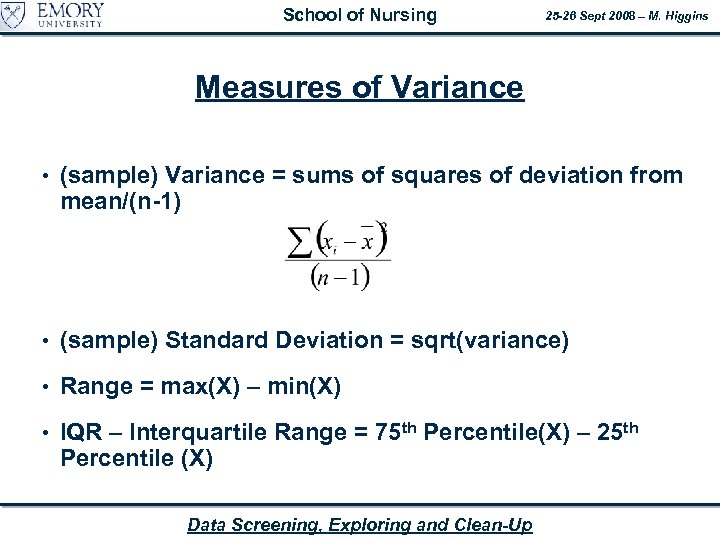 School of Nursing 25 -26 Sept 2008 – M. Higgins Measures of Variance • (sample) Variance = sums of squares of deviation from mean/(n-1) • (sample) Standard Deviation = sqrt(variance) • Range = max(X) – min(X) • IQR – Interquartile Range = 75 th Percentile(X) – 25 th Percentile (X) Data Screening, Exploring and Clean-Up
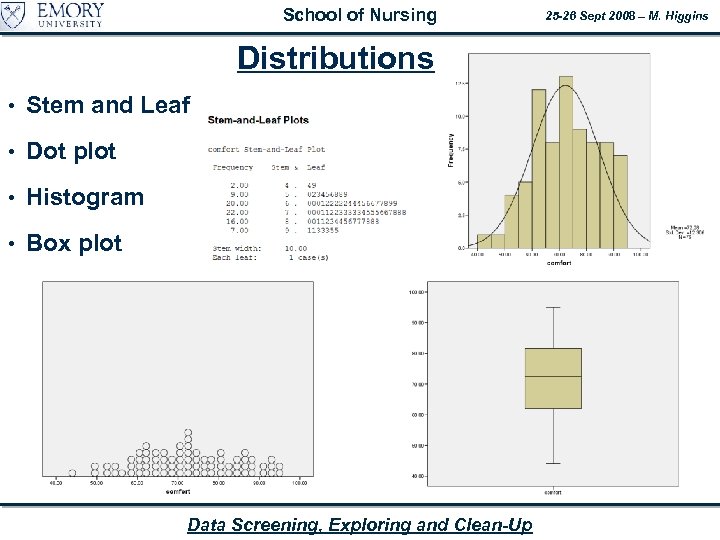 School of Nursing Distributions • Stem and Leaf • Dot plot • Histogram • Box plot Data Screening, Exploring and Clean-Up 25 -26 Sept 2008 – M. Higgins
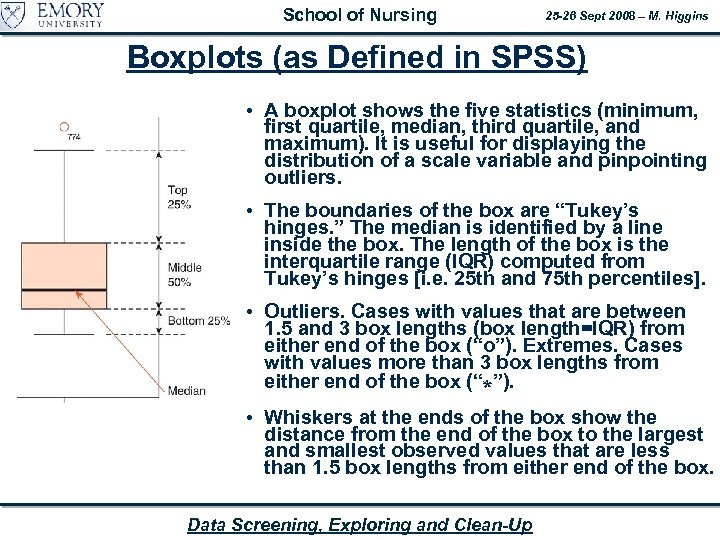 School of Nursing 25 -26 Sept 2008 – M. Higgins Boxplots (as Defined in SPSS) • A boxplot shows the five statistics (minimum, first quartile, median, third quartile, and maximum). It is useful for displaying the distribution of a scale variable and pinpointing outliers. • The boundaries of the box are “Tukey’s hinges. ” The median is identified by a line inside the box. The length of the box is the interquartile range (IQR) computed from Tukey’s hinges [i. e. 25 th and 75 th percentiles]. • Outliers. Cases with values that are between 1. 5 and 3 box lengths (box length=IQR) from either end of the box (“o”). Extremes. Cases with values more than 3 box lengths from either end of the box (“*”). • Whiskers at the ends of the box show the distance from the end of the box to the largest and smallest observed values that are less than 1. 5 box lengths from either end of the box. Data Screening, Exploring and Clean-Up
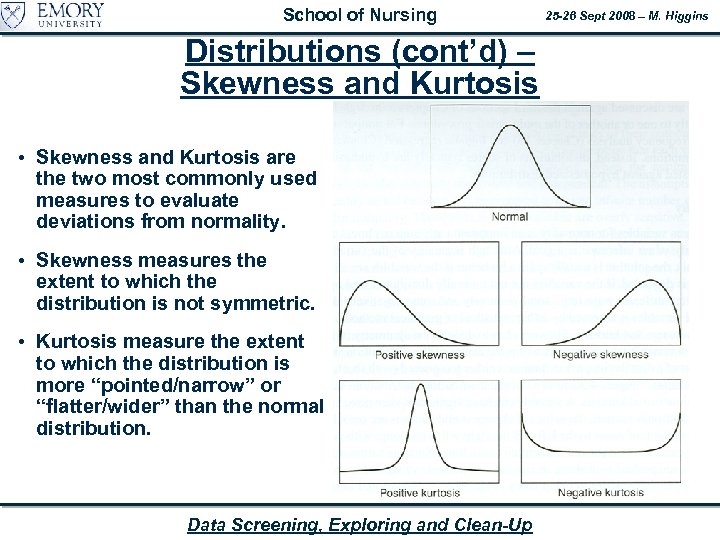 School of Nursing Distributions (cont’d) – Skewness and Kurtosis • Skewness and Kurtosis are the two most commonly used measures to evaluate deviations from normality. • Skewness measures the extent to which the distribution is not symmetric. • Kurtosis measure the extent to which the distribution is more “pointed/narrow” or “flatter/wider” than the normal distribution. Data Screening, Exploring and Clean-Up 25 -26 Sept 2008 – M. Higgins
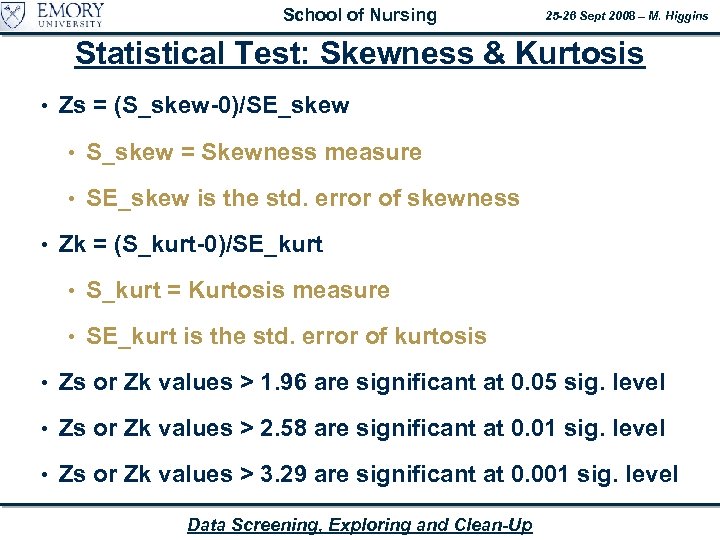 School of Nursing 25 -26 Sept 2008 – M. Higgins Statistical Test: Skewness & Kurtosis • Zs = (S_skew-0)/SE_skew • S_skew = Skewness measure • SE_skew is the std. error of skewness • Zk = (S_kurt-0)/SE_kurt • S_kurt = Kurtosis measure • SE_kurt is the std. error of kurtosis • Zs or Zk values > 1. 96 are significant at 0. 05 sig. level • Zs or Zk values > 2. 58 are significant at 0. 01 sig. level • Zs or Zk values > 3. 29 are significant at 0. 001 sig. level Data Screening, Exploring and Clean-Up
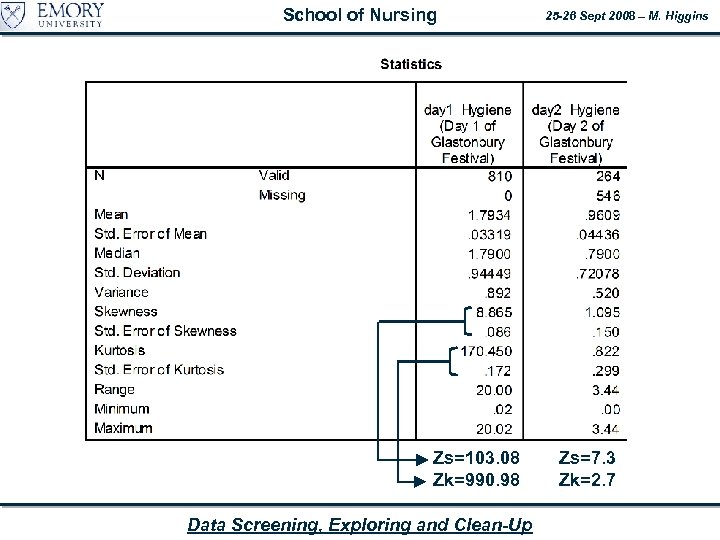 School of Nursing Zs=103. 08 Zk=990. 98 Data Screening, Exploring and Clean-Up 25 -26 Sept 2008 – M. Higgins Zs=7. 3 Zk=2. 7
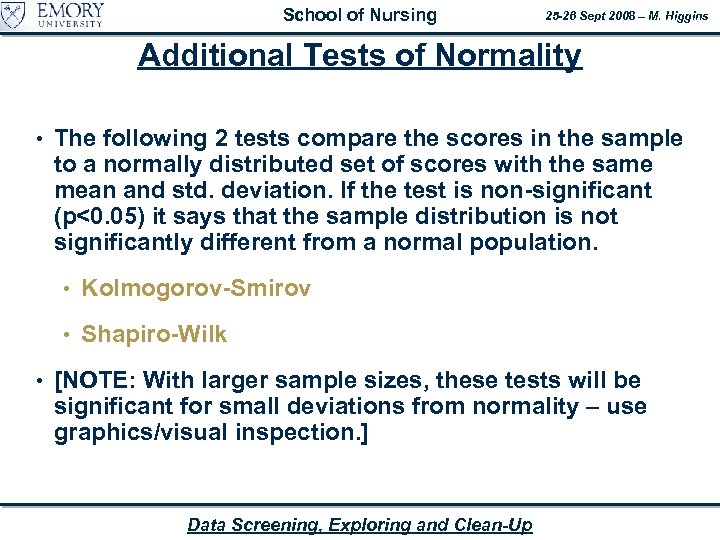 School of Nursing 25 -26 Sept 2008 – M. Higgins Additional Tests of Normality • The following 2 tests compare the scores in the sample to a normally distributed set of scores with the same mean and std. deviation. If the test is non-significant (p<0. 05) it says that the sample distribution is not significantly different from a normal population. • Kolmogorov-Smirov • Shapiro-Wilk • [NOTE: With larger sample sizes, these tests will be significant for small deviations from normality – use graphics/visual inspection. ] Data Screening, Exploring and Clean-Up
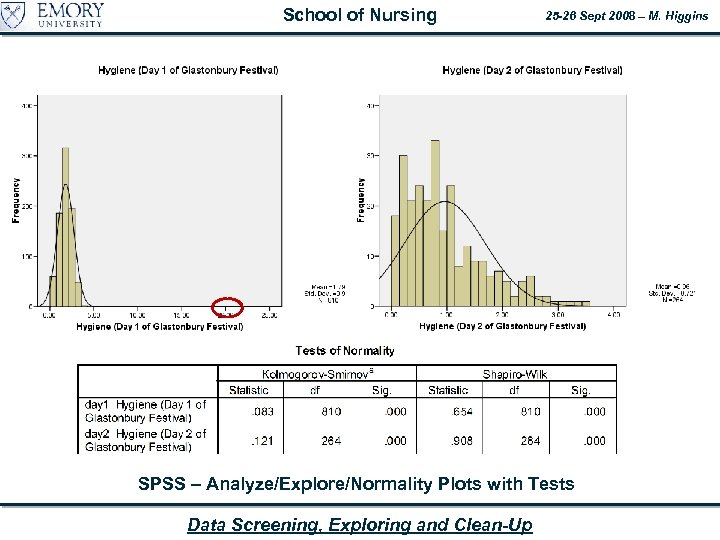 School of Nursing 25 -26 Sept 2008 – M. Higgins SPSS – Analyze/Explore/Normality Plots with Tests Data Screening, Exploring and Clean-Up
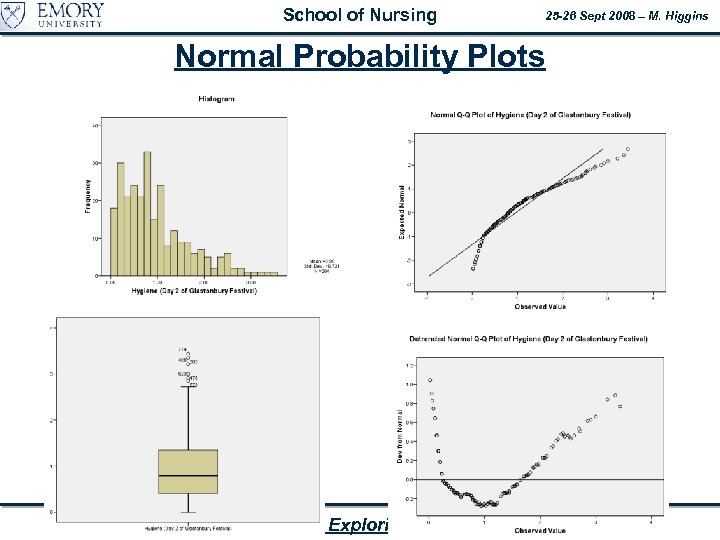 School of Nursing 25 -26 Sept 2008 – M. Higgins Normal Probability Plots Data Screening, Exploring and Clean-Up
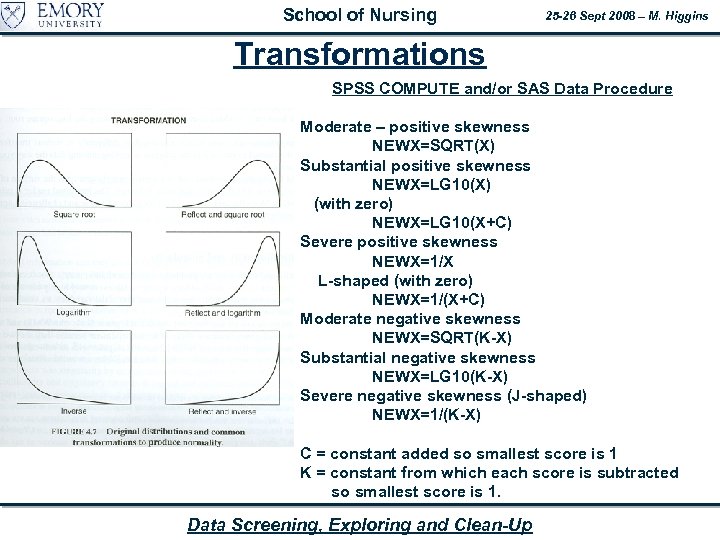 School of Nursing 25 -26 Sept 2008 – M. Higgins Transformations SPSS COMPUTE and/or SAS Data Procedure Moderate – positive skewness NEWX=SQRT(X) Substantial positive skewness NEWX=LG 10(X) (with zero) NEWX=LG 10(X+C) Severe positive skewness NEWX=1/X L-shaped (with zero) NEWX=1/(X+C) Moderate negative skewness NEWX=SQRT(K-X) Substantial negative skewness NEWX=LG 10(K-X) Severe negative skewness (J-shaped) NEWX=1/(K-X) C = constant added so smallest score is 1 K = constant from which each score is subtracted so smallest score is 1. Data Screening, Exploring and Clean-Up
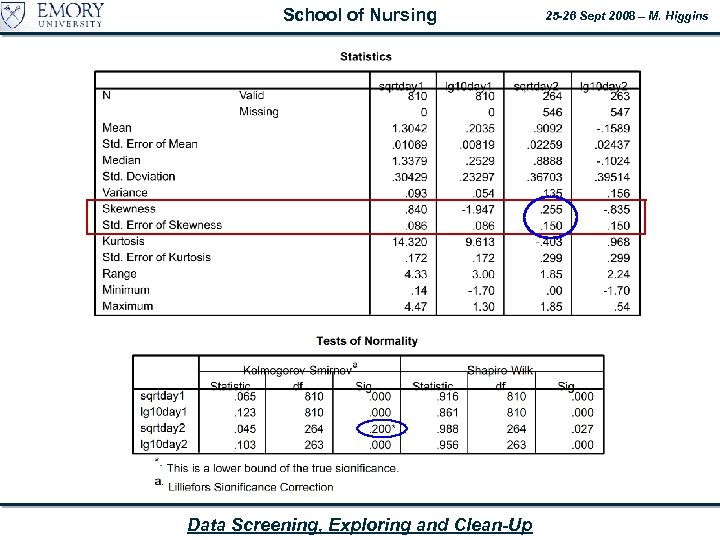 School of Nursing Data Screening, Exploring and Clean-Up 25 -26 Sept 2008 – M. Higgins
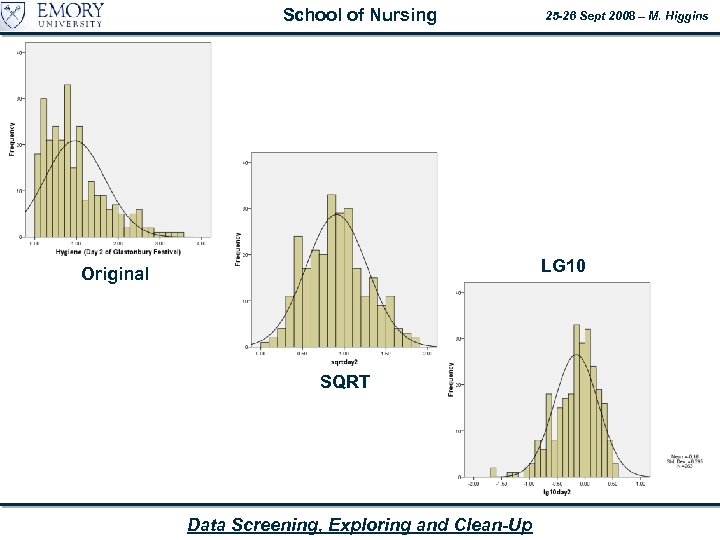 School of Nursing 25 -26 Sept 2008 – M. Higgins LG 10 Original SQRT Data Screening, Exploring and Clean-Up
 School of Nursing 25 -26 Sept 2008 – M. Higgins Outliers • Review histograms and boxplots and look for extreme values • Investigate values • is it “real? ” • can it be corrected? • Should it be deleted (or left out of analyses)? • [consider clinical reasons; procedural reasons] • Calculate z-scores (next page) and review amount of outliers • Is there a pattern? (compare outliers to non-outliers) Data Screening, Exploring and Clean-Up
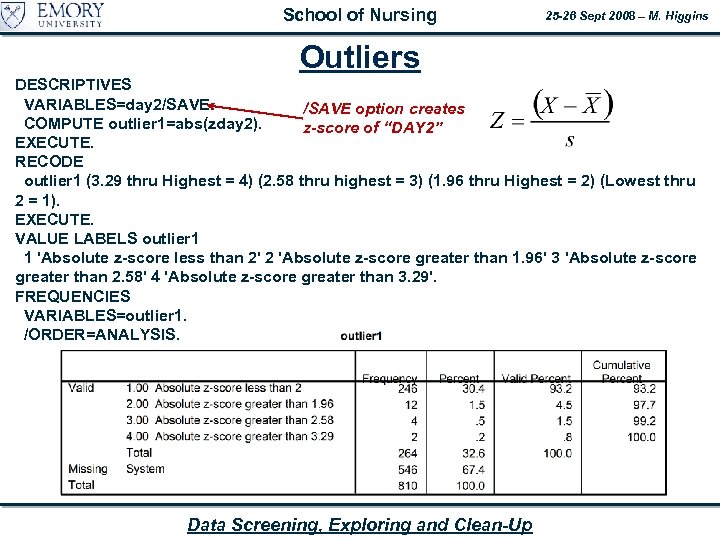 School of Nursing 25 -26 Sept 2008 – M. Higgins Outliers DESCRIPTIVES VARIABLES=day 2/SAVE option creates COMPUTE outlier 1=abs(zday 2). z-score of “DAY 2” EXECUTE. RECODE outlier 1 (3. 29 thru Highest = 4) (2. 58 thru highest = 3) (1. 96 thru Highest = 2) (Lowest thru 2 = 1). EXECUTE. VALUE LABELS outlier 1 1 'Absolute z-score less than 2' 2 'Absolute z-score greater than 1. 96' 3 'Absolute z-score greater than 2. 58' 4 'Absolute z-score greater than 3. 29'. FREQUENCIES VARIABLES=outlier 1. /ORDER=ANALYSIS. Data Screening, Exploring and Clean-Up
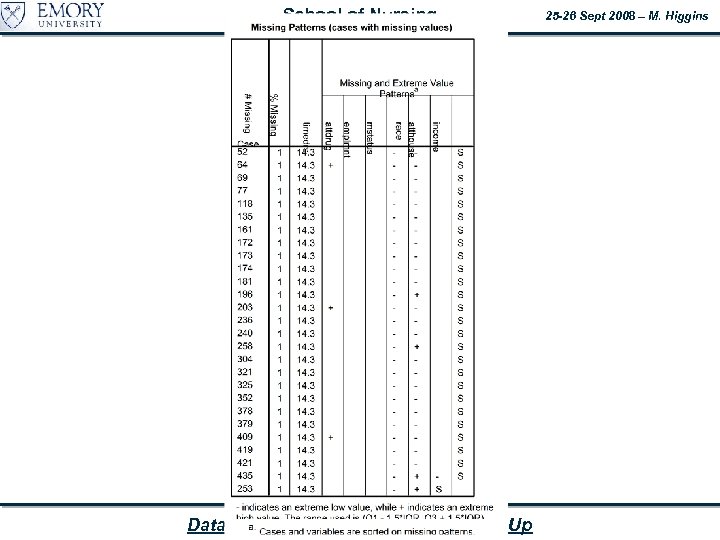
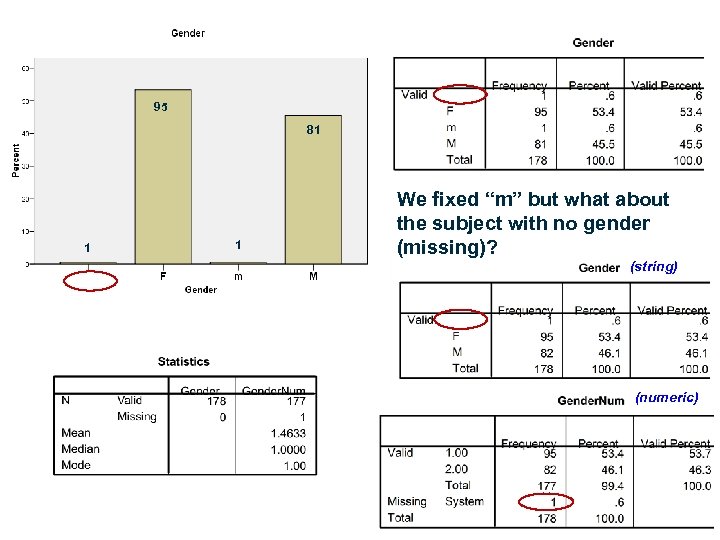
 School of Nursing 25 -26 Sept 2008 – M. Higgins Missing Data • Look for patterns (MVA next slide) and/or reason why missing • Can compare missing data subjects to non-missing data subjects • Can delete/ignore or Impute based on model • Goal is to: • Minimize Bias • Maximize utilization of information (data=$$) • Get good estimates of uncertainty • Censorship (survival analysis – “loss to follow-up”) • [SIDE NOTE: SPSS missing – strings vs. numeric data types] NOTE: Missing Data Imputation – to be discussed in another lecture Data Screening, Exploring and Clean-Up
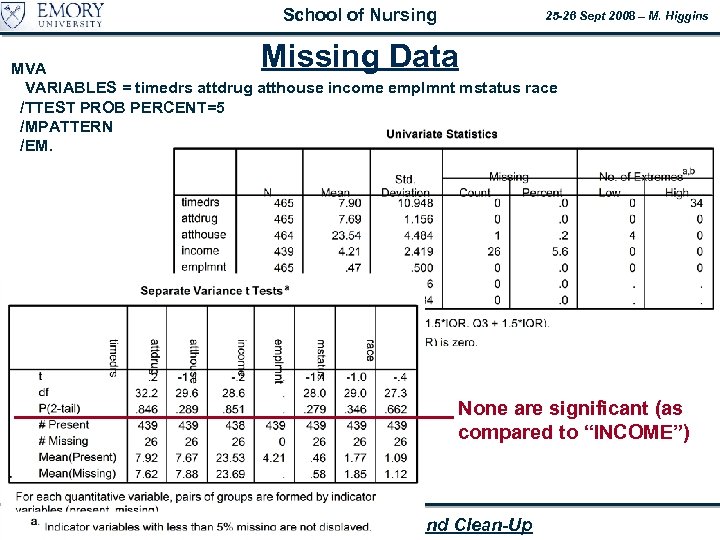 School of Nursing 25 -26 Sept 2008 – M. Higgins Missing Data MVA VARIABLES = timedrs attdrug atthouse income emplmnt mstatus race /TTEST PROB PERCENT=5 /MPATTERN /EM. None are significant (as compared to “INCOME”) Data Screening, Exploring and Clean-Up
 School of Nursing Data Screening, Exploring and Clean-Up 25 -26 Sept 2008 – M. Higgins
 95 81 1 1 We fixed “m” but what about the subject with no gender (missing)? (string) (numeric)
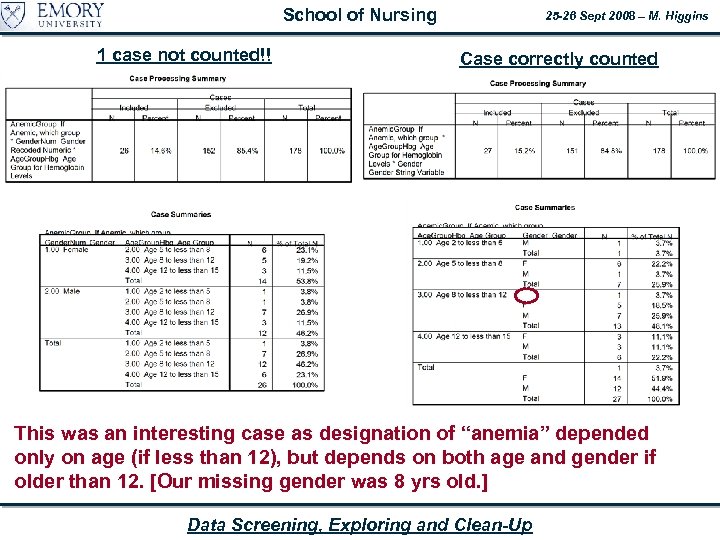 School of Nursing 1 case not counted!! 25 -26 Sept 2008 – M. Higgins Case correctly counted This was an interesting case as designation of “anemia” depended only on age (if less than 12), but depends on both age and gender if older than 12. [Our missing gender was 8 yrs old. ] Data Screening, Exploring and Clean-Up
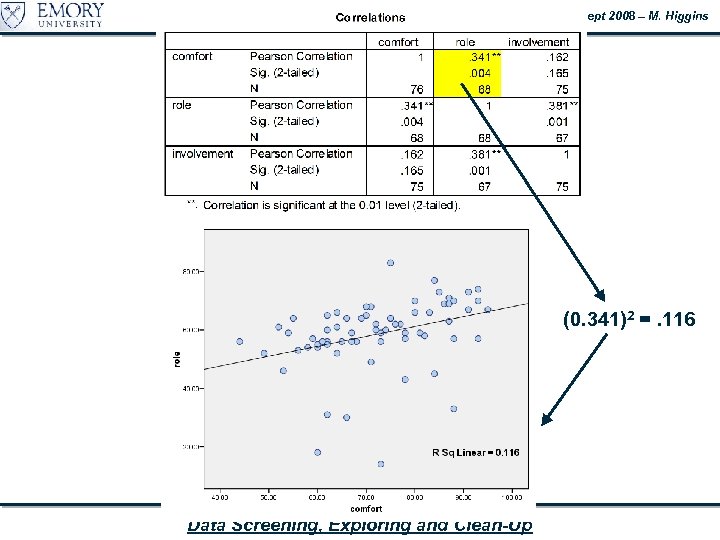
![School of Nursing Measures of Correlation • [Parametric] R 2 and R (X vs](https://present5.com/presentation/401bc80d26e95926260ec1eb9def0cc2/image-24.jpg "School of Nursing Measures of Correlation • [Parametric] R 2 and R (X vs") School of Nursing Measures of Correlation • [Parametric] R 2 and R (X vs Y or X 1 vs X 2) = Pearson's correlation coefficient • [Non-parametric] Spearman's rho, and Kendall's tau-b – both based on rank (see SPSS Help for further details) Data Screening, Exploring and Clean-Up 25 -26 Sept 2008 – M. Higgins
School of Nursing Measures of Correlation • [Parametric] R 2 and R (X vs Y or X 1 vs X 2) = Pearson's correlation coefficient • [Non-parametric] Spearman's rho, and Kendall's tau-b – both based on rank (see SPSS Help for further details) Data Screening, Exploring and Clean-Up 25 -26 Sept 2008 – M. Higgins
 School of Nursing 25 -26 Sept 2008 – M. Higgins (0. 341)2 =. 116 Data Screening, Exploring and Clean-Up
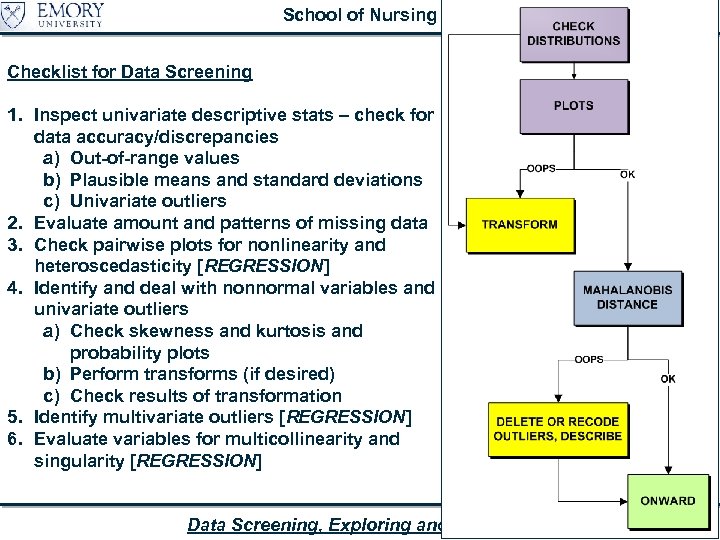 School of Nursing Checklist for Data Screening 1. Inspect univariate descriptive stats – check for data accuracy/discrepancies a) Out-of-range values b) Plausible means and standard deviations c) Univariate outliers 2. Evaluate amount and patterns of missing data 3. Check pairwise plots for nonlinearity and heteroscedasticity [REGRESSION] 4. Identify and deal with nonnormal variables and univariate outliers a) Check skewness and kurtosis and probability plots b) Perform transforms (if desired) c) Check results of transformation 5. Identify multivariate outliers [REGRESSION] 6. Evaluate variables for multicollinearity and singularity [REGRESSION] Data Screening, Exploring and Clean-Up 25 -26 Sept 2008 – M. Higgins
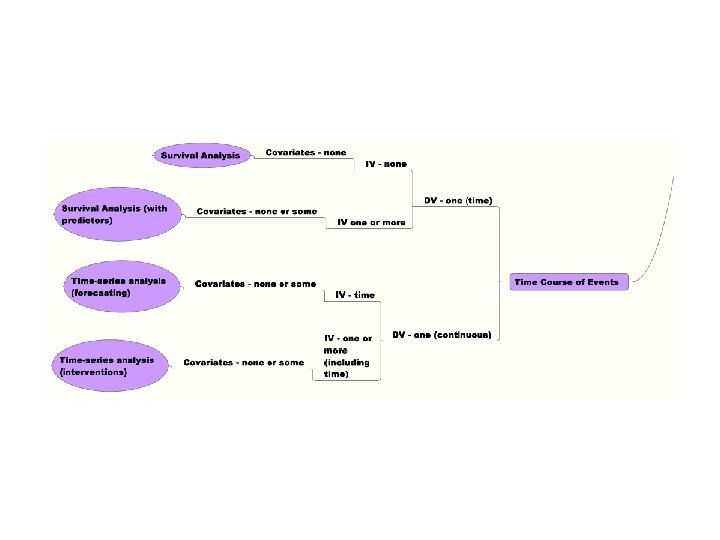
 School of Nursing 25 -26 Sept 2008 – M. Higgins What do I do Now? – A Decision Tree for Picking Statistical Methods to Use • Questions to Ask • Major Research Question? • Degree of Relationship Among Variables • Significant Group Difference • Prediction of Group Membership • Structure • Time/Course of Events • Number & Kind of Dependent Variables • Single vs Multiple & Discrete vs Continuous • Number & Kind of Independent Variables • Single vs Multiple & Discrete vs Continuous • Covariates? [yes/no] • Decision Tree Yields Analytic Strategy and Goal of Analysis Data Screening, Exploring and Clean-Up
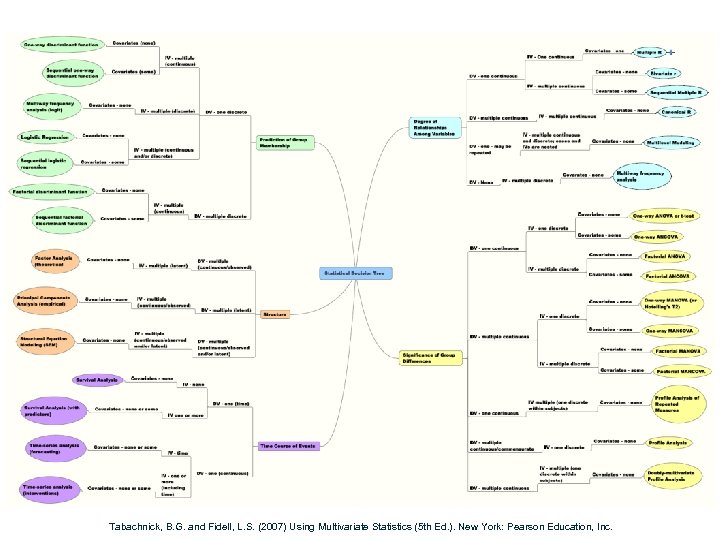 Tabachnick, B. G. and Fidell, L. S. (2007) Using Multivariate Statistics (5 th Ed. ). New York: Pearson Education, Inc.
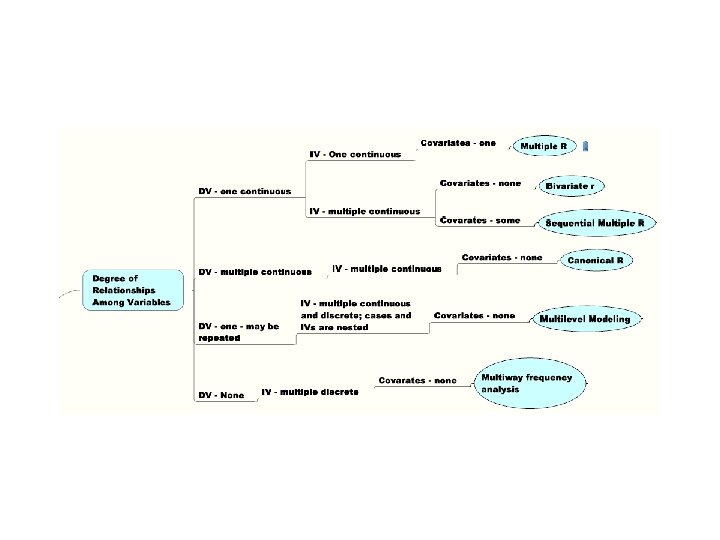
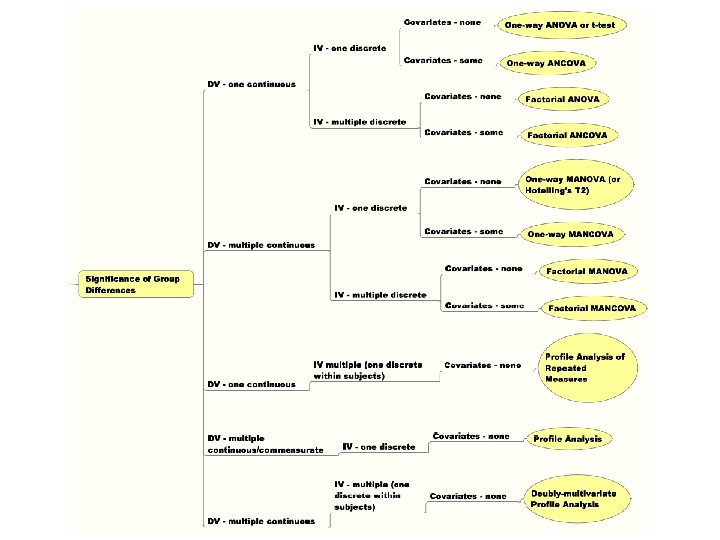
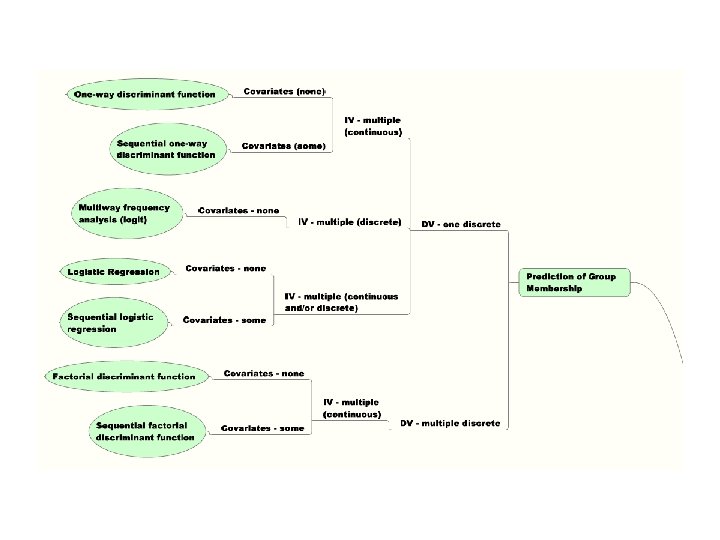
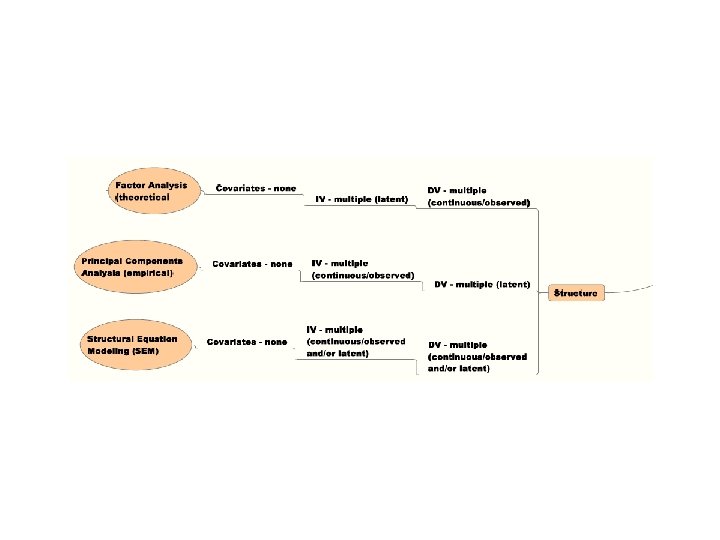
 School of Nursing 25 -26 Sept 2008 – M. Higgins “How to talk to a Statistician” • List of Hypotheses/Aims (end goals) • List of Variables • Type, Measure (numeric, string, date/time, scales, categorical) • Independent, covariates, dependent (outcomes) • Names, Labels and Values [consistency (q 1, q 2, q 3, …, item 01, item 02, …), length, consider graphics] • Model (hypothesized, general idea – theoretical concerns) • Graphics/figures/tables requested (reports, posters, grants) • POWER – idea on “effect size” (how big a change do you hope to see) – clinical significance, prior results? Data Screening, Exploring and Clean-Up
 School of Nursing 25 -26 Sept 2008 – M. Higgins VIII. Statistical Resources and Contact Info SON S: SharedStatistics_MKHigginswebsite 2index. htm [updates in process] Working to include tip sheets (for SPSS, SAS, and other software), lectures (PPTs and handouts), datasets, other resources and references Statistics At Nursing Website: [website being updated] http: //www. nursing. emory. edu/pulse/statistics/ And Blackboard Site (in development) for “Organization: Statistics at School of Nursing” Contact Dr. Melinda Higgins Melinda. higgins@emory. edu Office: 404 -727 -5180 / Mobile: 404 -434 -1785 Data Screening, Exploring and Clean-Up