


 Скачать презентацию School of Management Finance Chapter 12 Choosing an
696b62b45724ba535aa2a9343e4cf004.ppt
- Количество слайдов: 48
 School of Management Finance Chapter 12: Choosing an Investment Portfolio Objective • To understand theory of personal portfolio selection in theory and in practice 1
 School of Management Finance Chapter 12: Contents The process of personal portfolio selection v The trade-off between expected return and risk v Efficient diversification with many risky assets v 2
 School of Management Finance The Concept of ‘Portfolio’ v. A person’s wealth portfolio includes – Assets: stocks, bonds, shares in unincorporated business, houses or apartments, pensions benefits, insurance policies, etc. – Liabilities: student loans, auto loans, home mortgages, etc. 3
 School of Management Finance Portfolio Selection v v v A study of how people should invest their wealth optimally A process of trading off risk and expected return to find the best portfolio of assets and liabilities Narrow and broad definitions: – How much to invest in stocks, bonds, and other securities – Whether to buy or rent one’s house – What types and amounts of insurance to purchase – How to manage one’s liabilities – How much to invest in one’s human capital 4
 School of Management Finance Portfolio Selection v Although there are some general rules for portfolio selection that apply to virtually everyone, there is no single portfolio or portfolio strategy that is best for everyone. 5
 School of Management Finance The Life Cycle v v In portfolio selection, the best strategy depends on an individual’s personal circumstances (family status, occupation, income, wealth). Illustrations – Young couple: buy a house and take out a mortagage loan / older couple: sell house and invest in assets provding a steady stream of income. – Investing in stock market: Chang (30, a security analyst) / Obi (30, an English teacher). – Buying insurance policies: Miriam (a parent with dependent children) / Sanjiv (a single person with no dependents). 6
 School of Management Finance Time Horizon v In formulating a plan for portfolio selection, you begin by determining your goals and time horizons. – Planning horizon: the total length of time for which one plans – Decision horizon: the length of time between decisions to revise the portfolio – Trading horizon: the minimum time interval over which investors can revise their portfolios / its determination and impacts – Investment strategy & trading horizon: portfolio insurance or dynamic portfolio strategy. 7
 School of Management Finance Risk Tolerance A major determinant of portfolio choices v It is influenced by such characteristics as v – age, family status, job status, wealth, and – other attributes that affect a person’s ability to maintain his standard of living in the face of adverse movements in the market value of his investment portfolio 8
 Finance School of Management Professional Asset Managers v Investment advisors & “finished products” from a financial intermediary v Specialization, information and cost advantages 9
 Finance School of Management The Trade-off between Expected Return and Risk The objective is to find the portfolio which offers investors the highest expected rate of return for the degree of risk they are willing to tolerate. v Two step process: v – find the optimal combination of risky assets. – mix this optimal risk-asset with the riskless asset. 10
 School of Management Finance Riskless Asset v A security that offers a perfectly predictable rate of return in terms of the unit of account selected for the analysis and the length of the investor’s decision horizon. – For example, if the U. S dollars is taken as the unit of account and the decision horizon is half a year, the riskless rate is the interest rate on U. S Treasury bills maturing after half a year. 11
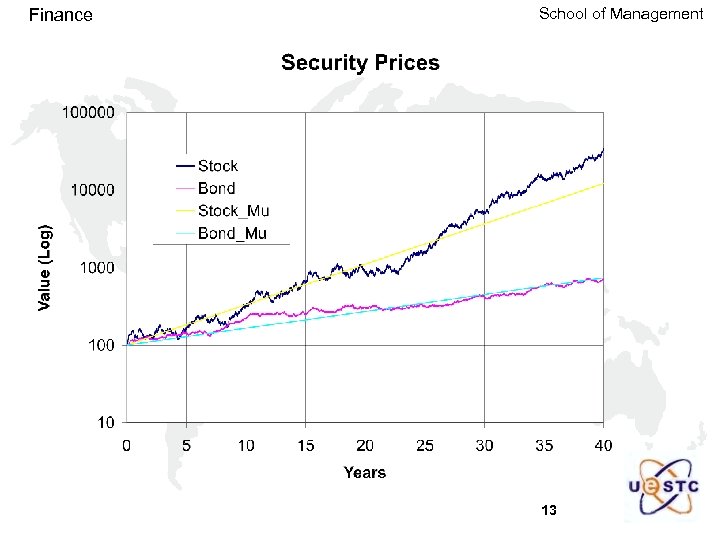
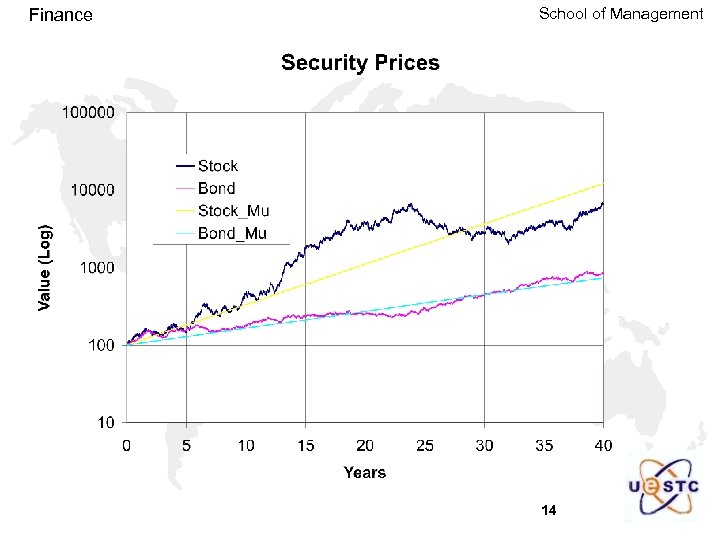
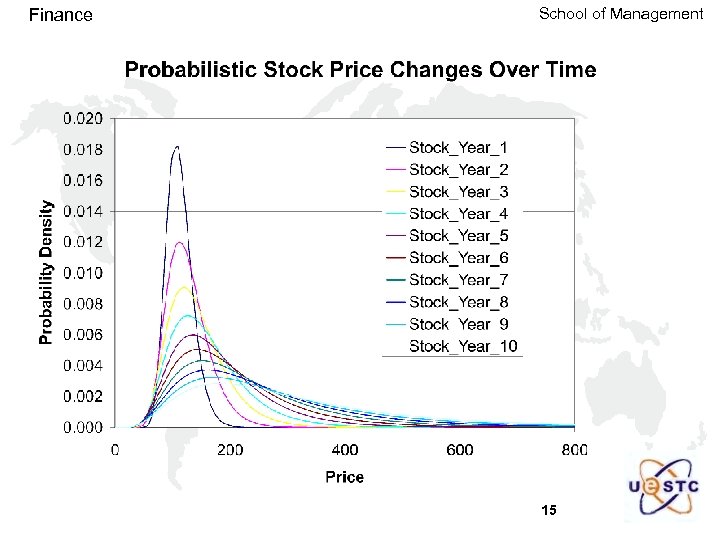
 School of Management Finance Rates of Return on Risky Assets v Required return depends on the risk of the investment. – Greater the risk, greater the return – Risk premium 12
 Finance School of Management 13
 Finance School of Management 14
 Finance School of Management 15
 Finance School of Management 16
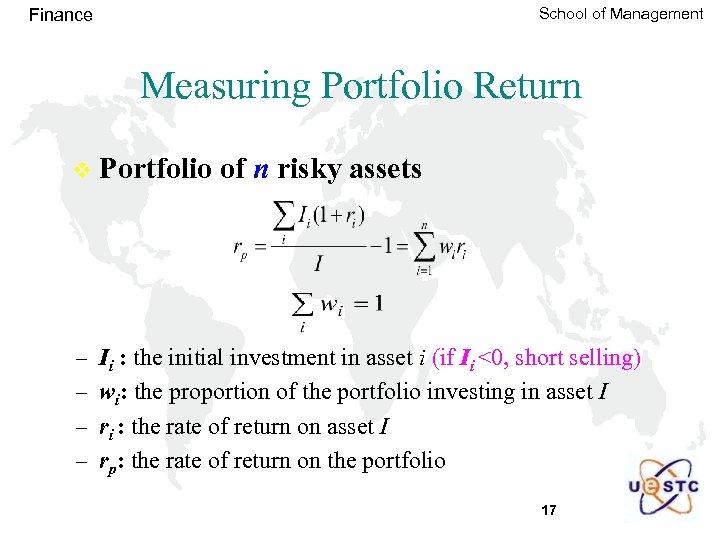 School of Management Finance Measuring Portfolio Return v Portfolio of n risky assets – Ii : the initial investment in asset i (if Ii <0, short selling) – wi: the proportion of the portfolio investing in asset I – ri : the rate of return on asset I – rp: the rate of return on the portfolio 17
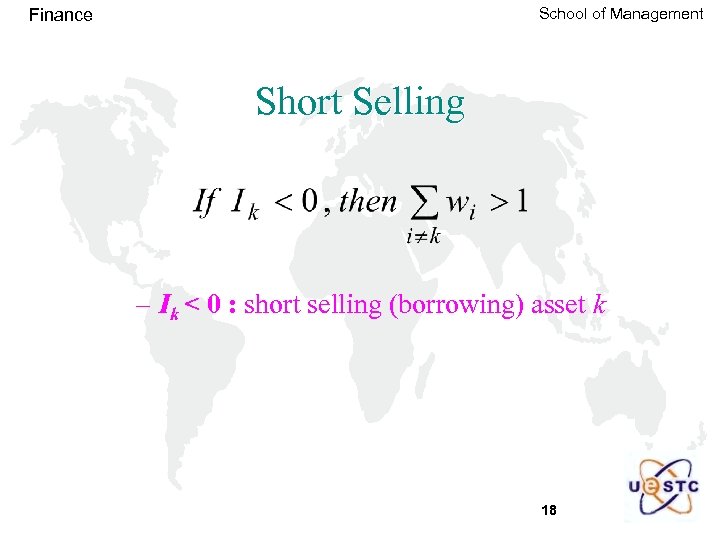 School of Management Finance Short Selling – Ik < 0 : short selling (borrowing) asset k 18
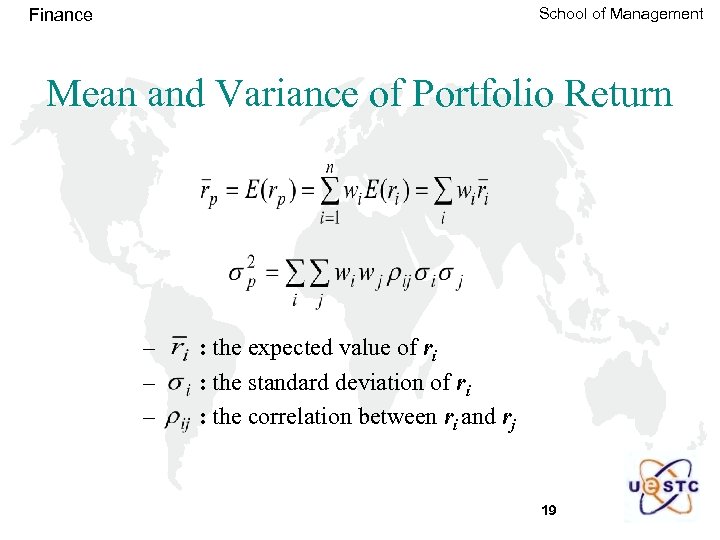 School of Management Finance Mean and Variance of Portfolio Return – – – : the expected value of ri : the standard deviation of ri : the correlation between ri and rj 19
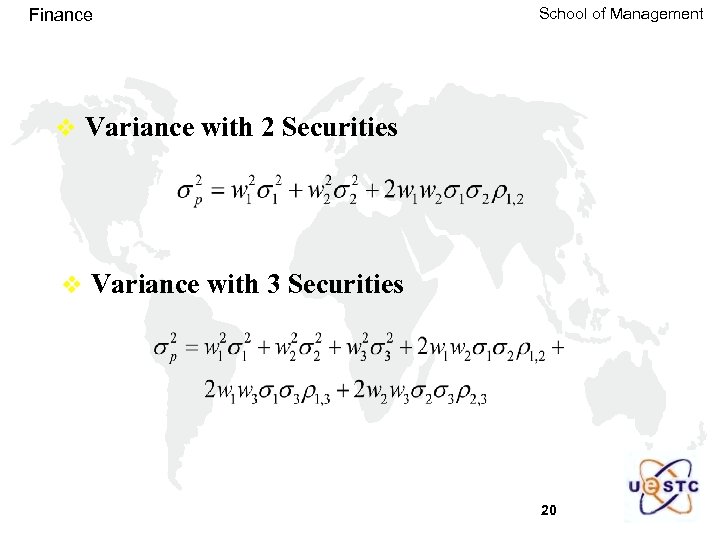 Finance School of Management v Variance with 2 Securities v Variance with 3 Securities 20
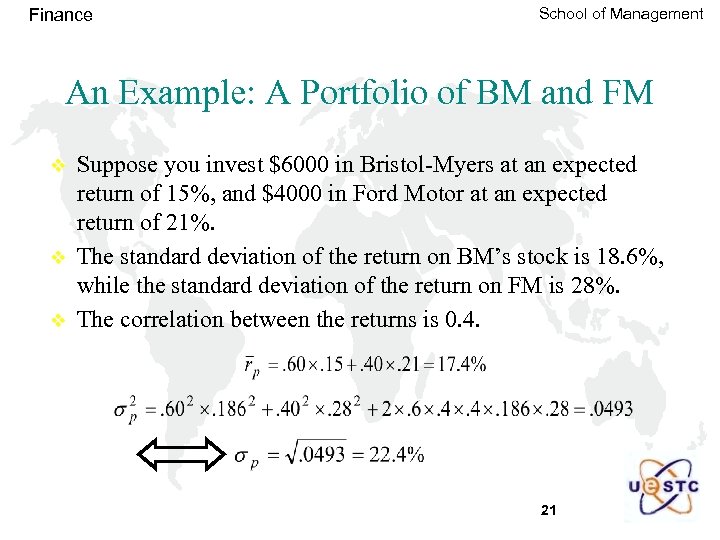 Finance School of Management An Example: A Portfolio of BM and FM v v v Suppose you invest $6000 in Bristol-Myers at an expected return of 15%, and $4000 in Ford Motor at an expected return of 21%. The standard deviation of the return on BM’s stock is 18. 6%, while the standard deviation of the return on FM is 28%. The correlation between the returns is 0. 4. 21
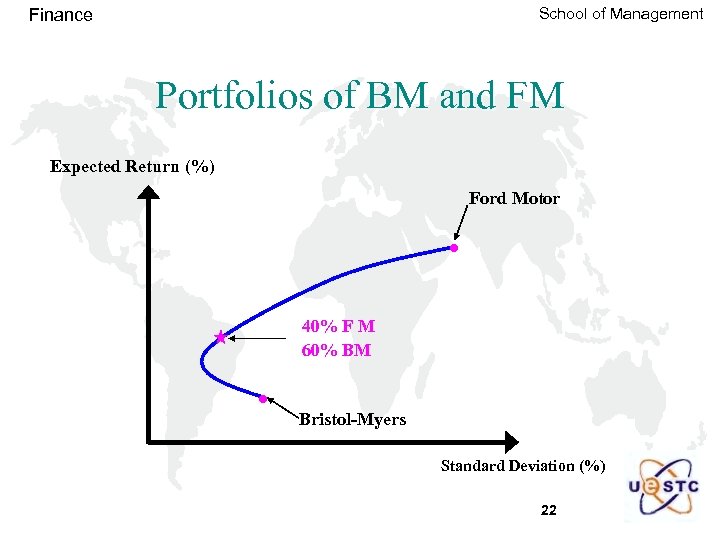 School of Management Finance Portfolios of BM and FM Expected Return (%) Ford Motor ● 40% F M 60% BM ● Bristol-Myers Standard Deviation (%) 22
 School of Management Finance Portfolios of Two Correlated Common Stock v Two common stock with these statistics: – mean return 1 = 0. 15 – mean return 2 = 0. 10 – standard deviation 1 = 0. 20 – standard deviation 2 = 0. 25 – correlation of returns = 0. 90 – initial price 1 = $57. 25 – initial price 2 = $72. 625 23
 Finance School of Management 24
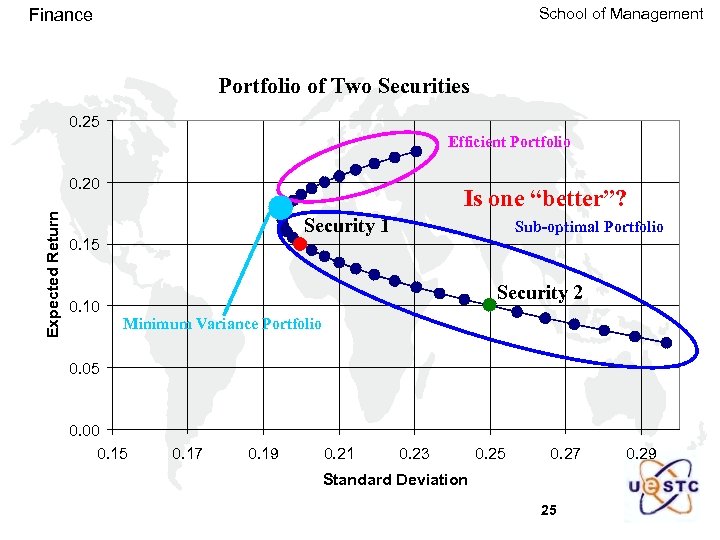 School of Management Finance Portfolio of Two Securities 0. 25 Efficient Portfolio Expected Return 0. 20 Is one “better”? Security 1 0. 15 0. 10 Sub-optimal Portfolio Security 2 Minimum Variance Portfolio 0. 05 0. 00 0. 15 0. 17 0. 19 0. 21 0. 23 0. 25 0. 27 Standard Deviation 25 0. 29
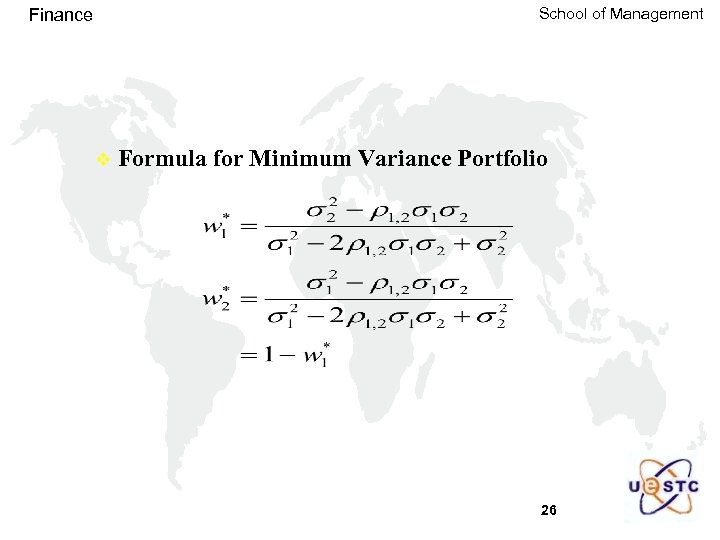 School of Management Finance v Formula for Minimum Variance Portfolio 26
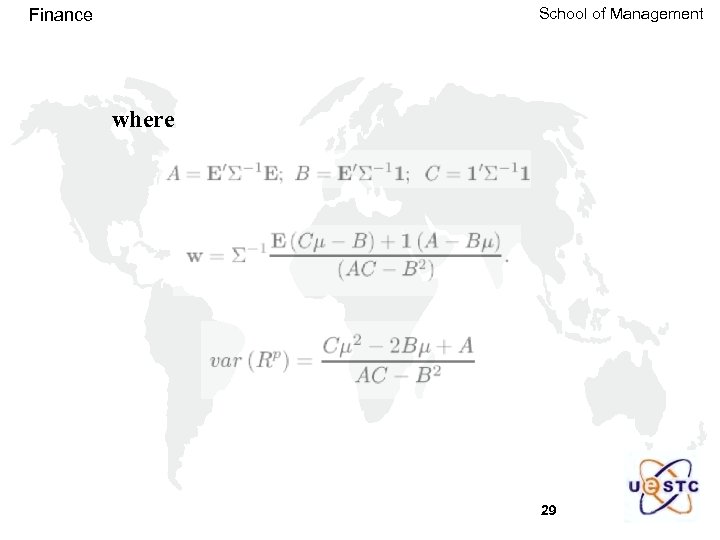
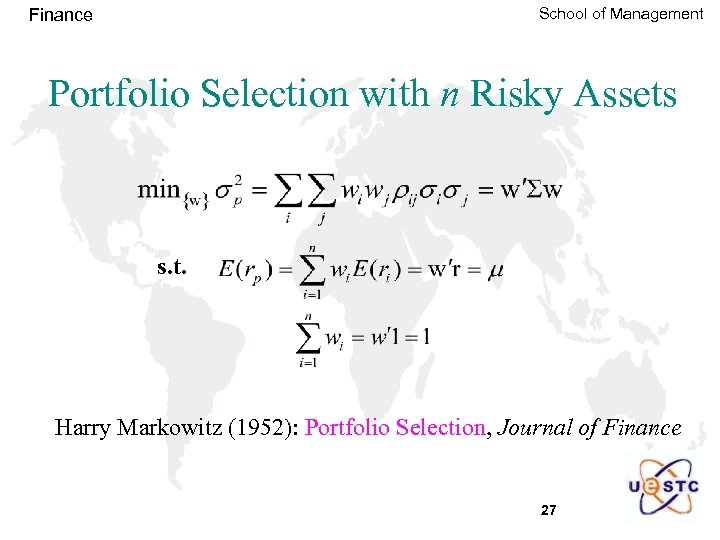 School of Management Finance Portfolio Selection with n Risky Assets s. t. Harry Markowitz (1952): Portfolio Selection, Journal of Finance 27
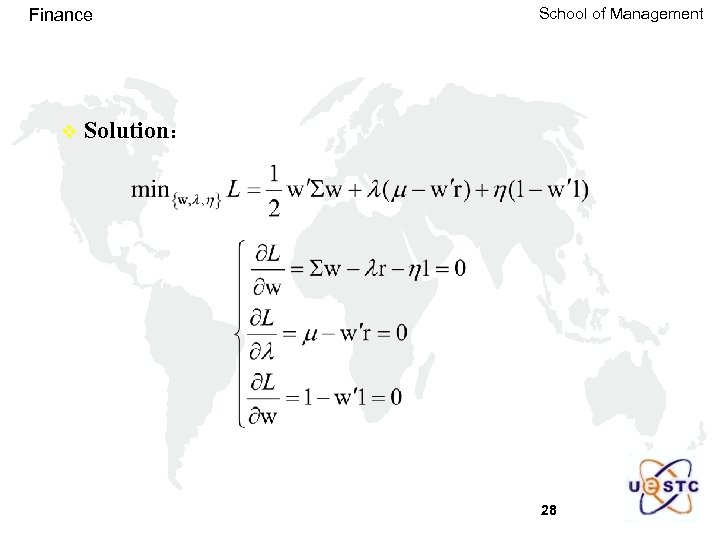 Finance v School of Management Solution: 28
 School of Management Finance where 29
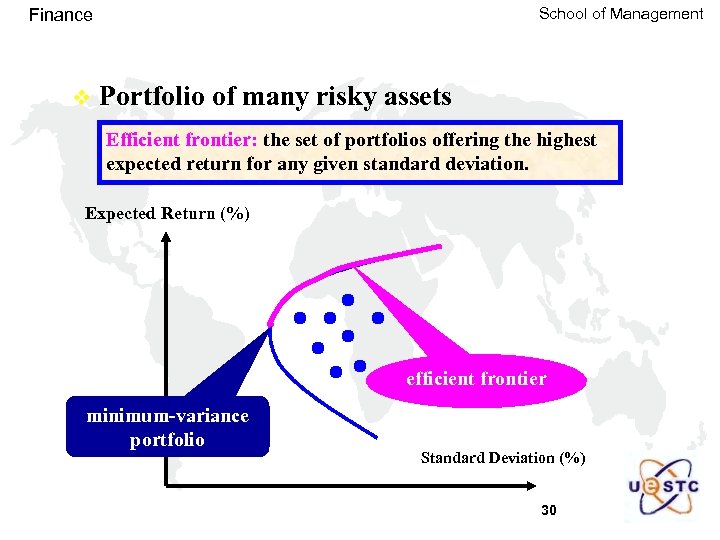 School of Management Finance v Portfolio of many risky assets Efficient frontier: the set of portfolios offering the highest expected return for any given standard deviation. Expected Return (%) efficient frontier minimum-variance portfolio Standard Deviation (%) 30
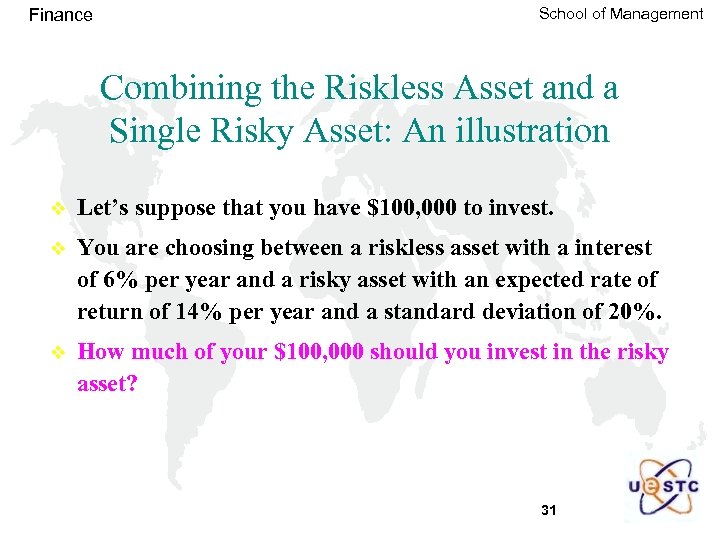 Finance School of Management Combining the Riskless Asset and a Single Risky Asset: An illustration v Let’s suppose that you have $100, 000 to invest. v You are choosing between a riskless asset with a interest of 6% per year and a risky asset with an expected rate of return of 14% per year and a standard deviation of 20%. v How much of your $100, 000 should you invest in the risky asset? 31
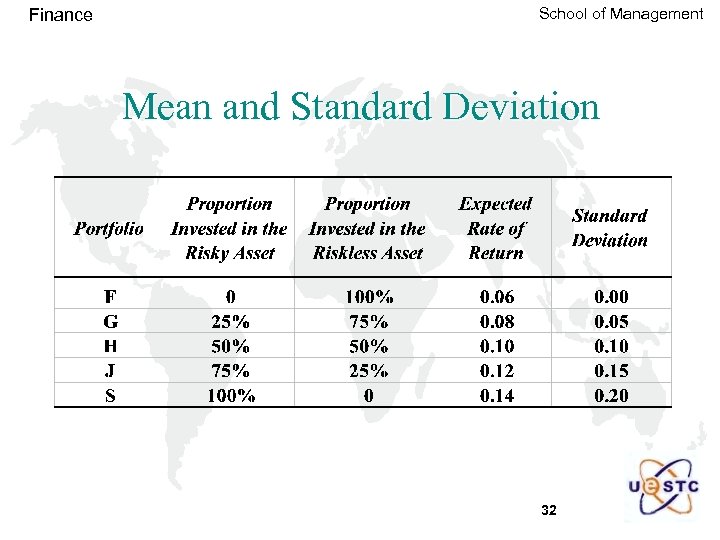 Finance School of Management Mean and Standard Deviation 32
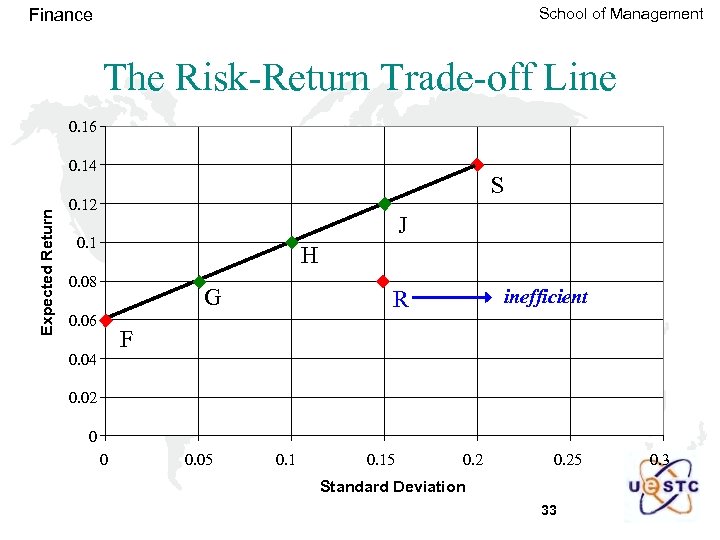 School of Management Finance The Risk-Return Trade-off Line 0. 16 Expected Return 0. 14 S 0. 12 J 0. 1 H 0. 08 G 0. 06 inefficient R F 0. 04 0. 02 0 0 0. 05 0. 15 0. 25 Standard Deviation 33 0. 3
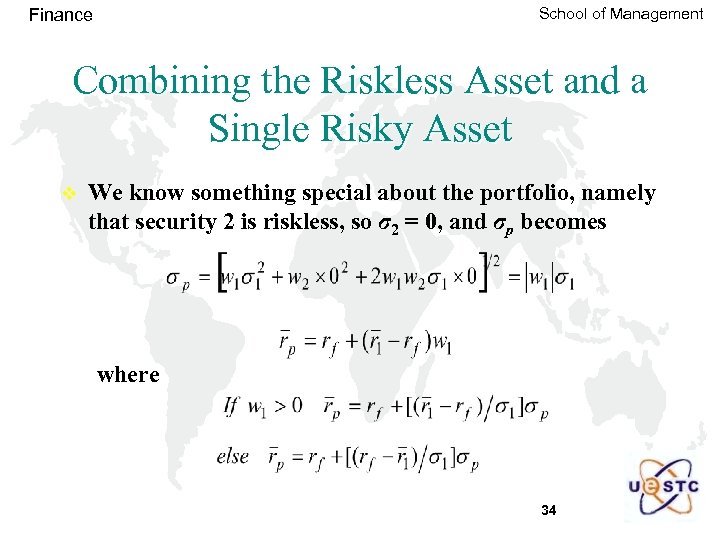 School of Management Finance Combining the Riskless Asset and a Single Risky Asset v We know something special about the portfolio, namely that security 2 is riskless, so σ2 = 0, and σp becomes where 34
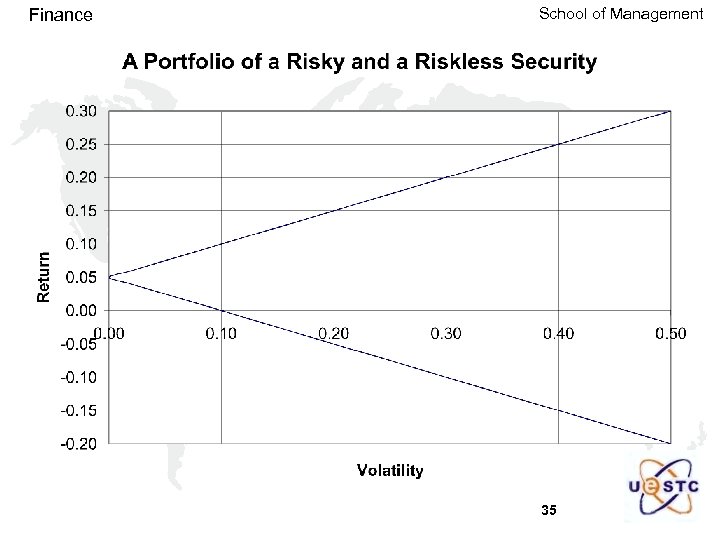 Finance School of Management 35
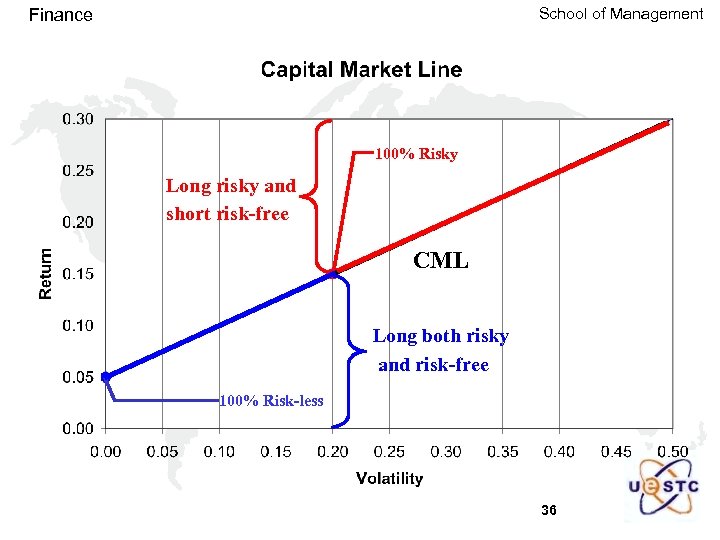 School of Management Finance 100% Risky Long risky and short risk-free CML Long both risky and risk-free 100% Risk-less 36
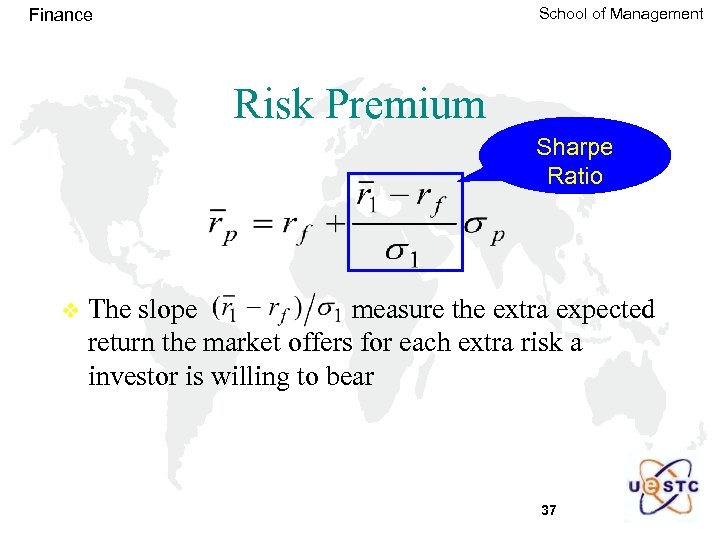 School of Management Finance Risk Premium Sharpe Ratio v The slope measure the extra expected return the market offers for each extra risk a investor is willing to bear 37
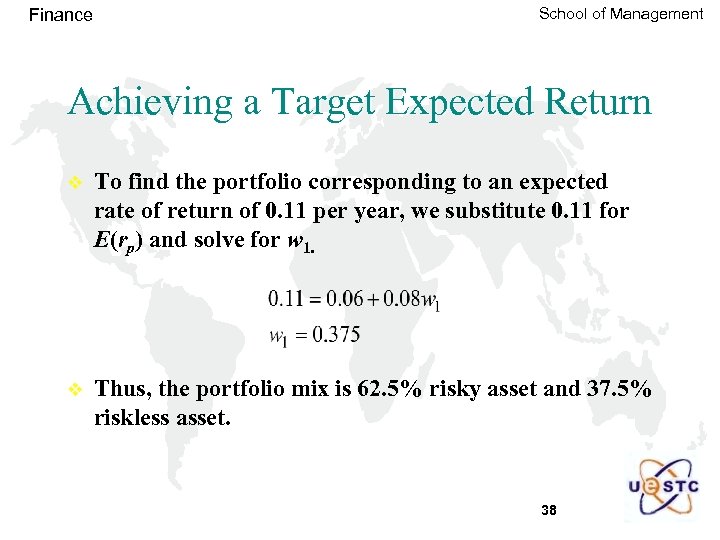 Finance School of Management Achieving a Target Expected Return v To find the portfolio corresponding to an expected rate of return of 0. 11 per year, we substitute 0. 11 for E(rp) and solve for w 1. v Thus, the portfolio mix is 62. 5% risky asset and 37. 5% riskless asset. 38
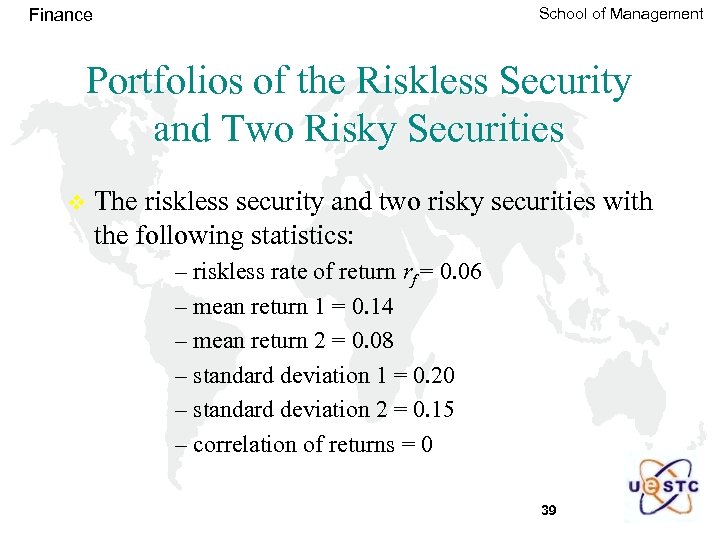 School of Management Finance Portfolios of the Riskless Security and Two Risky Securities v The riskless security and two risky securities with the following statistics: – riskless rate of return rf = 0. 06 – mean return 1 = 0. 14 – mean return 2 = 0. 08 – standard deviation 1 = 0. 20 – standard deviation 2 = 0. 15 – correlation of returns = 0 39
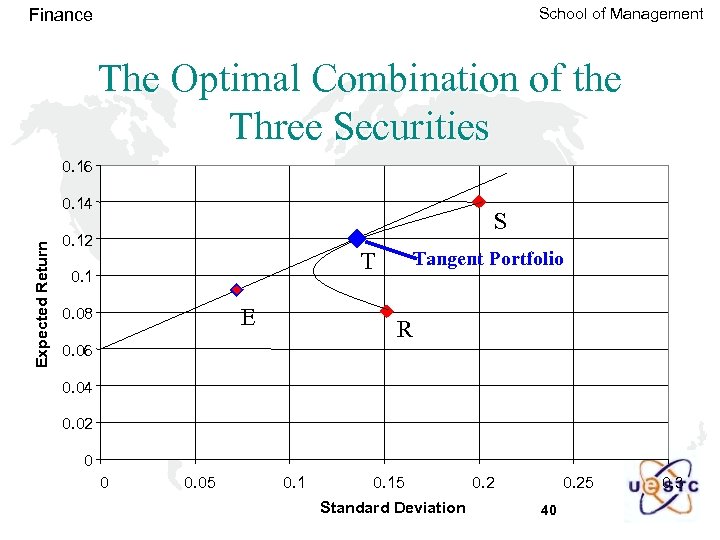 School of Management Finance The Optimal Combination of the Three Securities 0. 16 Expected Return 0. 14 S ◆ T 0. 12 0. 1 E 0. 08 Tangent Portfolio R 0. 06 0. 04 0. 02 0 0 0. 05 0. 15 Standard Deviation 0. 25 40 0. 3
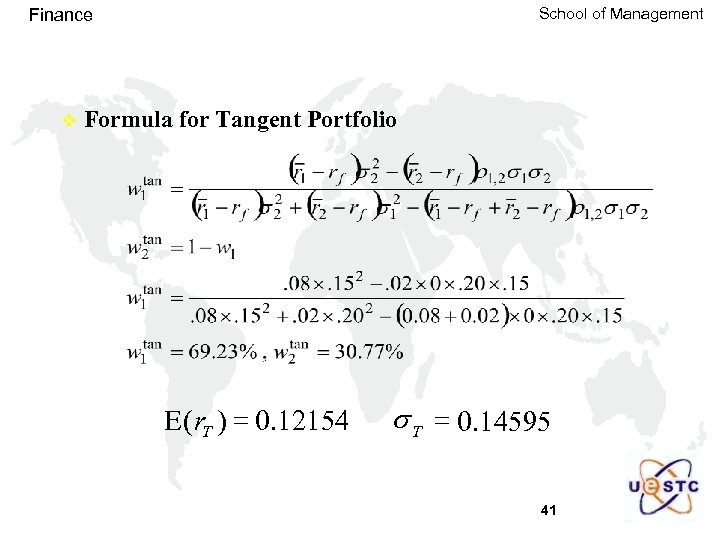 School of Management Finance v Formula for Tangent Portfolio E (r. T ) = 0. 12154 s T = 0. 14595 41
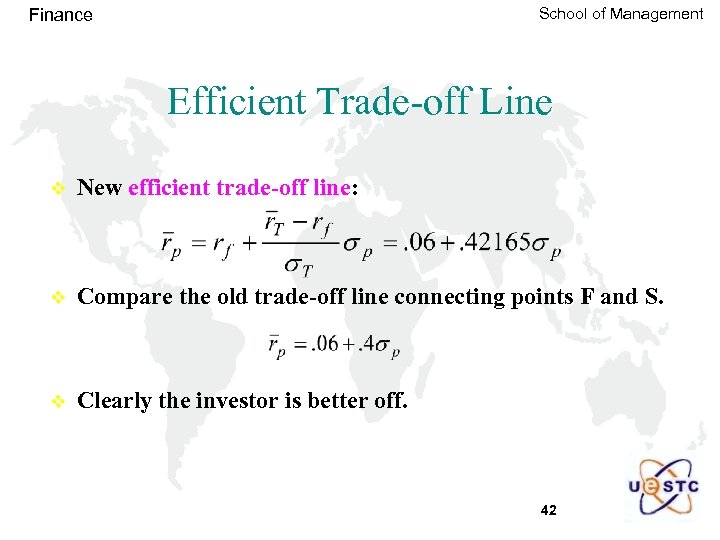 School of Management Finance Efficient Trade-off Line v New efficient trade-off line: v Compare the old trade-off line connecting points F and S. v Clearly the investor is better off. 42
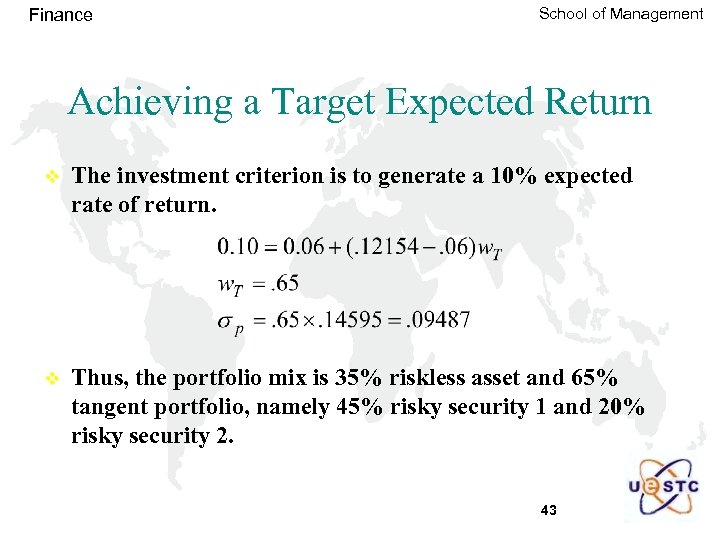 Finance School of Management Achieving a Target Expected Return v The investment criterion is to generate a 10% expected rate of return. v Thus, the portfolio mix is 35% riskless asset and 65% tangent portfolio, namely 45% risky security 1 and 20% risky security 2. 43
 Finance School of Management Selecting the Preferred Portfolio v It is important to note that in finding the optimal combination of risky assets, we do not need to know anything about investor preferences. v There is always a particular optimal portfolio of risky assets that all risk-averse investors who share the same forecasts of rates of return will combine with the riskless asset to reach their most-preferred portfolio. 44
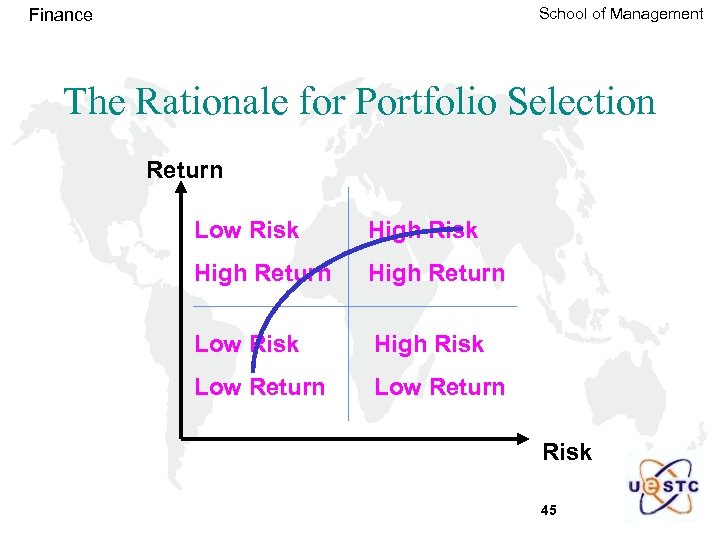 School of Management Finance The Rationale for Portfolio Selection Return Low Risk High Return Low Risk High Risk Low Return Risk 45
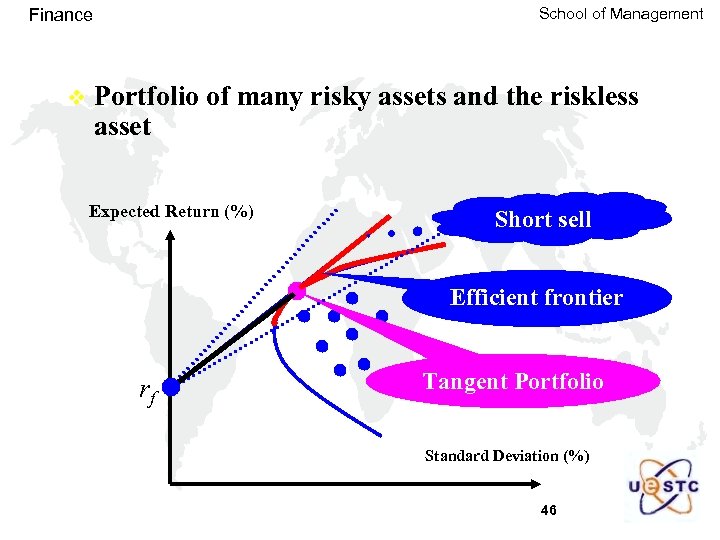 School of Management Finance v Portfolio of many risky assets and the riskless asset Expected Return (%) Short sell Efficient frontier rf Tangent Portfolio Standard Deviation (%) 46
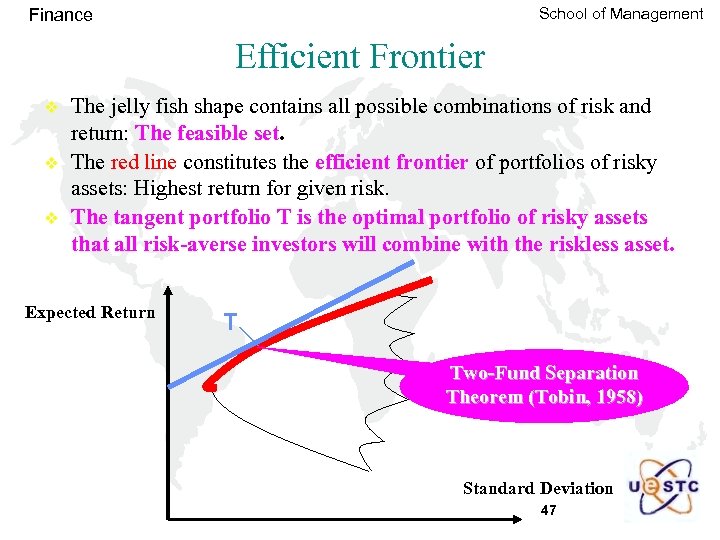 School of Management Finance Efficient Frontier v v v The jelly fish shape contains all possible combinations of risk and return: The feasible set. The red line constitutes the efficient frontier of portfolios of risky assets: Highest return for given risk. The tangent portfolio T is the optimal portfolio of risky assets that all risk-averse investors will combine with the riskless asset. Expected Return T Two-Fund Separation Theorem (Tobin, 1958) Standard Deviation 47
 School of Management Finance Theory & Practice v v v The static mean-variance model & elementary theory of mutual fund financial intermediation. Dynamic versions integrating intertemporal optimization of the life-cycle consumption-saving decisions with the allocation of those savings among alternative investments & a richer theory for the role of securities and financial intermediation. Optimal combination of assets & optimal hedging portfolio more tailored to the needs of different clienteles. 48