 Скачать презентацию School Direct Induction Training Day 1 September 2017
ab7efd6dd8ebd40404bfa741296d645c.ppt
- Количество слайдов: 71



School Direct Induction Training Day 1 September 2017
Introductions School Direct Team • • • Claire Murray Debbie Twineham Jo Heffer Elaine Norstom Karen Piper Carol Rogers – Bucks All contact details in the handbook
Accessing Information • http: //rbwmeducation. rbwm. org. uk/Content/? documents • Password protected – scitt 2014 • Questions – Post its • Handbook
Getting to know you… • • Name Previous experience Why teaching? Interesting fact • Be prepared to feedback on each other to the group.
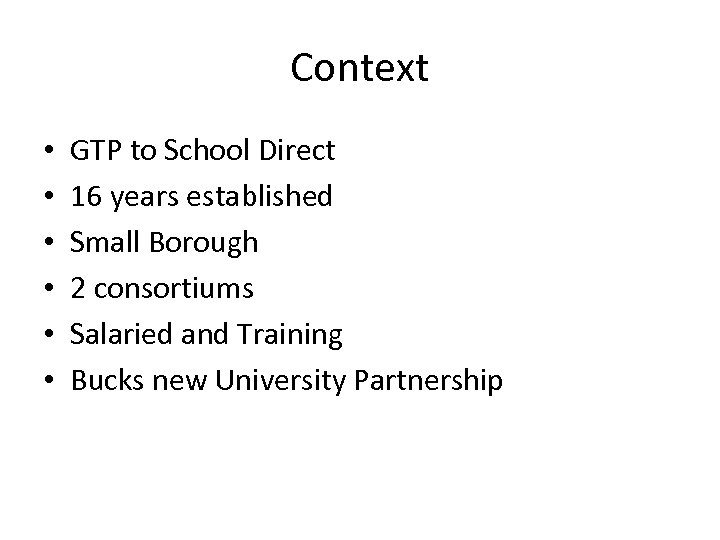
Context • • • GTP to School Direct 16 years established Small Borough 2 consortiums Salaried and Training Bucks new University Partnership
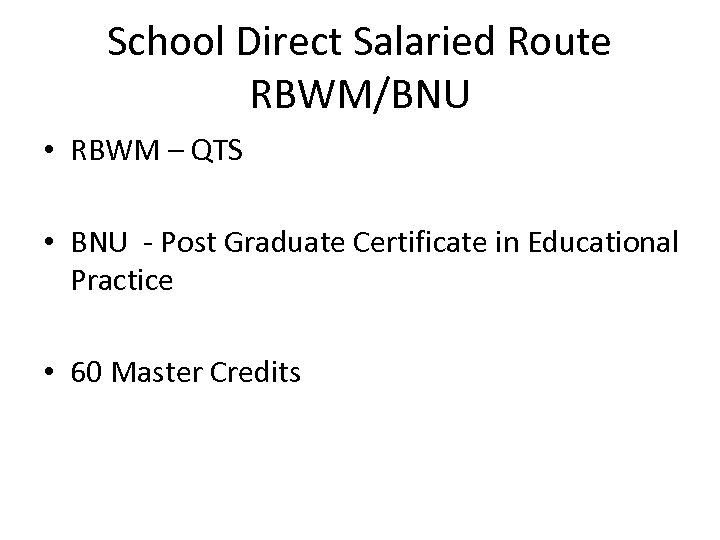
School Direct Salaried Route RBWM/BNU • RBWM – QTS • BNU - Post Graduate Certificate in Educational Practice • 60 Master Credits
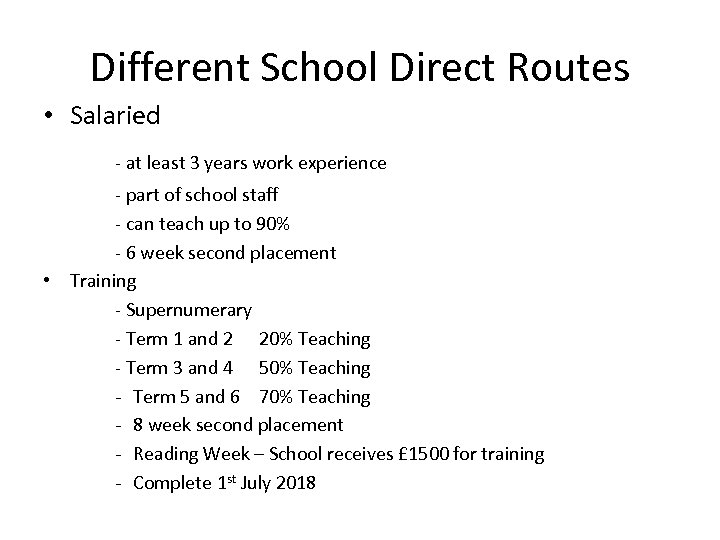
Different School Direct Routes • Salaried - at least 3 years work experience - part of school staff - can teach up to 90% - 6 week second placement • Training - Supernumerary - Term 1 and 2 20% Teaching - Term 3 and 4 50% Teaching - Term 5 and 6 70% Teaching - 8 week second placement - Reading Week – School receives £ 1500 for training - Complete 1 st July 2018
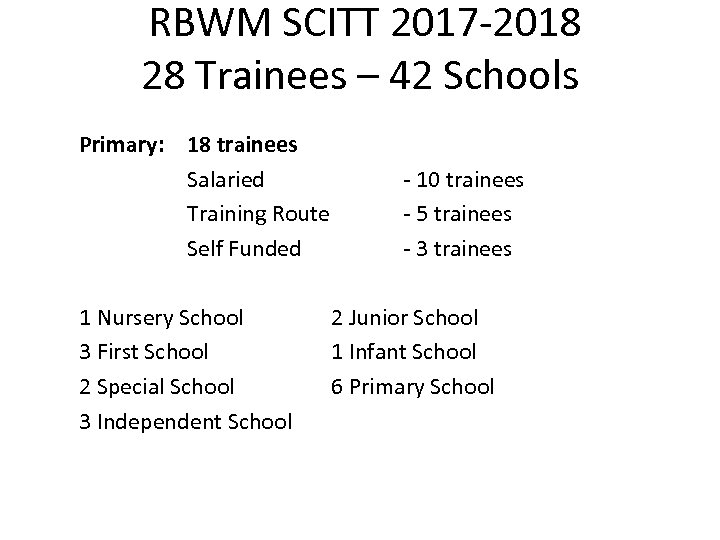
RBWM SCITT 2017 -2018 28 Trainees – 42 Schools Primary: 18 trainees Salaried Training Route Self Funded 1 Nursery School 3 First School 2 Special School 3 Independent School - 10 trainees - 5 trainees - 3 trainees 2 Junior School 1 Infant School 6 Primary School
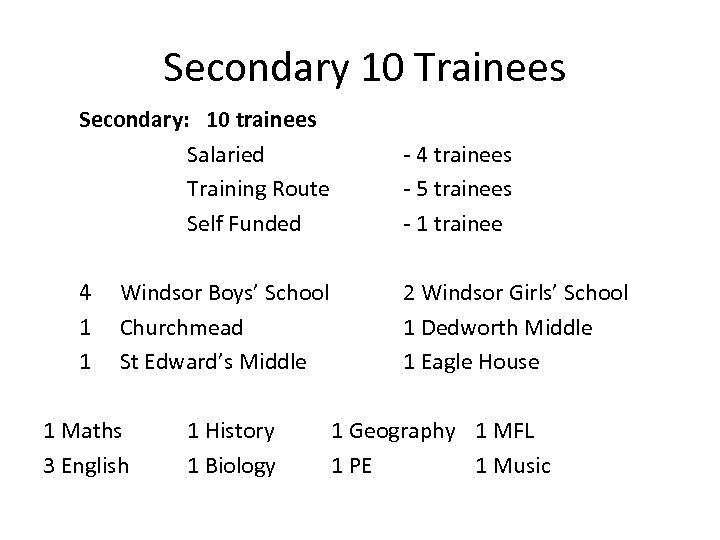
Secondary 10 Trainees Secondary: 10 trainees Salaried Training Route Self Funded - 4 trainees - 5 trainees - 1 trainee 4 1 1 2 Windsor Girls’ School 1 Dedworth Middle 1 Eagle House Windsor Boys’ School Churchmead St Edward’s Middle 1 Maths 3 English 1 History 1 Biology 1 Geography 1 MFL 1 PE 1 Music
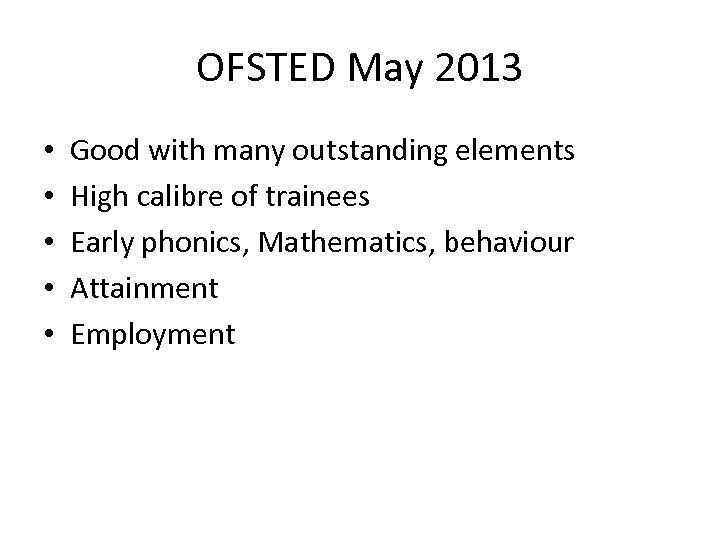
OFSTED May 2013 • • • Good with many outstanding elements High calibre of trainees Early phonics, Mathematics, behaviour Attainment Employment
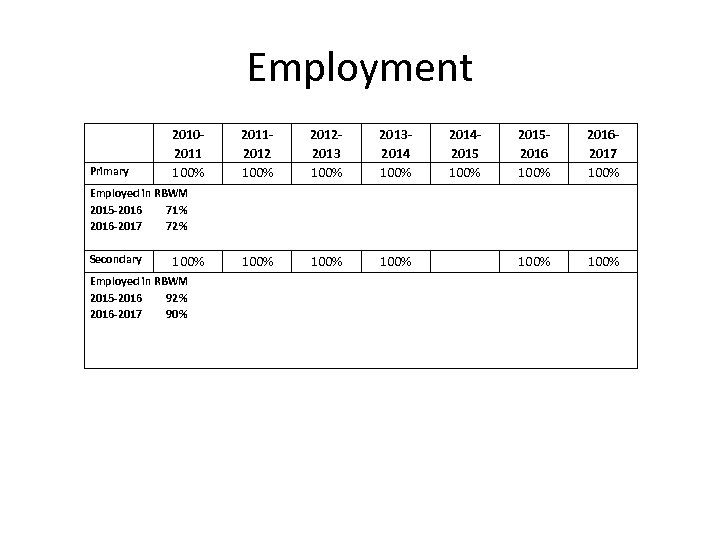
Employment Primary 20102011 100% 20112012 100% 20122013 100% 20132014 100% 20142015 100% 20152016 100% 20162017 100% Employed in RBWM 2015 -2016 71% 2016 -2017 72% Secondary 100% Employed in RBWM 2015 -2016 92% 2016 -2017 90%
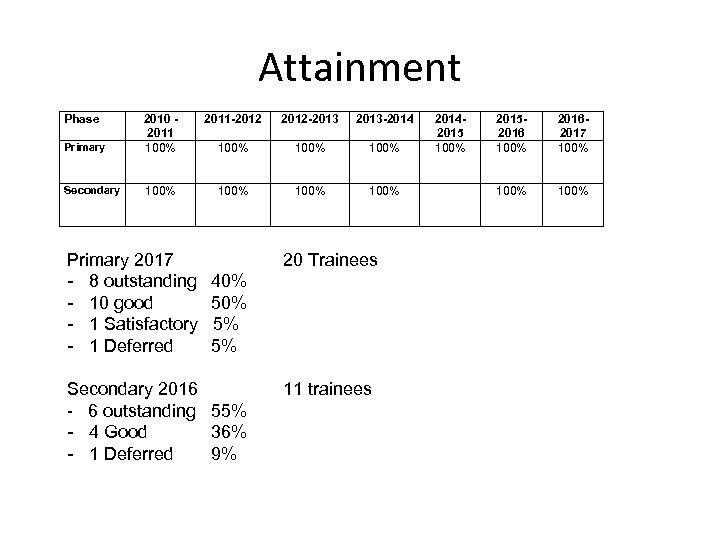
Attainment Phase 2011 -2012 -2013 -2014 Primary 2010 2011 100% Secondary 100% Primary 2017 - 8 outstanding 40% - 10 good 50% - 1 Satisfactory 5% - 1 Deferred 5% 11 trainees 20152016 100% 20162017 100% 20 Trainees Secondary 2016 - 6 outstanding 55% - 4 Good 36% - 1 Deferred 9% 20142015 100%
What makes an Outstanding Trainee? Discuss

• Feedback and Findings from External Moderator Report 2017
Teaching Standards • There are 8 standards and a part 2 • Within each standard there are several bullet points • Sort the bullets points to come under the correct heading
Central Training • • • Expectations Attendance Dress Code Lunch Links to Standards Evaluations
Education Philosophy • Tweet your education philosophy • What kind of teacher do you want to be • No more than 50 words
School Direct Lesson Observation
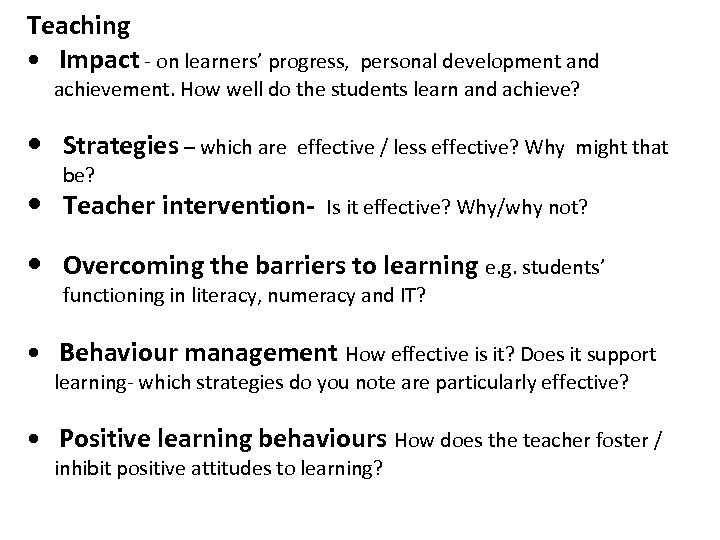
Teaching Impact - on learners’ progress, personal development and achievement. How well do the students learn and achieve? Strategies – which are effective / less effective? Why might that be? Teacher intervention- Is it effective? Why/why not? Overcoming the barriers to learning e. g. students’ functioning in literacy, numeracy and IT? Behaviour management How effective is it? Does it support learning- which strategies do you note are particularly effective? Positive learning behaviours How does the teacher foster / inhibit positive attitudes to learning?
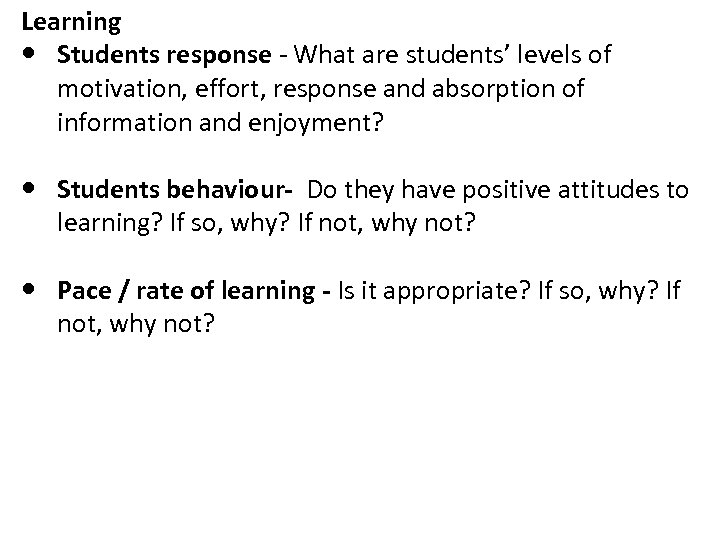
Learning Students response - What are students’ levels of motivation, effort, response and absorption of information and enjoyment? Students behaviour- Do they have positive attitudes to learning? If so, why? If not, why not? Pace / rate of learning - Is it appropriate? If so, why? If not, why not?
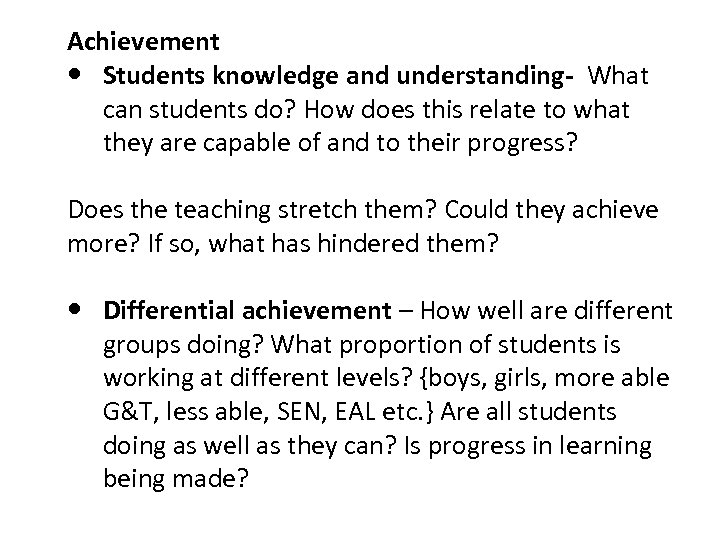
Achievement Students knowledge and understanding- What can students do? How does this relate to what they are capable of and to their progress? Does the teaching stretch them? Could they achieve more? If so, what has hindered them? Differential achievement – How well are different groups doing? What proportion of students is working at different levels? {boys, girls, more able G&T, less able, SEN, EAL etc. } Are all students doing as well as they can? Is progress in learning being made?
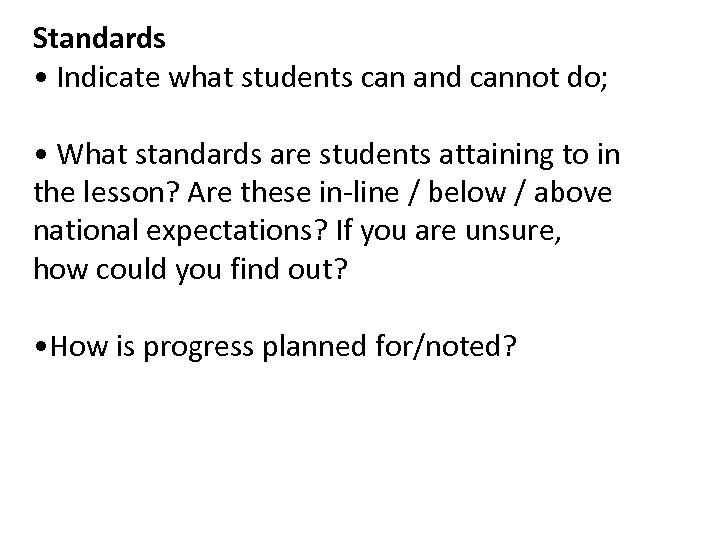
Standards • Indicate what students can and cannot do; • What standards are students attaining to in the lesson? Are these in-line / below / above national expectations? If you are unsure, how could you find out? • How is progress planned for/noted?
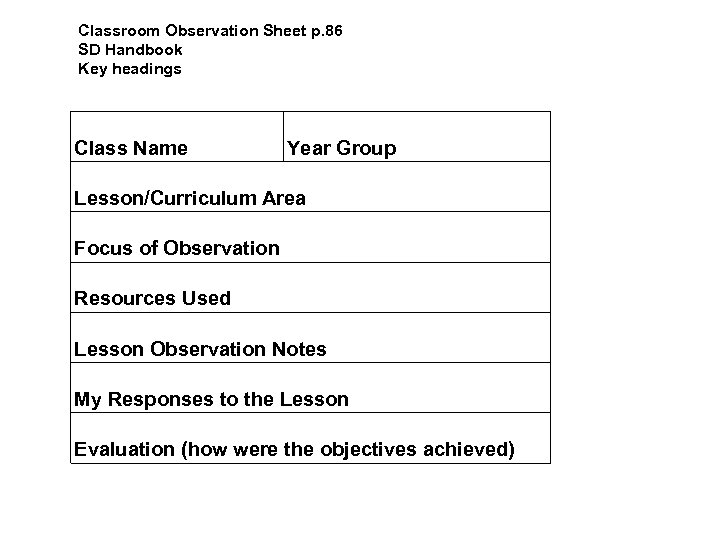
Classroom Observation Sheet p. 86 SD Handbook Key headings Class Name Year Group Lesson/Curriculum Area Focus of Observation Resources Used Lesson Observation Notes My Responses to the Lesson Evaluation (how were the objectives achieved)
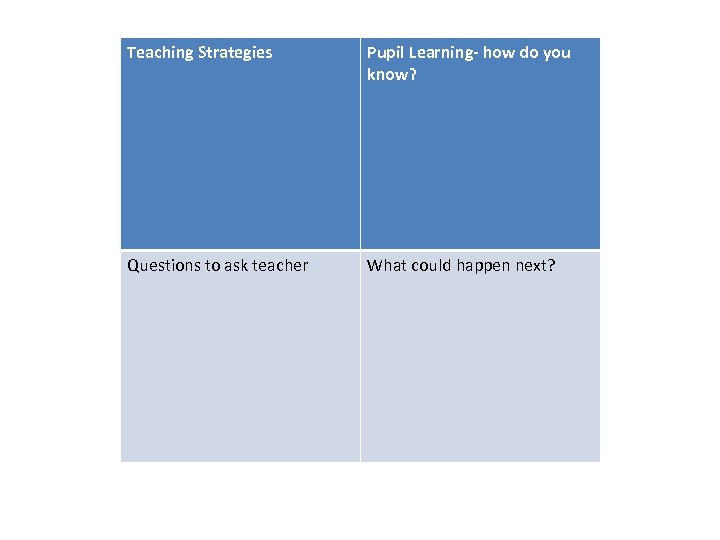
Teaching Strategies Pupil Learning- how do you know? Questions to ask teacher What could happen next?

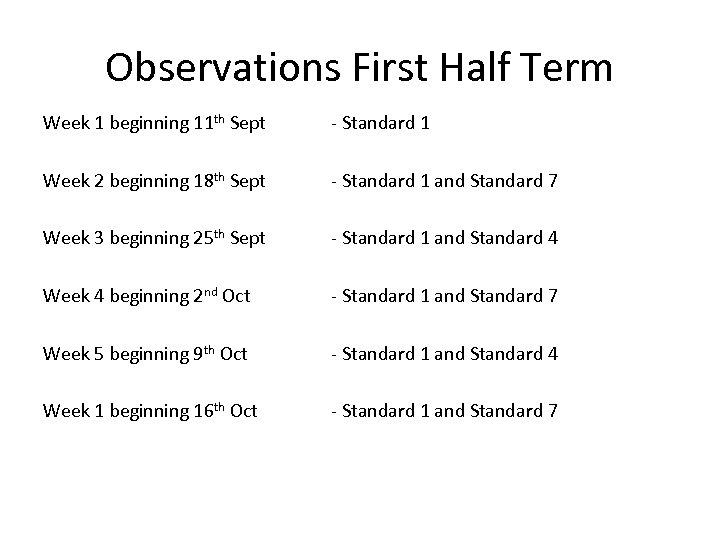
Observations First Half Term Week 1 beginning 11 th Sept - Standard 1 Week 2 beginning 18 th Sept - Standard 1 and Standard 7 Week 3 beginning 25 th Sept - Standard 1 and Standard 4 Week 4 beginning 2 nd Oct - Standard 1 and Standard 7 Week 5 beginning 9 th Oct - Standard 1 and Standard 4 Week 1 beginning 16 th Oct - Standard 1 and Standard 7
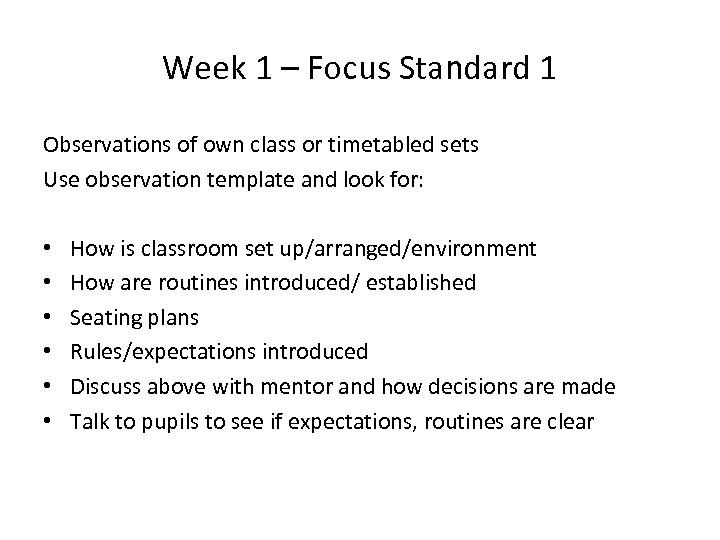
Week 1 – Focus Standard 1 Observations of own class or timetabled sets Use observation template and look for: • • • How is classroom set up/arranged/environment How are routines introduced/ established Seating plans Rules/expectations introduced Discuss above with mentor and how decisions are made Talk to pupils to see if expectations, routines are clear
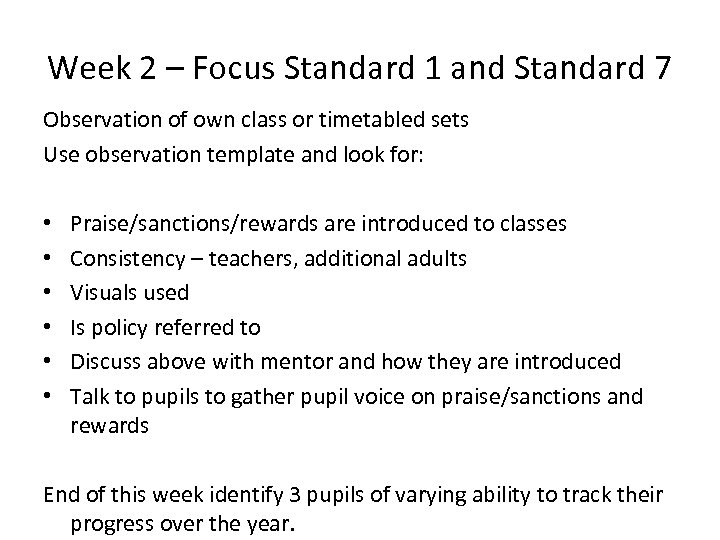
Week 2 – Focus Standard 1 and Standard 7 Observation of own class or timetabled sets Use observation template and look for: • • • Praise/sanctions/rewards are introduced to classes Consistency – teachers, additional adults Visuals used Is policy referred to Discuss above with mentor and how they are introduced Talk to pupils to gather pupil voice on praise/sanctions and rewards End of this week identify 3 pupils of varying ability to track their progress over the year.
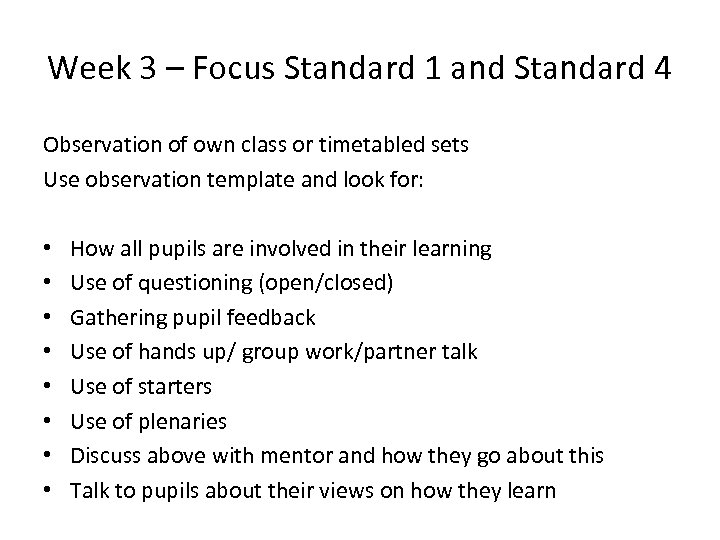
Week 3 – Focus Standard 1 and Standard 4 Observation of own class or timetabled sets Use observation template and look for: • • How all pupils are involved in their learning Use of questioning (open/closed) Gathering pupil feedback Use of hands up/ group work/partner talk Use of starters Use of plenaries Discuss above with mentor and how they go about this Talk to pupils about their views on how they learn
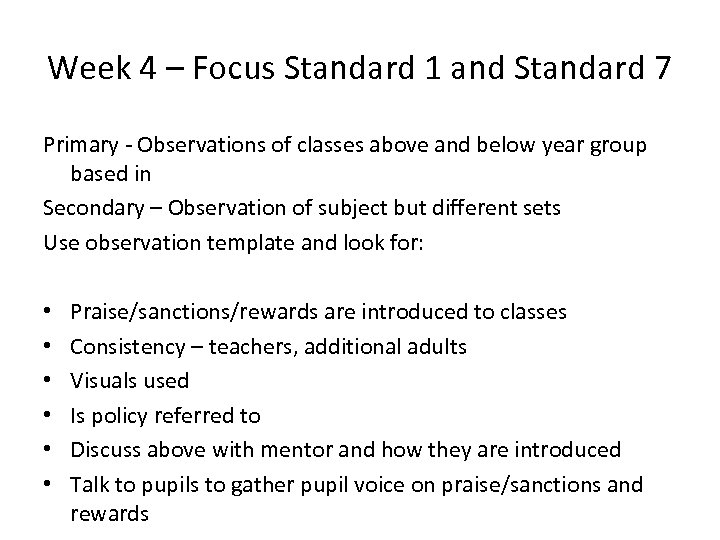
Week 4 – Focus Standard 1 and Standard 7 Primary - Observations of classes above and below year group based in Secondary – Observation of subject but different sets Use observation template and look for: • • • Praise/sanctions/rewards are introduced to classes Consistency – teachers, additional adults Visuals used Is policy referred to Discuss above with mentor and how they are introduced Talk to pupils to gather pupil voice on praise/sanctions and rewards
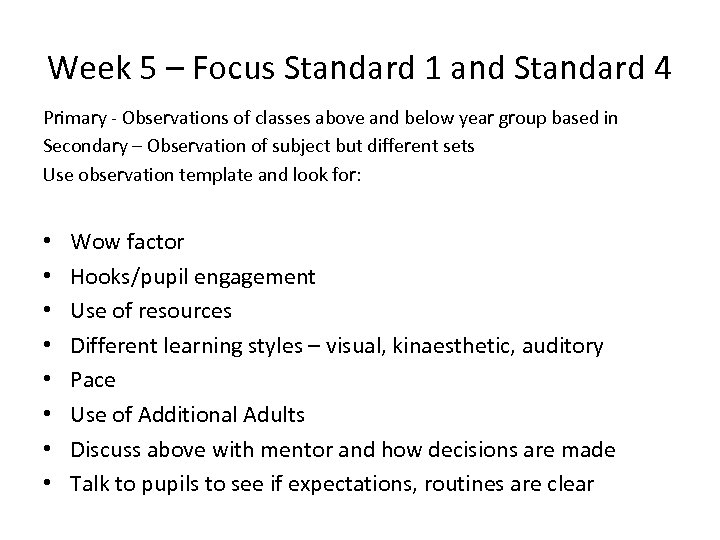
Week 5 – Focus Standard 1 and Standard 4 Primary - Observations of classes above and below year group based in Secondary – Observation of subject but different sets Use observation template and look for: • • Wow factor Hooks/pupil engagement Use of resources Different learning styles – visual, kinaesthetic, auditory Pace Use of Additional Adults Discuss above with mentor and how decisions are made Talk to pupils to see if expectations, routines are clear
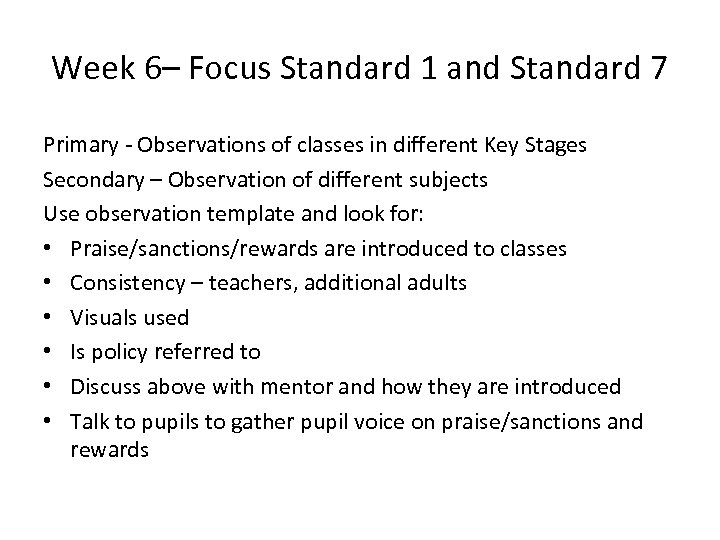
Week 6– Focus Standard 1 and Standard 7 Primary - Observations of classes in different Key Stages Secondary – Observation of different subjects Use observation template and look for: • Praise/sanctions/rewards are introduced to classes • Consistency – teachers, additional adults • Visuals used • Is policy referred to • Discuss above with mentor and how they are introduced • Talk to pupils to gather pupil voice on praise/sanctions and rewards
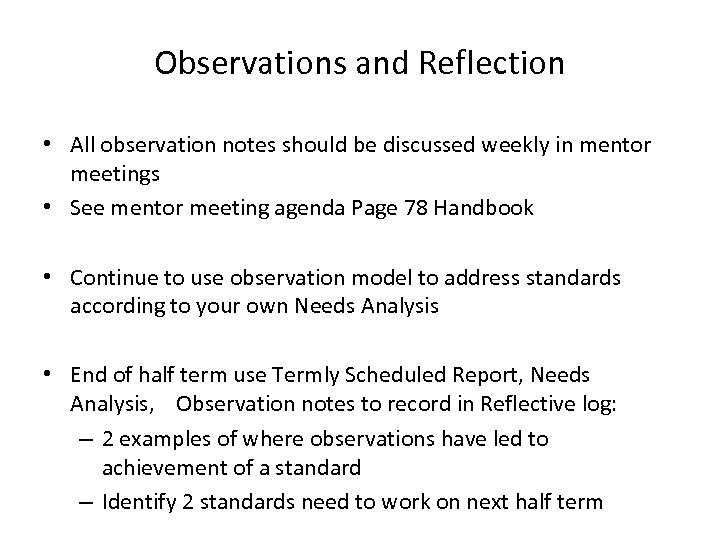
Observations and Reflection • All observation notes should be discussed weekly in mentor meetings • See mentor meeting agenda Page 78 Handbook • Continue to use observation model to address standards according to your own Needs Analysis • End of half term use Termly Scheduled Report, Needs Analysis, Observation notes to record in Reflective log: – 2 examples of where observations have led to achievement of a standard – Identify 2 standards need to work on next half term
Induction Day 2 September 2017 Mentor and Trainee Training
Introductions School Direct Team • • • Claire Murray Debbie Twineham Jo Heffer Elaine Norstom Karen Piper Carol Rogers – Bucks All contact details in the handbook
Accessing Information • http: //rbwmeducation. rbwm. org. uk/Content/? documents • Password protected – scitt 2014 • Questions – Post its • Handbook
Two groups • Mentors: • What makes an outstanding trainee? • Trainees: • What makes an outstanding mentor?
Mentor Standards • • Carter Review External Moderation Feedback 2017 Need for consistency amongst mentors Mentor Standards July 2016 Non Statutory Handbook Pages 8 -12, Pages 82 -97 RBWM SCITT Mentor Offer
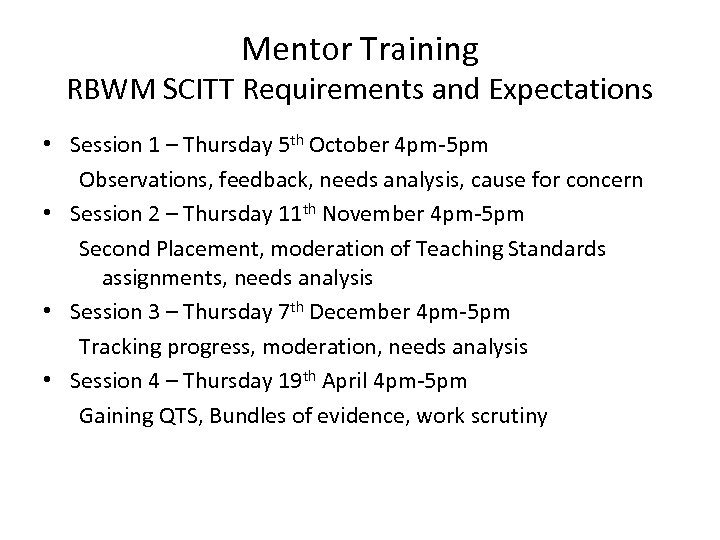
Mentor Training RBWM SCITT Requirements and Expectations • Session 1 – Thursday 5 th October 4 pm-5 pm Observations, feedback, needs analysis, cause for concern • Session 2 – Thursday 11 th November 4 pm-5 pm Second Placement, moderation of Teaching Standards assignments, needs analysis • Session 3 – Thursday 7 th December 4 pm-5 pm Tracking progress, moderation, needs analysis • Session 4 – Thursday 19 th April 4 pm-5 pm Gaining QTS, Bundles of evidence, work scrutiny
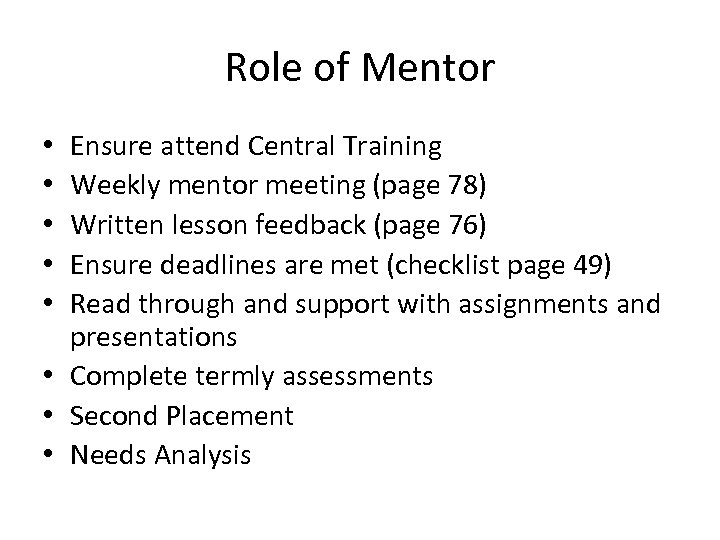
Role of Mentor Ensure attend Central Training Weekly mentor meeting (page 78) Written lesson feedback (page 76) Ensure deadlines are met (checklist page 49) Read through and support with assignments and presentations • Complete termly assessments • Second Placement • Needs Analysis • • •
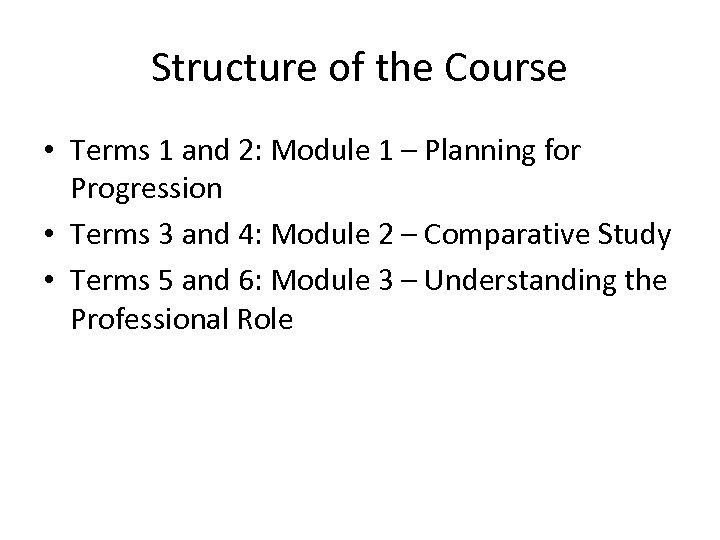
Structure of the Course • Terms 1 and 2: Module 1 – Planning for Progression • Terms 3 and 4: Module 2 – Comparative Study • Terms 5 and 6: Module 3 – Understanding the Professional Role
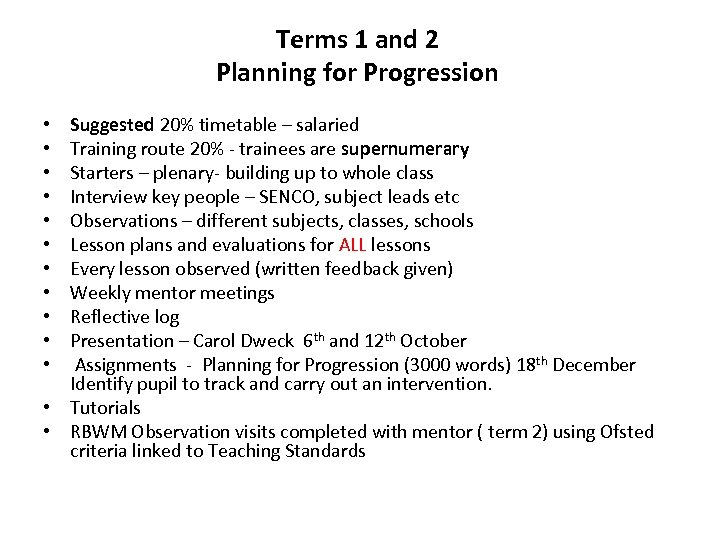
Terms 1 and 2 Planning for Progression Suggested 20% timetable – salaried Training route 20% - trainees are supernumerary Starters – plenary- building up to whole class Interview key people – SENCO, subject leads etc Observations – different subjects, classes, schools Lesson plans and evaluations for ALL lessons Every lesson observed (written feedback given) Weekly mentor meetings Reflective log Presentation – Carol Dweck 6 th and 12 th October Assignments - Planning for Progression (3000 words) 18 th December Identify pupil to track and carry out an intervention. • Tutorials • RBWM Observation visits completed with mentor ( term 2) using Ofsted criteria linked to Teaching Standards • • •
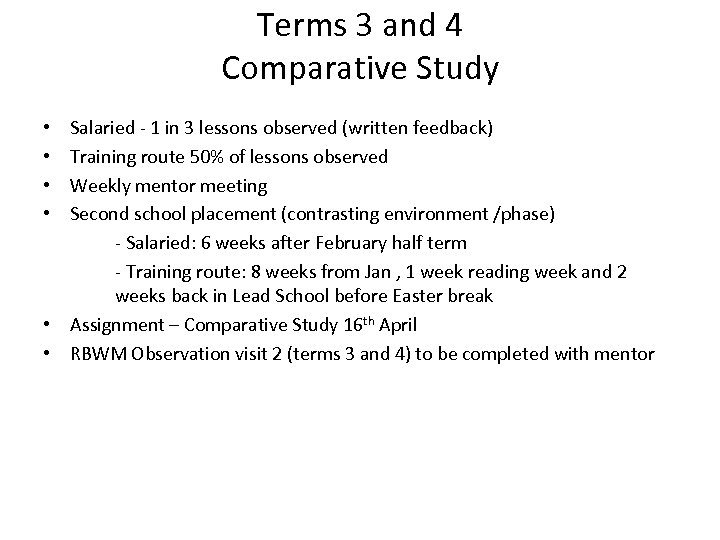
Terms 3 and 4 Comparative Study Salaried - 1 in 3 lessons observed (written feedback) Training route 50% of lessons observed Weekly mentor meeting Second school placement (contrasting environment /phase) - Salaried: 6 weeks after February half term - Training route: 8 weeks from Jan , 1 week reading week and 2 weeks back in Lead School before Easter break • Assignment – Comparative Study 16 th April • RBWM Observation visit 2 (terms 3 and 4) to be completed with mentor • •
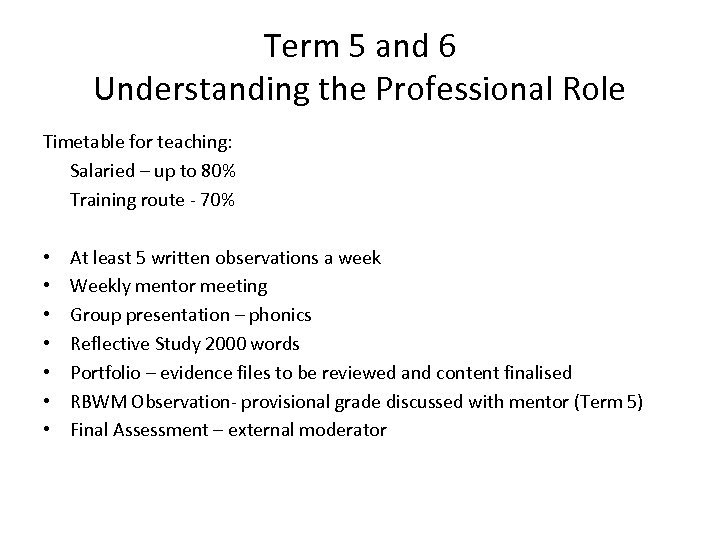
Term 5 and 6 Understanding the Professional Role Timetable for teaching: Salaried – up to 80% Training route - 70% • • At least 5 written observations a week Weekly mentor meeting Group presentation – phonics Reflective Study 2000 words Portfolio – evidence files to be reviewed and content finalised RBWM Observation- provisional grade discussed with mentor (Term 5) Final Assessment – external moderator
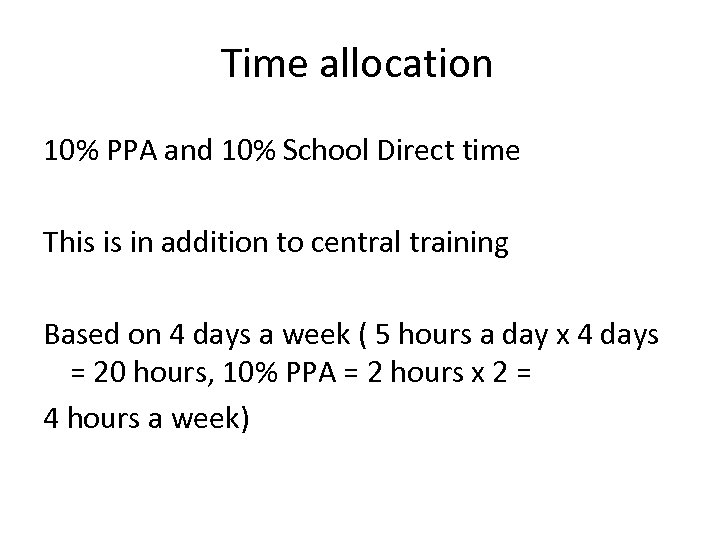
Time allocation 10% PPA and 10% School Direct time This is in addition to central training Based on 4 days a week ( 5 hours a day x 4 days = 20 hours, 10% PPA = 2 hours x 2 = 4 hours a week)
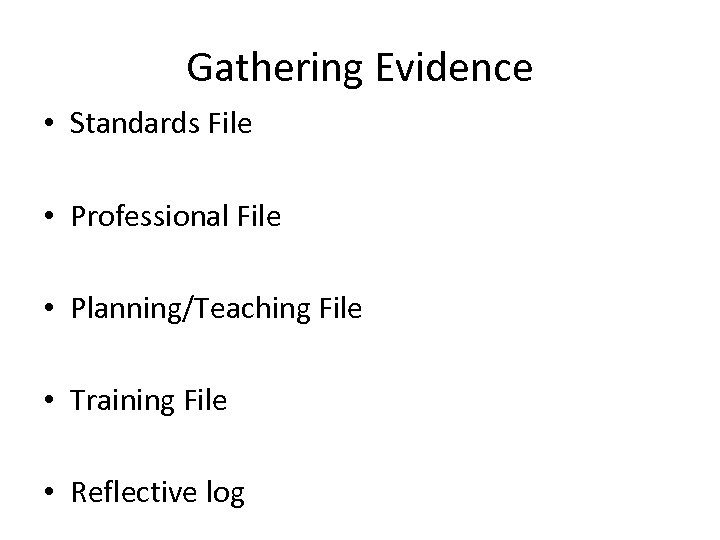
Gathering Evidence • Standards File • Professional File • Planning/Teaching File • Training File • Reflective log
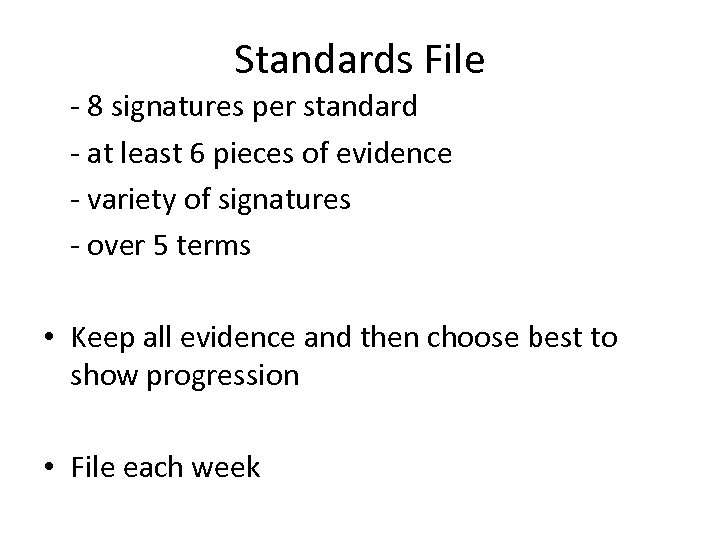
Standards File - 8 signatures per standard - at least 6 pieces of evidence - variety of signatures - over 5 terms • Keep all evidence and then choose best to show progression • File each week
Gathering Evidence for Standards • Look at the standard you have been given • List all the different ways you can gain evidence to show you have understanding of that standard
• Examples of types of evidence for Teaching Standards Handbook Pages 57 -67
Assessment • • Mentor observations Accredited Provider Observations Termly Scheduled Report Needs Analysis Mentor Meeting External Moderator Cause for Concern
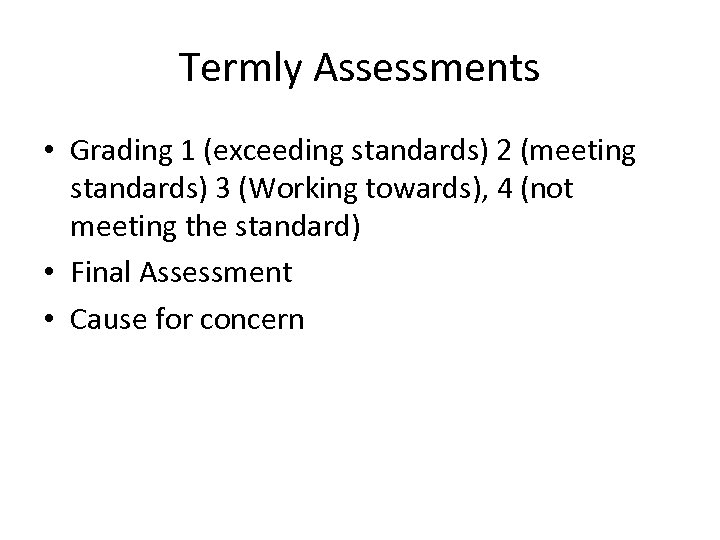
Termly Assessments • Grading 1 (exceeding standards) 2 (meeting standards) 3 (Working towards), 4 (not meeting the standard) • Final Assessment • Cause for concern
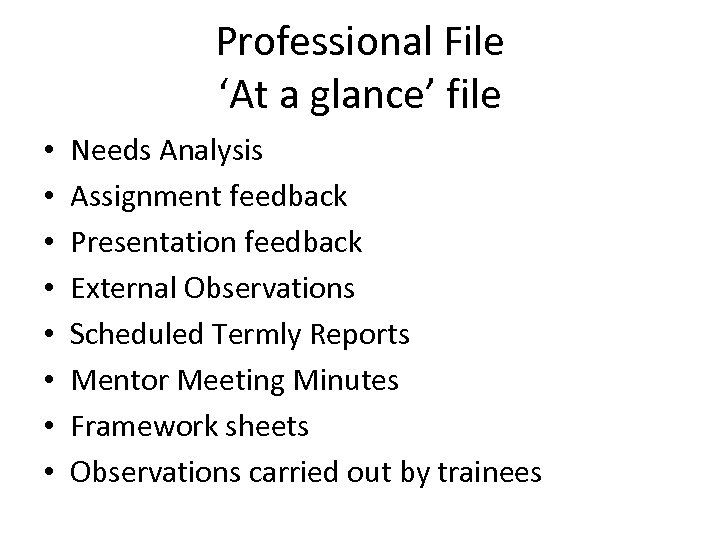
Professional File ‘At a glance’ file • • Needs Analysis Assignment feedback Presentation feedback External Observations Scheduled Termly Reports Mentor Meeting Minutes Framework sheets Observations carried out by trainees
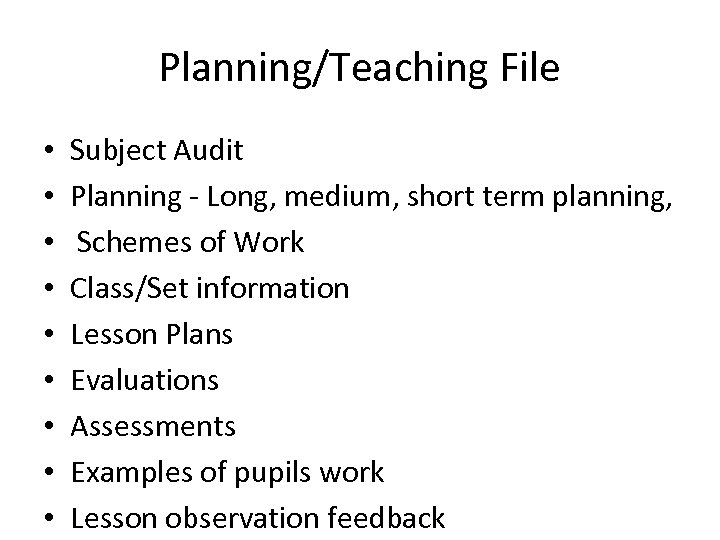
Planning/Teaching File • • • Subject Audit Planning - Long, medium, short term planning, Schemes of Work Class/Set information Lesson Plans Evaluations Assessments Examples of pupils work Lesson observation feedback
Training File • Central training notes • School Inset notes • External Training
Questions • Mentor evaluations
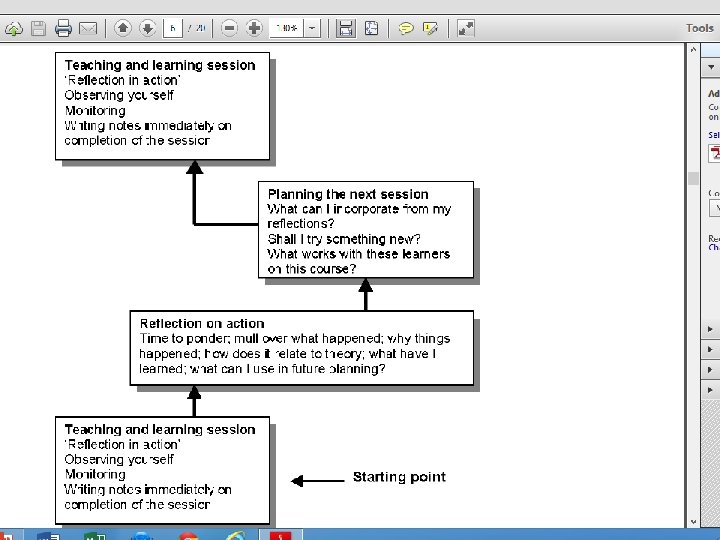
Reflective Log: becoming a reflective practitioner • ‘reflection is a form of thinking that deals with more complex or unstructured issues in a considered manner. It may be a matter of ‘making sense of ideas, or ‘re-ordering thoughts’. Jenny Moon
Group Activity: The Park Deeper reflection =better learning • Individually, read the version 1 of an incident which took place in The Park. Which features do you consider are reflective? • Discuss these features as a group and one member act as scribe to collect ideas/feedback to whole group • Read each version and then note reflective features • After version 4, discuss how accounts have changed – list in your groups how accounts have deepened
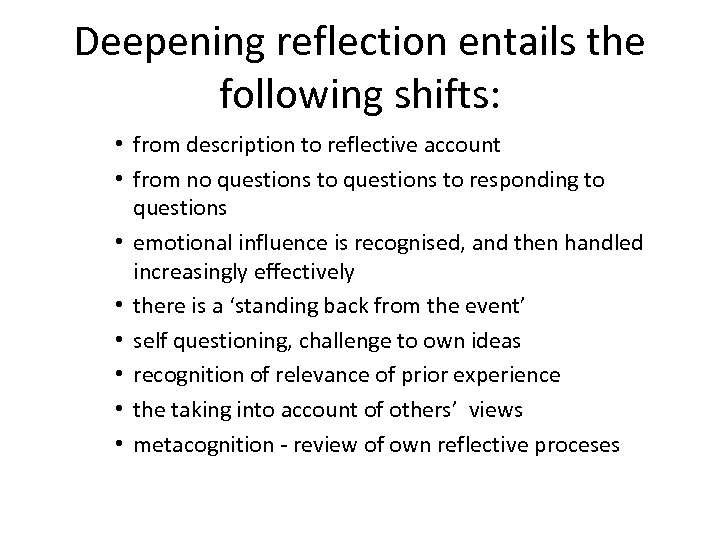
Deepening reflection entails the following shifts: • from description to reflective account • from no questions to responding to questions • emotional influence is recognised, and then handled increasingly effectively • there is a ‘standing back from the event’ • self questioning, challenge to own ideas • recognition of relevance of prior experience • the taking into account of others’ views • metacognition - review of own reflective proceses
10 handy tips for mentoring a trainee!!

10. Nothing is too obvious

9. No surprises!

8. Share and Steal!!
6. Take a step back

4. Let them know your secrets

3. Powerpoints= Nervous breakdown!

2. Prepare for tears!
1. Don’t say the T word!!
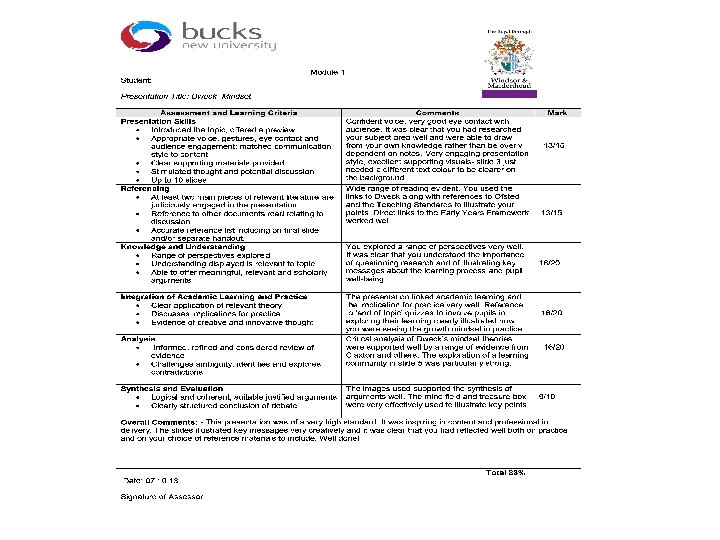
Presentation 1 – 30% of Module 1 Primary Friday 7 th October Secondary Thursday 6 th October This is an individual theoretical 10 minute presentation based on the work of Carol Dweck. Essential summer reading is: Mindset: the New Psychology of Success by Carol Dweck (2006) Trainees are ask to discuss the following quote. "Everyone is born with a tremendous exploratory spirit, but some more than others have this inquiring inquisitiveness, getting into everything, a tenaciousness that lends itself to a growth mindset. " Carol Dweck What do you think is the role of the teacher in ensuring that the exploratory spirit of all learners is fully developed?
 Скачать презентацию School Direct Induction Training Day 1 September 2017
ab7efd6dd8ebd40404bfa741296d645c.ppt