 Скачать презентацию Scholarly Communication Februrary 2005 UCSF Library Center
642944a34f24fa91b89abe7d81de23d3.ppt
- Количество слайдов: 26



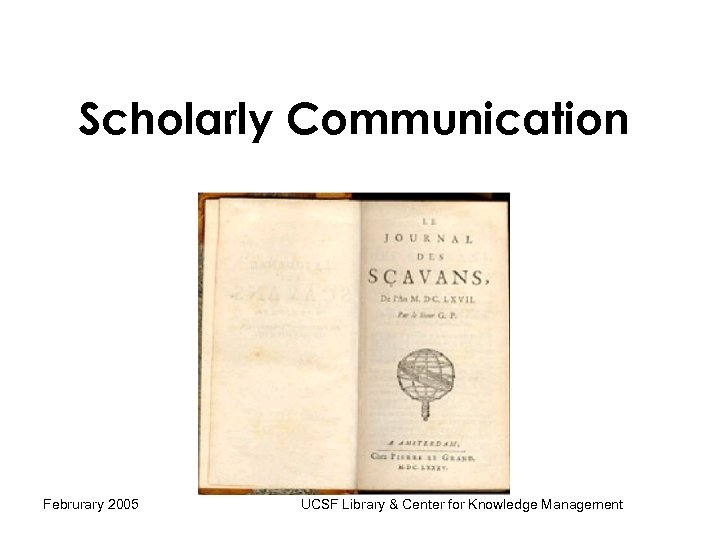
Scholarly Communication Februrary 2005 UCSF Library & Center for Knowledge Management
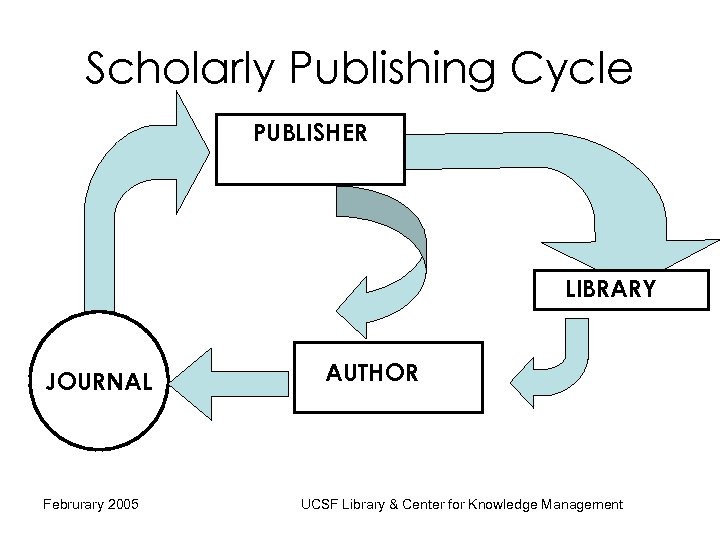
Scholarly Publishing Cycle PUBLISHER LIBRARY JOURNAL Februrary 2005 AUTHOR UCSF Library & Center for Knowledge Management
“Scholarly Communication” • Describes the process of disseminating research results and other scholarship in all disciplines • In the biomedical sciences, primary method of scholarly communication is the journal literature • Academic structure is based on this model – promotion and tenure Februrary 2005 UCSF Library & Center for Knowledge Management
Task Force Charge • Develop a plan for a scholarly communication program for UCSF that will: – Raise awareness among staff and campus community of the issues – Inform staff and community of developments and generate interest in them – Educate and support the community in alternate communication modes Februrary 2005 UCSF Library & Center for Knowledge Management
Task Force Members • Janice Contini – Introduction • Anneliese Taylor – Publishing Economics • David Owen – Copyright • Gail Persily – UC-wide & UCSF initiatives Februrary 2005 UCSF Library & Center for Knowledge Management
Publishing Economics Traditional and Open Access Models Februrary 2005 UCSF Library & Center for Knowledge Management
Traditional Publishers • Commercial publishers: Elsevier, Wiley, Springer, Nature, Oxford University Press • Society publishers: American Medical Association (JAMA), American Society of Microbiology (Infection & Immunity), AAAS (Science), National Academy of Sciences (PNAS) Februrary 2005 UCSF Library & Center for Knowledge Management
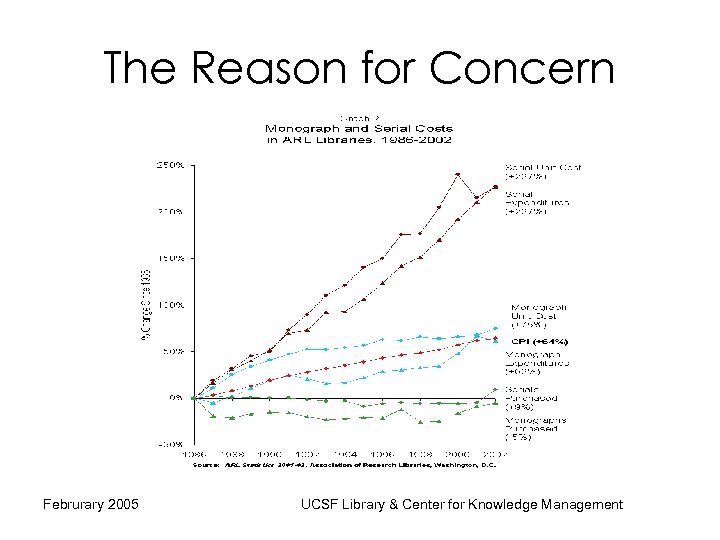
The Reason for Concern Februrary 2005 UCSF Library & Center for Knowledge Management
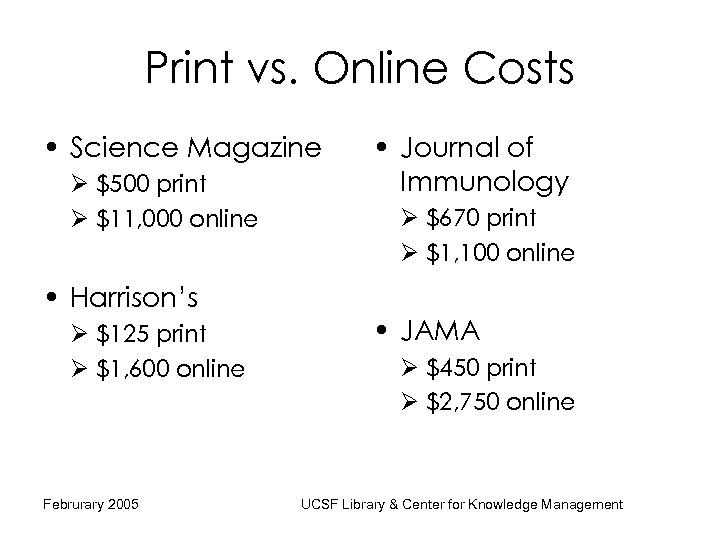
Print vs. Online Costs • Science Magazine Ø $500 print Ø $11, 000 online • Harrison’s Ø $125 print Ø $1, 600 online Februrary 2005 • Journal of Immunology Ø $670 print Ø $1, 100 online • JAMA Ø $450 print Ø $2, 750 online UCSF Library & Center for Knowledge Management
Open Access Defined • Open-access (OA) literature is digital, online, free of charge, and free of most copyright and licensing restrictions. • OA removes price barriers (subscriptions, licensing fees, pay-perview fees) and permission barriers (most copyright and licensing restrictions). Februrary 2005 • Flexible options – Some OA providers permit commercial re-use and some do not. – Some permit derivative works and some do not. • All of the major public definitions of OA agree that merely removing price barriers, or limiting permissible uses to "fair use" ("fair dealing" in the UK), is not enough. UCSF Library & Center for Knowledge Management
Open Access Journal Examples • PLo. S Biology & PLo. S Medicine • Bio. Med Central • Evidence-Based CAM (OUP) • Nucleic Acids Research (OUP) • Pub. Med Central – OA journal repository Februrary 2005 UCSF Library & Center for Knowledge Management
“Partial” Open Access • Some Bio. Med Central journals (Genome Biology, Breast Cancer Research) – Research articles only • Back issues from society publications – Journal of Immunology, NEJM, Diabetes, etc. • PNAS, Company of Biologists, Springer – Author pays to make article OA Februrary 2005 UCSF Library & Center for Knowledge Management
NIH Policy on Public Access • Sept 4, 2004 Proposal – Would have required authors to deposit articles from NIH-funded research into Pub. Med Central for public access after 6 months • February 3, 2005 Policy Release – Changed deposit date to within 12 months – Weakened to a requested deposit – Yet encourages authors to deposit sooner rather than later Februrary 2005 UCSF Library & Center for Knowledge Management
Is Open Access Cheaper? • OA Funding – Grants – Institutional ‘memberships’ – Article charges paid by authors (grants may cover) • Cornell Library study suggests it could be more costly than traditional model – for those with large research output Februrary 2005 UCSF Library & Center for Knowledge Management
OA – Focus on ‘Access’ • The primary benefit of OA is free, unrestricted access to all • Open-access (OA) literature is digital, online, free of charge, and free of most copyright and licensing restrictions Februrary 2005 UCSF Library & Center for Knowledge Management
Copyright • Any creative work of literary composition such as a song, essay, poem, novel, or scholarly work ie research article • In scholarly journals the publisher has traditionally owned the rights to research articles or scholarly works Februrary 2005 UCSF Library & Center for Knowledge Management
But who owns the copyright? • First assumption is that owners are the persons listed as “authors”, but: – Academic authors usually sign away rights to the journal publisher Februrary 2005 UCSF Library & Center for Knowledge Management
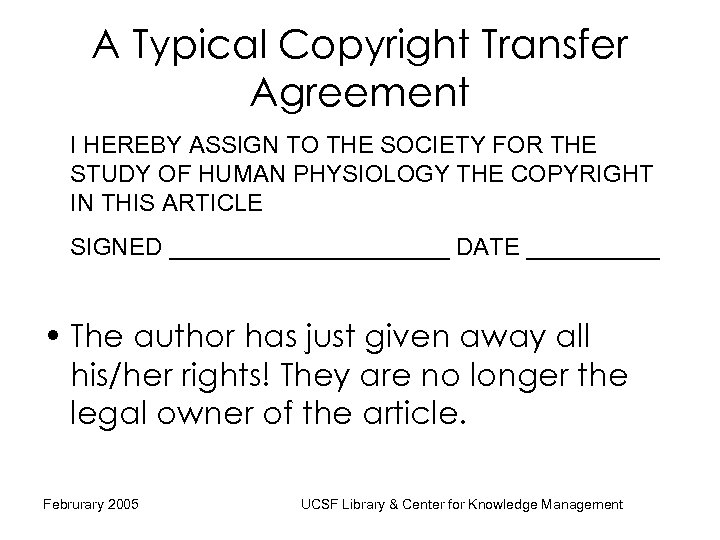
A Typical Copyright Transfer Agreement I HEREBY ASSIGN TO THE SOCIETY FOR THE STUDY OF HUMAN PHYSIOLOGY THE COPYRIGHT IN THIS ARTICLE SIGNED ___________ DATE _____ • The author has just given away all his/her rights! They are no longer the legal owner of the article. Februrary 2005 UCSF Library & Center for Knowledge Management
Impact of Copyright Transfer • Denies to the author many important rights – – – Distribute reprints Distribute abstracts Create derivative works Use own work in teaching Control (and benefit financially from) republication – Republish out of print but important works • Implies that institution must buy back its own works (at monopoly prices) Februrary 2005 UCSF Library & Center for Knowledge Management
Copyright Agreements • SHERPA: – a summary of permissions that are normally given as part of each publisher's copyright transfer agreement. Februrary 2005 UCSF Library & Center for Knowledge Management
UC-wide Initiatives Februrary 2005 UCSF Library & Center for Knowledge Management
UC-wide Initiatives • Office of Scholarly Communication • SCO group • Other UC-wide committees, e. g. CDC • Systemwide resolution • Promoting new models - e. Scholarship Februrary 2005 UCSF Library & Center for Knowledge Management
e. Scholarship Postprints • New repository for postprints of published articles • 25, 000 articles from 2004 • UCSF action – Publicize this project and use it to educate faculty about copyright issues – Talk to faculty – Address NIH public access policy Februrary 2005 UCSF Library & Center for Knowledge Management
SCTF Proposed Plan • Handout Februrary 2005 UCSF Library & Center for Knowledge Management
Discussion • Defining the message • Future updates? Discussions? Journal club? Februrary 2005 UCSF Library & Center for Knowledge Management
This work is licensed under a Creative Commons Attribution. Noncommercial-Share Alike 3. 0 United States License Februrary 2005 UCSF Library & Center for Knowledge Management
Скачать презентацию Scholarly Communication Februrary 2005 UCSF Library Center
642944a34f24fa91b89abe7d81de23d3.ppt