


 Скачать презентацию Scheduling with uncertain resources Elicitation of additional data
2966ebe336fbcd40fef39f840f0556a3.ppt
- Количество слайдов: 12
 Scheduling with uncertain resources Elicitation of additional data Ulaş Bardak, Eugene Fink, Chris Martens, and Jaime Carbonell Carnegie Mellon University
 Problem Scheduling a conference under uncertainty n Uncertain room properties n Uncertain equipment needs n Uncertain speaker preferences The automated scheduler needs to collaborate with the human user.
 Problem The system may not have enough data for producing a good schedule n The user may be able to obtain some of the missing data, but not all data The system should identify critical missing data and ask the user only for these data. n
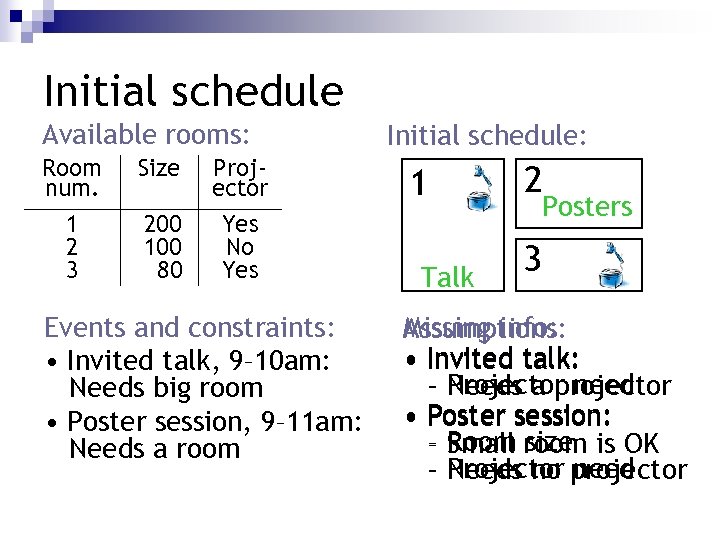 Initial schedule Available rooms: Room num. Size 1 2 3 200 100 80 Projector Yes No Yes Events and constraints: • Invited talk, 9– 10 am: Needs big room • Poster session, 9– 11 am: Needs a room Initial schedule: 1 Talk 2 Posters 3 Missing info: Assumptions: • Invited talk: – Projector need Needs a projector • Poster session: – Room room is OK Small size – Projector projector Needs no need
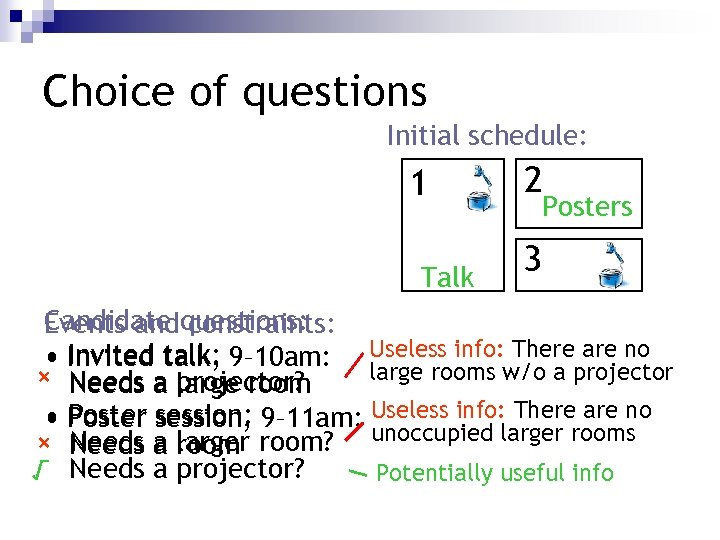 Choice of questions Initial schedule: 1 Talk 2 Posters 3 Candidate constraints: Events andquestions: • Invited talk, 9– 10 am: Useless info: There are no talk: large rooms w/o a projector × Needs a large room projector? session: • Poster session, 9– 11 am: Useless info: There are no unoccupied larger rooms × Needs a room? larger √ Needs a projector? Potentially useful info
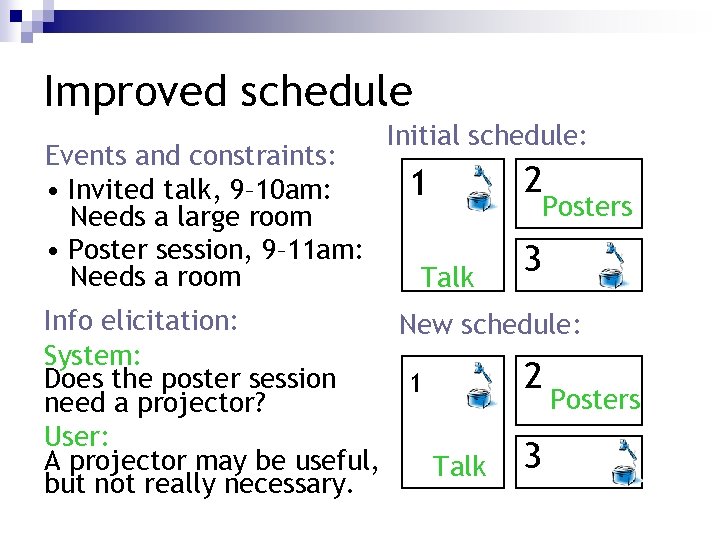 Improved schedule Events and constraints: • Invited talk, 9– 10 am: Needs a large room • Poster session, 9– 11 am: Needs a room Initial schedule: 1 Talk 2 Posters 3 Info elicitation: New schedule: System: 2 Does the poster session 1 Posters need a projector? User: A projector may be useful, Talk 3 but not really necessary.
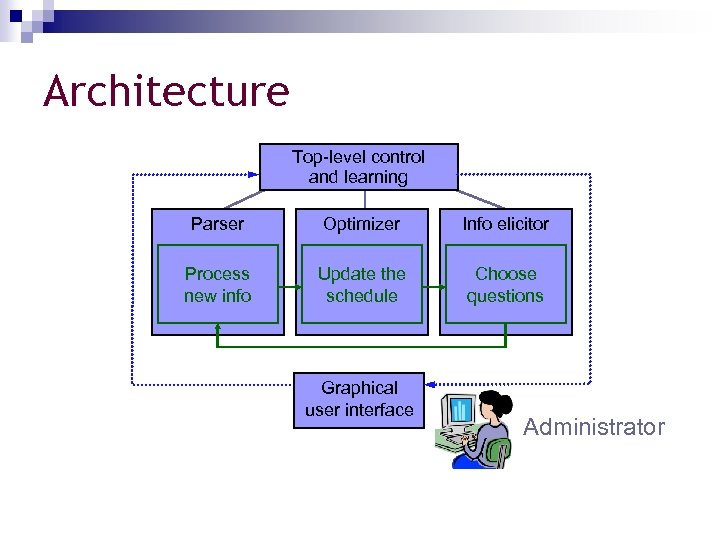 Architecture Top-level control and learning Parser Optimizer Info elicitor Process new info Update the schedule Choose questions Graphical user interface Administrator
 Choice of questions n For each candidate question, estimate the probabilities of possible answers n For each possible answer, compute the respective change of the schedule quality n For each question, compute its expected impact on the schedule quality, and select questions with large expected impacts
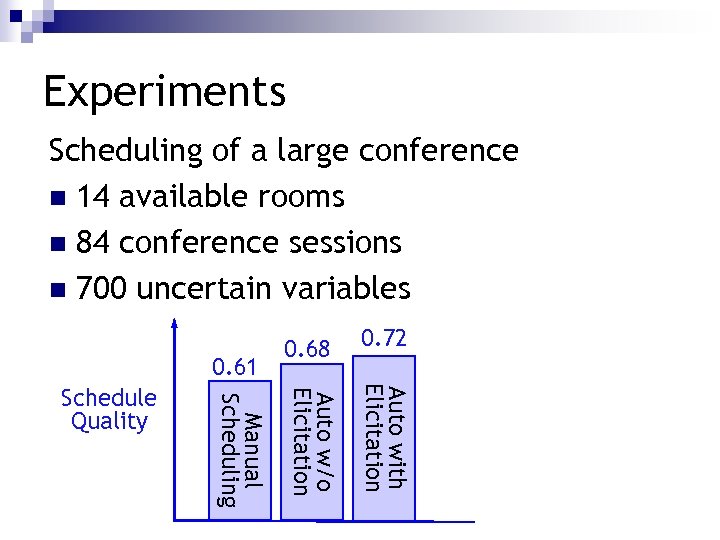 Experiments Scheduling of a large conference n 14 available rooms n 84 conference sessions n 700 uncertain variables Auto with Elicitation Manual Scheduling Schedule Quality 0. 72 Auto w/o Elicitation 0. 61 0. 68
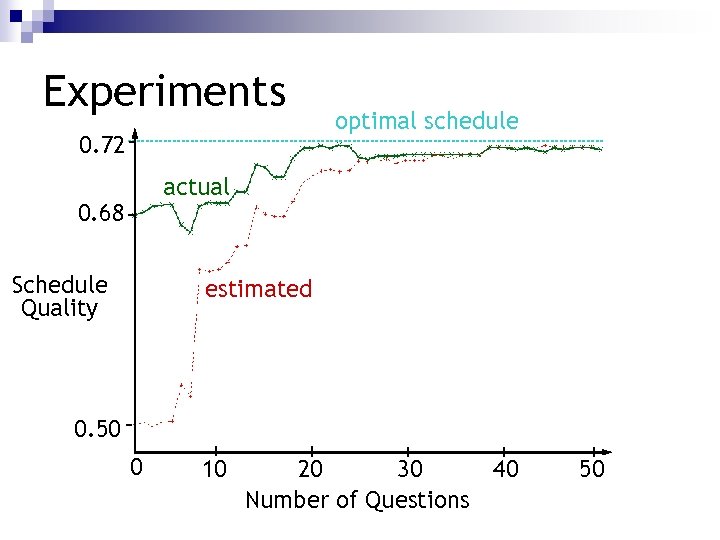 Experiments 0. 72 optimal schedule actual 0. 68 Schedule Quality estimated 0. 50 0 10 20 30 40 Number of Questions 50
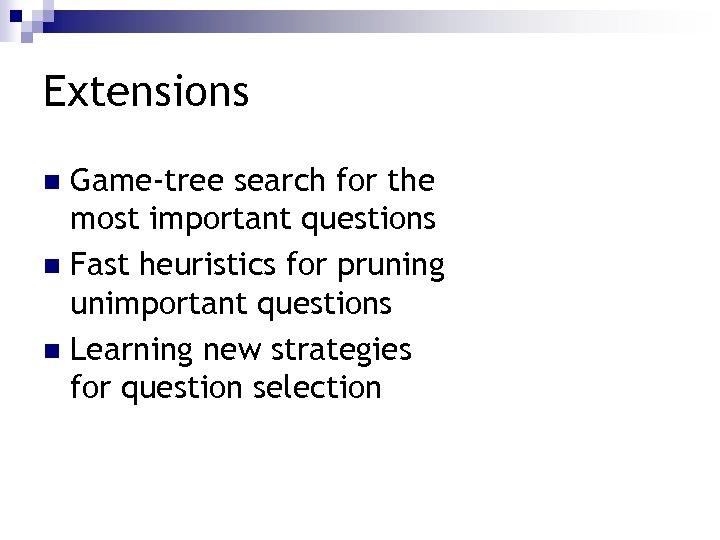 Extensions Game-tree search for the most important questions n Fast heuristics for pruning unimportant questions n Learning new strategies for question selection n
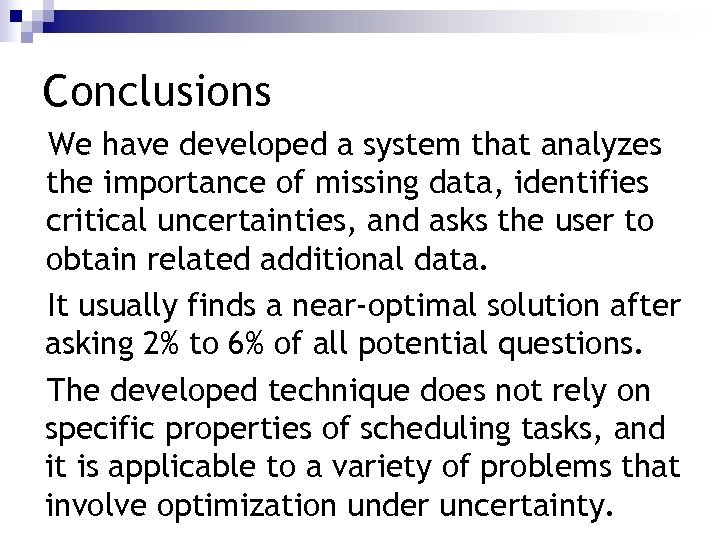 Conclusions We have developed a system that analyzes the importance of missing data, identifies critical uncertainties, and asks the user to obtain related additional data. It usually finds a near-optimal solution after asking 2% to 6% of all potential questions. The developed technique does not rely on specific properties of scheduling tasks, and it is applicable to a variety of problems that involve optimization under uncertainty.