 Скачать презентацию Scheduling of Flexible manufacturing systems an ant colony
433bdc76916daf937e21b1707c270ab0.ppt
- Количество слайдов: 26




Scheduling of Flexible manufacturing systems: an ant colony optimization approach By: R Kumar, M K Tiwari, and R Shankar Tom Willes 19 November 2008 ME 482
Paper Function FMS systems consist of numerous CNC machines able to perform many different functions on different parts. Due to this flexibility, a given operation could be performed on a number of different machines, allowing for many different routings. Among the many available routings, the best available machine for the process should be selected. This creates a very difficult scheduling problem. This paper attempts to use an ant colony optimization (ACO) approach to selecting the best route for each part.
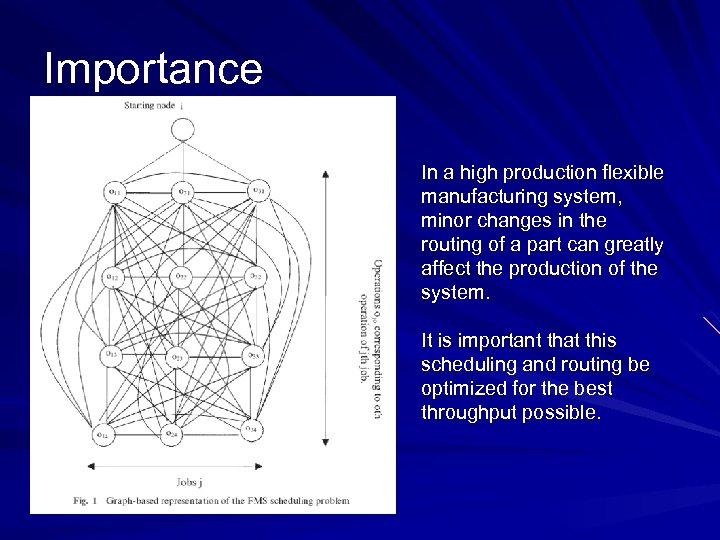
Importance In a high production flexible manufacturing system, minor changes in the routing of a part can greatly affect the production of the system. It is important that this scheduling and routing be optimized for the best throughput possible.
References 1 Li, D. C. and She, I. S. Using unsupervised learning technologies to induce scheduling knowledge for FMSs. Int. FMSs. J. Prod. Res. , 1994, 32(9), 2187± 2199. 2 Shinich, N. and Taketoshi, Y. Dynamic scheduling system utilizing machine learning as a knowledge acquisition Shinich, tool. Int. J. Prod. Res. , 1992, 30, 411± 413. 3 Haddock, J. and O’Keefe, R. M. Using artificial intelligence to facilitate manufacturing systems simulation. Computers and Ind. Engng, 1990, 18(3), 275± 283. Engng, 4 Stecke, K. E. Design, scheduling and control problems of flexible manufacturing systems. Ann. Op. Res. , 1995, Stecke, 3, 3± 12. 5 Andreatta, G. , Deserti, I. and Giraldo, L. N. Scheduling algorithm for a two machine flexible manufacturing Andreatta, Deserti, Giraldo, system. Int. J. Flexible Mfg Systems, 1995, 7, 207± 227. 6 Saruncuoglu, L. and Karabuk, S. A beam search-based algorithm and evaluation of scheduling approaches for Saruncuoglu, Karabuk, flexible manufacturing systems. IIE Trans. , 1999, 30, 179± 191. 7 Jeong, K. C. and Kim, Y. D. A real time scheduling mechanism for a flexible manufacturing system: using Jeong, simulation and dispatch rules. Int. J. Prod. Res. , 1998, 36(9), 2609± 2626. 8 Yih Y. and Thesen, A. Semi-Markov decision models for real-time scheduling. Int. J. Prod. Res. , 1991, 29, Thesen, 2331± 2346. 9 Thesen, A. and Lei, L. An expert scheduling system for material handling hoists. J. Mfg Systems, 1990, 9, Thesen, 247± 252. 10 Shaw, M. J. A pattern-directed approach to flexible manufacturing: a framework for intelligent scheduling, learning, and control. Int. J. Flexible Mfg Systems, 1989, 2, 121± 144. 11 Liang, T. P. , Moskowitz, H. and Yih, Y. Intelligent neural networks and semi-Markov process for automated Liang, Moskowitz, Yih, knowledge acquisition: a real time scheduling. Decision Sci. , 1992, 23, 1297± 1341. Sci. , 12 Chryssolouris, G. , Lee, M. and Domroese, M. The use of neural networks in determining operational policies for Chryssolouris, Domroese, manufacturing systems. J. Mfg Systems, 1991, 10, 166± 175. 13 Talvage, J. J. and Shodhan, R. Automated development of design and control strategy for FMS. Int. J. Talvage, Shodhan, Computer Integrated Mfg, 1992, 5, 335± 348.
References (continued) 14 Bengu, G. A simulation-based scheduler for flexible flow lines. Int. J. Prod. Res. , 1994, 321± 344. Bengu, 15 Kim, M. H. and Kim, Y. D. Simulation based real time scheduling mechanism in a flexible manufacturing system. J. Mfg Systems, 1994, 13, 85± 93. 16 Du N. A. and Prabhu, V. V. Real time distributed scheduling of heterarchical manufacturing systems. J. Mfg e, Du Prabhu, Systems, 1994, 13, 94± 107. 17 Ishii, N. and Muraki, M. An extended dispatching rule approach in an online scheduling framework for the batch Muraki, process management. Int. J. Prod. Res. , 1996, 34, 329± 348. 18 Marie, P. J. A class of Petri nets for manufacturing system integration. IEEE Trans. Robotics and Automn, 1997, 13, 317± 326. 19 Naiqi, W. Necessary and su cient conditions for deadlock free operation in ¯exible manufacturing systems Naiqi, su ¯exible using a colored Petri net model. IEEE Trans. Systems, Man and Cybernetics—Part C: Applications and Reviews, 1999, 29(2), 192± 204. 20 Kim, Y. W. , Inaba, A. , Suzuki, T. and Okuma, S. FMS scheduling based on timed Petri net model and RTA Inaba, algorithm. In Proceedings of the 2001 IEEE International Conference on Robotics and Automation, Seoul, Korea, 21± 26 May 2001, pp. 848± 853. 21 Dorigo, M. , Maniezzo, V. and Colorni, A. Positive feedback as a search strategy. Technical Report 91 -016, Dorigo, Maniezzo, Colorni, Dipartimento di Elettronica, Politechnico di Milano, Italy, 1991. Elettronica, Milano, 22 Dorigo, M. , Maniezzo, V. and Colorni, A. The ant systems: optimization by a colony of cooperative agents. Dorigo, Maniezzo, Colorni, IEEE Trans. Man, Machine and CyberneticsÐPart B, 1996, 26(1), 29± 41. 23 Gambardella, L. M. and Dorigo, M. Ant-Q: a reinforcement learning approach to the travelling salesman problem. Gambardella, L. Dorigo, M. In Proceedings of the Twelfth International Conference on Machine Learning, ML-95, 1995, pp. 252± 260. 24 Dorigo, M. and Gambardella, L. M. Ant colonies for the travelling salesman problem. Bio Systems, 1997, 43, Dorigo, 73± 81. 25 Dorigo, M. and Gambardella, L. M. Ant colony systems: a co-operative learning approach to the travelling Dorigo, salesman problem. IEEE Trans. Evolutionary Computation, 1997, 1(1), 53± 66. 26 Gambardella, L. M. and Dorigo, M. Solving symmetric and asymmetric TSPs by ant colonies. In Proceedings of Dorigo, the IEEE Conference on The Evolutionary Computation, ICE 96, 1996, pp. 622± 627.
References (continued) 27 Stutzle, T. and Hoos, H. The MAX±MIN ant systems and local search for the travelling salesman problem. In Stutzle, Hoos, Proceedings of IEEE±ICEC±EPS, IEEE International Conference on Evolutionary Computation and Evolutionary Programming, 1997, pp. 309± 314. 28 Stutzle, T. and Hoos, H. Improvements on the ant system: introducing MAX±MIN ant system. In Proceedings of Stutzle, Hoos, the International Conference on Artificial Neural Networks and Genetic Algorithms, 1997, pp. 245± 249. 29 Bullnheimer, B. , Hartl, R. F. and Strauss, C. A new rankbased version of the ant system: a computational study. Bullnheimer, Hartl, Technical Report POM-03/97, Institute of Management Science, University of Vienna. In Central European Journal for Operation Research and Economics, 1997. 30 Gambardella, L. M. , Taillard, E. D. and Dorigo, M. Ant colonies for the QAP. J. Opl Res. Soc. , 50, 167± 176. Taillard, Dorigo, 31 Stutzle, T. and Hoos, H. MAX±MIN ant systems and local search for the combinatorial optimization problems. Stutzle, Hoos, 1452 R KUMAR, M K TIWARI AND R SHANKAR Proc. Instn Mech. Engrs Vol. 217 Part B: J. Engineering Manufacture B 18802 # IMech. E 2003 In Advances and Trends in the Local Search Paradigms for the Optimization (Eds I. H. Osama, S. Martello and C. Roucariol), 1998, 137± 154. Roucariol), 32 Maniezzo, V. and Colorni, A. The ant systems applied to the quadratic assignment problem. IEEE Trans. Maniezzo, Colorni, Knowledge and Data Engng, 1999, 11(50), 769± 778. Engng, 33 Maniezzo, V. , Colorni, A. and Dorigo, M. The ant systems applied to the quadratic assignment problem. Maniezzo, Colorni, Dorigo, Technical Report IRIDIA, University Libre de Bruxelles, Belgium, Bruxelles, 1994, pp. 28± 94. 34 Colorni, A. , Dorigo, M. , Maniezzo, V. and Trubian, M. Ant system for job-shop scheduling. Belgian J. Op. Res. , Colorni, Dorigo, Maniezzo, Trubian, Statistics and Computer Sci. , 1994, 39± 53. Sci. , 35 Bullnheimer, B. , Hartl, R. F. and Strauss, C. Applying the ant systems to the vehicle routing problem. In Bullnheimer, Hartl, Advances and Trends in the Local Search Paradigms for Optimization (Eds I. H. Osama, S. Martello and C. (Eds Roucariol), 1998, pp. 109± 120. Roucariol), 36 Lee, D. Y. and Dicesare, F. FMS scheduling using Petri nets and heuristic search. IEEE Trans. Robotics and Dicesare, Automn, 1994, 10(2), 123± 132. Automn, 37 Yim, S. J. and Lee, D. Y. Scheduling method with the consideration of machine setup in flexible manufacturing Yim, systems. In Proceedings of IEEE International Conference on Robotics and Automation, Albuquerque, New Mexico, April 1997, pp. 2735± 2740.
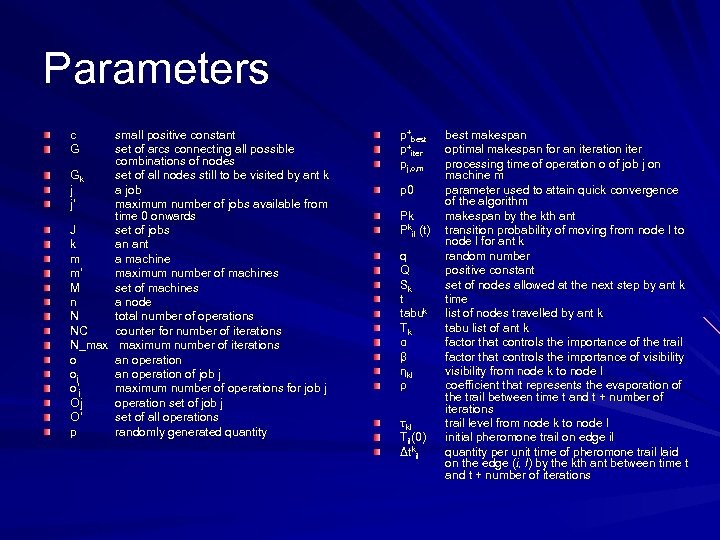
Parameters c G small positive constant set of arcs connecting all possible combinations of nodes Gk set of all nodes still to be visited by ant k j a job j’ maximum number of jobs available from time 0 onwards J set of jobs k an ant m a machine m’ maximum number of machines M set of machines n a node N total number of operations NC counter for number of iterations N_max maximum number of iterations o an operation oj an operation of job j o’j maximum number of operations for job j Oj operation set of job j O’ set of all operations p randomly generated quantity p+best p+iter pj, o, m p 0 Pk Pkil (t) q Q Sk t tabuk Tk α β ηkl ρ τkl Τil(0) Δtkil best makespan optimal makespan for an iteration iter processing time of operation o of job j on machine m parameter used to attain quick convergence of the algorithm makespan by the kth ant transition probability of moving from node I to node l for ant k random number positive constant set of nodes allowed at the next step by ant k time list of nodes travelled by ant k tabu list of ant k factor that controls the importance of the trail factor that controls the importance of visibility from node k to node l coefficient that represents the evaporation of the trail between time t and t + number of iterations trail level from node k to node l initial pheromone trail on edge il quantity per unit time of pheromone trail laid on the edge (i, l) by the kth ant between time t (i and t + number of iterations
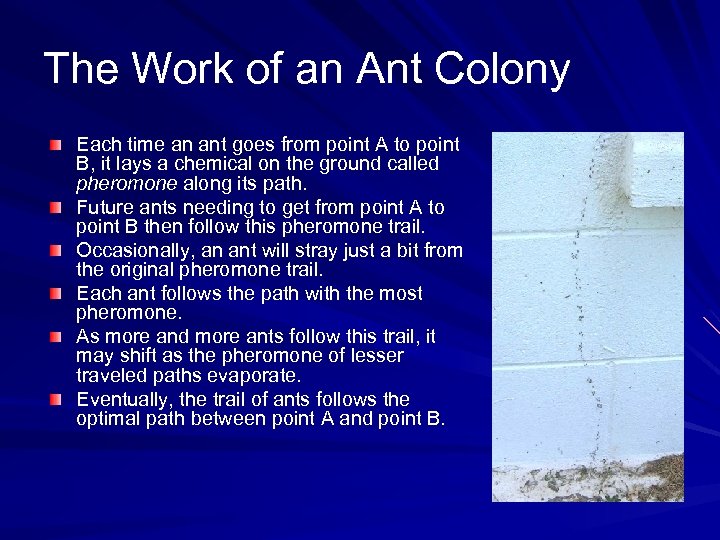
The Work of an Ant Colony Each time an ant goes from point A to point B, it lays a chemical on the ground called pheromone along its path. Future ants needing to get from point A to point B then follow this pheromone trail. Occasionally, an ant will stray just a bit from the original pheromone trail. Each ant follows the path with the most pheromone. As more and more ants follow this trail, it may shift as the pheromone of lesser traveled paths evaporate. Eventually, the trail of ants follows the optimal path between point A and point B.

Ants find shortest path video http: //video. google. com/videoplay? docid=4748362485426843791&hl=en
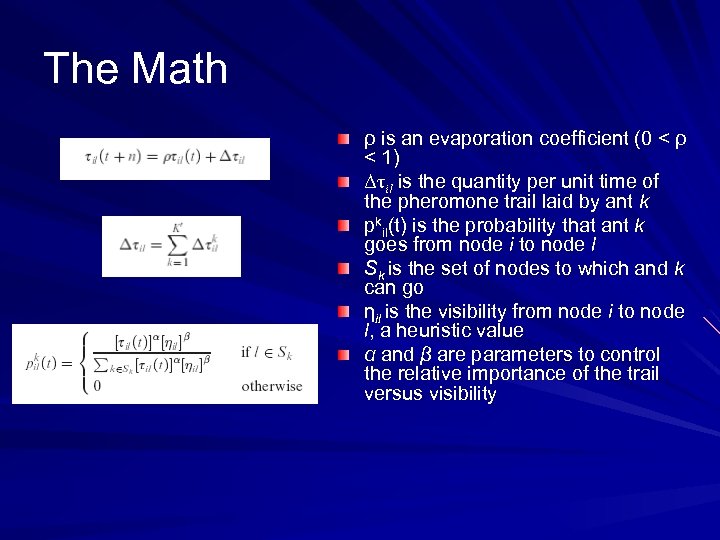
The Math ρ is an evaporation coefficient (0 < ρ < 1) Δτil is the quantity per unit time of the pheromone trail laid by ant k pkil(t) is the probability that ant k goes from node i to node l Sk is the set of nodes to which and k can go ηil is the visibility from node i to node l, a heuristic value α and β are parameters to control the relative importance of the trail versus visibility
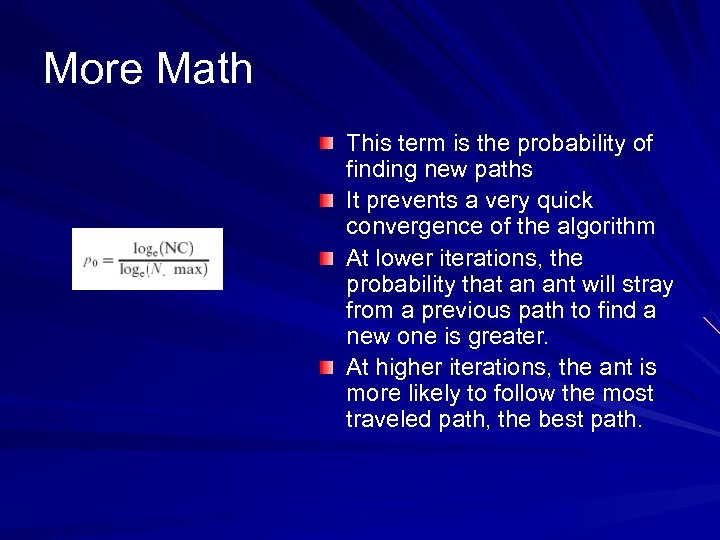
More Math This term is the probability of finding new paths It prevents a very quick convergence of the algorithm At lower iterations, the probability that an ant will stray from a previous path to find a new one is greater. At higher iterations, the ant is more likely to follow the most traveled path, the best path.
Program Summary Step 1: Initialize Program Step 2: Breaks iteration counting loop (2 -7) Step 3: Breaks ant counting loop (3 -6) Step 4: Breaks node selection loop (4 -5) Step 5: Node Selection (random) Step 6: Ant counter Step 7: Updating pheromone trail, probability value, and best makespan thus far Step 8: Output result
Step 1: Initialization 1. Represent the problem using a weighted directed graph. 2. Randomly distribute ants on the nodes. 3. Set t = 0; /*{time counter}*/ 4. Set NC = 1; /*(number of iterations/number of cycles counter)*/ 5. Set τil(0) = c; on each node /* τil(0) is the initial pheromone trail on the edge il and c is a small positive constant*/ 6. Set Δτil = 0; on each node /* Δτil is the increase in the trail level on edge il */ 7. Set tabuk = 0; /* tabuk gives the list of nodes traversed by ant k */ 8. Set p 0 = 0;
Steps 2 -4 Step 2. If NC > N_max go to Step 8, else go to Step 3 /*N_max is the maximum number of iterations*/ Step 3. If m > m_max go to Step 7 else go to Step 4 /*m gives the ant number and m_max stands for the maximum number of ants*/ Step 4. If tabuk > tabukmax go to Step 6 else go to Step 5 /*tabukmax gives the maximum number of nodes to be visited by ant k*/
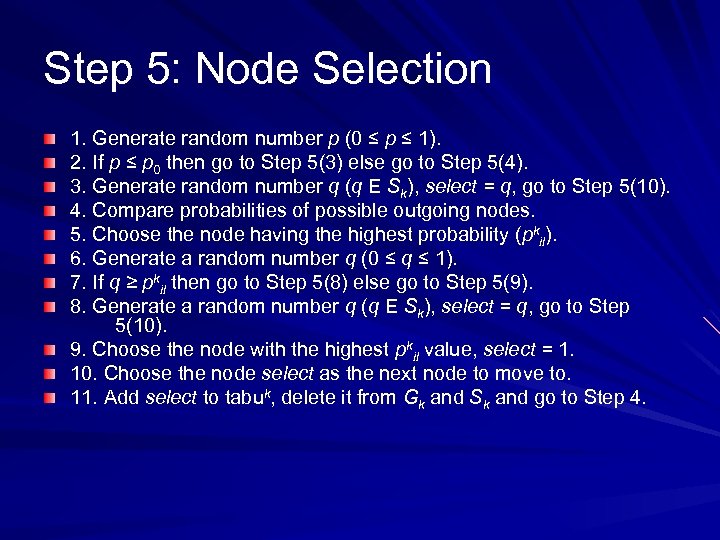
Step 5: Node Selection 1. Generate random number p (0 ≤ p ≤ 1). 2. If p ≤ p 0 then go to Step 5(3) else go to Step 5(4). 3. Generate random number q (q E Sk), select = q, go to Step 5(10). 4. Compare probabilities of possible outgoing nodes. 5. Choose the node having the highest probability (pkil). 6. Generate a random number q (0 ≤ q ≤ 1). 7. If q ≥ pkil then go to Step 5(8) else go to Step 5(9). 8. Generate a random number q (q E Sk), select = q, go to Step 5(10). 9. Choose the node with the highest pkil value, select = 1. 10. Choose the node select as the next node to move to. 11. Add select to tabuk, delete it from Gk and Sk and go to Step 4.
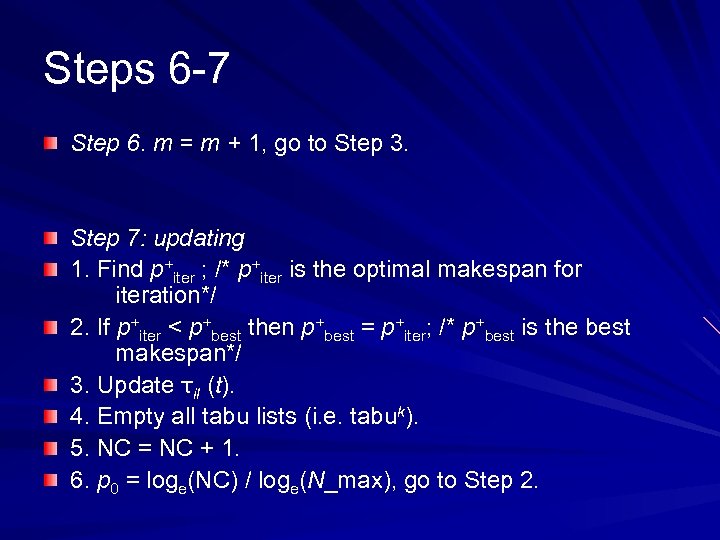
Steps 6 -7 Step 6. m = m + 1, go to Step 3. Step 7: updating 1. Find p+iter ; /* p+iter is the optimal makespan for iteration*/ 2. If p+iter < p+best then p+best = p+iter; /* p+best is the best makespan*/ 3. Update τil (t). 4. Empty all tabu lists (i. e. tabuk). 5. NC = NC + 1. 6. p 0 = loge(NC) / loge(N_max), go to Step 2.
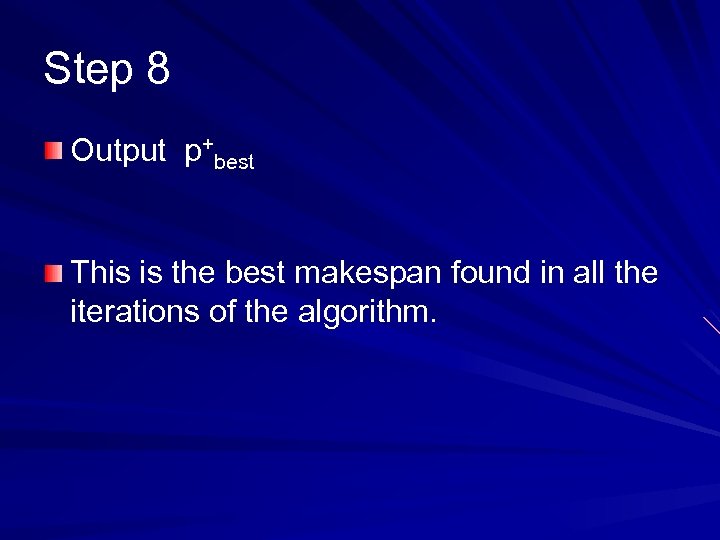
Step 8 Output p+best This is the best makespan found in all the iterations of the algorithm.
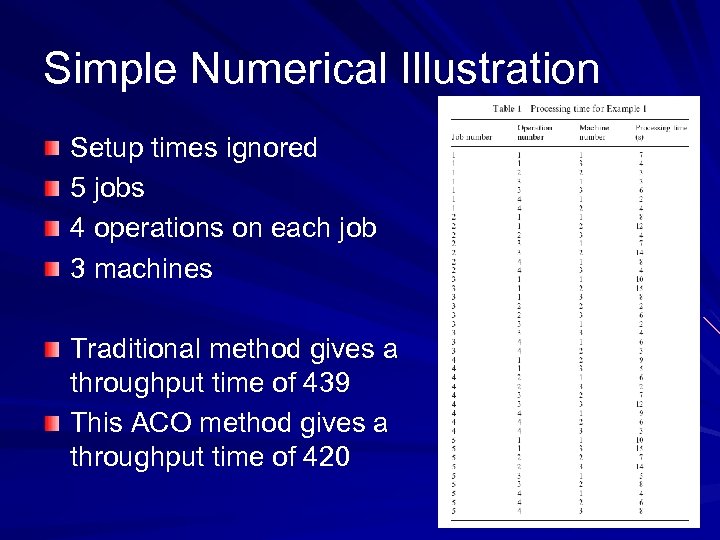
Simple Numerical Illustration Setup times ignored 5 jobs 4 operations on each job 3 machines Traditional method gives a throughput time of 439 This ACO method gives a throughput time of 420
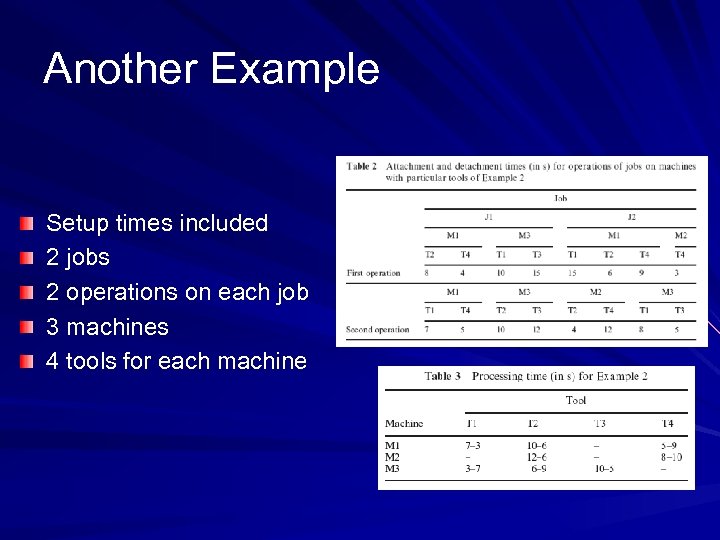
Another Example Setup times included 2 jobs 2 operations on each job 3 machines 4 tools for each machine
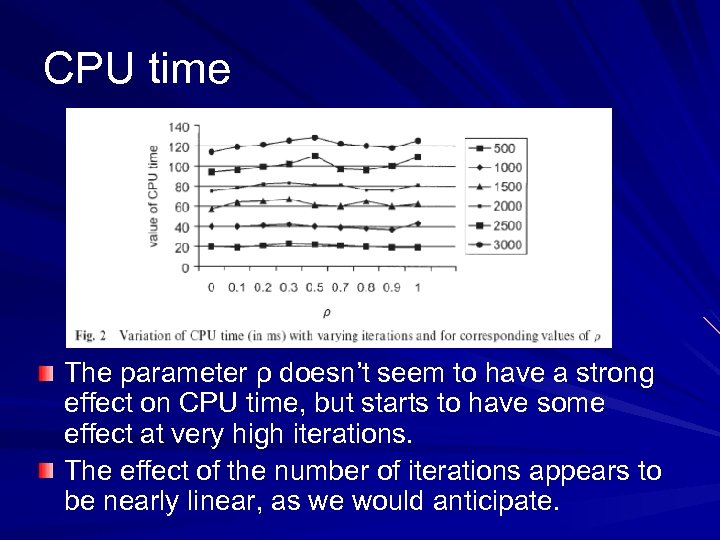
CPU time The parameter ρ doesn’t seem to have a strong effect on CPU time, but starts to have some effect at very high iterations. The effect of the number of iterations appears to be nearly linear, as we would anticipate.
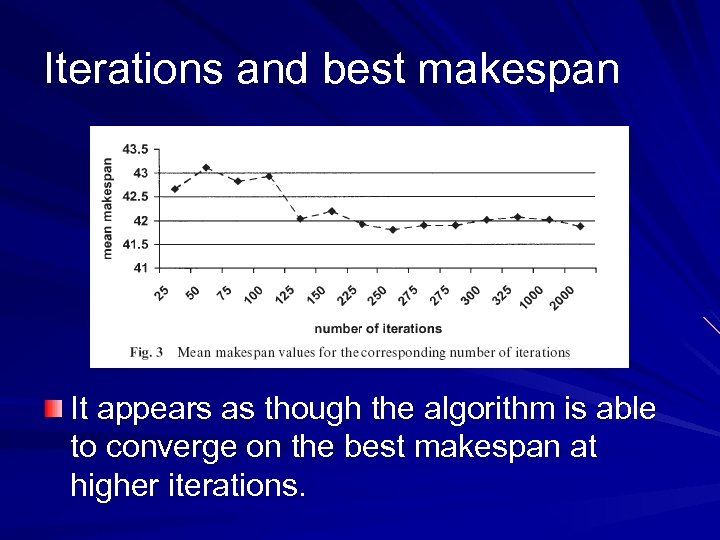
Iterations and best makespan It appears as though the algorithm is able to converge on the best makespan at higher iterations.
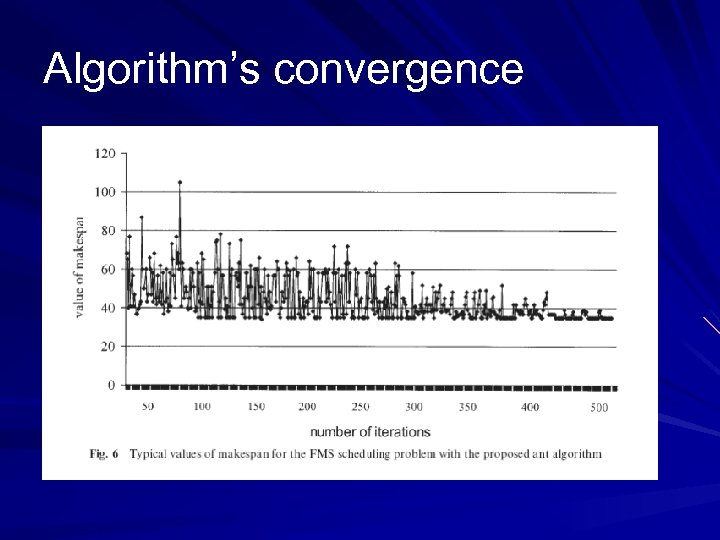
Algorithm’s convergence
Conclusions “The value of the makespan for the problem with 400 iterations comes out to be 439 by the method proposed by Lee and Dicesari [36] and Yim and Lee [37], whereas for the same problem the present method gives 420, which is lower than the value obtained by Lee and Dicesari [36]. Thus the superiority of the present method is proved over the PN-based method proposed by Lee and Dicesari [36]. ” (bottom of page 1447)
Conclusions (continued) I think… The authors failed to prove their method better than others in use. They failed to prove the value of this model. The authors were creative in their attempt to apply an ant model to a FMS.
Conclusions (continued) All they did was find a lower makespan. Is it attainable in a real FMS? What adjustments would make this more practical for industrial use? It would be more valuable if the output was a matrix showing the trail of the best makespan, the final ant trail.

BYU 31 Uof. U 27
Скачать презентацию Scheduling of Flexible manufacturing systems an ant colony
433bdc76916daf937e21b1707c270ab0.ppt