 Скачать презентацию Schedules and Overlays Interactions Between Information Scheduling and
f797e2f5813ca0c5d1cdc46772130a3f.ppt
- Количество слайдов: 40



Schedules and Overlays: Interactions Between Information Scheduling and Topology Management in P 2 P Streaming Torino, 21 th January 2011 Renato Lo Cigno University of Trento (UNITN) NAPA-WINE Final Workshop – Torino 20 -21 Jan 20 -21, 2011 locigno@disi. unitn. it
Agenda n n n Selecting peers and planning transfers: topology management or information scheduling? Scheduling in structured systems: What is the freedom? The NAPA-WINE architecture: a reprise An approach based on offer/trade protocol Analysis of Push based scheduling on quasirandom topologies NAPA-WINE Final Workshop – Torino 20 -21 Jan 20 -21, 2011 locigno@disi. unitn. it 2
Structures or Swarms n Structured systems follow regular topologies q q q n Imply a (relatively) small number of contacts Restrict freedom in scheduling information Simplify scheduling choices (if any) Swarms do not have a regular topology q q Large number of neighbors Reduced sensitivity to topology changes (churn) Multiple choices for information exchange Resilient but … can they perform? NAPA-WINE Final Workshop – Torino 20 -21 Jan 20 -21, 2011 locigno@disi. unitn. it 3
Structured systems: Scheduling follows topology n n n Trees & Multi-Trees The burden or performance is entirely on the tree maintenance algorithm Non bandwidth-optimal (trees) NAPA-WINE Final Workshop – Torino 20 -21 Jan 20 -21, 2011 locigno@disi. unitn. it 4
Structured systems: Scheduling follows topology n n n Trees & Multi-Trees The burden or performance is entirely on the tree maintenance algorithm Non bandwidth-optimal (trees) Regular trees (and forests) Suffer from heterogeneity NAPA-WINE Final Workshop – Torino 20 -21 Jan 20 -21, 2011 locigno@disi. unitn. it 5
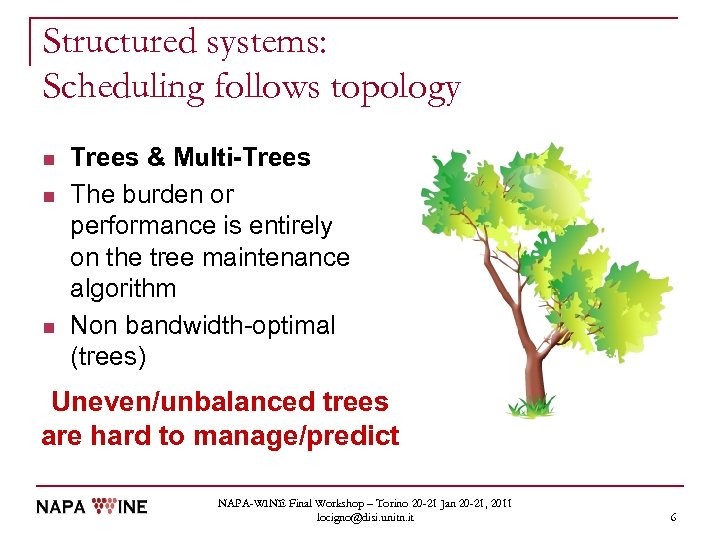
Structured systems: Scheduling follows topology n n n Trees & Multi-Trees The burden or performance is entirely on the tree maintenance algorithm Non bandwidth-optimal (trees) Uneven/unbalanced trees are hard to manage/predict NAPA-WINE Final Workshop – Torino 20 -21 Jan 20 -21, 2011 locigno@disi. unitn. it 6
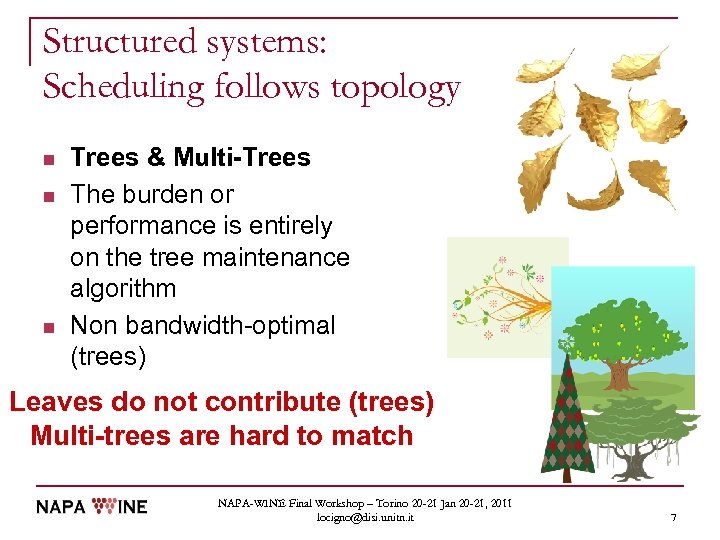
Structured systems: Scheduling follows topology n n n Trees & Multi-Trees The burden or performance is entirely on the tree maintenance algorithm Non bandwidth-optimal (trees) Leaves do not contribute (trees) Multi-trees are hard to match NAPA-WINE Final Workshop – Torino 20 -21 Jan 20 -21, 2011 locigno@disi. unitn. it 7
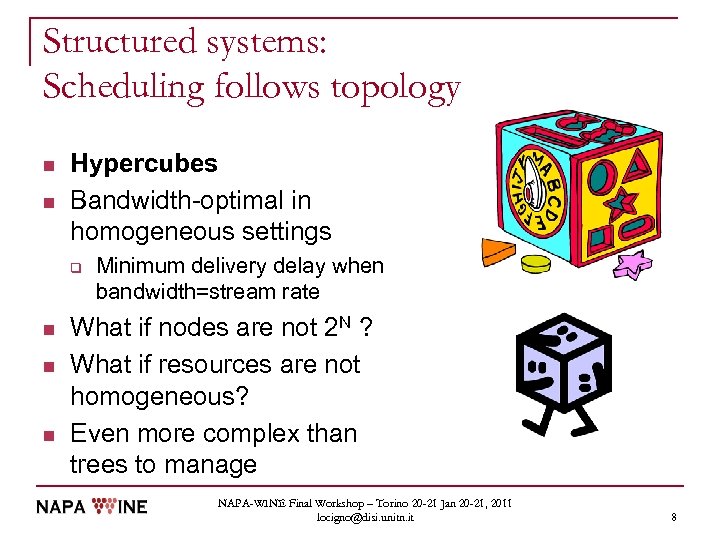
Structured systems: Scheduling follows topology n n Hypercubes Bandwidth-optimal in homogeneous settings q n n n Minimum delivery delay when bandwidth=stream rate What if nodes are not 2 N ? What if resources are not homogeneous? Even more complex than trees to manage NAPA-WINE Final Workshop – Torino 20 -21 Jan 20 -21, 2011 locigno@disi. unitn. it 8
Unstructured systems: Scheduling decisions are required n n n The information flow does not follow the structure of the topology Peers have a neighborhood, not parents & children ¿ What chunk to send / request ? ¿ To / From which peer ? ¿ When ? NAPA-WINE Final Workshop – Torino 20 -21 Jan 20 -21, 2011 locigno@disi. unitn. it 9
Unstructured systems: Random Topologies & Blind Selection n Normally based on Pull q q n Choose neighbors at random (nearly/biased) q n Blind Push is too wasteful Derived from file-sharing and Bit. Torrent Often following a selfish utility function Search in neighborhood the information (chunks) more needed from the peers that gives them fast q q Bad Neighborhood? n Sorry, watch TV next time … or try to change it Inefficient Neighborhood? n The networks (and other peers) will suffer … who cares! NAPA-WINE Final Workshop – Torino 20 -21 Jan 20 -21, 2011 locigno@disi. unitn. it 10
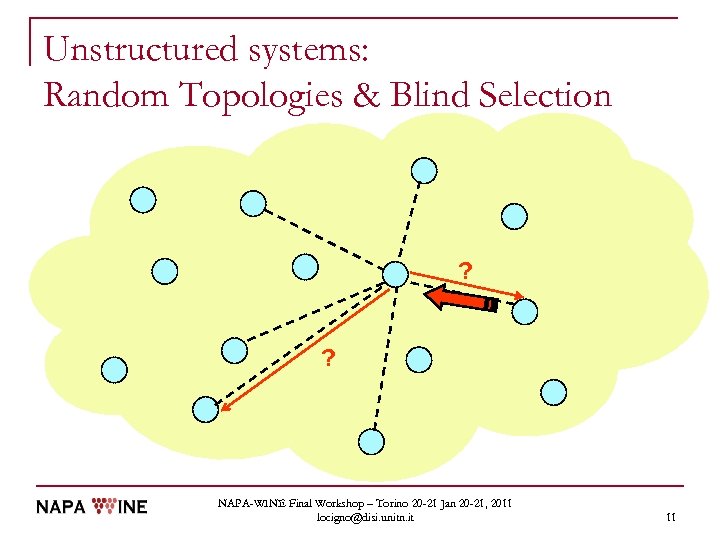
Unstructured systems: Random Topologies & Blind Selection ? ? NAPA-WINE Final Workshop – Torino 20 -21 Jan 20 -21, 2011 locigno@disi. unitn. it 11
Unstructured systems: Beyond Random Pull n Required functionalities q A Peer discovery protocol n n q n If good gives a random topology (may include a tracker) Includes decisions on When / Who / What and Pull / Push A chunk exchange protocol Additional (useful) functionalities q A Topology Management protocol n n q Obtains topologies with given characteristics May make use of ALTO-like oracles A robust, efficient, chunk/peer scheduler n n n Must be coupled to the Topology Management Requires knowledge (signaling overhead) Can be Pull/Push or mixed NAPA-WINE Final Workshop – Torino 20 -21 Jan 20 -21, 2011 locigno@disi. unitn. it 12
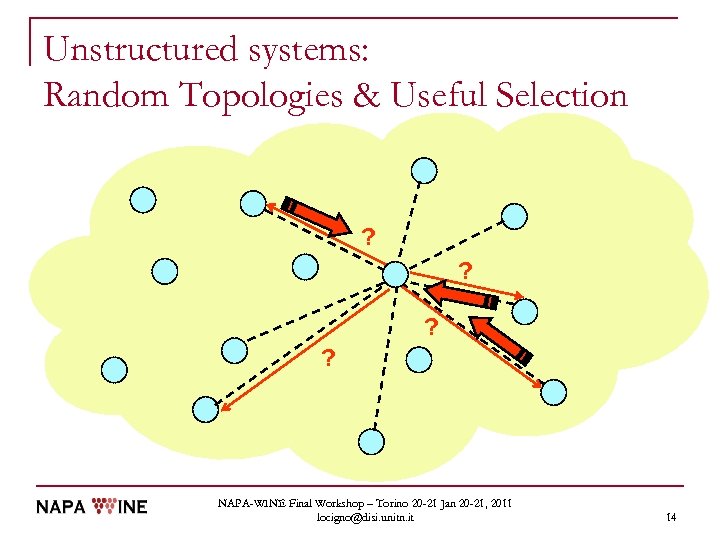
Unstructured systems: Random Topologies & Useful Selection ? ? NAPA-WINE Final Workshop – Torino 20 -21 Jan 20 -21, 2011 locigno@disi. unitn. it 14
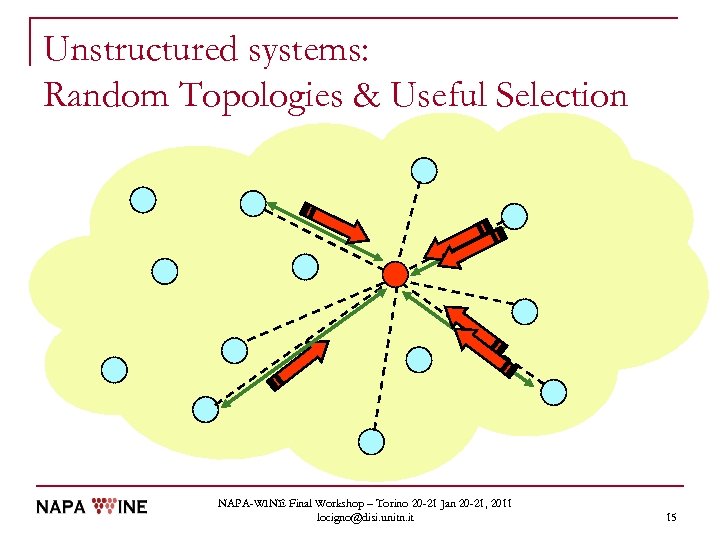
Unstructured systems: Random Topologies & Useful Selection NAPA-WINE Final Workshop – Torino 20 -21 Jan 20 -21, 2011 locigno@disi. unitn. it 15
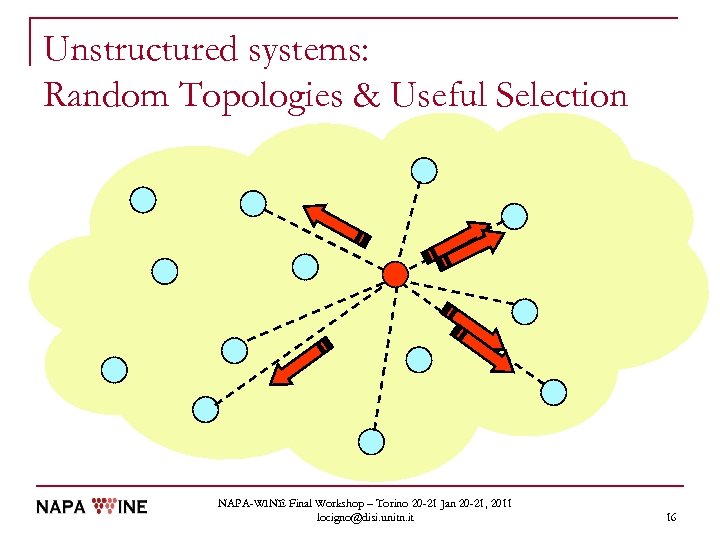
Unstructured systems: Random Topologies & Useful Selection NAPA-WINE Final Workshop – Torino 20 -21 Jan 20 -21, 2011 locigno@disi. unitn. it 16
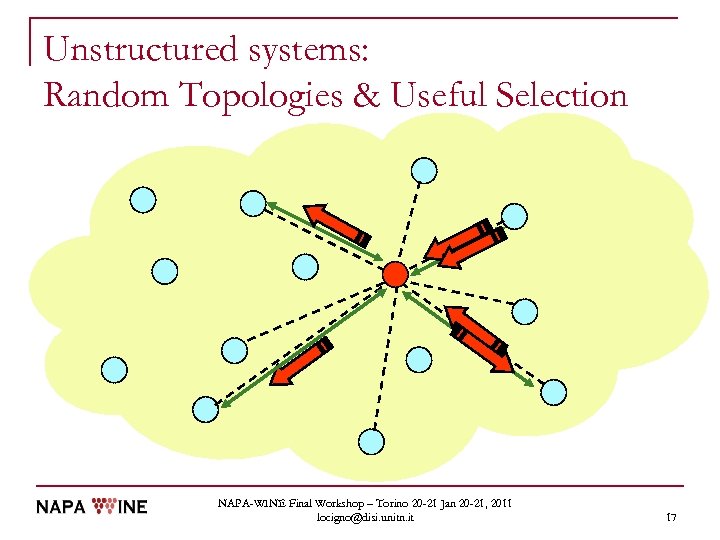
Unstructured systems: Random Topologies & Useful Selection NAPA-WINE Final Workshop – Torino 20 -21 Jan 20 -21, 2011 locigno@disi. unitn. it 17

NAPA-WINE architecture User Layer Video Source(s) Content Player Ingestion Display(s) Control Interface Overlay Layer Scheduler layer Ext-Rep Chunk buffer Active peers’ Info. Base Topology controller Net-Rep Monitoring layer Peer-Rep Trading Logic Peer Selection REP controller Neighbour set Monitoring Controller Pasv. meas Act. meas Messaging. Final Workshop – Torino. Conference 20 -21, 2011 Layer + NAT/FW traversal NAPA-WINE Second Video 20 -21 Jan NAPA-WINE 22 Oct 2008 locigno@disi. unitn. it IPv 4 / IPv 6 + UDP / TCP / SCTP /. . . 18
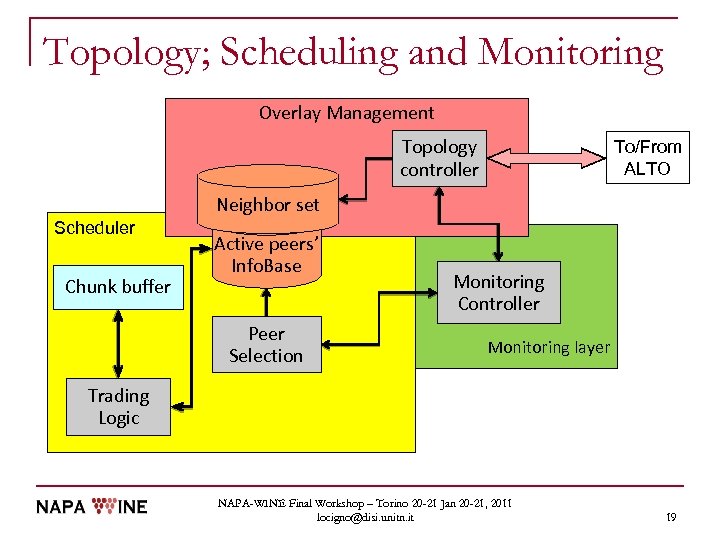
Topology; Scheduling and Monitoring Overlay Management Topology controller To/From ALTO Neighbor set Scheduler Chunk buffer Active peers’ Info. Base Peer Selection Monitoring Controller Monitoring layer Trading Logic NAPA-WINE Final Workshop – Torino 20 -21 Jan 20 -21, 2011 locigno@disi. unitn. it 19
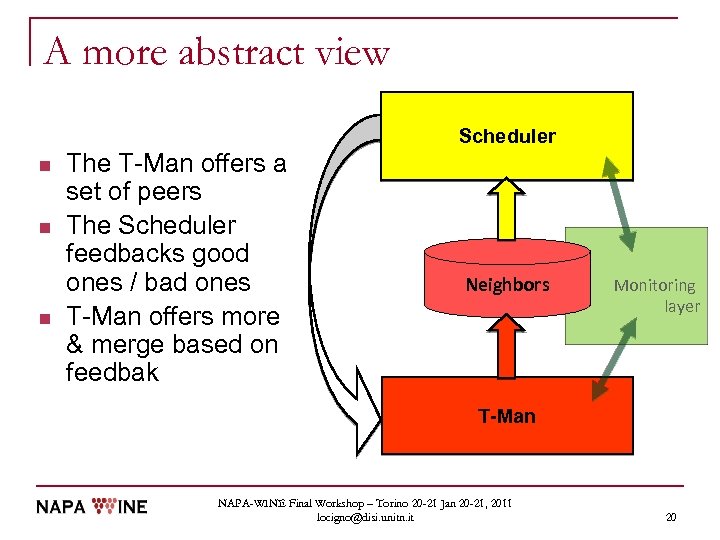
A more abstract view Scheduler n n n The T-Man offers a set of peers The Scheduler feedbacks good ones / bad ones T-Man offers more & merge based on feedbak Neighbors Monitoring layer T-Man NAPA-WINE Final Workshop – Torino 20 -21 Jan 20 -21, 2011 locigno@disi. unitn. it 20
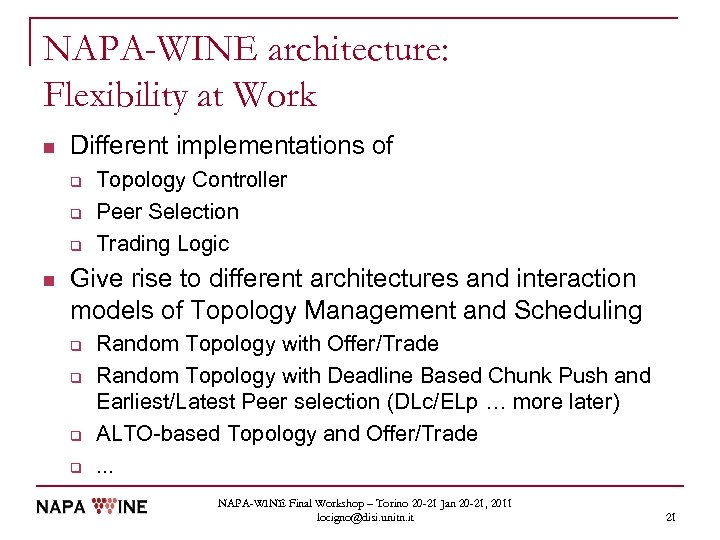
NAPA-WINE architecture: Flexibility at Work n Different implementations of q q q n Topology Controller Peer Selection Trading Logic Give rise to different architectures and interaction models of Topology Management and Scheduling q q Random Topology with Offer/Trade Random Topology with Deadline Based Chunk Push and Earliest/Latest Peer selection (DLc/ELp … more later) ALTO-based Topology and Offer/Trade. . . NAPA-WINE Final Workshop – Torino 20 -21 Jan 20 -21, 2011 locigno@disi. unitn. it 21
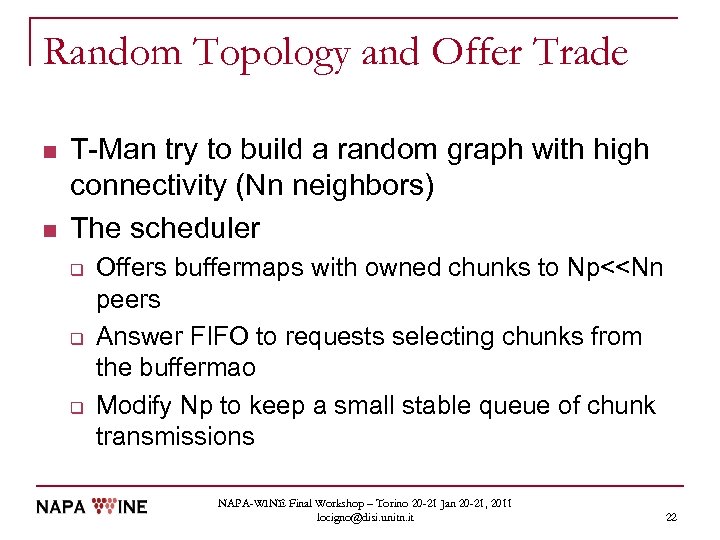
Random Topology and Offer Trade n n T-Man try to build a random graph with high connectivity (Nn neighbors) The scheduler q q q Offers buffermaps with owned chunks to Np<<Nn peers Answer FIFO to requests selecting chunks from the buffermao Modify Np to keep a small stable queue of chunk transmissions NAPA-WINE Final Workshop – Torino 20 -21 Jan 20 -21, 2011 locigno@disi. unitn. it 22
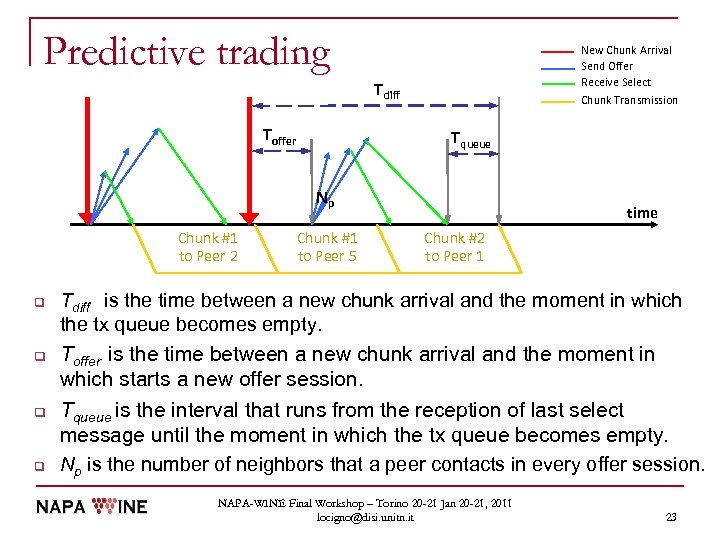
Predictive trading New Chunk Arrival Send Offer Receive Select Tdiff Toffer Chunk Transmission Tqueue Np Chunk #1 to Peer 2 q q Chunk #1 to Peer 5 time Chunk #2 to Peer 1 Tdiff is the time between a new chunk arrival and the moment in which the tx queue becomes empty. Toffer is the time between a new chunk arrival and the moment in which starts a new offer session. Tqueue is the interval that runs from the reception of last select message until the moment in which the tx queue becomes empty. Np is the number of neighbors that a peer contacts in every offer session. NAPA-WINE Final Workshop – Torino 20 -21 Jan 20 -21, 2011 locigno@disi. unitn. it 23
The Adaptative Signaling Protocol n Crucial parameters q Np should match peer upload capacity n If Np is too small v v v n If Np is too large v v v q Peers’ upload bandwidth is not exploited at best The transmission queue empties quickly Long periods of inactivity Transmission queue becomes too long Large delivery delays and, possibly, losses A lot of signaling overhead is produced Tdiff should match the minimum RTT among neighbors to avoid long idle periods (this means Toffer = Tqueue = 0) NAPA-WINE Final Workshop – Torino 20 -21 Jan 20 -21, 2011 locigno@disi. unitn. it 24
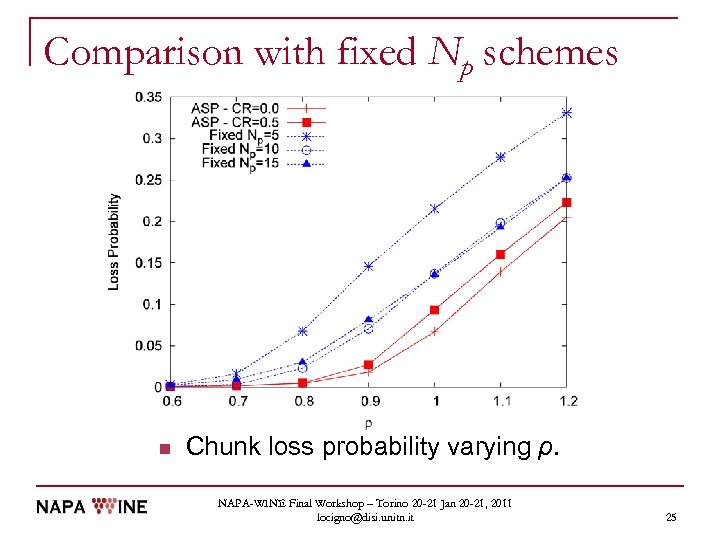
Comparison with fixed Np schemes n Chunk loss probability varying ρ. NAPA-WINE Final Workshop – Torino 20 -21 Jan 20 -21, 2011 locigno@disi. unitn. it 25
Offer/Trade scheduling n A form of Random Peer selection q q n Bias towards peers that are closer & with more bandwidth (faster to answer) Blind, or with explicit preference for peers with higher upload (must be diffused with signaling) Chunk selection left to the destination q q Selfish – does not take into account further distribution chances Random Useful (results shown) or Latest Useful NAPA-WINE Final Workshop – Torino 20 -21 Jan 20 -21, 2011 locigno@disi. unitn. it 27
More on Scheduling n Lots of works done q q Most ignore interaction with topology, assuming either full mesh or random with high connectivity Most ignore difference between n Pull (the receiver decides what to receive and from whom) Push (the sender decides what to send and to whom) Explored in NAPA-WINE q q q Push/Pull differences; Mixed schemes Chunk or Peer First strategies One distributed scheme, based on “Push, Chunk First” has been proven optimal NAPA-WINE Final Workshop – Torino 20 -21 Jan 20 -21, 2011 locigno@disi. unitn. it 28
Scheduling Chunks and Peers n Chunks q q n Random Useful (RU) Latest Useful (LU) – found fragile for pushing Earliest Useful (EU) Dead. Line (DL), updated dynamically Peers q q q Random Useful (RU) Most Deprived (MD) Earliest Latest (EL) n DLc/ELp Proven Optimal n All can be combined with “network awareness” (bandwidth, delay, . . . ) thus interacting with and modifying the topology NAPA-WINE Final Workshop – Torino 20 -21 Jan 20 -21, 2011 locigno@disi. unitn. it 29
DLc/ELp (push, chunk first) n DLc: select the chunk i with the minimum deadline di q q n di = chunk emission time + T’ Ntx T’: any time larger than the chunk duration T Ntx: number of times this copy or the chunk has been retransmitted by any peer Intuition: the smallest deadline identifies a chunk that is old AND has not diffused in the system ELp: select the Peer which has the oldest most recent chunk q q It is the peer which is distributing the oldest information Intuition: it is the peer that will be the first to start distributing the chunk we give it NAPA-WINE Final Workshop – Torino 20 -21 Jan 20 -21, 2011 locigno@disi. unitn. it 30
DLc/ELp (push, chunk first) n n n Distributed, but requires buffermap diffusion Robust to small neighborhoods Sensitive to stale buffermaps q n Confirmation before sending? OPTIMAL q q Uniform scenario with bandwidth = streaming rate All peer receive all stream with delay td td < log N + 1 NAPA-WINE Final Workshop – Torino 20 -21 Jan 20 -21, 2011 locigno@disi. unitn. it 31
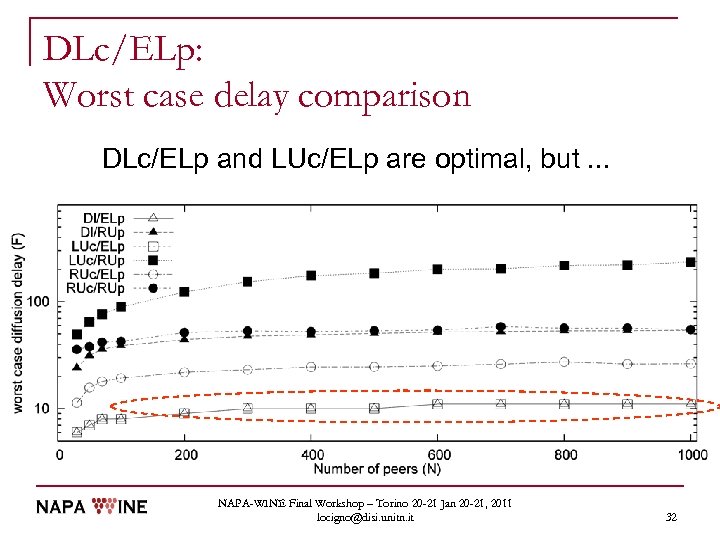
DLc/ELp: Worst case delay comparison DLc/ELp and LUc/ELp are optimal, but. . . NAPA-WINE Final Workshop – Torino 20 -21 Jan 20 -21, 2011 locigno@disi. unitn. it 32
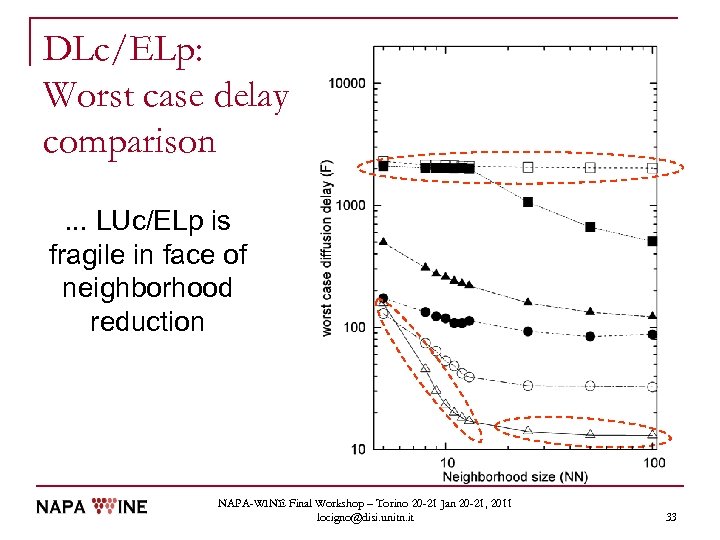
DLc/ELp: Worst case delay comparison. . . LUc/ELp is fragile in face of neighborhood reduction NAPA-WINE Final Workshop – Torino 20 -21 Jan 20 -21, 2011 locigno@disi. unitn. it 33
More on Scheduling The goals we have are three n 1. 2. 3. Minimize delays: Can we do better than offer/trade? Minimize bandwidth wastes: No wrong decisions Be Network-Aware: refine and optimize topology DLδc/BAβELP n q q δ is the postponing delay and can be used also for priorities (embedded in chunks – see the presentation on Qo. S for that) β is a weight for the bandwidth parameter NAPA-WINE Final Workshop – Torino 20 -21 Jan 20 -21, 2011 locigno@disi. unitn. it 34
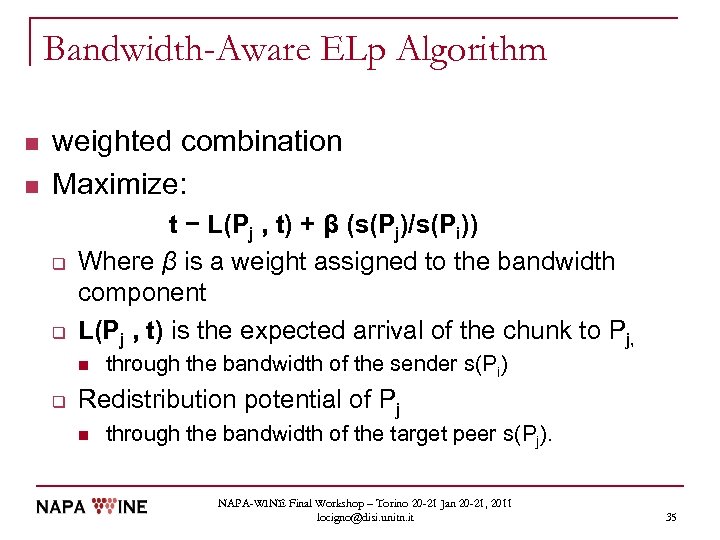
Bandwidth-Aware ELp Algorithm n n weighted combination Maximize: q q t − L(Pj , t) + β (s(Pj)/s(Pi)) Where β is a weight assigned to the bandwidth component L(Pj , t) is the expected arrival of the chunk to Pj, n q through the bandwidth of the sender s(Pi) Redistribution potential of Pj n through the bandwidth of the target peer s(Pj). NAPA-WINE Final Workshop – Torino 20 -21 Jan 20 -21, 2011 locigno@disi. unitn. it 35
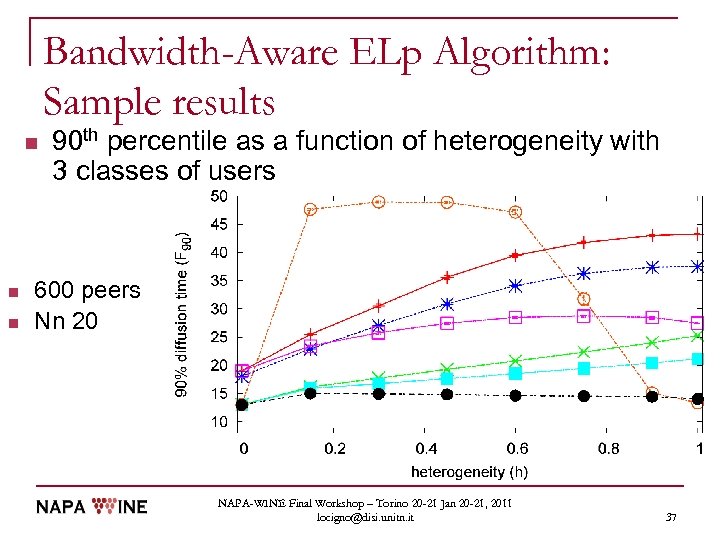
Bandwidth-Aware ELp Algorithm: Sample results n n n 90 th percentile as a function of heterogeneity with 3 classes of users 600 peers Nn 20 NAPA-WINE Final Workshop – Torino 20 -21 Jan 20 -21, 2011 locigno@disi. unitn. it 37
Selected Literature (from NAPA-WINE) n n C. Kiraly, R. Lo Cigno, and L. Abeni, “Deadline-based Differentiation in P 2 P Streaming, ” in IEEE GLOBECOM 2010, Miami, Florida, USA, Dec. 2010 A. Carta, M. Mellia, M. Meo, and S. Traverso, “Efficient Uplink Bandwidth Utilization in P 2 P-TV Streaming Systems, ” in IEEE GLOBECOM 2010, Miami, Florida, US), Dec. 2010 J. Seedorf, S. Niccolini, M. Stiemerling, E. Ferranti, and R. Winter, “Quantifying operational Cost-Savings through ALTOGuidance for P 2 P Live Streaming, ” in 3 rd Workshop on Economic Traffic Management (ETM 2010), Sept. 2010 R. Fortuna, E. Leonardi, M. Mellia, M. Meo, and S. Traverso, “Qo. E in Pull Based P 2 P-TV Systems: Overlay Topology Design Tradeoffs, ” in Proceedings of the 10 th International Conference on Peer-to-Peer Computing 2010 (P 2 P'10), Delft, The Netherlands, August 2010 NAPA-WINE Final Workshop – Torino 20 -21 Jan 20 -21, 2011 locigno@disi. unitn. it 38

Selected Literature (from NAPA-WINE) n n A. Russo and R. Lo Cigno, “Delay-Aware Push/Pull Protocols for Live Video Streaming in P 2 P Systems, ” in IEEE ICC 2010, Cape Town, South Africa, May 2010 L. Abeni, C. Kiraly, and R. Lo Cigno, “Robust Scheduling of Video Streams in Network-Aware P 2 P Applications, ” in IEEE ICC 2010, Cape Town, South Africa, May 2010 C. Kiraly, L. Abeni, and R. Lo Cigno, “Effects of P 2 P Streaming on Video Quality, ” in IEEE ICC 2010, Cape Town, South Africa, May 2010 A. Couto da Silva, E. Leonardi, M. Mellia, and M. Meo, “Chunk Distribution in Mesh-Based Large Scale P 2 P Streaming Systems: a Fluid Approach, ” IEEE Transactions on Parallel and Distributed Systems, To appear NAPA-WINE Final Workshop – Torino 20 -21 Jan 20 -21, 2011 locigno@disi. unitn. it 39
Selected Literature (from NAPA-WINE) n n R. Birke, E. Leonardi, M. Mellia, A. Bakay, T. Szemethy, C. K. amd R. Lo Cigno, F. Mathieu, L. Muscariello, S. Niccolini, J. Seedorf, and G. Tropea, “ Architecture of a Network-Aware P 2 P-TV Application: the NAPA-WINE Approach, ” IEEE Communication Magazine, To appear A. Couto da Silva, E. Leonardi, M. Mellia, and M. Meo, “Exploiting Heterogeneity in P 2 P Video Streaming, ” IEEE Transactions on Computers, vol. To appear F. Mathieu and D. Perino, “On resource aware algorithms in epidemic live streaming, ” in 22 nd International Teletraffic Congress (ITC 22), Amsterdam, NL, 2010 M. Stiemerling and S. Kiesel, “A System for Peer-to-Peer Video Streaming in Resource Constrained Mobile Environments, ” in Co. Next U-NET Workshop, Rome, IT, Dec. 2009 NAPA-WINE Final Workshop – Torino 20 -21 Jan 20 -21, 2011 locigno@disi. unitn. it 40

Selected Literature (from NAPA-WINE) n n L. Abeni, C. Kiraly, and R. Lo Cigno, “Scheduling P 2 P Multimedia Streams: Can We Achieve Performance and Robustness? , ” in IMSAA 2009, Bangalore, India, Dec. 2009 L. Abeni and A. Montresor, “Scheduling in P 2 P Streaming: from Algorithms to Protocols, ” in IWSOS 2009, Zurich, CH, Dec. 2009 J. Seedorf, S. Kiesel, and M. Stiemerling, “Traffic Localization for P 2 P-Applications: The ALTO Approach, ” in IEEE P 2 P 2009, Seattle, OR, USA, Sept. 2009 L. Abeni, C. Kiraly, and R. Lo Cigno, “SSSim: a Simple and Scalable Simulator for P 2 P Streaming Systems, ” in 14 th IEEE CAMAD, Pisa, Italy, June 2009 NAPA-WINE Final Workshop – Torino 20 -21 Jan 20 -21, 2011 locigno@disi. unitn. it 41
Selected Literature (from NAPA-WINE) n n R. Lobb, A. P. Couto da Silva, E. Leonardi, M. Mellia, and M. Meo, “Adaptive Overlay Topology for Mesh-Based P 2 P-TV Systems, ” in ACM NOSSDAV 2009, Williamsburg, VA, USA, June 2009 C. Kiraly and R. Lo Cigno, “On the Effects of Overlay Localization on P 2 P Networks, ” in IEEE Infocom 2009 Student Workshop, Rio de Janeiro, BR, Apr. 2009 A. Russo and R. Lo Cigno, “Push/Pull Protocols for Streaming in P 2 P Systems, ” in IEEE Infocom 2009 Student Workshop, Rio de Janeiro, BR, Apr. 2009 L. Abeni, C. Kiraly, and R. Lo Cigno, “On the Optimal Scheduling of Streaming Applications in Unstructured Meshes, ” in IFIP Networking, Aachen, DE, May 2009 NAPA-WINE Final Workshop – Torino 20 -21 Jan 20 -21, 2011 locigno@disi. unitn. it 42
THE END Thank you! Questions? Comments? IFIP Performance 2007
Скачать презентацию Schedules and Overlays Interactions Between Information Scheduling and
f797e2f5813ca0c5d1cdc46772130a3f.ppt