


 Скачать презентацию SCALING INCLEMENT HURDLES TO WOMEN PARTICIPATION IN NIGERIAN
1738215776e44e2f8020ec22fd265c2e.ppt
- Количество слайдов: 14
 SCALING INCLEMENT HURDLES TO WOMEN PARTICIPATION IN NIGERIAN POLITICS: A PRAGMATIC APPROACH MRS. M. M. AFOLABI CENTRE FOR GENDER AND SOCIAL POLICY STUDIES OBAFEMI AWOLOWO UNIVERSITY ILE-IFE, NIGERIA PRESENTED AT IAFFE 2009 ANNUAL CONFERENCE, BOSTON, USA
 Introduction Participation in politics refers to different ways in which people exercise their rights in a political process. It is seen as a means to an end, where the end may be referred to as political leadership. l The concept of participation lies in the culture of democracy. l This concept gives room to every human being to have a right to share in the making of decisions that affect their lives and that of their community l
 Importance of Politics in Human Society It ensures that human beings are governed in such ways that there is orderliness and development in society. l It ensures that human, natural and economic resources are controlled by few people who are versed in the acts of management, on behalf of the generality of the people. l It is a position of responsibility that confers on the holders, certain rights, authorities and privileges above their peers, l In order to take care of all human interests, the two genders are supposed to be fully engaged in politics l
 Conceptions of Women’s Role From Ages l. Women are usually known from their humble contributions in the maintenance of homes, and not as major contributors to any economy or politics.
 Why inclusion of women in development? l l l l Excluding women puts civilization at risk because we are partially using human resources which we are highly endowed with Misusing natural resources and disturbing natural system/ development The unprecedented increase in human population with limited utilization will have effects on development. All round development of human resources is an important aspect of national development. This requires the participation of all members of the society irrespective of their gender The United Nations Millennium Development Goals are people centered and participatory, with full attention to disadvantaged groups (children and women) for equal opportunity which will accelerate development. Economic development requires the harnessing and mobilization of all human resources. The reality all over the world is that women are now playing key roles in the social, economic and political life of their countries.
 Women participation in development: Pre-colonial period l l l Bassey 2003 in his writing about de-radicalisation of the women’s movement made it known that “The nature of women’s participation in precolonial Nigeria was that of prominence in the political space, even late into the colonial rule. Women in community governance of pre-colonial days were not seen as the Weaker Vessels’ and the traditional authorities recognized the intelligence, power and wealth which they possessed” Traditionally women assume the role of change agents capable of interacting with the state and other sectors of society The activities of the various arms of the women’s movements are built around ideological principles needed to change the situation hence their evolution is described as a process of radicalization (Mama, 1995) Example of women’s movement are Aboh kidnap movement of 1928, Ogoja Providence Turbulence of 1928, Aba Women’s Riot of 1929, Moremi Movement, Abeokuta Women’s revolt against the Nigerian colonial administration Madam Tinubu’s influence on Lagos politics during the colonial era.
 Post colonial to the present period Female presence in governance in Nigeria was not in significant numbers between 1960 -1999 l The emergence of military regime on August 27, 1985 signaled the real beginning of women’s mobilization on a large scale. First Ladyism emerged as a powerful state organ with a decentralised system for program development and implementation l First Lady Syndrome may not be so acceptable to all, due to its short comings such as promotion of autocratic practices, personal aggrandizement of the First Ladies etc. still there are potential positive impacts of it in creating opportunities for agency among female political actors. l Many women are now coming out , showing interest and those in public offices are showing that women are more that able, if given a chance. E. g Prof. Dora Akunyili of NAFDAC, Mrs. Okereke Onyiuke of the Nigerian stock Exchange. On the internaltional level the performance of such women as Indra Ghandi of India, Maria Estella of Argentina, Margaret Thatcher of UK and other attest to the fact that women could be excellent political administrators l
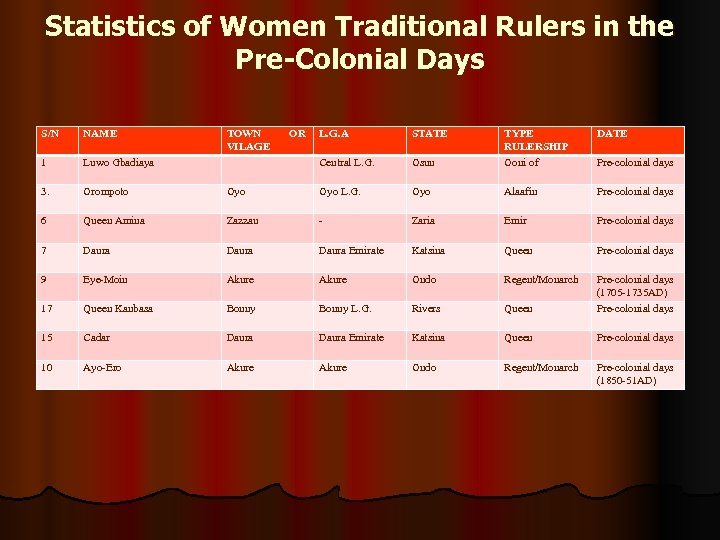 Statistics of Women Traditional Rulers in the Pre-Colonial Days S/N NAME 1 Luwo Gbadiaya 3. Orompoto 6 TOWN VILAGE OR L. G. A STATE DATE Osun TYPE RULERSHIP Ooni of Central L. G. Oyo L. G. Oyo Alaafin Pre-colonial days Queen Amina Zazzau - Zaria Emir Pre-colonial days 7 Daura Emirate Katsina Queen Pre-colonial days 9 Eye-Moin Akure Ondo Regent/Monarch 17 Queen Kanbasa Bonny L. G. Rivers Queen Pre-colonial days (1705 -1735 AD) Pre-colonial days 15 Cadar Daura Emirate Katsina Queen Pre-colonial days 10 Ayo-Ero Akure Ondo Regent/Monarch Pre-colonial days (1850 -51 AD) Pre-colonial days
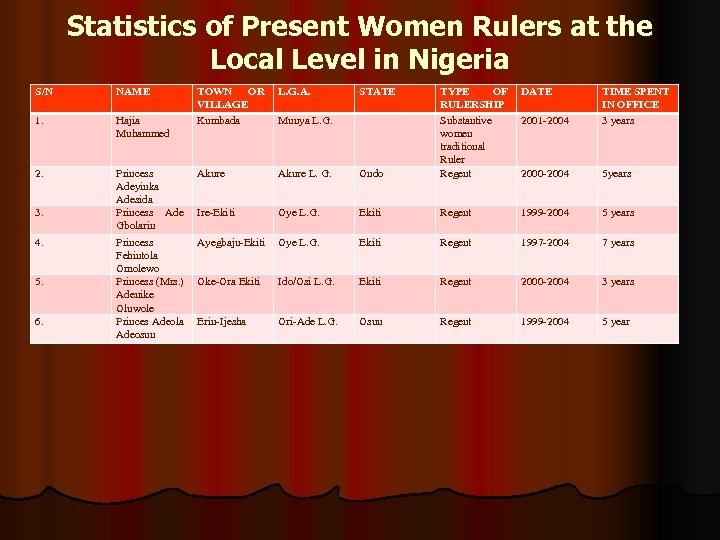 Statistics of Present Women Rulers at the Local Level in Nigeria S/N NAME 1. Hajia Muhammed 2. Princess Adeyinka Adesida Princess Ade Gbolarin Princess Fehintola Omolewo Princess (Mrs. ) Adenike Oluwole Princes Adeola Adeosun 3. 4. 5. 6. TOWN OR VILLAGE Kumbada L. G. A. Akure L. G. Ire-Ekiti STATE DATE Ondo TYPE OF RULERSHIP Substantive women traditional Ruler Regent 2001 -2004 TIME SPENT IN OFFICE 3 years 2000 -2004 5 years Oye L. G. Ekiti Regent 1999 -2004 5 years Ayegbaju-Ekiti Oye L. G. Ekiti Regent 1997 -2004 7 years Oke-Ora Ekiti Ido/Osi L. G. Ekiti Regent 2000 -2004 3 years Erin-Ijesha Ori-Ade L. G. Osun Regent 1999 -2004 5 year Munya L. G.
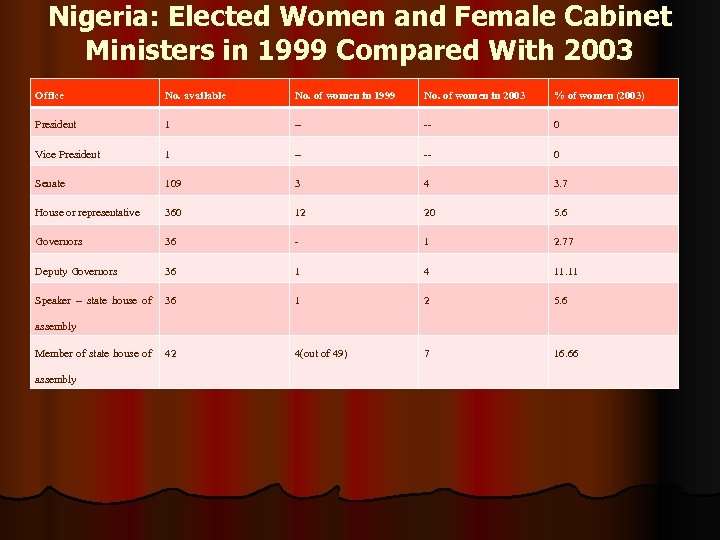 Nigeria: Elected Women and Female Cabinet Ministers in 1999 Compared With 2003 Office No. available No. of women in 1999 No. of women in 2003 % of women (2003) President 1 -- -- 0 Vice President 1 -- -- 0 Senate 109 3 4 3. 7 House or representative 360 12 20 5. 6 Governors 36 - 1 2. 77 Deputy Governors 36 1 4 11. 11 Speaker – state house of 36 1 2 5. 6 42 4(out of 49) 7 16. 66 assembly Member of state house of assembly
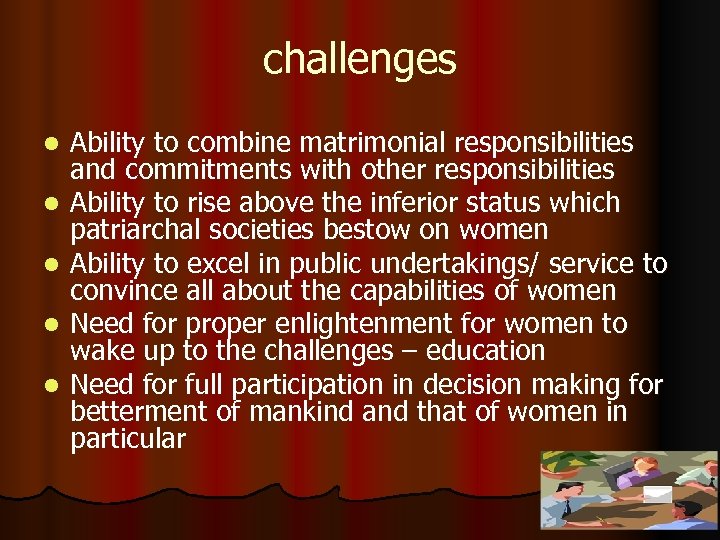 challenges l l l Ability to combine matrimonial responsibilities and commitments with other responsibilities Ability to rise above the inferior status which patriarchal societies bestow on women Ability to excel in public undertakings/ service to convince all about the capabilities of women Need for proper enlightenment for women to wake up to the challenges – education Need for full participation in decision making for betterment of mankind and that of women in particular
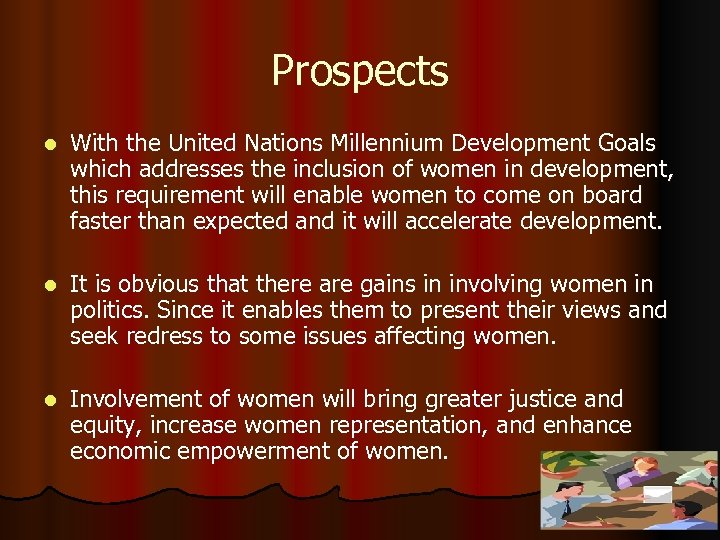 Prospects l With the United Nations Millennium Development Goals which addresses the inclusion of women in development, this requirement will enable women to come on board faster than expected and it will accelerate development. l It is obvious that there are gains in involving women in politics. Since it enables them to present their views and seek redress to some issues affecting women. l Involvement of women will bring greater justice and equity, increase women representation, and enhance economic empowerment of women.
 Conclusion l In the present dispensation, women have shown that they are up to the task. There is need for Federal Republic of Nigeria to make it mandatory that certain percentage of political appointments at all tiers of government be reserved exclusively for women.
 • Thanks for listening