 Скачать презентацию Scaling CFL-Reachability-Based Points-To Analysis Using Context-Sensitive Must-Not Alias
0e30b7f700db07de515328cab3e010f8.ppt
- Количество слайдов: 20



Scaling CFL-Reachability-Based Points-To Analysis Using Context-Sensitive Must-Not. Alias Analysis Guoqing Xu, Atanas Rountev, Manu Sridharan Ohio State University IBM T. J. Watson Research Center
Points-to Analysis • Many static analysis tools need highly precise whole-program points-to solution – (e. g. , data race detector, slicer) • Context-free-language(CFL) reachability formulation of points-to/alias analysis [Sridharan. Bodik PLDI’ 06] – High precision – Does not scale well for whole program analysis – A lot of redundant computation • Our approach targets CFL-reachability-based points -to analysis 2 – Pre-analyze the program to reduce the redundancy
![Example of CFL-Reachability Formulation[PLDI’ 06] a = new A(); // o 1 b =](https://present5.com/presentation/0e30b7f700db07de515328cab3e010f8/image-3.jpg "Example of CFL-Reachability Formulation[PLDI’ 06] a = new A(); // o 1 b =")
Example of CFL-Reachability Formulation[PLDI’ 06] a = new A(); // o 1 b = new A(); // o 2 c = a; e ]f o 1 [f id(p){ return p; } x = id(a); // call 1 y = id(b); // call 2 (1 o 3 o 4 o 2 o pts(v) if o flows. To v 3 (2 b x )1 p [f a. f = new C(); //o 3 b. f = new C(); //o 4 e = x. f; c a ret )2 y
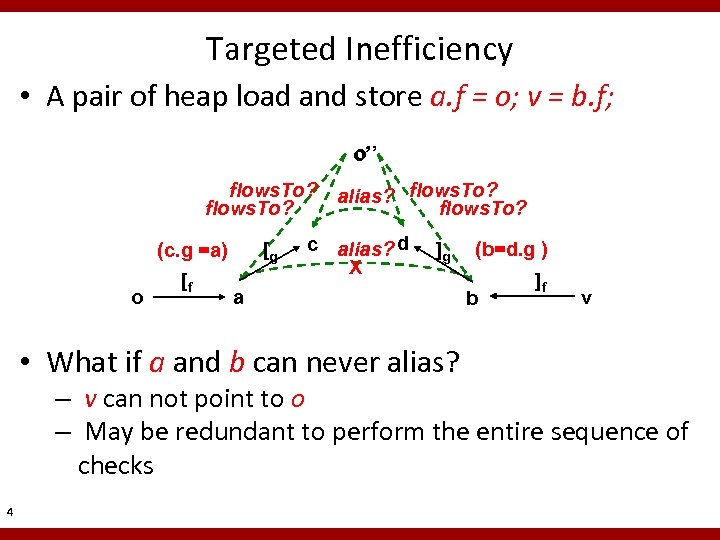
Targeted Inefficiency • A pair of heap load and store a. f = o; v = b. f; o’’ o’ flows. To? o (c. g =a) [f [g alias? flows. To? c alias? d X ]g a • What if a and b can never alias? (b=d. g ) b ]f v – v can not point to o – May be redundant to perform the entire sequence of checks 4
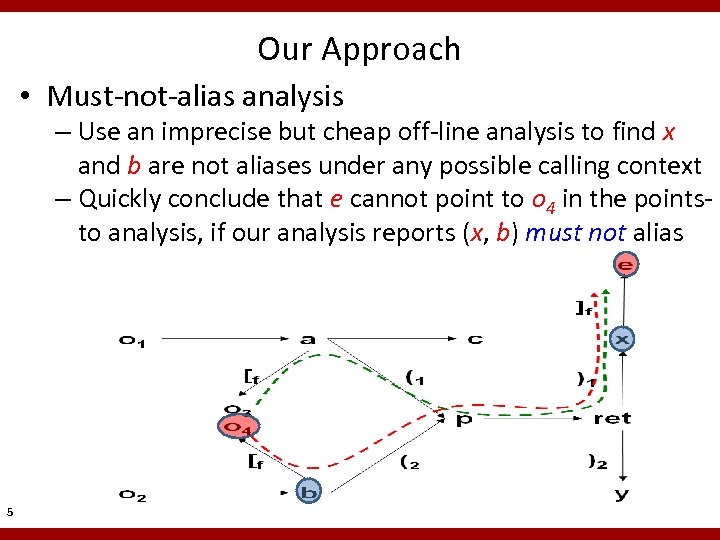
Our Approach • Must-not-alias analysis – Use an imprecise but cheap off-line analysis to find x and b are not aliases under any possible calling context – Quickly conclude that e cannot point to o 4 in the pointsto analysis, if our analysis reports (x, b) must not alias 5
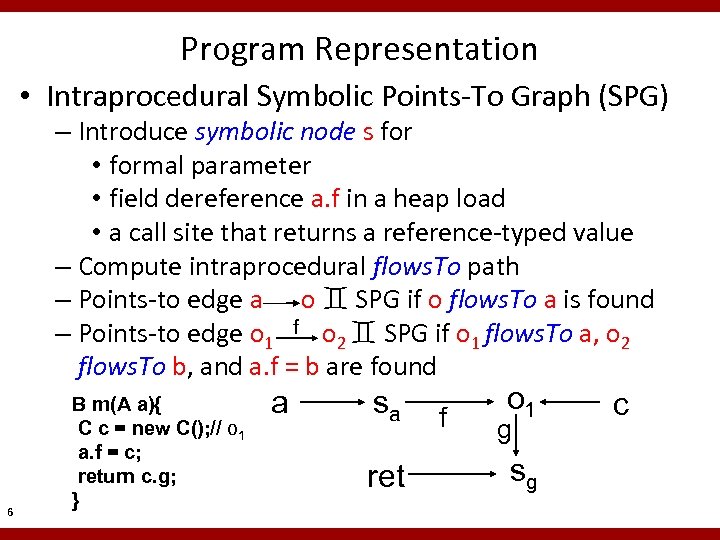
Program Representation • Intraprocedural Symbolic Points-To Graph (SPG) – Introduce symbolic node s for • formal parameter • field dereference a. f in a heap load • a call site that returns a reference-typed value – Compute intraprocedural flows. To path – Points-to edge a o SPG if o flows. To a is found – Points-to edge o 1 f o 2 SPG if o 1 flows. To a, o 2 flows. To b, and a. f = b are found 6 B m(A a){ C c = new C(); // o 1 a. f = c; return c. g; } a sa ret f o 1 g sg c
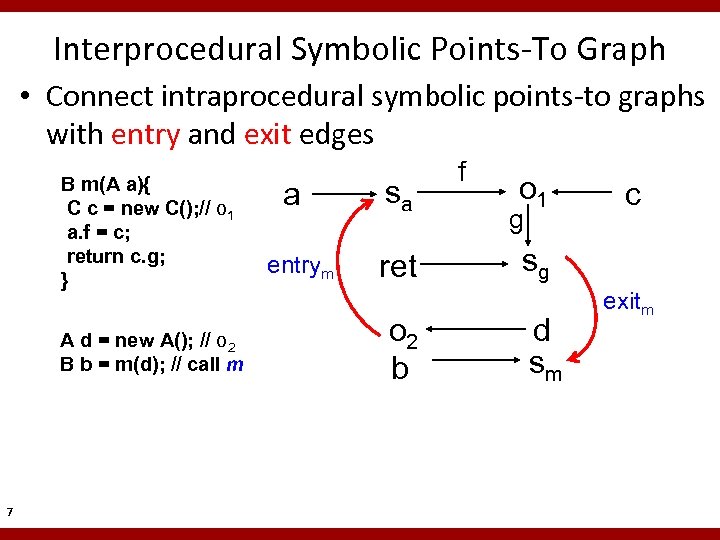
Interprocedural Symbolic Points-To Graph • Connect intraprocedural symbolic points-to graphs with entry and exit edges B m(A a){ C c = new C(); // o 1 a. f = c; return c. g; } A d = new A(); // o 2 B b = m(d); // call m 7 a entrym sa ret o 2 b f o 1 g c sg d sm exitm
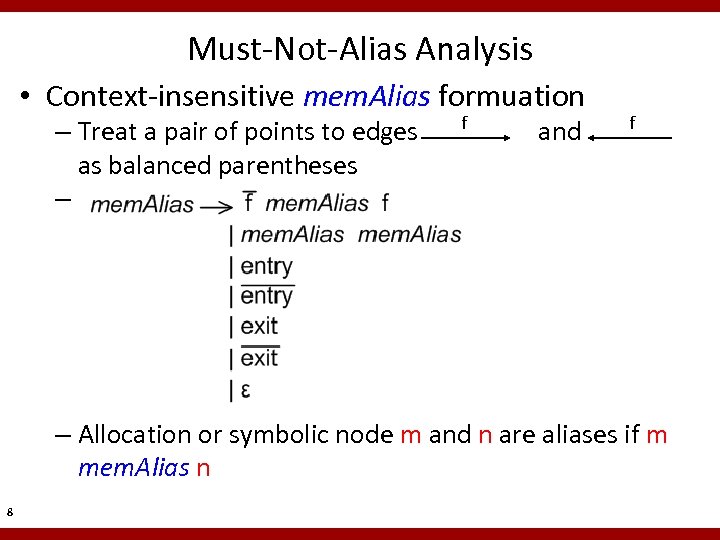
Must-Not-Alias Analysis • Context-insensitive mem. Alias formuation – Treat a pair of points to edges as balanced parentheses – f and f – Allocation or symbolic node m and n are aliases if m mem. Alias n 8
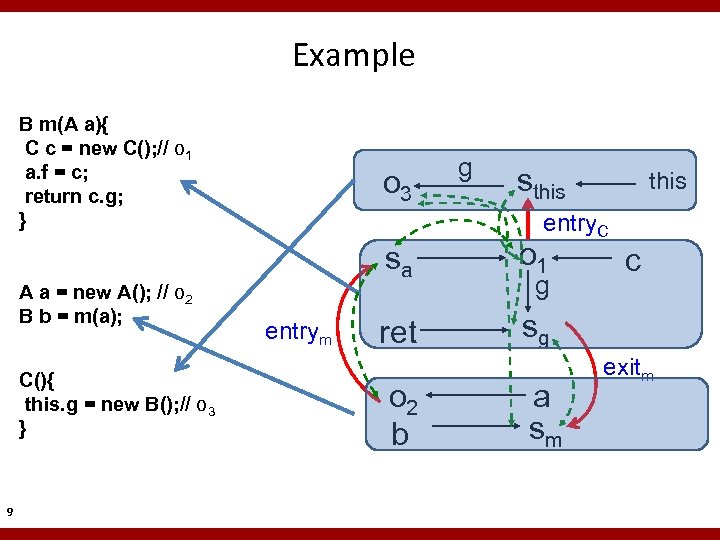
Example B m(A a){ C c = new C(); // o 1 a. f = c; return c. g; } A a = new A(); // o 2 B b = m(a); C(){ this. g = new B(); // o 3 } 9 o 3 g sthis entry. C sa entrym this o 1 ret sg o 2 b g a sm c exitm
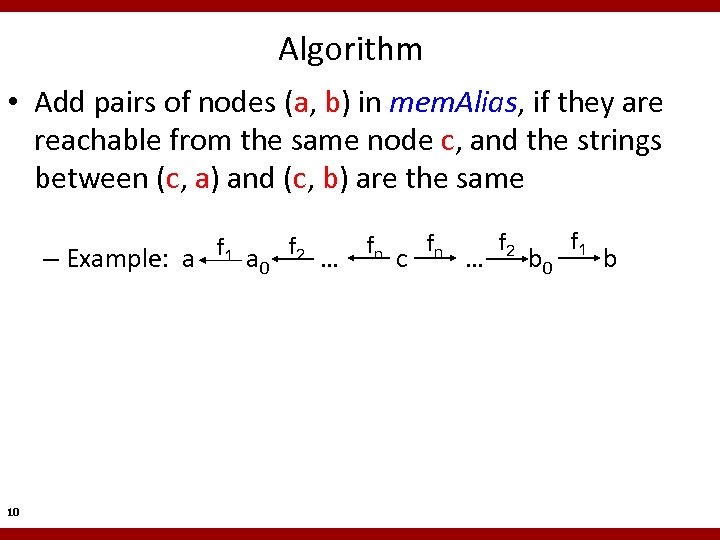
Algorithm • Add pairs of nodes (a, b) in mem. Alias, if they are reachable from the same node c, and the strings between (c, a) and (c, b) are the same – Example: a 10 f 1 a 0 f 2 … fn c fn … f 2 b 0 f 1 b
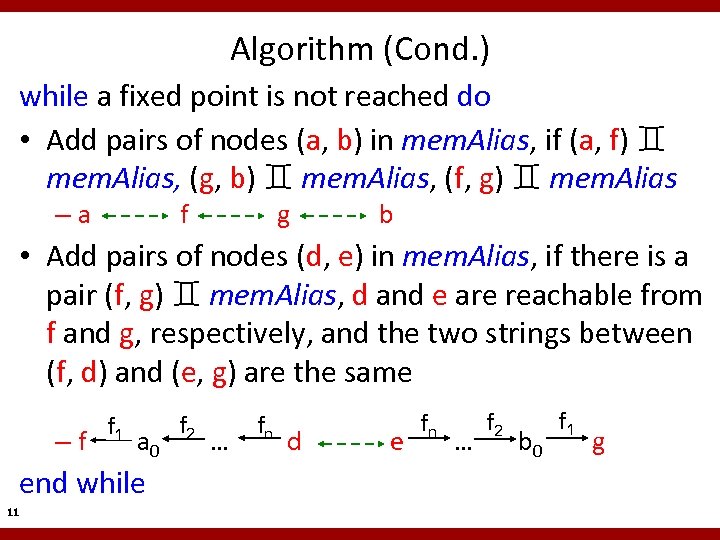
Algorithm (Cond. ) while a fixed point is not reached do • Add pairs of nodes (a, b) in mem. Alias, if (a, f) mem. Alias, (g, b) mem. Alias, (f, g) mem. Alias –a f g b • Add pairs of nodes (d, e) in mem. Alias, if there is a pair (f, g) mem. Alias, d and e are reachable from f and g, respectively, and the two strings between (f, d) and (e, g) are the same –f f 1 a 0 end while 11 f 2 … fn d e fn … f 2 b 0 f 1 g
Context-Sensitive Must-Not-Alias Analysis • Context-sensitivity is achieved by – Bottom-up traversing the call graph (i. e. , summarybased) – Cloning objects for 1 -level method calls when composing summaries • Context sensitivity – Full context-sensitivity for pointer variables – 1 -level context-sensitivity for pointer targets – Has almost the same precision as the 1 -object-sensitive analysis, but much cheaper 12
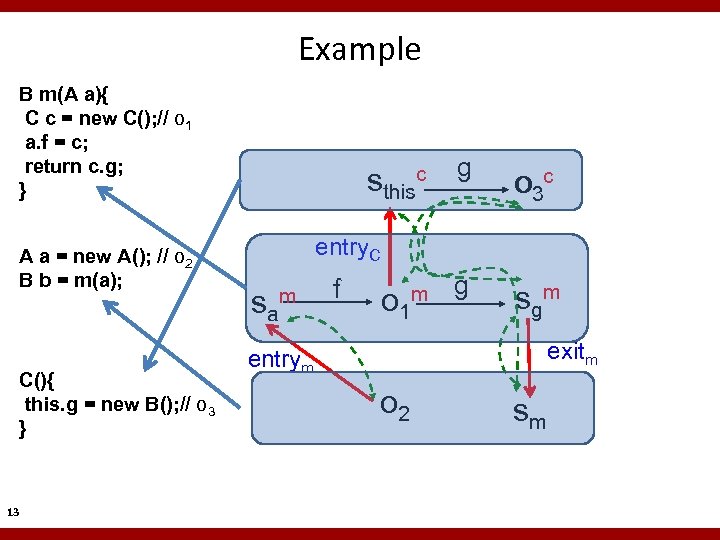
Example B m(A a){ C c = new C(); // o 1 a. f = c; return c. g; } A a = new A(); // o 2 B b = m(a); C(){ this. g = new B(); // o 3 } 13 c g o 3 c m g sgm sthis entry. C sam f o 1 exitm entrym o 2 sm
Using Must-Not-Alias Information • Object or symbolic nodes m and n must not alias if (m, n) mem. Alias • Using must-not-alias information in Sridharan. Bodik analysis – Check a pair of load and store a. f = o; c = b. f; – Don’t check whether a and b can alias if, for any object or symbolic nodes oa and ob such that a oa and b ob ISPG, oa and ob must not alias 14
Experiments • Benchmarks – Spec. JVM : 7 programs – Da. Capo: 4 programs – Others: 8 programs – Number of methods ranging from 2344 to 8789 • Comparison between Sridharan-Bodik representation and ISPG without var nodes – 1. 7 reduction in the number of nodes – 5. 6 reduction in the number of edges 15
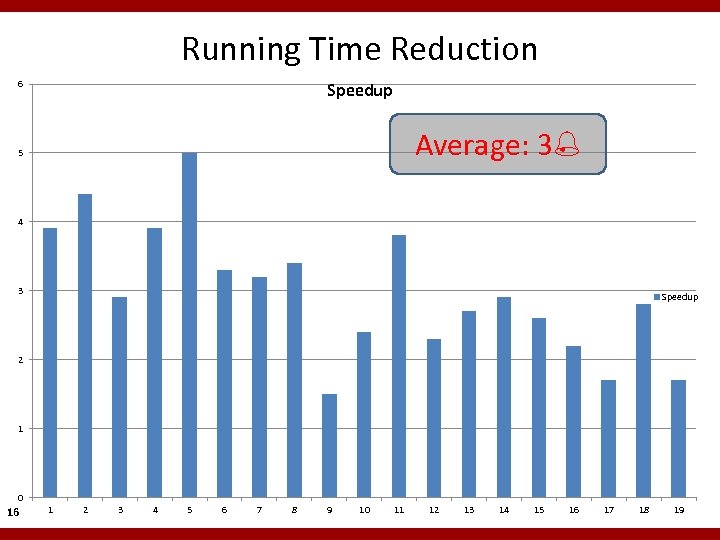
Running Time Reduction 6 Speedup Average: 3 5 4 3 Speedup 2 1 0 16 1 2 3 4 5 6 7 8 9 10 11 12 13 14 15 16 17 18 19
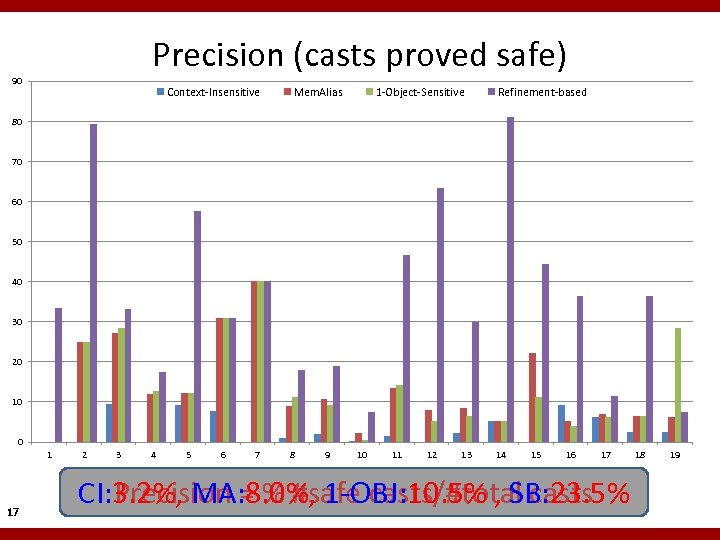
Precision (casts proved safe) 90 Context-Insensitive Mem. Alias 1 -Object-Sensitive Refinement-based 80 70 60 50 40 30 20 10 0 1 17 2 3 4 5 6 7 8 9 10 11 12 13 14 15 16 17 CI: 3. 2%, MA: 8. 0%, 1 -OBJ: 10. 5% , SB: 23. 5% Precision = % #safe casts/#total casts 18 19
Conclusions • Refinement-based points-to analysis is precise but expensive • A context-sensitive must-not-alias analysis – Pre-computes aliasing information – mem. Alias-reachability formulation – Used to quickly eliminate non-aliasing pairs in the points-to analysis • Experimental results 18 – Alias analysis has short running time – Significant time reduction for the points-to analysis – Points-to information derived from mem. Alias is almost as precise as 1 -object-sensitive analysis

Thank you 19
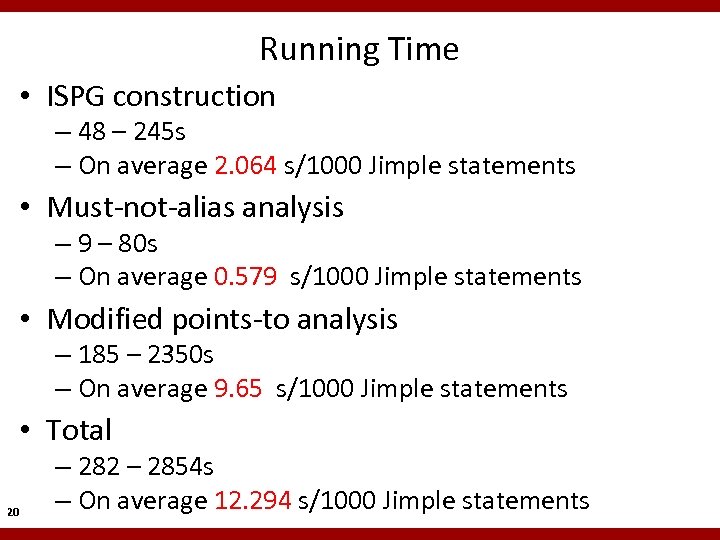
Running Time • ISPG construction – 48 – 245 s – On average 2. 064 s/1000 Jimple statements • Must-not-alias analysis – 9 – 80 s – On average 0. 579 s/1000 Jimple statements • Modified points-to analysis – 185 – 2350 s – On average 9. 65 s/1000 Jimple statements • Total 20 – 282 – 2854 s – On average 12. 294 s/1000 Jimple statements
Скачать презентацию Scaling CFL-Reachability-Based Points-To Analysis Using Context-Sensitive Must-Not Alias
0e30b7f700db07de515328cab3e010f8.ppt