 Скачать презентацию Сбор информации Важным этапом в написании качественного отчета
лекция по деловому английскому на русском.ppt
- Количество слайдов: 37




Сбор информации Важным этапом в написании качественного отчета является сбор информации. Если вы хотите написать хороший отчет, вы должны уметь пользоваться доступными источниками информации и решать, какая информация является полезной, а какая нет.
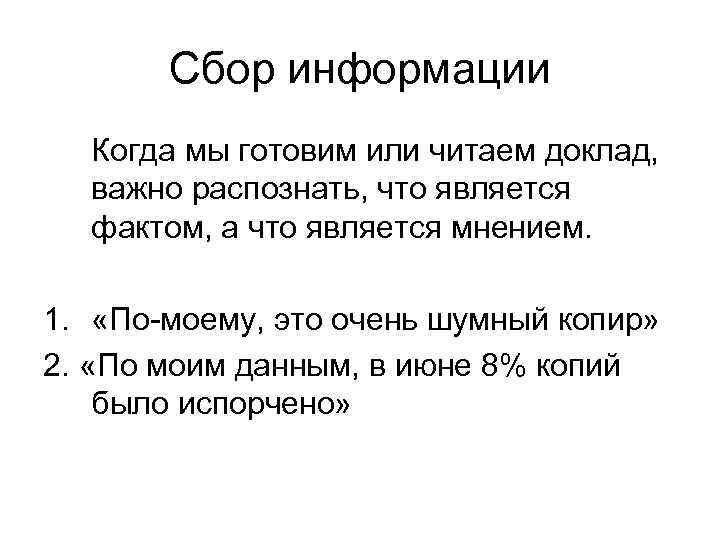
Сбор информации Когда мы готовим или читаем доклад, важно распознать, что является фактом, а что является мнением. 1. «По-моему, это очень шумный копир» 2. «По моим данным, в июне 8% копий было испорчено»
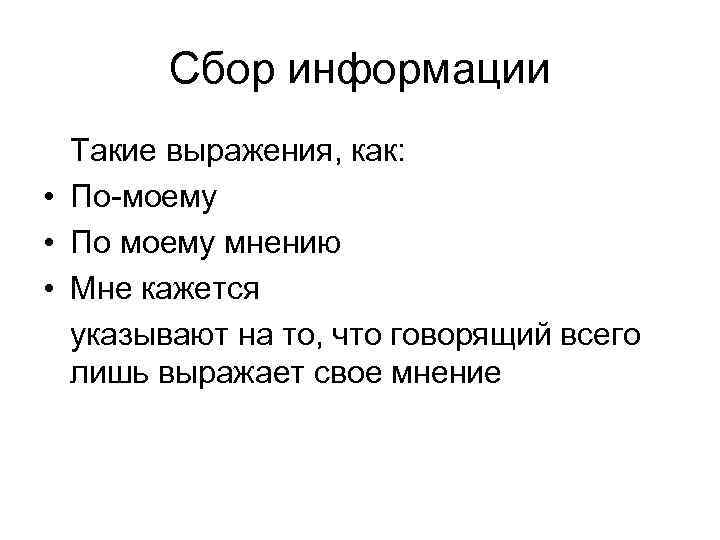
Сбор информации Такие выражения, как: • По-моему • По моему мнению • Мне кажется указывают на то, что говорящий всего лишь выражает свое мнение
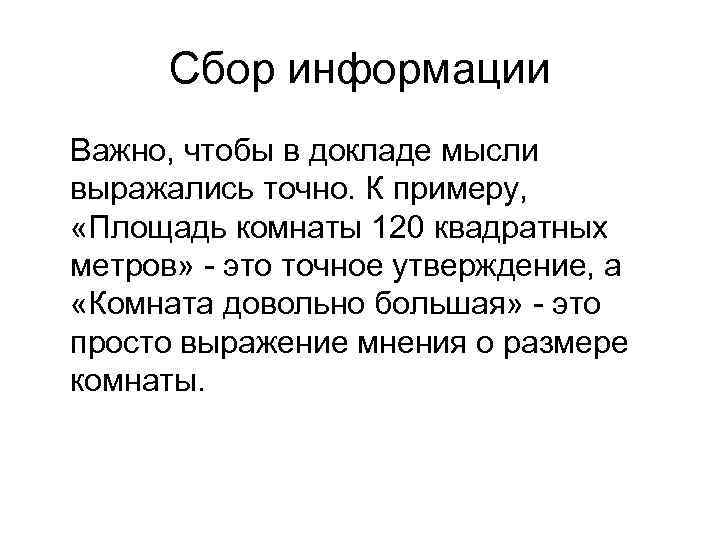
Сбор информации Важно, чтобы в докладе мысли выражались точно. К примеру, «Площадь комнаты 120 квадратных метров» - это точное утверждение, а «Комната довольно большая» - это просто выражение мнения о размере комнаты.
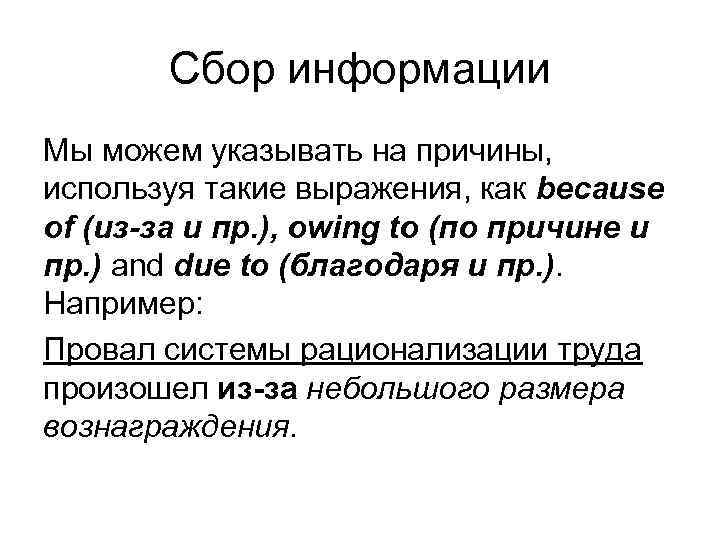
Сбор информации Мы можем указывать на причины, используя такие выражения, как because of (из-за и пр. ), owing to (по причине и пр. ) and due to (благодаря и пр. ). Например: Провал системы рационализации труда произошел из-за небольшого размера вознаграждения.
Сбор информации Мы можем выражать цель, используя такие выражения, как in order to (для и пр. ) и so as to (чтобы). Например: Компания продолжила пользовааться арендой чтобы избежать уплаты налогов. (см. документ Word, с. 1)
Сбор информации Обратите внимание, как можно объединять пары предложений для указания на причину и результат. Например, 1. Management was ineffective which resulted in/caused poor profits. 2. Poor profits resulted from/were caused by ineffective management. 1. Управление было неэффективным, что вызвало/привело к получению низкого дохода. 2. Низкий уровень дохода явился следствием/был вызван неэффективным управлением.
Сбор информации Таким же способом объедините следующие высказывания: (см документ Word, с. 2)
Использование графиков и статистических данных В докладе важно использовать иллюстрации (графики, таблицы и схемы). Иллюстрации можно использовать для доказательства выраженной в докладе точки зрения. Они всегда должны быть четкими, простыми и соответствовать целям доклада. (см. раздаточный материал)
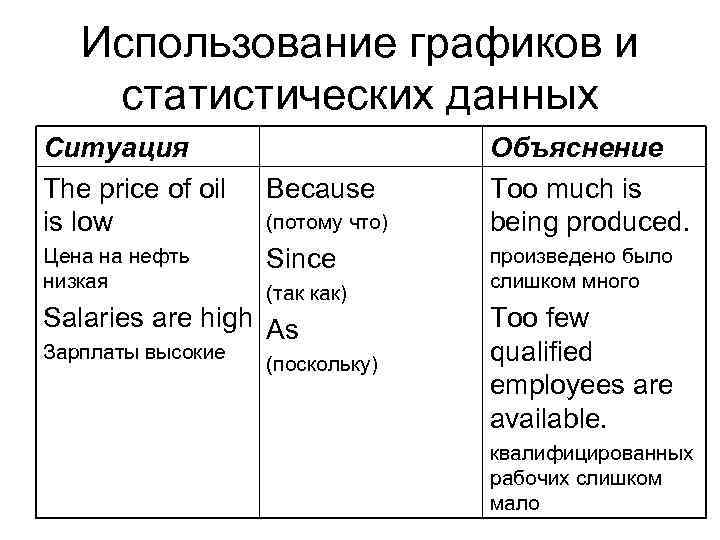
Использование графиков и статистических данных Ситуация The price of oil is low Because Цена на нефть низкая Since (потому что) (так как) Salaries are high As Зарплаты высокие (поскольку) Объяснение Too much is being produced. произведено было слишком много Too few qualified employees are available. квалифицированных рабочих слишком мало
Использование графиков и статистических данных Таким же образом соедините следующие ситуации и объяснения. (см. документ Word, с. 3)

Использование графиков и статистических данных
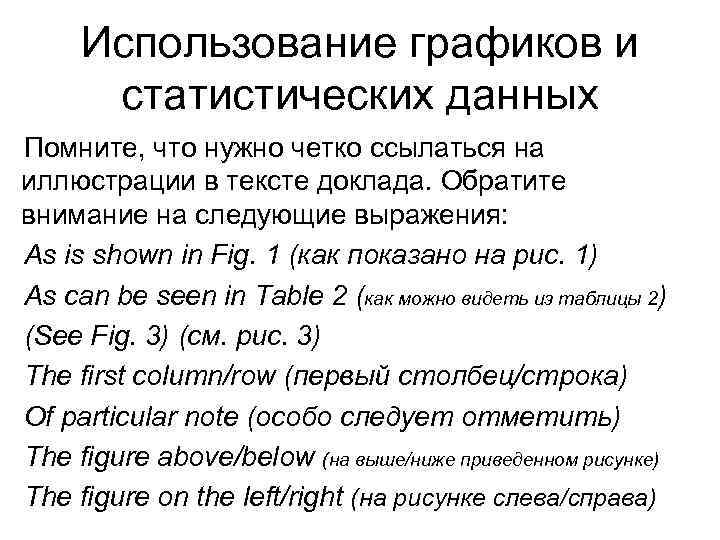
Использование графиков и статистических данных Помните, что нужно четко ссылаться на иллюстрации в тексте доклада. Обратите внимание на следующие выражения: As is shown in Fig. 1 (как показано на рис. 1) As can be seen in Table 2 (как можно видеть из таблицы 2) (See Fig. 3) (см. рис. 3) The first column/row (первый столбец/строка) Of particular note (особо следует отметить) The figure above/below (на выше/ниже приведенном рисунке) The figure on the left/right (на рисунке слева/справа)
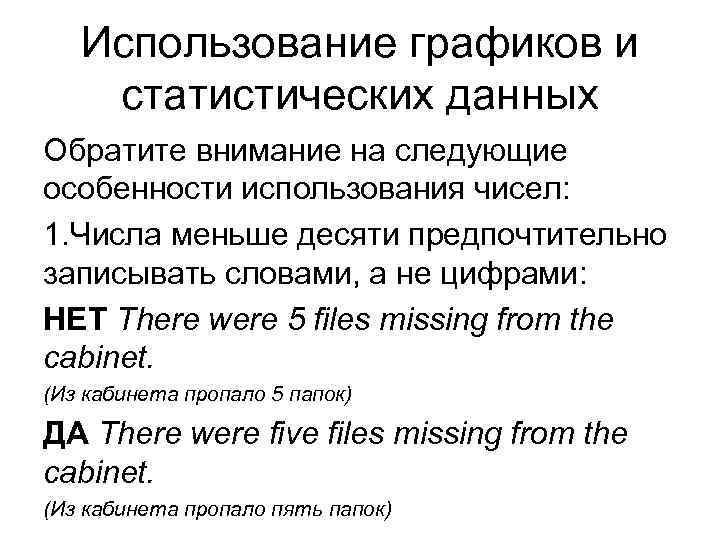
Использование графиков и статистических данных Обратите внимание на следующие особенности использования чисел: 1. Числа меньше десяти предпочтительно записывать словами, а не цифрами: НЕТ There were 5 files missing from the cabinet. (Из кабинета пропало 5 папок) ДА There were five files missing from the cabinet. (Из кабинета пропало пять папок)
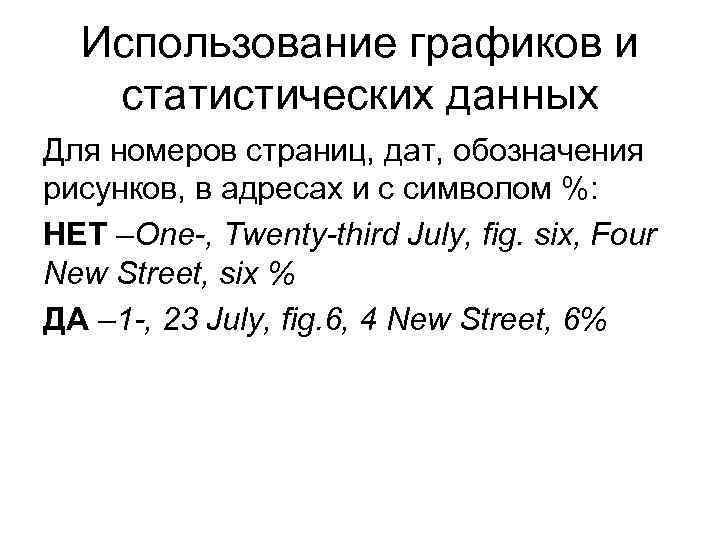
Использование графиков и статистических данных Для номеров страниц, дат, обозначения рисунков, в адресах и с символом %: НЕТ –One-, Twenty-third July, fig. six, Four New Street, six % ДА – 1 -, 23 July, fig. 6, 4 New Street, 6%
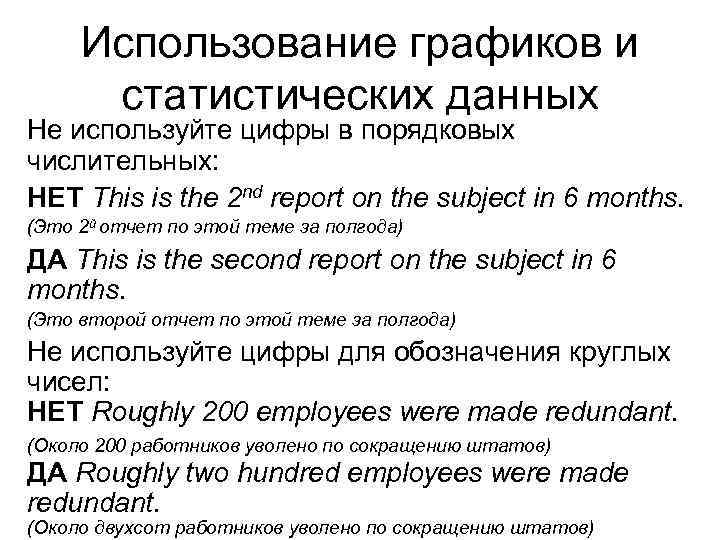
Использование графиков и статистических данных Не используйте цифры в порядковых числительных: НЕТ This is the 2 nd report on the subject in 6 months. (Это 2 й отчет по этой теме за полгода) ДА This is the second report on the subject in 6 months. (Это второй отчет по этой теме за полгода) Не используйте цифры для обозначения круглых чисел: НЕТ Roughly 200 employees were made redundant. (Около 200 работников уволено по сокращению штатов) ДА Roughly two hundred employees were made redundant. (Около двухсот работников уволено по сокращению штатов)
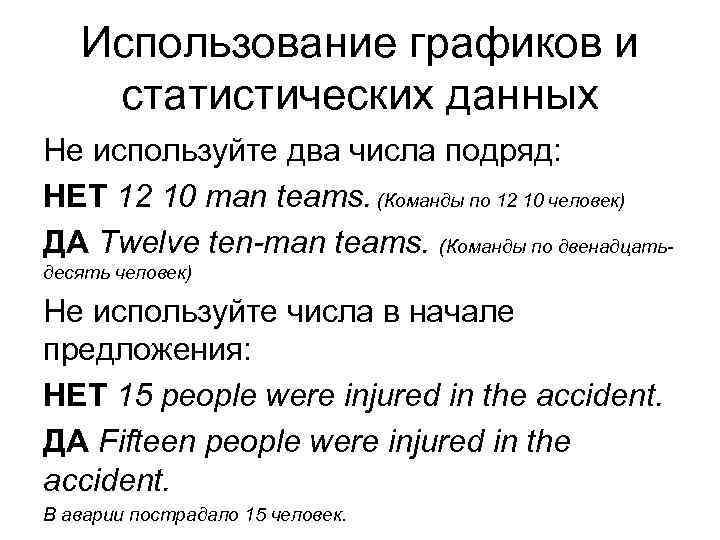
Использование графиков и статистических данных Не используйте два числа подряд: НЕТ 12 10 man teams. (Команды по 12 10 человек) ДА Twelve ten-man teams. (Команды по двенадцатьдесять человек) Не используйте числа в начале предложения: НЕТ 15 people were injured in the accident. ДА Fifteen people were injured in the accident. В аварии пострадало 15 человек.
Selecting and organising the material When the writer has assembled all the relevant material, he or she should be able to form some opinions. It is then necessary to decide how much information is needed in the report to support these opinions. Too much information will hide the point, too little information will not convince the reader.
Selecting and organising the material
Selecting and organising the material Examples: The Personnel Department is divided into five sections. One section, Training, consists of five staff. The Division is headed by an Executive Director. Below him, there are three line managers. There are six other directors on the Board in addition to the Managing Director.
Selecting and organising the material Reports are often formalised by using the passive. Compare these two sentences: 1)The Promotion Review Panel meets and discusses each candidate. 2) Each candidate is met and discussed by the Promotion Review Panel. Notice how the passive emphasises the candidate instead of the Promotion Review Panel. Noun phrases are also used formalising. E. g. : External advertising is proposed. (not We propose to advertise externally. )
Presenting findings The findings are the main part of the report. When the material has been selected and organised, you must present the findings as clearly as possible. You must decide whether a formal or informal style and personal or impersonal tone are appropriate.
Presenting findings Match the following extracts from reports with the styles listed on the right. (see Word doc, p. 4)
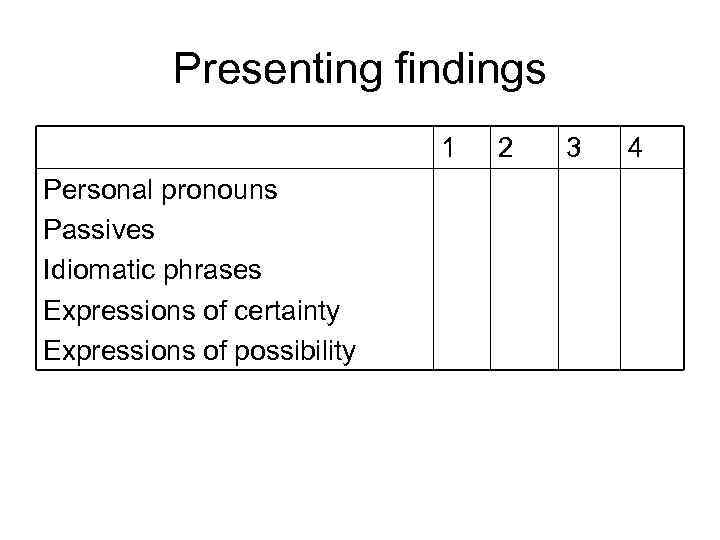
Presenting findings 1 Personal pronouns Passives Idiomatic phrases Expressions of certainty Expressions of possibility 2 3 4
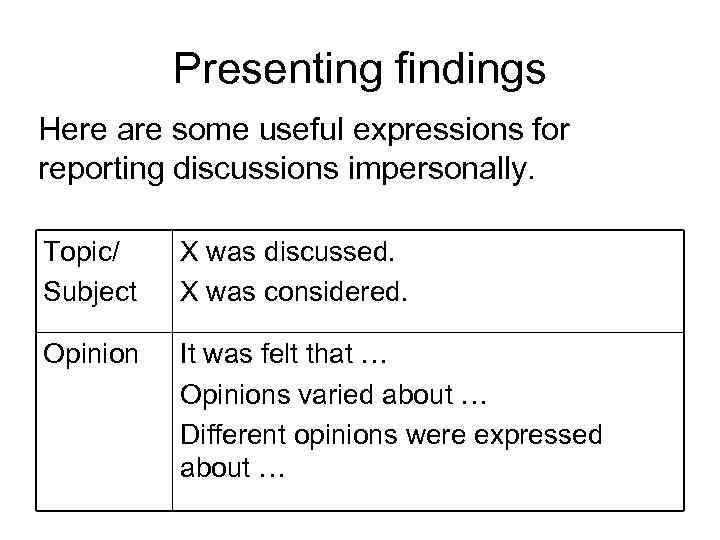
Presenting findings Here are some useful expressions for reporting discussions impersonally. Topic/ Subject X was discussed. X was considered. Opinion It was felt that … Opinions varied about … Different opinions were expressed about …
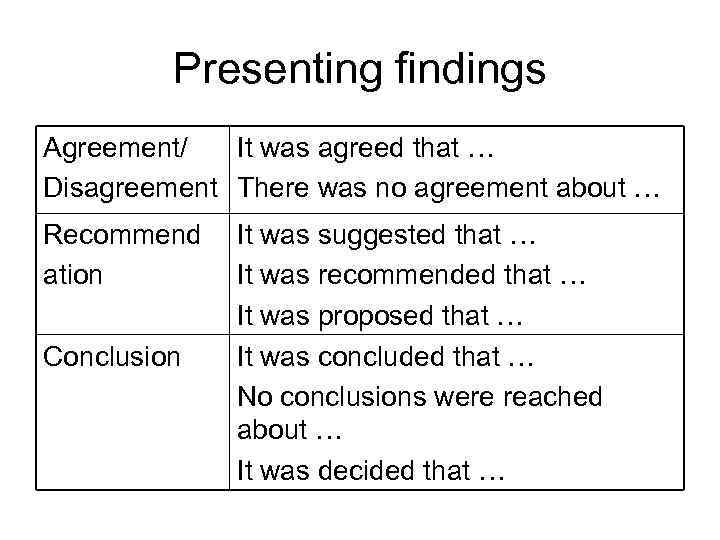
Presenting findings Agreement/ It was agreed that … Disagreement There was no agreement about … Recommend ation Conclusion It was suggested that … It was recommended that … It was proposed that … It was concluded that … No conclusions were reached about … It was decided that …
Concluding and recommending The conclusions and the recommendations are the separate stages of a report. However these two stages are connected logically. Conclusions are drawn when the findings have been analysed. Recommendations are practical courses of action based on the conclusions.

Concluding and recommending
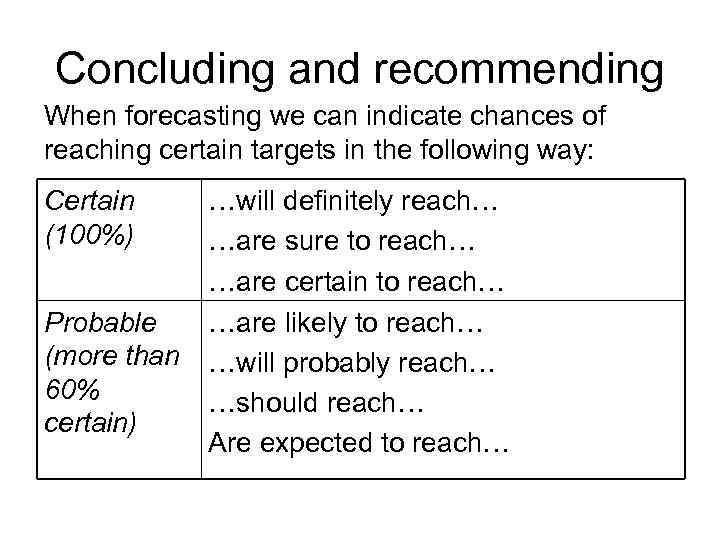
Concluding and recommending When forecasting we can indicate chances of reaching certain targets in the following way: Certain (100%) Probable (more than 60% certain) …will definitely reach… …are sure to reach… …are certain to reach… …are likely to reach… …will probably reach… …should reach… Are expected to reach…
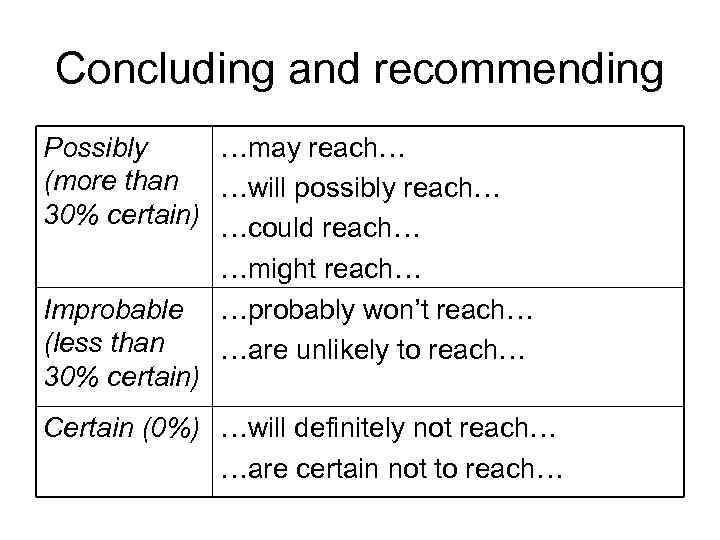
Concluding and recommending Possibly …may reach… (more than …will possibly reach… 30% certain) …could reach… …might reach… Improbable …probably won’t reach… (less than …are unlikely to reach… 30% certain) Certain (0%) …will definitely not reach… …are certain not to reach…
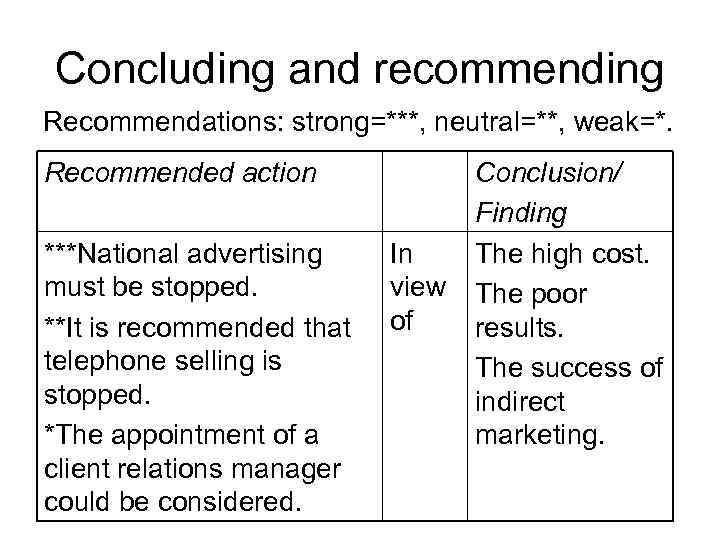
Concluding and recommending Recommendations: strong=***, neutral=**, weak=*. Recommended action ***National advertising must be stopped. **It is recommended that telephone selling is stopped. *The appointment of a client relations manager could be considered. In view of Conclusion/ Finding The high cost. The poor results. The success of indirect marketing.
Summarising A summary is a short statement of the content of a longer document. It can act as the introduction to a report, as an indication to the reader whether it is of interest or as a time-saver for readers who do not have time to read the whole report.

Summarising Look at the following ways of expressing contrast: 1) However is used for general contrasts where the ideas are not equivalent. Although is used when there is a contrast that surprises us. Even though is like although but more emphatic. E. g. : 1. Turnover increased. However, profitability fell. 2. Although turnover increased, profitability fell. 3. Profitability fell (even) though turnover increased.
Summarising 2) While/whereas are used where there is a contrast between equivalent ideas. E. g. : It would be difficult to ventilate site B, while/whereas the exterior position of site A would improve ventilation.
Summarising In the following statements of condition : 1) Expresses a universal situation, 2) Expresses a possible situation, 3) Expresses a hypothetical situation, 4) Expresses a hypothetical situation in the past.
Summarising 1) If the junior recruiters work more than four hours overtime, they receive overtime payments. 2) If business starts to improve, salaries will be increased. 3) If site A was chosen, 30 square metres of parking place would be lost. 4) If the increase had been more moderate, profitability would have kept pace with the rise of turnover.
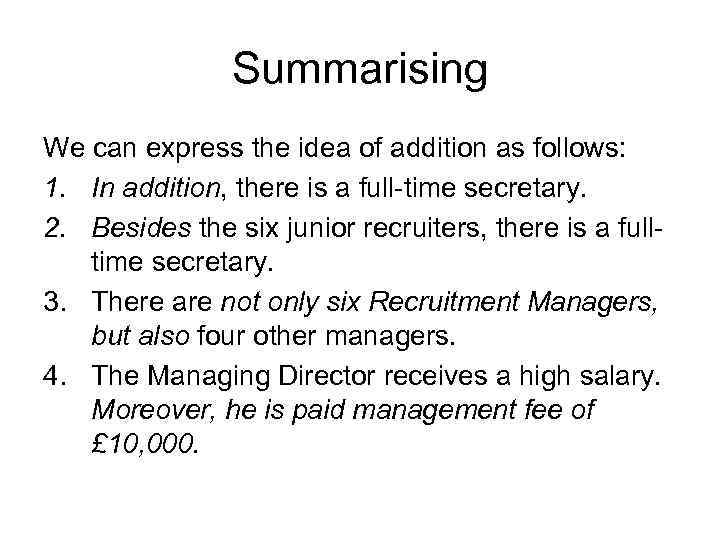
Summarising We can express the idea of addition as follows: 1. In addition, there is a full-time secretary. 2. Besides the six junior recruiters, there is a fulltime secretary. 3. There are not only six Recruitment Managers, but also four other managers. 4. The Managing Director receives a high salary. Moreover, he is paid management fee of £ 10, 000.
Скачать презентацию Сбор информации Важным этапом в написании качественного отчета
лекция по деловому английскому на русском.ppt