 Скачать презентацию SBKIM Telecommunications Management Architecture and Technologies for New
6444b06b30692063e94b5278546cd4bf.ppt
- Количество слайдов: 65



SBKIM Telecommunications Management Architecture and Technologies for New Generation 2000. 12 Seong-Beom Kim Korea Telecom sbkimm@kt. co. kr Korea Telecom KNOM-Tutorial 2000
Content SBKIM q Environmrntal Challenges q Definition and Scope q Activities q New Generation Operation Support System and Software(NGOSS) q Summary Korea Telecom 2 KNOM-Tutorial 2000
SBKIM Environmrntal Challenges Korea Telecom 3 KNOM-Tutorial 2000
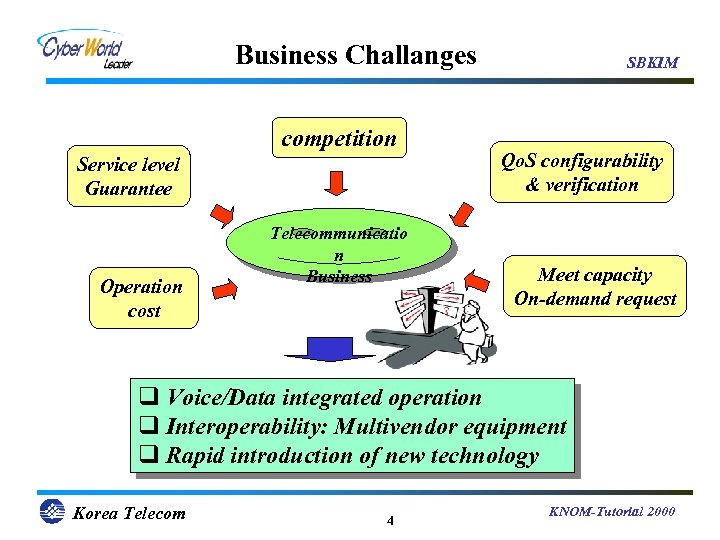
Business Challanges competition Service level Guarantee Operation cost Telecommunicatio n Business SBKIM Qo. S configurability & verification Meet capacity On-demand request q Voice/Data integrated operation q Interoperability: Multivendor equipment q Rapid introduction of new technology Korea Telecom 4 KNOM-Tutorial 2000
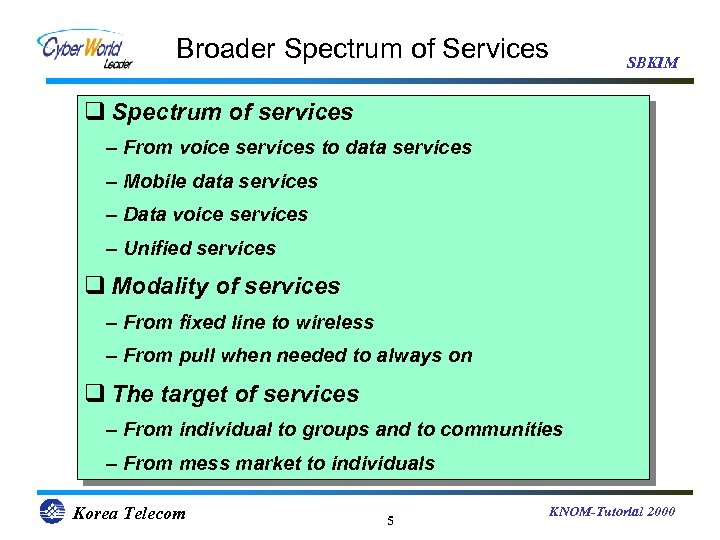
Broader Spectrum of Services SBKIM q Spectrum of services – From voice services to data services – Mobile data services – Data voice services – Unified services q Modality of services – From fixed line to wireless – From pull when needed to always on q The target of services – From individual to groups and to communities – From mess market to individuals Korea Telecom 5 KNOM-Tutorial 2000
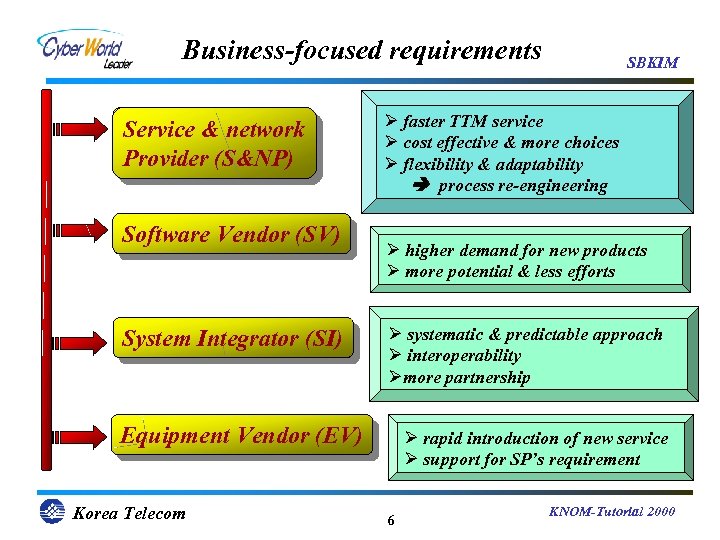
Business-focused requirements Service Provider & network Provider (S&NP) Software Vendor (SV) System Integrator (SI) Ø faster TTM service Ø cost effective & more choices Ø flexibility & adaptability process re-engineering Ø higher demand for new products Ø more potential & less efforts Ø systematic & predictable approach Ø interoperability Ømore partnership Equipment Vendor (EV) Korea Telecom SBKIM Ø rapid introduction of new service Ø support for SP’s requirement 6 KNOM-Tutorial 2000
SBKIM Network Management - Definition and Scope Korea Telecom 7 KNOM-Tutorial 2000
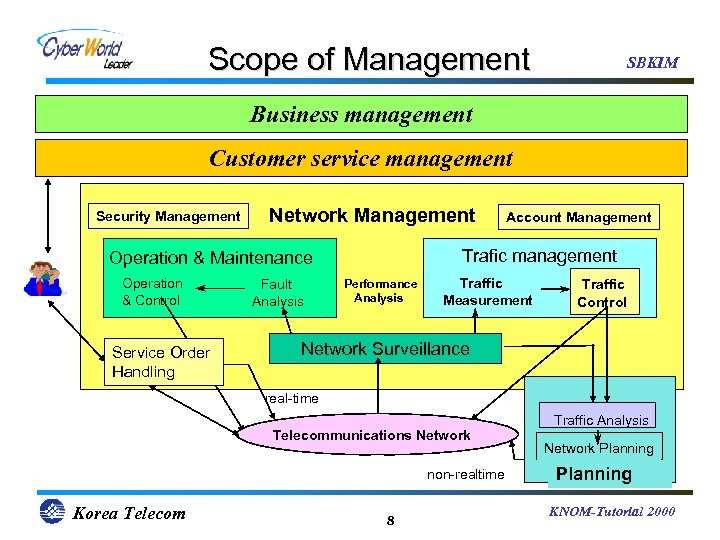
Scope of Management SBKIM Business management Customer service management Security Management Network Management Trafic management Operation & Maintenance Operation & Control Service Order Handling Fault Analysis Account Management Performance Analysis Traffic Measurement Traffic Control Network Surveillance real-time Telecommunications Network non-realtime Korea Telecom 8 Traffic Analysis Network Planning KNOM-Tutorial 2000
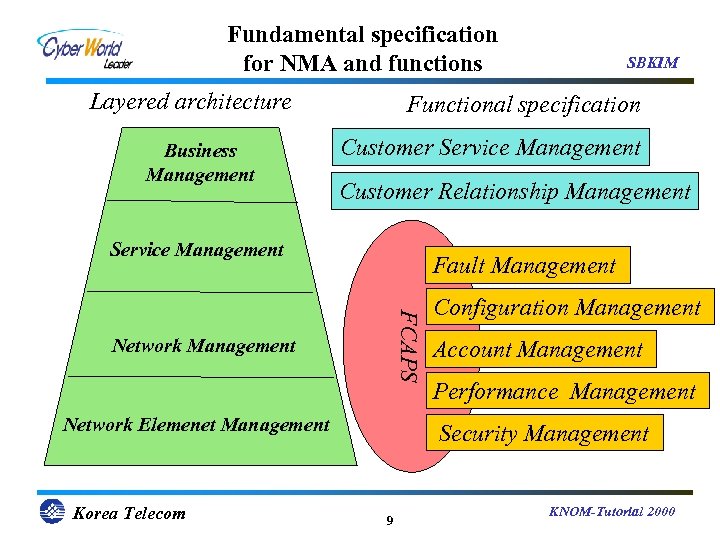
Fundamental specification for NMA and functions Layered architecture Business Management Functional specification Customer Service Management Customer Relationship Management Service Management Fault Management FCAPS Network Management Network Elemenet Management Korea Telecom SBKIM Configuration Management Account Management Performance Management Security Management 9 KNOM-Tutorial 2000
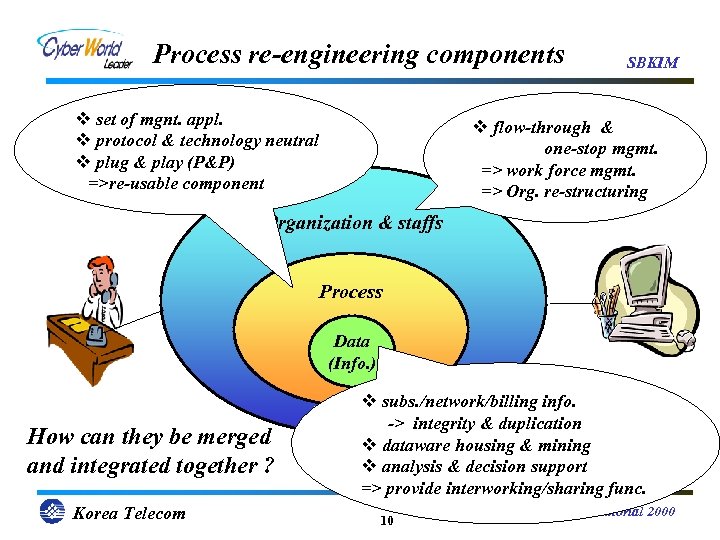
Process re-engineering components v set of mgnt. appl. v protocol & technology neutral v plug & play (P&P) =>re-usable component SBKIM v flow-through & one-stop mgmt. => work force mgmt. => Org. re-structuring Organization & staffs Process Data (Info. ) How can they be merged and integrated together ? Korea Telecom v subs. /network/billing info. -> integrity & duplication v dataware housing & mining v analysis & decision support => provide interworking/sharing func. 10 KNOM-Tutorial 2000
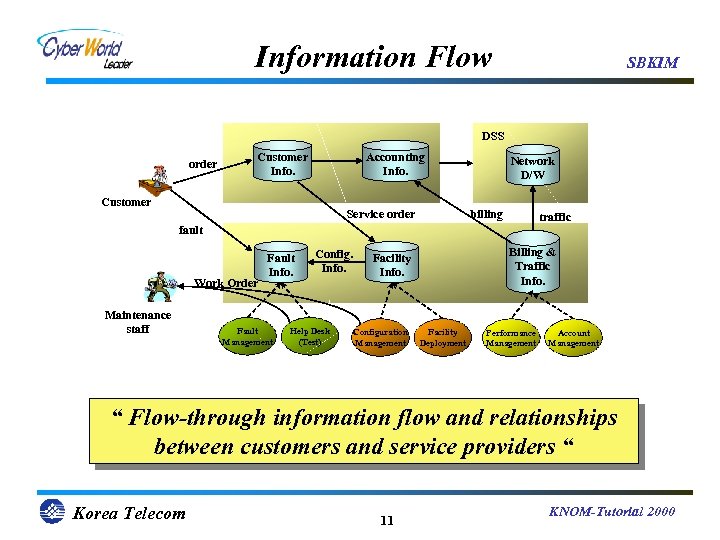
Information Flow SBKIM DSS order Customer Info. Accounting Info. Customer Service order Network D/W billing traffic fault Work Order Maintenance staff Fault Info. Fault Management Config. Info. Help Desk (Test) Billing & Traffic Info. Facility Info. Configuration Management Facility Deployment Performance Management Account Management “ Flow-through information flow and relationships between customers and service providers “ Korea Telecom 11 KNOM-Tutorial 2000
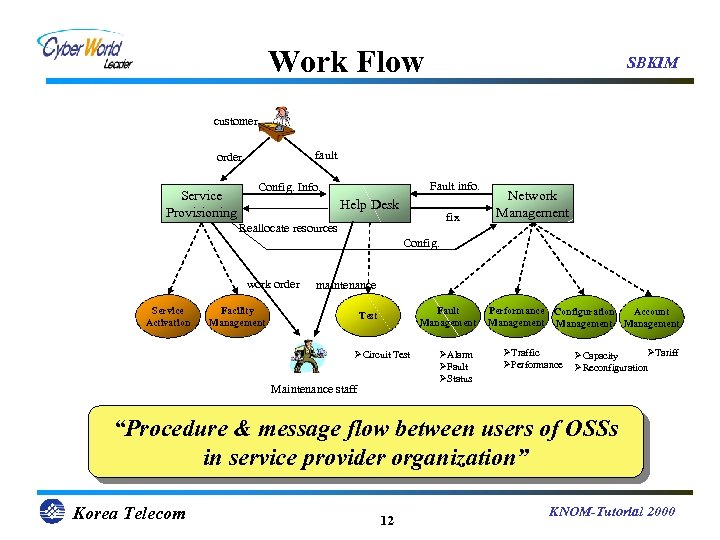
Work Flow SBKIM customer fault order Service Provisioning Fault info. Config. Info. Help Desk fix Reallocate resources Network Management Config. work order Service Activation maintenance Facility Management Fault Management Test ØCircuit Test Maintenance staff ØAlarm ØFault ØStatus Performance Configuration Account Management ØTraffic ØPerformance ØTariff ØCapacity ØReconfiguration “Procedure & message flow between users of OSSs in service provider organization” Korea Telecom 12 KNOM-Tutorial 2000
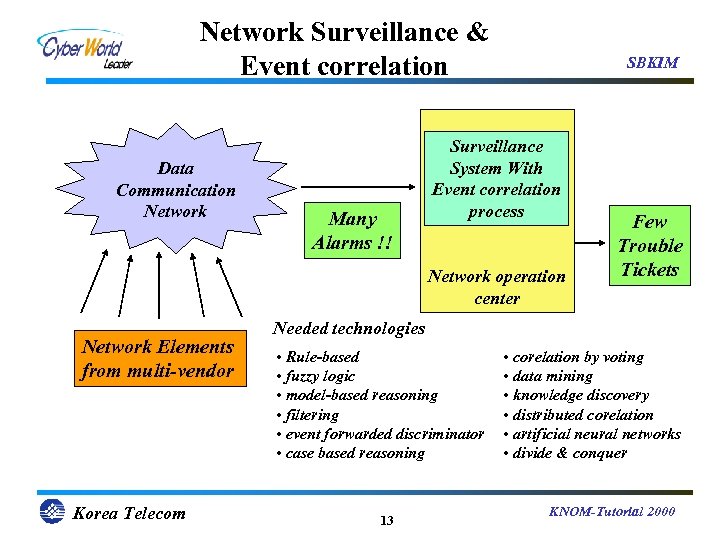
Network Surveillance & Event correlation Data Communication Network Many Alarms !! SBKIM Surveillance System With Event correlation process Network operation center Network Elements from multi-vendor Korea Telecom Few Trouble Tickets Needed technologies • Rule-based • fuzzy logic • model-based reasoning • filtering • event forwarded discriminator • case based reasoning 13 • corelation by voting • data mining • knowledge discovery • distributed corelation • artificial neural networks • divide & conquer KNOM-Tutorial 2000
SBKIM Activities Korea Telecom 14 KNOM-Tutorial 2000
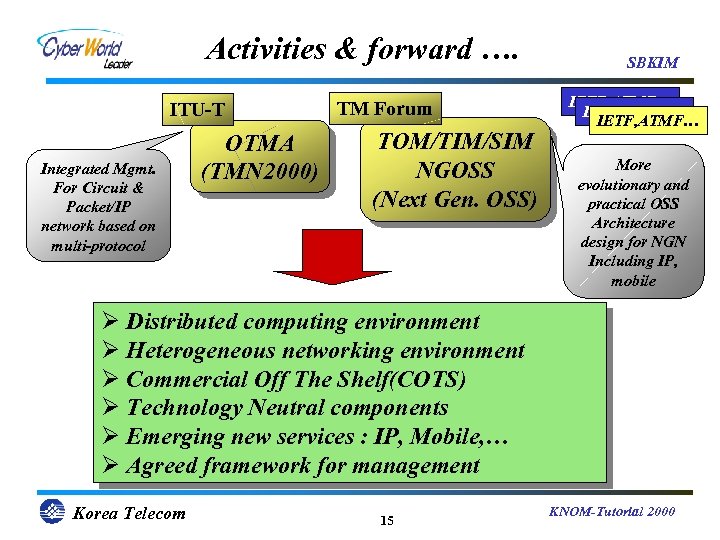
Activities & forward …. ITU-T Integrated Mgmt. For Circuit & Packet/IP network based on multi-protocol OTMA (TMN 2000) TM Forum TOM/TIM/SIM NGOSS (Next Gen. OSS) SBKIM IETF, ATMF… More evolutionary and practical OSS Architecture design for NGN Including IP, mobile Ø Distributed computing environment Ø Heterogeneous networking environment Ø Commercial Off The Shelf(COTS) Ø Technology Neutral components Ø Emerging new services : IP, Mobile, … Ø Agreed framework for management Korea Telecom 15 KNOM-Tutorial 2000
SBKIM TMN-2000 (ITU-T) Korea Telecom KNOM-Tutorial 2000
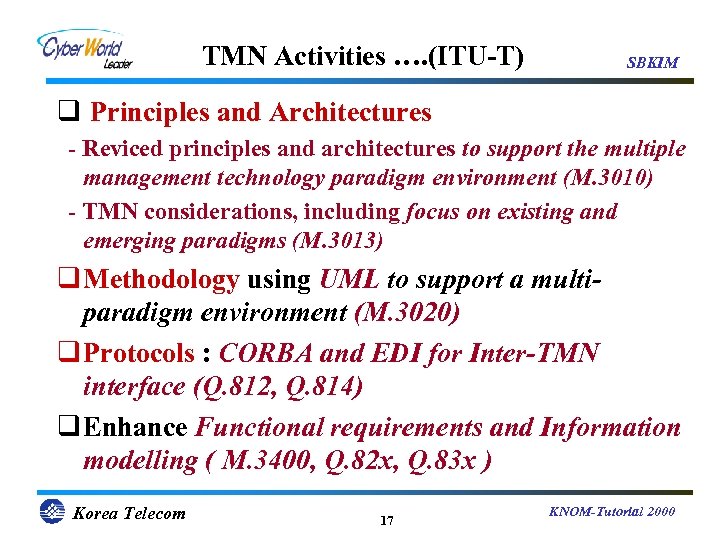
TMN Activities …. (ITU-T) SBKIM q Principles and Architectures - Reviced principles and architectures to support the multiple management technology paradigm environment (M. 3010) - TMN considerations, including focus on existing and emerging paradigms (M. 3013) q Methodology using UML to support a multiparadigm environment (M. 3020) q Protocols : CORBA and EDI for Inter-TMN interface (Q. 812, Q. 814) q Enhance Functional requirements and Information modelling ( M. 3400, Q. 82 x, Q. 83 x ) Korea Telecom 17 KNOM-Tutorial 2000
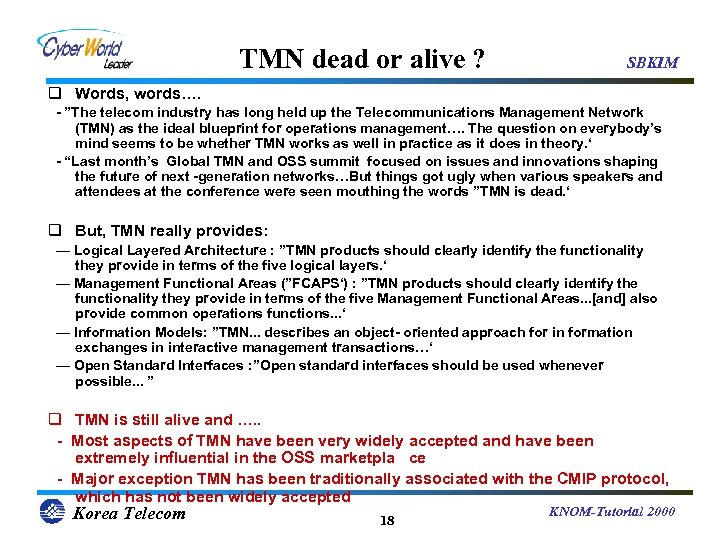
TMN dead or alive ? SBKIM q Words, words…. - ”The telecom industry has long held up the Telecommunications Management Network (TMN) as the ideal blueprint for operations management…. The question on everybody’s mind seems to be whether TMN works as well in practice as it does in theory. ‘ - “Last month’s Global TMN and OSS summit focused on issues and innovations shaping the future of next -generation networks…But things got ugly when various speakers and attendees at the conference were seen mouthing the words ”TMN is dead. ‘ q But, TMN really provides: — Logical Layered Architecture : ”TMN products should clearly identify the functionality they provide in terms of the five logical layers. ‘ — Management Functional Areas (”FCAPS‘) : ”TMN products should clearly identify the functionality they provide in terms of the five Management Functional Areas. . . [and] also provide common operations functions. . . ‘ — Information Models: ”TMN. . . describes an object- oriented approach for in formation exchanges in interactive management transactions…‘ — Open Standard Interfaces : ”Open standard interfaces should be used whenever possible. . . ” q TMN is still alive and …. . - Most aspects of TMN have been very widely accepted and have been extremely influential in the OSS marketpla ce - Major exception TMN has been traditionally associated with the CMIP protocol, which has not been widely accepted Korea Telecom 18 KNOM-Tutorial 2000
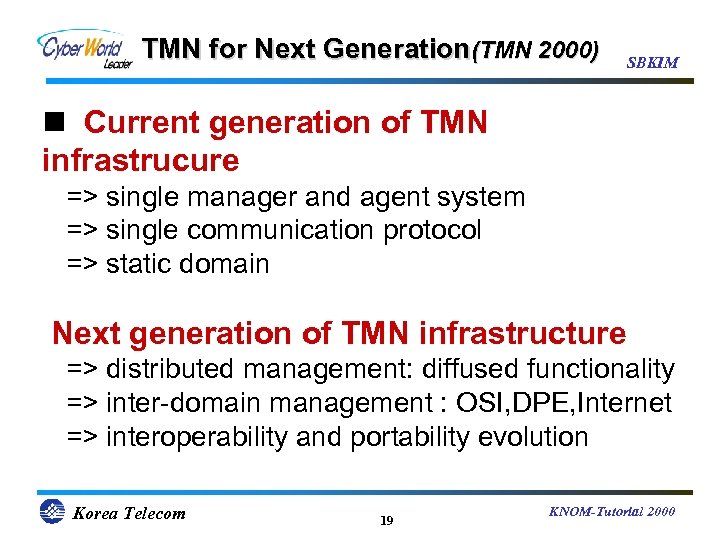
TMN for Next Generation(TMN 2000) SBKIM n Current generation of TMN infrastrucure => single manager and agent system => single communication protocol => static domain Next generation of TMN infrastructure => distributed management: diffused functionality => inter-domain management : OSI, DPE, Internet => interoperability and portability evolution Korea Telecom 19 KNOM-Tutorial 2000
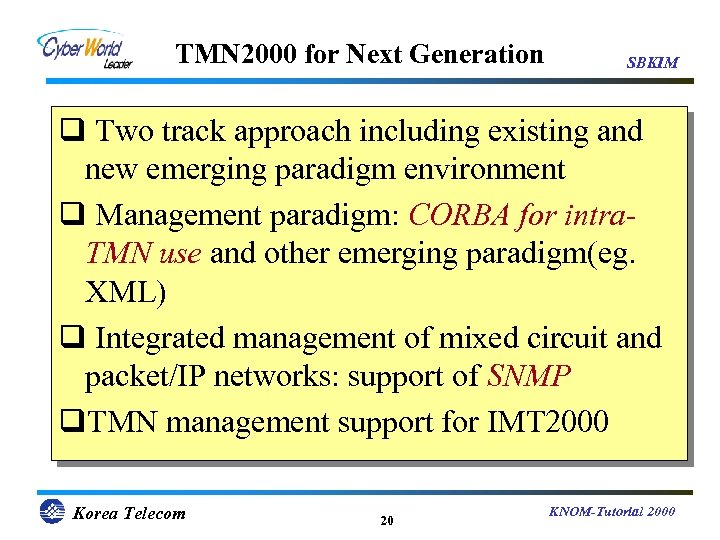
TMN 2000 for Next Generation SBKIM q Two track approach including existing and new emerging paradigm environment q Management paradigm: CORBA for intra. TMN use and other emerging paradigm(eg. XML) q Integrated management of mixed circuit and packet/IP networks: support of SNMP q. TMN management support for IMT 2000 Korea Telecom 20 KNOM-Tutorial 2000
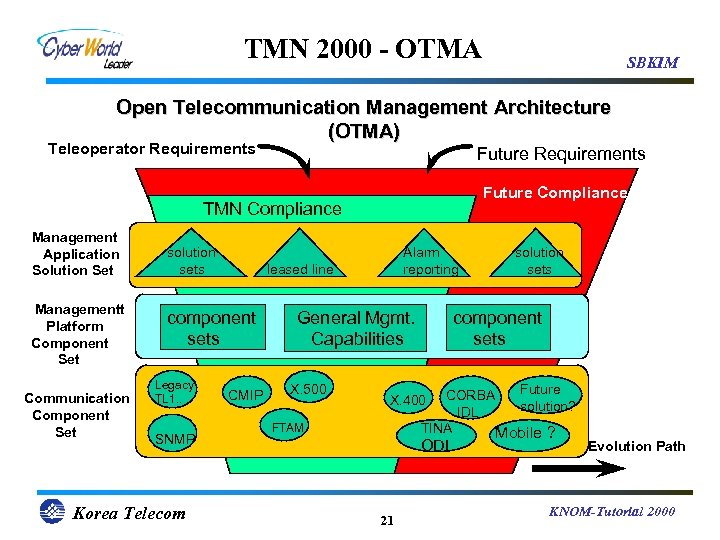
TMN 2000 - OTMA SBKIM Open Telecommunication Management Architecture (OTMA) Teleoperator Requirements Future Compliance TMN Compliance Management Application Solution Set Managementt Platform Component Set Communication Component Set solution sets leased line component sets Legacy TL 1. . SNMP Korea Telecom Alarm reporting CMIP General Mgmt. Capabilities X. 500 solution sets component sets Future CORBA solution? IDL TINA Mobile ? X. 400 FTAM ODL 21 Evolution Path KNOM-Tutorial 2000
SBKIM New Generation Operation Support System and Software (NGOSS) Korea Telecom 22 KNOM-Tutorial 2000
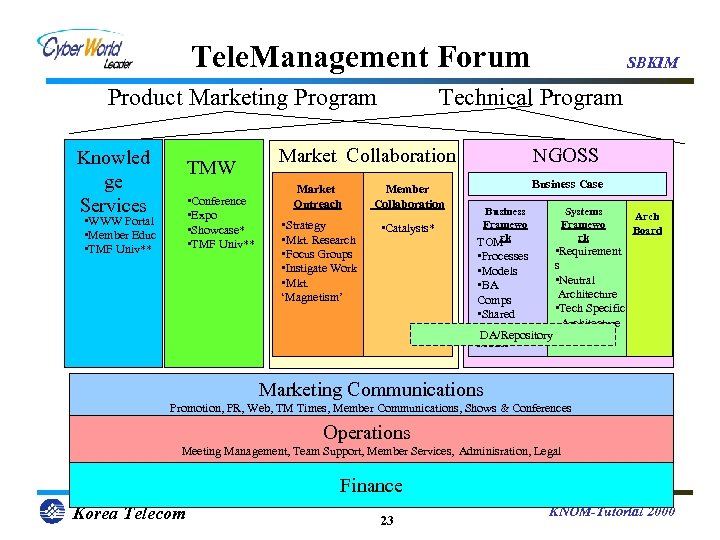
Tele. Management Forum Product Marketing Program Knowled ge Services TMW • Conference • Expo • Showcase* • TMF Univ** • WWW Portal • Member Educ • TMF Univ** SBKIM Technical Program Market Collaboration Market Outreach Member Collaboration • Strategy • Mkt. Research • Focus Groups • Instigate Work • Mkt. ‘Magnetism’ • Catalysts* NGOSS Business Case Business Framewo rk TOM Systems Framewo rk Arch Board • Requirement • Processes s • Models • Neutral • BA Architecture Comps • Tech Specific • Shared Architecture Data DA/Repository s Model Marketing Communications Promotion, PR, Web, TM Times, Member Communications, Shows & Conferences Operations Meeting Management, Team Support, Member Services, Adminisration, Legal Finance Korea Telecom 23 KNOM-Tutorial 2000
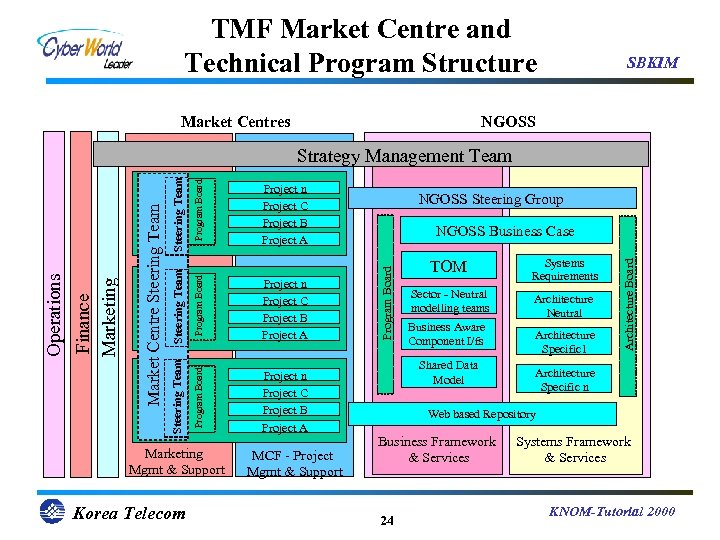
TMF Market Centre and Technical Program Structure Market Centres SBKIM NGOSS Marketing Mgmt & Support Korea Telecom MCF - Project Mgmt & Support NGOSS Business Case TOM Systems Requirements Sector - Neutral modelling teams Architecture Neutral Business Aware Component I/fs Shared Data Model Architecture Specific 1 Architecture Board Project n Project C Project B Project A NGOSS Steering Group Program Board Project n Project C Project B Project A Program Board Steering Team Project n Project C Project B Project A Steering Team Market Centre Steering Team Finance Marketing Operations Strategy Management Team Architecture Specific n Web based Repository Business Framework & Services 24 Systems Framework & Services KNOM-Tutorial 2000
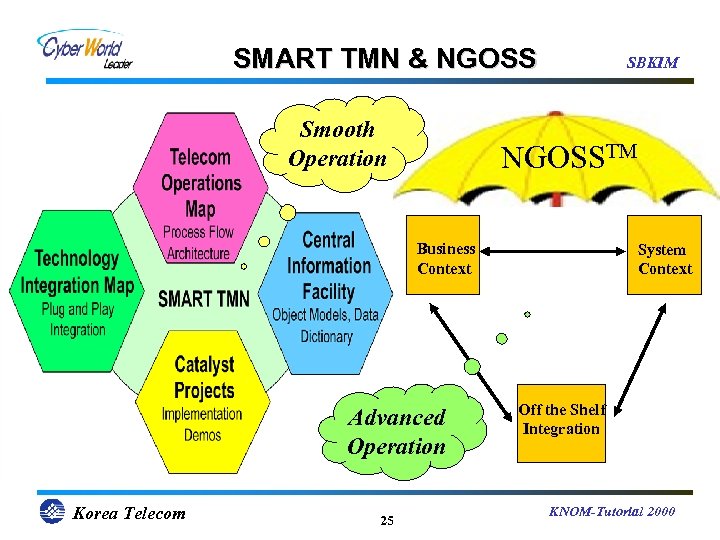
SMART TMN & NGOSS Smooth Operation SBKIM NGOSSTM Business Context Advanced Operation Korea Telecom 25 System Context Off the Shelf Integration KNOM-Tutorial 2000
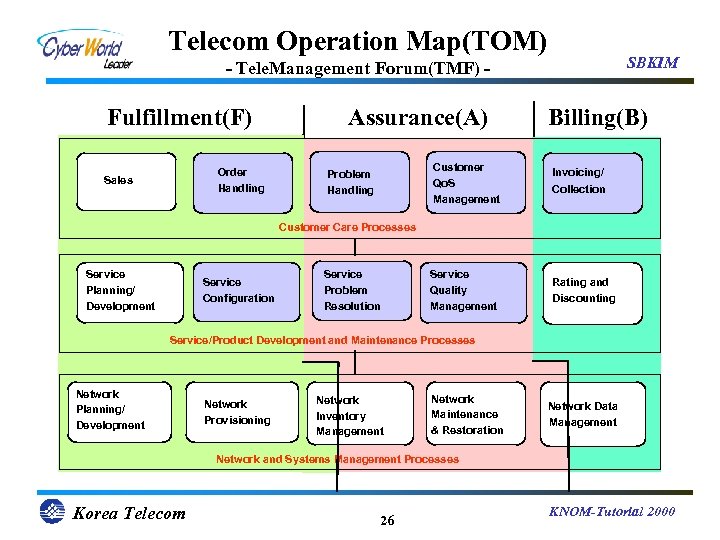
Telecom Operation Map(TOM) SBKIM - Tele. Management Forum(TMF) - Fulfillment(F) Order Handling Sales Assurance(A) Customer Qo. S Management Problem Handling Billing(B) Invoicing/ Collection Customer Care Processes Service Planning/ Development Service Configuration Service Problem Resolution Service Quality Management Rating and Discounting Service/Product Development and Maintenance Processes Network Planning/ Development Network Provisioning Network Inventory Management Network Maintenance & Restoration Network Data Management Network and Systems Management Processes Korea Telecom 26 KNOM-Tutorial 2000
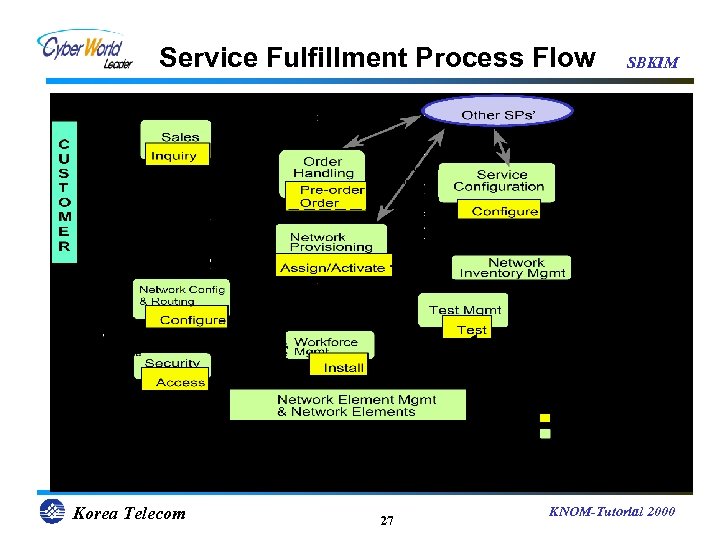
Service Fulfillment Process Flow Korea Telecom 27 SBKIM KNOM-Tutorial 2000
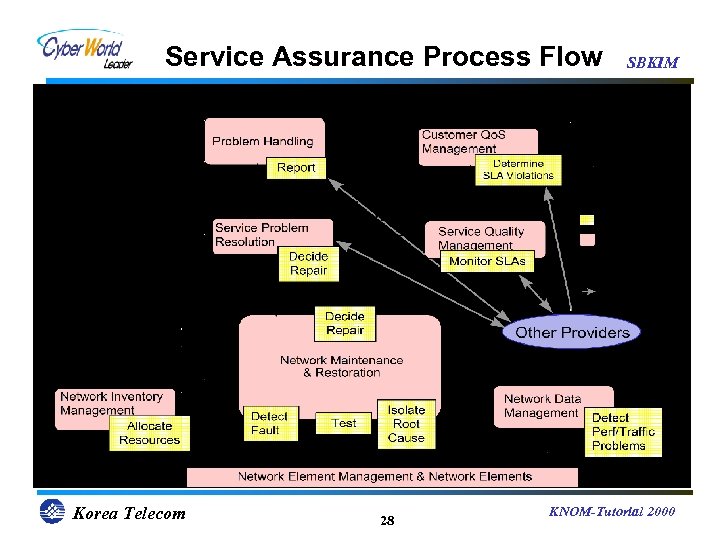
Service Assurance Process Flow Korea Telecom 28 SBKIM KNOM-Tutorial 2000
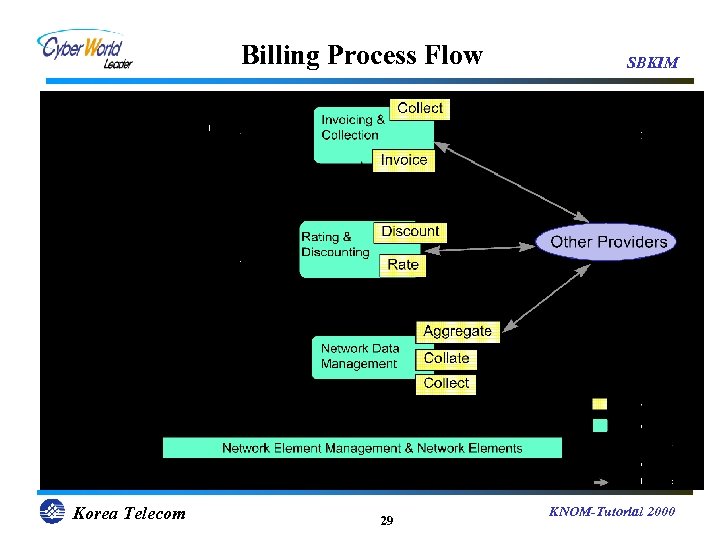
Billing Process Flow Korea Telecom 29 SBKIM KNOM-Tutorial 2000
![Example of Detail Process SBKIM [ Network Provisioning Process ] Korea Telecom 30 KNOM-Tutorial](https://present5.com/presentation/6444b06b30692063e94b5278546cd4bf/image-30.jpg "Example of Detail Process SBKIM [ Network Provisioning Process ] Korea Telecom 30 KNOM-Tutorial")
Example of Detail Process SBKIM [ Network Provisioning Process ] Korea Telecom 30 KNOM-Tutorial 2000
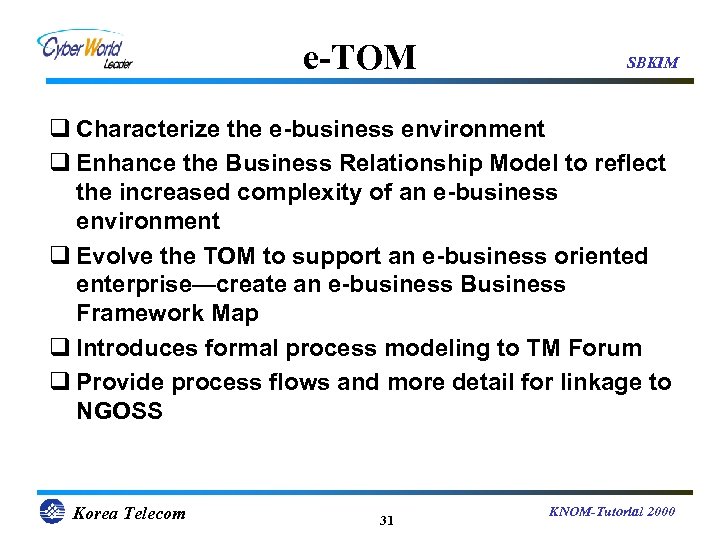
e-TOM SBKIM q Characterize the e-business environment q Enhance the Business Relationship Model to reflect the increased complexity of an e-business environment q Evolve the TOM to support an e-business oriented enterprise—create an e-business Business Framework Map q Introduces formal process modeling to TM Forum q Provide process flows and more detail for linkage to NGOSS Korea Telecom 31 KNOM-Tutorial 2000
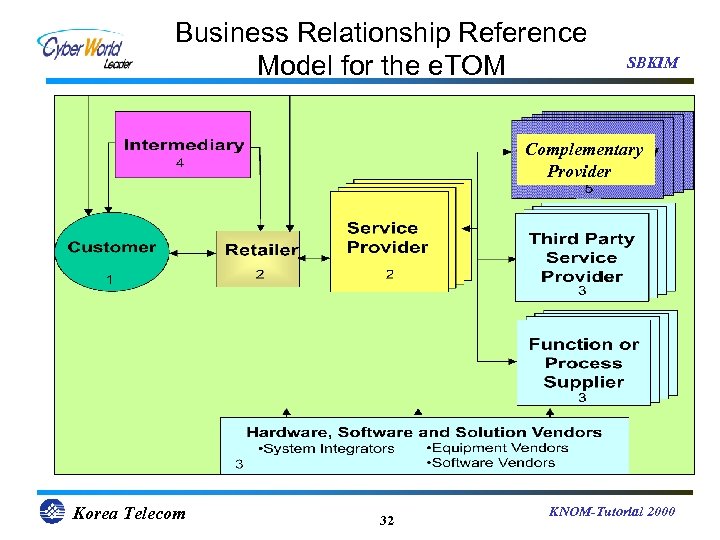
Business Relationship Reference Model for the e. TOM SBKIM Complementary Provider Korea Telecom 32 KNOM-Tutorial 2000
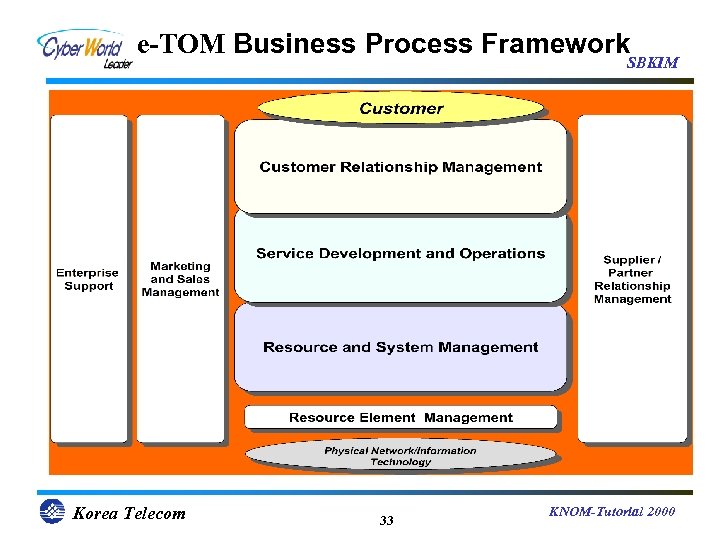
e-TOM Business Process Framework SBKIM Korea Telecom 33 KNOM-Tutorial 2000
![Process - Level 1 SBKIM [ The Enterprise Support process – Level 1 ]](https://present5.com/presentation/6444b06b30692063e94b5278546cd4bf/image-34.jpg "Process - Level 1 SBKIM [ The Enterprise Support process – Level 1 ]")
Process - Level 1 SBKIM [ The Enterprise Support process – Level 1 ] [ The Marketing and Sales Management process – Level 1 ] Korea Telecom 34 KNOM-Tutorial 2000
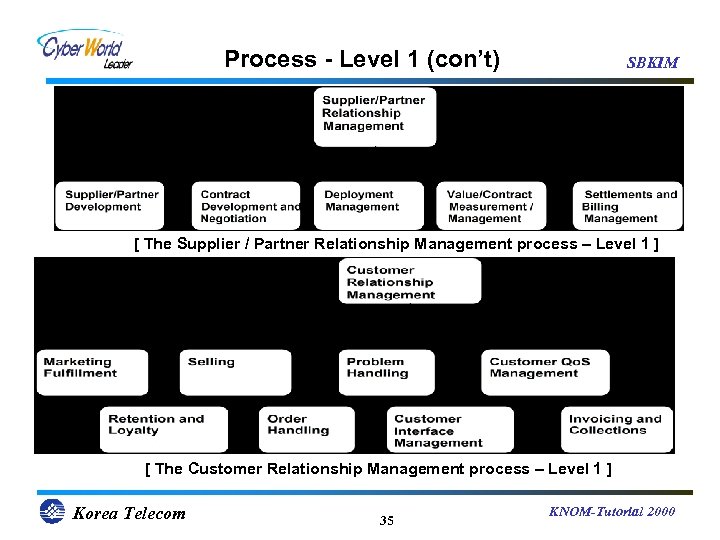
Process - Level 1 (con’t) SBKIM [ The Supplier / Partner Relationship Management process – Level 1 ] [ The Customer Relationship Management process – Level 1 ] Korea Telecom 35 KNOM-Tutorial 2000
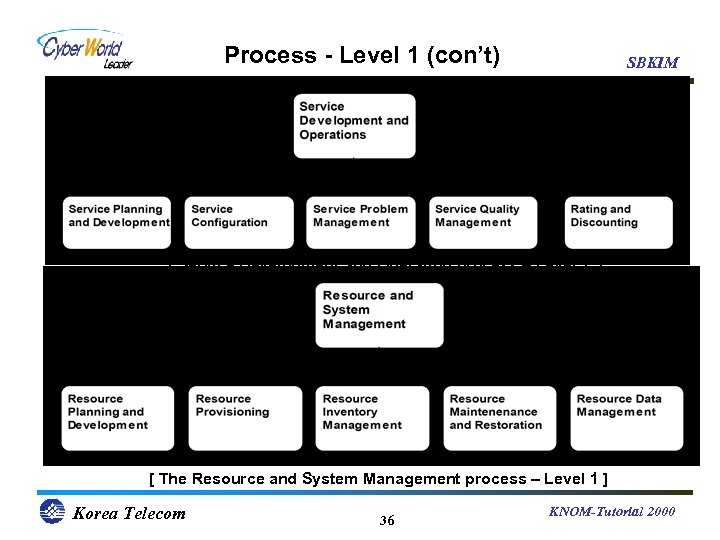
Process - Level 1 (con’t) SBKIM [ Service Development and Operation process – Level 1 ] [ The Resource and System Management process – Level 1 ] Korea Telecom 36 KNOM-Tutorial 2000
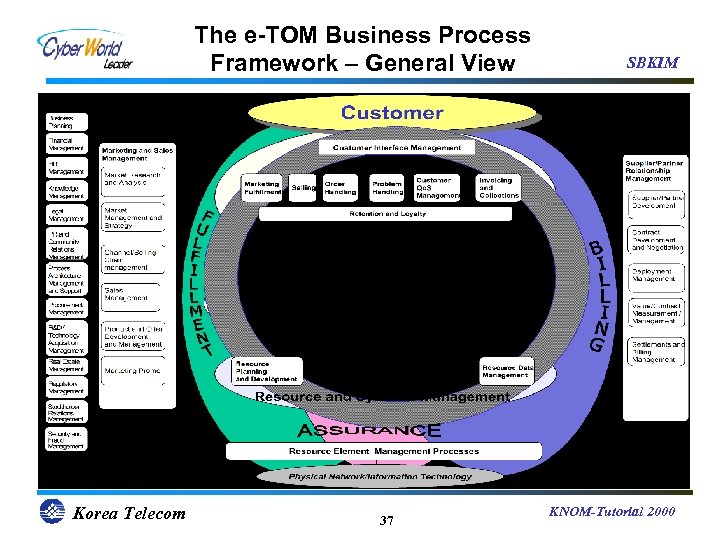
The e-TOM Business Process Framework – General View Korea Telecom 37 SBKIM KNOM-Tutorial 2000
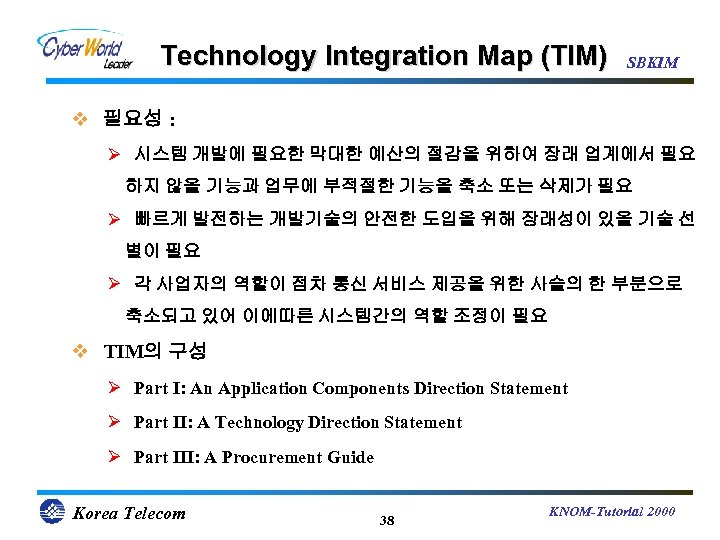
Technology Integration Map (TIM) SBKIM v 필요성 : Ø 시스템 개발에 필요한 막대한 예산의 절감을 위하여 장래 업계에서 필요 하지 않을 기능과 업무에 부적절한 기능을 축소 또는 삭제가 필요 Ø 빠르게 발전하는 개발기술의 안전한 도입을 위해 장래성이 있을 기술 선 별이 필요 Ø 각 사업자의 역할이 점차 통신 서비스 제공을 위한 사슬의 한 부분으로 축소되고 있어 이에따른 시스템간의 역할 조정이 필요 v TIM의 구성 Ø Part I: An Application Components Direction Statement Ø Part II: A Technology Direction Statement Ø Part III: A Procurement Guide Korea Telecom 38 KNOM-Tutorial 2000
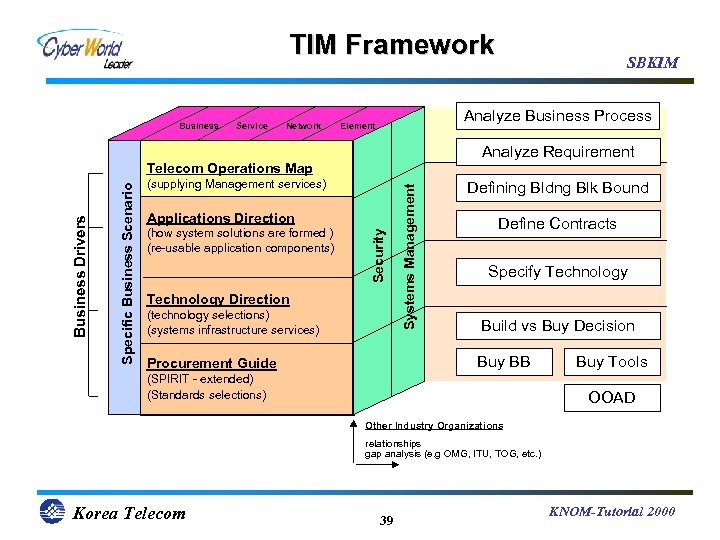
TIM Framework Business Service Network SBKIM Analyze Business Process Element Analyze Requirement Applications Direction (how system solutions are formed ) (re-usable application components) Technology Direction (technology selections) (systems infrastructure services) Systems Management (supplying Management services) Security Specific Business Scenario Business Drivers Telecom Operations Map Defining Bldng Blk Bound Define Contracts Specify Technology Build vs Buy Decision Buy BB Procurement Guide (SPIRIT - extended) (Standards selections) Buy Tools OOAD Other Industry Organizations relationships gap analysis (e. g OMG, ITU, TOG, etc. ) Korea Telecom 39 KNOM-Tutorial 2000
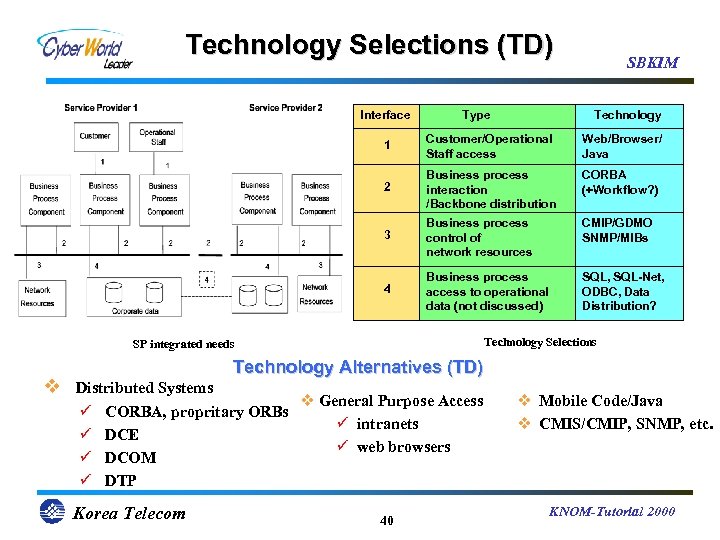
Technology Selections (TD) Interface Type SBKIM Technology 1 Customer/Operational Staff access Web/Browser/ Java 2 Business process interaction /Backbone distribution CORBA (+Workflow? ) 3 Business process control of network resources CMIP/GDMO SNMP/MIBs 4 Business process access to operational data (not discussed) SQL, SQL-Net, ODBC, Data Distribution? Technology Selections SP integrated needs v Technology Alternatives (TD) Distributed Systems v General Purpose Access ü CORBA, propritary ORBs ü intranets ü DCE ü web browsers ü DCOM ü DTP Korea Telecom 40 v Mobile Code/Java v CMIS/CMIP, SNMP, etc. KNOM-Tutorial 2000
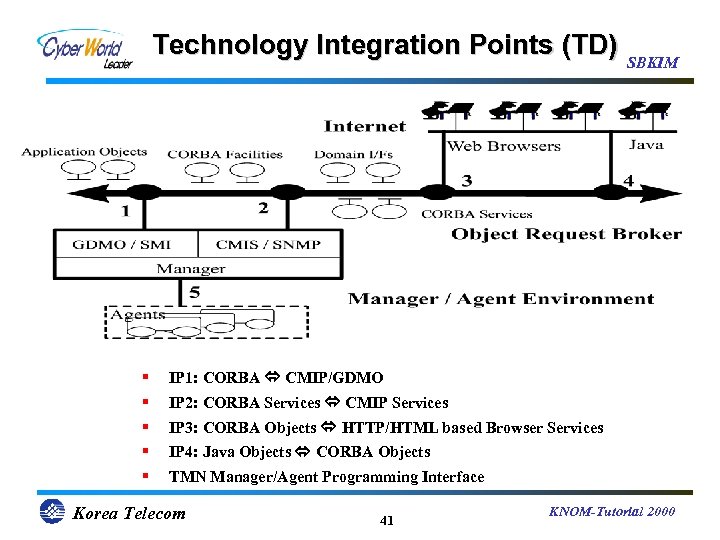
Technology Integration Points (TD) SBKIM § IP 1: CORBA CMIP/GDMO § IP 2: CORBA Services CMIP Services § IP 3: CORBA Objects HTTP/HTML based Browser Services § IP 4: Java Objects CORBA Objects § TMN Manager/Agent Programming Interface Korea Telecom 41 KNOM-Tutorial 2000
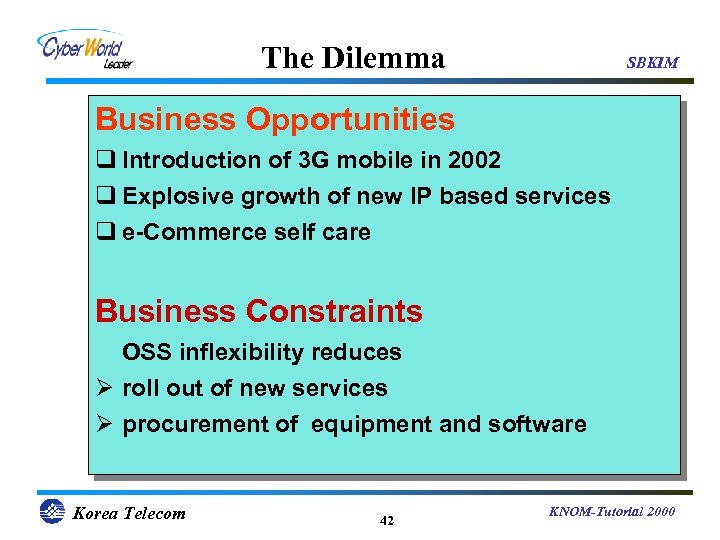
The Dilemma SBKIM Business Opportunities q Introduction of 3 G mobile in 2002 q Explosive growth of new IP based services q e-Commerce self care Business Constraints OSS inflexibility reduces Ø roll out of new services Ø procurement of equipment and software Korea Telecom 42 KNOM-Tutorial 2000
Hurdles to Overcome SBKIM q No “generally accepted” architecture that we can all base our systems on. q We spend too much time “getting systems to connect” and not enough time on “getting the functionality we need”! q We cannot change the systems as fast as the business is changing. … 50% of the work of integrating two systems in in the “plumbing” and “adapters”. This wasted work that takes away from creating actual usable functionality. q We cannot buy/ build/ lease new systems functionality without affecting everything currently installed. Korea Telecom 43 KNOM-Tutorial 2000
NGOSS (New Generation Operation System and Software) SBKIM Goal q Secure a leadership position by successfully delivering NGOSS with significant industry support. Program Objectives q Establish the NGOSS reference architecture as the industry’s umbrella architecture for all OSS solutions (Q 1 2001) q Deliver NGOSS reference implementation (Q 2 2001) q Gain involvement from key groups by launching collaborative work on key elements q Create market momentum by attracting support of pacesetter companies q Extend acceptance into other key sectors (ASPs, ISPs, etc. ) Korea Telecom 44 KNOM-Tutorial 2000
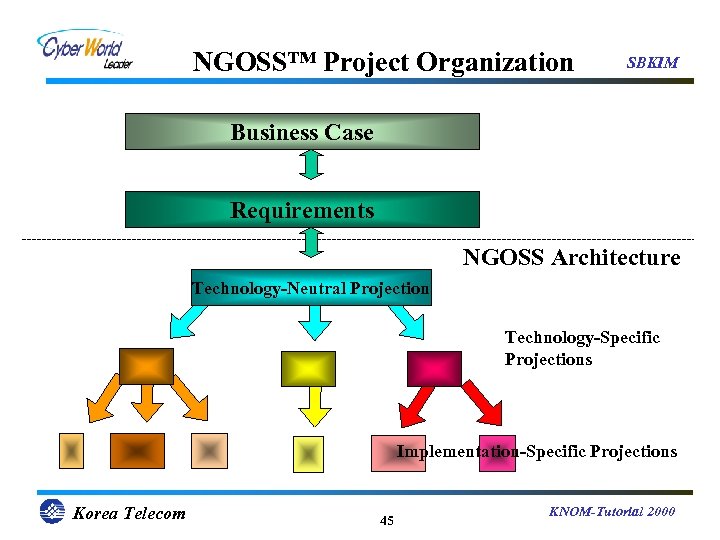
NGOSS™ Project Organization SBKIM Business Case Requirements NGOSS Architecture Technology-Neutral Projection Technology-Specific Projections Implementation-Specific Projections Korea Telecom 45 KNOM-Tutorial 2000
NGOSS Architecture SBKIM q System Definitions and Mappings § System equivalent view of TOM § Enterprise Solution q System Components § § § Component Interactions Component Interfaces 3 types of system components Business deployable components Mapping BP to Function interactions q Applying Technology to Concept § Technology neutral system architecture § Technology specific system architecture Korea Telecom 46 KNOM-Tutorial 2000
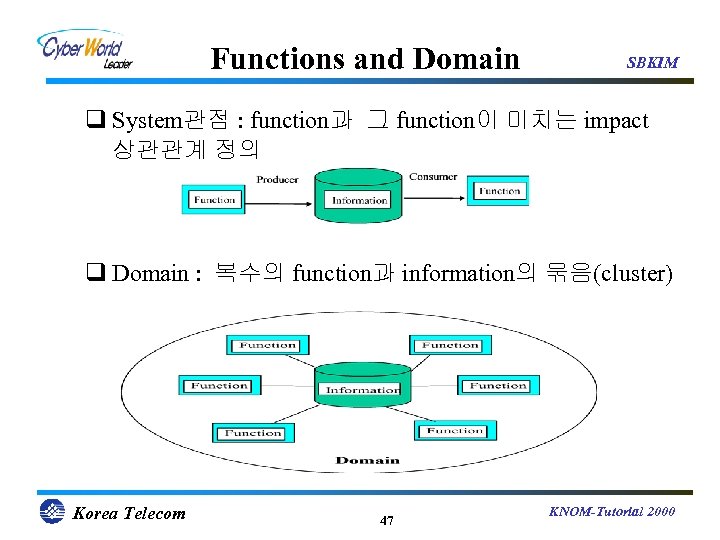
Functions and Domain SBKIM q System관점 : function과 그 function이 미치는 impact 상관관계 정의 q Domain : 복수의 function과 information의 묶음(cluster) Korea Telecom 47 KNOM-Tutorial 2000
![System Equivalent Viewpoint SBKIM [ Systems Equivalent View of TOM ] [Relationships between Multiple](https://present5.com/presentation/6444b06b30692063e94b5278546cd4bf/image-48.jpg "System Equivalent Viewpoint SBKIM [ Systems Equivalent View of TOM ] [Relationships between Multiple")
System Equivalent Viewpoint SBKIM [ Systems Equivalent View of TOM ] [Relationships between Multiple Domains with a System Korea Telecom 48 KNOM-Tutorial 2000
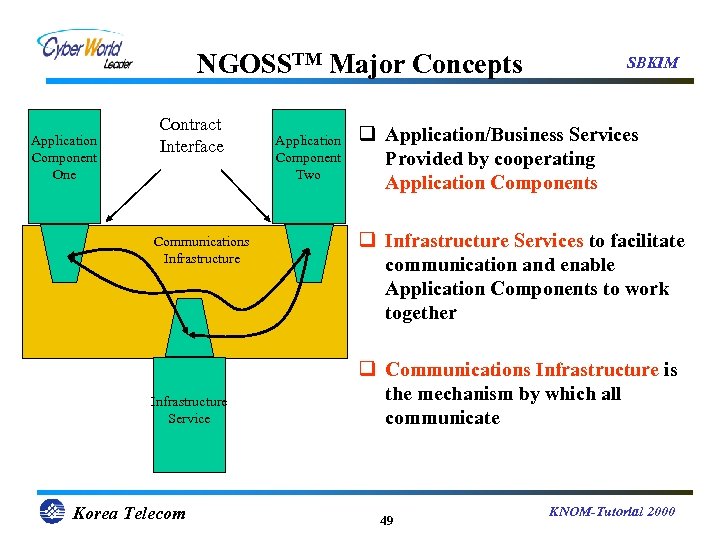
NGOSSTM Major Concepts Application Component One Contract Interface Communications Infrastructure Service Korea Telecom Application Component Two SBKIM q Application/Business Services Provided by cooperating Application Components q Infrastructure Services to facilitate communication and enable Application Components to work together q Communications Infrastructure is the mechanism by which all communicate 49 KNOM-Tutorial 2000
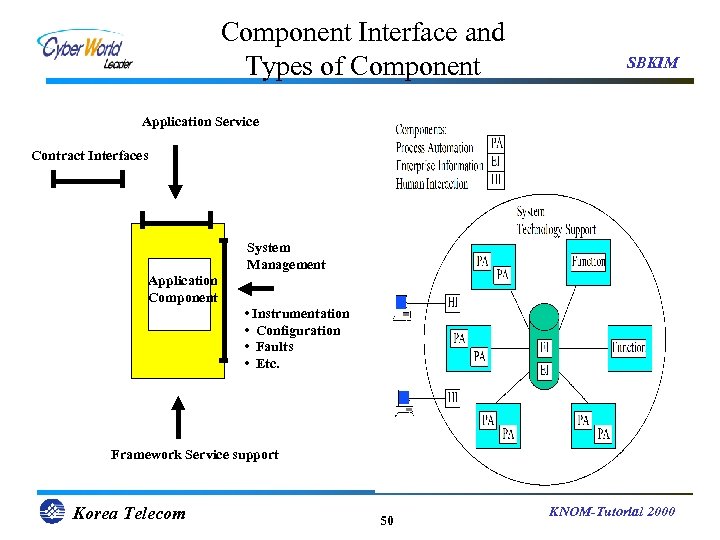
Component Interface and Types of Component SBKIM Application Service Contract Interfaces System Management Application Component • Instrumentation • Configuration • Faults • Etc. Framework Service support Korea Telecom 50 KNOM-Tutorial 2000
SBKIM q Business Rule을 반영한 contract interface와 system technology를 사용하여, Function/information은 system component로 mapping 됨 q Business environment나 business rule이 function, information을 invoke함으로써, business process가 진행됨 q Business Process와 Function간의 mapping은 GB 908(DOM)에 기술되어 있다. Korea Telecom 51 KNOM-Tutorial 2000
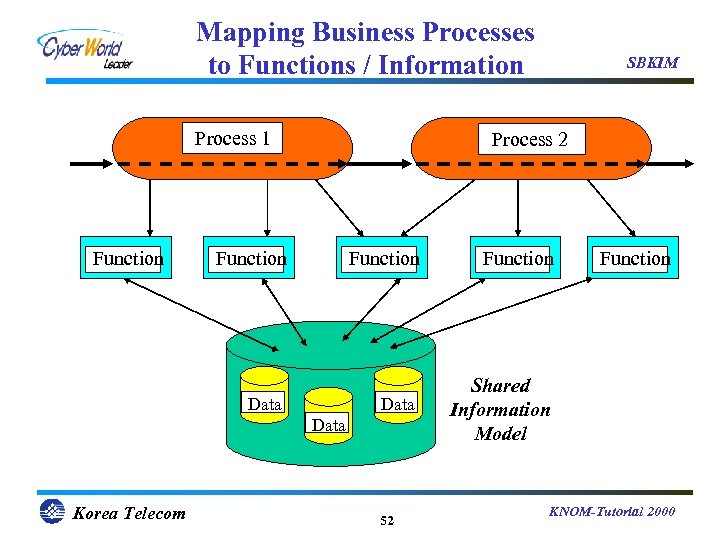
Mapping Business Processes to Functions / Information Process 1 Function Process 2 Function Data Shared Information Model Data Korea Telecom SBKIM 52 Function KNOM-Tutorial 2000
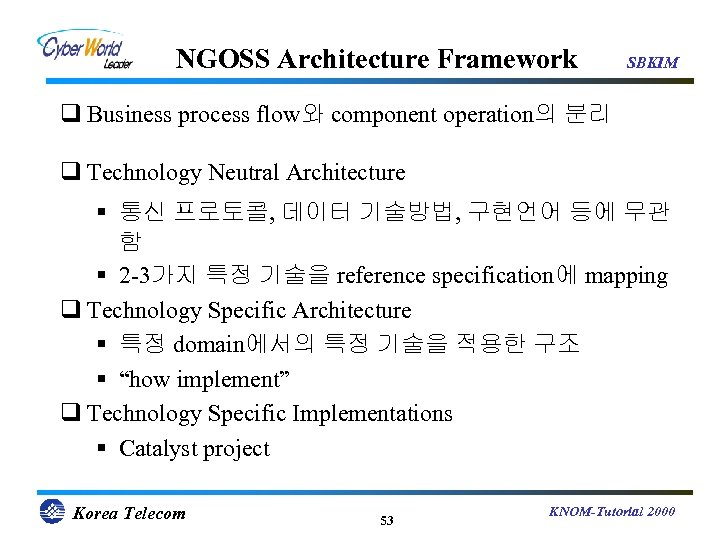
NGOSS Architecture Framework SBKIM q Business process flow와 component operation의 분리 q Technology Neutral Architecture § 통신 프로토콜, 데이터 기술방법, 구현언어 등에 무관 함 § 2 -3가지 특정 기술을 reference specification에 mapping q Technology Specific Architecture § 특정 domain에서의 특정 기술을 적용한 구조 § “how implement” q Technology Specific Implementations § Catalyst project Korea Telecom 53 KNOM-Tutorial 2000
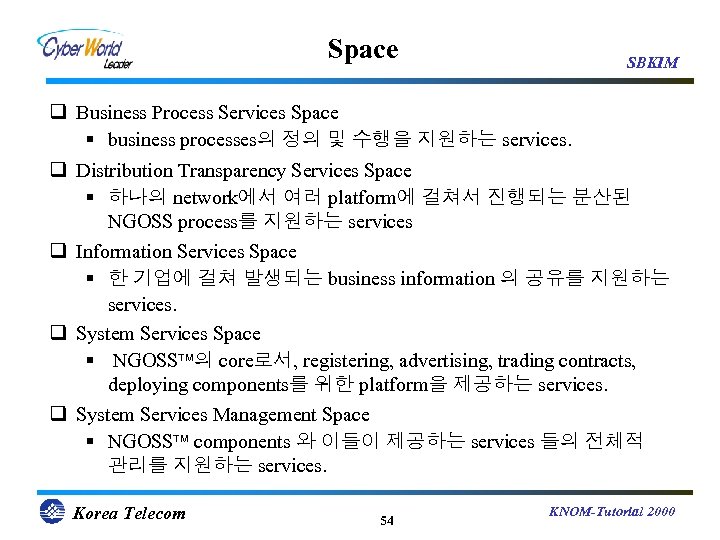
Space SBKIM q Business Process Services Space § business processes의 정의 및 수행을 지원하는 services. q Distribution Transparency Services Space § 하나의 network에서 여러 platform에 걸쳐서 진행되는 분산된 NGOSS process를 지원하는 services q Information Services Space § 한 기업에 걸쳐 발생되는 business information 의 공유를 지원하는 services. q System Services Space § NGOSS 의 core로서, registering, advertising, trading contracts, deploying components를 위한 platform을 제공하는 services. q System Services Management Space § NGOSS components 와 이들이 제공하는 services 들의 전체적 관리를 지원하는 services. Korea Telecom 54 KNOM-Tutorial 2000
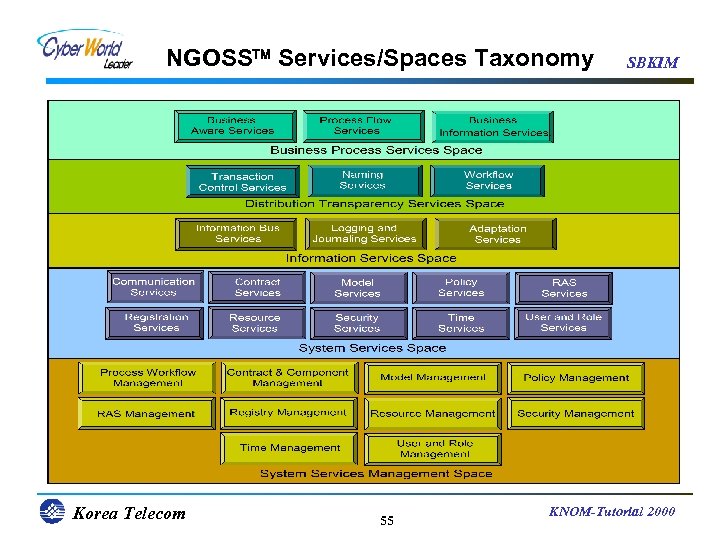
NGOSS Services/Spaces Taxonomy Korea Telecom 55 SBKIM KNOM-Tutorial 2000
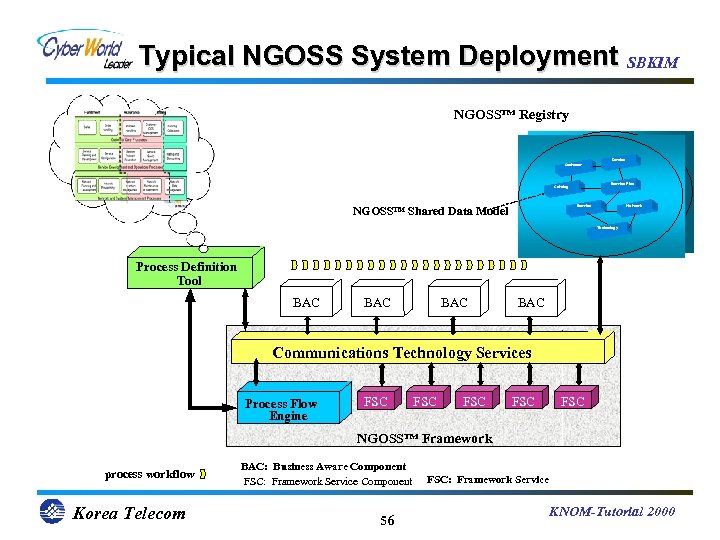
Typical NGOSS System Deployment SBKIM NGOSS™ Registry Customer Invoice Product Plan Service Catalog Network Service NGOSS™ Shared Data Model Technology Process Definition Tool BAC BAC Information Bus Communications Technology Services Workflow Process Flow Engine FSC FSC FSC NGOSS™ Framework process workflow Korea Telecom BAC: Business Aware Component FSC: Framework Service Component 56 FSC: Framework Service KNOM-Tutorial 2000
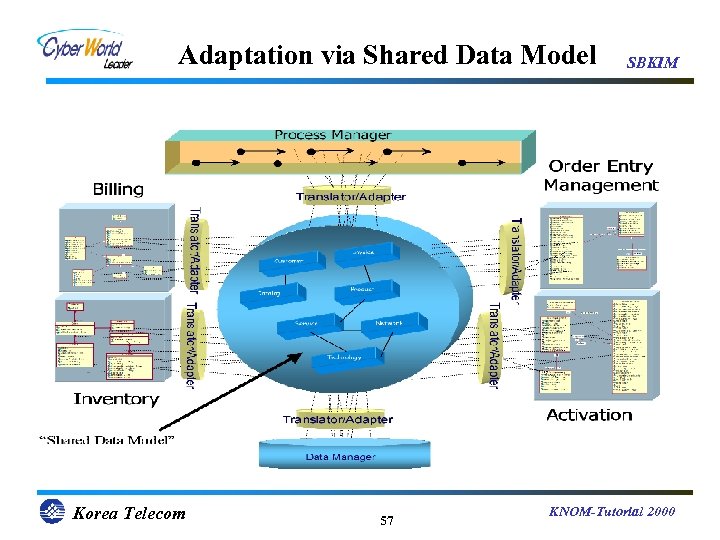
Adaptation via Shared Data Model Korea Telecom 57 SBKIM KNOM-Tutorial 2000
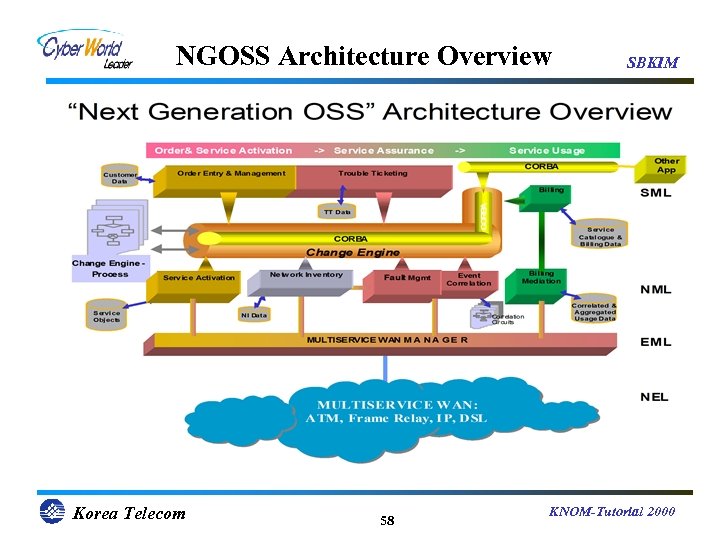
NGOSS Architecture Overview Korea Telecom 58 SBKIM KNOM-Tutorial 2000
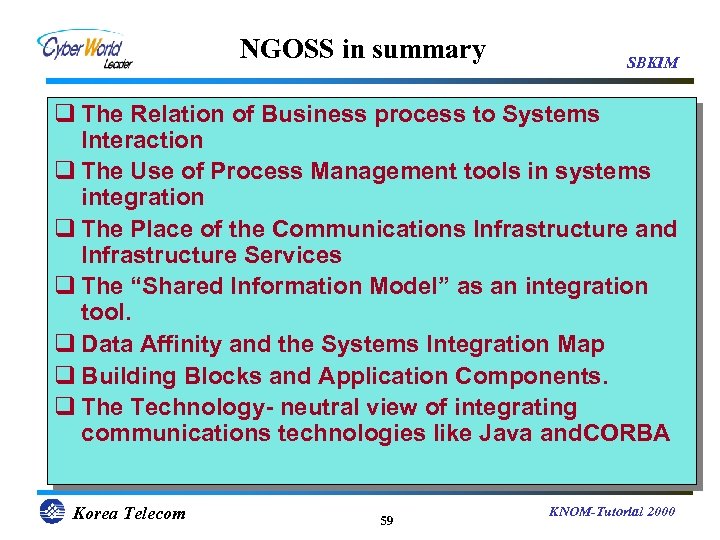
NGOSS in summary SBKIM q The Relation of Business process to Systems Interaction q The Use of Process Management tools in systems integration q The Place of the Communications Infrastructure and Infrastructure Services q The “Shared Information Model” as an integration tool. q Data Affinity and the Systems Integration Map q Building Blocks and Application Components. q The Technology- neutral view of integrating communications technologies like Java and. CORBA Korea Telecom 59 KNOM-Tutorial 2000
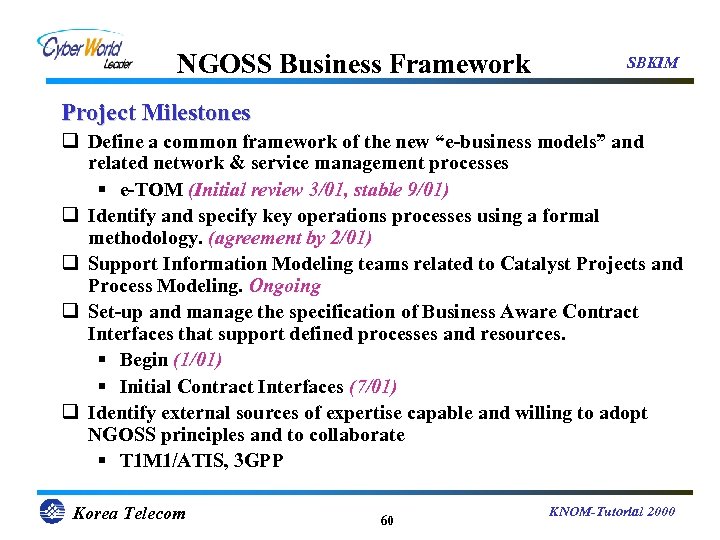
NGOSS Business Framework SBKIM Project Milestones q Define a common framework of the new “e-business models” and related network & service management processes § e-TOM (Initial review 3/01, stable 9/01) q Identify and specify key operations processes using a formal methodology. (agreement by 2/01) q Support Information Modeling teams related to Catalyst Projects and Process Modeling. Ongoing q Set-up and manage the specification of Business Aware Contract Interfaces that support defined processes and resources. § Begin (1/01) § Initial Contract Interfaces (7/01) q Identify external sources of expertise capable and willing to adopt NGOSS principles and to collaborate § T 1 M 1/ATIS, 3 GPP Korea Telecom 60 KNOM-Tutorial 2000
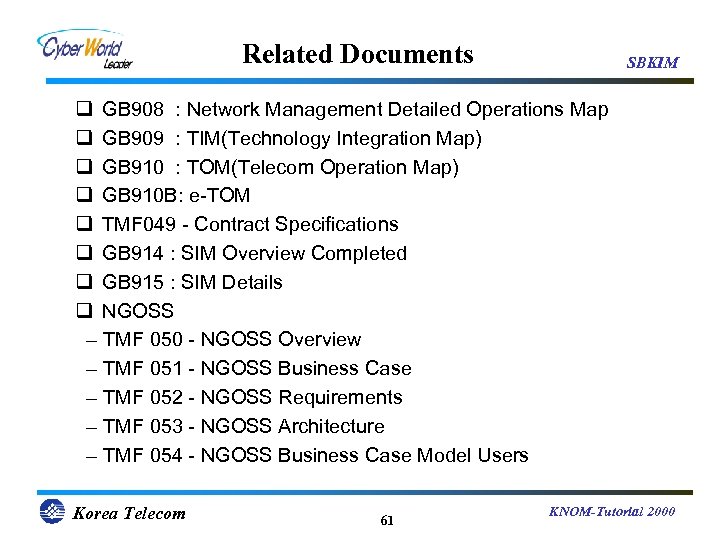
Related Documents SBKIM q GB 908 : Network Management Detailed Operations Map q GB 909 : TIM(Technology Integration Map) q GB 910 : TOM(Telecom Operation Map) q GB 910 B: e-TOM q TMF 049 - Contract Specifications q GB 914 : SIM Overview Completed q GB 915 : SIM Details q NGOSS – TMF 050 - NGOSS Overview – TMF 051 - NGOSS Business Case – TMF 052 - NGOSS Requirements – TMF 053 - NGOSS Architecture – TMF 054 - NGOSS Business Case Model Users Korea Telecom 61 KNOM-Tutorial 2000
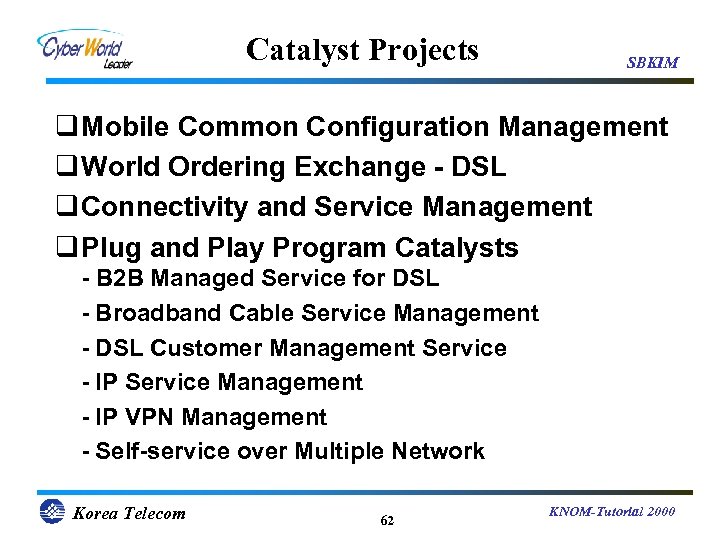
Catalyst Projects SBKIM q Mobile Common Configuration Management q World Ordering Exchange - DSL q Connectivity and Service Management q Plug and Play Program Catalysts - B 2 B Managed Service for DSL - Broadband Cable Service Management - DSL Customer Management Service - IP Service Management - IP VPN Management - Self-service over Multiple Network Korea Telecom 62 KNOM-Tutorial 2000
SBKIM Summary Korea Telecom 63 KNOM-Tutorial 2000
SBKIM q Key words and words …. . - Qo. S(Quality Of Service) : Quality - Technology Neutral Framework : Adaptability - Plug & Play : Reusability - Interoperability q Right Time to set forth the New Generation Management Architecture - To meet the higher requirements and demands of customers and service providers Korea Telecom 64 KNOM-Tutorial 2000
SBKIM Thank You !! For further discussions, please contact sbkimm@kt. co. kr +82 -42 -870 -8540 Korea Telecom KNOM-Tutorial 2000
Скачать презентацию SBKIM Telecommunications Management Architecture and Technologies for New
6444b06b30692063e94b5278546cd4bf.ppt