 Скачать презентацию Sberbank 2009 -2014 strategy highlights Analyst investor presentation December
82b0d7c3f8f5a2e324367f25dd01a215.ppt
- Количество слайдов: 21



Sberbank: 2009 -2014 strategy highlights Analyst/investor presentation December 2008
Legal disclaimer This presentation has been prepared by Sberbank (Savings Bank of the Russian Federation (the “Bank”), and comprises the slides for a presentation to investors concerning the Bank. This presentation does not constitute or form part of any offer or invitation to sell or issue, or any solicitation of any offer to purchase or subscribe for, any shares or other securities representing shares in the Bank, nor shall it or any part of it nor the fact of its presentation or distribution form the basis of, or be relied on in connection with, any contract or investment decision. The information in this presentation or in oral statements of the management of the Bank may include forward-looking statements. These forward-looking statements include all matters that are not historical facts, statements regarding the Bank's intentions, beliefs or current expectations concerning, among other things, the Bank's results of operations, financial condition, liquidity, prospects, growth, strategies, and the industry in which the Bank operates. By their nature, forward-looking statements involve risks and uncertainties, because they relate to events and depend on circumstances that may or may not occur in the future. The Bank cautions you that forward looking statements are not guarantees of future performance and that its actual results of operations, financial condition and liquidity and the development of the industry in which the Bank operates may differ materially from those made in or suggested by the forward-looking statements contained in this presentation or in oral statements of the management of the Bank. In addition, even if the Bank's results of operations, financial condition and liquidity and the development of the industry in which the Bank operates are consistent with the forward-looking statements contained in this presentation, those results or developments may not be indicative of results or developments in future periods. The information and opinions contained in this presentation or in oral statements of the management of the Bank are provided as at the date of this presentation and are subject to change without notice. 1
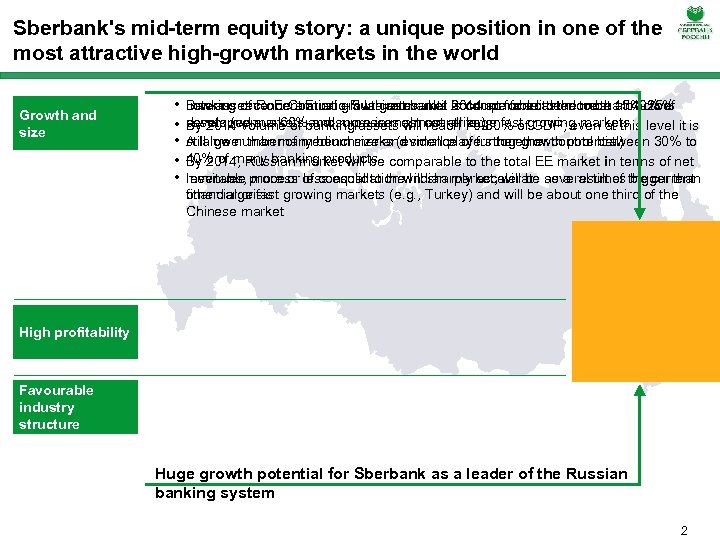
Sberbank's mid-term equity story: a unique position in one of the most attractive high-growth markets in the world Growth and size • • • Low asset concentration – 5 largest banks account for a little more than 40% of In terms of Ro. E-Co. E ratio Russian market is comparable to the most attractive Banking revenue annual growth rates until 2014 are forecasted to be 15%-25% assets (versus 60% and more in most countries), developed markets and surpasses almost all large fast growing markets By 2014 volume of banking assets will reach 70 -80% of GDP; even at this level it is A large number of medium size and small players together control between 30% to still lower than many benchmarks (evidence of further growth potential) 40% of many banking products By 2014, Russian market will be comparable to the total EE market in terms of net Inevitable process of consolidation will sharply accelerate as a result of the current revenues, more or less equal to the Indian market, will be several times bigger than financial crisis other large fast growing markets (e. g. , Turkey) and will be about one third of the Chinese market High profitability Favourable industry structure Huge growth potential for Sberbank as a leader of the Russian banking system 2
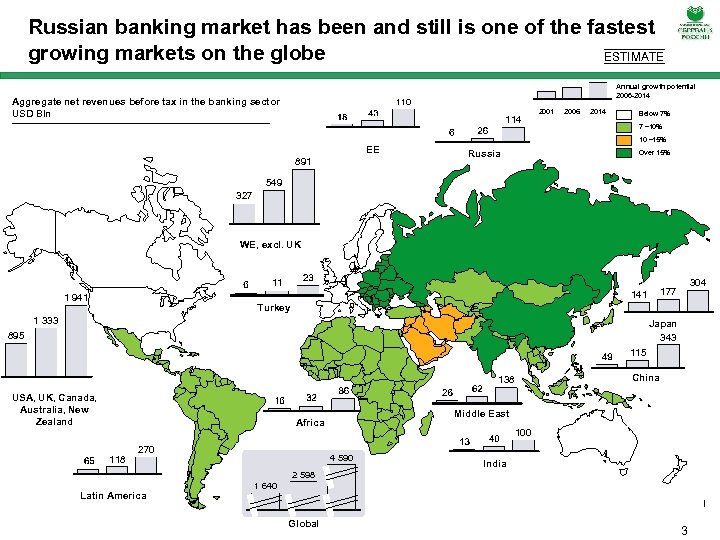
Russian banking market has been and still is one of the fastest growing markets on the globe ESTIMATE Aggregate net revenues before tax in the banking sector USD Bln Annual growth potential 2006 -2014 110 114 2001 2006 2014 Below 7% 7 – 10% 10 – 15% EE 891 Russia Over 15% 549 327 WE, excl. UK 1 941 304 177 141 Turkey 1 333 Japan 343 895 115 138 USA, UK, Canada, Australia, New Zealand Middle East Africa 118 270 China 100 4 590 India 2 598 Latin America 1 640 l Global 3
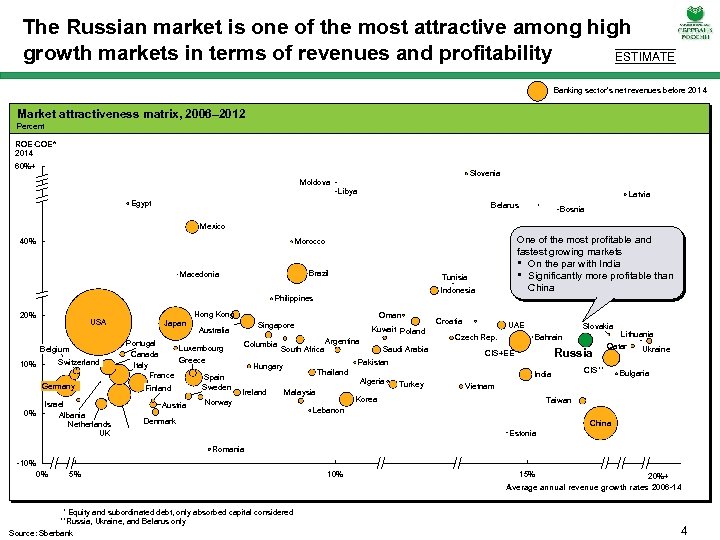
The Russian market is one of the most attractive among high growth markets in terms of revenues and profitability ESTIMATE Banking sector’s net revenues before 201 4 Market attractiveness matrix, 2006– 2012 Percent ROE-COE* 2014 60%+ Slovenia Moldova Libya Latvia Egypt Belarus Bosnia Mexico 40% Brazil Macedonia Tunisia Indonesia Philippines 20% USA Belgium Switzerland 10% Germany 0% One of the most profitable and fastest growing markets • On the par with India • Significantly more profitable than China Morocco Israel Albania Netherlands UK Hong Kong Japan Australia Portugal Luxembourg Canada Greece Italy France Spain Sweden Finland Austria Oman Singapore Columbia Kuwait Poland South Africa Argentina Saudi Arabia Pakistan Hungary UAE Malaysia Norway Slovakia Bahrain Czech Rep. Russia CIS+EE Thailand Algeria Ireland Croatia India Turkey Lithuania Qatar Ukraine CIS** Bulgaria Vietnam Korea Taiwan Lebanon Denmark China Estonia Romania -10% 0% 5% * Equity and subordinated debt, only absorbed capital considered **Russia, Ukraine, and Belarus only Source: Sberbank 10% 15% 20%+ Average annual revenue growth rates 2006 -14 4
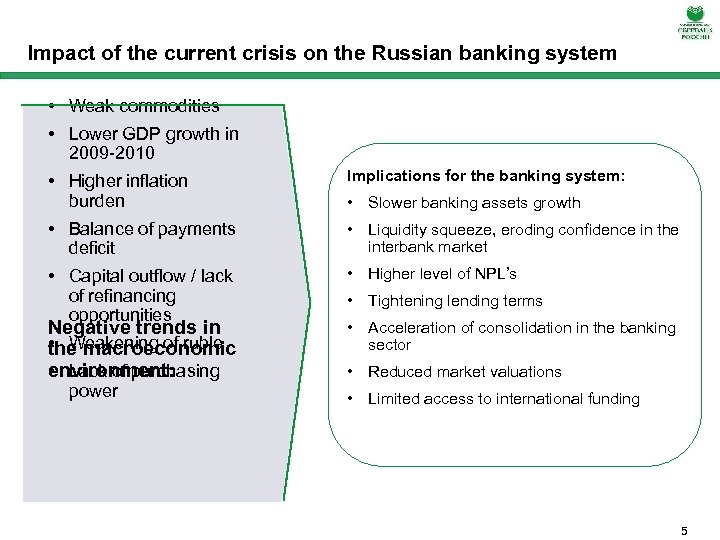
Impact of the current crisis on the Russian banking system • Weak commodities • Lower GDP growth in 2009 -2010 • Higher inflation burden Implications for the banking system: • Balance of payments deficit • Liquidity squeeze, eroding confidence in the interbank market • Capital outflow / lack of refinancing opportunities • Higher level of NPL’s Negative trends in • Weakening of ruble the macroeconomic environment: • Lack of purchasing power • Slower banking assets growth • Tightening lending terms • Acceleration of consolidation in the banking sector • Reduced market valuations • Limited access to international funding 5
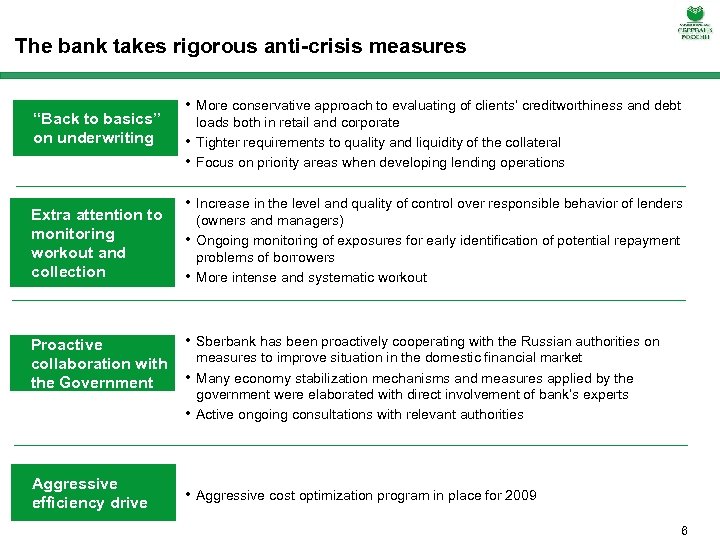
The bank takes rigorous anti-crisis measures “Back to basics” on underwriting Extra attention to monitoring workout and collection Proactive collaboration with the Government • More conservative approach to evaluating of clients’ creditworthiness and debt • • • Increase in the level and quality of control over responsible behavior of lenders • • (owners and managers) Ongoing monitoring of exposures for early identification of potential repayment problems of borrowers More intense and systematic workout • Sberbank has been proactively cooperating with the Russian authorities on • • Aggressive efficiency drive loads both in retail and corporate Tighter requirements to quality and liquidity of the collateral Focus on priority areas when developing lending operations measures to improve situation in the domestic financial market Many economy stabilization mechanisms and measures applied by the government were elaborated with direct involvement of bank’s experts Active ongoing consultations with relevant authorities • Aggressive cost optimization program in place for 2009 6
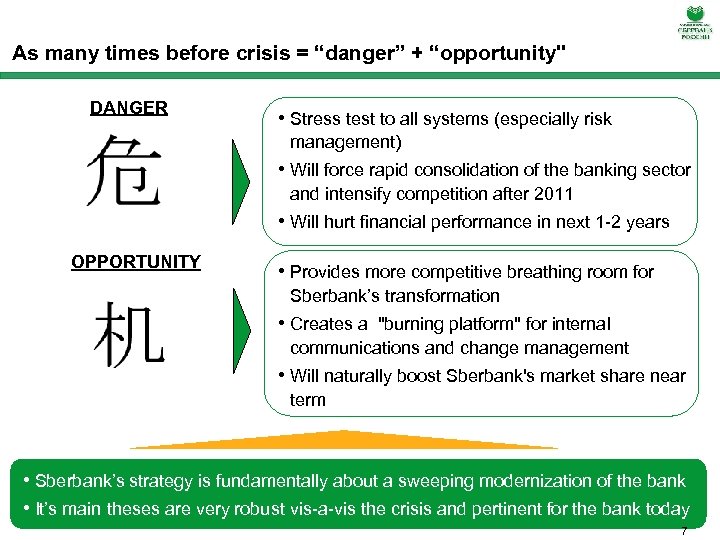
As many times before crisis = “danger” + “opportunity" DANGER • Stress test to all systems (especially risk management) • Will force rapid consolidation of the banking sector and intensify competition after 2011 • Will hurt financial performance in next 1 -2 years OPPORTUNITY • Provides more competitive breathing room for Sberbank’s transformation • Creates a "burning platform" for internal communications and change management • Will naturally boost Sberbank's market share near term • Sberbank’s strategy is fundamentally about a sweeping modernization of the bank • It’s main theses are very robust vis-a-vis the crisis and pertinent for the bank today 7
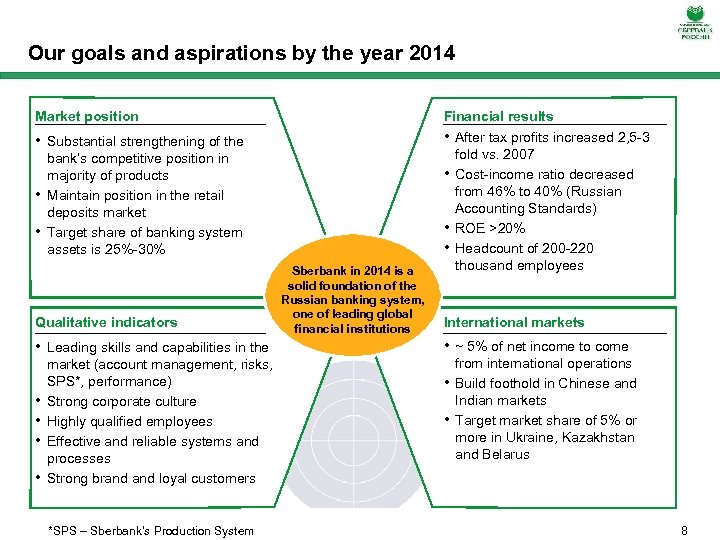
Our goals and aspirations by the year 2014 Market position Financial results • Substantial strengthening of the • After tax profits increased 2, 5 -3 • • bank’s competitive position in majority of products Maintain position in the retail deposits market Target share of banking system assets is 25%-30% Qualitative indicators • Leading skills and capabilities in the • • market (account management, risks, SPS*, performance) Strong corporate culture Highly qualified employees Effective and reliable systems and processes Strong brand loyal customers *SPS – Sberbank’s Production System • • • Sberbank in 2014 is a solid foundation of the Russian banking system, one of leading global financial institutions fold vs. 2007 Cost-income ratio decreased from 46% to 40% (Russian Accounting Standards) ROE >20% Headcount of 200 -220 thousand employees International markets • ~ 5% of net income to come • • from international operations Build foothold in Chinese and Indian markets Target market share of 5% or more in Ukraine, Kazakhstan and Belarus 8
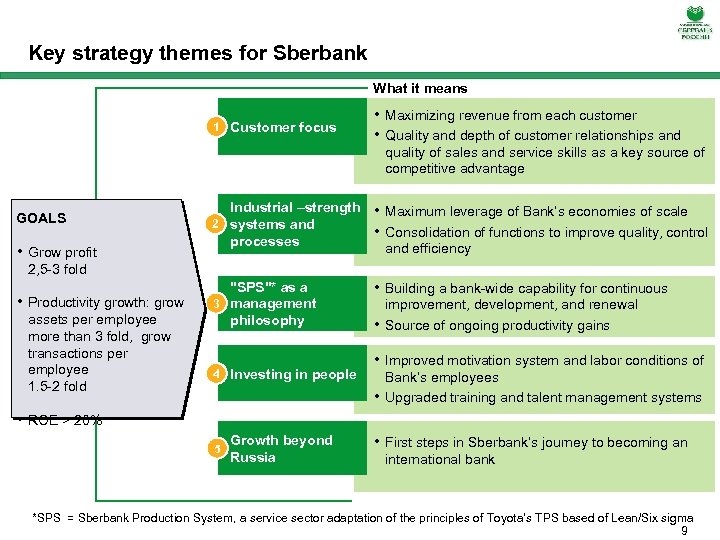
Key strategy themes for Sberbank What it means 1 Customer focus • Maximizing revenue from each customer • Quality and depth of customer relationships and quality of sales and service skills as a key source of competitive advantage GOALS • Grow profit Industrial –strength 2 systems and processes • Maximum leverage of Bank’s economies of scale • Consolidation of functions to improve quality, control "SPS"* as a 3 management philosophy • Building a bank-wide capability for continuous and efficiency 2, 5 -3 fold • Productivity growth: grow assets per employee more than 3 fold, grow transactions per employee 1. 5 -2 fold 4 Investing in people • improvement, development, and renewal Source of ongoing productivity gains • Improved motivation system and labor conditions of • Bank’s employees Upgraded training and talent management systems • ROE > 20% 5 Growth beyond Russia • First steps in Sberbank’s journey to becoming an international bank *SPS = Sberbank Production System, a service sector adaptation of the principles of Toyota’s TPS based of Lean/Six sigma 9
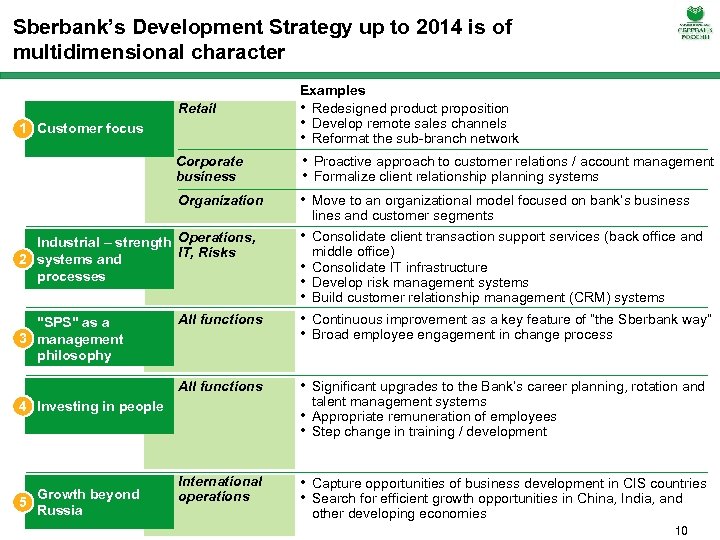
Sberbank’s Development Strategy up to 2014 is of multidimensional character Retail 1 Customer focus Corporate business Organization Industrial – strength Operations, IT, Risks 2 systems and processes "SPS" as a 3 management philosophy All functions 4 Investing in people Growth beyond 5 Russia Examples • Redesigned product proposition • Develop remote sales channels • Reformat the sub-branch network • Proactive approach to customer relations / account management • Formalize client relationship planning systems • Move to an organizational model focused on bank’s business lines and customer segments • Consolidate client transaction support services (back office and • • • Continuous improvement as a key feature of “the Sberbank way” Broad employee engagement in change process • Significant upgrades to the Bank’s career planning, rotation and • • International operations middle office) Consolidate IT infrastructure Develop risk management systems Build customer relationship management (CRM) systems talent management systems Appropriate remuneration of employees Step change in training / development • Capture opportunities of business development in CIS countries • Search for efficient growth opportunities in China, India, and other developing economies 10
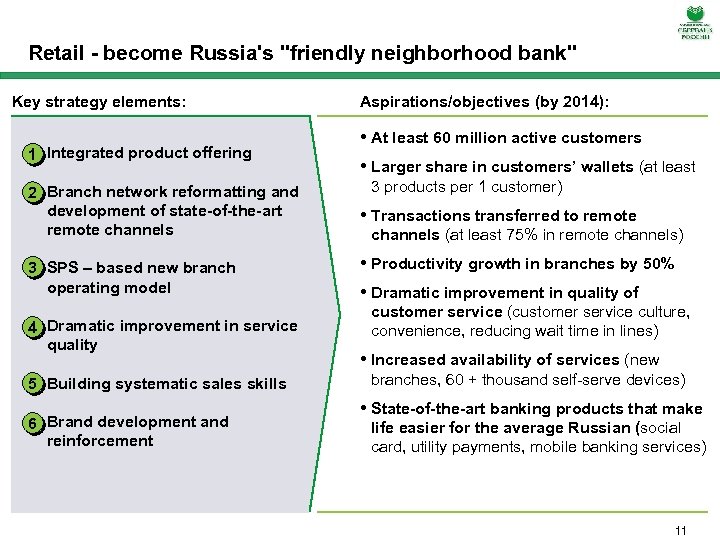
Retail - become Russia's "friendly neighborhood bank" Key strategy elements: 1 • Integrated product offering Aspirations/objectives (by 2014): • At least 60 million active customers • Larger share in customers’ wallets (at least 3 products per 1 customer) 2 • Branch network reformatting and development of state-of-the-art remote channels • Transactions transferred to remote 3 • SPS – based new branch operating model • Productivity growth in branches by 50% • Dramatic improvement in quality of 4 • Dramatic improvement in service quality 5 • Building systematic sales skills 6 • Brand development and reinforcement channels (at least 75% in remote channels) customer service (customer service culture, convenience, reducing wait time in lines) • Increased availability of services (new branches, 60 + thousand self-serve devices) • State-of-the-art banking products that make life easier for the average Russian (social card, utility payments, mobile banking services) 11
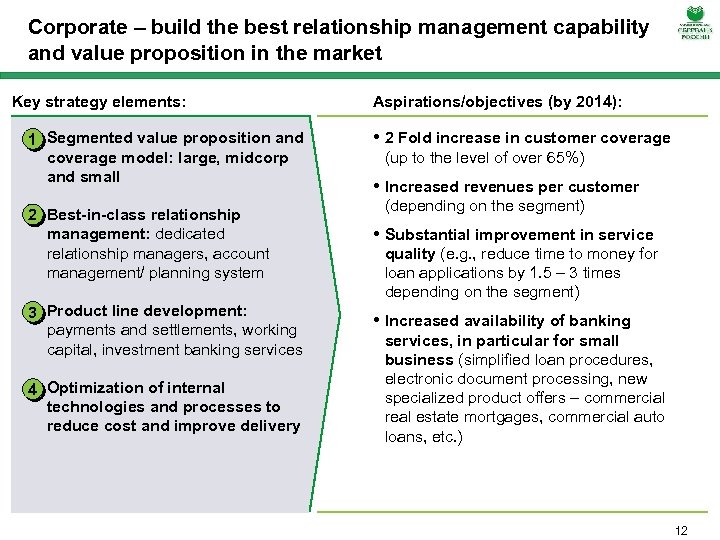
Corporate – build the best relationship management capability and value proposition in the market Key strategy elements: 1 • Segmented value proposition and coverage model: large, midcorp and small 2 • Best-in-class relationship management: dedicated relationship managers, account management/ planning system 3 • Product line development: payments and settlements, working capital, investment banking services 4 • Optimization of internal technologies and processes to reduce cost and improve delivery Aspirations/objectives (by 2014): • 2 Fold increase in customer coverage (up to the level of over 65%) • Increased revenues per customer (depending on the segment) • Substantial improvement in service quality (e. g. , reduce time to money for loan applications by 1. 5 – 3 times depending on the segment) • Increased availability of banking services, in particular for small business (simplified loan procedures, electronic document processing, new specialized product offers – commercial real estate mortgages, commercial auto loans, etc. ) 12
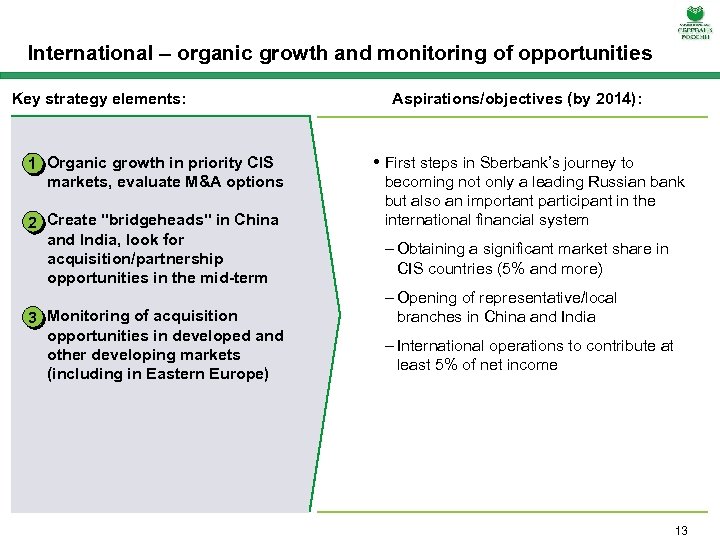
International – organic growth and monitoring of opportunities Key strategy elements: 1 • Organic growth in priority CIS markets, evaluate M&A options 2 • Create "bridgeheads" in China and India, look for acquisition/partnership opportunities in the mid-term 3 • Monitoring of acquisition opportunities in developed and other developing markets (including in Eastern Europe) Aspirations/objectives (by 2014): • First steps in Sberbank’s journey to becoming not only a leading Russian bank but also an important participant in the international financial system – Obtaining a significant market share in CIS countries (5% and more) – Opening of representative/local branches in China and India – International operations to contribute at least 5% of net income 13
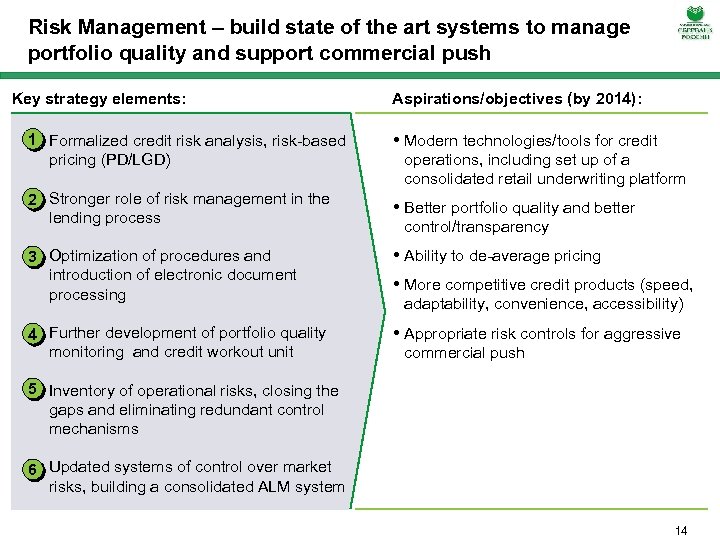
Risk Management – build state of the art systems to manage portfolio quality and support commercial push Key strategy elements: 1 • Formalized credit risk analysis, risk-based pricing (PD/LGD) Aspirations/objectives (by 2014): • Modern technologies/tools for credit operations, including set up of a consolidated retail underwriting platform 2 • Stronger role of risk management in the lending process • Better portfolio quality and better 3 • Optimization of procedures and introduction of electronic document processing • Ability to de-average pricing • More competitive credit products (speed, 4 • Further development of portfolio quality monitoring and credit workout unit • Appropriate risk controls for aggressive control/transparency adaptability, convenience, accessibility) commercial push 5 • Inventory of operational risks, closing the gaps and eliminating redundant control mechanisms 6 • Updated systems of control over market risks, building a consolidated ALM system 14
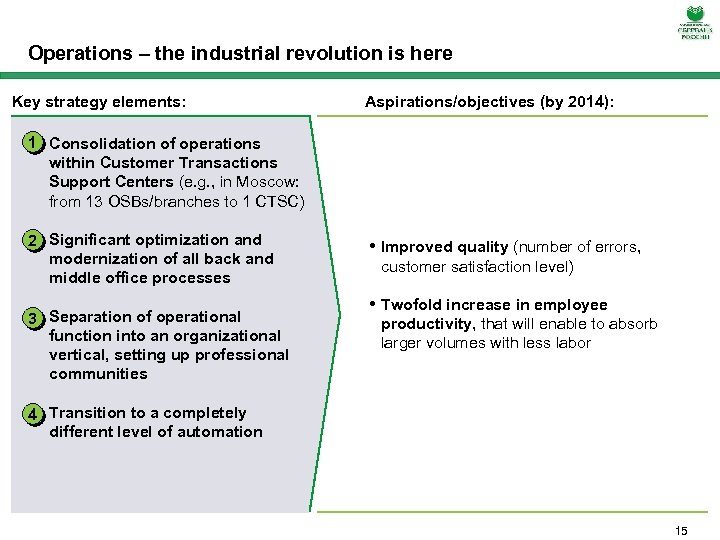
Operations – the industrial revolution is here Key strategy elements: Aspirations/objectives (by 2014): 1 • Consolidation of operations within Customer Transactions Support Centers (e. g. , in Moscow: from 13 OSBs/branches to 1 CTSC) 2 • Significant optimization and modernization of all back and middle office processes 3 • Separation of operational function into an organizational vertical, setting up professional communities • Improved quality (number of errors, customer satisfaction level) • Twofold increase in employee productivity, that will enable to absorb larger volumes with less labor 4 • Transition to a completely different level of automation 15
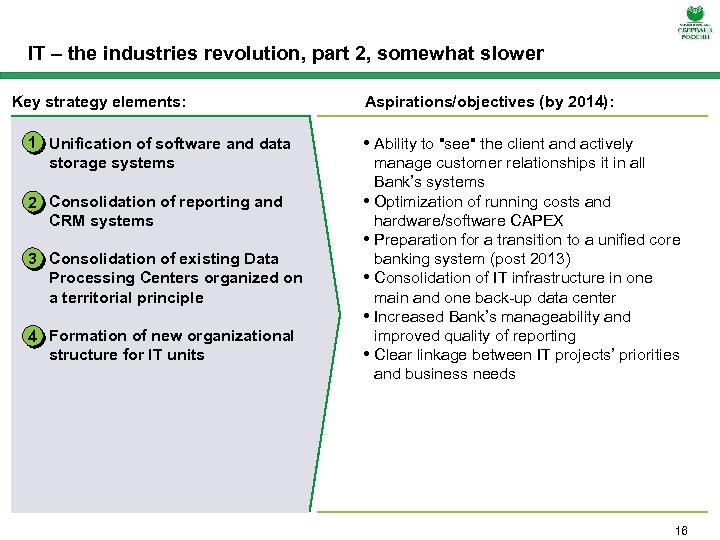
IT – the industries revolution, part 2, somewhat slower Key strategy elements: 1 • Unification of software and data storage systems 2 • Consolidation of reporting and CRM systems 3 • Consolidation of existing Data Processing Centers organized on a territorial principle 4 • Formation of new organizational structure for IT units Aspirations/objectives (by 2014): • Ability to "see" the client and actively manage customer relationships it in all Bank’s systems • Optimization of running costs and hardware/software CAPEX • Preparation for a transition to a unified core banking system (post 2013) • Consolidation of IT infrastructure in one main and one back-up data center • Increased Bank’s manageability and improved quality of reporting • Clear linkage between IT projects’ priorities and business needs 16
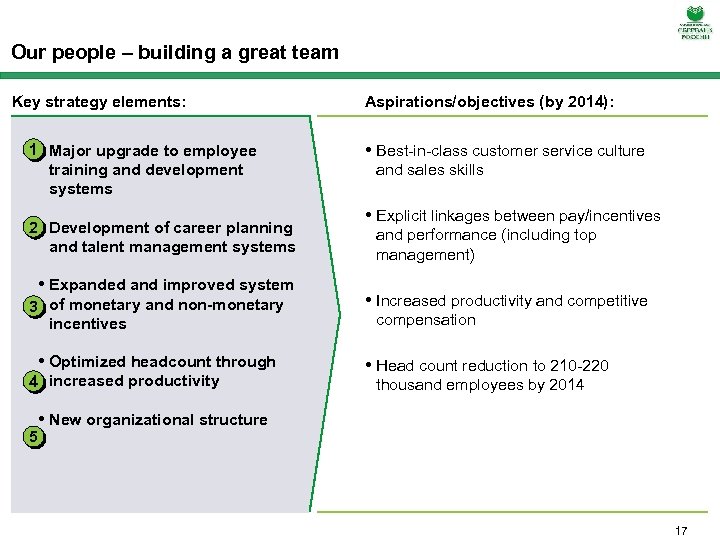
Our people – building a great team Key strategy elements: 1 • Major upgrade to employee training and development systems 2 • Development of career planning and talent management systems • Expanded and improved system 3 of monetary and non-monetary incentives • Optimized headcount through 4 increased productivity Aspirations/objectives (by 2014): • Best-in-class customer service culture and sales skills • Explicit linkages between pay/incentives and performance (including top management) • Increased productivity and competitive compensation • Head count reduction to 210 -220 thousand employees by 2014 • New organizational structure 5 17
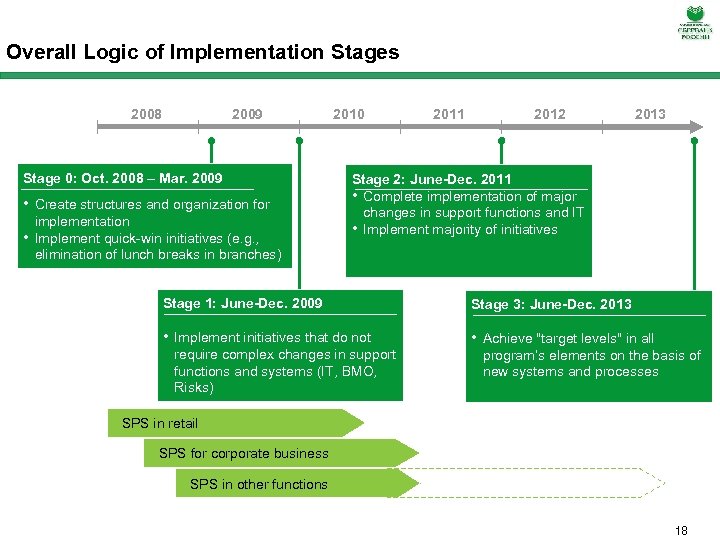
Overall Logic of Implementation Stages 2008 2009 Stage 0: Oct. 2008 – Mar. 2009 • Create structures and organization for • implementation Implement quick-win initiatives (e. g. , elimination of lunch breaks in branches) 2010 2011 2012 2013 Stage 2: June-Dec. 2011 • Complete implementation of major changes in support functions and IT • Implement majority of initiatives Stage 1: June-Dec. 2009 Stage 3: June-Dec. 2013 • Implement initiatives that do not • Achieve "target levels" in all require complex changes in support functions and systems (IT, BMO, Risks) program’s elements on the basis of new systems and processes SPS in retail SPS for corporate business SPS in other functions 18
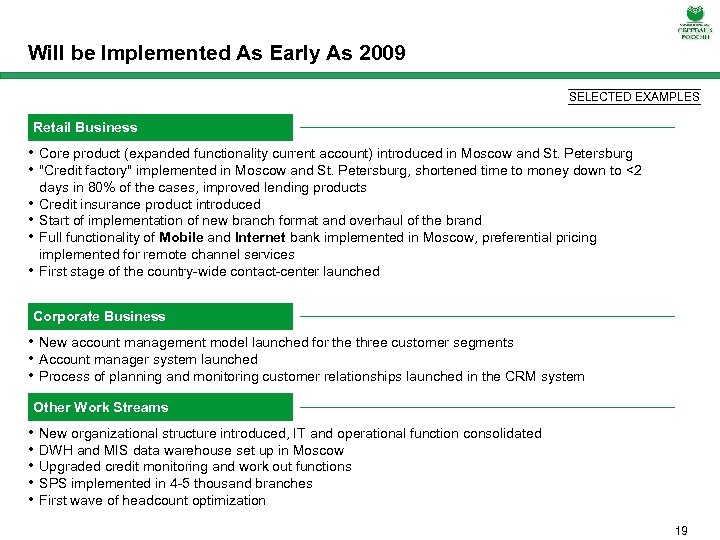
Will be Implemented As Early As 2009 SELECTED EXAMPLES Retail Business • Core product (expanded functionality current account) introduced in Moscow and St. Petersburg • "Credit factory" implemented in Moscow and St. Petersburg, shortened time to money down to <2 • • days in 80% of the cases, improved lending products Credit insurance product introduced Start of implementation of new branch format and overhaul of the brand Full functionality of Mobile and Internet bank implemented in Moscow, preferential pricing implemented for remote channel services First stage of the country-wide contact-center launched Corporate Business • New account management model launched for the three customer segments • Account manager system launched • Process of planning and monitoring customer relationships launched in the CRM system Other Work Streams • • • New organizational structure introduced, IT and operational function consolidated DWH and MIS data warehouse set up in Moscow Upgraded credit monitoring and work out functions SPS implemented in 4 -5 thousand branches First wave of headcount optimization 19
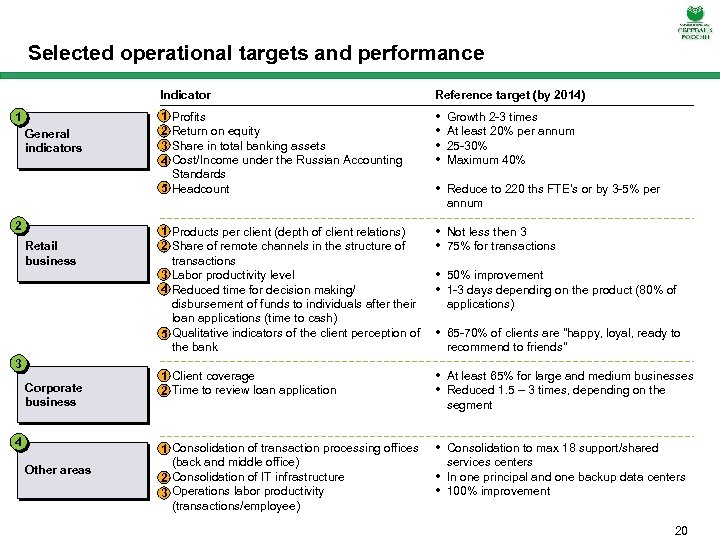
Selected operational targets and performance Indicator General indicators 1 • Profits • Return on equity 2 • Share in total banking assets 3 • Cost/Income under the Russian Accounting 4 • • Standards 5 • Headcount 1 Reference target (by 2014) • Reduce to 220 ths FTE’s or by 3 -5% per Growth 2 -3 times At least 20% per annum 25 -30% Maximum 40% annum 2 Retail business 1 • Products per client (depth of client relations) 2 • Share of remote channels in the structure of transactions 3 • Labor productivity level 4 • Reduced time for decision making/ disbursement of funds to individuals after their loan applications (time to cash) • Qualitative indicators of the client perception of 5 the bank 3 Corporate business 4 • Client coverage 1 • Time to review loan application 2 • Not less then 3 • 75% for transactions • 50% improvement • 1 -3 days depending on the product (80% of applications) • 65 -70% of clients are "happy, loyal, ready to recommend to friends" • At least 65% for large and medium businesses • Reduced 1. 5 – 3 times, depending on the segment • Consolidation of transaction processing offices • Consolidation to max 18 support/shared 1 Other areas (back and middle office) • Consolidation of IT infrastructure 2 • Operations labor productivity 3 (transactions/employee) • • services centers In one principal and one backup data centers 100% improvement 20
Скачать презентацию Sberbank 2009 -2014 strategy highlights Analyst investor presentation December
82b0d7c3f8f5a2e324367f25dd01a215.ppt