


 Скачать презентацию SAYRE MORRIS Seventh Edition CHAPTER 2 Demand
e75b44c25d6164b5ccd94684d4b4e0bc.ppt
- Количество слайдов: 63
 SAYRE | MORRIS Seventh Edition CHAPTER 2 Demand Supply: an Introduction © 2012 Mc. Graw-Hill Ryerson Limited 2 -1
 CHAPTER 2 Demand Supply: an Introduction Learning Objectives: 1. 2. 3. 4. Explain the concept of demand Explain the concept of supply Explain the term market Understand the concept of equilibrium © 2012 Mc. Graw-Hill Ryerson Limited 2 -2
 CHAPTER 2 Demand Supply: an Introduction Learning Objectives: 5. Understand causes and effects of a change in demand 6. Understand causes and effects of a change in supply 7. Understand why demand supply determine price and quantity traded © 2012 Mc. Graw-Hill Ryerson Limited 2 -3
 LO 1 Demand • the quantities that consumers are willing and able to buy over a period of time at various prices © 2012 Mc. Graw-Hill Ryerson Limited 2 -4
 LO 1 Demand • the quantities that consumers are willing and able to buy over a period of time at various prices • must be willing to purchase it AND • must have ability to pay for it © 2012 Mc. Graw-Hill Ryerson Limited 2 -5
 LO 1 Demand • the quantities that consumers are willing and able to buy over a period of time at various prices • measures quantities in a specific time period, e. g. a week / month / year © 2012 Mc. Graw-Hill Ryerson Limited 2 -6
 LO 1 Demand • the quantities that consumers are willing and able to buy over a period of time at various prices • shows relationship between quantity & price • price is the most important determinant • “ceteris paribus” – all else remains the same © 2012 Mc. Graw-Hill Ryerson Limited 2 -7
 LO 1 Demand Schedule • A table showing the various quantities demanded at different prices Demand Curve • A graphic representation of a demand schedule © 2012 Mc. Graw-Hill Ryerson Limited 2 -8
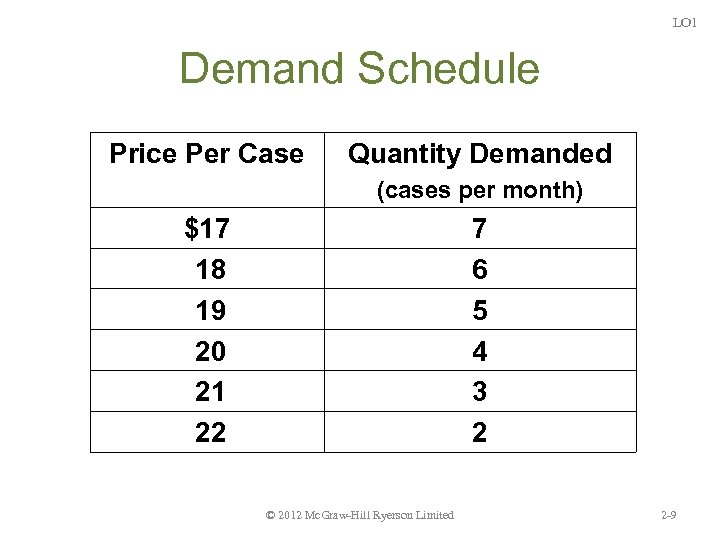 LO 1 Demand Schedule Price Per Case Quantity Demanded (cases per month) $17 18 19 20 21 22 7 6 5 4 3 2 © 2012 Mc. Graw-Hill Ryerson Limited 2 -9
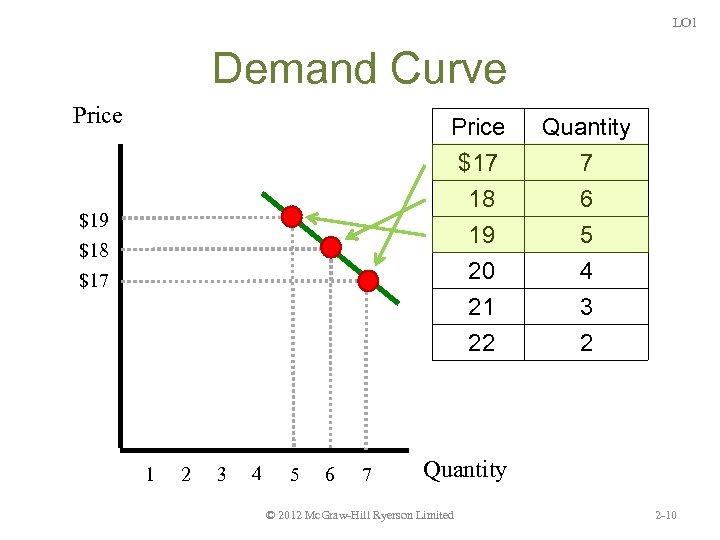 LO 1 Demand Curve Price $17 18 19 20 21 22 $19 $18 Quantity 7 6 5 4 3 2 $17 1 2 3 4 5 6 7 Quantity © 2012 Mc. Graw-Hill Ryerson Limited 2 -10
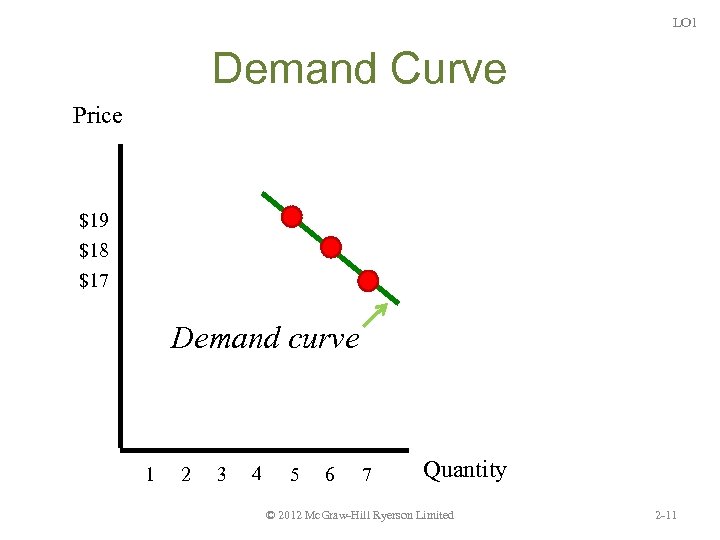 LO 1 Demand Curve Price $19 $18 $17 Demand curve 1 2 3 4 5 6 7 Quantity © 2012 Mc. Graw-Hill Ryerson Limited 2 -11
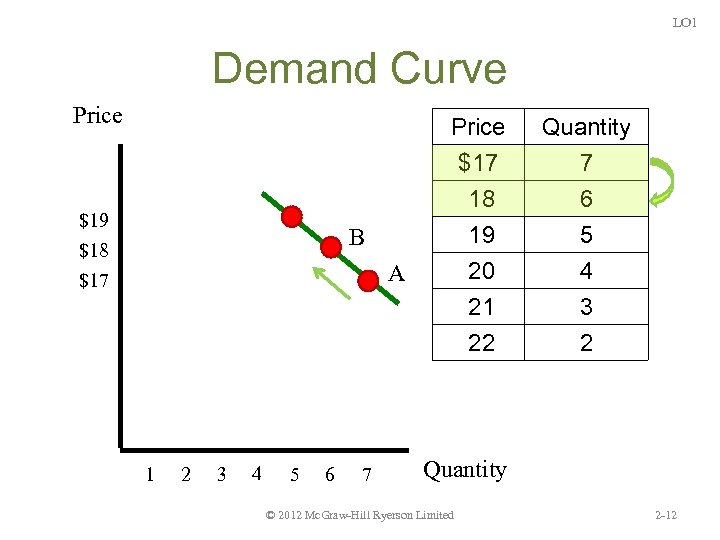 LO 1 Demand Curve Price $19 $18 Price $17 18 19 B Quantity 7 6 5 20 21 22 4 3 2 A $17 1 2 3 4 5 6 7 Quantity © 2012 Mc. Graw-Hill Ryerson Limited 2 -12
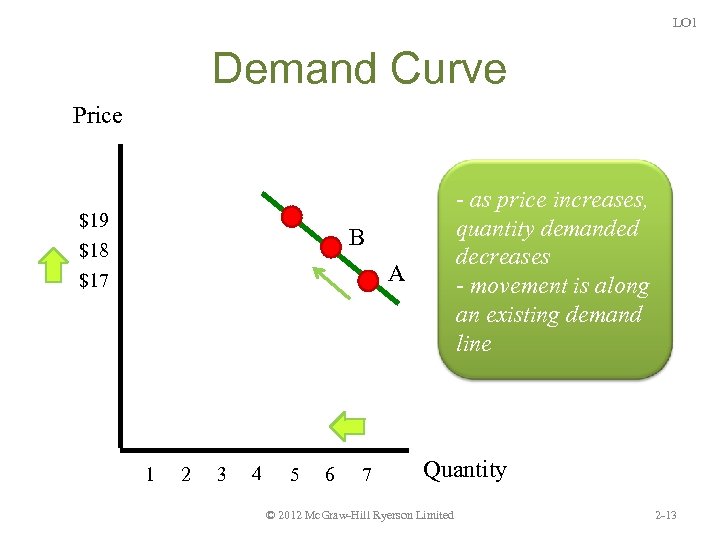 LO 1 Demand Curve Price $19 $18 - as price increases, quantity demanded decreases - movement is along an existing demand line B A $17 1 2 3 4 5 6 7 Quantity © 2012 Mc. Graw-Hill Ryerson Limited 2 -13
 LO 1 Why the Demand Curve Slopes Downward 1. Income effect • The effect of a price change on real income, and therefore on quantity demanded • Real income is measured in terms of the goods and services it will buy • Real income will increase if prices fall © 2012 Mc. Graw-Hill Ryerson Limited 2 -14
 LO 1 Why the Demand Curve Slopes Downward 2. Substitution effect • The substitution of one product for another as a result of a change in their relative prices © 2012 Mc. Graw-Hill Ryerson Limited 2 -15
 LO 1 Market Demand • The total demand for a product or service from all consumers © 2012 Mc. Graw-Hill Ryerson Limited 2 -16
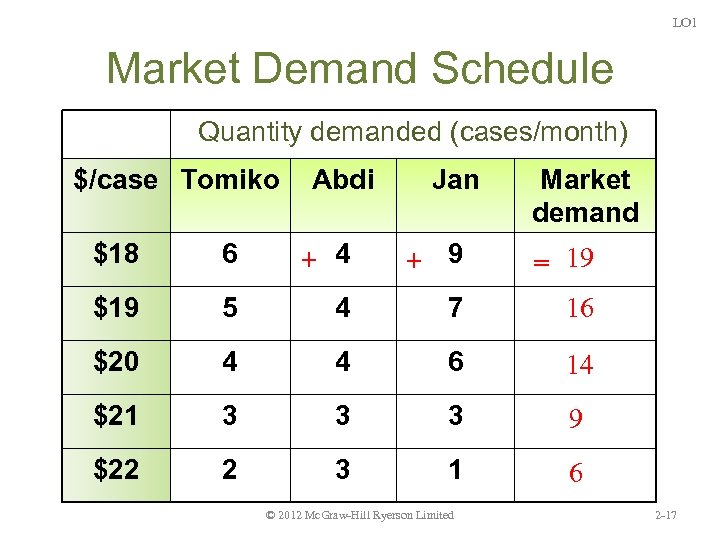 LO 1 Market Demand Schedule Quantity demanded (cases/month) $/case Tomiko Abdi Jan Market demand $18 6 + 4 + 9 = 19 $19 5 4 7 16 $20 4 4 6 14 $21 3 3 3 9 $22 2 3 1 6 © 2012 Mc. Graw-Hill Ryerson Limited 2 -17
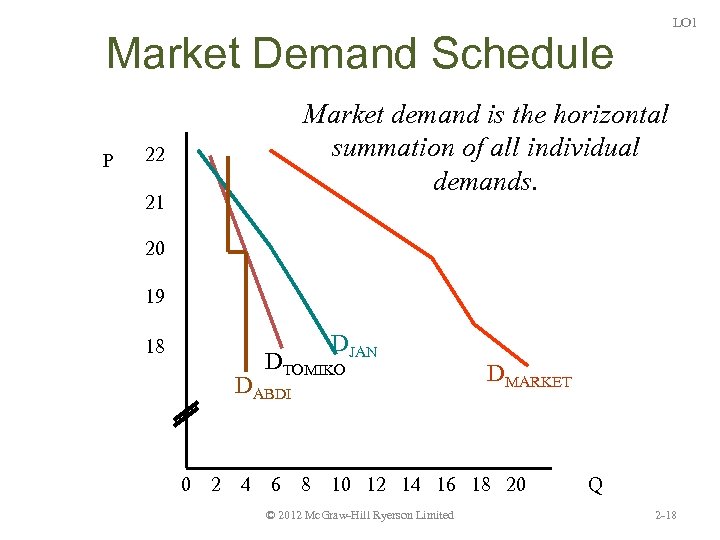 LO 1 Market Demand Schedule P Market demand is the horizontal summation of all individual demands. 22 21 20 19 DJAN 18 DTOMIKO DABDI 0 2 4 6 8 DMARKET 10 12 14 16 18 20 © 2012 Mc. Graw-Hill Ryerson Limited Q 2 -18
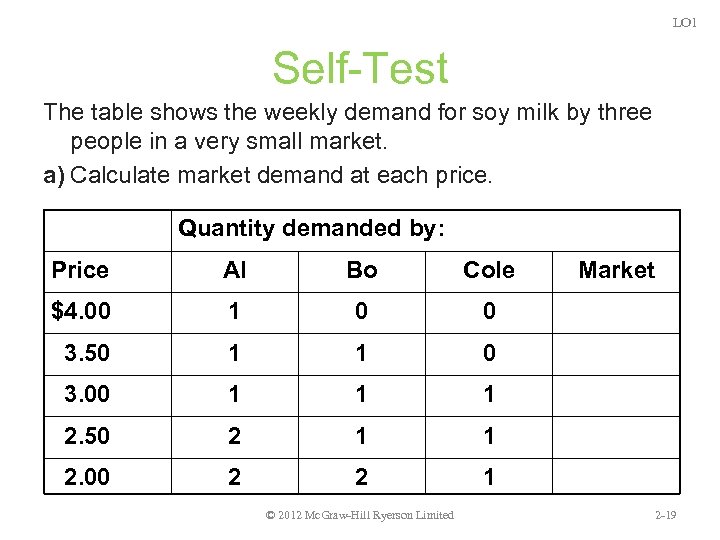 LO 1 Self-Test The table shows the weekly demand for soy milk by three people in a very small market. a) Calculate market demand at each price. Quantity demanded by: Price Al Bo Cole $4. 00 1 0 0 3. 50 1 1 0 3. 00 1 1 1 2. 50 2 1 1 2. 00 2 2 1 © 2012 Mc. Graw-Hill Ryerson Limited Market 2 -19
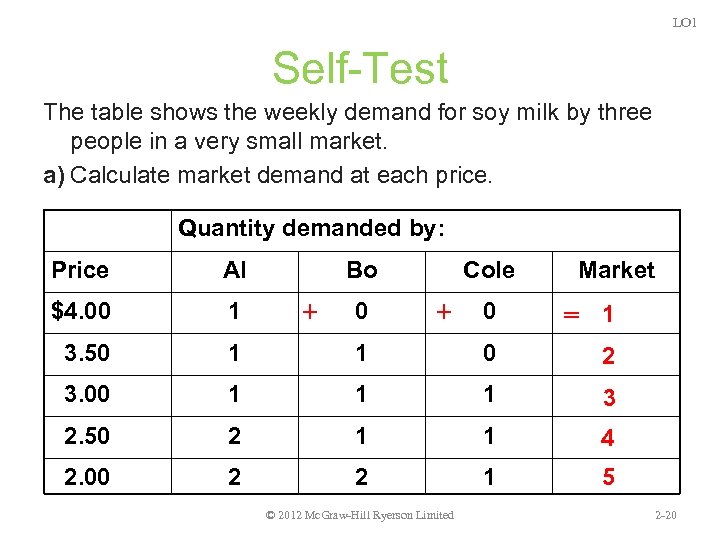 LO 1 Self-Test The table shows the weekly demand for soy milk by three people in a very small market. a) Calculate market demand at each price. Quantity demanded by: Price Al $4. 00 1 3. 50 1 3. 00 Bo + 0 Cole + Market 0 = 1 1 0 2 1 1 1 3 2. 50 2 1 1 4 2. 00 2 2 1 5 © 2012 Mc. Graw-Hill Ryerson Limited 2 -20
 LO 2 Supply • the quantities that producers are willing and able to supply over a period of time at various prices © 2012 Mc. Graw-Hill Ryerson Limited 2 -21
 LO 2 Supply Schedule • A table showing the various quantities supplied period of time at different prices Supply Curve • A graphic representation of the supply schedule © 2012 Mc. Graw-Hill Ryerson Limited 2 -22
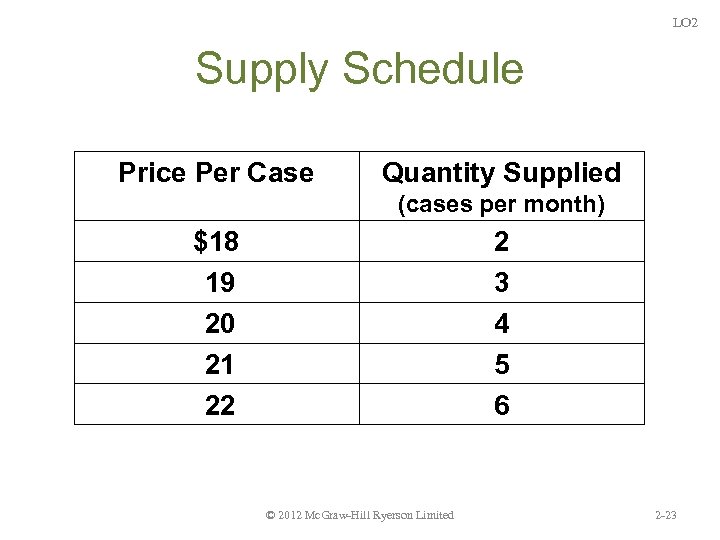 LO 2 Supply Schedule Price Per Case Quantity Supplied (cases per month) $18 19 20 21 22 2 3 4 5 6 © 2012 Mc. Graw-Hill Ryerson Limited 2 -23
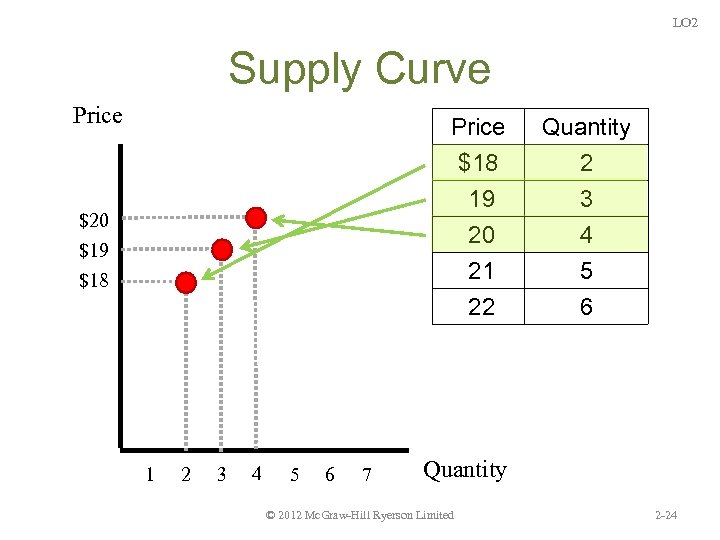 LO 2 Supply Curve Price $18 19 20 21 22 $20 $19 Quantity 2 3 4 5 6 $18 1 2 3 4 5 6 7 Quantity © 2012 Mc. Graw-Hill Ryerson Limited 2 -24
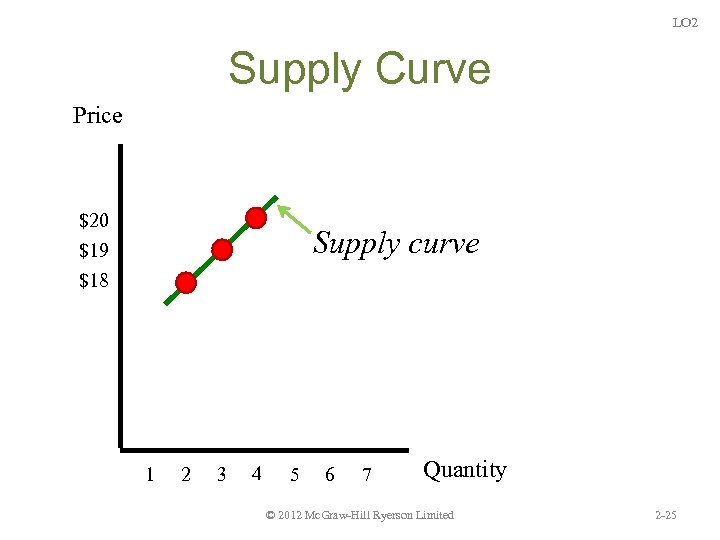 LO 2 Supply Curve Price $20 $19 Supply curve $18 1 2 3 4 5 6 7 Quantity © 2012 Mc. Graw-Hill Ryerson Limited 2 -25
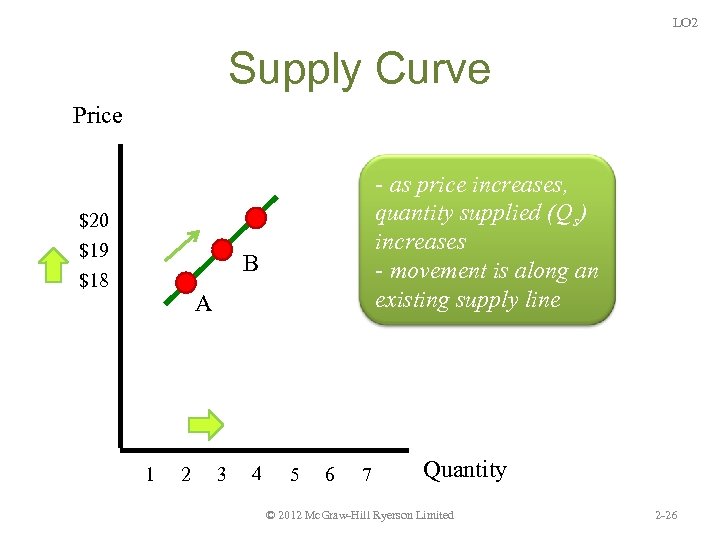 LO 2 Supply Curve Price $20 $19 - as price increases, quantity supplied (Qs) increases - movement is along an existing supply line B $18 A 1 2 3 4 5 6 7 Quantity © 2012 Mc. Graw-Hill Ryerson Limited 2 -26
 LO 2 Why the Supply Curve Slopes Upward • • • Suppliers are motivated by profit Higher price means more profit, more suppliers are willing to produce the product Costs rise as more is produced, so higher prices required to supply more © 2012 Mc. Graw-Hill Ryerson Limited 2 -27
 LO 2 Market Supply Curve • Total supply from all producers of a product • Horizontal summation of each individual producer’s supply curve Assumptions: • producers are all making a similar product • consumers have no preference as to which supplier or product they use © 2012 Mc. Graw-Hill Ryerson Limited 2 -28
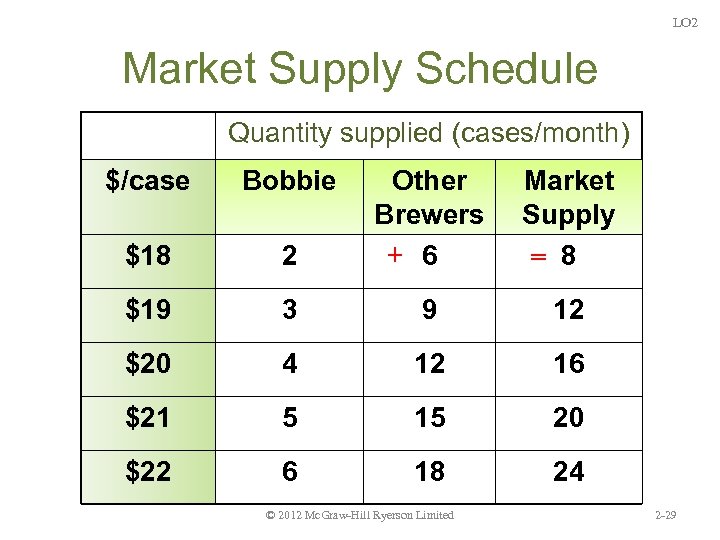 LO 2 Market Supply Schedule Quantity supplied (cases/month) $/case Bobbie 2 Other Brewers + 6 Market Supply = 8 $19 3 9 12 $20 4 12 16 $21 5 15 20 $22 6 18 24 © 2012 Mc. Graw-Hill Ryerson Limited 2 -29
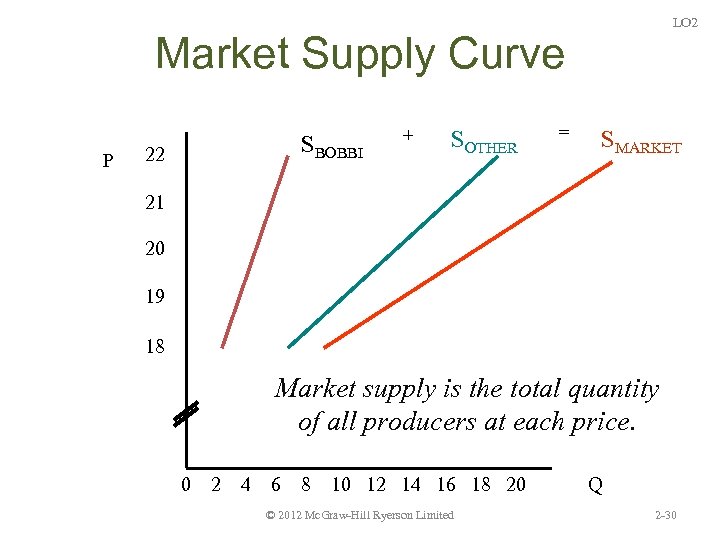 LO 2 Market Supply Curve P SBOBBI 22 + SOTHER = SMARKET 21 20 19 18 Market supply is the total quantity of all producers at each price. 0 2 4 6 8 10 12 14 16 18 20 © 2012 Mc. Graw-Hill Ryerson Limited Q 2 -30
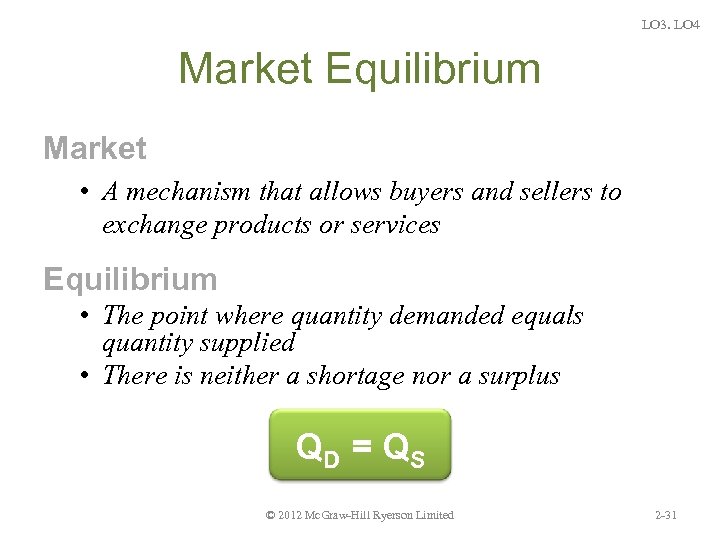 LO 3. LO 4 Market Equilibrium Market • A mechanism that allows buyers and sellers to exchange products or services Equilibrium • The point where quantity demanded equals quantity supplied • There is neither a shortage nor a surplus QD = Q S © 2012 Mc. Graw-Hill Ryerson Limited 2 -31
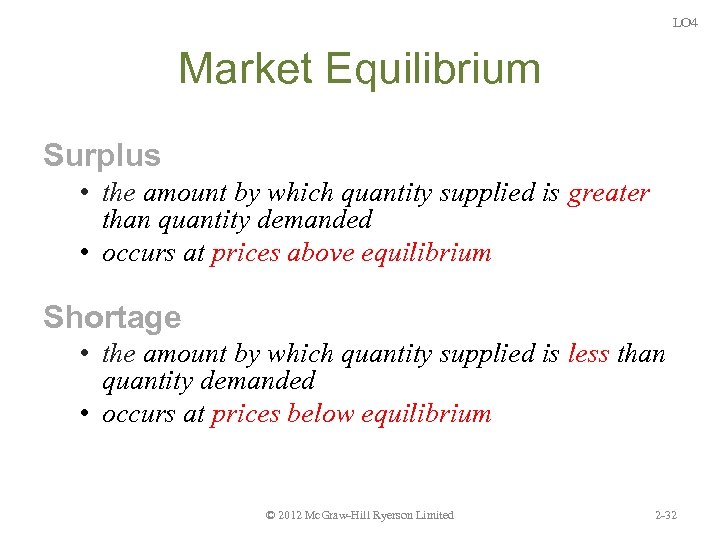 LO 4 Market Equilibrium Surplus • the amount by which quantity supplied is greater than quantity demanded • occurs at prices above equilibrium Shortage • the amount by which quantity supplied is less than quantity demanded • occurs at prices below equilibrium © 2012 Mc. Graw-Hill Ryerson Limited 2 -32
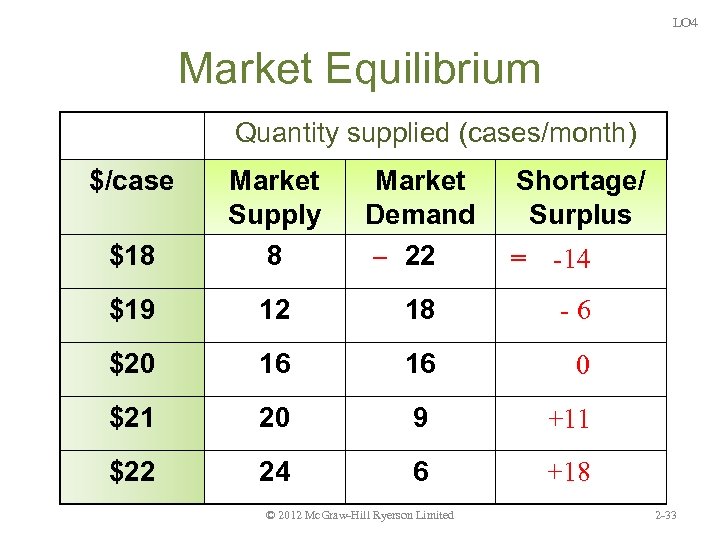 LO 4 Market Equilibrium Quantity supplied (cases/month) $/case $18 Market Supply 8 Market Demand _ 22 $19 12 18 -6 $20 16 16 0 $21 20 9 +11 $22 24 6 +18 © 2012 Mc. Graw-Hill Ryerson Limited Shortage/ Surplus = -14 2 -33
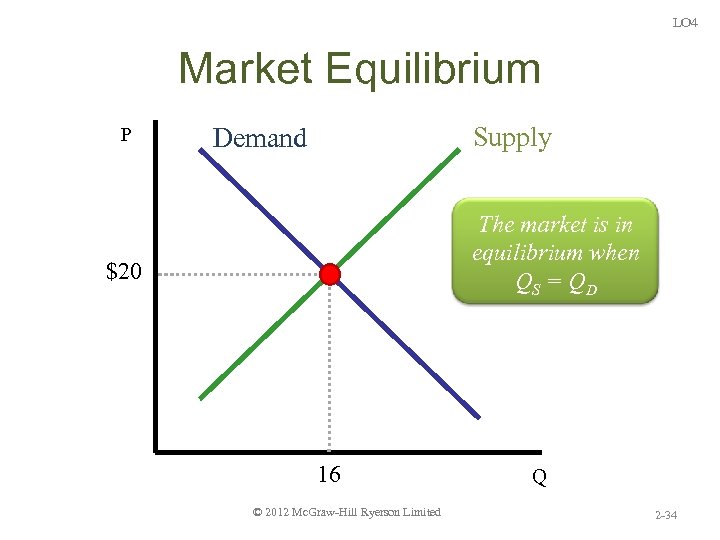 LO 4 Market Equilibrium P Supply Demand The market is in equilibrium when QS = Q D $20 16 © 2012 Mc. Graw-Hill Ryerson Limited Q 2 -34
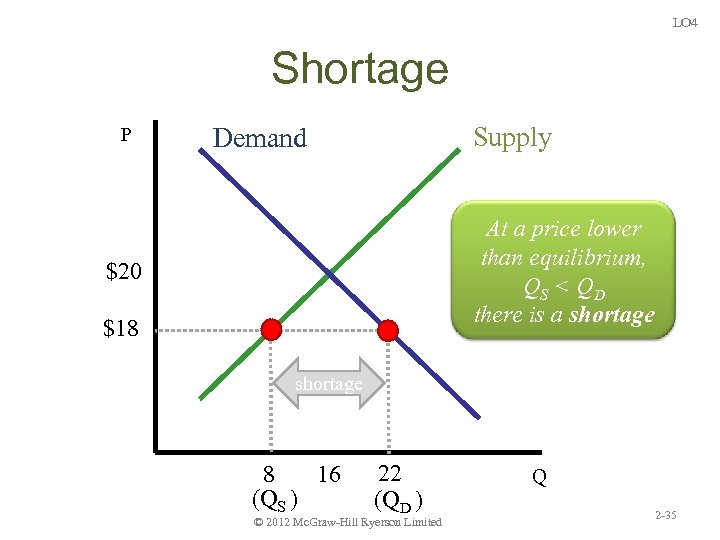 LO 4 Shortage P Supply Demand At a price lower than equilibrium, QS < Q D there is a shortage $20 $18 shortage 16 8 (QS ) 22 (QD ) © 2012 Mc. Graw-Hill Ryerson Limited Q 2 -35
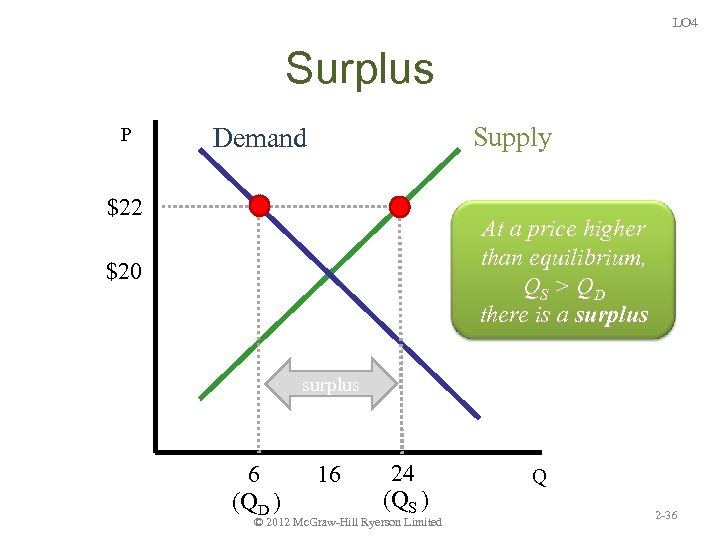 LO 4 Surplus P Supply Demand $22 At a price higher than equilibrium, QS > Q D there is a surplus $20 surplus 6 (QD ) 16 24 (QS ) © 2012 Mc. Graw-Hill Ryerson Limited Q 2 -36
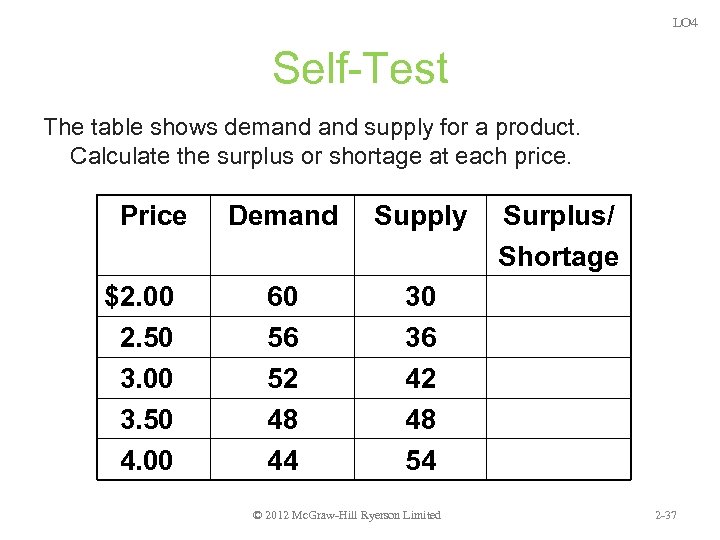 LO 4 Self-Test The table shows demand supply for a product. Calculate the surplus or shortage at each price. Price $2. 00 2. 50 3. 00 3. 50 4. 00 Demand Supply 60 56 52 48 44 30 36 42 48 54 © 2012 Mc. Graw-Hill Ryerson Limited Surplus/ Shortage 2 -37
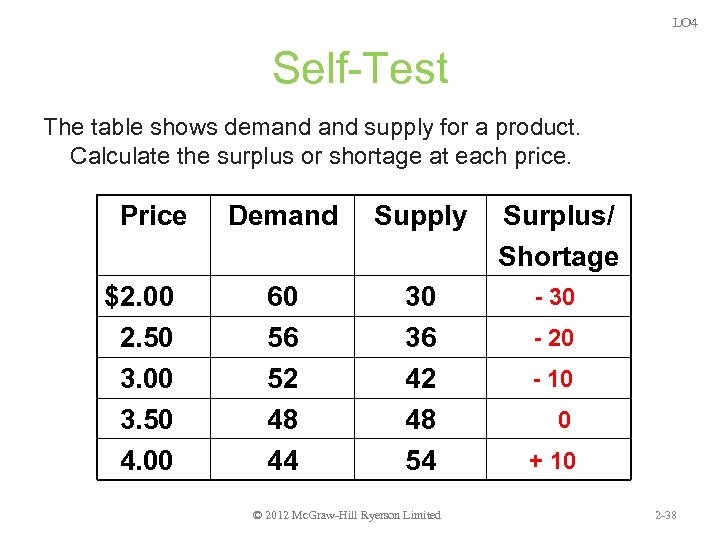 LO 4 Self-Test The table shows demand supply for a product. Calculate the surplus or shortage at each price. Price $2. 00 2. 50 3. 00 3. 50 4. 00 Demand Supply Surplus/ Shortage 60 56 52 48 44 30 36 42 48 54 - 30 © 2012 Mc. Graw-Hill Ryerson Limited - 20 - 10 0 + 10 2 -38
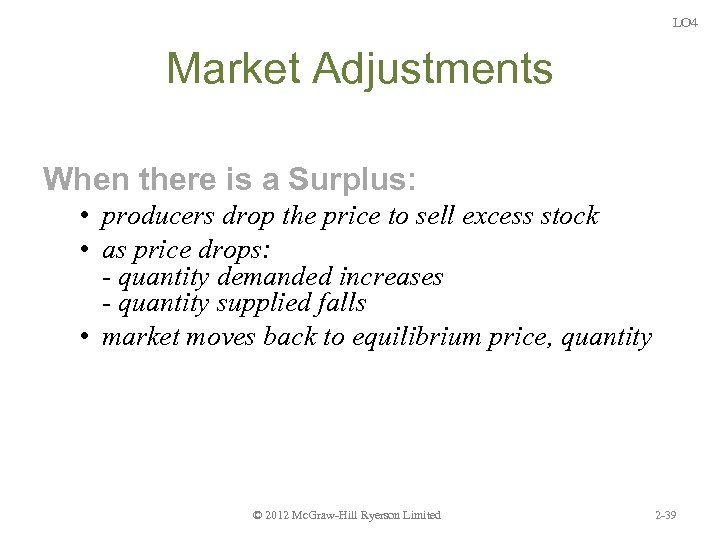 LO 4 Market Adjustments When there is a Surplus: • producers drop the price to sell excess stock • as price drops: - quantity demanded increases - quantity supplied falls • market moves back to equilibrium price, quantity © 2012 Mc. Graw-Hill Ryerson Limited 2 -39
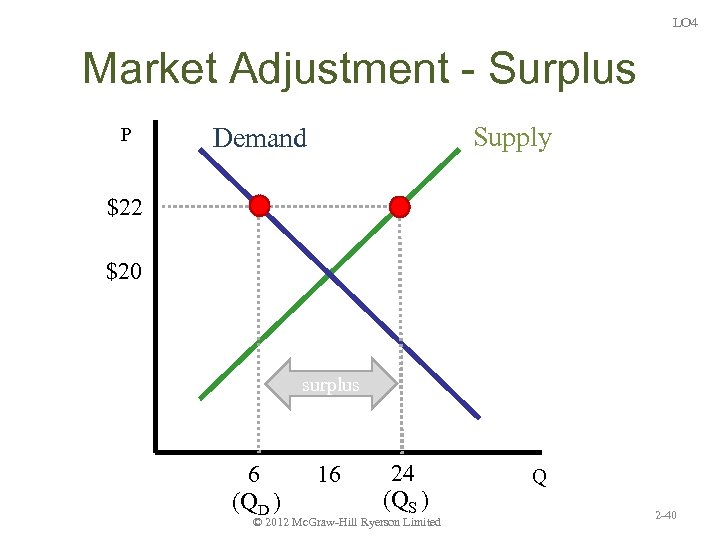 LO 4 Market Adjustment - Surplus P Supply Demand $22 $20 surplus 6 (QD ) 16 24 (QS ) © 2012 Mc. Graw-Hill Ryerson Limited Q 2 -40
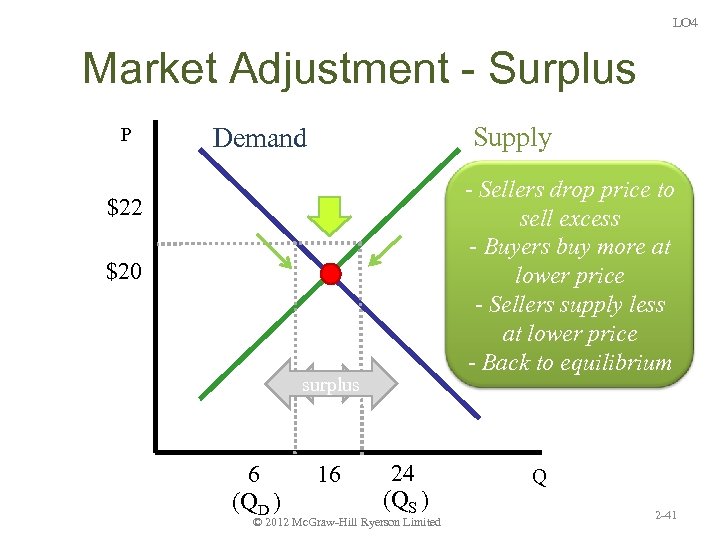 LO 4 Market Adjustment - Surplus P Supply Demand - Sellers drop price to sell excess - Buyers buy more at lower price - Sellers supply less at lower price - Back to equilibrium $22 $20 surplus 6 (QD ) 16 24 (QS ) © 2012 Mc. Graw-Hill Ryerson Limited Q 2 -41
 LO 4 Market Adjustments When there is a Shortage: • buyers bid up the price • as price rises: - quantity demanded decreases - quantity supplied increases • market moves back to equilibrium price, quantity © 2012 Mc. Graw-Hill Ryerson Limited 2 -42
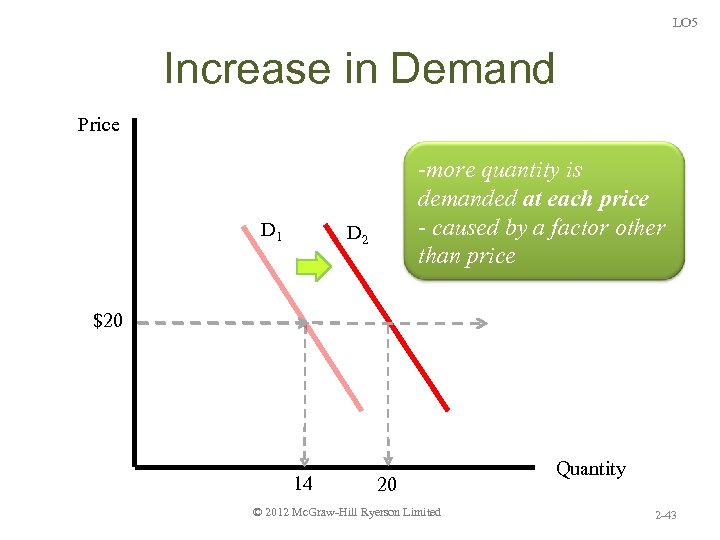 LO 5 Increase in Demand Price D 1 -more quantity is demanded at each price - caused by a factor other than price D 2 $20 14 20 © 2012 Mc. Graw-Hill Ryerson Limited Quantity 2 -43
 LO 5 Determinants of Demand 1. Consumer preferences • If tastes change, demand changes 2. Consumer incomes • Normal Products: buy more when income rises, less when income falls • Inferior Products: buy more when income falls, less when income rises © 2012 Mc. Graw-Hill Ryerson Limited 2 -44
 LO 5 Determinants of Demand 3. Prices of Related Products: • Products are related if a change in the price of one product causes a change in demand for the other product • Two types of related products: • Substitutes • Complements © 2012 Mc. Graw-Hill Ryerson Limited 2 -45
 LO 5 Determinants of Demand 3. Prices of Related Products • Substitute Product • similar products that can be substituted for each other • increase in price of one product causes increased demand for the related product © 2012 Mc. Graw-Hill Ryerson Limited 2 -46
 LO 5 Determinants of Demand 3. Prices of Related Products • Complementary Product • tend to be bought together • Increase in price of one product causes a decrease in demand for related product © 2012 Mc. Graw-Hill Ryerson Limited 2 -47
 LO 5 Determinants of Demand 4. Expectations of future prices, income, availability • If prices or incomes expected to rise, consumers buy more • If goods expected to be scarcer, buy more now 5. Population size, income, and age distribution • Increases in population or incomes cause increase in demand • Changes in age distribution affect demand © 2012 Mc. Graw-Hill Ryerson Limited 2 -48
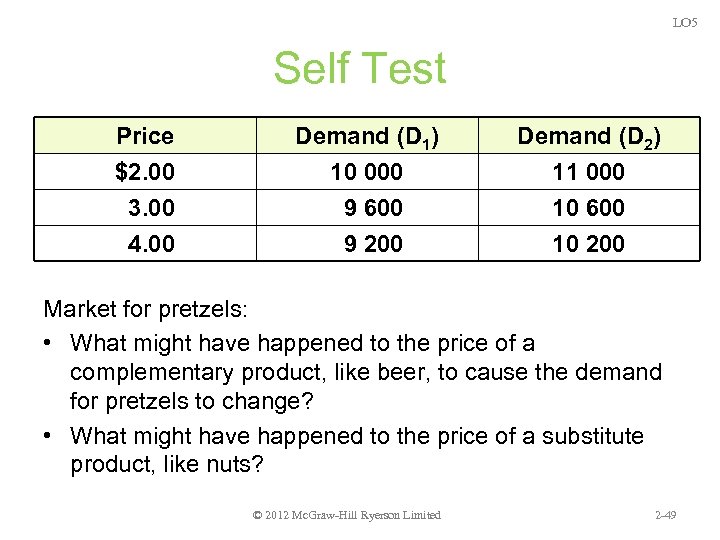 LO 5 Self Test Price $2. 00 3. 00 4. 00 Demand (D 1) 10 000 9 600 9 200 Demand (D 2) 11 000 10 600 10 200 Market for pretzels: • What might have happened to the price of a complementary product, like beer, to cause the demand for pretzels to change? • What might have happened to the price of a substitute product, like nuts? © 2012 Mc. Graw-Hill Ryerson Limited 2 -49
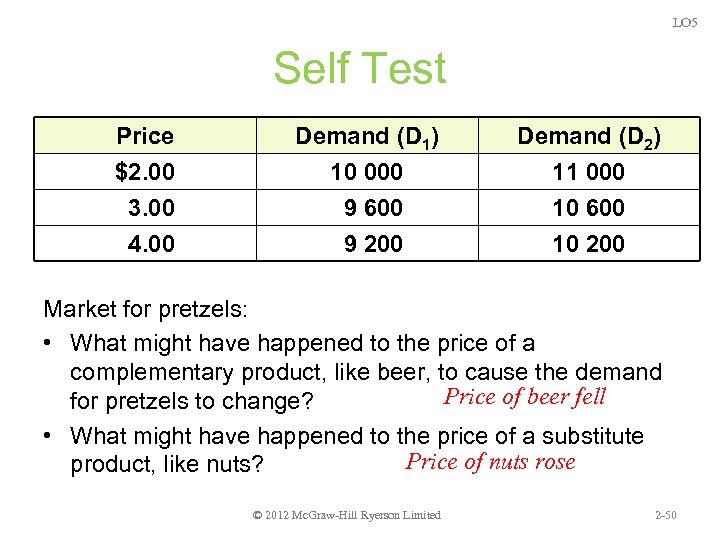 LO 5 Self Test Price $2. 00 3. 00 4. 00 Demand (D 1) 10 000 9 600 9 200 Demand (D 2) 11 000 10 600 10 200 Market for pretzels: • What might have happened to the price of a complementary product, like beer, to cause the demand Price of beer fell for pretzels to change? • What might have happened to the price of a substitute Price of nuts rose product, like nuts? © 2012 Mc. Graw-Hill Ryerson Limited 2 -50
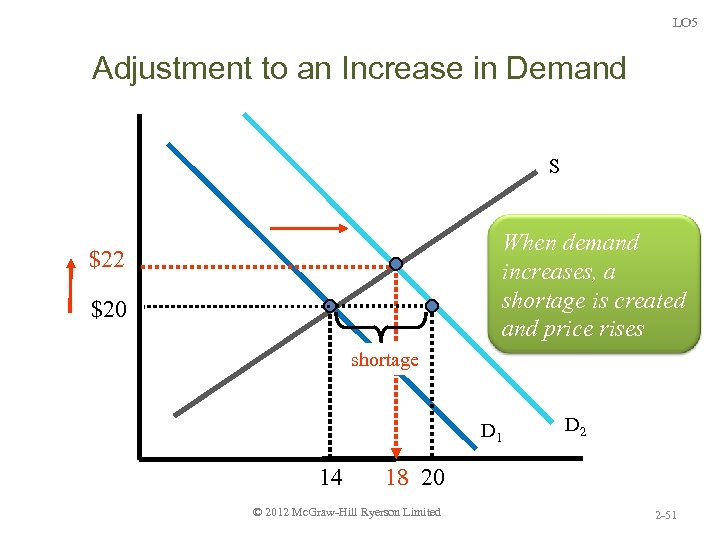 LO 5 Adjustment to an Increase in Demand S When demand increases, a shortage is created and price rises $22 $20 shortage D 1 14 D 2 18 20 © 2012 Mc. Graw-Hill Ryerson Limited 2 -51
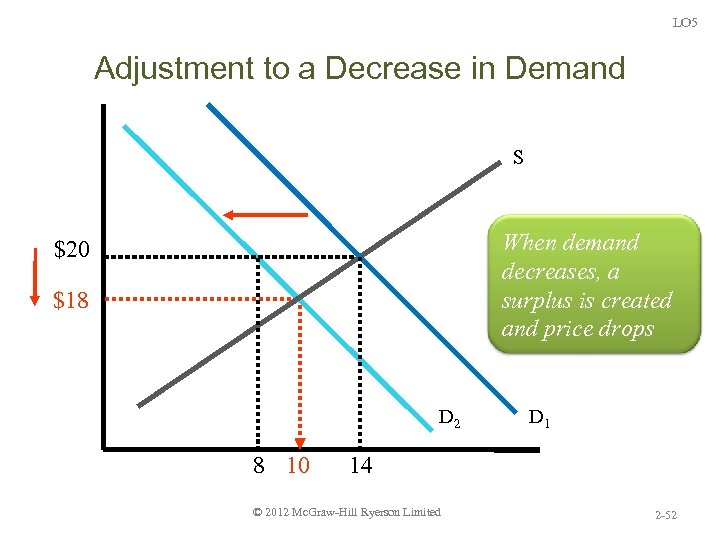 LO 5 Adjustment to a Decrease in Demand S When demand decreases, a surplus is created and price drops $20 $18 D 2 8 10 D 1 14 © 2012 Mc. Graw-Hill Ryerson Limited 2 -52
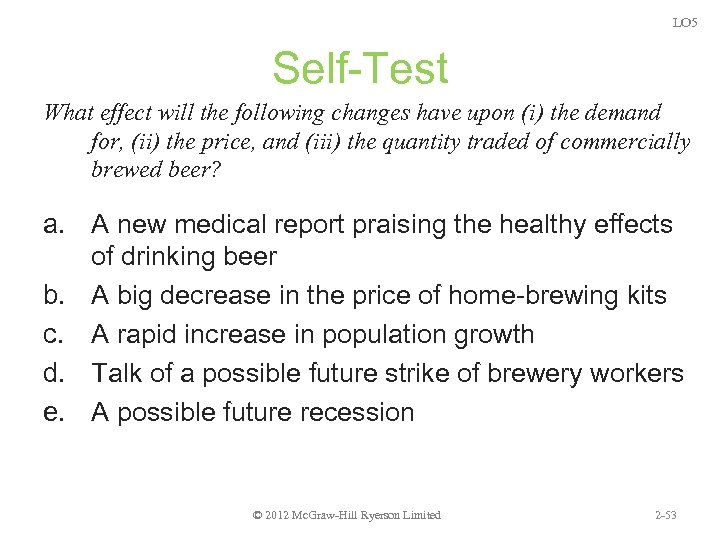 LO 5 Self-Test What effect will the following changes have upon (i) the demand for, (ii) the price, and (iii) the quantity traded of commercially brewed beer? a. A new medical report praising the healthy effects of drinking beer b. A big decrease in the price of home-brewing kits c. A rapid increase in population growth d. Talk of a possible future strike of brewery workers e. A possible future recession © 2012 Mc. Graw-Hill Ryerson Limited 2 -53
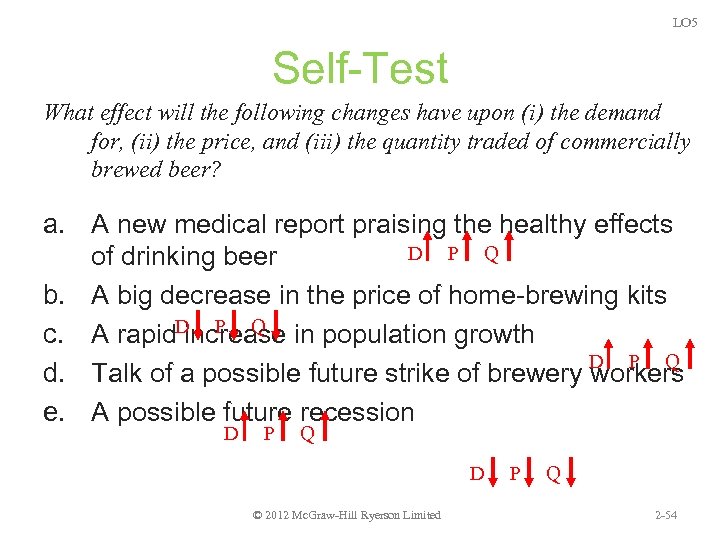 LO 5 Self-Test What effect will the following changes have upon (i) the demand for, (ii) the price, and (iii) the quantity traded of commercially brewed beer? a. A new medical report praising the healthy effects D P Q of drinking beer b. A big decrease in the price of home-brewing kits P Q c. A rapid. Dincrease in population growth D P Q d. Talk of a possible future strike of brewery workers e. A possible future recession D P Q D © 2012 Mc. Graw-Hill Ryerson Limited P Q 2 -54
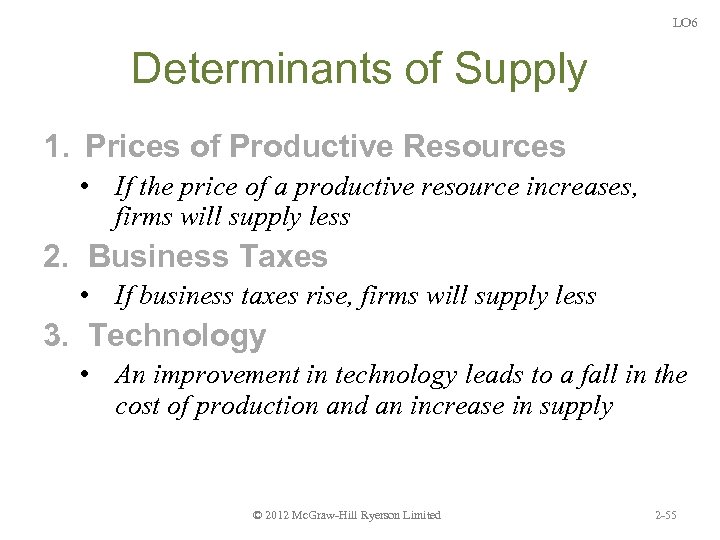 LO 6 Determinants of Supply 1. Prices of Productive Resources • If the price of a productive resource increases, firms will supply less 2. Business Taxes • If business taxes rise, firms will supply less 3. Technology • An improvement in technology leads to a fall in the cost of production and an increase in supply © 2012 Mc. Graw-Hill Ryerson Limited 2 -55
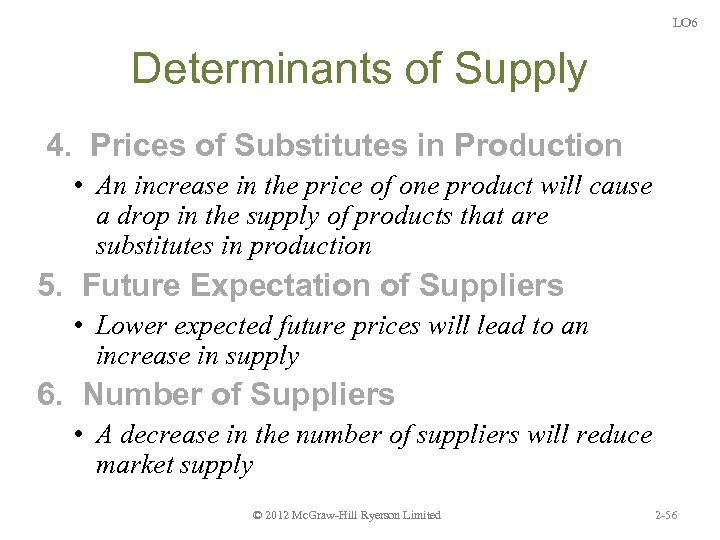 LO 6 Determinants of Supply 4. Prices of Substitutes in Production • An increase in the price of one product will cause a drop in the supply of products that are substitutes in production 5. Future Expectation of Suppliers • Lower expected future prices will lead to an increase in supply 6. Number of Suppliers • A decrease in the number of suppliers will reduce market supply © 2012 Mc. Graw-Hill Ryerson Limited 2 -56
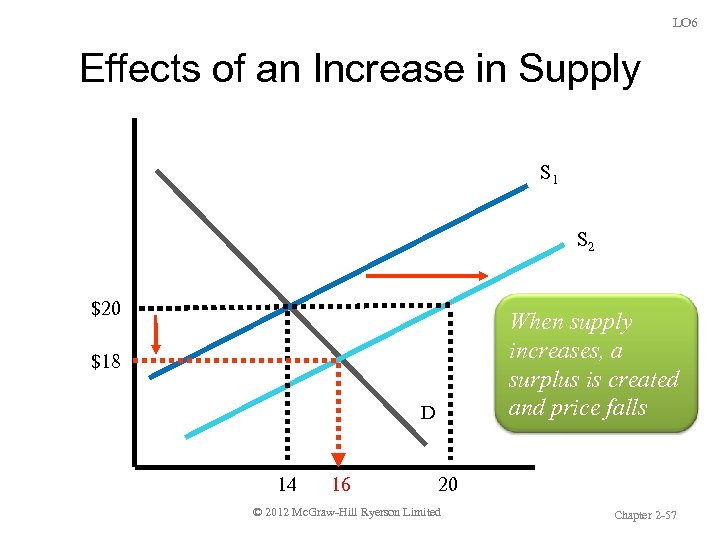 LO 6 Effects of an Increase in Supply S 1 S 2 $20 When supply increases, a surplus is created and price falls $18 D 14 16 20 © 2012 Mc. Graw-Hill Ryerson Limited Chapter 2 -57
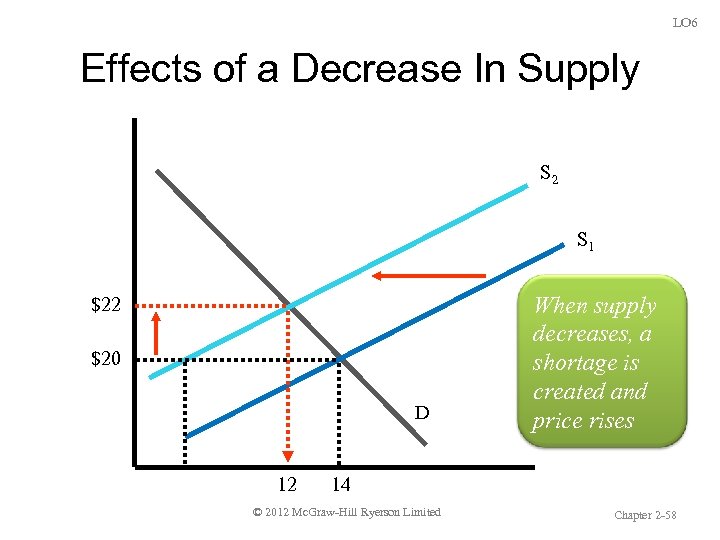 LO 6 Effects of a Decrease In Supply S 2 S 1 $22 $20 D 12 When supply decreases, a shortage is created and price rises 14 © 2012 Mc. Graw-Hill Ryerson Limited Chapter 2 -58
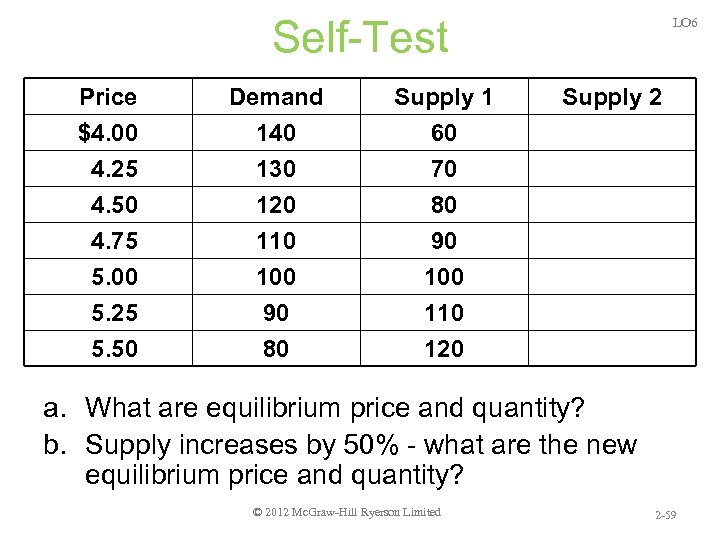 Self-Test Price $4. 00 4. 25 4. 50 Demand 140 130 120 Supply 1 60 70 80 4. 75 5. 00 5. 25 5. 50 110 100 90 80 LO 6 Supply 2 90 100 110 120 a. What are equilibrium price and quantity? b. Supply increases by 50% - what are the new equilibrium price and quantity? © 2012 Mc. Graw-Hill Ryerson Limited 2 -59
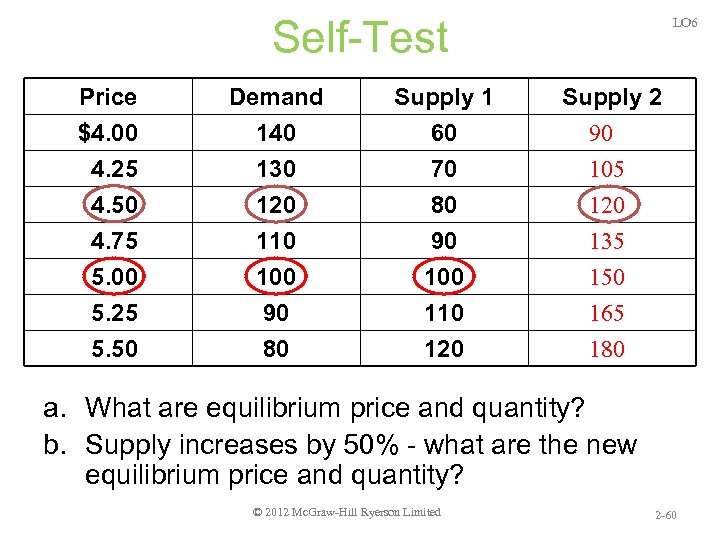 Self-Test Price $4. 00 4. 25 4. 50 Demand 140 130 120 Supply 1 60 70 80 4. 75 5. 00 5. 25 5. 50 110 100 90 80 90 100 110 120 LO 6 Supply 2 90 105 120 135 150 165 180 a. What are equilibrium price and quantity? b. Supply increases by 50% - what are the new equilibrium price and quantity? © 2012 Mc. Graw-Hill Ryerson Limited 2 -60
 Self-Test 7 LO 6 a) A poor harvest in the grape industry results in a big decrease in the supply of grapes b) The number of wineries increases c) The sales tax on wine increases d) The introduction of a new fermentation method reduces the time needed for the wine to ferment e) The gov’t introduces a subsidy for each bottle of wine produced domestically f) The gov’t introduces a quota limiting the amount of foreign-made wine entering Canada © 2012 Mc. Graw-Hill Ryerson Limited 2 -61
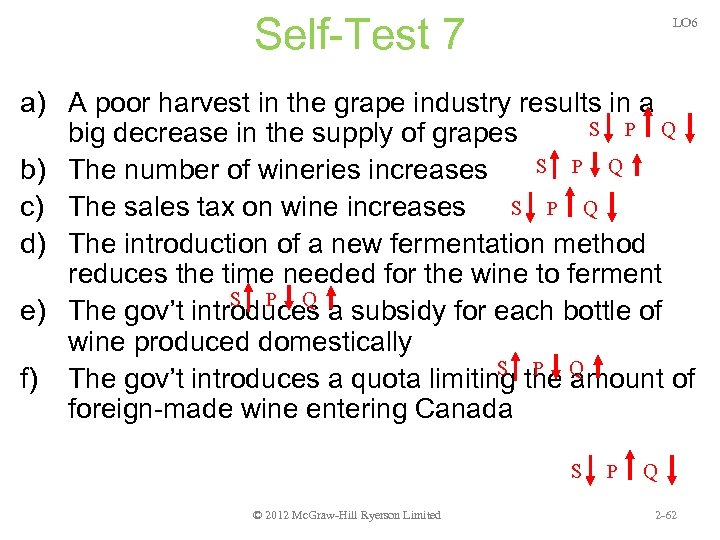 Self-Test 7 LO 6 a) A poor harvest in the grape industry results in a S P Q big decrease in the supply of grapes S P Q b) The number of wineries increases S P Q c) The sales tax on wine increases d) The introduction of a new fermentation method reduces the time needed for the wine to ferment S P Q e) The gov’t introduces a subsidy for each bottle of wine produced domestically S P f) The gov’t introduces a quota limiting the Q amount of foreign-made wine entering Canada S © 2012 Mc. Graw-Hill Ryerson Limited P Q 2 -62
 CHAPTER 2 SUMMARY Key Concepts to Remember: • • The concept of demand vs quantity demanded The concept of supply vs quantity supplied The term “market” The concept of equilibrium price and quantity The determinants of demand supply The effects of a change in demand or a change in supply Why demand supply determine price, not the reverse © 2012 Mc. Graw-Hill Ryerson Limited 2 -63