


 Скачать презентацию SAWA An Assistant for Higher-Level Fusion and Situation
cfd01f16ba436efc587347ea39cce04a.ppt
- Количество слайдов: 22
 SAWA: An Assistant for Higher-Level Fusion and Situation Awareness Christopher J. Matheus, Mieczyslaw M. Kokar, Kenneth Baclawski, Jerzy A. Letkowski, Catherine Call, Michael Hinman, John Salerno, Douglas Boulware
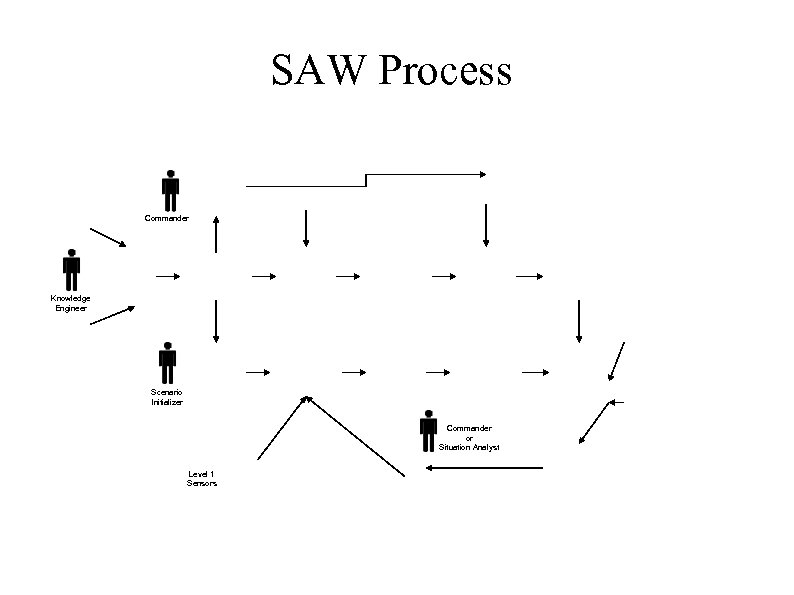 SAW Process Commander Knowledge Engineer Scenario Initializer Commander or Situation Analyst Level 1 Sensors
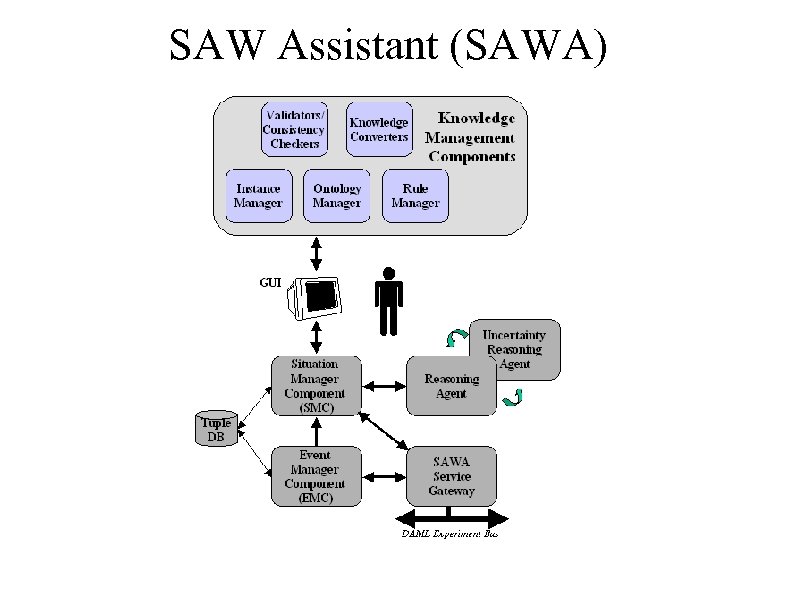 SAW Assistant (SAWA)
 Supply Logistics Scenario ● ● ● Scenario for supplying units using ground transports via roads that may not be under friendly control Configuration files control types and quantities of resources, transports, suppliers and consumers Generates events based on our SAW Core, Supply Logistics and Event Ontologies
 OWL: Web Ontology Language ● ● ● W 3 C’s ontology language for the Semantic Web Mainly intended to provide means for describing web content in a form amiable to automated reasoning Used to construct OWL ontologies that define domain specific classes and properties along with the inherent constraints among them OWL ontologies are then used to describe specific instances or situations in the given domain Built on top of RDF and XML Three flavors: Full, DL and Lite
 SWRL ● ● W 3 C’s Semantic Web Rule Language Extends representational power of OWL by adding implication in the form of Horn Clauses (i. e. , a form of if-then rules) Leverages the descriptive capabilities of OWL DL Leverages the rule and variable syntax of Rule. ML
 SWRL Pros and Cons ● Pros: – – ● Formal Foundation W 3 C Effort Based on Rule. ML Can connect to OWL Ontologies Cons: – – Limited to Binary Relations (makes higher-order relations difficult to represent) Verbose/complex syntax No Existential Quantification in rule heads (makes higher-order relations impossible to infer – we thus are ignoring this constraint with the expectation it will be removed) Still evolving
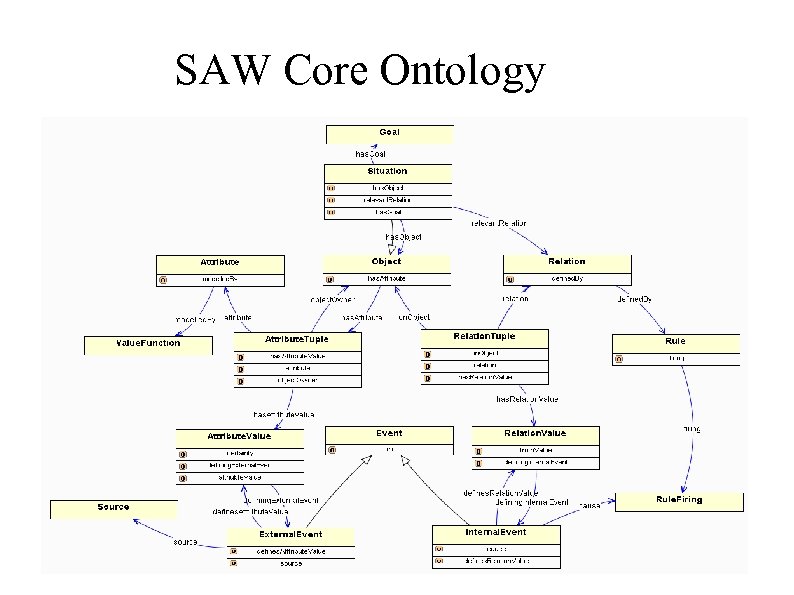 SAW Core Ontology
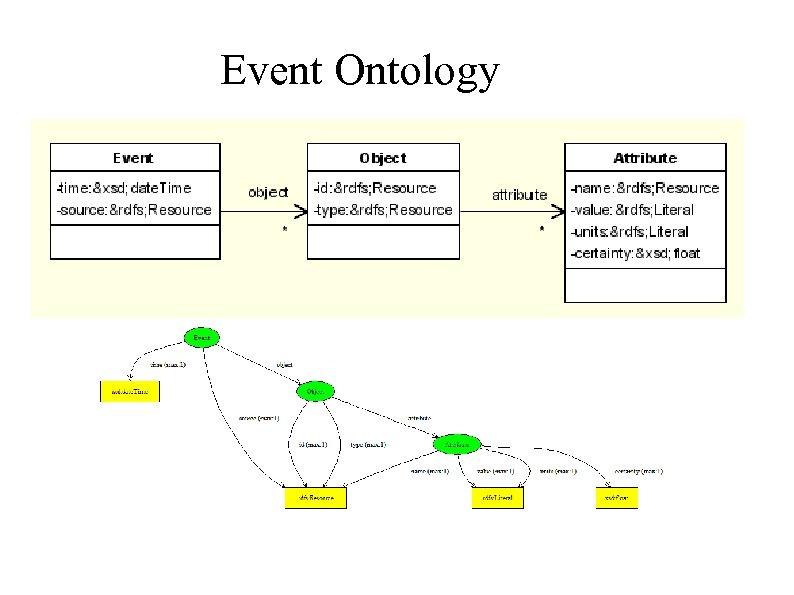 Event Ontology
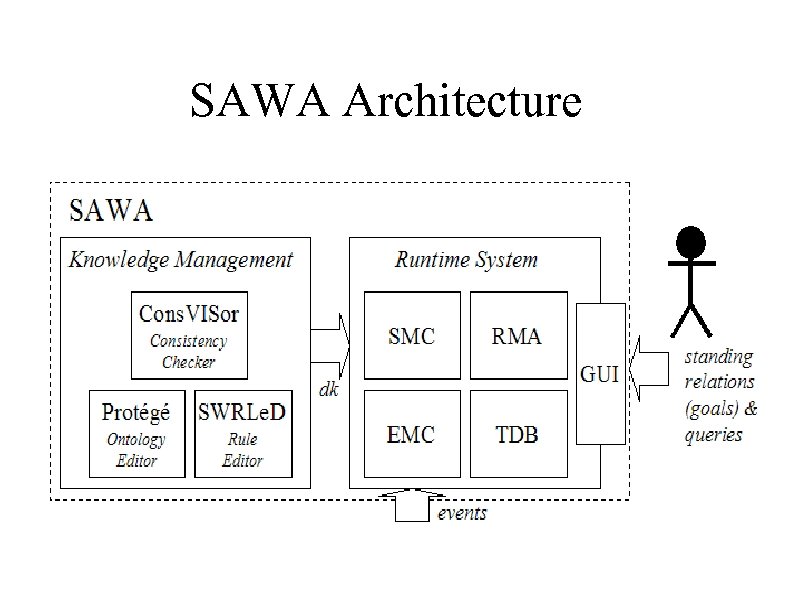 SAWA Architecture
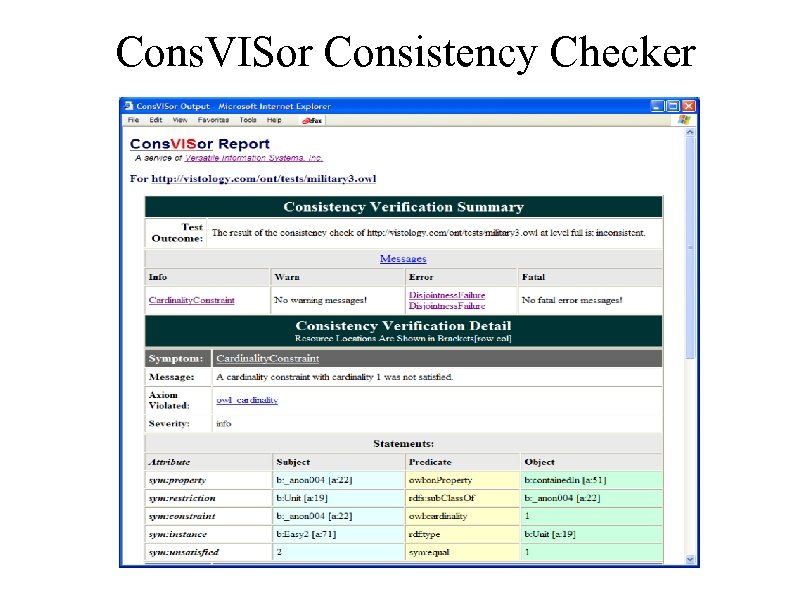 Cons. VISor Consistency Checker
 Rule. VISor Rule Editor ● ● Graphical SWRL Editor Support for – – ● Does not support arbitrary embedded OWL constructs – ● all Rule. ML capabilities (everything in SWRL from ruleml: namespace) all new SWRL elements (from swrlx: namespace, e. g. , swrlx: builtin) OWL Ontologies are required to be external Ontologies used as basis for rule building blocks
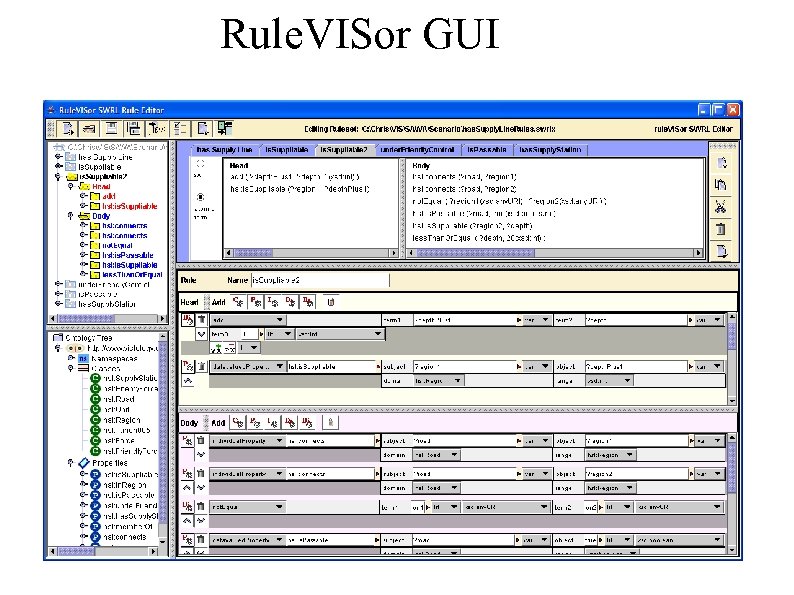 Rule. VISor GUI
 Supply Logistics Rule Set
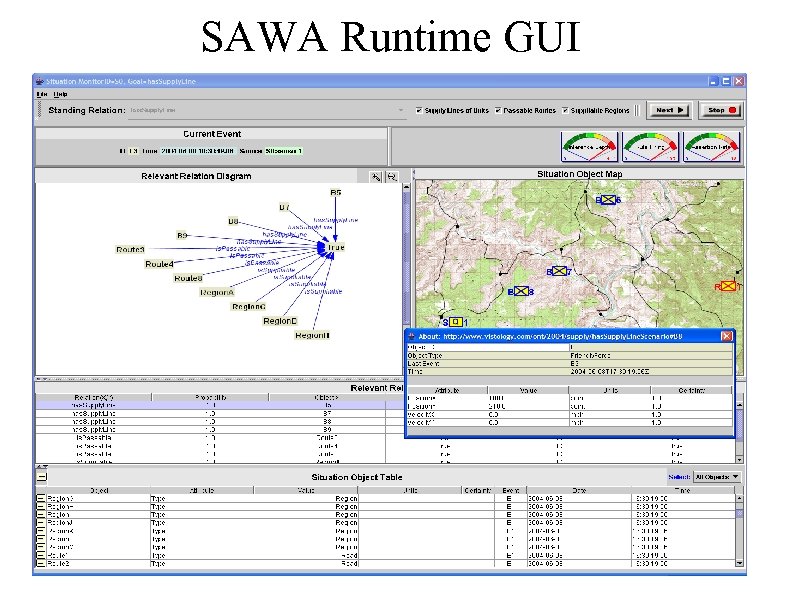
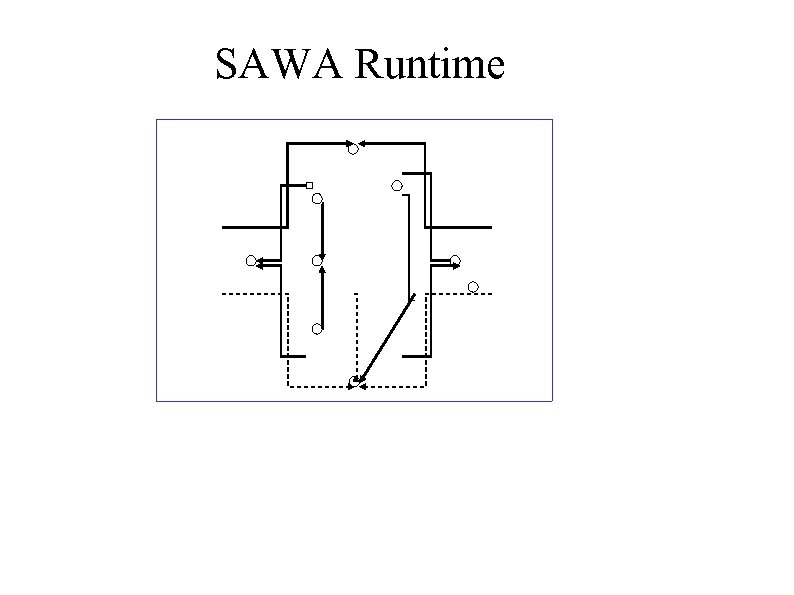 SAWA Runtime
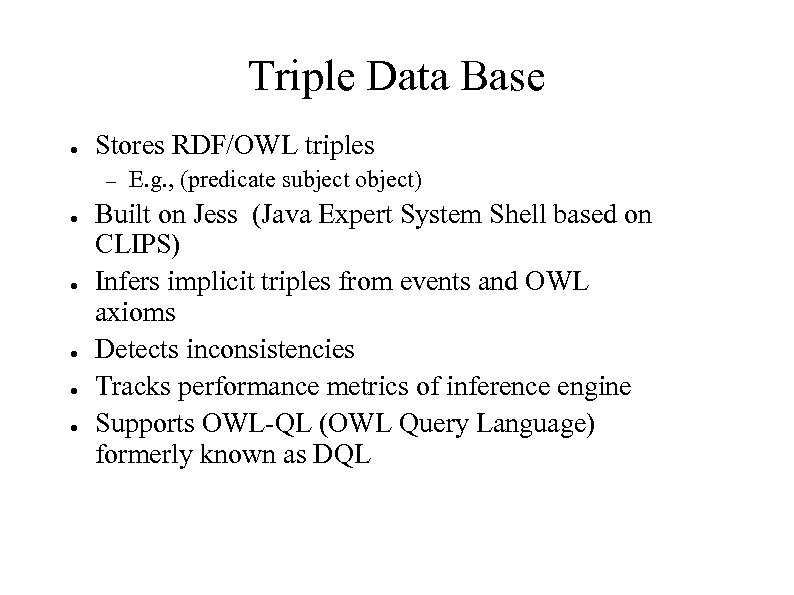 Triple Data Base ● Stores RDF/OWL triples – ● ● ● E. g. , (predicate subject object) Built on Jess (Java Expert System Shell based on CLIPS) Infers implicit triples from events and OWL axioms Detects inconsistencies Tracks performance metrics of inference engine Supports OWL-QL (OWL Query Language) formerly known as DQL
 Query Capabilities ● ● Full support of OWL Query Language – DARPA sponsored effort Permits Queries over patterns in triples – – ● “What If” Query capability – ● ● e. g. , (consumes ? user “food”) (type ? user “company”) Results returned as variable bindings assumptions posited and then retracted after query returns Writing queries and interpreting results can be challenging Prompted move to implement simple GUI
 Query Interface ● ● Simplifies query construction Initial version based on static templates with fill-in slots Demo Extensions: – – – constraints between slot values enforced by GUI automatic generation of candidate templates free-form query wizard
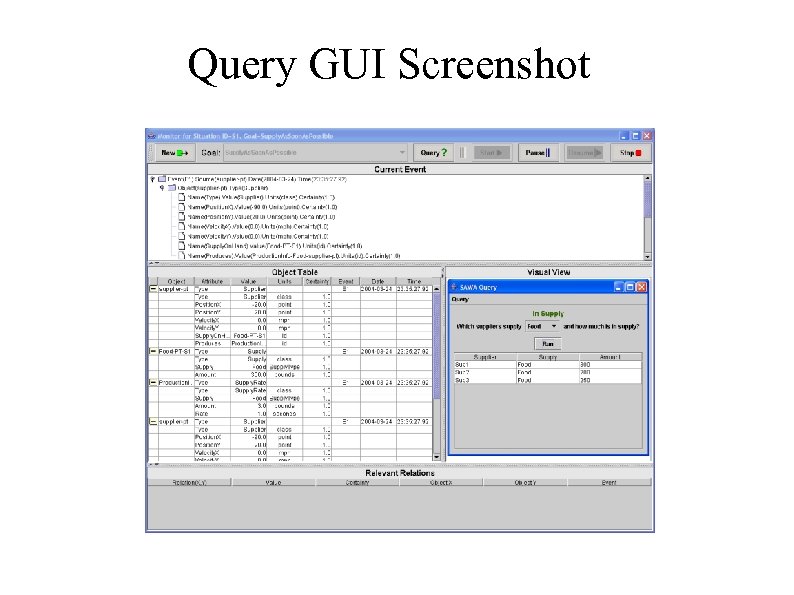 Query GUI Screenshot
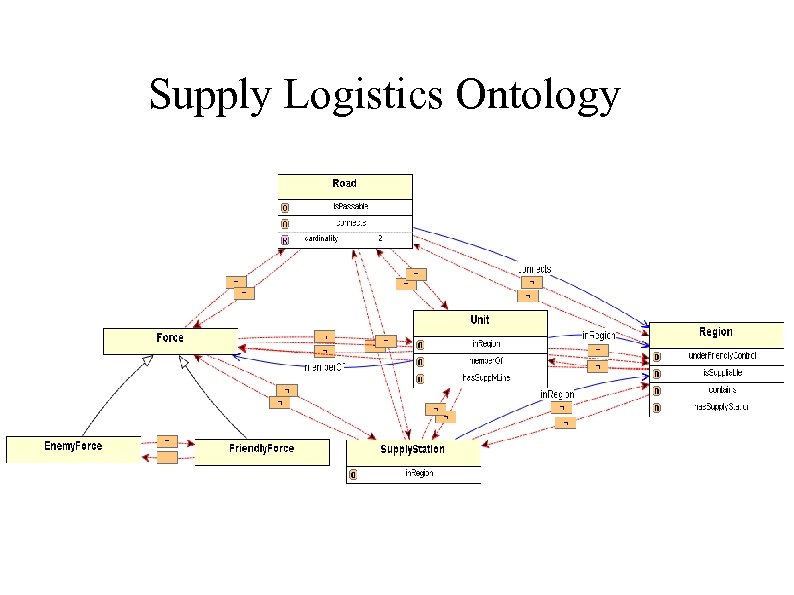 Supply Logistics Ontology
 SAWA Runtime GUI
 Conclusion ● SAWA is a general purpose assistant for situation awareness: – – ● ● based on the Semantic Web languages OWL and SWRL. – ● supports formal reasoning techniques for level-2 fusion. – ● monitors the evolution of relevant higher-order relations within a situation. performs relevance reasoning. The domain ontology and rules are constructed and checked using an ontology editor, rule editor and consistency checker. At runtime events are processed to determine relevance and to infer higher-order relations. As higher-order relations are detected they are passed to the GUI, which displays them in both tabular and graphical forms. The query capability allows for both ordinary and “what if” queries.