


 Скачать презентацию Save our Planet www suprememastertv com Urgency
fb0269a02fc5dc364ae8c5c86aad33c3.ppt
- Количество слайдов: 32
 Save our Planet www. suprememastertv. com
 Urgency We are at crisis point “We are all toast if we don’t get on another path. ” ~ James Hansen, Director of the Goddard Institute of Space Sciences “We have 18 months left to halt global warming. ” (May 2008) ~ His Royal Highness Prince Charles, Prince of Wales “We are so close to the red line, we may wake up tomorrow and discover there is nothing left to save. ” ~ Maneka Gandhi, former Indian Environment Minister “We are in a planetary emergency. ” ~ Al Gore, former US Vice President Sources: - James Hansen, Live Science, 23 June 2008 http: //tinyurl. com/57 en 56 - Prince Charles, Telegraph, UK, 18 May 2008 http: //tinyurl. com/58 z 58 s - Maneka Ghandi, India e. News, 28 May 2008 http: //tinyurl. com/6 zkwwl - Al Gore, Fog City Journal, 28 October 2006 http: //tinyurl. com/5 drkt 3
 The most effective action we can take as individuals for the survival of the planet? Reduce meat & dairy consumption “. . . the balance of environmental analysis suggests that a healthy, low-impact diet would contain less meat and fewer dairy products than we typically eat today. ” Source: Cabinet Office, “Food Matters: Towards a Strategy for the 21 st Century”, July 2008 http: //tinyurl. com/6 bhjho
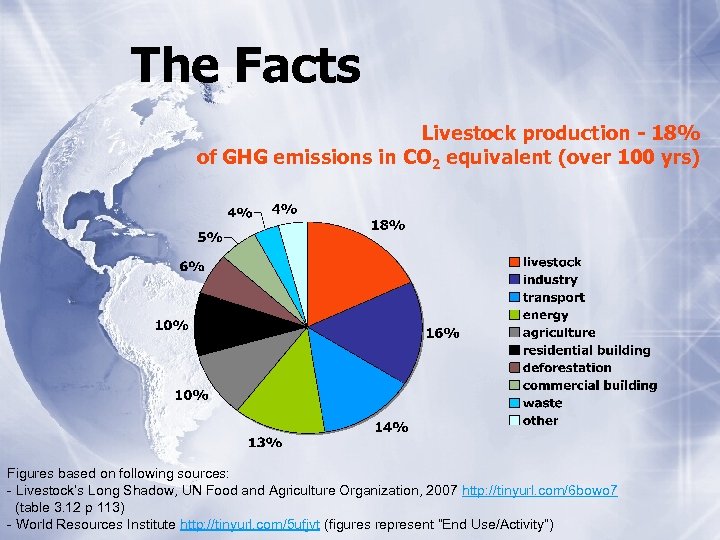 The Facts Livestock production - 18% of GHG emissions in CO 2 equivalent (over 100 yrs) Figures based on following sources: - Livestock’s Long Shadow, UN Food and Agriculture Organization, 2007 http: //tinyurl. com/6 bowo 7 (table 3. 12 p 113) - World Resources Institute http: //tinyurl. com/5 ufjvt (figures represent “End Use/Activity”)
 Livestock Industry ~ Emissions The single largest producer of Methane and Nitrous Oxide globally Ø 37% of global METHANE emission - 23 x more potent than CO 2 over 100 years - 68 x more potent than CO 2 over 20 years Ø 65% of global NITROUS OXIDE emission - 297 x more potent than CO 2 Ø 64% of the world’s AMMONIA - contributing to acid rain - affecting biodiversity Ø 9% of total CO 2 emissions Source: Livestock’s Long Shadow, UN Food and Agriculture Organization, 2007, Chapter 3, p 82, p 114 http: //tinyurl. com/6 bowo 7
 Livestock Industry ~ Environmental Costs Ø Eating meat is a major cause of global warming, which is one of the main reasons for the unprecedented ice melts in the Arctic and the Antarctic. Ø The most devastating effect of rising temperatures and melting ice is the release of 400 billion tonnes of methane gas from the ocean seabed. This gas, in such huge quantities, is enough to end life on Earth as we know it. Ø Climate change could release unexpectedly huge stores of carbon dioxide from Arctic soils, which would in turn fuel a vicious circle of global warming. Sources: - Methane Burps: Ticking Time Bomb, Energy Bulletin, 15 December 2004, http: //tinyurl. com/3 lg 5 fd - Global warming time bomb trapped in Arctic soil: study, Phys. Org, 24 August 2008
 Livestock Industry ~ Environmental costs THREAT TO BIODIVERSITY Ø Livestock take up 30% of the earth’s land surface which was once habitat for wildlife. Ø Tropical forests hold half of the world’s species which are becoming extinct at an alarming rate due to deforestation for meat production. Ø 53% of global fishmeal production is used by the livestock sector feed, seriously affecting the world’s fish population. Sources: - Livestock’s Long Shadow, UN Food and Agriculture Organization, 2007 http: //tinyurl. com/6 bowo 7 (p 32 / p 185 -p 188) - Salt-Water Fish Extinction Seen By 2048 http: //tinyurl. com/yc 22 al
 Livestock Industry ~ Environmental costs WATER POLLUTION Ø Livestock production is the largest sectoral source of water pollutants. Ø Animal wastes contribute to large oceanic “dead zones”, extending to nearly 7, 903 square miles in the Gulf of Mexico during Summer 2007. Ø In the UK, the annual external costs of water contamination by agriculture about £ 220 million. Sources: - Livestock’s Long Shadow, UN Food and Agriculture Organization, 2007 http: //tinyurl. com/6 bowo 7 (executive summary, pxxii) - Soil Association: Organic Farming & the Environment
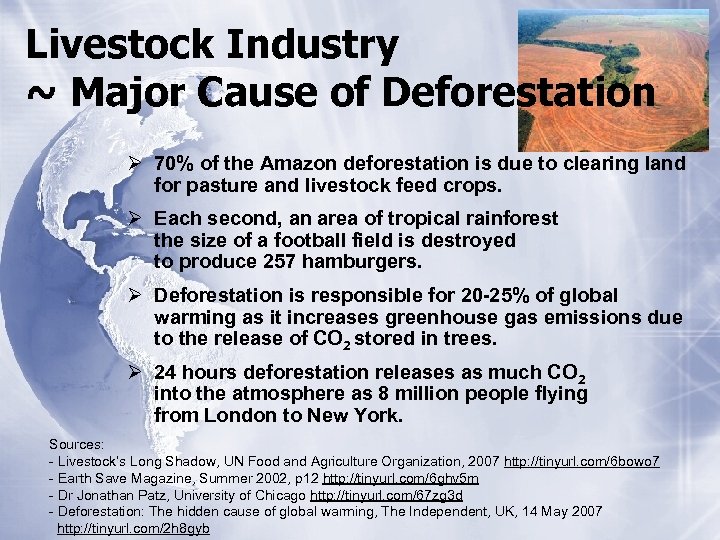 Livestock Industry ~ Major Cause of Deforestation Ø 70% of the Amazon deforestation is due to clearing land for pasture and livestock feed crops. Ø Each second, an area of tropical rainforest the size of a football field is destroyed to produce 257 hamburgers. Ø Deforestation is responsible for 20 -25% of global warming as it increases greenhouse gas emissions due to the release of CO 2 stored in trees. Ø 24 hours deforestation releases as much CO 2 into the atmosphere as 8 million people flying from London to New York. Sources: - Livestock’s Long Shadow, UN Food and Agriculture Organization, 2007 http: //tinyurl. com/6 bowo 7 - Earth Save Magazine, Summer 2002, p 12 http: //tinyurl. com/6 ghv 5 m - Dr Jonathan Patz, University of Chicago http: //tinyurl. com/67 zg 3 d - Deforestation: The hidden cause of global warming, The Independent, UK, 14 May 2007 http: //tinyurl. com/2 h 8 gyb
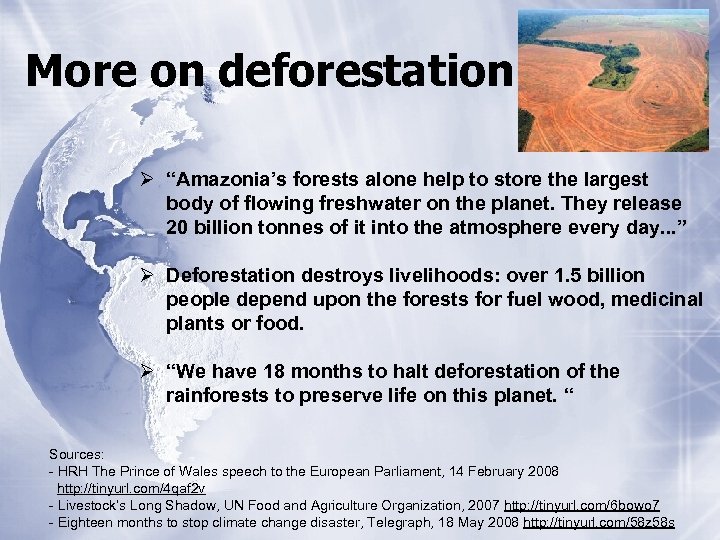 More on deforestation Ø “Amazonia’s forests alone help to store the largest body of flowing freshwater on the planet. They release 20 billion tonnes of it into the atmosphere every day. . . ” Ø Deforestation destroys livelihoods: over 1. 5 billion people depend upon the forests for fuel wood, medicinal plants or food. Ø “We have 18 months to halt deforestation of the rainforests to preserve life on this planet. “ Sources: - HRH The Prince of Wales speech to the European Parliament, 14 February 2008 http: //tinyurl. com/4 qaf 2 v - Livestock’s Long Shadow, UN Food and Agriculture Organization, 2007 http: //tinyurl. com/6 bowo 7 - Eighteen months to stop climate change disaster, Telegraph, 18 May 2008 http: //tinyurl. com/58 z 58 s
 Water Scarcity ~Beyond Normal Drought Cycles Ø 1. 1 billion people on the planet don't have access to safe, clean drinking water. That's 1 in 6 of us. Ø On a global basis, the amount of fresh water available person is falling rapidly: - by 2025: more than 50% of the population - by 2050: 75% of the population could face water scarcity. Ø By 2100, 1/3 of the planet will be desert. Sources: - Livestock’s Long Shadow, UN Food and Agriculture Organization, 2007 http: //tinyurl. com/6 bowo 7 - United Nations Environment Programme (2002): Global Environmental Outlook - The Century of Drought, The Independent, UK, 4 October 2006 http: //tinyurl. com/6 m 2 h 6 c
 Livestock Industry WATER SCARCITY Meat production, particularly the production of feed, consumes large amounts of critically important water resources. ØAgriculture uses 70% of all water. ØIndustry uses 20% of all water. ØHomes use 10% of all water. Sources: - Livestock’s Long Shadow, UN Food and Agriculture Organization, 2007 http: //tinyurl. com/6 bowo 7 - Saving Water: from Field to Fork, SIWI, IWMI, Chalmers & SEI, May 2008 http: //tinyurl. com/58 padp
 Livestock Industry WATER SCARCITY Ø The meat and dairy industries are among the biggest contributors to the problem of water scarcity, through both over-use and pollution. Ø A diet containing less meat and dairy products is not only healthier than our current eating habits, but is better for the environment. Ø Water-intensive food items like meat and dairy products are placing increased stress on food production systems. Sources: - Animal Aid: “Eating Meat: Wrecking. The Planet And Creating A Global Food Shortage” http: //www. animalaid. org. uk/images/pdf/factfiles/wreck. pdf - Food Matters, Cabinet Office, July 2008, p. 15 - Stockholm International Water Institute and the International Water Management Institute, 2004: Water – More nutrition per drop
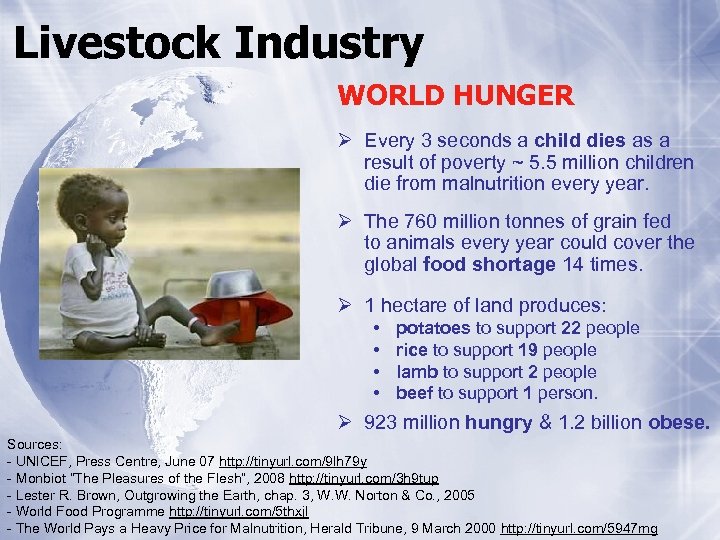 Livestock Industry WORLD HUNGER Ø Every 3 seconds a child dies as a result of poverty ~ 5. 5 million children die from malnutrition every year. Ø The 760 million tonnes of grain fed to animals every year could cover the global food shortage 14 times. Ø 1 hectare of land produces: • • potatoes to support 22 people rice to support 19 people lamb to support 2 people beef to support 1 person. Ø 923 million hungry & 1. 2 billion obese. Sources: - UNICEF, Press Centre, June 07 http: //tinyurl. com/9 lh 79 y - Monbiot “The Pleasures of the Flesh”, 2008 http: //tinyurl. com/3 h 9 tup - Lester R. Brown, Outgrowing the Earth, chap. 3, W. W. Norton & Co. , 2005 - World Food Programme http: //tinyurl. com/5 thxjl - The World Pays a Heavy Price for Malnutrition, Herald Tribune, 9 March 2000 http: //tinyurl. com/5947 mg
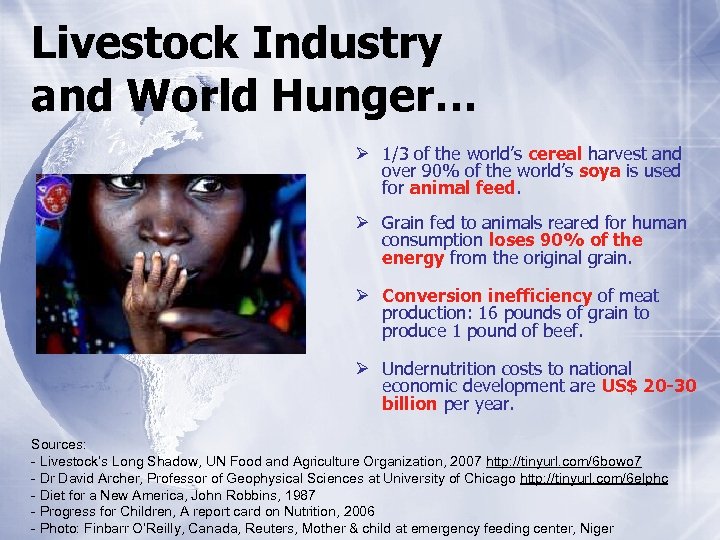 Livestock Industry and World Hunger… Ø 1/3 of the world’s cereal harvest and over 90% of the world’s soya is used for animal feed. Ø Grain fed to animals reared for human consumption loses 90% of the energy from the original grain. Ø Conversion inefficiency of meat production: 16 pounds of grain to produce 1 pound of beef. Ø Undernutrition costs to national economic development are US$ 20 -30 billion per year. Sources: - Livestock’s Long Shadow, UN Food and Agriculture Organization, 2007 http: //tinyurl. com/6 bowo 7 - Dr David Archer, Professor of Geophysical Sciences at University of Chicago http: //tinyurl. com/6 elphc - Diet for a New America, John Robbins, 1987 - Progress for Children, A report card on Nutrition, 2006 - Photo: Finbarr O’Reilly, Canada, Reuters, Mother & child at emergency feeding center, Niger
 Livestock Industry ~Future Outlook Consumption is expected to double by 2050, hence emissions & other “costs” as well. Plans to reduce emissions through: Ø Reducing methane production by using feed additives and vaccines. BUT - adding more chemicals to the environment is not a sustainable solution. Ø Planting trees. BUT - the number of trees cut by the livestock industry far exceeds the number that is intended to be planted. Sources: - Reducing GHG Emissions from the Northern Territory (NT) Pastoral Industry, NT Government, Australia http: //tinyurl. com/5 dedjy - Why are Greenhouse Gas Emissions Important? , Alberta Government, Canada
http: //tinyurl. com/66 s 3 k 2
Livestock Industry ~Future Outlook Consumption is expected to double by 2050, hence emissions & other “costs” as well. Plans to reduce emissions through: Ø Reducing methane production by using feed additives and vaccines. BUT - adding more chemicals to the environment is not a sustainable solution. Ø Planting trees. BUT - the number of trees cut by the livestock industry far exceeds the number that is intended to be planted. Sources: - Reducing GHG Emissions from the Northern Territory (NT) Pastoral Industry, NT Government, Australia http: //tinyurl. com/5 dedjy - Why are Greenhouse Gas Emissions Important? , Alberta Government, Canada
http: //tinyurl. com/66 s 3 k 2
 Our Future with Livestock With current meat & dairy consumption trends and predicted growth, continued livestock production is an environmental and planetary catastrophe for the Earth and its inhabitants. It can lead to: • Release of huge quantities of Methane and Carbon Dioxide, enough to end civilisation as we know it. • The release of methane could create an uncontrollable feedback effect, dramatically warming the atmosphere and leading to catastrophic climate change with increased severity and frequency. • Social unrest, war, disease, widespread food and water shortages, exodus of refugees. Catastrophes have no preferences; everyone is affected. We simply cannot sustain our planet and its people with livestock’s disastrous effects on every scale, from local to global. Money will not serve us where there is barren land, destruction and collapsed economies.
 Solution? The quickest and the most effective way to reduce GHG emissions is: To reduce or eliminate our meat consumption.
 Meat-free Diet ~ Why A Quicker & Easier Solution Ø Turnover rate of farm animals is 1 -2 years, while turnover rate of cars & power plants, etc can be decades. Ø Methane can disappear from the atmosphere in 9 -15 years, while CO 2 can stay in the atmosphere for more than a century. Ø Introduction of new techniques and further research takes many years. Ø Cut in CO 2 involves fighting powerful & wealthy business interests, while veggie foods are readily available. Source: A New Global Warming Strategy, Noam Mohr, Earth. Save International, August 2005 http: //tinyurl. com/2 usvxl
 Meat-free Diet ~ Advantages Ø Stops 70% of deforestation. Ø A solution for world hunger: • Frees up 760 million tons of grain/year (nearly half the world’s grain supply) • Frees up 3, 433 million hectares (total land area occupied by livestock) which is equivalent to 26% of the ice-free terrestrial surface of the planet. Sources: - Livestock’s Long Shadow, UN Food and Agriculture Organization, 2007, pxxi http: //tinyurl. com/6 bowo 7 - The Pleasures of the Flesh, Montbiot, 2008 http: //tinyurl. com/3 go 885 - UN-FAO - Managing Livestock-Environment Interactions, April 2007, p 2 - A. 8 http: //tinyurl. com/5 homq 9
 Meat-free Diet ~ Advantages Ø Uses 2/3 less fossil fuels. Ø Reduces pollution from untreated animal waste. Ø Maintains cleaner air. Ø Saves up to 4. 5 tons of emissions per household per year. Sources: - Supreme Master Television http: //tinyurl. com/6 zzkwt - Livestock’s Long Shadow, UN Food and Agriculture Organization, 2007 http: //tinyurl. com/6 bowo 7
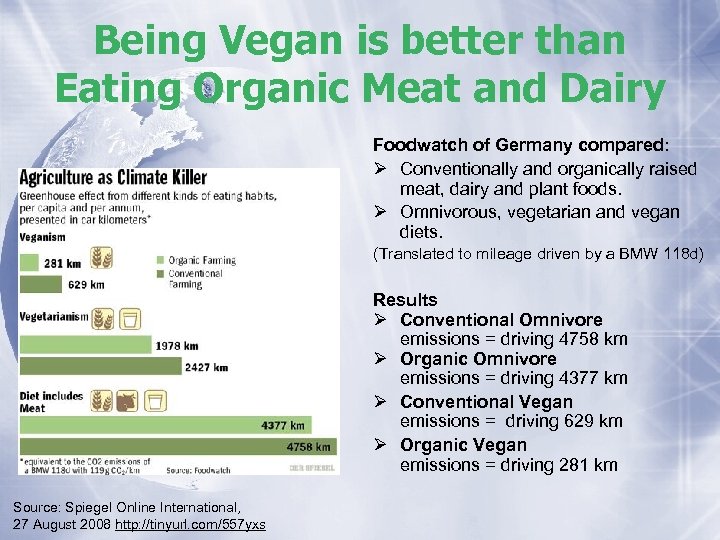 Being Vegan is better than Eating Organic Meat and Dairy Foodwatch of Germany compared: Ø Conventionally and organically raised meat, dairy and plant foods. Ø Omnivorous, vegetarian and vegan diets. (Translated to mileage driven by a BMW 118 d) Results Ø Conventional Omnivore emissions = driving 4758 km Ø Organic Omnivore emissions = driving 4377 km Ø Conventional Vegan emissions = driving 629 km Ø Organic Vegan emissions = driving 281 km Source: Spiegel Online International, 27 August 2008 http: //tinyurl. com/557 yxs
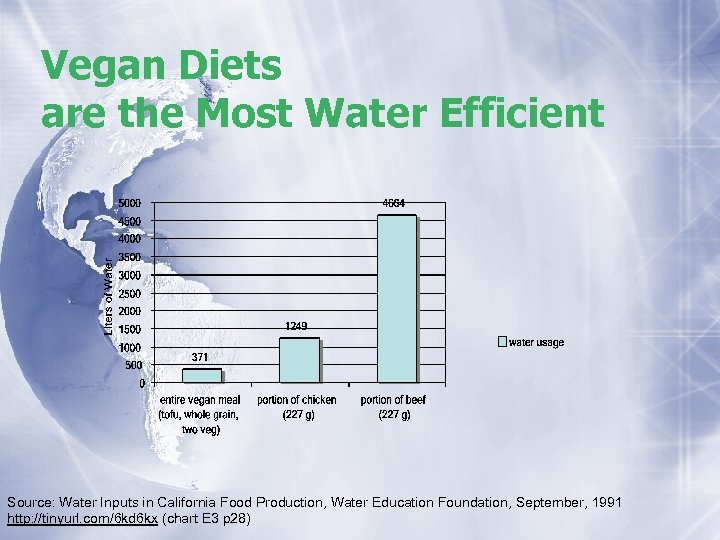 Vegan Diets are the Most Water Efficient Source: Water Inputs in California Food Production, Water Education Foundation, September, 1991 http: //tinyurl. com/6 kd 6 kx (chart E 3 p 28)
 Meat-free Diet ~ Environmental Advantages Ø If everybody in the UK ate no meat for 2 days per week, it would save the equivalent of almost 73 million return flights from London to Ibiza. Ø If everybody in the UK ate no meat for 6 days per week, it would create greater carbon savings than removing all the cars off UK roads (29 million cars). Source: Pieter van Beukering, Kim van der Leeuw, Desire Immerzeel and Harry Aiking (2008) Meat the Truth. The contribution of meat consumption in the UK to climate change. Institute for Environmental Studies (IVM), VU University, Amsterdam, the Netherlands / HM Government (2006) Climate Change, the UK programme 2006 http: //tinyurl. com/5 q 3 vwx
 Meat-free Diet ~ Advantages Ø Ø Ø Ø Ø Prevent high blood pressure Lower cholesterol levels Reduce Type 2 diabetes Prevent stroke conditions Reverse atherosclerosis Reduce heart disease risk - 50% Reduce heart surgery risk - 80% Prevent many forms of cancer Stronger immune system Increase life expectancy up to 15 years Sources: - ADA position paper on vege diets http: //tinyurl. com/djodu - Jenkins DJA et al. , 2003. Type 2 diabetes and the vegetarian diet, American Journal of Clinical Nutrition, Vol. 78, No. 3, 610 S-616 S, Sep 03 http: //tinyurl. com/9 sohlt - Ornish D, Scherwitz L, Billings J, et al. Intensive lifestyle changes for reversal of coronary heart disease Five-year follow-up of the Lifestyle Heart Trial. Journal of the American Medical Association. 1998; 280: 2001 -2007 http: //tinyurl. com/6 djlgg
 Food for Thought Nothing will benefit human health and increase chances for survival of life on Earth as much as the evolution to a vegetarian diet. ~ Albert Einstein If slaughterhouses had glass walls, everyone would be a vegetarian. ~ Paul Mc. Cartney While we ourselves are the living graves of murdered beasts, how can we expect any ideal conditions on this earth? ~ George Bernard Shaw “Thou shalt not kill" does not apply to murder of one's own kind only, but to all living beings; and this Commandment was inscribed in the human breast long before it was proclaimed from Sinai. ~ Leo Tolstoy
 Meat-eating ~ What’s the Logic ? ! We all love animals. Why do we call some "pets" and others "dinner? " ~ K. D. Lang You put a baby in a crib with an apple and a rabbit. If it eats the rabbit and plays with the apple, I'll buy you a new car. ~ Harvey Diamond Auschwitz begins wherever someone looks at a slaughterhouse and thinks: they’re only animals. ~ Theodor Adorno
 Call for Action It’s time for the truth about meat to be brought to light. Animal agriculture and the consumption of animal products are destroying our planet and are the root cause of the most pressing challenges of our time. We can no longer hide from the fact that meat is the single greatest contributor to the most prevalent and deadly global health problems, such as cardiovascular disease, diabetes and obesity. We must recognize that meat is causing global food shortage as we feed over one third of all grain products to animals (over 7 times the amount used for biofuels), and as farmers in developing nations grow feed crop for animals rather than food crops for their fellow citizens. And we must address the reality that meat and dairy are the leading causes of global warming, pushing our precious Earth beyond the tipping point, heading to where it can no longer maintain life as we know it. The facts and figures presented here are compiled from the latest research by leading climate scientists, government bodies, the United Nations, many independent organizations, and health professionals. They show clearly how by stopping the devastation of meat production and consumption and embracing a plant-based diet, we will be able to live in optimal health, preserve our planet and have enough food and clean water for all.
 Links VIDEOS Devour-the-earth http: //tinyurl. com/3 zgg 9 n Earthlings http: //tinyurl. com/3 n 5 jgj Meet your meat http: //tinyurl. com/27 mpem Top 3 reasons for not eating fish http: //tinyurl. com/53 ou 7 g Earth Song, Mother Earth’s Plea http: //tinyurl. com/4 jx 2 df WWF 2007: The Bio-Da Versity Code http: //tinyurl. com/3 nlz 2 z ORGANISATIONS Veg 4 Earth http: //tinyurl. com/5 bx 7 p 5 Viva! http: //tinyurl. com/3 mjubw Earthsave http: //tinyurl. com/2 usvxl Vegetarian and Vegan Foundation http: //tinyurl. com/46 gybf Animal Aid: “Eating Meat: Wrecking The Planet And Creating A Global Food Shortage” http: //tinyurl. com/43 ta 6 y Nutrition Ecology International Center http: //tinyurl. com/4 x 3 dzf PRESS The Pleasures of the Flesh, Monbiot, The Guardian http: //tinyurl. com/3 h 9 tup Another Inconvenient Truth: Meat is a Global Warming Issue, e-Magazine http: //tinyurl. com/4 hmdq 3 It is time to become a vegetarian? The Guardian http: //tinyurl. com/3 jt 3 gf Study: vegan diets healthier for planet, people than meat diets, Univ of Chicago http: //tinyurl. com/r 2 tde
 Our Mission To share scientific data with the public, the media, the government and other organisations on the significant and devastating effects of eating animal products on the health of our planet, including climate change, drought and deforestation, and on global hunger. To provide the means for individuals to encourage the media to speak about these topics, and to encourage governments and other institutions to pass and adopt laws and policies which will result in people eating less animal products in order to reverse climate change, ensure there is enough clean water for all our needs, and feed the world’s hungry.
 We have only ONE planet, only ONE chance. Its future depends on each one of us. And there is ONE thing we all can do: Go Veg, Be Green, Save our Planet www. suprememastertv. com