Скачать презентацию Savanna class looked at some different resources to
b88e6159d0348e0a9af6640145f25ebb.ppt
- Количество слайдов: 26

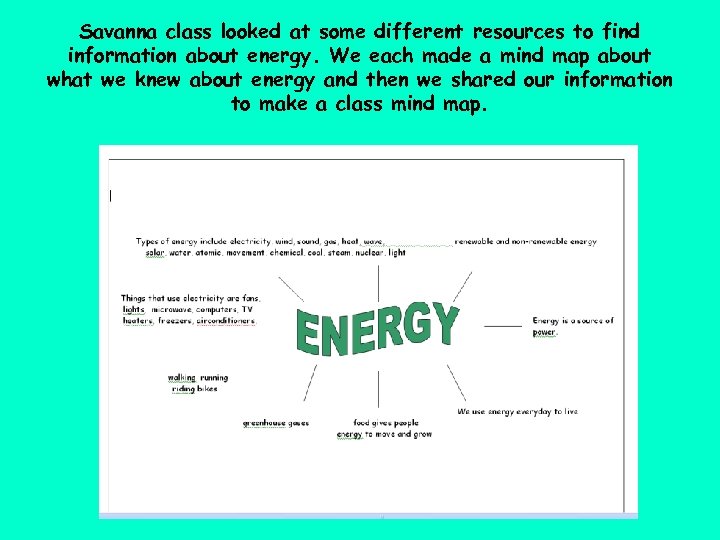 Savanna class looked at some different resources to find information about energy. We each made a mind map about what we knew about energy and then we shared our information to make a class mind map.
 This is more information that we learnt after using internet sources and discussions in our class. We found out that energy is a source of power. Some sources of power are electricity, sunlight, atomic, sound, movement, chemicals, heat, waves, wind, food and nuclear. We used an internet dictionary to find the meaning of sustainability. Sustainability means that we can 'keep it going' by maintaining a steady supply. In our environment we can sustain an ecological balance by using more natural resources.
 Renewable energy sources are those that can be replenished quickly or are neverending. eg. sunlight, wind, water, waves. Renewable energy is environmentally friendly and sustainable. Non-renewable energy sources are those that are used faster than they can be replenished. They are finite. eg. coal, natural gas, petroleum - they are all fossil fuels. If we use too many non-renewable energy sources we will not have enough resources for the future and they will all be gone. If we burn too much fossil fuel there will be too much carbon dioxide in the atmosphere. This can cause greenhouse gases to contribute to global warming.
 • We used a demonstration of dividing an apple (The Allegorical Apple Earthdaynetwork - www. earthday. net) to show much of the land we have to use for survival using natural resources. • We also completed the Bobbie Bigfoot Quiz to see how our ecological footprint was affecting the earth. This quiz measured the amount of nature needed to support our life choices.
 * * * HOW DO WE USE ENERGY IN OUR SCHOOL? Electrical Energy - Lights, fans, air conditioners, computers, printers, overhead projectors, CD player, data projector, charge laptop, refrigerator, charge microphone, Slushy Machine, popcorn machine, kettle, toaster, alarm system, microwave, canteen freezer, dishwasher, oven, taps, Battery Energy - clock, laptop, microphone, FM Hearer, air freshener, Gas Energy - heaters Solar Energy - sky lights, solar panels Movement Energy - walking, running
 WHY DO WE NEED TO ACT? After we talked about the energy that our school uses we thought we could use less electrical energy in our school. If we used less electricity there would be less carbon dioxide going into the air. Less carbon dioxide would mean less pollution and we could reduce the greenhouse gas emissions. Also our electricity bills at Windsor Park Public School would not be as high. This would mean that our school could use this money in other learning areas. These changes would help to sustain our environment.
 To explore the energy use at Windsor Park Public School we carried out the following investigations:
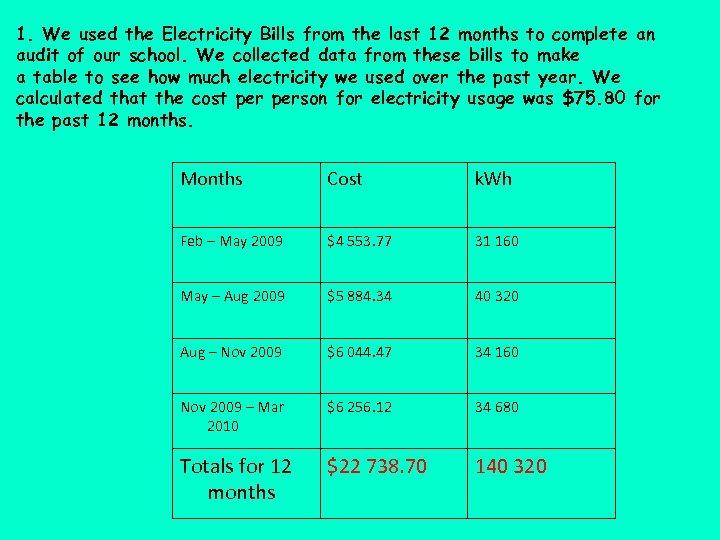 1. We used the Electricity Bills from the last 12 months to complete an audit of our school. We collected data from these bills to make a table to see how much electricity we used over the past year. We calculated that the cost person for electricity usage was $75. 80 for the past 12 months. Months Cost k. Wh Feb – May 2009 $4 553. 77 31 160 May – Aug 2009 $5 884. 34 40 320 Aug – Nov 2009 $6 044. 47 34 160 Nov 2009 – Mar 2010 $6 256. 12 34 680 Totals for 12 months $22 738. 70 140 320
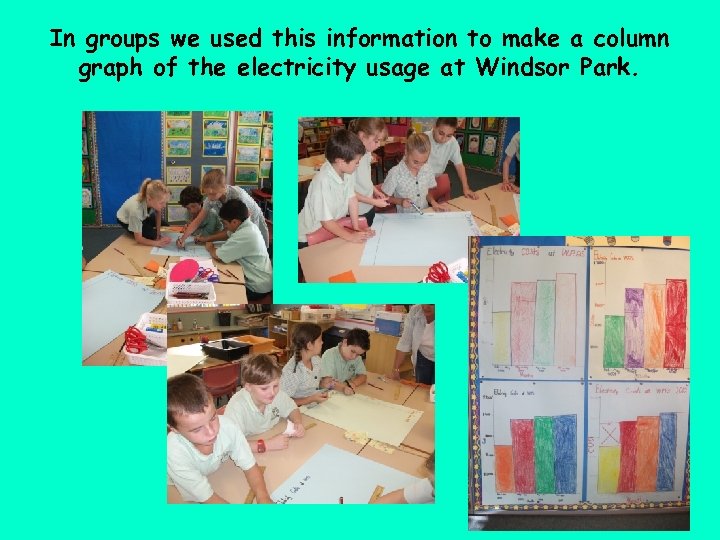 In groups we used this information to make a column graph of the electricity usage at Windsor Park.
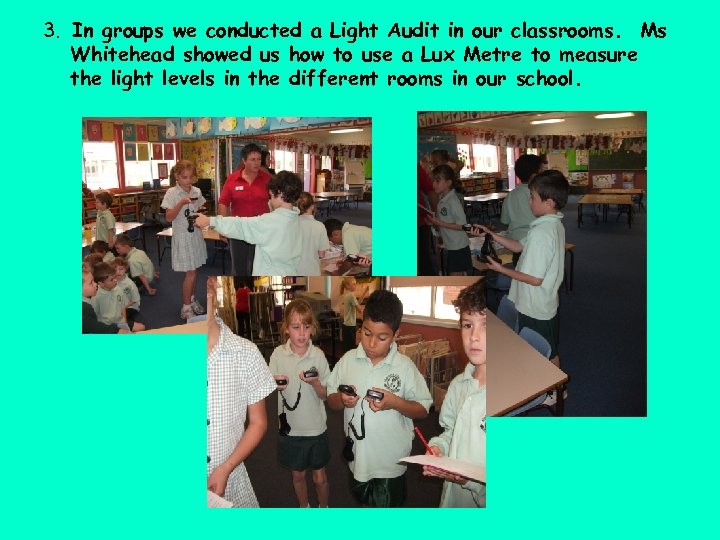 3. In groups we conducted a Light Audit in our classrooms. Ms Whitehead showed us how to use a Lux Metre to measure the light levels in the different rooms in our school.
 We collated the information on a table (see figure 3). We discovered that some rooms did not have the recommended lux for the use of the room. When we discussed possible reasons for this we found that recently all the skylights in our classrooms were covered with colourbond to stop water leaks and mice being trapped in the skylights. The leaking water was rotting timber in the roof. This has resulted in less natural light being able to enter each classroom. Also some of the classrooms did not have their blinds completely pulled up. The new buildings near some classrooms have also blocked some of the natural light.
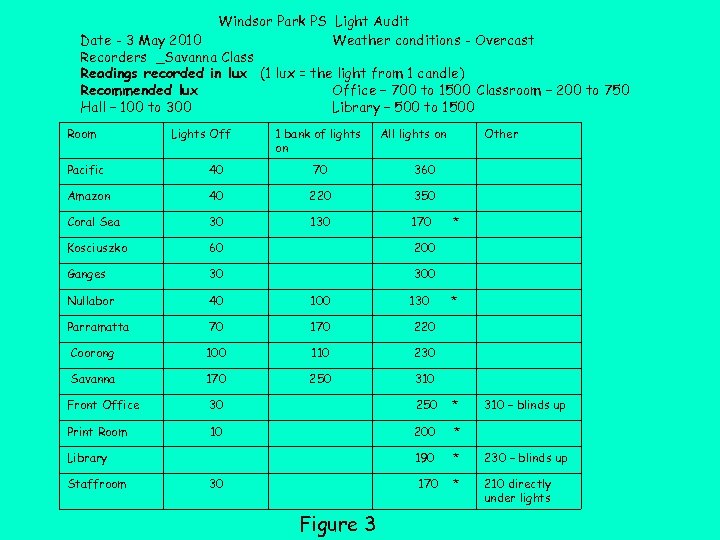 Windsor Park PS Light Audit Date - 3 May 2010 Weather conditions - Overcast Recorders _Savanna Class Readings recorded in lux (1 lux = the light from 1 candle) Recommended lux Office – 700 to 1500 Classroom – 200 to 750 Hall – 100 to 300 Library – 500 to 1500 Room Lights Off 1 bank of lights on All lights on Other Pacific 40 70 360 Amazon 40 220 350 Coral Sea 30 170 Kosciuszko 60 200 Ganges 30 300 Nullabor 40 100 Parramatta 70 170 220 Coorong 100 110 230 Savanna 170 250 310 Front Office 30 250 * Print Room 10 200 * 190 * 230 – blinds up 170 * 210 directly under lights Library Staffroom 30 Figure 3 130 * * 310 – blinds up
 3. We decided to monitor the use of lights in 10 classroom and in our school hall. We conducted a light survey over 5 school days to record the number of classrooms that had lights left on during recess and lunchtime when no one was using the classroom. We also surveyed the number of days that lights that were left on in the hall, when it was empty during recess, lunch and during class time when it was not being used. If the lights were on and teachers or students were in the classrooms we did not include these classrooms in the survey. We also monitored the times that lights were left on in our school hall when nobody was using it (see figure 4).
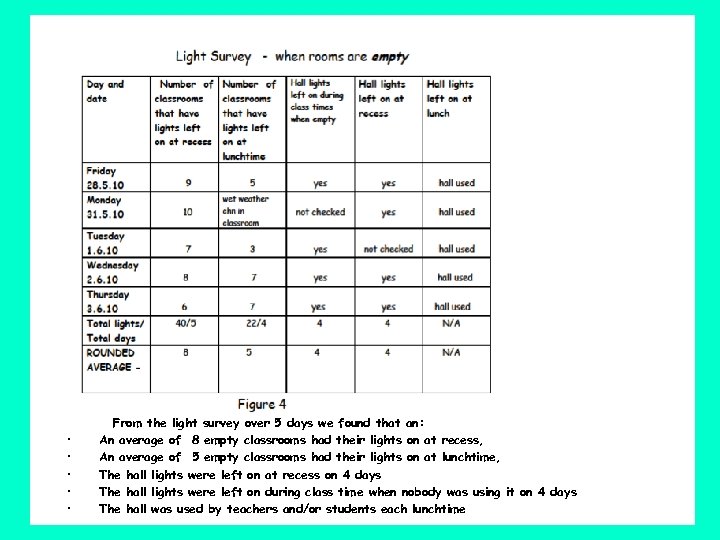 • • • From the light survey over 5 days we found that an: An average of 8 empty classrooms had their lights on at recess, An average of 5 empty classrooms had their lights on at lunchtime, The hall lights were left on at recess on 4 days The hall lights were left on during class time when nobody was using it on 4 days The hall was used by teachers and/or students each lunchtime
 What would we like to see as a future goal for energy use at Windsor Park Public School? As a future goal we would like to see people at Windsor Park using less electricity. We would like people to be less wasteful and more responsible when using electricity. We hope the electricity bills at Windsor Park would be reduced and we could use the money we save on electricity to buy solar panels. As solar energy is renewable this would help us to have a more sustainable approach to the use of energy in our local environment.
 What do we need to change and why? We discussed things that we could change in our school in relation to energy use. Our ideas were: * buy new skylights * ask someone to fix our skylights * get new energy efficient and brighter lights for the dark classrooms * get people to turn lights off in their classrooms at recess and lunchtime * get people to turn off the light in the hall at recess and during class time if the hall isn't being used.
 How will we know if the change we have made has been successful? If we change people's attitudes and behaviours to electricity usage - especially lights - we can reduce our electricity consumption and greenhouse gas emissions. We could compare our electricity bills after these changes to see if our power use has gone down. We will monthly monitor the light use in classrooms and in the hall to see if people are turning their lights off when the rooms are empty.
 What types of action can we take to bring about the change we want? * Talk to the principal and staff about what we found out. * Talk to the students at assemblies about what we found out. * Design posters and create plays to educate people about energy saving. * Writing to Assets Management (DET) about conducting an official light audit and installing energy efficient brighter lights in the dark classrooms if needed. * Learn more about energy saving strategies.
 Who might be available to help us? * Cleaner * Principal * Teachers * Students * Asset Management * CCES Regional Coordinators * Energy Expert (David Brown) What time is available for the project? We need to implement our plan in Term 3 and early Term 4. We will monitor use of lights during Term 4 and next year.
 What finances are available for the project? We can apply for up to $2000 from CCES. We can ask for $200. 00 from the school environment money. We will ask Asset Management to pay for a lighting upgrade if needed in the dark classrooms. What might limit our actions? Asset Management not helping and not getting CCES funding will limit our actions.
 We have decided we need to teach the students and teachers in our school about how we use electricity. We need to show them how we are wasting electricity by leaving lights on when the classrooms are empty. We will do this by: * speaking to the teachers at a staff meeting to show our audit results * make presentations and plays to show at assemblies so students will know what we want to change * make posters for classrooms to remind people to turn lights off when they leave the classroom or hall * invite an energy expert (Mr Brown)to talk to our class and the whole school about energy and why we need to save energy * buy a Lux Meter so we can continue doing audits
 We have also found that some of our classrooms are too dark even with lights on. We would like Asset Management to do an audit to see if our results are correct and fix the lights with energy efficient lights that are brighter. We will do this by: writing to Assets Management with our results and asking them to come and do an audit themselves.
 What will the changes cost? 2 Lux Metres Energy Expert (David Brown) Cardboard, paper, textas, laminating pouches Total $ 80 $ 300 $ 200 $ 580 Who will take the actions? All of Savanna class will be involved in various ways - writing letters, contacting speaker, ordering equipment, making posters, plays and presenting at assemblies.
 Who will we need to share our plan with? The Principal and teachers at Windsor Park PS How will we use feedback to improve our proposal? After presenting our proposal to our principal we will discuss as a class any changes we may need to make and decide if we can make these changes.